Billboards in Grand Ledge, MI
No Minimum Spend. No Long-Term Contracts. Just Results.
Trusted by Leading Brands


Billboard advertising
in Grand Ledge has never been easier
How much is a billboard in Grand Ledge?
Why Choose Blip for Billboard Advertising in Grand Ledge
Blip lets Grand Ledge advertisers launch fast on M-100 or I-96, reaching commuters without long setup times.
Set flexible daily budgets in Grand Ledge and only pay when your ad plays, perfect for testing local and regional traffic.
Use dayparting in Grand Ledge to catch 6-9 a.m. commuters and 3-7 p.m. return trips on I-69 and M-43.
No contracts in Grand Ledge means you can pause or shift spend for school events, MSU game weekends, or seasonal demand.
Track Grand Ledge performance in real time and optimize around Delta Township shoppers and Eaton County drivers.
Blip's creative tools help Grand Ledge brands tailor bold, clear ads for river life, family audiences, and nearby Lansing traffic.
Frequently Asked Questions About Billboard Advertising in Grand Ledge
How much does a billboard cost in Grand Ledge with Blip?
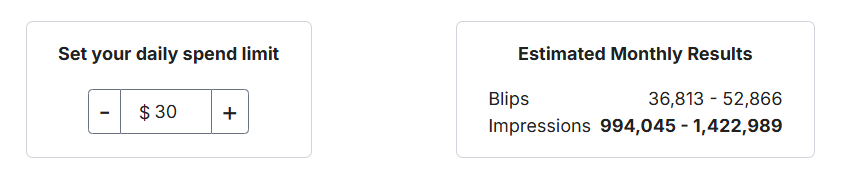
In Grand Ledge, billboard advertising with Blip is designed to fit real budgets. Instead of paying a flat rate, you set a daily budget and only pay when your ad actually appears as a 7.5-to-10-second “blip” on a rotating digital billboard, with prices starting at $0.01 per display. Blip’s algorithm uses your budget to bid for available ad slots, and the cost per blip can change based on time of day, location, and advertiser demand.
Where can I advertise with Blip in Grand Ledge?
Grand Ledge sits in an advantageous spot between small-town residential life and the region’s busiest employment and retail corridors. Key traffic areas include I-96 and I-69 east of Grand Ledge, M-100 through Grand Ledge, M-43 and West Saginaw Highway toward Delta Township, and I-496 into downtown Lansing. These routes let campaigns reach both local households and regional commuters.
Why is Grand Ledge a strong billboard market for Blip?
Grand Ledge is a strong billboard market because we are not just speaking to a small city of about 8,000 residents. We are reaching a car-first community that sits roughly 12 miles west of Lansing, inside a broader Lansing-area trade zone of more than 540,000 people, where more than 4 in 5 workers commute by driving alone. That combination gives advertisers dependable local frequency and regional reach.
What kind of people do Grand Ledge billboards reach?
The most effective Grand Ledge billboard campaigns are built around the actual audiences moving through the market. We can reach commuters and working adults, family and homeowner households, students and young adults, and visitors and recreation seekers. This market also includes a strong family profile supported by Grand Ledge Public Schools and the wider Eaton County residential base.
When is the best time to run Blip billboards in Grand Ledge?
Seasonality matters in Grand Ledge because local behavior changes noticeably with weather, school schedules, and regional events. From about May through September, the market is at its most visually and recreationally active, while late August and September are strong timing windows because family routines reset. Winter changes the market, but it does not weaken billboard value, since people become more focused on convenience, safety, healthcare, warm food, and urgent home services.
Do I need a contract to advertise with Blip in Grand Ledge?
No, Blip has no long-term contracts or minimum commitments. You can start, pause, or stop your campaign at any time.
How fast can I launch a billboard campaign with Blip in Grand Ledge?
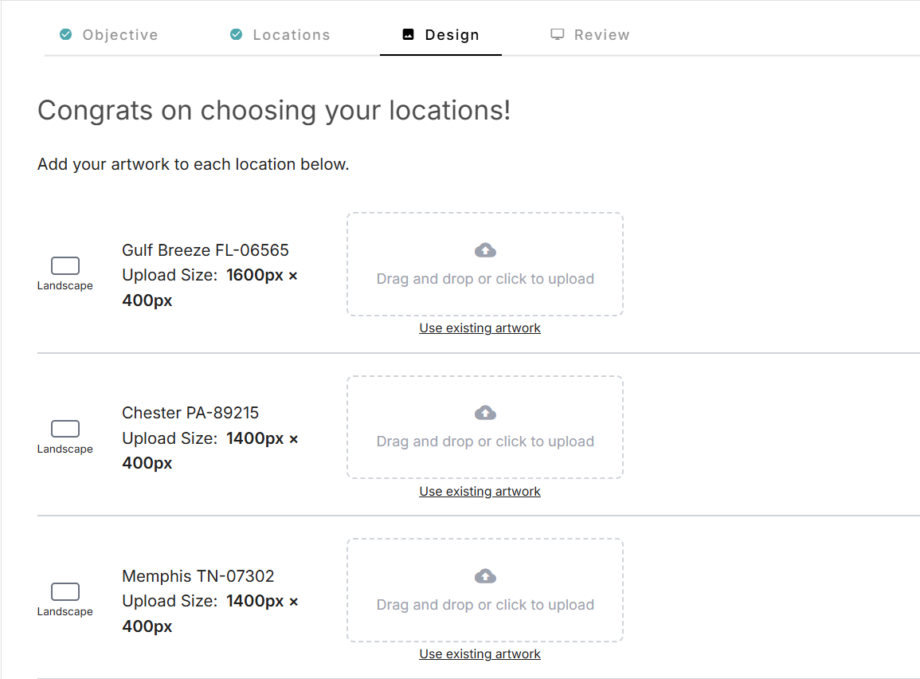
You can have your campaign live in minutes. Create a free account, select your locations, set your budget, upload your design, and start running once approved.
Where can I advertise with Blip in Grand Ledge?
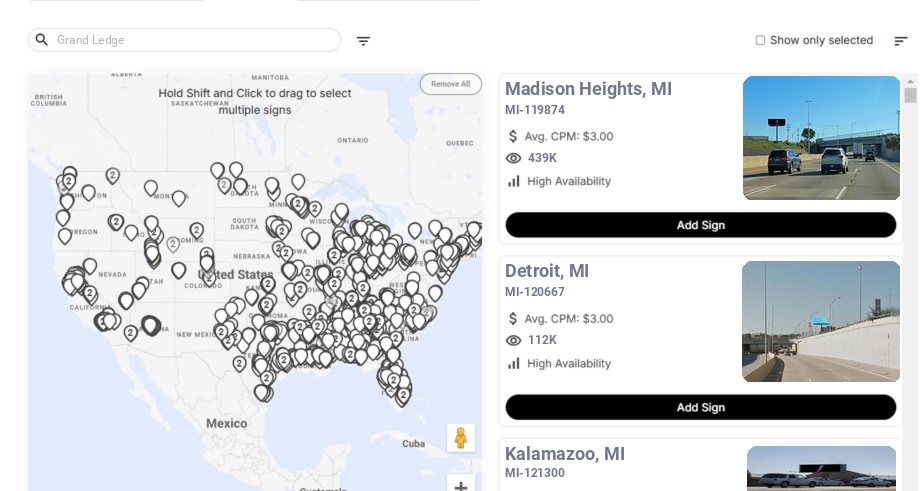
Blip has digital billboards in Grand Ledge. You can browse available locations on a map, choose the ones that fit your audience, and start advertising right away.
Still have questions? Launch a campaign in minutes — no contracts, no commitments.
Start Your CampaignGrand Ledge Billboard Advertising Guide
Grand Ledge 8,000 residents. We are reaching a car-first community that sits roughly 12 miles west of Lansing, inside a broader Lansing-area trade zone of more than 540,000 people, where more than 4 in 5 workers commute by driving alone.
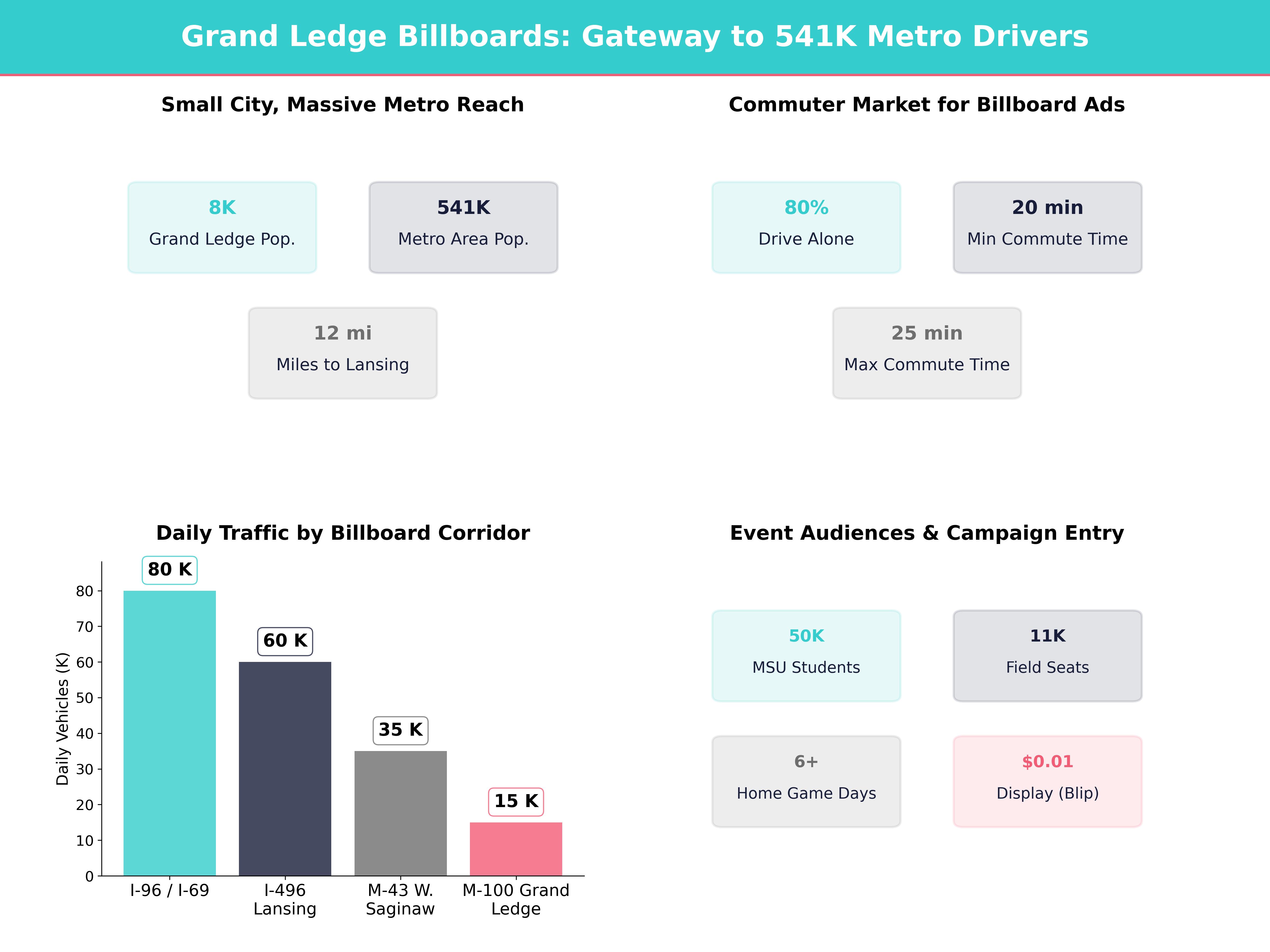
That combination gives us two advantages at once: dependable local frequency from everyday drivers, and regional reach from commuters moving between Eaton County Ingham County, and Clinton County
Grand Ledge Market Overview
Grand Ledge works best when we think of it as a local hub inside a larger, stable regional economy. The City of Grand Ledge
Eaton County 109,175 residents in the 2020 Census, and the wider Lansing-East Lansing metropolitan area had just over 541,000 residents, which gives billboard campaigns a much bigger audience than the city limit alone suggests.
Grand Ledge’s position inside the Lansing trade area
Grand Ledge sits in an advantageous spot between small-town residential life and the region’s busiest employment and retail corridors. Delta Charter Township, immediately to the east, has about 33,000 residents and a large concentration of shopping, restaurants, and industrial employment.
Lansing has about 112,000 residents, and East Lansing 47,000, so a campaign in and around Grand Ledge can influence local households while also reaching workers and visitors moving toward the urban core.
This geography matters because Grand Ledge advertisers rarely need to choose between “local” and “regional.” We can often do both. A healthcare provider, home service company, or restaurant in Grand Ledge can attract nearby residents from Eaton County while also catching people traveling in from Lansing, Delta Township, or western suburbs.
Car dependence and commuter behavior in Grand Ledge
Grand Ledge is fundamentally a driving market. In Eaton County, more than 4 in 5 workers commute by driving alone, and the typical one-way trip is roughly 20 to 25 minutes.
Capital Area Transportation Authority
For billboard advertisers, that means outdoor media fits the way people actually consume local information. Drivers use the same major roads repeatedly through the week, which gives us the repetition needed to build recall.
It also means advertisers with location-based offers, limited-time promotions, or recruiting messages can benefit from repeated visibility on familiar commuter routes.
Economic anchors that shape Grand Ledge demand
Grand Ledge benefits from several durable regional demand engines. Michigan State University enrolls more than 50,000 students, and its faculty, staff, visitors, and event traffic ripple across the whole metro.
The Lansing area also has a major concentration of state-government employment, healthcare systems such as UM Health-Sparrow and McLaren Greater Lansing General Motors, and business recruitment led by the Lansing Economic Area Partnership.
Closer to home, Grand Ledge Public Schools serves more than 5,000 students, which reinforces the family-oriented nature of the market. That family concentration tends to favor categories such as grocery, healthcare, banking, child enrichment, home improvement, quick-service food, community events, and seasonal services.
Key Traffic Corridors for Grand Ledge Billboards
Grand Ledge’s road network gives us several distinct billboard strategies. Some corridors are best for broad regional reach, while others are better for local frequency and directional relevance.
I-96 and I-69 east of Grand Ledge
According to Michigan Department of Transportation 70,000 to 90,000 vehicles per day on key segments, with some interchange-adjacent stretches exceeding 80,000 AADT.
This is the most important regional funnel for advertisers who want to reach westside Lansing commuters, logistics traffic, manufacturing workers, retail shoppers, and visitors traveling to and from the capital region.
This corridor is especially effective for the following advertiser types:
- Retailers and restaurants perform well here because drivers are often making same-trip decisions about where to eat, shop, or stop.
- Healthcare providers benefit because the route reaches a broad mix of families, workers, and older adults from multiple counties.
- Recruiters and staffing firms gain value because the corridor connects residential areas with manufacturing, warehousing, government, and service-sector job centers.
- Regional attractions and event venues benefit because this route captures both weekday commuters and weekend visitors.
M-100 through Grand Ledge
M-100 is Grand Ledge’s most important local connector. MDOT counts on parts of the route are commonly in the 10,000 to 15,000 vehicles per day range, which makes it smaller than the interstates but extremely valuable for local businesses that need relevance more than sheer scale.
This route ties together neighborhoods, schools, downtown activity, and the approach to I-96.
For many advertisers, M-100 is where we build familiarity. A local dentist, HVAC company, insurance agency, daycare, church event, or independent restaurant can benefit from appearing where residents pass repeatedly during school runs, errands, and work trips.
In a town like Grand Ledge, frequency on a trusted local route can matter as much as raw impressions.
M-43 and West Saginaw Highway toward Delta Township
The M-43 and West Saginaw Highway corridor links Grand Ledge to one of the region’s biggest commercial areas in Delta Charter Township. MDOT traffic volumes in major commercial stretches commonly run about 20,000 to 35,000 vehicles per day, depending on the segment.
This route is ideal when we want to intercept shoppers, restaurant traffic, and service-seeking households before they finalize where they will spend money.
This corridor tends to work especially well for:
- Retail and entertainment brands because the audience is already in a spending mindset.
- Auto dealers and financial services because consumers on this route are often comparing options and planning purchases.
- Home services and healthcare because suburban households along the corridor respond well to practical, needs-based messaging.
I-496 into downtown Lansing
For advertisers who want to extend Grand Ledge reach into the metro core, I-496 matters. Key stretches of I-496 in the Lansing area carry more than 60,000 vehicles per day, creating a strong final approach to downtown offices, government buildings, hospitals, and entertainment destinations.
Campaigns that need urban workforce reach, event awareness, or regional brand visibility can pair Grand Ledge-area boards with I-496 placements for broader saturation.
Grand Ledge Audience Segments We Can Reach
The most effective Grand Ledge billboard campaigns are built around the actual audiences moving through the market. Those audiences are diverse enough that we can tailor creative by route, season, and time of day.
Grand Ledge commuters and working adults
Many Grand Ledge residents work outside the city, especially in Lansing, Delta Township, and East Lansing. That creates a dependable weekday audience of commuters who see the same boards in the morning and evening.
We can reach state employees, healthcare workers, school staff, tradespeople, retail workers, and manufacturing employees with concise messages about convenience, trust, price, and immediate action.
Recruitment campaigns are especially strong in this segment. Employers can use billboard visibility to stay in front of workers who are already driving to job sites and may be open to a better opportunity closer to home.
Grand Ledge families and homeowner households
Grand Ledge has a strong family profile, supported by Grand Ledge Public Schools and the wider Eaton County residential base. Family audiences tend to respond to advertisers that solve practical weekly needs, including pediatric care, orthodontics, grocery, home repair, insurance, fitness, and quick dining.
Because people in this segment drive the same errand loops repeatedly, billboards can reinforce brand familiarity in a way that complements search and social advertising.
This segment also responds well to seasonal triggers. Home improvement messages pick up in spring, family fun promotions gain traction in summer, back-to-school campaigns matter in late summer, and holiday retail messaging strengthens in November and December.
Grand Ledge students, faculty, and young adults
The Grand Ledge market is close enough to Michigan State University, Lansing Community College, and downtown Lansing nightlife to justify student and young-professional targeting. MSU alone has more than 50,000 students, and the school calendar affects traffic, spending patterns, and event attendance across the region.
When we want to reach this audience, boards on routes leading toward Lansing and East Lansing tend to outperform purely local placements.
Young-adult creative in this market usually works best when it feels immediate and useful. Fitness offers, entertainment, food delivery, live events, apartments, career programs, and app-based services are common fits.
Grand Ledge visitors and recreation seekers
Grand Ledge has a real tourism and recreation story, even if it is smaller than a classic destination market. The Grand River 252 miles, and the city’s sandstone ledges rise roughly 60 feet above it, creating one of the state’s most distinctive natural landmarks.
Outdoor spaces such as Fitzgerald Park
Grand Ledge also benefits from the region’s broader visitor economy. Choose Lansing promotes attractions such as Wharton Center for Performing Arts, Potter Park Zoo, Jackson Field Lansing Center, which offers more than 70,000 square feet of meeting and exhibition space.
Jackson Field 11,000 people, and those eventgoers create useful waves of regional movement for hospitality, dining, and attraction-focused campaigns.
Seasonal and Timing Opportunities in Grand Ledge
Seasonality matters in Grand Ledge because local behavior changes noticeably with weather, school schedules, and regional events. We can improve performance by aligning messages with those rhythms.
Grand Ledge in spring and summer
From about May through September, Grand Ledge is at its most visually and recreationally active. Average July highs in the Lansing area are around 82°F, which supports parks, river recreation, dining patios, community festivals, and weekend day trips.
This is the ideal window for advertisers promoting outdoor dining, landscaping, pest control, golf, local attractions, family entertainment, and home improvement.
Summer is also when local imagery works especially well. Creative that references the river, the ledges, green space, and family activity feels authentic in this market.
Grand Ledge in back-to-school and fall
Late August and September are strong timing windows because family routines reset. School starts, commuting patterns stabilize again, and advertisers have an opportunity to speak to parents, students, and working households with structured weekly schedules.
This is a prime time for healthcare checkups, tutoring, after-school programs, sports registration, and everyday retail.
Fall also brings college sports and regional events. Michigan State University football typically brings 6 or 7 home Saturdays to East Lansing, and those weekends increase traffic for restaurants, bars, retail, hotels, and entertainment across the region.
October is also a natural fit for Grand Ledge’s scenic identity, especially as visitors come for fall color, outdoor recreation, and community events.
Grand Ledge in winter and early spring
Winter changes the market, but it does not weaken billboard value. The Lansing area averages around 40 inches of snow per year, and January highs are roughly 30°F.
When driving conditions are less inviting, people become more focused on convenience, safety, healthcare, warm food, indoor entertainment, and urgent home services.
That shift creates good billboard opportunities for urgent care, auto service, snow removal, insurance, heating, plumbing, comfort food, and indoor family attractions. Early spring then becomes a reset period for tax services, fitness, remodeling, lawn care, and spring retail.
Grand Ledge Billboard Design Tips for the Local Market
Creative in Grand Ledge should reflect the market’s practical mindset and local character. We do not need to be flashy for the sake of being flashy. We need to be clear, relevant, and rooted in what matters to local drivers.
Use Grand Ledge cues that feel familiar
Imagery tied to the river, sandstone ledges, parks, trails, and four-season outdoor life can make a campaign feel more local. Grand Ledge is proud of its natural setting, so visuals that echo that identity often feel more credible than generic stock photography.
Warm earth tones, blues, and strong autumn color palettes can be especially effective when we want the ad to feel connected to place.
If we are advertising to people traveling east toward Lansing or Delta Township, it can also help to frame Grand Ledge as the easier, calmer, or more convenient alternative. That message resonates because many residents actively balance small-town living with metro-area access.
Keep Grand Ledge messaging practical and specific
Grand Ledge audiences tend to respond to useful information. Price points, strong offers, directional cues, service categories, and immediate benefits often outperform vague branding alone.
If a business is close to the route, we should say so clearly. If an offer saves time, money, or hassle, we should make that benefit unmistakable.
In this market, concise lines such as “Dinner on Your Way Home,” “Now Hiring in Delta Township,” or “Family Care Close to Home” usually fit the audience better than abstract slogans. We can also tailor messages to commuting direction, which is especially useful on I-96, I-69, and M-43.
Match the visual style to the route
High-speed interstate boards need larger type, fewer elements, and a single idea. Slower local routes like M-100 can support slightly more detail, especially for businesses that depend on local recognition and repeat exposure.
For East Lansing game-day traffic, we can nod to Saturday energy and school spirit without relying on trademarked names or logos. For family audiences, faces, food, homes, and simple calls to action usually outperform dense copy.
Regional Strategies Around Grand Ledge
A smart Grand Ledge campaign usually performs best when we divide the area into sub-markets and tailor the message to each one.
Grand Ledge core and the M-100 spine
This is where we focus on familiarity, trust, and repeat exposure. Local healthcare, dentists, schools, community events, gyms, churches, and service providers should prioritize boards that speak directly to Grand Ledge households.
The goal here is not just reach. The goal is becoming part of the community’s routine decision set.
Delta Township and the I-96 retail belt
This sub-area is ideal for regional retailers, chain restaurants, entertainment brands, recruiting campaigns, and destination-based businesses. The traffic is heavier, the commercial context is stronger, and consumers are more likely to make same-day stop decisions.
Businesses in Grand Ledge can also use this area defensively by reminding westbound drivers that they have appealing options before or after the busiest retail cluster.
Lansing and East Lansing extensions from Grand Ledge
When we want to reach office workers, students, hospital employees, state-government staff, or eventgoers, we should extend beyond Grand Ledge into Lansing and East Lansing approaches. This strategy works well for higher education, healthcare, legal services, major events, and broad brand-awareness campaigns.
It is also useful for Grand Ledge businesses that draw from the whole metro rather than from one town.
Wider Eaton County approaches
For advertisers serving customers beyond Grand Ledge, regional boards can speak to surrounding communities and rural households that come into town for shopping, services, and schools. In these areas, value-driven messaging, trust cues, and practical offers usually outperform trend-driven creative.
Local banks, tractor and equipment dealers, feed and hardware stores, medical clinics, and trades-based employers can all benefit from this broader Eaton County approach.
Using Blip Tools in Grand Ledge
Grand Ledge is a great fit for Blip because the market has clear commuting windows, clear corridor differences, and clear seasonal shifts. We can use the platform’s flexibility to match those patterns instead of overbuying inventory we do not need.
Daypart Grand Ledge campaigns around real movement
Morning and evening commuting windows are especially important here. We should consider emphasizing 6:00 to 9:00 a.m. for coffee, breakfast, healthcare, and recruiting messages, and 3:00 to 7:00 p.m. for dining, retail, grocery, and family-service campaigns.
Event-based advertisers can add weekend pushes when MSU games, concerts, or festivals increase regional movement.
Test multiple Grand Ledge corridors without overcommitting
Because Grand Ledge has both local and regional routes, we can test 2 or 3 corridor types at once instead of guessing. We might pair a local M-100 board with an eastbound interstate placement and a Delta Township retail-corridor board, then compare which route produces the strongest response.
That kind of disciplined testing is especially valuable for small and mid-sized businesses.
Refresh creative with the Grand Ledge calendar
Blip’s artwork tools make it easier to swap creative as the local calendar changes. We can run one message during school registration, another before football weekends, and another during holiday shopping without rebuilding an entire outdoor plan.
That is particularly useful in a market where weather, school routines, and event calendars shift behavior quickly.
Use analytics to separate local frequency from metro reach
Grand Ledge campaigns often perform best when we measure boards by role, not just by total impressions. One board may be best for local repetition, while another may be best for intercepting regional traffic.
Blip’s analytics help us see that difference and optimize accordingly.
Getting Started with Billboard Rental in Grand Ledge
Renting a billboard in Grand Ledge becomes much easier when we start with a clear objective and map it to the right route. We do not need every board in the market. We need the boards that match where our audience is already driving.
Define our Grand Ledge goal first
Before we choose locations, we should decide whether the campaign is meant to drive immediate store visits, build local awareness, recruit employees, support an event, or reach the broader Lansing metro. A Grand Ledge pizza restaurant, a Delta Township retailer, and a Lansing healthcare provider all need different placements, even if they are advertising in the same geography.
Evaluate Grand Ledge boards by context, not just by map pin
The best location is not automatically the busiest one. We should evaluate each board by traffic direction, travel speed, nearby decision points, and distance from the business.
A board close to an exit, retail node, or daily commuter turn can outperform a larger regional board if the message depends on immediate action.
We should also think about whether the audience is in arrival mode or departure mode. Eastbound morning traffic may be perfect for recruiting, while westbound evening traffic may be better for dinner, grocery, and home-service messages.
Start with a focused flight in Grand Ledge
For many advertisers, a 2 to 4 week test is enough to learn which routes, dayparts, and creative angles work best. We recommend starting with 1 primary goal and a small cluster of placements, then expanding based on performance.
That approach keeps the campaign disciplined and makes optimization much easier.
Why Blip is especially useful for Grand Ledge billboard rental
Traditional outdoor buying can feel oversized for a market like Grand Ledge, especially for local businesses that want flexibility. Blip simplifies the process by letting us choose boards on a map, control spend, and adjust timing as we learn.
Because each digital display lasts about 7.5 to 10 seconds, and pricing starts at $0.01 per display, we can build practical local tests without committing to a rigid long-term package.
For Grand Ledge advertisers, that flexibility matters. We can align budget with commute hours, school calendars, football weekends, or seasonal promotions, and we can pause or revise quickly when conditions change.
That makes billboard rental feel less like a fixed gamble and more like a controllable part of a smart regional marketing plan.