Billboards in Saginaw, MI
No Minimum Spend. No Long-Term Contracts. Just Results.
Trusted by Leading Brands


Billboard advertising
in Saginaw has never been easier
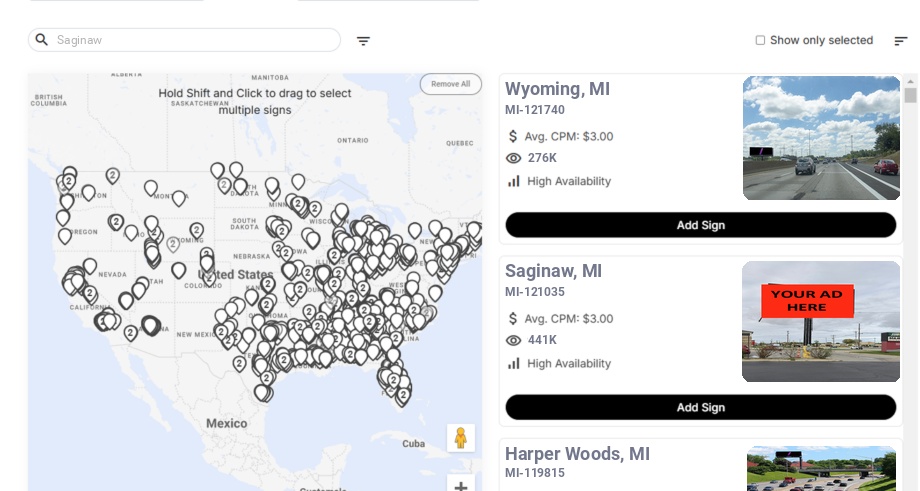



How much is a billboard in Saginaw?
Frequently Asked Questions About Billboard Advertising in Saginaw
Do I need a contract to advertise with Blip in Saginaw?
No, Blip has no long-term contracts or minimum commitments. You can start, pause, or stop your campaign at any time.
How fast can I launch a billboard campaign with Blip in Saginaw?
You can have your campaign live in minutes. Create a free account, select your locations, set your budget, upload your design, and start running once approved.
Where can I advertise with Blip in Saginaw?
Blip has digital billboards in Saginaw. You can browse available locations on a map, choose the ones that fit your audience, and start advertising right away.
Still have questions? Launch a campaign in minutes — no contracts, no commitments.
Start Your CampaignSaginaw Billboard Advertising Guide
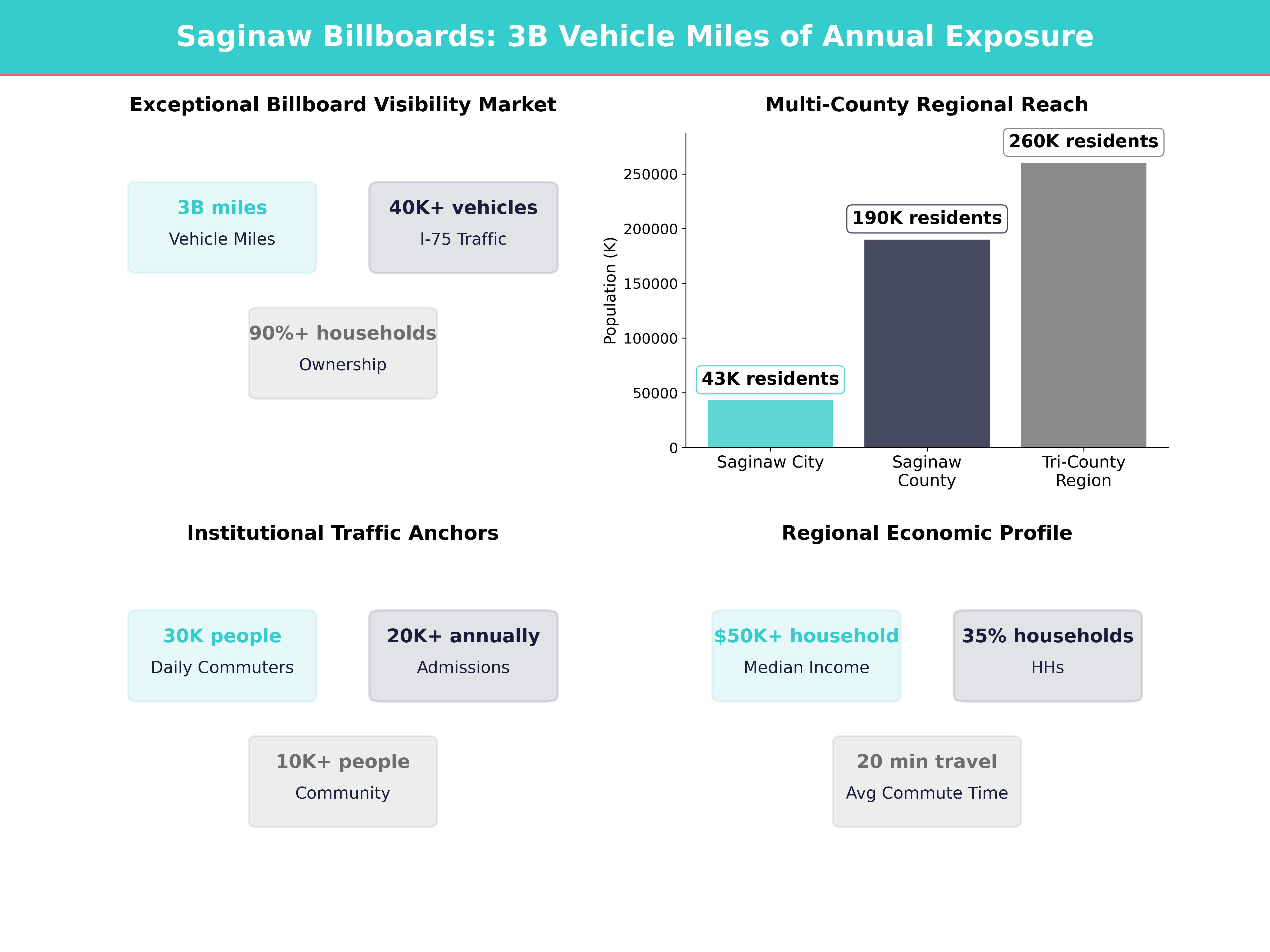
Saginaw sits at the heart of Michigan’s Great Lakes Bay Region and functions as a commercial, medical, and cultural hub for nearly a quarter‑million people in and around the “Tri‑Cities” (Saginaw, Bay City, Midland). When we use digital billboards in Saginaw with Blip, we tap into heavy commuter flows on I‑75 and I‑675, busy retail corridors around Fashion Square Mall and Kochville Township, and a steady stream of regional visitors coming for sports, shopping, and health care. Local roads in Saginaw County carry more than 3 billion vehicle miles traveled annually, and I‑75 alone carries well over 40,000 vehicles per day on key segments near Saginaw, giving advertisers frequent, repeated exposure on Saginaw billboards. Below, we outline how to make the most of this market using data‑driven strategy and Blip’s flexible tools.
Saginaw Market Snapshot: Why This Geography Matters
Saginaw’s city proper has roughly 43,000 residents, but the effective advertising market for Saginaw billboard advertising is far larger:
- Saginaw County’s population is around 190,000, and the combined Great Lakes Bay Region (Saginaw, Bay, and Midland counties) totals more than 260,000 residents.
- The City of Saginaw’s median age is around 35–36 years, with more than 25% of residents under 18 and roughly 15% age 65+, creating a strong presence of both younger working adults and older residents who rely heavily on regional services.
- Median household income in Saginaw city is in the upper‑$30,000 to low‑$40,000 range, compared with roughly mid‑$50,000s to low‑$60,000s for the broader region, indicating a very mixed market: budget‑conscious households close to downtown and higher‑income segments clustered in townships and neighboring cities like Saginaw Township, Kochville Township, and Frankenmuth.
- Vehicle ownership is widespread: in Saginaw County, more than 90% of households have access to at least one vehicle, and over 35% have access to two or more, reinforcing auto‑oriented media like billboards in Saginaw.
Key economic anchors:
- Health care and social assistance are top employers, centered around Covenant HealthCare and Ascension St. Mary’s Hospital. Covenant operates more than 600 beds and reports well over 20,000 inpatient admissions and hundreds of thousands of outpatient visits annually. Combined, the two major systems support thousands of jobs in Saginaw County.
- Manufacturing and automotive suppliers such as Nexteer Automotive in Buena Vista Township employ several thousand workers across multiple shifts. Overall, manufacturing accounts for roughly 1 in 6 jobs in the broader Great Lakes Bay Region.
- Education hubs include Saginaw Valley State University (enrollment typically around 7,000–8,000 students each year) and Delta College’s Saginaw Center and other satellite sites, which collectively serve thousands of additional students. These institutions generate daily traffic along Bay Road, Pierce Road, and Tittabawassee.
- The regional tourism and visitor economy, promoted by Go Great Lakes Bay, draws an estimated 1–2 million overnight and day‑trip visitors annually across the Great Lakes Bay Region, producing hundreds of millions of dollars in visitor spending on lodging, food, attractions, and retail.
For advertisers, this combination means we can use digital Saginaw billboards to reach:
- Local residents making frequent short trips between neighborhoods, township retail corridors, and downtown.
- Commuters from surrounding townships and counties (including Bay, Midland, Tuscola, and Gratiot), who collectively account for tens of thousands of inbound and outbound work trips each weekday.
- Out‑of‑town visitors arriving via I‑75/I‑675 or US‑10 for games, concerts, shopping, and hospital appointments.
To better understand municipal priorities, business regulations, and event calendars that influence travel demand, advertisers can monitor resources from the City of Saginaw and Saginaw County.
Understanding Who You’ll Reach in Saginaw
When we plan creative and scheduling for Saginaw billboard advertising, it helps to think in terms of the area’s main audience segments.
Commuters and working professionals
- Average commute times in the Saginaw area are around 20 minutes, shorter than large metros but still dominated by car travel; over 80–85% of workers drive alone to work, while only a small share (usually under 2%) relies on public transit through Saginaw Transit Authority Regional Services (STARS).
- Many workers commute between Saginaw, Bay City, and Midland. Regional data show that more than 30,000 residents in the Tri‑Cities commute across county lines daily, funneling traffic through the I‑75 and I‑675 corridors and along M‑46/Gratiot and US‑10.
- Shift‑based employers (healthcare, manufacturing, logistics) generate additional peaks around 6–8 a.m., 2–4 p.m., and 10 p.m.–midnight.
Advertising implication: concise, high‑contrast creative with simple offers (“Exit 3B – 2 miles ahead,” “Lunch Under $10 – Next 2 Exits”) works especially well along interstate and state trunkline routes. With typical highway speeds of 60–70 mph, drivers often see a board for just 3–5 seconds, so minimal wording and large type are critical.
Healthcare users and caregivers
With regional hospitals and specialty clinics clustered in Saginaw:
- Covenant HealthCare and Ascension St. Mary’s together handle hundreds of thousands of patient encounters per year, including emergency visits, surgeries, and specialty care. Regional data show that healthcare jobs account for over 15% of employment in Saginaw County.
- Many patients and families travel from rural counties (e.g., Tuscola, Huron, Gratiot) through Saginaw’s highway network. In some nearby rural areas, more than 1 in 4 residents must drive 30 minutes or more for specialty care, so Saginaw becomes the main hub.
- Hospital visitor volumes spike around weekdays 8 a.m.–6 p.m. and during specific clinics (cardiology, oncology, orthopedics), increasing exposure on nearby corridors.
Advertising implication: healthcare, senior services, pharmacies, urgent care, and hospitality (hotels, restaurants near the hospitals) can all benefit from targeted messaging on the main approach routes to medical campuses. For example, a hotel within 2–3 miles of the hospitals can reach thousands of caregivers and out‑of‑town patients passing through I‑675 each week.
Students and young adults
Between Saginaw Valley State University, Delta College, and local high schools:
- There are well over 10,000 college students plus faculty and staff regularly traveling in and out of the Saginaw/Kochville area. SVSU alone typically houses 2,000+ students on campus and draws thousands more commuters.
- The Saginaw Public School District educates more than 6,000 K‑12 students, with related daily travel on neighborhood arterials.
- Students concentrate heavily along Bay Road, Tittabawassee Road, and the Kochville Township retail corridors, which can see daily traffic counts in the 20,000–35,000 vehicles‑per‑day range on busy segments.
Advertising implication: campaigns for quick‑service restaurants, entertainment, banking, and wireless services should focus placements along northwestern Saginaw and near major retail hubs, with calls to action that are short, price‑focused, and mobile‑friendly. Including QR codes or short URLs on boards near stoplights or slower‑speed zones can increase engagement among this segment.
Shoppers and families
The Fashion Square Mall area and Tittabawassee Road corridor host national retailers, big‑box stores, and restaurants that draw shoppers from across the region:
- Daily traffic counts on Tittabawassee and Bay Road segments frequently reach into the tens of thousands of vehicles per day; busy intersections near the mall can exceed 25,000–30,000 vehicles daily during peak periods, according to the Michigan Department of Transportation traffic monitoring.
- Weekends and pre‑holiday periods see especially high volumes. Regional retail data show that November–December sales can account for 20–25% of annual revenue for many store categories.
- The nearby Birch Run Premium Outlets and Frankenmuth attractions add additional cross‑traffic via Dixie Highway and I‑75, especially on summer weekends and during fall festivals.
Advertising implication: retail and seasonal promotions should prioritize these corridors Thursday–Sunday and during pre‑holiday shopping windows, using Blip’s day‑parting and date targeting to capture the highest‑conversion moments. Short, time‑bound messages (“Ends Sunday,” “2‑Day Doorbusters”) tend to perform best when shoppers are already en route and seeing multiple billboards in Saginaw during these peak windows.
Key Corridors and Placement Strategy
While Blip controls the exact sign inventory, it’s helpful to understand the dominant traffic corridors where digital billboards in Saginaw typically perform best:
1. I‑75 and I‑675
- I‑75 is one of Michigan’s main north–south arteries, carrying regional traffic between Detroit/Flint and northern destinations (Bay City, Midland, Up North). On some Saginaw‑area segments, annual average daily traffic has been measured at 40,000–60,000 vehicles per day.
- I‑675 loops into downtown Saginaw, channeling both commuters and visitors heading to the central business district, hospitals, and The Dow Event Center. During major events, traffic volumes on I‑675 and adjacent downtown streets can spike significantly in the 2–3 hours before start time.
Strategy:
- Use these corridors for high‑reach, brand‑building campaigns and for businesses that draw from a wide radius: auto dealers, hospitals, tourism attractions, regional retailers.
- If your business is near a particular exit, include exit numbers or distance (“Next Exit – State St / M‑58”). Data from multiple highway signage studies show that boards with specific distance or exit cues can improve recall and on‑route response rates by 10–20% versus generic branding alone.
2. M‑46 / Gratiot Avenue and State Street
- M‑46 runs east–west through the city, linking Saginaw to Alma and other central Michigan communities. It serves as a primary commuter and commercial route for residents traveling from western Saginaw County.
- State Street is a key commercial avenue running into Saginaw Township, with professional offices, restaurants, and local retail. Posted speeds are generally lower (35–45 mph), giving drivers slightly more time to absorb billboard messages.
Strategy:
- Ideal for professional services (insurance, financial, legal), dine‑in restaurants, and local retail that serve nearby residential neighborhoods.
- Emphasize trust, convenience, and proximity: “5 minutes from here in Saginaw Twp,” “Walk‑in appointments today.”
- Because traffic speeds and stoplights create more viewing time, this is a good place for slightly more detailed messages (e.g., including a phone number or brief benefit statement).
3. Bay Road & Tittabawassee Road / Kochville Township
- This is a powerhouse commercial zone featuring Fashion Square Mall, big‑box clusters, and proximity to SVSU. Individual big‑box stores in this area can attract hundreds to thousands of customer visits per day.
- Daily traffic is dominated by shoppers, students, and commuters, with late‑afternoon and weekend peaks.
Strategy:
- Drive urgent, promotional messaging: limited‑time sales, weekend events, new product drops.
- Rotate creative by day and time: student‑focused offers in late afternoon and evening; family and shopper offers on weekends and early evenings.
- When major retail events (Black Friday, back‑to‑school, tax‑refund season) occur, consider increasing Blip impressions by 25–50% during those windows on these corridors for maximum lift.
4. Dixie Highway and surrounding townships
- Dixie Highway (old US‑10/US‑23) serves as an alternative corridor parallel to I‑75, connecting Saginaw with Bridgeport, Birch Run (home to the Birch Run Premium Outlets), and Frankenmuth’s tourism area.
- Birch Run Premium Outlets alone includes 100+ stores and can attract tens of thousands of visitors on peak weekends. Frankenmuth draws an estimated several hundred thousand to more than a million visitors annually for events like Zehnder’s Snowfest and holiday festivals, many of whom pass near Saginaw before or after their stay.
- Traffic includes both locals and out‑of‑area shoppers/tourists, often traveling in family groups and spending on food, gas, and shopping along the way.
Strategy:
- Great for campaigns aimed at destination shoppers and tourists, especially during peak weekends, outlet sales, and festivals in nearby Frankenmuth.
- Use directional cues and “on your way home” positioning: “Grab Dinner in Saginaw – 10 minutes ahead.”
- Consider messaging that highlights easy freeway access and parking, since visitors often prioritize convenience when choosing where to stop.
Seasonality and Timing: When to Run Your Blips
Saginaw experiences four distinct seasons, and each has implications for scheduling and creative in Saginaw billboard advertising campaigns.
Winter (December–March)
- Saginaw County averages around 40–50 inches of snowfall per year, with significant lake‑effect events possible. Snow, early sunsets, and more cautious driving behaviors influence visibility and travel times.
- In mid‑winter, sunset can occur before 5:30 p.m., meaning the entire evening rush hour (roughly 4–7 p.m.) occurs mostly in the dark.
- Holiday shopping and post‑holiday clearance campaigns are strong drivers; retailers can generate 20–30% of annual sales during this season.
Tactics:
- Take advantage of illuminated digital screens: bright, high‑contrast designs are particularly visible on dark evenings and in snow.
- Emphasize warmth, comfort, and convenience: home heating services, auto repair, indoor entertainment, and delivery services. Messaging tied to safety (“Winter Tire Sale,” “24/7 Emergency Heat Repair”) resonates strongly in this season.
- Concentrate budgets around commuting windows and weekend shopping periods; consider increasing impressions on Fridays and Saturdays when traffic volumes and purchase intent are both high.
Spring (April–May)
- Road construction season begins in Michigan, rerouting and concentrating traffic on certain corridors. The Michigan Department of Transportation and City of Saginaw regularly publish project maps and detours.
- Outdoor activities ramp up as temperatures moderate into the 50s and 60s, increasing trips to parks, home improvement stores, and garden centers.
Tactics:
- If construction alters patterns, shift Blip spending to the detour corridors grabbing extra flow. Detours can move thousands of additional vehicles per day onto alternate arterials.
- Promote landscaping, home improvement, tax services, and graduation‑related offerings. In many households, April and May see spikes in discretionary spending tied to tax refunds and spring projects.
- Use flexible flighting: increase impressions during specific weeks (e.g., tax deadline, graduation, prom season) and taper in between peaks.
Summer (June–August)
- Tourism, events, and festivals across Saginaw and the broader region swell local road traffic. Visitor data show that summer months can account for 35–45% of annual tourism spending in Michigan.
- Go Great Lakes Bay highlights events like Friday Night Live concert series, the Saginaw African Cultural Festival, and waterfront activities.
- Families travel for sports, camps, and vacations, often via I‑75 and I‑675. Youth sports tournaments alone can bring hundreds of teams and thousands of families through the region on certain weekends.
Tactics:
- Time creative to coincide with major events at The Dow Event Center and Temple Theatre—concerts, Saginaw Spirit games, and festivals. Event calendars from these venues help pinpoint specific high‑traffic evenings.
- Emphasize experience‑driven offers: dining, attractions, retail experiences, tourism partnerships. Offers like “Kids Eat Free,” “Family 4‑Pack,” or “Show Your Ticket & Save 10%” align well with event‑goers.
- Lean into dayparting: afternoons and evenings when recreational travel is highest, and late‑week (Thursday–Sunday) when regional visitors are most active.
Fall (September–November)
- Back‑to‑school and college semesters drive predictable travel around SVSU and local schools. On weekdays, morning and afternoon traffic near schools can surge by 10–20% versus summer months.
- High school and college sports, including football games, increase evening and weekend traffic around stadiums and downtown.
- Retailers pivot to Halloween, hunting season, and early holiday shopping, each creating specific demand peaks.
Tactics:
- Run education, apparel, electronics, and QSR campaigns aligned to school starts and sports schedules. A focused 2–4 week push around late August/early September can capture a large share of back‑to‑school spending.
- Consider “game day” and “post‑game” messaging targeting travel to and from stadiums and arenas—especially along State Street, M‑46, and I‑675.
- For hunting and outdoor categories, emphasize early‑morning and weekend dayparts when sportsmen are on the road.
Creative Strategy: What Works on Saginaw Billboards
The Saginaw market combines short urban trips with longer regional drives, so effectiveness comes from clarity and relevance. Well‑planned Saginaw billboard advertising makes it easy for drivers to understand who you are and what to do next.
1. Keep it readable for 3–5 seconds
- Limit copy to 7–10 words or fewer; research across outdoor campaigns shows that messages within this range can deliver 20–30% better recall than more text‑heavy designs.
- Use large, sans‑serif fonts and strong color contrast; snow, fog, and low light can reduce legibility.
- Avoid clutter: one image, one headline, one call to action. On high‑speed corridors like I‑75, every extra element dilutes impact.
2. Localize your message
Saginaw drivers respond well to hyper‑local cues:
- Reference well‑known landmarks and exits: “Near Fashion Square Mall,” “Downtown Saginaw by the riverfront,” “Exit 149 – Birch Run / Saginaw.”
- For healthcare, mention “minutes from Covenant / Ascension St. Mary’s.”
- Use neighborhood names like Saginaw Township, Old Town, Kochville, and downtown Saginaw where appropriate.
- Consider including local symbols or colors tied to area teams or schools (e.g., Saginaw Spirit) when relevant; community‑aligned creative can improve emotional connection and brand favorability.
3. Use time‑sensitive offers
Blip allows creative swapping and schedule control:
- Rotate breakfast, lunch, and dinner offers for restaurants. National QSR data show that time‑of‑day‑specific ads can increase response by 10–15% over generic messaging.
- Change weekly specials for retailers or dealerships to line up with payday cycles (for many households, the 1st and 15th of the month) and major sale events.
- Promote limited events—concerts, trade shows, holiday parades—and switch to branding or new offers afterward. Saginaw’s event calendars from the City of Saginaw and local venues make it easy to plan these rotations.
4. Align tone with audience segments
- Working‑class commuters and manufacturing shifts: straightforward, value‑driven messaging (“Save $50 on brakes today,” “Union‑friendly, open late”). In markets with a strong blue‑collar base, price and reliability are key purchase drivers.
- Students and young adults: bolder colors, informal language, QR codes, and social handles. This audience is highly mobile‑first; short URLs and scannable codes can bridge billboard impressions to digital engagement.
- Families and older residents: trust, dependability, and community involvement (“Serving Saginaw County for 30+ years”). Including years in business, locally owned claims, or community sponsorship mentions can increase credibility.
Industry-Specific Insights for Saginaw Advertisers
Healthcare and wellness
- With Saginaw as a regional medical hub, signage on I‑675, M‑46, and State Street is ideal to reach patients and caregivers heading to appointments. Medical‑related trips can represent 10–15% of some households’ non‑work driving, particularly among older residents.
- Many local practices and clinics report that a majority of their patients come from within a 20–30‑minute drive radius, making billboards within that zone highly relevant.
- Emphasize quick access, wait‑time advantages, and specialties (“Cardiology – 5 minutes from downtown Saginaw,” “Walk‑in Urgent Care – Open 7 Days”). Including simple calls like “Search: [Practice Name] Saginaw” helps bridge offline to online.
Automotive and repair
- Many residents commute by car and keep older vehicles on the road longer due to income levels; in similar mid‑Michigan markets, the average vehicle age is over 11 years.
- Winters and freeze‑thaw cycles contribute to potholes and wear, driving seasonal spikes in demand for tires, alignments, and suspension work.
- Promote oil changes, tire deals, winterization packages, and financing. Highlight price points, warranties, and same‑day service.
- Target high‑traffic commuter routes in morning and evening, especially in fall and before winter storms. Using weather‑triggered scheduling—boosting impressions 1–2 days before a forecasted storm—can significantly increase response for tires and maintenance.
Retail and shopping centers
- Focus on corridors around Fashion Square Mall, Tittabawassee, Bay Road, and Dixie Highway, where combined daily traffic easily reaches into the tens of thousands.
- Combine broad brand messages (“Your Home Store in Saginaw”) with short‑run sale creatives (“3‑Day Sale – This Weekend Only”).
- Time heavy flights around pay periods, holidays, and major sale events (Black Friday, back‑to‑school). National retail data suggest that aligning promotional bursts with these periods can lift store traffic by 10–25%.
- For multi‑location retailers, consider creative variations that call out the nearest Saginaw or Saginaw Township store specifically.
Restaurants and hospitality
- Downtown Saginaw, Old Town, and the riverfront are increasingly active cultural zones, supported by coverage from outlets like MLive’s Saginaw News and WNEM TV5. Events, gallery nights, and concerts drive spikes in evening and weekend foot traffic.
- Hotels near I‑75/I‑675, the hospitals, and major employers often see occupancy rates climb on event weekends and during peak tourism season.
- Use highway and arterial signs to pull visitors exiting I‑675 and I‑75 into downtown and township restaurants. Clear exit and distance information helps transient travelers decide quickly.
- Rotate creative by meal period; highlight specials tied to events at the Dow Event Center or Saginaw Spirit games (“Show Your Ticket & Save 10% Tonight”). On big event nights, consider doubling impressions 2–3 hours before and after the event for maximum lift.
Education and workforce training
- Use placements near SVSU, Kochville, and major commuting routes to reach prospective students and working adults. Many local colleges report that 60–70% of students live within a 30–40‑mile radius, making local billboards highly relevant.
- Highlight short programs, flexible scheduling, and job placement statistics where available (“9 in 10 grads employed within 6 months”).
- Coordinate campaigns with application deadlines, open houses, and semester start dates. A focused 4–6 week billboard run leading into these milestones can meaningfully boost inquiries.
Tourism, entertainment, and events
- Promote concerts, sports, and festivals in coordination with The Dow Event Center, Temple Theatre, and regional attractions listed on Go Great Lakes Bay.
- Saginaw Spirit home games and major concerts can draw several thousand attendees per event, many of whom arrive by car via I‑675 and State Street.
- Ramp up impressions 7–10 days before event dates, peak the last 2–3 days, and pivot quickly to your next event or offer. Short, countdown‑style messages (“3 Days Until…”, “Tonight Only”) can heighten urgency.
- Pair billboards with coverage from local outlets like MLive Saginaw and WNEM to create a multi‑channel awareness lift.
Using Blip’s Flexibility for Saginaw Success
Blip’s tools are especially powerful in a market like Saginaw where traffic patterns, weather, and events change rapidly, making flexible billboard rental in Saginaw a major advantage over static buys.
1. Dayparting by commute and purpose
- Morning (6–9 a.m.): commuters, hospital staff, shift changes—promote coffee, breakfast, auto service, healthcare, financial services. In many markets, 25–35% of weekday vehicle trips occur during this window.
- Midday (11 a.m.–2 p.m.): shoppers, retirees, students—promote restaurants, retail, daytime events. Lunch and errand trips often spike traffic on key arterials.
- Evening (4–8 p.m.): return commuters, families, event‑goers—promote dinner, entertainment, big‑ticket retail, and services open late.
We can allocate a higher share of budget to the most profitable dayparts while still maintaining baseline awareness in others. For example, you might devote 50% of impressions to evening, 30% to morning, and 20% to midday, then adjust based on performance.
2. Weather‑aware budgeting
Saginaw’s winter weather can influence driving habits and consumer needs:
- Before and during major snowstorms, emphasize auto repair, towing, grocery, and home heating services. Grocery trips can surge 20–30% in the 24 hours before a forecasted storm.
- After storms, push auto body shops, windshield repair, and contractors as damage assessments begin.
- In hot summer periods, shift creative toward HVAC tune‑ups, ice cream, beverages, and indoor attractions.
Adjust daily budgets dynamically so your ads appear more often when demand is highest. Blip’s flexibility allows you to increase spending just for specific dates or time ranges tied to forecasted events, ensuring your billboards in Saginaw are most visible when consumers are ready to act.
3. Event and payday calendars
Use local calendars from the City of Saginaw, Saginaw County, and regional tourism sites to map:
- Event clusters (festivals, parades, concerts).
- High‑shopping weekends (e.g., tax refund times, Black Friday, back‑to‑school).
- Neighborhood‑specific events, like Old Town festivals or riverfront celebrations, which can draw thousands of local attendees.
Then schedule Blip campaigns to ramp up in the 3–10 days leading into those peaks. For offer‑driven businesses, aligning billboard rental in Saginaw with paydays (usually biweekly or on the 1st and 15th) can improve conversion rates.
Measuring and Refining Your Campaign
To make Saginaw billboard campaigns continuously more effective, we should track and iterate:
1. Align billboard flights with in‑store or web metrics
- Compare store traffic, calls, and online conversions on days and times when Blip activity is highest versus control periods. Even a 5–10% lift during billboard flights can be significant.
- Watch for spikes tied to specific creatives or schedule patterns (e.g., weekend‑only promos, event‑aligned messaging).
- For multi‑location businesses, track which store sees the strongest lift to refine geographic focus.
2. Use unique landing pages or promo codes
- Create Saginaw‑specific URLs or coupon codes displayed on your billboards (e.g., “/Saginaw10” or “Mention ‘I‑75’ for 10% Off”).
- Track the number of redemptions or visits linked to those unique identifiers. If one corridor’s code outperforms another by 20–30%, shift more impressions to that corridor.
- For service businesses, track inbound calls from local area codes during and shortly after flight windows.
3. Incorporate local feedback
- Ask customers “Where did you hear about us?” and specifically track “digital billboard” mentions. Over a few weeks, you can build a data set showing which messages and timeframes resonate.
- Monitor social media mentions from local residents and coverage from local outlets like MLive Saginaw and WNEM when you run high‑profile campaigns. Screenshots of your boards shared online are a valuable signal of creative impact.
- Use community insight from local chambers and business groups, such as the Saginaw County Chamber of Commerce, to understand emerging trends and adjust messaging.
4. Refine creative and schedule
- If one creative outperforms another, shift more impressions to the stronger design. A/B testing (running two variations simultaneously and comparing results) can highlight winners quickly.
- Move more of your budget to the corridors, days, or dayparts that correspond to the best response. If weekend evenings on I‑675 drive more redemptions than weekday mornings on M‑46, reallocate accordingly.
- Revisit your strategy quarterly to account for seasonal shifts, new construction, and evolving consumer behavior.
By leveraging Saginaw’s unique blend of commuters, regional visitors, students, and healthcare traffic—and by using Blip’s flexible scheduling, budgeting, and creative rotation—we can build billboard campaigns that are both highly visible and tightly aligned to local behavior. With the right messages in the right places at the right times, digital Saginaw billboards become a powerful, measurable growth channel for any business using Saginaw billboard advertising and billboard rental in Saginaw to reach the greater Great Lakes Bay Region.