Billboards near Beverly Hills, MI
No Minimum Spend. No Long-Term Contracts. Just Results.
Trusted by Leading Brands


Billboard advertising
near Beverly Hills has never been easier




How much is a billboard near Beverly Hills?
Why Choose Blip for Billboard Advertising near Beverly Hills
Blip lets you launch in Beverly Hills, Michigan fast, reaching I-696 and Telegraph commuters without a long lease.
Set any budget in Beverly Hills, Michigan and tap affluent Oakland County shoppers on your terms.
Use Blip dayparting in Beverly Hills, Michigan to hit rush hour on I-75 and evening traffic to Royal Oak or Birmingham.
No contracts in Beverly Hills, Michigan means you can test weekend spikes from Royal Oak events and scale only what works.
Track real-time results in Beverly Hills, Michigan and shift spend as traffic builds around Southfield, Troy, and Auburn Hills.
Blip's creative tools make it easy to tailor ads for Beverly Hills, Michigan families, professionals, and high-income commuters.
Frequently Asked Questions About Billboard Advertising near Beverly Hills
How much does a billboard cost near Beverly Hills, Michigan with Blip?
With Blip, you stay in control by setting your own daily budget for Beverly Hills billboards, so you can start small and scale up whenever you’re ready. Each “blip” is a brief 7.5 to 10-second ad on digital billboards near Beverly Hills, Michigan, and you only pay for the individual blips you receive. Prices for each blip adjust based on the time of day, location, and advertiser demand, giving you flexible options that match your goals.
Where can I advertise near Beverly Hills, Michigan with Blip?
We serve the Beverly Hills area with 23 digital billboards located within about 10 miles, primarily along the core commuter corridors of southern Oakland County. These include nearby boards in Oak Park, Royal Oak, Madison Heights, Hazel Park, and Auburn Hills. Instead of a single sign locked to one location, Blip lets you distribute your impressions across these 23 boards.
Who does billboard advertising near Beverly Hills, Michigan reach?
Beverly Hills is a small, high-income village surrounded by major employment and retail centers, with roughly 10,300–10,500 residents and a median household income commonly reported in the $145,000–155,000 range. For advertisers, this means campaigns on digital billboards serving the Beverly Hills area can reach a concentrated audience of higher-income homeowners, professionals, and families who are highly active across the region. In practice, well-placed Beverly Hills billboards can support branding for premium products and services that rely on repeat visibility and high-intent local customers.
What traffic patterns make Beverly Hills, Michigan billboards effective with Blip?
The roads serving the Beverly Hills area carry some of the heaviest daily volumes in Michigan, including I-696, I-75, M-10 / Lodge Freeway, Telegraph Road, and Woodward Avenue. These flows translate into millions of weekly impressions available to campaigns serving the Beverly Hills area. With Blip, you can selectively bid on time slots when these volumes and your preferred audiences are highest, including rush-hour windows.
When is the best time to run Beverly Hills, Michigan billboard ads?
Because the Beverly Hills area is tied so tightly to commuting and destination shopping, timing strategy is crucial. Weekdays are strongest during the morning peak, midday, and evening peak, while weekends shift toward retail, dining, entertainment, and recreation. Using Blip’s scheduling tools, you can turn local knowledge into efficient ad timing.
Do I need a contract to advertise with Blip near Beverly Hills?
No, Blip has no long-term contracts or minimum commitments. You can start, pause, or stop your campaign at any time.
How fast can I launch a billboard campaign with Blip near Beverly Hills?
You can have your campaign live in minutes. Create a free account, select your locations, set your budget, upload your design, and start running once approved.
Where can I advertise with Blip near Beverly Hills?
Blip has digital billboards near Beverly Hills. You can browse available locations on a map, choose the ones that fit your audience, and start advertising right away.
Still have questions? Launch a campaign in minutes — no contracts, no commitments.
Start Your CampaignBeverly Hills Billboard Advertising Guide
Beverly Hills, Michigan sits at the heart of one of the most affluent, highly educated, and heavily traveled pockets of the Detroit metro, making it an ideal hub for billboard advertising near Beverly Hills and the surrounding suburbs. With 23 digital billboards serving the Beverly Hills area from nearby communities like Oak Park, Royal Oak, Madison Heights, Hazel Park, and Auburn Hills Oakland County
Understanding the Beverly Hills Area Market
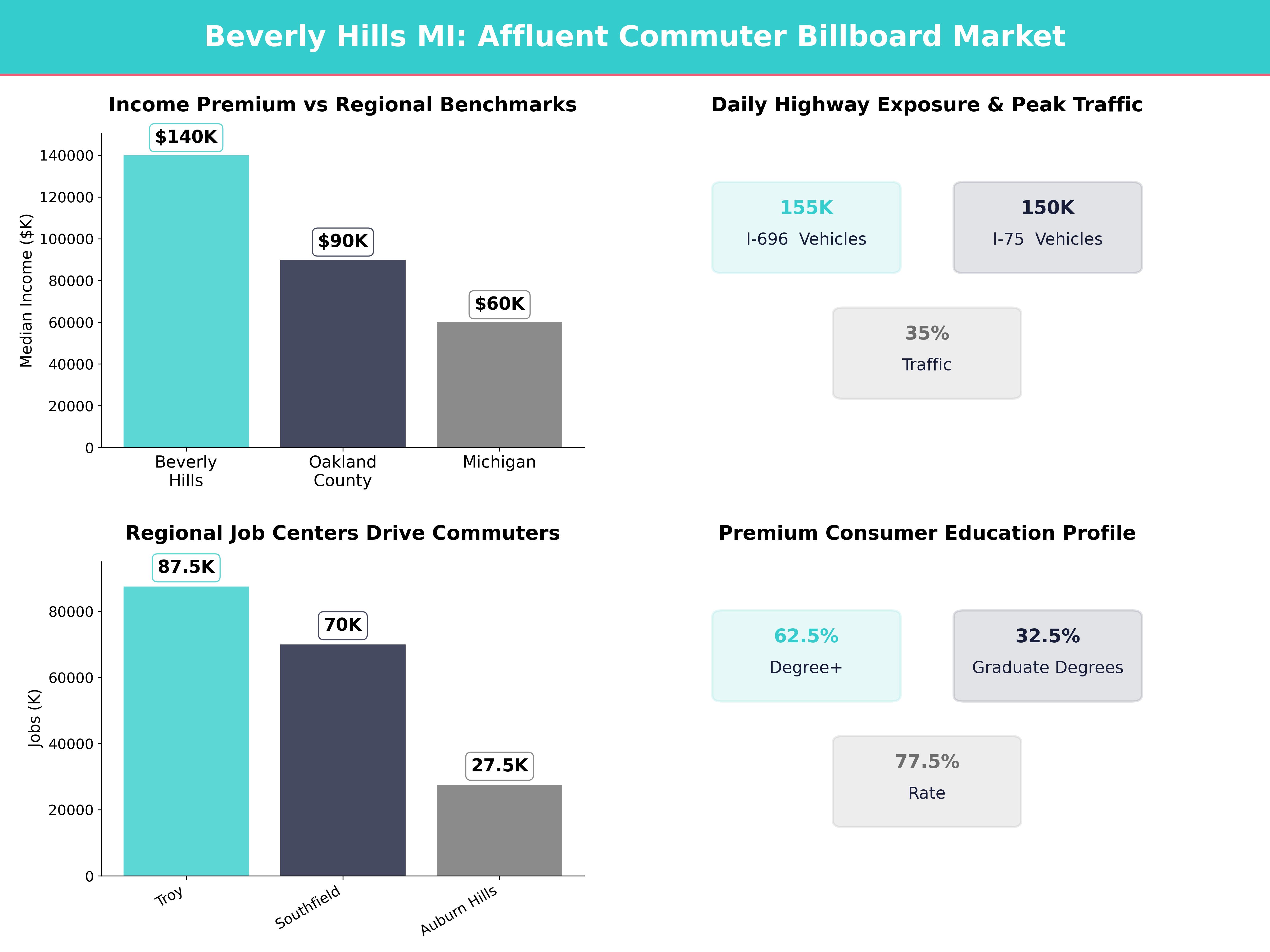
Beverly Hills is a small, high-income village surrounded by major employment and retail centers. According to recent local planning and demographic data, the village has roughly 10,300–10,500 residents, with a median household income commonly reported in the $145,000–155,000 range and a large share of residents holding bachelor’s or graduate degrees. The broader Oakland County region has about 1.27 million residents and a median household income near $90,000–95,000, placing it among the higher-income counties in Michigan and well above the statewide median, which sits in the low $60,000s.
Key local context:
- Beverly Hills is bordered by Southfield to the south, Birmingham to the east, and Bloomfield Township to the north, tying it directly into some of metro Detroit’s most desirable residential and shopping areas.
- Major employment centers in nearby Southfield, Troy, and Auburn Hills host well over 200,000 combined jobs, drawing tens of thousands of daily commuters through the Beverly Hills area. Troy alone reports around 85,000–90,000 jobs, Southfield more than 70,000, and Auburn Hills roughly 25,000–30,000.
- The village is governed by the Village of Beverly Hills and is closely tied to regional decisions from Oakland County and the Southeast Michigan Council of Governments (SEMCOG)
For advertisers, this means campaigns on digital billboards serving the Beverly Hills area can reach a concentrated audience of higher-income homeowners, professionals, and families who are highly active across the region, with local per‑capita incomes and discretionary spending power significantly above state averages. In practice, well-placed Beverly Hills billboards can support branding for premium products and services that rely on repeat visibility and high-intent local customers.
Where Our 23 Nearby Billboards Reach
We serve the Beverly Hills area with 23 digital billboards located within about 10 miles, primarily along the core commuter corridors of southern Oakland County. These corridors connect to destinations highlighted by Visit Detroit and Oakland County’s visitor resources
- Oak Park (3.8 miles away): Strong exposure to traffic using I‑696 and Greenfield/Telegraph to move between Southfield, Beverly Hills, and Royal Oak. Segments of I‑696 near Oak Park typically carry 150,000–165,000 vehicles per day.
- Royal Oak (5.3 miles away): A key hub for dining, nightlife, and shopping, supported by a downtown that attracts an estimated 10,000–20,000 visitors on busy weekends, according to local coverage from outlets such as The Oakland Press and Hometown Life. Woodward Avenue and I‑696 traffic here captures many Beverly Hills residents heading to downtown Royal Oak or Detroit.
- Madison Heights (7.3 miles away): Positioned near I‑75 and 14 Mile, great for north–south commuter flows between Birmingham/Beverly Hills and Troy or Detroit. I‑75 at 14 Mile often sees 130,000–150,000 vehicles per day.
- Hazel Park (8.1 miles away): Access to the I‑75 and I‑696 interchange, one of the busiest junctions in the state, where combined flows can exceed 250,000 vehicles per day when both freeways are counted.
- Auburn Hills (9.8 miles away): A major employment and retail center (including Great Lakes Crossing Outlets, which draws more than 8–10 million visitors annually per local tourism reporting) that attracts a significant share of higher-income commuters from the Beverly Hills area.
Instead of a single sign locked to one location, Blip lets you distribute your impressions across these 23 boards. That flexibility is ideal for reaching Beverly Hills area residents not only near home, but along their entire daily path—school drop-offs, commutes, shopping trips, and nights out. For many residents, that means 20–40 minutes of drive time each way on weekdays plus multiple shorter trips on weekends, creating repeated exposure opportunities and making digital billboard rental near Beverly Hills an efficient way to build frequency.
Who You’re Reaching Near Beverly Hills
By combining local planning data, school district profiles, and regional economic reports from entities such as Oakland County Economic Development SEMCOG
Demographics & household profile
- Population in the immediate Beverly Hills area: roughly 10,000–12,000, with daytime population swelling as workers, service providers, and visitors travel through.
- Median household income in Beverly Hills: frequently reported above $140,000, roughly 1.5–1.7× the Oakland County median and more than 2× the statewide median. In nearby Birmingham and Bloomfield Township, median household incomes often exceed $120,000–$130,000, reinforcing the concentration of wealth.
- Homeownership in nearby communities such as Beverly Hills, Birmingham, and Bloomfield often exceeds 75–80%, with owner-occupied rates in some census tracts over 85%, signaling a strong base of established, long-term residents.
- Educational attainment: in and around Beverly Hills, more than 60–65% of adults 25+ hold at least a bachelor’s degree, and in some adjacent neighborhoods the share of residents with graduate or professional degrees approaches 30–35%.
- Age profile: a balanced mix of families and established professionals, with many neighborhoods where 25–35% of residents are under 18 and a sizable share of adults in the 35–64 age range—prime decision-makers for high‑value purchases.
Commuter and lifestyle characteristics
- Oakland County employment levels exceed 700,000 jobs, with significant clusters in Southfield (major office parks), Troy (financial and professional services), and Auburn Hills (automotive and tech R&D).
- SEMCOG data shows over 80–82% of metro Detroit workers commute by driving alone, with average commute times in Oakland County of about 27–28 minutes, slightly above the national average and ideal for out‑of‑home visibility.
- Roughly 20–25% of workers in affluent Oakland County communities commute 35 minutes or longer, meaning many Beverly Hills–area residents see the same signs multiple times per week on longer highway trips.
- Beverly Hills sits near premier retail and entertainment destinations such as downtown Birmingham, Woodward Avenue corridors in Royal Oak and Ferndale, and shopping clusters along Telegraph Road and Big Beaver in Troy, which hosts more than 5 million square feet of office space and major retail centers like Somerset Collection
- Regional attractions such as Little Caesars Arena, Ford Field, and Comerica Park in nearby Detroit regularly attract crowds of 20,000–65,000 attendees, adding to peak evening and weekend traffic on key routes.
For advertisers, this means:
- High disposable income for categories like automotive (luxury and leases), home services, financial services, travel, healthcare, and premium retail. Local auto ownership data show above‑average rates of 2+ vehicles per household, with strong demand for maintenance and upgrades.
- Strong interest in local schools, youth activities, and family-oriented services: school districts serving the area often post graduation rates above 90–95%, and many families invest in tutoring, athletics, and arts programs.
- A commuter-heavy lifestyle where digital billboards are seen dozens of times per month by the same households, reinforcing brand recall and driving search and direct traffic. For businesses, this makes billboard advertising near Beverly Hills a powerful complement to search, social, and other digital channels.
Traffic Patterns and Prime Outdoor Exposure
The roads serving the Beverly Hills area carry some of the heaviest daily volumes in Michigan. Transportation data from the Michigan Department of Transportation (MDOT)
- I‑696 (near Oak Park, Royal Oak, Madison Heights, Hazel Park): Segments in southern Oakland County frequently carry 140,000–170,000 vehicles per day. Over a 7‑day week, that translates to roughly 1.0–1.2 million vehicle trips on a single segment.
- I‑75 (near Madison Heights, Hazel Park, Auburn Hills): Daily traffic volumes often range from 120,000 to over 180,000 vehicles depending on the segment, including heavy commuter and freight traffic. Over a month, that can exceed 3.5–4.0 million vehicle trips per segment.
- M‑10 / Lodge Freeway and Telegraph Road (M‑24/M‑10 corridors): Commonly carry 70,000–120,000 vehicles per day in nearby segments connecting Southfield, Beverly Hills, and surrounding communities.
- Woodward Avenue (M‑1) near Royal Oak and Birmingham: As a major arterial and regional destination street, many segments see 35,000–60,000 vehicles per day, increasing significantly during weekends and special events like the Woodward Dream Cruise, which can draw 1–1.5 million visitors on its peak weekend according to local news outlets such as the Detroit Free Press and The Detroit News.
These flows translate into millions of weekly impressions available to campaigns serving the Beverly Hills area. With Blip, you can selectively bid on time slots when these volumes (and your preferred audiences) are highest, and even prioritize rush-hour windows when MDOT and SEMCOG counts show 30–40% of daily traffic occurs, maximizing the value of billboard rental near Beverly Hills and its feeder routes.
Timing Your Campaign: Dayparts, Weekparts, and Seasonality
Because the Beverly Hills area is tied so tightly to commuting and destination shopping, timing strategy is crucial. Using Blip’s scheduling tools, you can turn local knowledge into efficient ad timing.
Weekday vs. weekend
-
Weekdays (Mon–Fri):
- Morning peak: roughly 7:00–9:00 a.m., when many of the region’s 700,000+ workers are on the move toward Southfield, Detroit, Troy, and Auburn Hills.
- Midday: 11:00 a.m.–1:00 p.m., capturing service calls, medical appointments, and lunch traffic.
- Evening peak: roughly 4:00–6:30 p.m., with some corridors staying busy to around 7:00 p.m. as commuters return home or stop in Royal Oak or Birmingham.
- Best for: professional services, healthcare, financial services, B2B, education, and commuter-oriented offers (coffee, quick service restaurants, auto services).
-
Weekends:
- Traffic shifts toward retail, dining, entertainment, and recreation. Local shopping and entertainment zones in Royal Oak, Birmingham, and Auburn Hills see weekend visitor surges of 30–50% above typical weekdays, per local tourism and news coverage.
- Oak Park, Royal Oak, and Auburn Hills boards become especially valuable as people move along I‑75, I‑696, and Woodward Avenue for shopping, events, and family outings.
- Best for: restaurants, retail promotions, entertainment venues, youth sports, events, and local attractions promoted through outlets like Visit Detroit and Visit Oakland County
Seasonal considerations
-
Winter (Dec–Feb):
- Shorter daylight hours mean more driving in the dark—sunset before 5:30 p.m. for much of the winter makes digital billboards stand out with bright, high-contrast messaging.
- Traffic volumes remain strong on weekdays despite weather, and regional data shows collision rates increase by 10–20% in snow/ice conditions, heightening attention to safety and auto care messaging.
- Focus on concise copy and high visibility for safety-related services, home services (heating, roofing), auto care, and financial planning (tax season).
-
Spring (Mar–May):
- Home improvement, landscaping, and real estate campaigns perform well as homeowners in the Beverly Hills area plan projects and relocations. Local real estate data often shows 25–35% of annual listings hitting the market between March and June.
- Use Blip to increase frequency ahead of listing season and before graduation/wedding seasons, when spending on events, apparel, and services can spike 15–25% over winter baselines.
-
Summer (Jun–Aug):
- Family activities, camps, travel, and automotive are strong categories. Many school districts are out for 10–11 weeks, increasing daytime travel and family outings.
- Leverage weekend-heavy rotations around Royal Oak and Auburn Hills to catch vacation and shopping traffic, including visitors to Great Lakes Crossing and outdoor events promoted by Visit Detroit’s events calendar.
-
Fall (Sep–Nov):
- Back‑to‑school, after‑school programs, healthcare (annual physicals, flu shots), and financial services campaigns can benefit from consistent weekday presence.
- Sports-related and entertainment campaigns gain traction as high school, college, and pro sports seasons ramp up; Saturday and Sunday TV and stadium audiences in metro Detroit often surpass 70,000–100,000 attendees plus large at‑home viewership.
Creative Strategies That Fit Beverly Hills Area Audiences
Creative that resonates near Beverly Hills should be polished, concise, and aspirational, reflecting the area’s higher-income, education-focused profile.
Design principles
-
Prioritize clarity at speed. At 60–70 mph on I‑75 or I‑696, drivers have roughly 3–6 seconds to absorb your message. Aim for:
- 7–10 words of main copy
- 1 clear logo or brand mark
- 1 primary visual element
- High contrast, not clutter. Dark backgrounds with light text—or vice versa—perform well in all weather and lighting conditions and are easier to read at 300–600 feet.
- Device-friendly CTAs. Since more than 80–85% of local adults own smartphones, use short URLs, concise search prompts (“Search: Beverly Hills pediatric dentist”), or clear brand names that are easy to remember after a quick glance.
Message positioning for this market
-
Emphasize quality, trust, and expertise. For professional services (law, medical, financial), highlight credentials, years in business, or local roots:
- “Trusted by Beverly Hills area families for 25+ years”
- “Serving Oakland County professionals since 1998”
-
Lean into family and education themes. The market values good schools, enrichment, and kids’ activities:
- “After‑school STEM classes 5 minutes from Beverly Hills area neighborhoods”
- “Enroll now – limited to 60 students per session”
-
Highlight convenience and location. Many residents are busy professionals:
- “Same‑day urgent care near Royal Oak & I‑696 – Open 7 days”
- “Premium auto detail on your commute home – Exit 14 Mile / I‑75”
Local visual cues and references
Including subtle nods to familiar local landmarks or institutions can increase relevance:
- References to nearby destinations (Birmingham, Royal Oak, Great Lakes Crossing Outlets, Woodward Avenue) when you’re targeting those travel patterns.
- Mentions of “near Telegraph & 13 Mile” or “just off Woodward in Royal Oak” can boost perceived proximity; MDOT and local wayfinding data show that simple, well‑known intersections improve navigation recall.
- Colors or imagery that echo local school or community identities—without violating any trademark rules—can make messages feel “of the community.”
Using Blip’s Tools to Target the Beverly Hills Area Smarter
Blip’s model—pay‑per‑“blip” (per display) and flexible scheduling—pairs especially well with the Beverly Hills area’s concentrated but mobile audience and makes it easy to test and scale billboard advertising near Beverly Hills without committing to long-term static leases.
Geographic strategy
-
Clustered coverage:
- Combine boards in Oak Park and Royal Oak to dominate I‑696 and Woodward for Beverly Hills area commutes. These corridors alone can expose your message to 200,000–250,000 vehicles per day across multiple segments.
- Add Madison Heights and Hazel Park boards to capture I‑75 flows for residents commuting toward Troy or Detroit.
- Layer in Auburn Hills boards if your audience includes professionals heading to corporate campuses or shoppers visiting Great Lakes Crossing and nearby employers such as major automotive and tech firms.
-
Hyperlocal dominance:
- If your physical location is near a specific interchange or arterial (e.g., a medical office near I‑696 & Telegraph), concentrate bid budgets on the nearest 3–5 signs for repeated exposure. Research on out‑of‑home frequency suggests that 8–12 impressions per viewer per month can significantly improve recall and response for local businesses.
Budget and frequency
- Start by setting a daily budget that delivers enough impressions to be noticed during key commute windows—often the equivalent of several dozen to a few hundred blips per day, depending on competition and your bids. For many small and mid‑sized advertisers, this can translate to effective campaigns starting at a few tens of dollars per day, scaled up as results appear.
- Use higher bids and tighter schedules for your most critical windows (e.g., 7–9 a.m. and 4–6:30 p.m. weekdays) and lower bids or broader schedules for general awareness.
- Monitor how many days per week your target audience is likely to pass a given board (often 4–5 days for commuters), then back into an impression target that delivers multiple exposures per week.
Testing and optimization
-
A/B test creatives:
- Run two versions: one focused on price/value and another on quality/trust. Monitor performance and external indicators (web traffic, calls, coupon redemptions) during each 2–4 week flight.
-
Rotate seasonally relevant messages:
- Use Blip to switch artwork at no additional printing cost—promote tax services in March–April, summer camps in May–June, and flu shots in fall. Seasonal campaigns can see 10–30% higher response when directly tied to timely needs.
-
Align with local events:
- Use coverage in Royal Oak and along Woodward to time campaigns during festivals and events covered by outlets like the Detroit Free Press, The Detroit News, Crain’s Detroit Business Oakland County Times.
- For regional travel and entertainment tie‑ins, monitor calendars from Visit Detroit and local city event pages from Royal Oak, Birmingham, and Auburn Hills.
Campaign Ideas by Industry
To make the most of the Beverly Hills area’s demographics and traffic, consider these tailored approaches:
Local retail and restaurants
- Target evening and weekend slots on boards near Royal Oak, Oak Park, and Madison Heights to catch residents heading out for dining and shopping. Regional consumer data shows food and beverage spending for higher‑income households can be 20–30% above national averages.
- Feature limited‑time offers (“This Weekend Only,” “Ends Sunday”) with simple CTAs like “Exit 14 Mile – Royal Oak” or “Just off Woodward,” and consider including quantifiable hooks such as “Save 20% this weekend only.”
- Align promotions with events like the Woodward Dream Cruise, Royal Oak’s downtown festivals, and Birmingham events promoted by Hometown Life’s Birmingham-area coverage.
Healthcare and wellness
- Promote pediatric, dental, primary care, and specialty practices serving the Beverly Hills area, emphasizing convenience and expertise—e.g., “New patients seen within 48 hours.”
- Schedule heavy rotations during weekday mornings and late afternoons when parents are driving kids to and from school and activities. Local surveys often show that 60–70% of healthcare decisions in families are made or strongly influenced by parents in the 30–54 age range, a core Beverly Hills demo.
- Integrate with articles and awareness campaigns from local healthcare systems often featured in Hometown Life’s Birmingham-area coverage, The Oakland Press, and Crain’s Detroit Business health coverage
Home services and real estate
- Given the high rate of homeownership and larger homes, campaigns for roofing, renovations, landscaping, HVAC, windows, and real estate services are especially effective. In many nearby neighborhoods, median home values sit in the $350,000–$600,000+ range, supporting higher-ticket projects.
- Run seasonally aligned creatives (e.g., “Book your spring landscaping now – 10% off early bookings”) and use boards along I‑696 and I‑75 to catch commuters who own homes in the Beverly Hills area but work elsewhere.
- Promote open houses and new listings with hyperlocal CTAs (“New listing in Beverly Hills – 3BR/2.5BA – Visit today”) and time campaigns for Thurs–Sun when 60–70% of showings occur.
Professional services and financial institutions
-
Advertise attorneys, financial advisors, CPAs, and insurance agencies with messaging focused on trust, local expertise, and long-term planning:
- “Managing $100M+ in client assets in Oakland County”
- “Serving local families for 30 years”
- Cluster boards nearest to office districts in Southfield, Troy, and Auburn Hills while still reaching the Beverly Hills area base. These corridors collectively employ more than 150,000 white‑collar workers, many in decision‑making roles.
- Use tax season (Jan–Apr) and year‑end planning periods (Oct–Dec) for intensified rotations; financial services often see inquiry volumes rise 20–40% in these windows.
Education, enrichment, and youth activities
- Promote tutoring centers, music schools, sports academies, STEM programs, and private or charter schools. Families in higher‑income suburbs frequently allocate 5–10% of household budgets to education, childcare, and extracurriculars.
- Focus on after‑school and early evening dayparts (3–7 p.m.) Monday–Friday, plus weekend mornings for sports and activities.
- Coordinate with school-year calendars from districts and local coverage via outlets like The Oakland Press and Hometown Life to time enrollment pushes, tryouts, or seasonal registrations.
Staying Aligned With Local Context and Regulations
While Blip handles compliance with digital billboard standards and local sign codes on our side, it helps to understand the broader local environment:
- The Village of Beverly Hills and neighboring communities maintain strong standards for aesthetics, traffic safety, and community character. You can review local policies via the Village of Beverly Hills official site and Oakland County government Royal Oak Planning, and Auburn Hills Planning Services
- Avoid misleading directional claims; if your store or office is not directly in Beverly Hills, clearly reference the actual city and nearby landmarks (“5 minutes from Beverly Hills area neighborhoods,” “Just east of Telegraph in Southfield”). Clear wayfinding can reduce confusion and missed visits, and local traffic studies show that accurate exit and distance cues improve follow‑through.
- Lean into messages that reflect community values—quality education, family life, safety, and long-term investment in the region. These themes consistently test well in higher‑income suburban markets in Southeast Michigan.
Bringing It All Together
Digital billboard campaigns serving the Beverly Hills, Michigan area are uniquely powerful because they reach a concentrated, high‑value audience along some of the busiest corridors in the state. With 23 strategically placed digital billboards in nearby Oak Park, Royal Oak, Madison Heights, Hazel Park, and Auburn Hills, we can help you:
- Reach affluent, highly mobile households multiple times per week, leveraging corridors that see tens of thousands to well over 150,000 vehicles per day.
- Align your messaging with commuter patterns, shopping trips, and evening entertainment that collectively account for hundreds of millions of vehicle miles traveled annually in Oakland County.
- Adapt creative quickly as seasons, offers, and events change—without printing costs—allowing you to pivot around school calendars, tax season, holidays, and marquee local events.
By pairing local insight with Blip’s flexible scheduling and budgeting tools, advertisers can build efficient, data-informed campaigns that authentically connect with the Beverly Hills area and the broader Oakland County market. Whether you’re testing billboard advertising near Beverly Hills for the first time or scaling an established presence with additional billboards near Beverly Hills, Blip makes it simple to turn everyday commutes into consistent, measurable brand exposure.