Billboards near Southfield, MI
No Minimum Spend. No Long-Term Contracts. Just Results.
Trusted by Leading Brands


Billboard advertising
near Southfield has never been easier



How much is a billboard near Southfield?
Why Choose Blip for Billboard Advertising near Southfield
Blip lets you launch Southfield billboards in minutes, reaching M-10, I-696, and Telegraph commuters without traditional buying hassles.
Set any budget in Southfield and pay only for 7.5–10 second blips, so your spend flexes with weekday office traffic and weekend shoppers.
Use dayparting in Southfield to hit rush hours, lunch breaks, or Detroit event nights on M-10 and I-75 when traffic is busiest.
No contracts with Blip means Southfield advertisers can test campaigns, then shift fast as spring home-service demand or fall open enrollment changes.
Track Southfield performance in real time and optimize by corridor, from Oak Park to Farmington Hills, based on what drives the best response.
Blip's creative tools help tailor bold Southfield ads for diverse commuters and the Southfield Town Center office crowd on fast-moving freeways.
Frequently Asked Questions About Billboard Advertising near Southfield
How much does a billboard cost near Southfield, Michigan with Blip?
With Blip, you can run eye-catching digital ads on Southfield billboards with any budget, because you choose a daily spend that Blip will never exceed. Each ad play, or “blip,” is a 7.5–10 second spot on digital billboards near Southfield, Michigan, and you only pay for the blips you receive. Prices for each blip adjust based on when and where you choose to appear and current advertiser demand, giving you control over both cost and exposure in the Southfield area.
Where can I advertise with Blip near Southfield, Michigan?
There are 26 digital billboards serving the Southfield area from nearby cities like Oak Park, Royal Oak, Hazel Park, Madison Heights, Farmington Hills, and Detroit. These boards are positioned to intersect with major travel patterns on I-696, M-10, US-24, and I-75. Within a roughly 10-mile radius of Southfield, these corridors serve a combined population base of 700,000–800,000 residents plus hundreds of thousands of daily workers and visitors.
What kind of audience do Southfield, Michigan billboards reach?
Southfield sits at the center of one of Metro Detroit’s most important business and commuter hubs, so campaigns near Southfield can reach both local residents and a broad mix of commuters from Oakland, Wayne, and Macomb counties. The city has roughly 75,000–76,000 residents, and the broader trade area pushes well above 200,000 residents. Southfield is also one of the nation’s larger majority-Black suburbs, so inclusive creative and diverse imagery tend to feel especially relevant.
When is the best time to run billboards near Southfield, Michigan with Blip?
Weekday commute windows are especially strong, with the morning commute from 6:30–9:30 a.m. and the evening commute from 3:30–7:00 p.m. often offering the highest traffic and dwell time. Midday is useful for lunch, medical, and errand trips, while weekends are better for shopping, entertainment, worship, and family visits. With Blip, you can schedule ads down to specific hours and days, so you can focus spend on the most active times.
What roads get the most traffic for Southfield, Michigan billboard advertising?
The strength of billboard advertising near the Southfield area lies in its highways and major corridors. I-696 near Southfield commonly exceeds 140,000–160,000 vehicles per day on key segments, while M-10 often carries 100,000–130,000 vehicles per day. US-24, I-75, and local arterials like Greenfield Road, Evergreen Road, Northwestern Highway, Lahser Road, and 12 Mile Road also carry heavy traffic and create strong opportunities for localized messaging.
Do I need a contract to advertise with Blip near Southfield?
No, Blip has no long-term contracts or minimum commitments. You can start, pause, or stop your campaign at any time.
How fast can I launch a billboard campaign with Blip near Southfield?
You can have your campaign live in minutes. Create a free account, select your locations, set your budget, upload your design, and start running once approved.
Where can I advertise with Blip near Southfield?
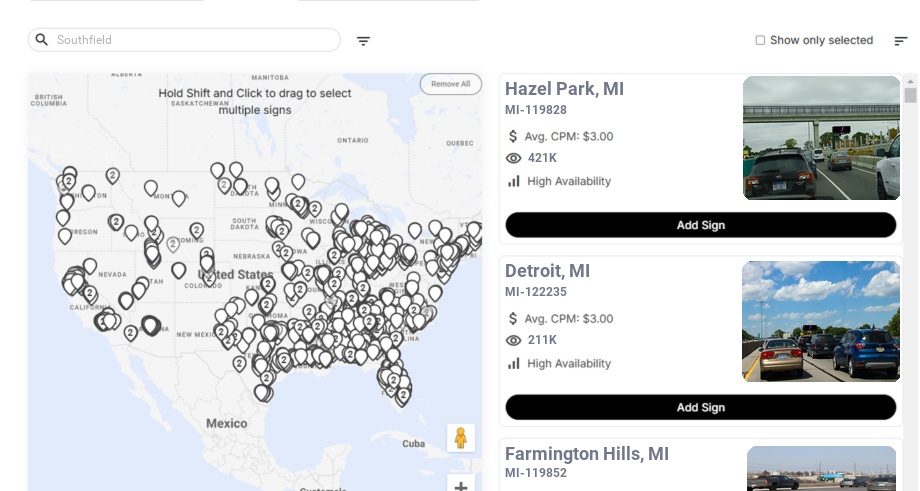
Blip has digital billboards near Southfield. You can browse available locations on a map, choose the ones that fit your audience, and start advertising right away.
Still have questions? Launch a campaign in minutes — no contracts, no commitments.
Start Your CampaignSouthfield Billboard Advertising Guide
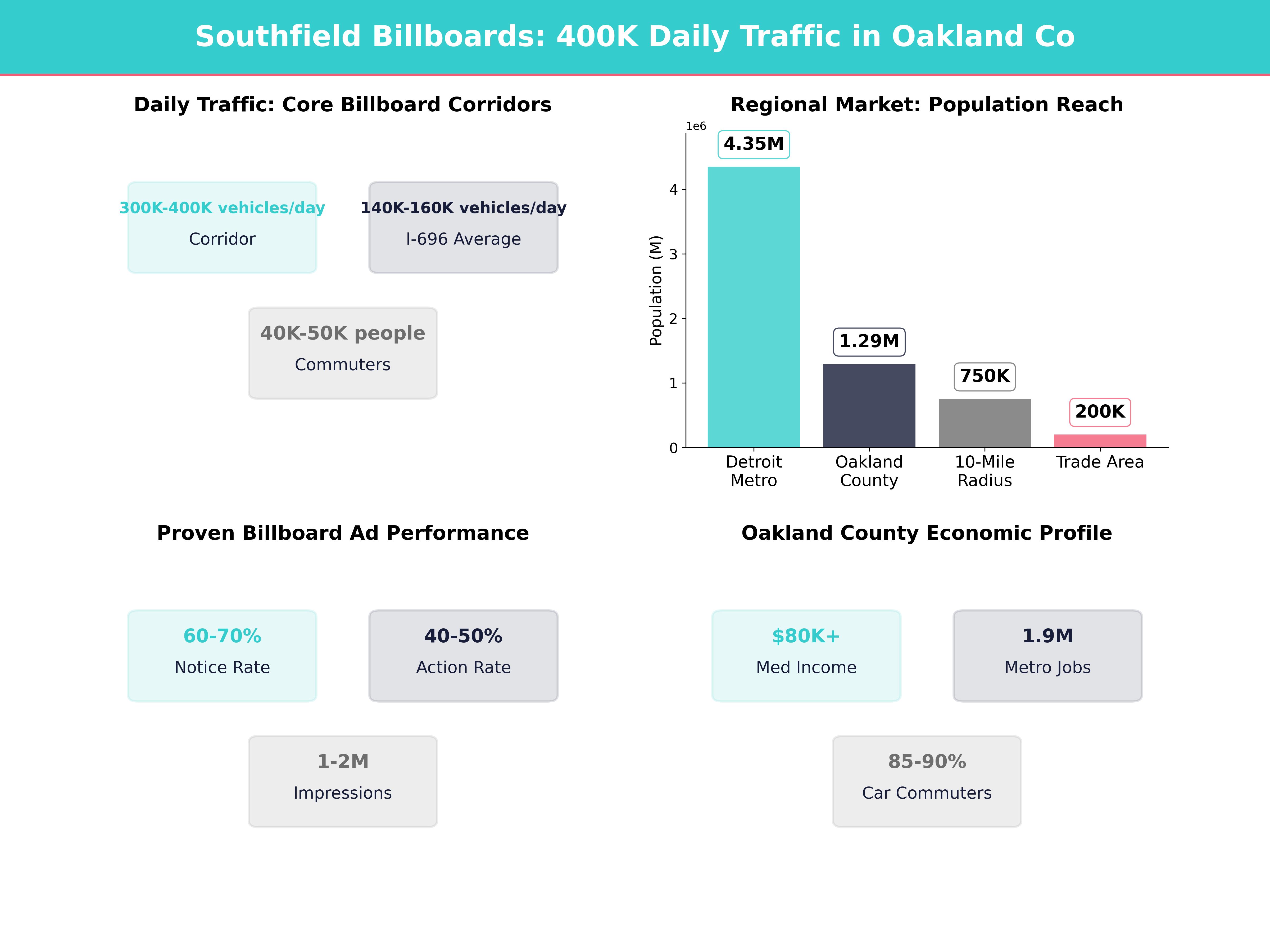
Southfield sits at the center of one of Metro Detroit’s most important business and commuter hubs. With 26 digital billboards serving the Southfield area from nearby cities like Oak Park, Royal Oak, Hazel Park, Madison Heights, Farmington Hills, and Detroit, we can tap into dense daily traffic and a highly diverse, upwardly mobile audience. Industry studies on out-of-home (OOH) media consistently show that digital billboards are noticed by more than 60–70% of drivers in a given week, and over 40–50% report taking some form of action (searching online, visiting a website, or visiting a store) after seeing an OOH ad. This guide walks through how to build a smart, data-driven digital billboard strategy near Southfield using Blip’s flexibility in budgeting, timing, and creative rotation for businesses specifically seeking billboards near Southfield.
Understanding the Southfield Area Market
Southfield is a major employment and commercial center for Oakland County and the broader Metro Detroit region, which is why demand for Southfield billboards has grown steadily for brands looking to reach both commuters and local residents.
- Population: The city of Southfield has roughly 75,000–76,000 residents, while Oakland County as a whole is home to about 1,275,000–1,300,000 people. The broader “south-central Oakland County” area that includes Southfield, Oak Park, Beverly Hills, Lathrup Village, and Farmington Hills pushes the immediate trade area well above 200,000 residents.
- Regional reach: The Detroit metropolitan area totals roughly 4.3–4.4 million residents, and more than 1.9 million jobs, giving campaigns near Southfield the potential to reach both local and regional audiences that travel through the area daily.
- Government and business context: Southfield brands itself as “The Center of It All,” emphasizing its central location and office base. You can see this positioning reflected on the City of Southfield and Oakland County Southfield Downtown Development Authority
Southfield has historically offered over 20–25 million square feet of office space, making it one of Metro Detroit’s largest suburban office markets. The iconic Southfield Town Center complex alone contains over 2.2 million square feet of Class A office space across five towers. Even with hybrid work, the city still attracts tens of thousands of non-resident workers on weekdays. Regional planning data from organizations such as the Southeast Michigan Council of Governments (SEMCOG)
What this means for billboard advertisers near the Southfield area:
- Your audience is larger than just local residents; you’re speaking to a broad mix of commuters from Oakland, Wayne, and Macomb counties. Southfield is within about a 20–25 minute drive of Downtown Detroit, Royal Oak, Farmington Hills, and Novi, creating a wide commuter catchment area that makes billboard advertising near Southfield highly efficient for regional reach.
- B2B and professional-service messages work especially well given the large daytime office population; many office buildings in Southfield report weekday occupancy rates in the 60–75% range, meaning thousands of professionals are still coming in several days per week.
- Creative can lean on “central location” language—e.g., “Your Southfield-area solution for…”—because many viewers see Southfield as a central, neutral meeting point for meetings, medical visits, and shopping.
Demographics and Audience Segments to Target
Southfield’s population profile is distinctive within Metro Detroit and should shape your messaging and creative for Southfield billboards and related digital campaigns.
Core demographic characteristics (city-level, rounded):
-
Racial/Ethnic makeup:
- Roughly 70–75% Black or African American
- Around 18–20% White
- A small but growing share—roughly 5–10% combined—of Middle Eastern/North African, Asian, Hispanic/Latino, and multiracial residents
-
Age:
- Median age is in the low-to-mid 40s (approximately 42–44), several years higher than the U.S. median of around 38.
- Adults 25–64 typically make up about 55–60% of residents, reflecting a strong working-age base.
-
Income:
- Median household income is around $60,000–$65,000.
- Approximately 35–40% of households fall in the $50,000–$100,000 income band, with another 15–20% at $100,000 and above.
- Nearby suburbs that feed into Southfield’s road network—such as Farmington Hills, Birmingham, Beverly Hills, and Royal Oak—report median household incomes commonly in the $80,000–$120,000+ range, giving advertisers access to higher-income consumers who regularly pass through the area.
Education levels in Southfield are also relatively strong: about 30–35% of adults 25+ hold a bachelor’s degree or higher, supporting demand for professional services, financial products, and education offerings. The presence of Lawrence Technological University Oakland Community College and Wayne State University further boosts the student and young professional segment that travels through the area.
Implications for creative:
- Professional and aspirational messaging: With a mature, professional audience and a large share of households above $60,000 in income, emphasize career, stability, education, and financial wellness. Services like banking, insurance, wealth management, continuing education, and B2B solutions are a strong fit.
- Family-oriented appeals: Many Southfield-area households include families and multigenerational homes. In several nearby communities, over 25–30% of households include children under 18. Promoting childcare, healthcare, after-school activities, and home services can resonate with this segment.
- Cultural resonance: Southfield is one of the nation’s larger majority-Black suburbs. Featuring diverse imagery and inclusive language is not just a best practice—it aligns with the lived reality of the community. Campaigns that acknowledge Black-owned businesses, local cultural institutions, or events covered by outlets like the Southfield Sun (C&G Newspapers), Detroit Free Press, The Detroit News, WXYZ Detroit, and FOX 2 Detroit tend to feel noticeably more relevant.
You can further refine your strategy by following local coverage and business news at sources such as Crain’s Detroit Business Southfield Area Chamber of Commerce, and community updates from the City of Southfield to track development projects, neighborhood priorities, and new employers that may drive incremental demand for billboard advertising near Southfield.
Key Roadways and Traffic Patterns Near Southfield
The strength of billboard advertising near the Southfield area lies in its highways and major corridors. Michigan Department of Transportation ( MDOT
-
I‑696 (Reuther Freeway): East–west artery just north of Southfield
- Average Annual Daily Traffic (AADT) near Southfield commonly exceeds 140,000–160,000 vehicles per day on key segments, with some stretches approaching or surpassing 170,000.
- Connects commuters between Farmington Hills, Southfield, Madison Heights, and further east toward Warren and St. Clair Shores, linking multiple major job and retail clusters.
-
M‑10 (John C. Lodge Freeway):
- Runs north–south through the Southfield area.
- Segments near Southfield often carry 100,000–130,000 vehicles per day.
- Main commuter route between the Southfield area and Downtown Detroit, where tens of thousands of workers travel daily to employment centers, courts, hospitals, and entertainment venues.
-
US‑24 (Telegraph Road):
- Major commercial corridor with AADT frequently around 80,000–100,000 vehicles per day in the Southfield area.
- Serves large auto dealerships, medical offices, retail centers, and service businesses, making it especially valuable for “visit today” or “next exit” messages.
-
I‑75 near Madison Heights, Royal Oak, and Hazel Park:
- AADT on many segments surpasses 140,000–160,000 vehicles per day, with certain sections exceeding 170,000.
- Serves a large commuter base traveling between Oakland County and Detroit and plays a key role for weekend shopping and entertainment trips to Royal Oak, Midtown, and Downtown.
In addition, local arterials such as Greenfield Road, Evergreen Road, Northwestern Highway, Lahser Road, and 12 Mile Road carry tens of thousands of vehicles daily, particularly near office clusters and shopping centers. Data from the Road Commission for Oakland County show many of these corridors handling 20,000–40,000 vehicles per day, creating strong opportunities for more localized, neighborhood-focused messaging.
Our 26 digital billboards serving the Southfield area are positioned in nearby cities that intersect with these travel patterns:
- Oak Park (3.1 miles from Southfield)
- Royal Oak (6.7 miles)
- Hazel Park (8.0 miles)
- Madison Heights (8.1 miles)
- Farmington Hills (8.8 miles)
- Detroit (9.7 miles)
Within a roughly 10-mile radius of Southfield, these corridors serve a combined population base of 700,000–800,000 residents plus hundreds of thousands of daily workers and visitors, making them prime locations for businesses searching for billboards near Southfield for maximum exposure.
How to leverage this with Blip:
- Target boards along I‑696 and M‑10 to capture the core Southfield-area commuter stream. A few well-positioned boards on these routes can expose your message to more than 1–2 million impressions per week when traffic volumes and repetition are considered.
- Use boards in Farmington Hills and Royal Oak to reach higher-income and younger professional audiences who commute through or do business near Southfield. Both communities have strong concentrations of residents aged 25–44 and above-average household incomes, making them ideal for premium services and lifestyle brands.
- Tap boards in Detroit to influence workers and visitors heading to or from Downtown and Midtown via the Lodge or I‑75, especially around major event nights at venues like Ford Field, Comerica Park, and Little Caesars Arena, when traffic spikes substantially before and after games and concerts.
Timing Your Blips: When the Southfield Area Is Most Active
Commuter patterns and local routines should guide your ad scheduling. In Metro Detroit, vehicle travel is highly car-centric. Across the region, roughly 85–90% of workers commute by car, truck, or van, and only a small share—often under 5%—rely on transit, walking, or biking. The limited but important bus network operated by SMART and DDOT does not significantly reduce freeway volumes, which remain heavy through much of the day.
Weekday patterns to target:
-
Morning commute (6:30–9:30 a.m.)
- Many major freeways around Southfield see traffic volumes at or near peak capacity during this period, with speed reductions and stop‑and‑go conditions, which actually increases dwell time with your billboard.
-
Strong for:
- Coffee, quick-service restaurants, and breakfast promotions
- Traffic and weather–related services (auto repair, insurance, car wash, roadside assistance)
- B2B and professional services (“Start your workday with…”)
-
Midday (11:00 a.m.–2:00 p.m.)
- Typically 60–75% of peak commuter volume remains on the roads as office workers, students, and retirees make lunch, medical, and errand trips.
-
Ideal for:
- Lunch specials near Southfield office clusters and retail centers like Evergreen Plaza and nearby strip malls
- Health and wellness (medical offices, urgent care, dental, physical therapy)
- Retail reminders (“Stop by after work” messaging)
-
Evening commute (3:30–7:00 p.m.)
- Often the single highest-traffic window, especially on Thursdays and Fridays when outbound commuting and shopping trips overlap.
-
Strong for:
- Family dining and takeout
- After-work fitness, classes, and events
- Home services and big-ticket purchases (furniture, auto, home improvement)
Weekend patterns to consider:
- Saturdays and Sundays feature more discretionary travel for shopping, entertainment, worship, and visiting friends and family. Retail centers in the region often report 20–30% higher foot traffic on Saturdays compared with an average weekday.
-
Focus on:
- Malls and shopping districts (e.g., nearby Twelve Oaks Mall in Novi and Somerset Collection
- Local events and attractions promoted via Visit Detroit and city calendars
- Faith-based services, especially for Sunday morning and midweek evenings, given the high density of churches, mosques, and synagogues in and around Southfield and Oak Park
With Blip, we can schedule ads down to specific hours and days, allowing you to front-load budget into high-impact windows (e.g., weekday rush hours only, or Friday–Sunday retail pushes) rather than spreading spend thinly across all times. This flexibility is especially useful if you’re testing billboard advertising near Southfield for the first time and want to learn which time blocks perform best.
Crafting Effective Creative for the Southfield Area
Strong creative is critical on fast-moving Detroit-area freeways. We recommend the following guidelines tailored to viewers near the Southfield area:
1. Keep it bold and simple
- Use 7–10 words or fewer whenever possible; studies of OOH readability show recall drops sharply beyond about 10–12 words.
- High-contrast color schemes: For instance, white or yellow text on dark backgrounds or dark text on a bright, solid field.
- Consider that vehicles on freeways are often traveling 60–70 mph; at those speeds, drivers typically have 5–7 seconds of visibility for a digital board, so aim for a 1–2 second comprehension time.
2. Localize to the Southfield area
-
Use phrases like:
- “Serving the Southfield area”
- “Minutes from Southfield at Telegraph & [Your Street]”
- “Southfield-area professionals trust [Your Brand]”
- If you’re in a nearby suburb, treat Southfield as a focal point: “Just 8 minutes from Southfield” or “Southfield-area offices, we come to you.”
- You can also reference well-known local landmarks such as the Southfield Town Center skyline, the Northland City Center
3. Speak to the dominant audience segments
-
For the strong professional and office worker base:
- B2B services, co-working, staffing, IT, and financial services.
- Taglines like “Southfield-area businesses choose…” or “Managed IT for Southfield-area offices.”
-
For families and homeowners:
- Emphasize reliability and convenience: “Same-day service in the Southfield area.”
- Highlight offers that fit middle- and upper-middle-income households, such as home upgrades, elective medical or dental services, and youth activities.
-
For culturally diverse audiences:
- Use inclusive imagery; consider acknowledging local cultural events, festivals, and holidays covered by outlets like Metro Times and shared on Visit Detroit.
4. Use motion and rotation wisely
Digital billboards allow for:
-
Multiple creatives in rotation:
- Showcase 2–4 variations: one brand image, one promo, one call-to-action, and one seasonal or event-specific ad.
- Campaigns with 3–4 creative variants often see higher recall than single-image campaigns because of repeated, but varied, exposures.
-
Time-specific content:
- Morning vs. evening variants (e.g., “Visit us before work” vs. “Order tonight for pickup”).
- Weekday vs. weekend messaging aligned to office crowds and leisure travel.
-
Countdowns and urgency:
- “3 days left to save” or “This weekend only near Southfield.”
- Short, time-based campaigns scheduled around major sales, open houses, or local festivals often drive noticeable short-term lifts in web traffic and in-store visits.
Choosing Which Nearby Cities and Boards to Prioritize
Because our 26 digital billboards serving the Southfield area are placed in surrounding cities, we can strategically mix locations to match your goals. Within a typical 15–20 minute drive of Southfield, these communities together represent several hundred thousand residents and tens of thousands of jobs, giving you a flexible footprint for billboard rental near Southfield.
Oak Park (3.1 miles)
- Very close to Southfield; shares many local trips and neighborhood errands. Oak Park’s population is around 29,000–30,000, with a strong mix of families and multigenerational households.
-
Good for:
- Local retail, restaurants, salons, auto services targeting both Southfield and Oak Park residents.
- Faith-based organizations and community programs; Oak Park and bordering neighborhoods have a high concentration of religious institutions, many of which draw attendees from multiple nearby cities.
- You can monitor community news and development in the area via Oak Park’s city website and local reporting from C&G Newspapers.
Farmington Hills (8.8 miles)
- Higher-income residential base and major employment center; median household income typically exceeds $90,000, and the population is around 80,000–82,000.
-
Ideal for:
- Medical, dental, and professional services drawing patients/clients from the Southfield area.
- Private schools, tutoring, and higher-end retail, especially for families with school-age children and college-bound teens.
- Farmington Hills’ business and community resources, highlighted by the City of Farmington Hills, reinforce its role as a key source of affluent commuters who regularly pass near Southfield.
Royal Oak & Madison Heights (6.7–8.1 miles)
- Royal Oak is a nightlife and dining hub with a population of roughly 58,000–60,000, a strong presence of adults aged 25–44, and a vibrant downtown.
- Madison Heights is a strong retail and light industrial corridor along I‑75 with around 28,000–30,000 residents and a large daytime worker population.
-
Use these boards to:
- Capture younger professionals who work or pass through the Southfield area and tend to go out for dining, bars, and entertainment in Royal Oak.
- Promote restaurants, bars, entertainment, and service businesses that see cross-traffic between Royal Oak and the Southfield area.
- Reach industrial and logistics decision-makers in Madison Heights’ industrial parks with B2B or workforce recruitment messaging.
- City resources such as Royal Oak’s official site and Madison Heights provide event calendars and development updates that can inspire time-sensitive creative.
Hazel Park & Detroit (8.0–9.7 miles)
- Hazel Park, with about 15,000–16,000 residents, sits directly on I‑75, making it an efficient location to reach north–south commuters.
- Detroit, with a population just under 640,000, anchors the regional economy. Downtown and Midtown host major employers, hospitals, universities, and sports venues that attract hundreds of thousands of workers and visitors weekly.
-
Hazel Park and Detroit boards allow you to:
- Reach commuters who live in Detroit or closer to the city but work in the Southfield area.
- Promote events, cultural experiences, and sports tied to venues in Detroit while still touching the Southfield-area audience.
- Connect with city-focused audiences who frequently use the Lodge, I‑75, and the Davison Freeway to access Southfield and its office parks.
- For event-driven campaigns, keep an eye on the City of Detroit calendar, Visit Detroit’s events listings, and venue schedules via 313 Presents.
With Blip’s location tools, you can select only the boards that align with your target corridors, test performance by cluster (e.g., “Farmington Hills + I‑696 corridor” vs. “Detroit + M‑10 corridor”), and then shift budget toward the best-performing set. This level of control makes billboard rental near Southfield accessible for both small and large advertisers.
Budgeting and Scaling with Blip in the Southfield Area
Blip’s pay-per-“blip” model lets you start small and scale up as you see results. Because each “blip” can be as short as 7.5–10 seconds on most digital boards, even a modest budget can generate hundreds or thousands of impressions per day, depending on bid levels and competition.
- Set a daily budget as low as a few dollars (e.g., $5–$10) to begin testing messaging.
- Adjust your bid-per-blip to increase or decrease how often your ad shows relative to other advertisers; higher bids generally secure more showings during high-demand times such as weekday rush hours.
-
Concentrate spending on:
- Morning + evening drive times on weekdays, when combined traffic on I‑696, M‑10, and Telegraph can exceed 300,000–400,000 vehicles per day.
- Specific days for sales or events (e.g., weekend festivals, grand openings, or game days in Detroit), when visitor volumes near venues and shopping areas can spike 20–50% above typical levels.
As you gain confidence with billboard advertising near Southfield, you can gradually expand your schedule, add more boards, and test additional creative angles without committing to long-term static placements.
Sample strategies:
-
Local service provider pilot (e.g., HVAC or roofing)
- Budget: $15–$30/day
- Time: 6 a.m.–9 a.m. and 3:30 p.m.–7 p.m., weekdays only
- Boards: Focus on Oak Park, Farmington Hills, and key freeway boards that commuters from the Southfield area use.
- Frequency goal: Aim for enough blips to reach the same commuter multiple times per week (e.g., 3–7 exposures), which OOH research indicates significantly improves ad recall.
- Messaging: “Same-day service in the Southfield area – Call [Number].”
-
Regional retailer or medical practice
- Budget: $50–$100/day
- Time: 9 a.m.–7 p.m., 7 days a week
- Boards: Blend of Farmington Hills, Royal Oak, Madison Heights, and Detroit to reach a wide radius of potential patients or customers traveling near Southfield.
- Messaging: Rotating creatives for awareness (“Now seeing new patients near Southfield”), promotions (“Free consultation this month”), and directions (“Off I‑696 at [Exit]”).
-
Event-based or seasonal push (e.g., back-to-school, open enrollment, holiday sales)
- Budget: $30–$75/day for 2–4 weeks around the key dates
- Time: Mix of commute hours plus weekend daytime
- Boards: Emphasize corridors feeding the event location (e.g., M‑10 and I‑75 for Downtown Detroit events; I‑696 and Telegraph for Southfield-area events).
- Messaging: Date-specific calls-to-action and countdowns (“Enroll by Nov 15,” “Festival this Saturday in Southfield – Free admission”).
Using Events and Seasonality to Your Advantage
The Southfield area and Metro Detroit see clear seasonal and event-driven patterns that can boost campaign effectiveness.
Seasonal hooks:
-
Winter (Dec–Feb):
- Snow and ice conditions often contribute to spikes in collision and roadside assistance calls. Auto service, tires, insurance, and towing can benefit from visibility on high-traffic routes like I‑696 and M‑10.
- Indoor entertainment, fitness, and healthcare become top-of-mind as average temperatures drop below freezing for extended periods.
-
Spring (Mar–May):
- Home improvement, landscaping, roofing, and real estate marketing becomes more active; many local contractors report that 30–40% of their annual leads begin in spring.
- Tax preparation and financial planning services see peak demand leading up to tax filing deadlines.
-
Summer (Jun–Aug):
- Festivals, concerts, and outdoor dining heavily promoted by Visit Detroit and communities across Oakland and Wayne counties draw tens of thousands of visitors to parks, downtowns, and waterfronts.
- Youth camps, sports leagues, and back-to-school previews are strong fits; many families make enrollment and purchase decisions 4–8 weeks before school resumes.
-
Fall (Sep–Nov):
- Back-to-school and college enrollment (Southfield is near several colleges and universities, including Lawrence Technological University University of Detroit Mercy) drive decisions on tutoring, technology, and extracurriculars.
- Holiday shopping, end-of-year sales, and healthcare open enrollment. Health insurers and medical practices often see elevated engagement when they run OOH alongside digital campaigns during this period.
Local events:
Monitor:
- The City of Southfield events calendar
- Oakland County tourism and event listings on Oakland County Royal Oak and Farmington Hills
- Regional events via Visit Detroit and coverage from local outlets like WXYZ Detroit and ClickOnDetroit / Local 4.
Then, align creative and timing:
- “Welcome Southfield-area festival visitors!” or “After the game, stop at…”
- Short-term Blip campaigns that run only in the week leading into a major event, when interest peaks.
- Dayparting around event times (e.g., mid-afternoon to late night for concerts and sports; mornings for road races and community fairs).
Measuring Impact and Optimizing Over Time
While billboards don’t provide click-through data, we can still build a disciplined, performance-focused approach.
1. Use trackable calls-to-action
- Dedicated URLs (e.g.,
/southfield), landing pages, or QR codes on creatives. Even if only a small percentage of viewers scan or visit (often 1–3 per 1,000 impressions), you gain measurable engagement data. - Unique phone numbers or extensions that can be tracked through call analytics.
- Promo codes such as “SOUTHFIELD20” that you can monitor in your POS or CRM system.
2. Watch geography in your analytics
- Monitor traffic from zip codes and cities that correspond to Southfield-area commuters (e.g., 48033, 48034, 48075, adjacent zips in Oak Park, Beverly Hills, and Farmington Hills).
- Compare baseline metrics (web traffic, store visits, calls, form fills) for 2–4 weeks before your campaign to the same metrics during and after your campaign.
- Use tools like Google Analytics’ city and zip code reports, and ask customers, “How did you hear about us?” to cross-check billboard impact.
3. Split-test creatives and time windows
- Run two different messages at the same time on similar boards (e.g., one price-focused, one brand-focused) and watch which correlates with better results in calls, web visits, or coupon redemptions.
-
Experiment with:
- Weekday-only vs. full week.
- Rush-hour-only vs. all-day exposure.
- Board clusters (e.g., “I‑696 corridor” vs. “I‑75 corridor”) to see which side of the region responds best.
- Over time, shift 60–80% of your budget toward the combinations that generate the clearest lift, while reserving 20–40% for ongoing testing.
With Blip, it’s easy to update creatives and adjust your schedule in near-real time, allowing you to incrementally improve your campaign based on what your data shows and what you observe from local market trends reported by sources like Crain’s Detroit Business Detroit Regional Chamber
Who Can Win with Billboards Near the Southfield Area?
A wide range of businesses can succeed with digital billboards serving the Southfield area and surrounding suburbs:
- Professional and B2B services (law firms, accounting, IT, staffing, consulting), especially those serving the 20–25 million square feet of office space around Southfield and nearby corridors.
- Medical and wellness providers (urgent care, specialists, dental, mental health) who benefit from being top-of-mind along commuter routes leading to clinics, hospitals, and medical office buildings.
- Education and training (colleges, trade schools, tutoring centers) that can reach thousands of daily commuters passing institutions such as Lawrence Technological University Oakland Community College, and schools across Oakland and Wayne counties.
- Home services (HVAC, roofing, renovation, landscaping, plumbing, cleaning), especially in spring and summer when service volumes spike and households are more likely to act on outdoor advertising.
- Automotive (dealerships, repair, collision, car wash) positioned along key corridors like Telegraph and I‑696, where high traffic volumes and weather-related needs keep demand steady.
- Retail, food, and entertainment (restaurants, shopping centers, gyms, cinemas, local attractions) that can use billboards to intercept shoppers heading to destinations like Twelve Oaks Mall, Somerset Collection
- Nonprofits and faith-based organizations (events, fundraisers, community programs) that rely on regional visitors and attendees from multiple cities.
By understanding Southfield’s role as a central business hub, its diverse and predominantly Black population, its strong commuter flows on I‑696, M‑10, I‑75, and Telegraph, and the daily rhythms of its residents and workers, we can design digital billboard campaigns that reach the right people, at the right time, with messages that resonate. Whether you are exploring your first Southfield billboards or expanding an existing multi-city campaign, the same principles of targeting, timing, and measurement apply.
Blip’s flexibility in choosing specific boards near Southfield, controlling your budget, and quickly refreshing creatives makes it possible to start small, learn quickly, and scale what works into a powerful, ongoing presence in the Southfield area with billboard advertising near Southfield tailored to your unique goals.