Billboards near Melvindale, MI
No Minimum Spend. No Long-Term Contracts. Just Results.
Trusted by Leading Brands


Billboard advertising
near Melvindale has never been easier




How much is a billboard near Melvindale?
Why Choose Blip for Billboard Advertising near Melvindale
Blip lets you launch Melvindale billboards in minutes and reach I-75/I-94 commuters with a budget you control.
Daypart your Melvindale ads for 5-9 a.m. shifts or 3:30-6:30 p.m. rush hour—perfect for Downriver workers on the move.
No contracts means Melvindale brands can test airport traffic near Romulus and ramp up when DTW flights spike.
Track real-time results in Melvindale, then shift spend toward Allen Park or Detroit corridors that drive more response.
Use Blip's creative tools to make bold, readable Melvindale ads for industrial workers, families, and freeway drivers.
Frequently Asked Questions About Billboard Advertising near Melvindale
How much does a billboard cost near Melvindale, Michigan with Blip?
With Blip, you control exactly how much you spend to reach drivers on Melvindale billboards. You set a daily budget that fits your goals, and Blip automatically keeps your campaign within that amount, showing your message in short blips of 7.5 to 10 seconds on digital billboards near Melvindale, Michigan. Each blip is individually priced based on when and where it runs and on real-time advertiser demand, so you only pay for the exposure you actually receive.
Where can I advertise with Blip near Melvindale, Michigan?
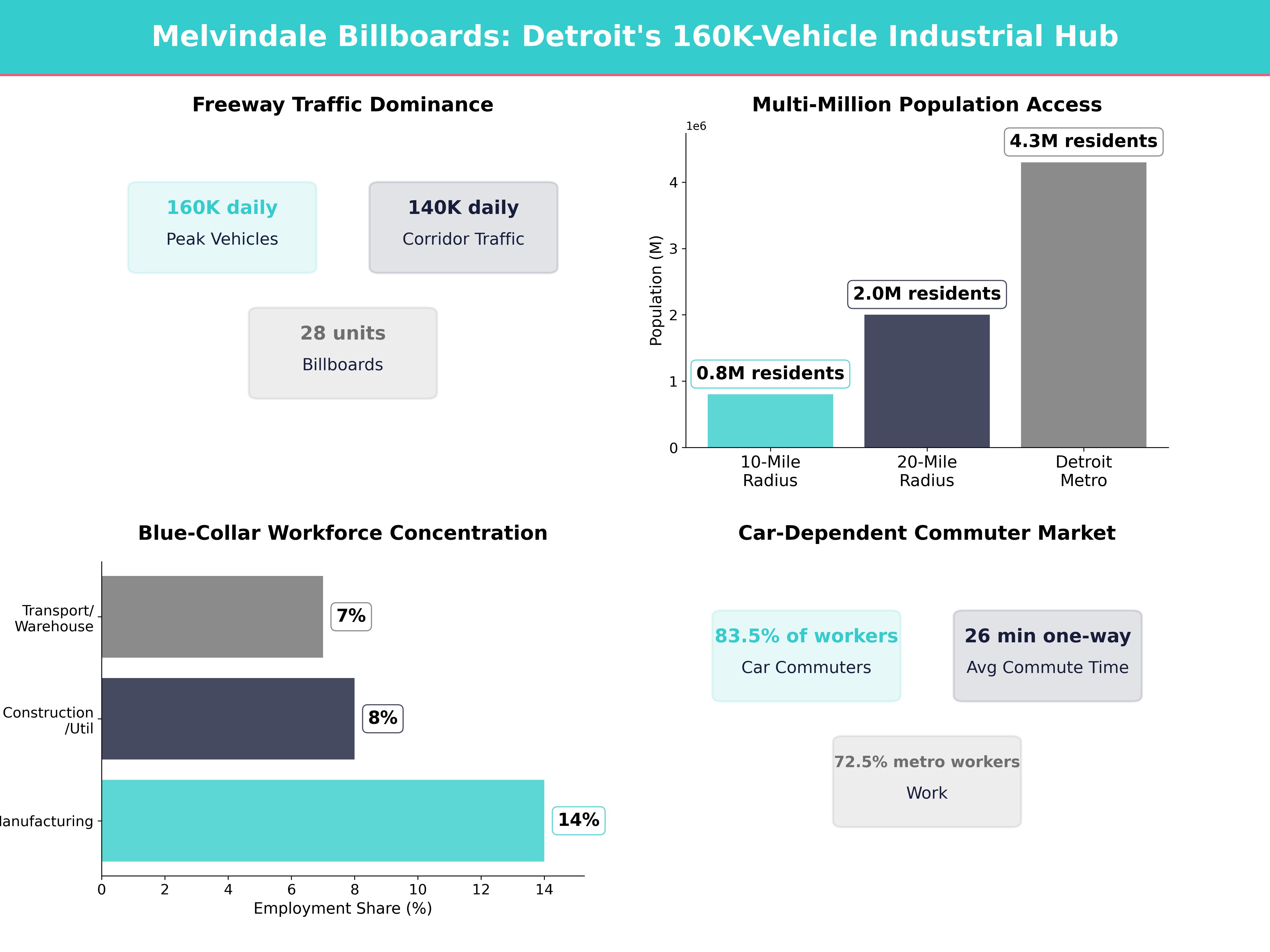
Our 28 digital billboards serving the Melvindale area are concentrated in three nearby hubs: Allen Park, Detroit, and Romulus. These locations intersect with some of Michigan’s busiest roadways, where multiple segments carry 100,000–150,000+ vehicles per day according to the Michigan Department of Transportation. For advertisers looking for billboards near Melvindale specifically, these nearby placements function as highly efficient extensions of the city’s main commuter routes.
What kind of audience do Melvindale billboards reach?
Melvindale sits at the heart of Detroit’s Downriver industrial and commuter corridor, making the Melvindale area a high-value zone for reaching blue-collar workers, families, and daily freeway commuters. In the broader Detroit–Wayne County area, roughly 13–15% of workers are employed in manufacturing, about 6–8% in transportation and warehousing, and another 7–9% in construction and utilities. The local median age is in the mid-30s, and nearby households often include children, which makes the area especially useful for family-oriented and value-driven campaigns.
When is the best time to run billboards near Melvindale, Michigan with Blip?
Timing strategy is crucial because commuter peaks can concentrate 30–40% of daily freeway traffic into just 4–6 hours each weekday. Typical weekday patterns show a morning peak around 6:30–9:00 a.m. and an evening peak around 3:30–6:30 p.m. With Blip, you can schedule ads by time of day, day of week, and even around specific events.
What roads around Melvindale get the most billboard traffic?
I‑75 and I‑94 near Allen Park and Detroit are major corridors for reaching Melvindale area commuters. I‑75 commonly shows average annual daily traffic of 120,000–150,000 vehicles per day, while I‑94 near Detroit, Allen Park, and Romulus frequently ranges from 100,000 to 140,000 vehicles per day. Local arterials like M‑39/Southfield Freeway and US‑24/Telegraph Road also carry strong daily traffic and are effective for neighborhood-focused promotions.
Do I need a contract to advertise with Blip near Melvindale?
No, Blip has no long-term contracts or minimum commitments. You can start, pause, or stop your campaign at any time.
How fast can I launch a billboard campaign with Blip near Melvindale?
You can have your campaign live in minutes. Create a free account, select your locations, set your budget, upload your design, and start running once approved.
Where can I advertise with Blip near Melvindale?
Blip has digital billboards near Melvindale. You can browse available locations on a map, choose the ones that fit your audience, and start advertising right away.
Still have questions? Launch a campaign in minutes — no contracts, no commitments.
Start Your CampaignMelvindale Billboard Advertising Guide
Melvindale sits at the heart of Detroit’s Downriver industrial and commuter corridor, making the Melvindale area a high-value zone for reaching blue-collar workers, families, and daily freeway commuters. With 28 digital billboards serving the Melvindale area from Allen Park, Detroit, and Romulus, we can help you place your brand directly along the routes your audience actually drives every day, capturing tens of thousands of impressions per board per day along the region’s highest-volume freeways. For advertisers looking for billboards near Melvindale specifically, these nearby placements function as highly efficient extensions of the city’s main commuter routes.
Understanding the Melvindale Area Market
Melvindale is a compact but strategically located city in Wayne County. According to 2020 data, Melvindale’s population is about 12,800, within a county of roughly 1.75 million residents and a Detroit metro region of over 4.3 million people. Within a 10‑mile radius of Melvindale, you tap into more than 800,000 residents; within 20 miles, that climbs to well over 2 million. That means campaigns near Melvindale can be hyper-local while still tapping into a massive regional flow of traffic and spending power, making Melvindale billboards a smart play for both small businesses and regional brands.
For additional community and demographic context, you can review the City of Melvindale, Wayne County, and City of Detroit websites.
Key local context:
-
Working-class and industrial heritage
The Melvindale area sits just south of Detroit’s historic industrial core. Nearby facilities include the Ford Rouge Complex Dearborn, the Marathon petroleum refinery in southwest Detroit, and numerous logistics, warehousing, and manufacturing operations throughout Downriver. In the broader Detroit–Wayne County area, roughly 13–15% of workers are employed in manufacturing, about 6–8% in transportation and warehousing, and another 7–9% in construction and utilities, giving you a dense concentration of blue-collar and skilled-trades audiences. Shifts at these facilities often run 24/7, which means billboard exposure is not limited to traditional 9–5 commuters. -
Income and value sensitivity
Median household income in Melvindale is around the mid‑$40,000s to low‑$50,000s, slightly below the Wayne County median (about $54,000–$56,000) and below the overall Detroit metro median (roughly $63,000–$66,000). Around 20–25% of households in similar Downriver communities have incomes under $35,000, while a sizable segment in the $50,000–$75,000 range is highly responsive to clear value propositions. This suggests that value-driven messaging (price, savings, reliability, “made local”) resonates strongly, especially for consumer services, automotive, home improvement, and retail when delivered through billboard advertising near Melvindale and along nearby freeways. -
Younger, family-oriented demographics
The median age near Melvindale is in the mid‑30s, younger than the U.S. median of about 38–39. In nearby Downriver and southwest Detroit neighborhoods, 30–35% of households include children under 18, and in some census tracts around Melvindale that can reach 40%+. This makes billboards particularly effective for:- Family attractions and entertainment
- K–12 and trade/technical education
- Healthcare (pediatrics, urgent care, dental)
- Youth sports, camps, and after-school programs
The local school district, Melvindale-Northern Allen Park Schools Allen Park Public Schools and Dearborn Public Schools.
-
Heavy commuter patterns
In Wayne County, about 82–85% of workers commute by car, truck, or van, and only around 3–4% use public transit. Average one-way commute times are roughly 25–27 minutes, with many Melvindale area residents traveling north into Detroit, west toward the airport corridor in Romulus, or east/west along I‑94 and I‑75. More than 60% of workers in the broader Downriver region commute alone in a car, creating very frequent daily exposures along the main freeways. Your billboard campaign benefits from this high-frequency exposure among habitual drivers, especially when you focus your billboard advertising near Melvindale’s heaviest travel corridors.
To ground your campaign in local realities, review resources such as the City of Melvindale, Wayne County, and regional tourism site Visit Detroit. These can inform your tone, imagery, and seasonal tie-ins, as well as help identify key attractions, neighborhoods, and events that influence traffic patterns around Melvindale billboards.
Key Traffic Corridors and Billboard Placement Strategy
Our 28 digital billboards serving the Melvindale area are concentrated in three nearby hubs: Allen Park (about 3.1 miles away), Detroit (about 5.8 miles away), and Romulus (about 8.3 miles away). These locations intersect with some of Michigan’s busiest roadways, where multiple segments carry 100,000–150,000+ vehicles per day according to the Michigan Department of Transportation (MDOT)
1. I‑75 and I‑94 Near Allen Park and Detroit
- I‑75 (Fisher Freeway) runs north–south just east of Melvindale. MDOT traffic counts near the Downriver/Detroit stretch commonly show average annual daily traffic (AADT) of 120,000–150,000 vehicles per day, with certain segments near the I‑94 and I‑96 interchanges occasionally exceeding 160,000 vehicles.
- I‑94 runs east–west a short drive north of Melvindale, connecting Detroit to the airport and western suburbs. AADT volumes near Detroit, Allen Park, and Romulus frequently range from 100,000 to 140,000 vehicles per day, with peak hours accounting for 8–10% of that daily total in just a couple of hours.
When you multiply these volumes by Blip’s 8–10 second ad slots and typical rotation frequencies, individual boards can generate tens of thousands of impressions per day and hundreds of thousands per week for campaigns with sufficient share of voice.
Strategic implications:
- Place impressions along I‑75 and I‑94 near Allen Park and Detroit to capture Melvindale area commuters both ways—heading into Detroit in the morning and heading back through the Downriver area in the evening. This approach ensures your billboards near Melvindale stay in front of drivers during their full commute cycle.
- These corridors are ideal for regional brands, healthcare systems, auto dealers, and recruitment ads that benefit from sheer traffic volume and broad reach.
- Because roughly 70–75% of metro Detroit workers travel across city or suburb boundaries for work, boards on these freeways reach not only Melvindale residents but also large numbers of commuters from Dearborn, Lincoln Park, Allen Park, Taylor, and southwest Detroit.
For more detail on current traffic volumes and construction schedules that can affect visibility, consult MDOT’s traffic resources and construction map via Michigan.gov/MDOT
2. Airport Corridor Near Romulus
Romulus is home to Detroit Metropolitan Wayne County Airport (DTW), one of the busiest hubs in the Midwest. In recent years, DTW has handled on the order of 30–35 million passengers annually (with 2023 totals publicly reported at just over 32 million passengers, including arrivals and departures). The airport also supports more than 18,000–20,000 on-site jobs and thousands more in the surrounding hotel, parking, and logistics sectors.
Our digital billboards near Romulus allow you to:
- Reach airport employees and logistics workers commuting daily on I‑94 and local arterials like Merriman, Middlebelt, and Wick Roads, which can each carry 20,000–40,000 vehicles per day near the airport area.
-
Target inbound and outbound travelers, especially for:
- Parking, hotels, and airport shuttles
- Attractions in Detroit and Downriver
- Car rentals, rideshare, and transit services
With Blip, you can daypart and budget specifically for flight-peak times—early mornings and late afternoons—when airport-related traffic intensifies and arrival/departure banks push hourly passenger volumes into the thousands per terminal. Combined with boards closer to the Downriver corridor, this gives you continuous billboard advertising near Melvindale-connected travel patterns, from neighborhood streets to airport access roads.
For additional context on airport traffic and development, explore City of Romulus and Wayne County Airport Authority
3. Local Arterials and Retail Corridors
In Allen Park and Detroit, several state routes and local arterials (e.g., M‑39/Southfield Freeway, US‑24/Telegraph Road, and major commercial streets like Allen Road and Fort Street) carry strong daily traffic. MDOT counts on key segments of M‑39 near the Downriver region often show 60,000–80,000+ vehicles per day, while major commercial roads frequently range between 18,000 and 35,000 vehicles per day.
These corridors are effective for:
- Local retailers, restaurants, and service businesses appealing directly to Melvindale area residents running errands.
- QSR (quick-service restaurant) and convenience stores—use “Next Exit” or “2 miles ahead in Allen Park” messaging to intercept hungry or time-pressed drivers.
- High-frequency campaigns where you want repeated exposure to the same local audience; on a road with 25,000 vehicles per day, a well-placed board can generate 175,000+ weekly vehicle contacts.
Local municipal sites such as the City of Allen Park and City of Lincoln Park can help you understand where shopping districts, civic facilities, and special events cluster along these corridors, which is especially useful when planning billboard rental near Melvindale for neighborhood-focused promotions.
Audience Profiles and Message Strategy
To design impactful creative near the Melvindale area, align your message to the specific audiences traveling these roads. Billboards near Melvindale naturally reach a mix of industrial workers, families, and cross-metro commuters, so tailoring message and timing is essential.
Blue-Collar and Trade Workers
Industrial and logistics employment is a major driver around Melvindale, Allen Park, and southwest Detroit. In Wayne County and adjacent areas, roughly 25–30% of all jobs are in blue-collar or logistics-adjacent sectors (manufacturing, transportation and warehousing, construction, utilities, and related support services). Many commuters work 10–12 hour shifts and rely on cars or trucks to get to job sites, creating strong demand for straightforward billboard advertising near Melvindale that speaks to pay, hours, and benefits.
Messaging tips:
- Emphasize practical benefits: better pay, overtime, tools, durability, fuel savings, or convenience. Job postings that clearly list pay can increase response rates by 20–30% in many recruitment campaigns.
-
Recruitment ads should use strong, concise hooks:
- “Hiring Welders – $28/hr + Benefits – Apply at [Exit Number]”
- “CDL Drivers Wanted – Home Daily – Call ###‑###‑####”
- Use bold, no-frills visuals: high contrast, easy-to-read fonts, images of real workers or equipment.
- Consider aligning campaigns with large industrial employers’ hiring cycles; for example, auto and logistics sectors often ramp up in late summer and pre‑holiday (Oct–Dec).
Families and Local Residents
For family-oriented campaigns near Melvindale:
- Highlight safety, affordability, and local pride (“Serving Downriver Families Since 1995”). Surveys of Detroit-area consumers consistently show that over 60% prefer to support “local” or “family-owned” businesses when price and quality are comparable.
-
For healthcare or education, lead with one clear value proposition:
- “Same-Day Pediatric Appointments – 5 Minutes from Melvindale”
- “Trade Programs – Graduate in 12 Months – Near I‑75”
- Use imagery that reflects the community: diverse families, school sports, and neighborhood scenes similar to what you’ll see around Melvindale parks and facilities
For additional community programming and resident information, you can consult Melvindale community notices Allen Park Parks & Recreation
Commuters and Regional Shoppers
With 100,000+ vehicles per day passing on nearby I‑75 and I‑94, you’ll reach many people who don’t live in Melvindale but regularly pass through its orbit. In the broader Detroit metro area, about 40–45% of workers commute across county or city lines, reinforcing the region’s cross-boundary shopping and entertainment patterns.
For this broader audience:
- Use exit-based calls to action: “Exit 204 – 3 Minutes Ahead in Allen Park.”
- Promote large-format retail, auto dealers, casinos, and attractions that draw from across metro Detroit.
- Consider brand-building campaigns with consistent exposure along multiple boards, reinforcing name recognition over time. Outdoor industry research frequently shows that adding 3–5 locations along a commuter’s route significantly improves ad recall and increases the likelihood of in-store visits or brand searches.
Local media like the Detroit Free Press, The Detroit News, and ClickOnDetroit (WDIV) can help you understand what issues and stories are currently top-of-mind, informing the tone and themes you showcase on billboards near Melvindale.
Timing Your Campaign with Local Patterns
Digital billboards with Blip allow you to schedule ads by time of day, day of week, and even around specific events. In the Melvindale area, timing strategy is crucial because commuter peaks can concentrate 30–40% of daily freeway traffic into just 4–6 hours each weekday. Smart scheduling is one of the easiest ways to improve ROI on billboard rental near Melvindale without increasing your overall budget.
Daily Commuter Peaks
Typical weekday patterns in the Detroit metro region show:
- Morning peak: ~6:30–9:00 a.m. (often accounting for 15–20% of daily traffic)
- Evening peak: ~3:30–6:30 p.m. (another 15–20% of daily traffic)
We recommend:
- Workforce and recruitment ads: Concentrate on early morning (5:30–9:00 a.m.) and late afternoon (3:00–7:00 p.m.) when workers are heading to and from industrial facilities and distribution centers. For shift-based industries that start at 6:00 a.m. or 7:00 a.m., you may want heavier exposure in the 5:00–7:00 a.m. window.
- Drive-time retail and food service: Emphasize late afternoon and early evening (4:00–7:30 p.m.) for “Tonight Only” deals, dinner offers, and after-work services.
Airport and Weekend Travel
Airport traffic near Romulus often spikes:
- Early morning (5:00–8:00 a.m.)
- Late afternoon and early evening (3:00–7:00 p.m.)
These peaks align with major flight banks, when terminal curbside traffic and freeway ingress/egress volumes can jump 20–30% above mid-day lulls. Weekends and holidays see increased leisure and family travel; during busy periods such as summer vacation and Thanksgiving/Christmas, DTW may process 90,000–100,000+ passengers per day.
Use these windows to:
- Promote weekend events, entertainment, and sports in the Detroit and Downriver area.
- Highlight short-stay hotels, attractions, and shopping to travelers heading to or from DTW.
- Run parking, rental car, and rideshare offers that emphasize time savings and proximity (“3 Minutes from DTW – Save 20% on Parking”).
Check local events calendars via Visit Detroit and regional news outlets like The News-Herald (a key Downriver paper) and Metro Times to sync your flight schedules with festivals, concerts, and community events that cause localized traffic surges and increase the value of billboard advertising near Melvindale and the airport corridor.
Seasonal Cycles
Seasonality heavily affects behavior near Melvindale and metro Detroit:
-
Winter (Dec–Feb):
- Short daylight hours mean more night-time impressions; sunset can be as early as 4:50 p.m. in December. Use high contrast, large fonts, and minimal detail for readability in dark and snowy conditions.
- Push auto repair, tires, heating/utility services, and winter retail promotions. Michigan crash data shows that over 20% of weather-related accidents occur in winter months, making safety and maintenance messages especially timely.
-
Spring (Mar–May):
- Strong period for home improvement, landscaping, tax prep, and graduation-related services. Home-improvement and garden spending typically spikes 20–30% above winter levels in the Great Lakes region during this season.
- Consider campaigns leading up to April 15 for tax services.
-
Summer (Jun–Aug):
- Traffic to attractions, parks, and events rises. Regional tourism agencies report that summer can account for 35–40% of annual leisure travel in Michigan.
- Great for outdoor recreation, ice cream and QSR, summer sales, and local festivals. Downriver events and Detroit riverfront festivals regularly draw thousands of attendees per weekend.
-
Fall (Sep–Nov):
- Back-to-school and sports seasons; promote schools, tutoring, youth leagues, and weekend entertainment.
- Retailers often launch pre-holiday promotions in late October and November, when consumer spending starts to ramp up toward Black Friday and the holiday season.
With Blip, you can ramp up spending during your high-impact seasons and scale back (without cancelation penalties) when demand or budgets are lower, allowing you to mirror seasonal revenue patterns and get more from your billboard rental near Melvindale and the surrounding communities.
Creative Best Practices for the Melvindale Area
To make the most of heavy freeway and arterial traffic near Melvindale, your creative must be clear, bold, and locally relevant.
Keep It Simple and Legible
At freeway speeds (60–70 mph), drivers only have 3–6 seconds to view your message. Outdoor industry research indicates that keeping text to 7 words or fewer and limiting design clutter can improve message retention by up to 30–40%.
Follow these guidelines:
- 7 words or fewer of primary text.
- One main visual (photo or icon) and one clear logo.
- Font height that’s easily readable at a distance (at least ~18–24 inches in physical size; your designer or Blip’s specs can translate that into pixels).
- Strong contrast: light text on dark background or vice versa.
- Avoid paragraphs, fine print, or more than one phone number or web address; simpler contact points see higher recall.
Add Local Cues
People in the Melvindale area respond when they feel a message is “for them”:
-
Reference nearby landmarks or identifiers:
- “Minutes from the Ford Rouge Complex”
- “Downriver’s Choice for Auto Repair”
- “Near Southfield Freeway – M‑39 Exit”
- Use “Near Melvindale,” “Serving the Melvindale Area,” or “Downriver Location – Exit XX” to communicate proximity clearly and compliantly. These small touches help turn generic creative into targeted billboard advertising near Melvindale that feels locally relevant.
- Feature regional imagery: Detroit skyline, industrial riverfront, local sports fandom (Lions, Tigers, Red Wings, Pistons) when appropriate. Detroit’s pro teams have fan bases in which 70%+ of metro residents report following at least one team, making sports themes highly relatable.
Align to Commute Direction
When your creative is placed:
- Inbound toward Detroit: Emphasize morning needs (coffee, gas, quick breakfast, job applications, news apps, safety checks).
- Outbound toward Melvindale/Downriver: Emphasize evening needs (dinner, groceries, family activities, classes, healthcare, auto repair).
Blip’s placement data and map view help you see where each board is located relative to traffic flow in the Melvindale area. Combining that with live traffic information from sources like MDOT and local news outlets (such as Fox 2 Detroit) can help you fine-tune which creatives run at which times and directions.
Using Blip Tools to Target Efficiently
Blip’s platform lets us tailor your campaign near Melvindale in ways that traditional static boards can’t, giving you more control over how and when you buy billboard rental near Melvindale and neighboring hubs.
Micro-Budget, High-Flexibility Buying
- Set a daily or total campaign budget as low as a few dollars per day; some advertisers start at $10–20 per day and scale up after seeing results.
- Pay per “blip” (each ad display), which typically lasts 8–10 seconds.
- Scale up during critical weeks (product launches, hiring pushes, special sales) and ramp down or pause instantly when your goals are met. This is especially useful for short-term promotions tied to weekend events, tax deadlines, or seasonal storms.
Geographic and Screen-Level Targeting
With 28 digital billboards serving the Melvindale area:
- You can choose panels clustered near Allen Park, close to key Detroit corridors, or around the airport and Romulus based on your audience.
-
For example:
- A Downriver contractor may focus on Allen Park + southwest Detroit screens to saturate daily commuters near job sites, potentially reaching 50,000–100,000+ daily vehicles within a tight footprint.
- A hotel or parking service may allocate most impressions to Romulus/airport-adjacent boards, prioritizing air travelers and airport workers.
- A regional healthcare system may spread impressions across all three hubs to build system-wide awareness across hundreds of thousands of weekly vehicle contacts.
This level of control makes it easy to scale and shift your billboard advertising near Melvindale as your priorities change.
Dayparting and Day-of-Week Control
- Target weekday rush hours for commuter-focused messages and recruitment.
- Emphasize weekends for events, attractions, and retail when leisure travel and shopping trips peak.
- Run overnight for cost-efficient branding if you serve night-shift workers at nearby factories and warehouses. A notable share of industrial and logistics operations run 2nd and 3rd shifts, so late-night/early-morning impressions can still be highly valuable.
Local Campaign Ideas for the Melvindale Area
Below are concrete concepts you can adapt for campaigns near Melvindale.
1. Skilled Trades Recruitment
Audience: Industrial workers commuting to facilities near Melvindale
- Target boards on I‑75 and I‑94 serving the Melvindale area and nearby arterials heading toward Downriver plants.
- Run 5–9 a.m. and 3–7 p.m., Mon–Sat, covering typical start and end times for 1st and 2nd shifts.
-
Creative examples:
- “Electricians: $35/hr + Union Benefits – Apply 2 Miles Ahead in Allen Park”
- “Now Hiring at Our Romulus Warehouse – Text JOB to 55555”
- In metro areas with similar labor markets, clear wage-based recruitment billboards have been observed to increase inbound applications by 15–25% compared to digital-only job postings.
2. Auto Repair and Tire Shops
Audience: Everyday drivers in the Melvindale area
- Focus on Allen Park and Detroit boards along commuter routes where tens of thousands of vehicles pass daily, ensuring your billboards near Melvindale appear on the routes people already use.
-
Emphasize urgency and convenience:
- “Check Engine Light On? Exit XX – Melvindale Area’s Trusted Shop”
- “Tires Installed Today – 5 Minutes from Melvindale”
- Increase frequency during winter and early spring, when potholes and weather-related damage are common; Michigan roadway conditions in late winter can spike demand for tires and alignment services by 20–40% over summer baselines.
- Link messaging to nearby cross streets or landmarks to reassure drivers they won’t have to detour far from their route.
3. Healthcare and Urgent Care
Audience: Families and workers who want quick access to care
- Target boards near both Melvindale-bound and Detroit-bound traffic.
-
Creative examples:
- “Urgent Care, Open 7 Days – Near Melvindale – Walk In Today”
- “New Patients Welcome – Family Dental – Evening Appointments Available”
- Emphasize short wait times, walk-in access, and insurance acceptance—all key drivers for healthcare choices in surveys where over 60% of patients rank convenience as a top factor.
- Consider seasonal rotations: flu shots and urgent care in fall/winter, sports physicals and camp physicals in late spring/summer.
4. Local Restaurants and QSR
Audience: Lunch and dinner traffic, especially commuters
- Daypart around 11 a.m.–2 p.m. for lunch, 4–7 p.m. for dinner; these windows typically capture 60–70% of daily restaurant visits.
-
Highlight limited-time deals and proximity:
- “2-for-$6 Sandwiches – Exit XX in Allen Park – Today Only”
- “Kids Eat Free Tuesdays – Near Melvindale High School Area”
- Rotate multiple creatives through Blip to promote different menu items or daily specials. Advertisers that rotate 3–5 offers over a month often see higher engagement than those running a single static message.
- Pair billboard flights with digital coupons or loyalty programs and track redemptions by location to measure which routes perform best.
5. Education and Training Programs
Audience: Young adults and mid-career workers
-
Emphasize fast completion and job outcomes:
- “Become a Diesel Tech in 12 Months – Train Near the Melvindale Area”
- “Evening Classes for Working Adults – Enroll by Sept 1”
- Run heavier late summer and early fall, with a lighter presence year-round for brand recall. Post-secondary programs commonly see application spikes of 20–30% during July–September.
- Use exit-based directions to nearby campuses or training centers, and consider linking to local institutions highlighted by regional education resources via Michigan.gov
Measuring Success and Iterating
Effective digital billboard campaigns near Melvindale combine strategic placement with continuous measurement.
Trackable Calls to Action
- Use unique URLs, QR codes (for slower roads or arterials), or promo codes tied to different creatives or corridors.
-
Example:
YourBrand.com/Melvindalevs.YourBrand.com/Airportto see which corridor drives more traffic or sign-ups.
- In many campaigns, adding a unique landing page or promo code makes it 30–50% easier to attribute conversions directly to outdoor impressions.
Correlate with Web and Store Data
- Watch for spikes in direct traffic, branded search volume, or store visits after launching or increasing your Blip campaign. Many advertisers observe noticeable lifts within 1–3 weeks of consistent exposure.
-
Tie flight dates to changes in:
- Job applications
- Phone inquiries
- Walk-in visits
- Online quote requests or appointment bookings
- If you have location analytics or footfall tracking in place, compare average weekly visits before vs. after billboard campaigns near key corridors to estimate incremental lift.
Test and Optimize Creative
-
Run A/B tests by:
- Rotating two different headlines.
- Testing price vs. benefit-led messaging.
- Comparing brand-forward vs. offer-forward designs.
- Outdoor advertisers who systematically test and refine creative often see 10–30% improvements in response metrics (web traffic, coupon redemptions, calls) over several iterations.
- Use performance metrics (like web visits or QR scans) along with time-based sales data to find which creative resonates best with the Melvindale area audience. Then, shift more of your Blip budget to the best-performing messages and corridors.
By aligning your message with Melvindale’s commuter patterns, industrial base, and family-focused neighborhoods—and by taking advantage of Blip’s flexible, data-driven tools—you can turn the 28 digital billboards serving the Melvindale area into a powerful, efficient growth engine for your business. Well-planned billboard advertising near Melvindale can deliver hundreds of thousands of relevant impressions every week across Downriver, Detroit, and the airport corridor, giving you sustained visibility where your customers actually drive.