Billboards near Riverview, MI
No Minimum Spend. No Long-Term Contracts. Just Results.
Trusted by Leading Brands


Billboard advertising
near Riverview has never been easier
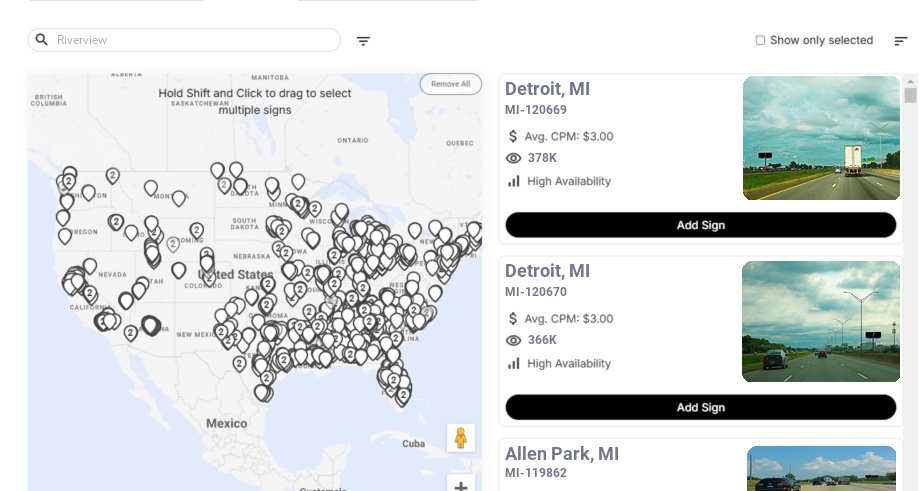



How much is a billboard near Riverview?
Why Choose Blip for Billboard Advertising near Riverview
Blip lets you launch Riverview ads fast and self-serve, reaching I-75 commuters near Allen Park and Romulus without the usual billboard hurdles.
Set a daily budget for Riverview and let Blip stay within it—ideal for testing campaigns on Downriver commuters, airport travelers, and shift workers.
Daypart your Riverview campaign for rush hours or late-night DTW traffic, so your message hits I-94 and Telegraph Road when people are moving.
No contracts mean Riverview brands can pivot with Detroit River summer events, back-to-school season, or winter road conditions as demand changes.
Use Blip's real-time analytics and creative tools to tweak Riverview billboards for families, industrial workers, and airport traffic as results come in.
Frequently Asked Questions About Billboard Advertising near Riverview
How much does a billboard cost near Riverview, Michigan with Blip?
With Blip, you choose your own daily budget for Riverview billboards, and Blip automatically keeps your campaign within that limit, so you’re always in control. Each “blip” is a brief 7.5–10 second ad on rotating digital billboards near Riverview, Michigan, and you only pay for the blips you receive. Pricing is flexible because the cost per blip changes based on when and where you choose to advertise and on advertiser demand, making it easy to start small and scale up as you see results.
Where can I advertise with Blip near Riverview, Michigan?
There are 11 digital billboards serving the Riverview area, all within about a 10-mile radius and positioned to function as high-impact Riverview billboards for both residents and visitors. Key nearby locations include Allen Park, about 4.9 miles from Riverview, and Romulus, about 8.3 miles from Riverview. These boards reach commuters, airport travelers, industrial workers, and families moving through the Detroit River corridor.
Who sees the Riverview, Michigan billboards?
Riverview is a compact, car-oriented city in southern Wayne County with a strong middle-class, family-centered base and heavy commuting patterns. Many Riverview residents commute 20–35 minutes to jobs in Detroit, Dearborn, Taylor, and other Wayne County cities, and a significant share are in blue- and white-collar jobs linked to the auto industry, health systems, and public services. The area also includes airport travelers and logistics traffic moving along I-94 and nearby industrial corridors.
When is the best time to run billboards near Riverview, Michigan with Blip?
For Riverview-area targeting, the page recommends focusing on morning commute, midday, evening commute, and late night dayparts depending on your audience. Morning peak volumes are often 30–40% higher than mid-day, while evening rush hours can stay congested for 3+ hours. Late-night placements can be useful for shift workers and airport-related travelers.
Why should I advertise in Riverview, Michigan instead of just Detroit?
Riverview sits at the heart of Detroit’s Downriver communities, with daily movement between Riverview, nearby suburbs, and the city of Detroit. The broader Downriver cluster is home to well over 250,000 residents within a roughly 15–20 minute drive, and the metro area is strongly auto-oriented with 90%+ of workers commuting by car. That creates steady visibility for brands that want to reach commuters, shoppers, and travelers multiple times a week.
Do I need a contract to advertise with Blip near Riverview?
No, Blip has no long-term contracts or minimum commitments. You can start, pause, or stop your campaign at any time.
How fast can I launch a billboard campaign with Blip near Riverview?
You can have your campaign live in minutes. Create a free account, select your locations, set your budget, upload your design, and start running once approved.
Where can I advertise with Blip near Riverview?
Blip has digital billboards near Riverview. You can browse available locations on a map, choose the ones that fit your audience, and start advertising right away.
Still have questions? Launch a campaign in minutes — no contracts, no commitments.
Start Your CampaignRiverview Billboard Advertising Guide
The Riverview, Michigan area sits at the heart of Detroit's “Downriver” communities, with daily movement between Riverview, nearby suburbs, and the city of Detroit. With 11 digital billboards near Riverview serving the area from nearby Allen Park and Romulus, we can tap into a dense mix of commuters, airport travelers, industrial workers, and families who live, shop, and relax along the Detroit River. This guide walks through how to use that coverage—and Blip’s flexible tools—to build high-impact Riverview billboards campaigns that speak directly to the Riverview area audience.
Understanding the Riverview Area Market
Riverview is a compact, car‑oriented city in southern Wayne County with a strong middle‑class, family-centered base and heavy commuting patterns:
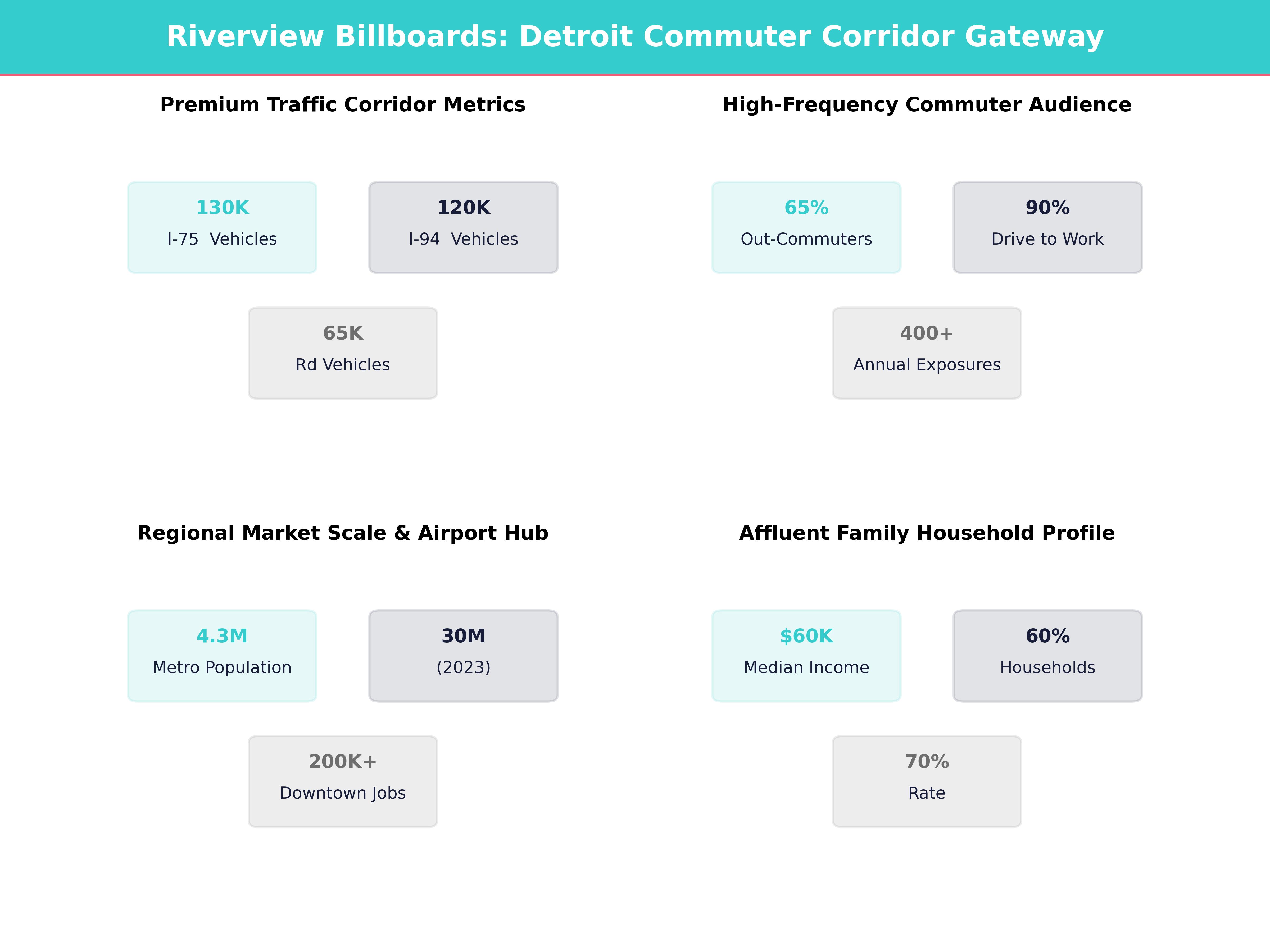
- Population in Riverview is roughly 12,000 residents, nested within Wayne County's 1.75+ million people and the broader Detroit metro area’s 4.3+ million residents. Wayne County remains one of the most populous counties in Michigan, accounting for about 18–20% of the state’s residents, according to regional demographic summaries from Wayne County.
- Median household income in the Riverview area is in the mid‑$60,000s, within a broader Downriver band where many communities fall between $55,000 and $75,000. Homeownership rates in similar Downriver suburbs typically range from 65–75%, reflecting a relatively stable, settled resident base.
- The city reports that about one-third of its land is dedicated to parks, open spaces, and recreational uses, reflecting a strong quality-of-life focus and frequent community events. You can see local amenities and event info on the City of Riverview website.
- Riverview sits within the Downriver cluster (Riverview, Trenton Wyandotte, Southgate, Taylor, and others), collectively home to well over 250,000 residents within a roughly 15–20 minute drive. Regional tourism and business resources such as Discover Downriver Downriver Community Conference help coordinate economic and community initiatives across these cities.
- The broader Detroit region is strongly auto‑oriented: metro Detroit regularly reports 90%+ of workers commuting by car, and average one‑way commute times for suburban communities often fall in the 23–28 minute range—consistent with patterns observed in Riverview and nearby suburbs.
For advertisers, this means:
- You’re speaking to commuting families who value convenience, local services, and recreational activities. Family households make up well over 60% of households in many Downriver cities, and approximately 20–25% of residents are under age 18.
- There is a large pool of workers tied to the auto industry, logistics, and manufacturing, especially along the Detroit River and I‑75 corridor. Manufacturing and related fields still account for roughly 1 in 7 private‑sector jobs in Wayne County, while health care and social assistance account for roughly 1 in 5.
- Many Riverview residents routinely travel to Allen Park, Romulus, Dearborn, Taylor, Southgate, and Detroit for work, shopping, entertainment, and flights from nearby Detroit Metropolitan Wayne County Airport (DTW) in Romulus. DTW’s economic impact studies estimate that airport activity supports 80,000+ regional jobs and billions of dollars in annual economic output, drawing substantial daily traffic through the corridor.
- Downriver’s daytime population swells significantly: local planning documents and economic development reports often show daytime employment counts 20–30% higher than resident population in some nearby industrial and commercial zones, creating additional billboard impressions beyond local residents.
By using boards and digital billboard advertising near Riverview on those key routes, we can effectively “follow” Riverview area residents throughout their day.
Where Our Billboards Are and How They Serve the Riverview Area
We have 11 digital billboards serving the Riverview area, all within about a 10‑mile radius and positioned to function as high-impact Riverview billboards for both residents and visitors:
-
Allen Park (approx. 4.9 miles from Riverview)
Allen Park sits right along I‑75 and near Southfield Freeway (M‑39). This is prime territory for:- Downriver–to–Detroit commuters: Allen Park and adjacent communities send thousands of workers daily toward downtown Detroit and Dearborn; regional counts show corridor segments moving well over 100,000 commuters per weekday.
- Shoppers heading to nearby retail and dining clusters, including major big‑box centers and auto dealerships along I‑75 and Outer Drive.
- Workers accessing major auto and logistics facilities, including Ford and supplier operations. Wayne County economic reports regularly list auto manufacturing and parts as contributing tens of thousands of direct jobs in and around Dearborn and the Downriver area.
-
Romulus (approx. 8.3 miles from Riverview)
Romulus is home to Detroit Metropolitan Wayne County Airport (DTW), which handled over 30 million passengers in 2023, according to Detroit Metro Airport. DTW also recorded more than 350,000 aircraft operations (takeoffs and landings) and handles over 450,000 metric tons of air cargo annually. Boards near Romulus tap:- Airport travelers and “welcome home” messaging for Riverview area residents returning from trips
- Hospitality, rental car, and parking patrons; hotel clusters near DTW total 30+ hotels with several thousand rooms
- Logistics traffic on I‑94 and surrounding industrial corridors, where dozens of distribution centers, trucking depots, and air‑cargo operators are located
Key traffic patterns that matter:
- I‑75 near Allen Park sees average daily traffic in the 120,000–140,000 vehicles per day range, based on recent Michigan Department of Transportation counts. A significant share of these vehicles are through‑commuters and freight: truck traffic can account for 10–15% of daily volume on key segments.
- I‑94 near Romulus similarly carries around 110,000–130,000 vehicles per day, including a heavy mix of airport and freight traffic. MDOT classifications show I‑94 as one of southeast Michigan’s top interstate freight routes, supporting thousands of daily commercial vehicle trips tied to DTW and regional logistics parks.
- Telegraph Road (US‑24), a major north–south artery used by many Riverview area commuters, carries 60,000–70,000 vehicles per day on some segments in nearby communities. Sections of Fort Street (M‑85) and Eureka Road in the Downriver area also routinely record 30,000–45,000 vehicles per day, sustaining strong visibility for local retail and service advertisers.
Because Riverview is only a few miles south of Allen Park and within easy reach of Romulus, these boards collectively give us strong visibility to:
- Daily commuters from the Riverview area heading to Detroit, Dearborn, and other employment hubs like the 200,000+ jobs clustered in and around downtown Detroit, Midtown, and major hospital and university campuses.
- Shoppers visiting big-box retail, entertainment, and dining near the freeways. Regional retail market reports often note that Downriver draws consumers from a 15–25 mile radius for large-format shopping and auto purchases.
- Air travelers from Riverview and the larger Downriver region: DTW passenger surveys frequently show a sizable portion of travelers originating from Wayne County suburbs, including Downriver and the I‑75 corridor.
For brands considering billboard rental near Riverview, this cluster of locations allows you to reach all three of these high-value flows with a single, coordinated campaign.
Audience Profiles in the Riverview Area
To design effective creative, it’s helpful to think in terms of key audience slices that frequently pass our boards.
1. Commuter Families
- Many Riverview residents commute 20–35 minutes to jobs in Detroit, Dearborn, Taylor, and other Wayne County cities. Regional commuting data for similar suburbs shows that 60–70% of workers travel outside their home city for work.
- A significant share are in blue‑ and white‑collar jobs linked to the auto industry, health systems, and public services. In Wayne County, health care, education, and public administration together account for roughly 25–30% of payroll jobs, while manufacturing accounts for about 15%.
- Family size often ranges from 2–4 people, with many households including school‑aged children; school enrollment statistics for local districts show thousands of students across elementary, middle, and high schools in the Downriver area.
-
This creates strong demand for:
- Groceries, pharmacies, and big-box retail: large regional chains within a 5–10 mile radius of Riverview draw thousands of weekly visits.
- After-school programs, sports, and tutoring: local youth sports leagues and recreation programs advertised by Riverview Community Schools and Riverview’s Parks & Recreation
- Quick-service restaurants and casual dining, especially along Fort Street, Eureka Road, and the I‑75 interchanges.
- Local medical, dental, and eye care, often located within 10–15 minutes of Riverview neighborhoods.
Messaging tips:
- Emphasize time savings, convenience, and local proximity:
“On your way home to Riverview? Dinner done in 10 minutes – Exit 00” - Use clear value statements:
“$39 oil change – 10 minutes from Riverview” - Consider including simple directional cues (“Just south of I‑75 on Fort St”) that reflect actual travel paths between Riverview and nearby cities, reinforcing that these are billboards near Riverview designed for their daily routines.
2. Industrial and Logistics Workforce
Nearby I‑75 and I‑94 corridors, plus proximity to the Detroit River, support a robust industrial and logistics ecosystem:
- Wayne County supports roughly 85,000+ manufacturing jobs and 60,000+ transportation and warehousing jobs, based on county economic development summaries from Wayne County Economic Development.
- Downriver riverfront cities host multiple steel, chemical, auto‑supplier, and logistics facilities. Local economic reports often show that in certain tracts, 30–40% of jobs are in manufacturing or transportation.
- Many of these workers live in or pass near the Riverview area daily, often working non‑traditional hours such as 6 a.m.–2 p.m., 2 p.m.–10 p.m., or overnight shifts.
Messaging tips:
- Appeal to shift workers with off‑peak dayparts (early morning, late night).
-
Focus on:
- Quick food options (“Open 24/7 near I‑75 & XXXX”)
- Auto repair and tire services, since commuting and job‑site driving can push annual mileage above 15,000–20,000 miles per vehicle.
- Workwear, tools, and equipment, especially for trades where gear replacement cycles are often 6–12 months.
- Training programs and trade schools in nearby communities that offer certifications in HVAC, welding, CDL, and industrial maintenance, which routinely rank among the region’s in‑demand skills.
3. Airport Travelers and Visitors
With DTW in Romulus, Riverview area residents and visitors regularly travel the I‑94 corridor:
- DTW handled over 350,000 flights and 30+ million passengers in the last year, with passenger volumes rebounding to more than 90% of pre‑pandemic levels, according to Detroit Metro Airport.
- The airport consistently ranks among the top 20–25 busiest airports in the U.S. for passenger traffic and among the top 20 for cargo.
- Many travelers drive from Downriver communities, including the Riverview area, and park or stay nearby. Regional parking and hotel inventory studies show thousands of off‑airport parking spaces and several thousand hotel rooms within a 3–5 mile radius of DTW.
Messaging tips:
- For local businesses:
“Flying from DTW? Park with us – Save up to 40% vs. on‑airport” - For attractions and hospitality:
“Welcome to Downriver – Riverfront dining 15 minutes south in Riverview area” - For cities and tourism groups: coordinate with campaigns from Visit Detroit, the Pure Michigan The News-Herald to align billboards with broader destination messaging.
Linking to regional tourism resources like Visit Detroit and the Downriver-focused content in local outlets such as The News-Herald can help align campaigns with broader destination messaging and strengthen billboard advertising near Riverview that speaks to visitors and returning residents.
Timing Your Campaign: Dayparts, Weekparts, Seasonality
Because Blip lets us choose when our ads run, we can match our schedule to how people in the Riverview area actually move.
Daypart Strategy
Traffic and mobility studies for metro Detroit show that 60–70% of daily vehicle trips occur between 6 a.m.–9 p.m., with pronounced peaks during commute windows. For Riverview‑area targeting, that translates into:
-
Morning Commute (5:30 a.m. – 9:30 a.m.):
- Target Detroit- and Dearborn-bound commuters starting from the Riverview area. In many corridors, morning peak volumes are 30–40% higher than mid‑day.
- Best for coffee shops, breakfast spots, childcare, auto repair, and urgent-care reminders.
- Use quick, action‑driven CTAs: “Call before 9 a.m. for same-day appointment.”
-
Midday (10:00 a.m. – 3:00 p.m.):
- Reach stay‑at‑home parents, seniors, and shift workers. In suburban corridors, midday trips often account for 25–30% of total daily volume.
- Great for grocery deals, medical and dental appointments, car dealerships, and home services.
- Messaging can be more informational (office hours, phone numbers, special offers).
-
Evening Commute (3:30 p.m. – 7:00 p.m.):
- Capture workers returning to the Riverview area. Evening rush hours can be slightly longer than morning peaks, with some corridors staying congested for 3+ hours.
- Highlight dinner, entertainment, fitness, and after‑work errands.
- Strong for “Tonight only” offers and promotions running 5–9 p.m.
-
Late Night (9:00 p.m. – 2:00 a.m.):
- Reach shift workers and airport‑related travelers. DTW’s flight schedules show substantial departures and arrivals in the 5 a.m.–midnight range, plus overnight cargo operations.
- Good for 24‑hour diners, gas stations, convenience stores, and emergency services.
Weekpart Strategy
Travel behavior also shifts across the week:
-
Monday–Thursday:
- Weekday patterns are dominated by work and school: in most metro areas, 65–75% of weekday trips are work, school, or routine errands.
- Focus on routine needs: commuting, service appointments, errands.
Example: auto shops, HVAC, financial services, childcare.
-
Friday–Sunday:
- Weekend travel skews more toward leisure and shopping; retail centers and dining districts can see 10–25% higher traffic on Saturdays compared with a typical Tuesday.
- Emphasize discretionary spending and leisure.
Example: restaurants, weekend events, sports bars, casinos, riverfront activities, and local festivals publicized by Riverview’s Parks & Recreation ClickOnDetroit and WXYZ Detroit.
Seasonal Opportunities
Metro Detroit experiences strong seasonality, with temperature swings of more than 80°F between winter lows and summer highs. That seasonality drives different purchasing patterns:
-
Winter (Dec–Feb):
- Snow, ice, and cold make auto maintenance, heating services, and indoor entertainment top of mind. Southeast Michigan often records 40–50 inches of snowfall per season, with multiple significant storms.
- Auto clubs and insurance data show spikes in roadside assistance calls during cold snaps, underscoring the value of winter maintenance messages.
- Use weather‑triggered creative (where possible) or rotate winter‑specific designs:
“Slippery roads? Free brake inspection this week.”
-
Spring (Mar–May):
- Home improvement, landscaping, and tax season. Hardware and home centers regularly report double‑digit sales lifts in spring compared with winter months.
- Push local contractors, lawn care, garden centers, and financial services.
- Promote Little League, school sports, and community events common in the Riverview area; school calendars and local leagues often pack 8–12 weeks of games and tournaments into this window.
-
Summer (Jun–Aug):
- Heavy use of parks and the Detroit River; more tourism and local festivals. Downriver riverfront parks and marinas can host dozens of events across the season, from fireworks to concerts.
-
Strong period for:
- Outdoor dining and entertainment
- Ice cream, quick-service food, and family attractions
- Boat sales, marinas, and riverfront businesses
- Coordinate messaging with regional coverage from outlets like WXYZ Detroit and ClickOnDetroit when they highlight Downriver events, as these stories can generate thousands to tens of thousands of local page views and social shares.
-
Fall (Sep–Nov):
- Back-to-school, football season, and pre‑holiday shopping. Retail industry benchmarks typically show 15–20% sales increases for school‑related categories in late summer and early fall.
- Target school‑related purchases, tutoring, healthcare checkups, and sports bars promoting college and Detroit Lions games. Local sports coverage from outlets like the Detroit Free Press and The Detroit News keeps football top of mind well into November.
Creative Best Practices for the Riverview Area
Drivers in the Riverview area are often on freeways moving at 55–70 mph or on major arterials at 35–45 mph, limiting attention span to 6–8 seconds. Traffic safety research consistently finds that messages with fewer than 10 words and strong visual contrast are significantly more likely to be recalled.
Effective creative should reflect that.
1. Keep Messages Simple and Local
- Limit to 6–8 words total.
- Use a single, bold call to action.
- Reference the Riverview area or a well-known landmark:
“Just south of Riverview on Fort St”
“10 minutes from Riverview via I‑75” - Including a local identifier (“Downriver,” “near DTW,” “Fort St & Eureka”) can improve relevance and recall among commuters who see the same board 5 days per week, especially when you are investing in billboard advertising near Riverview to build consistent visibility.
2. High-Contrast, Auto-Friendly Design
- Use large, block fonts with strong contrast (white/yellow on dark backgrounds or dark colors on light backgrounds).
- Avoid thin scripts or cluttered images—viewers should “get it” at a glance.
- Feature one main visual element (a product, a face, or a logo), not a collage.
- Digital billboard studies show that ads with one main image and one line of copy can perform 20–30% better in unaided recall tests than more complex designs.
3. Distance and Direction Cues
-
Because our boards are in Allen Park and Romulus, directional cues are powerful:
- “Exit 00, 7 miles south to Riverview”
- “Next 3 exits serve Riverview area shoppers”
- Use simple icons (arrows, exit signs) that mimic roadway signage.
- When possible, match the wording and color cues drivers already see on signs (e.g., green backgrounds for exit-style creative) to speed comprehension within 2–3 seconds.
4. Relevance to Commute
- Many Riverview area residents make the same drive each day; a typical full‑time commuter will pass the same point more than 400 times per year.
- Rotating 2–4 variations of the same core message (e.g., different deals, days, or seasonal twists) keeps the message fresh for repeat viewers while reinforcing brand recall.
- Frequency matters: even brief Blips shown multiple times per weekly commute can build dozens of impressions per person per month among your core audience.
Using Blip to “Own” Key Corridors Serving the Riverview Area
Blip allows granular control over when and where ads run, which is ideal for a compact market like the Riverview area.
Here are practical tactics:
1. Corridor Domination for Short Bursts
- Focus budget on a tight window (e.g., 7–9 a.m. and 4–6 p.m., Monday–Friday) across multiple boards in Allen Park and Romulus.
- Deliver frequent impressions to the same commuters from the Riverview area as they head toward and from Detroit or DTW. If your creative runs every 1–2 minutes during peak windows, a single commuter could see your ad 5–10 times per week.
-
Great for:
- Grand openings
- Limited‑time offers
- Election campaigns (where permitted by law)
- Seasonal promotions (tax prep, holiday sales)
This style of concentrated coverage makes short-term billboard rental near Riverview especially effective for time-sensitive messages.
2. Layering Airport + Local Messaging
- Use Romulus boards heavily on flight “surge” times (early morning and late afternoon) to reach airline travelers; DTW’s schedules often show 30–40% of daily departures and arrivals concentrated in a few key banks.
- Complement that with Allen Park boards focusing on local patronage from residents returning to the Riverview area.
-
For example:
- Romulus boards: “Flying today? Park & Save – 24/7 shuttle to DTW”
- Allen Park boards: “Back in town? Visit Riverview’s newest restaurant this weekend”
- This approach lets you connect with the same traveler multiple times—on the way to the airport, returning home, and during their daily commute—potentially creating 3–5 touchpoints per trip.
3. Daypart Budget Optimization
-
Allocate more budget to drive times that closely match your customer behavior:
- A dentist might concentrate 70–80% of impressions between 9 a.m. and 4 p.m. on weekdays, when scheduling calls and online bookings typically peak.
- A sports bar could prioritize Thurs–Mon evenings, especially during NFL and college football seasons, when game broadcasts regularly draw local TV audiences in the hundreds of thousands across metro Detroit.
- Use performance data (call logs, web traffic, walk‑in counts) to re‑weight dayparts every 2–4 weeks, shifting spend to the best‑performing windows.
4. Event and News-Driven Bursts
- When local outlets like The News-Herald, Detroit Free Press, or ClickOnDetroit spotlight a Downriver event or trend, briefly ramp up impressions to “ride the wave” of increased regional attention.
-
Examples:
- Local festival near Riverview: saturate afternoon and evening commute slots with event-related offers in the 7–14 days leading up to the event.
- Auto show or major sports event in Detroit: target Riverview area residents heading downtown via I‑75; regional visitor estimates for marquee events can reach tens of thousands of attendees, many passing near your boards.
Example Campaign Approaches by Business Type
To make these ideas concrete, here are sample strategies using boards near the Riverview area.
Local Restaurant or Bar (Riverview or Nearby Downriver)
- Goal: Increase evening and weekend visits.
-
Tactics:
- Run Blips 3:30–7:30 p.m. on weekdays and 11 a.m.–8 p.m. on weekends, when dining and bar visits typically peak; restaurant industry data show 50–60% of weekly revenue often comes from these windows.
- Creative 1: “Riverview’s riverfront patio – Live music Fri/Sat”
- Creative 2: “Kids eat free Tuesdays – 10 min south of Allen Park”
- Creative 3: “Game day specials – Watch every Lions game with us”
- Why it works: Reaches commuters and weekend traffic when they are deciding where to eat or watch the game. If even 1–2% of weekly impressions convert into visits, a single board can drive measurable table turns and bar sales.
Home Services (HVAC, Plumbing, Roofing) Serving the Riverview Area
- Goal: Fill schedule with high-value jobs within 15–20 minutes of Riverview.
-
Tactics:
- Heavier spend in spring and fall (tune‑up season), when heating and cooling transitions often lead to 20–30% more service calls.
- Run throughout the day, but bid higher in early morning and late afternoon, when homeowners are most likely to call or book online.
- Creative 1: “Riverview area homes – A/C tune‑up $89 – Call today”
- Creative 2 (weather‑specific): “Furnace acting up? 24/7 emergency in Riverview area”
- Why it works: Aligns with seasonal urgency and keeps the message in front of homeowners during commuting and planning times. For jobs averaging $300–$1,000+, just a handful of incremental monthly conversions can cover a full month’s Blip spend.
Healthcare Provider or Urgent Care
- Goal: Increase awareness and new patient visits from the Riverview area.
-
Tactics:
- Run morning to early evening, Monday–Saturday, when primary care and urgent care usage is highest; outpatient visits often peak between 9 a.m. and 7 p.m..
- Creative 1: “Urgent care near Riverview – Open 8–8 daily”
- Creative 2: “Sports physicals $X – Walk in today”
- Creative 3: “New patients welcome – Family doctor 5 minutes from Riverview”
- Why it works: Reinforces convenience and accessibility for families managing busy schedules. Even a 10–15% lift in monthly new‑patient calls from nearby ZIP codes can significantly grow a clinic’s active panel over 6–12 months.
Automotive Dealer or Repair Shop
- Goal: Attract Riverview area owners driving older vehicles or commuting long distances.
-
Tactics:
- Prioritize peak commuting hours on I‑75 and I‑94 corridors, which may account for 40–50% of weekday vehicle miles traveled.
- Creative 1: “Free brake check – Exit XX near Allen Park”
- Creative 2: “Trade in & trade up – Payments from $XXX/mo – 12 min from Riverview”
- Why it works: The auto-centric region and long commutes make car upkeep an everyday concern. With average vehicle age in the U.S. now exceeding 12 years, Downriver’s large base of older vehicles provides ongoing demand for repairs and trade‑ins, making consistent billboard advertising near Riverview especially valuable for auto-related businesses.
Measuring and Optimizing Your Riverview Area Campaign
To make the most of the Riverview area’s 11 digital billboards, we should treat campaigns as ongoing experiments.
1. Set Concrete, Localized Goals
-
Examples:
- “Increase weekend dine‑in traffic from the Riverview area by 15% in 60 days.”
- “Generate 50 additional calls per month from ZIP codes nearest Riverview.”
- “Boost walk-ins for our Riverview area urgent care by 10% in three months.”
- Use local baselines: look at current average weekly sales, calls, or visits over the last 4–8 weeks to set realistic targets.
2. Use Simple Tracking Mechanisms
- Unique phone numbers or extensions shown only on your billboard creative; many call‑tracking tools can attribute 95%+ of calls accurately by source.
- Short URLs (or QR codes if traffic speeds allow) specific to the billboard campaign; even a small QR scan rate of 0.1–0.3% of impressions can provide useful feedback.
- “Mention this Riverview board and get ___” to track redemptions; train staff to log how many customers mention the offer each week. This type of offer is especially helpful when testing different Riverview billboards or rotating creatives.
3. Rotate and Compare Creative
- Run 2–4 creative variations and monitor which message or offer correlates with stronger response.
- Swap out underperforming designs every 2–4 weeks to keep performance improving.
- Aim for each creative to generate at least 1,000–2,000 impressions before deciding whether to keep or replace it, so you’re not reacting to noise.
4. Adjust By Time and Location
- If you see more response during evening hours, shift more of your Blip budget into those dayparts; moving even 20–30% of your impressions into higher‑performing windows can noticeably improve ROI.
- If airport‑driven offers outperform, tilt spend toward Romulus boards; if neighborhood or commuting offers do better, lean into Allen Park.
- Use local web analytics (e.g., tracking visitors from Wayne County ZIP codes), POS data, and call logs to identify where your strongest responding customers live and travel, then adjust your billboard rental near Riverview accordingly.
By combining data‑driven scheduling, carefully targeted creative, and our 11 digital billboards serving the Riverview area from nearby Allen Park and Romulus, we can help your brand become a familiar part of daily life for Riverview area residents. With flexible budgets and precise controls, Blip makes it possible to test, learn, and scale what works—so your next customer is already thinking about you by the time they arrive back in the Riverview area and pass your billboards near Riverview once again.