Billboards near Dearborn, MI
No Minimum Spend. No Long-Term Contracts. Just Results.
Trusted by Leading Brands


Billboard advertising
near Dearborn has never been easier
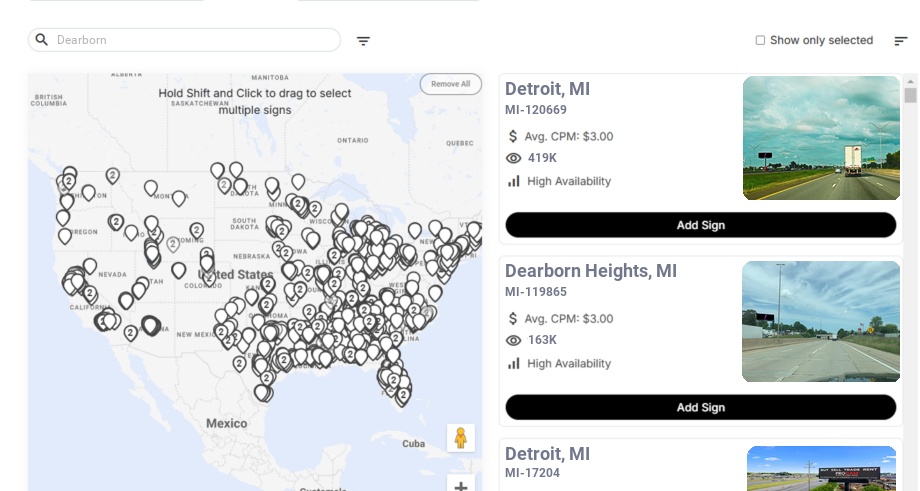



How much is a billboard near Dearborn?
Why Choose Blip for Billboard Advertising near Dearborn
Blip lets you launch on Dearborn corridors like I-94 and M-39 fast, reaching commuters who drive 80%+ of local trips.
Set flexible budgets for Dearborn billboards and scale with Ford, Fairlane, and DTW traffic without long-term contracts.
Daypart your Dearborn ads for 6:30-9:30 a.m. and 3:30-7 p.m. to catch commuters twice a day on the same route.
Track Dearborn campaigns in real time and shift spend as Henry Ford tourism and DTW arrivals rise by season.
Use Blip creative tools to test bilingual Dearborn messages for Arab-American families, students, and regional travelers.
Frequently Asked Questions About Billboard Advertising near Dearborn
How much does a billboard cost near Dearborn, Michigan with Blip?
With Blip, you control exactly what you spend on Dearborn billboards by setting a daily budget that can be adjusted anytime. Each “blip” is a brief, 7.5–10 second display, and you only pay for the blips you receive. Prices for each blip vary based on the time of day, location, and advertiser demand, so your total cost is simply the sum of all the blips your message gets in the Dearborn area.
Where can I advertise with Blip near Dearborn, Michigan?
Our 30 digital billboards serving the Dearborn area are strategically located in nearby, high-traffic corridors. Nearby placements include Detroit, Allen Park, and Romulus, giving you flexible options for billboard advertising near Dearborn. You can build a “Dearborn corridor” by combining these locations and guiding drivers from the airport or downtown Detroit toward your business.
What kind of audience can Blip reach in Dearborn, Michigan?
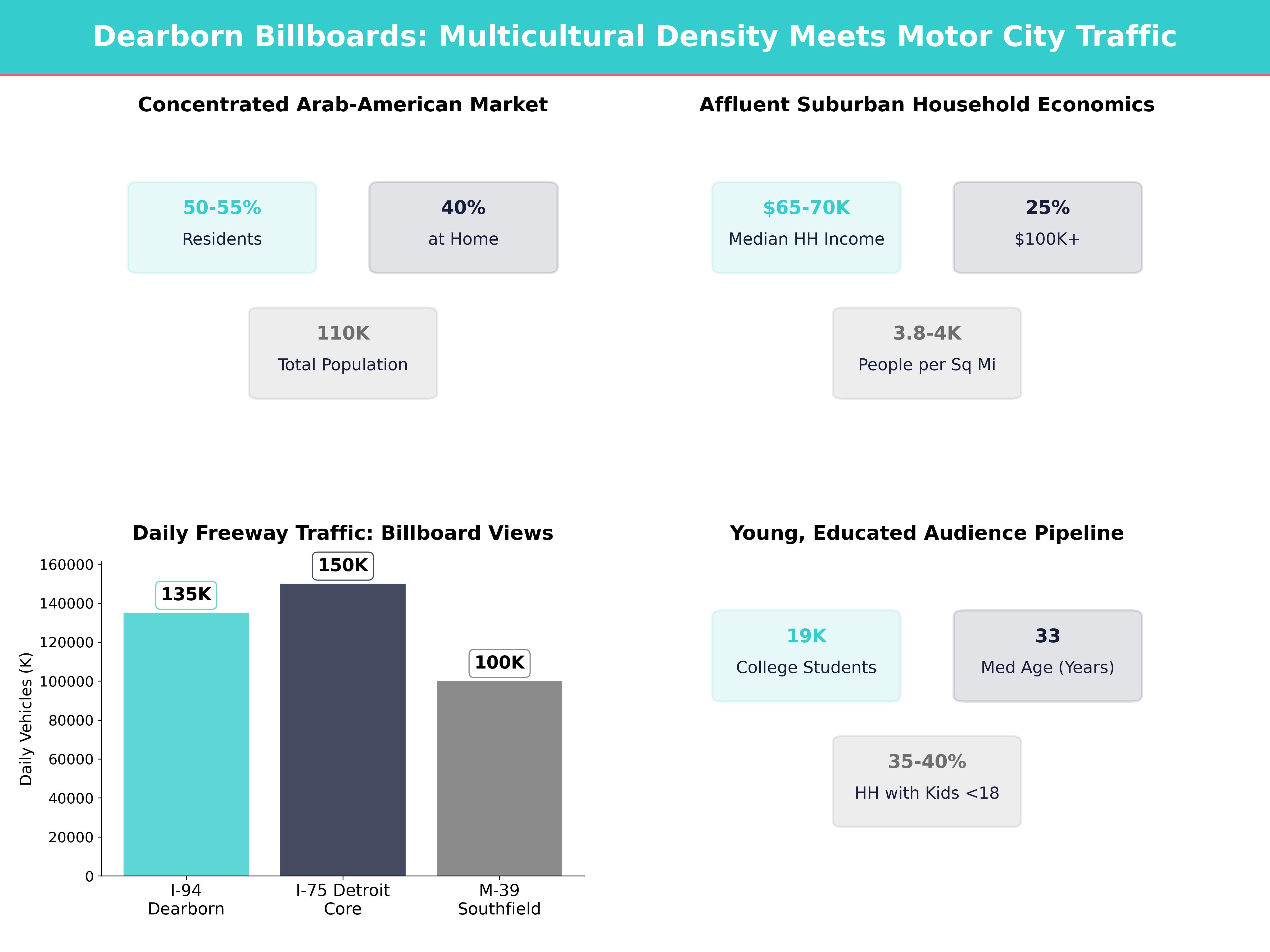
Dearborn is a dense, economically diverse city with roughly 110,000 residents and a population density of about 3,800–4,000 residents per square mile. Around 35–40% of households include children under 18, and about 50–55% of residents are of Arab or Middle Eastern/North African descent. More than 40% of residents speak a language other than English at home, creating a uniquely bilingual, multicultural advertising environment.
When is the best time to run billboards in Dearborn, Michigan with Blip?
To maximize the value of each “blip,” campaigns are matched to how people actually move through the Dearborn area. Morning drive, evening peak, and late-night periods can all be useful depending on your audience, and weekday rush hours can reach the same driver twice per weekday. With Blip, you can selectively buy only the dayparts that match your audience rather than paying for 24/7 coverage.
What traffic corridors are best for billboard advertising near Dearborn, Michigan?
Key freeways near Dearborn, such as I‑94, I‑75, and M‑39, register high annual average daily traffic. I‑94 near Dearborn often carries 120,000–150,000 vehicles per day on busier segments, I‑75 in the Detroit core typically sees 140,000–160,000+ vehicles per day, and M‑39 through Dearborn/Allen Park generally handles 90,000–110,000 vehicles per day. Our placements in nearby cities leverage that volume to reach drivers who live, work, or shop near Dearborn.
Do I need a contract to advertise with Blip near Dearborn?
No, Blip has no long-term contracts or minimum commitments. You can start, pause, or stop your campaign at any time.
How fast can I launch a billboard campaign with Blip near Dearborn?
You can have your campaign live in minutes. Create a free account, select your locations, set your budget, upload your design, and start running once approved.
Where can I advertise with Blip near Dearborn?
Blip has digital billboards near Dearborn. You can browse available locations on a map, choose the ones that fit your audience, and start advertising right away.
Still have questions? Launch a campaign in minutes — no contracts, no commitments.
Start Your CampaignDearborn Billboard Advertising Guide
Dearborn sits at the crossroads of metro Detroit’s industry, culture, and tourism, making the Dearborn area one of the most efficient places in Southeast Michigan to capture both local residents and regional travelers. With 30 digital billboards serving the Dearborn area from nearby Detroit, Allen Park, and Romulus, we can help you turn this daily movement of people into measurable exposure for your brand—whether you’re seeking always-on billboards near Dearborn or a short-term promotional flight.
Dearborn Area Market Snapshot
Dearborn is a dense, economically diverse city inside Wayne County’s core:
- Population: Dearborn has roughly 110,000 residents (about 109,000–110,000 based on recent estimates), while Wayne County counts about 1.75 million residents overall. Within the inner-ring suburbs surrounding Detroit—including Dearborn Heights Lincoln Park, and Taylor—there are 680,000+ people, giving advertisers a broad but locally concentrated reach for Dearborn billboards.
- Density: Dearborn’s population density is approximately 3,800–4,000 residents per square mile, significantly higher than the statewide Michigan average (under 200 per square mile), which makes out-of-home advertising and billboard advertising near Dearborn especially efficient.
- Age & family structure: The median age in Dearborn is around 33 years, several years younger than the U.S. median (about 38). Around 35–40% of households include children under 18, making family-focused messaging particularly powerful.
- Income: Median household income in Dearborn is in the $65,000–$70,000 range, with substantial neighborhood-level variation—from entry-level manufacturing and service workers to high-earning engineers, medical professionals, and corporate managers. About 1 in 4 households earns $100,000+ annually, while a sizable share remains in the $35,000–$75,000 band, supporting both value-focused and premium offerings.
- Commuting profile: Roughly 80–85% of workers in Dearborn and surrounding suburbs commute by car, with average one-way commute times around 23–25 minutes. That translates to hundreds of thousands of daily vehicle trips intersecting with key billboard corridors and creating strong demand for billboards near Dearborn.
- Cultural profile: Dearborn is home to one of the largest Arab-American communities in the U.S.—local surveys and community organizations estimate that 50–55% of residents are of Arab or Middle Eastern/North African descent. More than 40% of residents speak a language other than English at home, with Arabic being the most common. This creates a uniquely bilingual, multicultural advertising environment that rewards culturally attuned creative.
Key local anchors that drive traffic and economic activity include:
- Ford Motor Company global headquarters and large engineering/office campuses along Michigan Avenue, which collectively employ tens of thousands of workers in and around Dearborn every weekday.
- The Henry Ford museum and Greenfield Village, drawing roughly 1.7 million visitors annually from across the Midwest and beyond. Tourism research shows that more than 60% of visitors travel from outside Wayne County, and many pair a visit with local dining, lodging, and shopping that can be influenced by Dearborn billboards.
-
Major higher-ed institutions:
- University of Michigan–Dearborn – approximately 8,000–8,500 students, plus several hundred faculty and staff.
- Henry Ford College – around 11,000–12,000 students enrolled annually across credit and non-credit programs.
- Regional shopping and employment hubs like Fairlane Town Center, which has 100+ stores and restaurants and anchors a major retail and office district just off Michigan Avenue and Southfield Freeway.
Local government and civic information is centralized at the City of Dearborn website, and regional tourism insights—such as annual visitor counts, hotel occupancy, and major events—can be found via Visit Detroit and the Dearborn Area Chamber of Commerce.
These factors combine to create a steady, year-round audience near Dearborn that is highly mobile, diverse, and frequently exposed to out-of-home media.
Where Our Billboards Serve the Dearborn Area
Our 30 digital billboards serving the Dearborn area are strategically located in nearby, high-traffic corridors, giving you flexible options for billboard advertising near Dearborn:
- Detroit (about 4.7 miles from Dearborn) – capturing downtown workers, sports fans, concertgoers, and traffic on interstates like I‑75, I‑94, and the Lodge Freeway (M‑10). Downtown Detroit draws 15–20 million visits per year for work, dining, sports, and entertainment, driven in part by teams like the Detroit Lions, Detroit Tigers, Detroit Red Wings, and Detroit Pistons, plus concerts at venues such as Little Caesars Arena.
- Allen Park (about 4.9 miles from Dearborn) – reaching shoppers and commuters along I‑94 and the Southfield Freeway (M‑39), including those heading toward Dearborn’s retail districts and Ford facilities. The Allen Park and Southgate area supports hundreds of retail, restaurant, and service businesses, generating thousands of daily trips that pass through shared freeway segments with Dearborn and are ideal for Dearborn billboards focused on shopping and services.
- Romulus (about 7.9 miles from Dearborn) – intercepting travelers around Detroit Metropolitan Wayne County Airport (DTW), which handled more than 34 million passengers in 2023. DTW supports roughly 18,000 on-airport jobs and indirectly supports tens of thousands more in hospitality, transportation, and logistics across Wayne County, many of whom commute daily by car.
According to Michigan Department of Transportation (MDOT) traffic tools, key freeways near Dearborn—such as I‑94, I‑75, and M‑39—register high annual average daily traffic (AADT):
- I‑94 near Dearborn often carries 120,000–150,000 vehicles per day on busier segments.
- I‑75 in the Detroit core typically sees 140,000–160,000+ vehicles per day.
- M‑39 (Southfield Freeway) through Dearborn/Allen Park generally handles 90,000–110,000 vehicles per day.
Our placements in nearby cities leverage that volume to reach drivers who live, work, or shop near Dearborn, converting ordinary commuting and airport traffic into repeated impressions for your brand and maximizing the value of billboard rental near Dearborn.
Understanding Dearborn’s Core Audiences
When we plan billboard campaigns serving the Dearborn area, we usually think in terms of several major audience segments:
1. Commuters and Industrial Workforce
Tens of thousands of workers commute daily between Dearborn, Detroit, and nearby suburbs:
- Ford engineering and corporate staff, auto suppliers, logistics and warehouse employees across Wayne County’s 3,000+ manufacturing and transportation businesses.
- Healthcare workers traveling to nearby hospitals and medical centers, including facilities within the Beaumont / Corewell Health and Henry Ford Health systems, which together employ tens of thousands of people regionally.
- Municipal and service workers commuting from surrounding neighborhoods in cities like Dearborn Heights, Taylor, and Allen Park.
Typical patterns:
- Morning inbound (6:30–9:30 a.m.) to office, retail, and industrial zones along Michigan Avenue, I‑94, and M‑39. On heavily used segments, MDOT data show morning traffic peaks near 5,000–7,000 vehicles per hour.
- Evening outbound (3:30–7:00 p.m.) with heavy congestion on I‑94 and M‑39 as Detroit and Dearborn workers return to suburbs to the west and south.
For advertisers:
- Emphasize work-related offers (B2B services, training programs, lunch options, car care) in rush-hour dayparts, when commuter billboard exposure can reach the same driver twice per weekday.
- Use ultra-clear calls to action: “Next Exit on I‑94,” “Order Before You Clock Out,” or “Fleet Service – Call Today.”
2. Local Families and Neighborhood Shoppers
Dearborn’s relatively young, family-oriented population drives steady demand for everyday goods and services:
- With roughly 35–40% of households hosting children, local families make frequent trips for K–12 schools, youth sports, medical visits, and shopping—often multiple times per week.
- Retail corridors like Michigan Avenue (US‑12), the Fairlane-area retail district, and nearby centers in Allen Park and Taylor generate thousands of daily shopping visits. Centers such as Fairlane Town Center, neighborhood strip malls, and big-box clusters along I‑94 attract both local and regional shoppers.
- In many Wayne County communities, over 90% of households own at least one vehicle, reinforcing car-based shopping patterns that align perfectly with billboard exposure.
For advertisers:
- Promote family packages, weekend deals, and local events that tie into high-traffic shopping times: Saturday midday, weekday late afternoons, and early evenings.
- Use simple, benefit-forward copy: “Kids Eat Free,” “Same-Day Pediatric Appointments,” “Enroll for Summer Camp,” and consider including short URLs or QR codes for on-the-go lookups.
3. Arab-American and Multilingual Audiences
Dearborn’s Arab-American community is nationally significant, with many households using Arabic in addition to English:
- Local organizations and research estimate that 50–55% of Dearborn residents have Arab or Middle Eastern/North African roots, and a substantial share are first- or second-generation immigrants.
- More than 40% of residents speak a language other than English at home, and in some neighborhoods Arabic signage and media are the norm.
- Community institutions like the Arab American National Museum and numerous cultural festivals draw thousands of visitors annually, reinforcing Dearborn’s identity as a cultural hub.
For advertisers:
-
Consider bilingual creative (English + Arabic) for maximum resonance, especially for:
- Financial services
- Healthcare
- Education and training
- Retail and restaurants
- Even a short line—“Welcome” or a key offer—rendered in Arabic can dramatically increase perceived relevance and trust. In multicultural markets, studies commonly show double-digit lifts in recall and favorability when ads use a consumer’s home language.
- Highlight values like family, community, education, and stability, which research consistently finds to be high priorities among local households.
4. Students and Young Adults
With the combined presence of UM–Dearborn and Henry Ford College:
- Over 19,000 students, plus several thousand faculty and staff, are regularly on or near local campuses during the academic year.
- A majority of these students commute. Regional surveys suggest that 60–70% of students at commuter schools drive to campus, relying on corridors such as I‑94, Southfield Freeway (M‑39), and Michigan Avenue.
- Dearborn’s 18–34 age cohort accounts for roughly one-quarter of the city’s population, forming a sizable market for quick-service restaurants, entertainment, fitness, and entry-level career training.
For advertisers:
-
Focus on price-sensitive, time-sensitive offers:
- “$5 Lunch Near Campus”
- “Finish Your Degree Online”
- “Student Discount – Scan Now”
- Choose dayparts around class transitions: mid-morning, lunchtime, late afternoon, and early evening (roughly 9 a.m.–3 p.m. and 5–9 p.m.) when campus-adjacent traffic spikes.
5. Regional and Out-of-Town Visitors
Major visitor drivers in the Dearborn area include:
- The Henry Ford attractions (museum, Greenfield Village, Ford Rouge Factory Tour), drawing 1.7 million+ visitors per year, with strong peaks from late spring through early fall and around major holiday periods.
- DTW Airport, a major regional hub handling 34 million+ passengers annually and serving over 125 nonstop destinations. A significant portion of those travelers pass through hotel and dining clusters in Romulus, Dearborn, and along I‑94.
- Events and games in downtown Detroit—Lions at Ford Field, Tigers at Comerica Park, Pistons and Red Wings at Little Caesars Arena—which together account for hundreds of major events per year and millions of annual attendees.
For advertisers:
-
Use billboards near Romulus and Detroit to intercept:
- Visitors heading from the airport toward Dearborn hotels and attractions.
- Sports fans and concertgoers looking for pre- or post-event dining, parking, and lodging.
- Add location cues: “10 Minutes West in Dearborn,” “Stay Near The Henry Ford,” or “Free Parking 5 Minutes from Ford Field Exit.”
Commuting Patterns and Optimal Dayparts
To maximize the value of each “blip,” we match campaign schedules to how people actually move through the Dearborn area. In Wayne County, more than 8 in 10 workers commute by car, and many use the same route at least 5 days per week, creating strong frequency potential with the right placements.
Morning Drive (6:00–9:30 a.m.)
- Audience: Commuters into Dearborn, Detroit, and industrial zones; students heading to early classes at UM–Dearborn and Henry Ford College; airport workers on early shifts.
- Traffic intensity: On major freeways like I‑94 and I‑75, MDOT data show morning peaks reaching 5,000–7,000 vehicles per lane per hour on some stretches, yielding very high impression density.
-
Best for:
- Coffee shops, breakfast QSRs, and convenience stores.
- B2B services, staffing agencies, training programs.
- Healthcare and professional services seeking appointment bookings.
Midday (10:00 a.m.–3:00 p.m.)
- Audience: Shift workers, stay-at-home parents, retirees, visitors to The Henry Ford, and off-peak shoppers.
- Behavior: Midday tends to have slightly lower volume but longer dwell times due to errands and local trips, which can boost ad engagement.
-
Best for:
- Retail, grocery, car dealerships, service centers.
- Museums, attractions, and tourism.
- Healthcare, dental, and urgent care with daytime availability.
Evening Peak (3:30–7:30 p.m.)
- Audience: Workers heading home, students finishing classes, families picking up kids or heading to activities, and fans heading to or from Detroit events.
- Spending patterns: Many households make day-of decisions about dinner, shopping, and entertainment in this window, and studies often find elevated response rates for time-sensitive offers in late afternoon/early evening.
-
Best for:
- Restaurants, delivery, and curbside pickup.
- Fitness centers and recreation.
- Big-ticket purchases (autos, furniture) when people have time to research.
Late Night (8:00 p.m.–1:00 a.m.)
- Audience: Hospitality workers, airport travelers, late-shift employees, and nightlife in Detroit and Dearborn.
- Volume: Lower total vehicle counts than peak periods, but a high share of travelers making destination decisions (lodging, late-night dining, rideshare).
-
Best for:
- Late-night dining and quick-service restaurants.
- Rideshare and transit information (including services like SMART and local taxi providers).
- Emergency and 24/7 services.
With Blip, you can selectively buy only the dayparts that match your audience, rather than paying for 24/7 coverage. That’s especially powerful in a commuting-heavy market like the Dearborn area, where aligning with peak flows can increase exposure efficiency by 30–50% compared to untargeted schedules and make every billboard rental near Dearborn work harder.
Seasonality and Event-Driven Opportunities
While the Dearborn area provides consistent year-round traffic, certain periods are especially valuable:
Winter (December–February)
- Holiday shopping and travel spikes drive higher volumes to regional malls and shopping corridors. Retail sales in metro Detroit typically see double-digit percentage increases compared with fall months.
- DTW experiences strong peaks around late December and early January, adding hundreds of thousands of additional passengers over baseline months.
-
Emphasize:
- Retail promotions, gift cards, seasonal services.
- Auto care (tires, maintenance) and home services (heating, plumbing).
- “Open Late” and “Same-Day Service” messaging for weather-related needs.
Spring (March–May)
- Tax refund season boosts discretionary spending on home, auto, and personal services.
- Graduation season for high schools, UM–Dearborn, and Henry Ford College brings thousands of visiting family members into the area for ceremonies and celebrations.
-
Emphasize:
- Education programs, training, and career services timed for late spring enrollment.
- Home renovation, landscaping, and exterior services as temperatures rise.
- Bridal, event venues, and photography tied to the spring and early summer wedding season.
Summer (June–August)
- Tourism peaks: regional tourism groups often report that 30–40% of annual visitor activity clusters in these months. The Henry Ford and Greenfield Village see some of their highest monthly attendance in June, July, and August.
- More local road trips and outdoor events across metro Detroit—festivals, parades, and concerts—drive additional weekend freeway traffic.
-
Emphasize:
- Hotels, attractions, and family entertainment.
- Summer camps, youth programs, and festivals.
- Auto, RV, and recreational sales and rentals.
Fall (September–November)
- Back-to-school for K–12 and college students refocuses spending on education, supplies, technology, and after-school activities.
- Football season and major events in Detroit, including college and NFL games, generate repeated weekend traffic surges along I‑94, I‑75, and the Lodge Freeway.
-
Emphasize:
- School supplies, tutoring, and after-school programs.
- Restaurants and bars promoting game-day specials and watch parties.
- Health services (flu shots, annual check-ups) as many households schedule fall appointments.
Keep an eye on local news outlets like the Detroit Free Press, The Detroit News, and the Dearborn Press & Guide for event calendars and storylines you can align with your campaigns. These sources regularly highlight festivals, parades, construction detours, and sports schedules that can inform when and where to increase your billboard presence.
Creative Best Practices for Billboards Serving the Dearborn Area
To stand out on high-speed corridors like I‑94 and M‑39, your creative needs to work in under 2 seconds of viewing time and at viewing distances of 500–1,000 feet. For the Dearborn area, we recommend:
1. Hyper-Clear Value + Location
-
Pair a strong value statement with a precise local cue:
- “Oil Change in 15 Minutes – Exit 204, Dearborn”
- “Save 20% on Dinner in the Dearborn Area Tonight”
- Research on out-of-home effectiveness shows that including a clear location cue can increase visit intent by up to 20–30%, especially for restaurants, fuel, and services.
2. Bilingual and Culturally Aware Messaging
-
When targeting Dearborn’s Arab-American community:
- Use both English and Arabic if possible, but keep the message short so both lines remain legible at freeway speeds.
- Focus on trust, family, and community—core themes in local culture that repeatedly surface in community surveys and outreach.
- Feature culturally inclusive imagery (modest clothing options, family groupings, etc.) where appropriate.
- Bilingual messaging can also help with international visitors arriving via DTW, many of whom speak languages other than English and are actively looking for lodging, dining, and transportation options.
3. High-Contrast, Simple Layouts
- Use large, bold fonts with high contrast (e.g., white or yellow on dark, or dark on light).
- Limit yourself to 7 words or fewer when possible; studies routinely show that shorter copy is associated with higher recall on highway billboards.
- Make your logo and CTA large enough to be understood at 60–70 mph, with key elements occupying at least one-third of the canvas.
4. Directional and Time-Sensitive Copy
-
Add time- or distance-based hooks:
- “3 Minutes Ahead on Michigan Ave”
- “Tonight Only – 2-for-1 Tickets”
-
For airport-area boards near Romulus:
- “Stay 10 Minutes from DTW in the Dearborn Area”
- “Shuttle to DTW – Book Now”
- Time-limited offers can create urgency; many advertisers see significantly higher short-term response when pairing discounts with phrases like “Today Only” or “This Week.”
5. Rotate Creative Variants with Blip
-
Run multiple creatives:
- Version A: Brand awareness (“Know Our Name”).
- Version B: Tactical offers (“$10 Off Oil Change This Week”).
- Version C: Seasonal or event-based (“Game Day Special – Tigers Home Game”).
- Testing different creatives and measuring response by period (e.g., weekly or monthly) can help you shift budget to the highest-performing messages, often yielding 10–20% better ROI over time.
With Blip, you can instantly swap or test creatives, allowing you to tailor messages as seasons, news cycles, or promotions change.
Using Blip’s Tools to Target the Dearborn Area
Digital billboards give you controls that traditional static billboards cannot, especially in a complex regional network like metro Detroit. If you are exploring billboard rental near Dearborn for the first time, these tools make it easy to start small and scale up.
1. Precision in Location Selection
-
Choose boards in nearby Detroit to reach:
- Downtown workers and event attendees who live or shop in the Dearborn area.
- Visitors staying in Detroit hotels but looking for daytime attractions such as The Henry Ford.
-
Choose Allen Park boards to reach:
- Shoppers and commuters using I‑94 and M‑39 east and west of Dearborn.
- Households in dense inner-ring suburbs that frequently visit Dearborn for dining, services, and entertainment.
-
Choose Romulus boards to reach:
- Airport travelers heading to Dearborn hotels, conference centers, and attractions.
- Airport employees and logistics workers who commute along I‑94 daily.
You can build a “Dearborn corridor” by combining these locations, guiding drivers from the airport or downtown Detroit toward your business and creating multi-touch exposure along the route with billboards near Dearborn at each step of the journey.
2. Budget Control and Bid Strategy
-
Set a total campaign budget and adjust your maximum bid per “blip” based on:
- Peak vs. off-peak times.
- Weekdays vs. weekends.
- Event days (sports, festivals) vs. typical days.
-
For example, you might:
- Bid 30–50% higher on Friday evenings and weekend afternoons during sports seasons to capture game-day traffic.
- Maintain lower, always-on bids during midweek midday hours to preserve baseline awareness at a lower cost.
3. Dayparting and Calendar Scheduling
-
Align your campaign schedule with your operating hours and audience:
- Restaurants: Heavier bidding 11 a.m.–2 p.m. and 4–9 p.m., particularly Thursday–Sunday when dining traffic peaks.
- Auto services: 7 a.m.–6 p.m. weekdays, with weekend boosts during seasonal changeovers (spring tire changes, fall maintenance).
- Colleges/trade schools: Early evening hours (5–9 p.m.) when prospective students are commuting home and more open to education-related messages.
- Use calendar tools to increase presence around key local dates—start of school terms, holiday weekends, and major events listed on Visit Detroit and local government or chamber calendars.
4. Measurability
Combine Blip impressions with your own tracking:
- Use custom URLs, QR codes, or unique promo codes (“DEARBORN10”) to attribute response. Many advertisers find that even a simple code can reveal measurable uplift in redemptions during active billboard flights.
- Watch for lifts in branded search volume and website visits from Wayne County zip codes during your campaign dates.
- Compare store traffic data (if available) or appointment volume during your campaign to prior periods, adjusting your schedule to emphasize the highest-converting times and corridors.
Example Campaign Strategies for Key Local Industries
To make this concrete, here are practical ways advertisers can use our Dearborn-area coverage:
Auto Dealerships and Service Centers
- Target corridors leading from Detroit and Romulus into the Dearborn area, where tens of thousands of vehicles daily pass within a short drive of your showroom or service bay.
-
Run:
- Brand-focused creative constantly at a lower budget to build name recognition.
- Limited-time offers (0% APR weekends, service coupons) with boosted bids Thursday–Sunday, when auto shopping and maintenance visits typically rise.
- Use directions like “Next to Fairlane” or “5 Minutes from The Henry Ford” to anchor your location to well-known landmarks and improve wayfinding.
Restaurants and Cafés
-
If you’re near Michigan Avenue or around major retail nodes:
- Heavy lunch and dinner dayparting within 3–5 miles, which is a common “willingness to travel” range for dining in suburban markets.
- Bilingual creative to stand out to local families and visitors exploring Arab cuisine and other multicultural offerings.
- Around event days (sports, concerts), increase impressions on Detroit-facing boards, inviting fans to “Eat on the Way Home in the Dearborn Area” and capitalizing on tens of thousands of attendees leaving downtown after games.
Education and Training Providers
-
Community colleges, trade schools, and certification programs:
- Target commuters who might want a career change—especially in corridors with high concentrations of industrial and service workers.
- Focus on after-work and weekend dayparts, when people are more receptive to thinking about long-term goals.
- Rotate creatives: “Graduate Faster,” “Earn More in 12 Months,” “Evening & Online Classes,” and consider adding statistics like “Local grads earn up to X% more” if you have that data.
Healthcare and Wellness
-
Clinics, urgent care, and dental offices:
- Emphasize convenience and access: “Same-Day Appointments,” “Walk-Ins Welcome,” “Open 7 Days.”
- Use simple visuals: a friendly provider, a family, or a clear icon (tooth, heart, cross).
- Schedule heavier presence at the start of the week (when people plan appointments) and during cold/flu season (typically late fall through early spring).
Tourism, Attractions, and Hospitality
-
Hotels, event venues, museums, and local attractions:
- Target Romulus and Detroit boards to catch visitors before they decide where to stay or eat. Tourism organizations often note that a large share of visitors book dining and some activities within 24–48 hours of arrival, making last-minute influence critical.
- Use short-path messaging: “5 Minutes West to Dearborn Hotels,” “Stay Near The Henry Ford,” “Free Breakfast – Exit at Michigan Ave.”
- Coordinate messaging around regional events promoted by Visit Detroit and highlighted in outlets like the Detroit Free Press.
Bringing It All Together
The Dearborn area offers advertisers a rare combination: dense, multicultural neighborhoods; massive commuter flows; and a steady stream of regional and national visitors. By leveraging 30 digital billboards in nearby Detroit, Allen Park, and Romulus, we can help you:
- Zero in on the exact corridors your audience uses, where AADT often tops 100,000+ vehicles per day.
- Buy only the most valuable times of day, improving cost efficiency by focusing on the hours when your customers are on the road and ready to decide.
- Tailor creative to Dearborn’s unique cultural and economic profile, including one of the nation’s largest Arab-American communities and tens of thousands of students.
- Adjust and optimize continuously as you learn what works, shifting impressions toward the best-performing audiences, locations, and dayparts.
With the right mix of local insight, clear creative, and smart scheduling, your Blip campaign can turn everyday trips near Dearborn into consistent, measurable growth for your business through highly targeted billboard advertising near Dearborn.