Billboards near Flat Rock, MI
No Minimum Spend. No Long-Term Contracts. Just Results.
Trusted by Leading Brands


Billboard advertising
near Flat Rock has never been easier
How much is a billboard near Flat Rock?
Why Choose Blip for Billboard Advertising near Flat Rock
Blip lets you launch fast in Flat Rock, near I-75 and I-94 commuter traffic, with self-serve control and no rep delays.
Set flexible budgets for Flat Rock campaigns and pay only when ads run, ideal for reaching Downriver families and DTW travelers.
Use dayparting in Flat Rock to hit 5-9 a.m. commuters and 2-6 p.m. shift changes on the Romulus airport corridor.
No contracts means Flat Rock advertisers can test brief runs, then pause or scale around seasonal Lake Erie Metropark and back-to-school traffic.
Blip's real-time analytics help Flat Rock brands adjust creative as routes, airport volume, and weekend demand shift across the week.
Build billboard creative for Flat Rock quickly with simple tools, tailored to fast-moving drivers on Telegraph, I-75, and local connectors.
Frequently Asked Questions About Billboard Advertising near Flat Rock
How much does a billboard cost in Flat Rock with Blip?
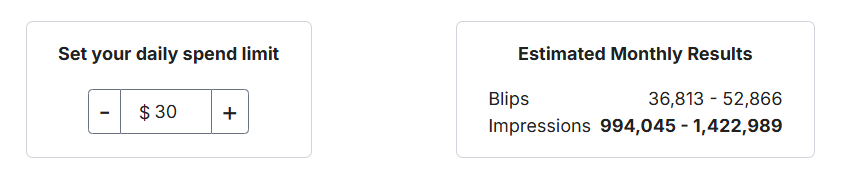
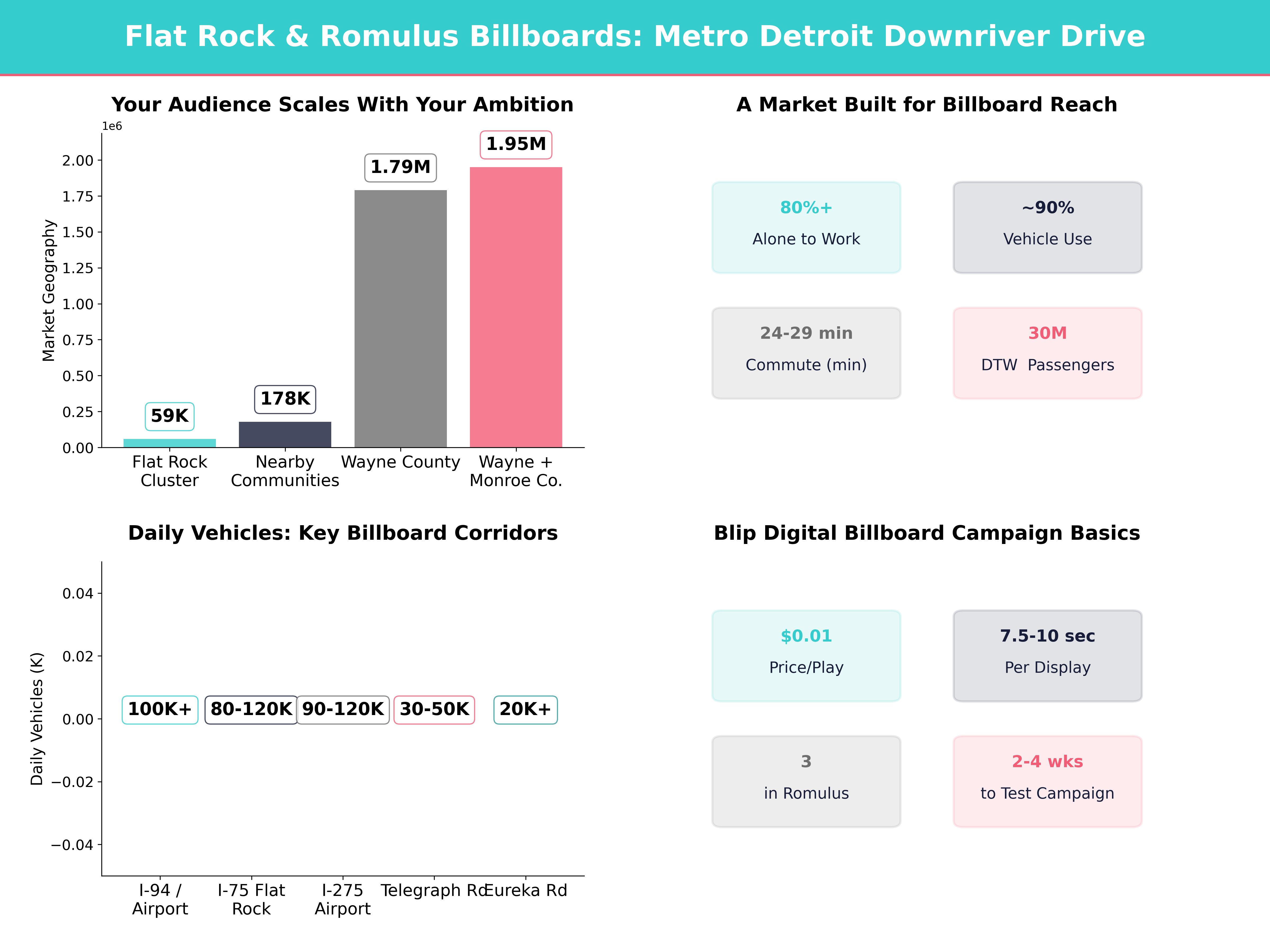
Blip makes billboard advertising in the Flat Rock area flexible and affordable. You set a daily budget, and Blip’s algorithm uses it to bid for open ad slots on rotating digital billboards serving the Flat Rock area. You only pay when your ad actually appears, with each “blip” lasting 7.5 to 10 seconds and starting at just $0.01 per display.
Where can I advertise with Blip near Flat Rock, Michigan?
Our 3 digital billboards in nearby Romulus, all within 10.0 miles of Flat Rock, give us an efficient way to reach drivers serving the Flat Rock area without relying on long traditional booking cycles. The local audience travels heavily by car, and the routes connecting the Flat Rock area to Detroit Metropolitan Wayne County Airport, I-75, I-94, and west-side job centers create repeated exposure all week long. That combination makes billboard campaigns near Flat Rock especially useful for retail, healthcare, home services, recruiting, education, dining, and travel-related brands.
Why is Flat Rock, Michigan a good market for billboard advertising with Blip?
Flat Rock is a strong place to target with billboard advertising because it sits where Downriver commuting, airport-driven commerce, and suburban household spending overlap. The local audience travels heavily by car, and the routes connecting the Flat Rock area to Detroit Metropolitan Wayne County Airport, I-75, I-94, and west-side job centers create repeated exposure all week long. That combination makes billboard campaigns near Flat Rock especially useful for retail, healthcare, home services, recruiting, education, dining, and travel-related brands.
When is the best time to run a billboard campaign in Flat Rock?
We usually recommend heavier delivery during 5:00 to 9:00 a.m. and 2:00 to 6:00 p.m. when a campaign is built around hiring, healthcare appointments, financial services, or destination retail. Spring and summer are prime seasons for household spending and recreation serving the Flat Rock area, while late summer and fall are excellent for back-to-school, healthcare, recruiting, automotive maintenance, and football-season dining offers. Holiday travel makes November and December especially relevant for airport parking, hotels, restaurants, gift retail, and convenience categories serving the Flat Rock area through nearby Romulus.
What kind of traffic do Flat Rock-area billboards get with Blip?
Major Downriver segments of I-75 commonly carry about 80,000 to 120,000 vehicles per day, depending on the exact segment. I-94 near the airport regularly runs well above 100,000 vehicles per day on key segments, and I-275 near the airport often lands around 90,000 to 120,000 vehicles per day. Those are exactly the kinds of traffic levels we want when we are building frequency for a campaign serving the Flat Rock area.
Do I need a contract to advertise with Blip near Flat Rock?
No, Blip has no long-term contracts or minimum commitments. You can start, pause, or stop your campaign at any time.
How fast can I launch a billboard campaign with Blip near Flat Rock?
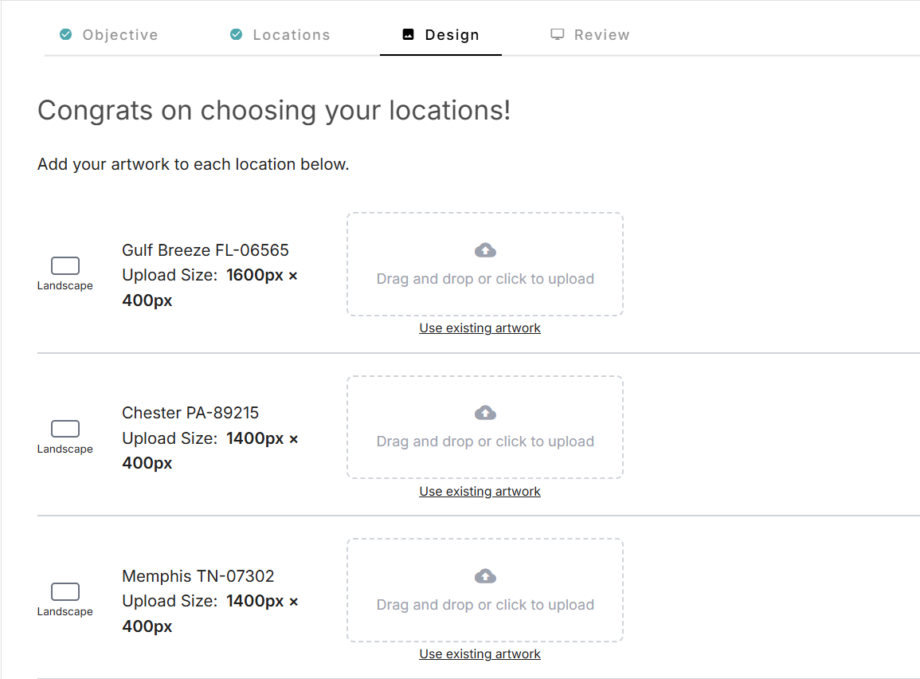
You can have your campaign live in minutes. Create a free account, select your locations, set your budget, upload your design, and start running once approved.
Where can I advertise with Blip near Flat Rock?
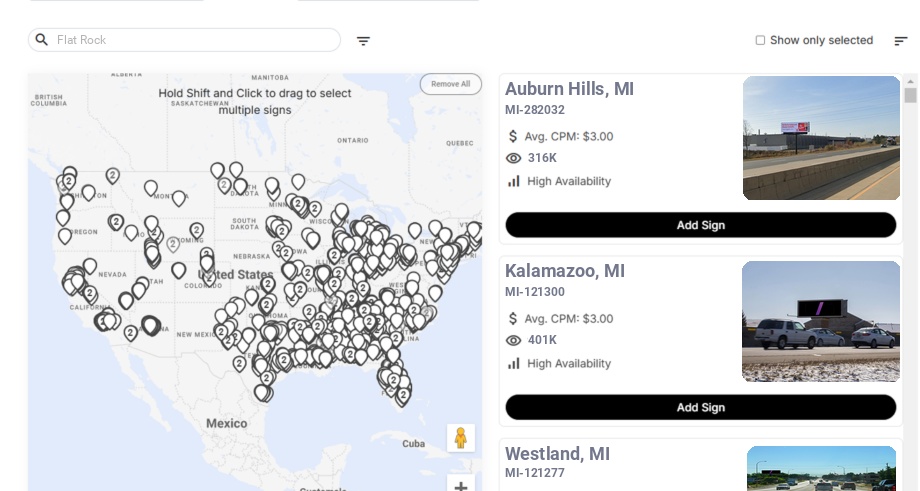
Blip has digital billboards near Flat Rock. You can browse available locations on a map, choose the ones that fit your audience, and start advertising right away.
Still have questions? Launch a campaign in minutes — no contracts, no commitments.
Start Your CampaignFlat Rock Billboard Advertising Guide
Flat Rock is a strong place to target with billboard advertising because it sits where Downriver commuting, airport-driven commerce (more than 30 million passengers in 2023 at DTW), and suburban household spending overlap. Our 3 digital billboards in nearby Romulus, all within 10.0 miles of Flat Rock, give us an efficient way to reach drivers serving the Flat Rock area without relying on long traditional booking cycles. The local audience travels heavily by car, and the routes connecting the Flat Rock area to Detroit Metropolitan Wayne County Airport, I-75, I-94, and west-side job centers create repeated exposure all week long. That combination makes billboard campaigns near Flat Rock especially useful for retail, healthcare, home services, recruiting, education, dining, and travel-related brands.
Market overview for the Flat Rock area
Population scale and trade area around Flat Rock
We should think about Flat Rock as a focused city market inside a much larger regional drive shed. At the 2020 Census, Flat Rock had 10,541 residents, but the surrounding communities quickly expand the reachable audience for advertisers serving the Flat Rock area.
- Brownstown Township had 30,627 residents.
- Woodhaven had 12,941 residents.
- Southgate had 30,047 residents.
- Taylor 63,409 residents.
- Romulus had 25,178 residents.
- Gibraltar 4,997 residents.
- Wayne County had 1,793,561 residents, making it Michigan’s most populous county.
- Monroe County 154,809 residents just to the south.
Those numbers matter because many businesses serving the Flat Rock area do not depend on one small municipal boundary. They depend on a cluster of nearby neighborhoods and commuting patterns. Just Flat Rock, Brownstown Township, Woodhaven, and Gibraltar total 59,106 residents. When we add Romulus, Taylor, and Southgate, the nearby audience rises to 177,740 residents. If a business draws from both Wayne and Monroe counties, the larger north-south market totals 1,948,370 residents.
We also like this market because it sits inside the SEMCOG 7 counties across Southeast Michigan. That regional scale gives advertisers near Flat Rock a much larger economic backdrop than the city size alone might suggest.
Economy and commuting behavior serving the Flat Rock area
The Flat Rock area is tied to several durable economic engines. We see steady demand tied to Ford, especially the Flat Rock Assembly Plant, the airport and logistics ecosystem around DTW, retail corridors in Taylor Southgate, and a broad mix of healthcare, education, construction, and service businesses across Downriver. State labor information from the Michigan Center for Data and Analytics consistently reflects how important transportation, manufacturing, warehousing, and services are across this part of Southeast Michigan.
For billboard strategy, the most important behavioral fact is simple: this is a driving market. SEMCOG driving alone above 80% of work trips, and total private-vehicle commuting usually reaches roughly 9 in 10 workers once carpooling is included. Public transit exists through SMART, but it plays a much smaller role here than private vehicles. Mean commute times across nearby communities often land in the 24- to 29-minute range, which gives us enough roadway time for repeated ad exposure to matter.
That pattern is why digital billboards near Flat Rock work well for practical, high-intent categories. When people are already on the road for work, errands, school, appointments, airport trips, and recreation, we can meet them during real decision windows instead of hoping they happen to search at the right moment.
Key traffic corridors serving the Flat Rock area
I-75 and the Downriver spine near Flat Rock
For many advertisers, I-75 is the core north-south artery serving the Flat Rock area. It connects drivers from Flat Rock and Brownstown Township to Woodhaven, Taylor Southgate, Detroit job centers, and Monroe County destinations. According to MDOT traffic count maps 80,000 to 120,000 vehicles per day, depending on the exact segment.
We pay close attention to I-75 because it supports several different advertiser goals at once. It carries weekday commuters, shift workers, shopping trips, high school and youth sports traffic, and weekend leisure trips. If a business serves the Flat Rock area but also draws from the rest of Downriver, I-75 is often the route that knits those audiences together.
Local feeder roads such as Gibraltar Road and Huron River Drive matter too, because they move neighborhood traffic toward the interstate network. Even when our billboards are in nearby Romulus instead of directly along I-75, we still think about I-75 as a primary origin corridor for the audience we want to intercept.
I-94, I-275, and the Romulus airport corridor serving Flat Rock
Our Flat Rock-area inventory is especially useful because all 3 of our nearby digital billboards are in Romulus, within 10.0 miles of Flat Rock, and Romulus sits at one of the region’s biggest mobility hubs. DTW handled more than 30 million passengers in 2023, and the roads around the airport also serve airport employees, freight operators, hotel traffic, rental-car users, rideshare drivers, and logistics workers.
That produces very strong highway exposure. MDOT well above 100,000 vehicles per day on key segments. I-275 near the airport often lands around 90,000 to 120,000 vehicles per day. Those are exactly the kinds of traffic levels we want when we are building frequency for a campaign serving the Flat Rock area.
This corridor is especially valuable for advertisers whose customers move west toward the airport district, north toward retail and employment centers, or outward for regional travel. It is also useful for recruiting campaigns, because airport and warehouse operations often run multiple shifts and generate repeated commuter patterns from the same households.
Telegraph Road and local connectors near Flat Rock
Telegraph Road Taylor Dearborn-area destinations, and the I-94 network. MDOT traffic count maps 30,000 to 50,000 vehicles per day.
We also watch surface connectors that bridge local neighborhoods to regional travel. Selected segments of Eureka Road near the airport district exceed 20,000 vehicles per day, and local routes such as Gibraltar Road, Huron River Drive, and Telegraph help convert neighborhood demand into regional drive traffic. From a strategy standpoint, that means a Romulus billboard can still be highly relevant to the Flat Rock area because it sits on the route system people already use for work, shopping, flights, and regional errands.
In practical terms, the short distance between Flat Rock and our Romulus inventory helps. A nearby billboard is much more valuable when it matches an actual trip pattern than when it simply shares a ZIP code. That is why we focus on route alignment, not just proximity.
Audience segments near Flat Rock
Commuters, shift workers, and industrial employees serving Flat Rock
The first major audience near Flat Rock is the commuter base. Because driving alone is typically 80%+ of work trips in nearby communities, and total private-vehicle commuting is around 90%, commuters are the clearest billboard audience in this market. We can reach office workers, tradespeople, healthcare employees, automotive workers, logistics teams, airport personnel, and service technicians during habitual weekday travel.
We usually recommend heavier delivery during 5:00 to 9:00 a.m. and 2:00 to 6:00 p.m. when a campaign is built around hiring, healthcare appointments, financial services, or destination retail. Those windows line up especially well with the Flat Rock area because so much of the workforce follows scheduled shifts rather than purely remote or flexible work patterns.
This segment is a strong fit for:
- Staffing and recruiting campaigns.
- Trade schools and career education.
- Auto service, tire, and oil-change offers.
- Urgent care, dental, and vision appointments.
- Insurance, banking, and tax services.
Families, homeowners, and local service buyers in the Flat Rock area
The second major audience is the family and homeowner market. Flat Rock, Brownstown Township, Woodhaven, and Gibraltar combine for 59,106 residents, and the broader nearby cluster reaches 177,740 when we include Romulus, Taylor Southgate. That is a meaningful suburban base for businesses that need household decision-makers rather than only downtown office density.
We see this audience respond well to practical categories that fit daily life in the Flat Rock area, including:
- Roofing, HVAC, plumbing, and remodeling.
- Grocery, pharmacy, and quick-service dining.
- Pediatric, family dental, and urgent care services.
- Furniture, mattresses, and home improvement stores.
- Youth activities, tutoring, and seasonal programs.
Because many of these purchases are not impulsive, billboard frequency matters. A parent may not act the first time they see an ad near Flat Rock, but repeated impressions across the same weekly routes can put a brand at the top of mind when the need becomes urgent.
Travelers, students, and recreation audiences serving Flat Rock
The third audience is a mix of travelers, students, and recreation-oriented consumers. The airport corridor in nearby Romulus broadens the audience beyond local residents. With 30 million-plus annual passengers at DTW, there is constant circulation from visitors, airport workers, hotels, and mobility services that overlaps with local consumer spending.
Seasonal recreation adds another layer. The 1,607-acre Lake Erie Metropark, operated by the Huron-Clinton Metroparks, pulls warm-weather visitation from across the south Wayne and Monroe corridor. That helps categories like dining, entertainment, fuel, convenience retail, sporting goods, and healthcare screening campaigns.
Students matter as well. Flat Rock Community Schools August through early June, and broader college-oriented traffic reaches toward University of Michigan-Dearborn Henry Ford College, and Wayne County Community College District. We often see education, banking, telecom, and entry-level recruiting campaigns perform best around August, January, and May.
Seasonal and timing opportunities in the Flat Rock area
Spring and summer timing near Flat Rock
Spring and summer are prime seasons for household spending and recreation serving the Flat Rock area. We usually like March through June for tax-season offers, home improvement, landscaping, windows, roofing, and remodeling. That same period also supports medical checkups, family dining, graduation promotions, and moving-related services.
By June through August, the market adds more outdoor activity, park trips, youth sports, and airport leisure travel. Campaigns tied to DTW, the Huron-Clinton Metroparks, and regional dining or entertainment often benefit from stronger afternoon, evening, and weekend weighting during the warm months.
Fall and winter timing serving Flat Rock
Late summer and fall are excellent for back-to-school, healthcare, recruiting, automotive maintenance, and football-season dining offers. We often recommend stronger schedules from late August through November for brands targeting parents, students, and workers settling into routine weekday patterns again.
Holiday travel makes November and December especially relevant for airport parking, hotels, restaurants, gift retail, and convenience categories serving the Flat Rock area through nearby Romulus. Winter then opens opportunities for HVAC, tires, batteries, urgent care, and high-contrast weather-driven messaging from December through February. In a Michigan market, seasonal relevance is not cosmetic. It is a direct response to how people actually drive, shop, and solve problems.
Billboard design tips for campaigns near Flat Rock
Creative choices that fit the Flat Rock market
The Flat Rock area is a windshield market, not a walk-up downtown market. That means we should design for drivers moving at roughly 55 to 70 mph on highways and fast arterials. Our best local creative is usually simple, practical, and unmistakable.
We recommend a few geography-specific habits. We keep the main headline to 7 words or fewer whenever possible. We use one strong visual, one offer, and one call to action. We favor high-contrast palettes because Michigan winter light, road spray, and gray skies can reduce legibility. We use imagery that feels native to the region, including clean automotive cues, family-service visuals, travel imagery, and blue or green tones that fit the Huron River and Lake Erie environment. We avoid cluttered urban-style layouts with too much text, because they slow comprehension on I-94, I-275, and other fast corridors.
For the Flat Rock area, straightforward messaging usually beats abstract branding. A healthcare provider, staffing firm, airport service, or home contractor should look helpful and immediate, not mysterious.
Messages that work with Flat Rock-area drivers
We see the best results near Flat Rock when the message fits a real trip. Examples include travel cues such as “Minutes from DTW,” recruiting cues such as “Hiring 1st Shift,” and family-service cues such as “Downriver Dental Appointments.” Those lines are short enough to read quickly and specific enough to remember later.
We also recommend directional or regional phrasing when it is true. Terms like “Near I-75,” “Off Telegraph,” “Serving Downriver Families,” or “Airport Parking Ahead” can make a billboard feel more useful to local drivers. Price-led promotions can work well here too, especially for automotive, dining, healthcare screening, or home service categories.
One caution matters in this market: QR codes are usually a weak choice on fast roads. For campaigns near Flat Rock, a short URL, a memorable brand name, or a simple offer usually works better than asking drivers to complete a scan at speed.
Regional strategies serving the Flat Rock area
Using nearby Romulus billboards to reach Flat Rock consumers
Because our Flat Rock-area inventory is concentrated in nearby Romulus, we treat it as a regional interception strategy rather than a hyperlocal neighborhood strategy. That is a strength, not a limitation. Romulus sits where airport traffic, freight movement, hotel demand, and west-side commuting all converge, so it gives us access to the kind of repeated drive behavior that makes digital billboards efficient.
We especially like the Romulus boards for:
- Recruiting campaigns for warehouse, manufacturing, aviation, healthcare, and skilled-trade jobs.
- Airport-related brands such as parking, hotels, shuttles, rideshare services, and travel products.
- Destination businesses that draw customers from multiple Downriver communities.
- Regional healthcare providers, colleges, and retail brands that want broad awareness serving the Flat Rock area.
When a brand needs frequency across a practical daily route, nearby Romulus often does more work than a smaller local placement would.
Matching offers to suburban corridors and commercial zones near Flat Rock
We generally divide the Flat Rock market into a few functional zones, even when the billboard inventory is nearby rather than inside every zone.
For the Flat Rock, Brownstown Township, Woodhaven, and Gibraltar household cluster, we recommend family-service messaging. Home services, medical practices, dentists, childcare, tutoring, grocery, and local dining all fit well because the combined population there is 59,106 and the purchase behavior is strongly household-driven.
For Taylor Southgate, we like retail and destination messaging. Those cities add 93,456 residents together, and they function as larger commercial nodes for much of Downriver. Furniture, entertainment, restaurants, auto dealerships, and price-led promotions often make sense there.
For the Romulus airport and interchange zone, we prefer business-travel, workforce, and convenience categories. The airport corridor is where “open now,” “hiring now,” “nearby parking,” “same-day care,” and similar messages tend to feel most natural.
Blip tools and capabilities for the Flat Rock area
Smart scheduling for Flat Rock-area traffic patterns
We do not need to overcomplicate a Flat Rock-area campaign to make it effective. We can choose the nearby Romulus billboards on a map, set a daily budget, schedule the times and days that matter most, and align the creative to the specific trip pattern we want. That flexibility is especially useful in a market where weekday commuting, airport travel, school calendars, and seasonal recreation all change the audience mix.
For example, we can weight a campaign toward 6:00 to 9:00 a.m. and 3:00 to 7:00 p.m. if the goal is commuter frequency, or we can shift toward afternoons and weekends if the goal is dining, entertainment, or airport-related demand. Because pricing is pay-per-play and starts at $0.01 per display, we can test corridor strategy without committing to a rigid long-term buy.
Optimization and testing near Flat Rock
Digital inventory also lets us improve creative and timing as we learn. Each ad display lasts about 7.5 to 10 seconds, so we want to use those seconds carefully. We often recommend starting with 2 or 3 creative versions and then watching performance to see whether the local audience responds better to hiring language, price language, seasonal language, or a stronger geographic cue.
That matters near Flat Rock because the market contains several overlapping behaviors at once. A commuter-heavy weekday message may outperform on Monday through Friday, while a family-oriented weekend version may perform better from Thursday through Sunday. Real-time analytics make those adjustments much easier than they are with a traditional static billboard buy.
Getting started with billboard rental near Flat Rock
How we evaluate billboard locations serving Flat Rock
When we plan billboard rental near Flat Rock, we start with the customer journey, not the map pin alone. A board in nearby Romulus can be a stronger fit than a theoretically closer location if it matches the route your audience actually drives.
We usually ask four questions first:
- Are we trying to reach Flat Rock-area residents on the way to work, on the way home, or on the way to the airport?
- Are we targeting household decision-makers, shift workers, travelers, students, or broad regional consumers?
- Do we need weekday commuter volume, weekend family traffic, or both?
- Is the goal immediate action, such as calls or applications, or longer-term awareness that supports later search and store visits?
For the Flat Rock area, those answers often determine whether we should emphasize airport-corridor frequency, suburban household messaging, or destination-retail awareness.
What to expect when renting a billboard near Flat Rock with Blip
Traditional billboard buying often requires fixed terms, rep negotiations, large commitments, and very limited agility once a campaign starts. We take a simpler approach. We can launch quickly, run only when the audience matters most, pause if priorities change, and optimize based on live results rather than waiting out a contract.
For advertisers serving the Flat Rock area, we usually suggest starting with a focused test. A 2- to 4-week campaign is often enough to evaluate whether a message is generating lift in direct traffic, branded search, phone calls, appointment requests, coupon use, or job applications. From there, we can sharpen the dayparts, swap in stronger creative, or increase delivery around the best-performing windows.
The biggest advantage is control. We can align the nearby Romulus boards with the real mobility patterns of the Flat Rock area, use only the budget we want, and improve the campaign as the data comes in. That makes billboard rental near Flat Rock far more approachable than many advertisers expect, especially for businesses that want regional reach without traditional out-of-home friction.