Billboards in Clinton, MI
No Minimum Spend. No Long-Term Contracts. Just Results.
Trusted by Leading Brands


Billboard advertising
in Clinton has never been easier



How much is a billboard in Clinton?
Why Choose Blip for Billboard Advertising in Clinton
Blip lets you launch in Clinton on US-12 and M-52 with any budget, so you can reach commuters without a big upfront buy.
Use Clinton's crossroads traffic to daypart ads for weekday drivers and weekend visitors headed to MIS or Hayes State Park.
No contracts in Clinton means you can test messaging for Adrian, Chelsea, and Ann Arbor traffic, then adjust fast.
Blip's real-time analytics help Clinton advertisers track what's working on car-heavy routes where most workers drive alone.
Create and swap Clinton billboard copy quickly for race weekends, school traffic, or hiring campaigns across Lenawee County.
Frequently Asked Questions About Billboard Advertising in Clinton
How much does a billboard cost in Clinton, Michigan with Blip?
With Blip, billboard advertising in Clinton can be surprisingly affordable because you only pay when your ad actually appears. Each “blip” is a 7.5-to-10-second display on a rotating digital billboard, and pricing starts at just $0.01 per display. Since costs change based on time of day, location, and advertiser demand, you stay in control while Blip works to maximize exposure for your budget.
Where can I advertise with Blip in Clinton, Michigan?
Clinton, Michigan is a strong billboard market because we are advertising at a true crossroads rather than in an isolated small town. The Village of Clinton sits at the intersection of US-12 and M-52, giving access to daily commuters, regional shoppers, and seasonal visitors moving between Adrian, Chelsea, Saline, Ann Arbor, Brooklyn, and Jackson. US-12 through Clinton commonly runs in roughly the 9,000 to 12,000 vehicles-per-day range, depending on the segment and count year.
Why is Clinton, Michigan a good market for billboard advertising with Blip?
Clinton is a strong billboard market because it sits at a true crossroads and reaches a much larger regional audience than its small population suggests. Lenawee County is stable, while Washtenaw County to the northeast has grown, which is useful for speaking to both longtime local households and more dynamic commuter, student, and professional flows. Because local travel is overwhelmingly car-based, billboards can deliver both frequency and timely intent.
What kind of drivers does Blip reach on billboards in Clinton, Michigan?
The most dependable audience in Clinton is the commuter household. About 83% of workers drive alone to work, about 8% carpool, and the average commute is about 26 minutes. That high vehicle dependency makes billboard campaigns especially effective for categories like healthcare, quick-service restaurants, auto service, insurance, and skilled-trades recruiting.
When is the best time to run billboard ads in Clinton, Michigan with Blip?
Late August through November is one of the best advertising windows in this market because school resumes, college towns repopulate, and football weekends add energy. Spring and summer also favor tourism, outdoor living, and home projects, while winter rewards clarity, urgency, and earlier dayparting. We can use Blip’s scheduling tools to concentrate spend on weekday commute windows, then pivot to Friday afternoon, Saturday, and Sunday schedules for tourism, restaurants, and event-driven categories.
Do I need a contract to advertise with Blip in Clinton?
No, Blip has no long-term contracts or minimum commitments. You can start, pause, or stop your campaign at any time.
How fast can I launch a billboard campaign with Blip in Clinton?
You can have your campaign live in minutes. Create a free account, select your locations, set your budget, upload your design, and start running once approved.
Where can I advertise with Blip in Clinton?
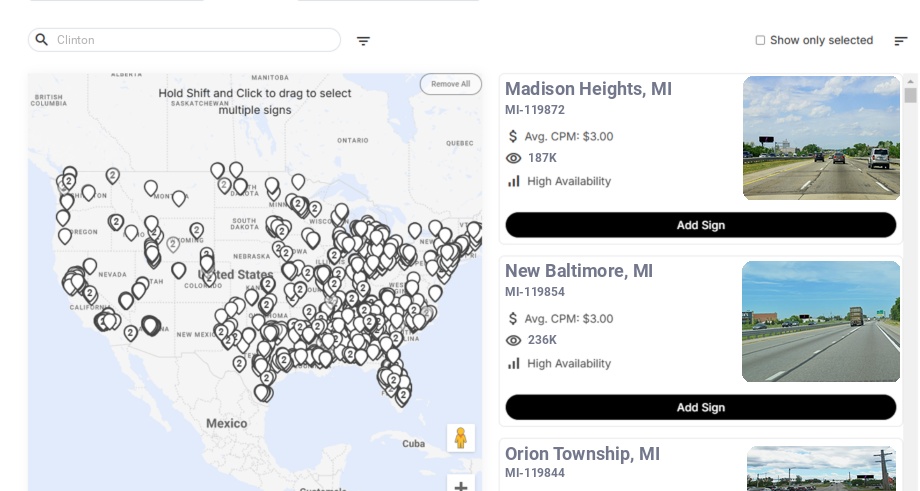
Blip has digital billboards in Clinton. You can browse available locations on a map, choose the ones that fit your audience, and start advertising right away.
Still have questions? Launch a campaign in minutes — no contracts, no commitments.
Start Your CampaignClinton Billboard Advertising Guide
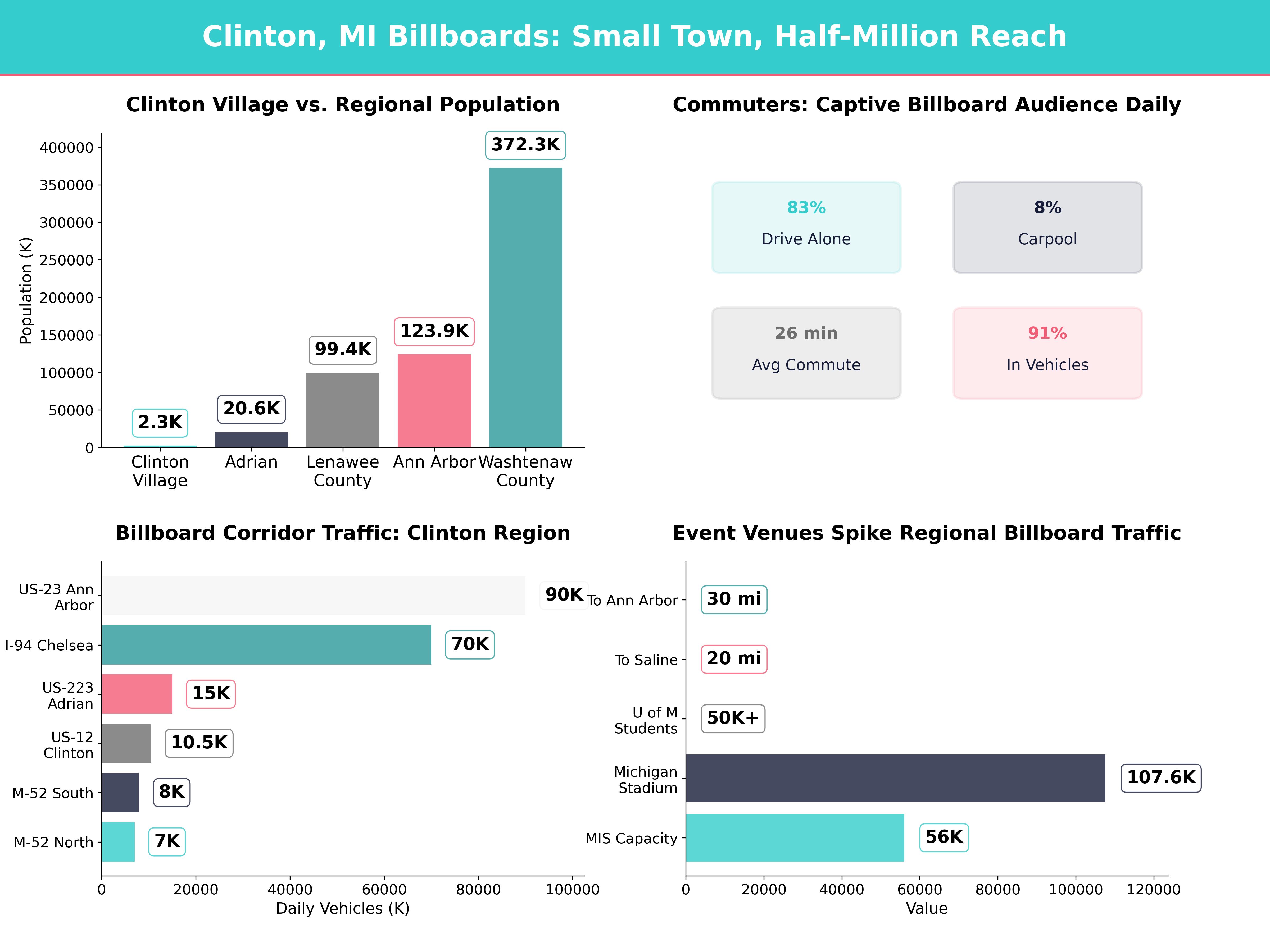
Clinton, Michigan is a strong billboard market because we are advertising at a true crossroads rather than in an isolated small town. The Village of Clinton has only about 2,300 residents, but it sits at the intersection of US-12 and M-52 Adrian, Chelsea, Saline, Ann Arbor, Brooklyn Jackson Lenawee County 99,423 residents, and nearby Washtenaw County adds 372,258 more, so even a Clinton-focused campaign can reach a much larger regional audience. Because local travel is overwhelmingly car-based, with about 83% of workers driving alone and about 8% carpooling, and because tourism assets like Michigan International Speedway Hidden Lake Gardens W. J. Hayes State Park
Clinton Market Overview
Clinton’s size is small, but its trade area is regional.
When we plan outdoor advertising in Clinton, we should think beyond the village limits. Clinton’s own population is about 2,300, but the surrounding market is much larger because the village sits between the service hub of Adrian, population 20,645, and the higher-growth orbit of Ann Arbor, population 123,851. Clinton is roughly 15 miles from Adrian, around 20 miles from Saline, about 20 miles from Chelsea, and roughly 30 to 35 miles from both Ann Arbor and Jackson.
That geography matters because it lets us reach multiple consumer patterns with one regional message. A family in Clinton might shop in Adrian, work near Chelsea, attend events in Ann Arbor, and spend summer weekends near Brooklyn or the Irish Hills. For billboard advertisers, that kind of overlap is valuable because it turns a rural crossroads into a repeated-exposure market.
Clinton sits in a stable county and next to a faster-growing county.
Lenawee County 99,423 residents in 2020, compared with 99,892 in 2010, which is a change of about -0.5% across the decade. That tells us the county is stable rather than rapidly expanding. Stable markets can be excellent for billboards because businesses are often competing for share of wallet, repeat local visits, and trusted brand recall.
Just to the northeast, Washtenaw County grew from 344,791 residents in 2010 to 372,258 in 2020, which is an increase of about 8.0%. That contrast is useful. We can use Clinton-area boards to speak both to longtime Lenawee County households and to the more dynamic commuter, student, and professional flows connected to the Ann Arbor area.
Clinton is a driving market, which is exactly what billboard advertisers want.
Local travel behavior strongly favors outdoor media. ACS-based county profiles show that about 83% of workers in Lenawee County drive alone to work, about 8% carpool, and the average commute is about 26 minutes. In practical terms, that means more than 9 in 10 commuters are in vehicles, not on trains or sidewalks, during their daily travel.
That high vehicle dependency makes billboard campaigns especially effective for categories that benefit from repeated visual reminders. We should think about healthcare, quick-service restaurants, convenience stores, auto service, hardware, insurance, legal services, regional colleges, skilled-trades recruiting, and tourism businesses that want to intercept travelers before they make a turn or choose a destination.
The economic mix supports both consumer and recruitment campaigns.
Organizations like Lenawee Now and Michigan Works! Southeast 40,000s, so workforce messaging is not a niche play here. Employers can use Clinton-area billboards to recruit welders, technicians, CDL drivers, healthcare workers, and front-line service employees moving along US-12 and M-52.
For consumer brands, the same roads also carry households making practical spending decisions. This is a market where clear offers, convenience, trust, and location cues often outperform abstract brand language.
Key Traffic Corridors for Clinton Billboards
US-12 through Clinton
According to traffic count maps from the Michigan Department of Transportation 9,000 to 12,000 vehicles-per-day range, depending on the segment and count year. That is meaningful volume for a village this size, especially because US-12 is not just a local street. It is the east-west spine connecting Clinton to Saline, Ann Arbor, Brooklyn
This corridor is especially useful for the following advertisers:
- Restaurants, convenience brands, and fuel stops can use US-12 to capture drivers who are already in motion and deciding where to stop next.
- Healthcare providers, dental offices, and urgent care brands can use US-12 for repeated weekday frequency among local households.
- Retailers and service businesses can use directional copy because many drivers are traveling from one town to another with a purchase already in mind.
US-12 works best when we pair awareness with clear action. In Clinton, “Next right,” “Ahead in Adrian,” and “Worth the short drive” can be more persuasive than vague slogans.
M-52 north and south of Clinton
M-52 is the other core corridor, and it gives Clinton its north-south relevance. MDOT count maps commonly place M-52 south of Clinton toward Adrian in roughly the 7,000 to 9,000 AADT band, while segments north of town toward Manchester and Chelsea often fall around 6,000 to 8,000 AADT.
That traffic profile is ideal for campaigns that need regional reach rather than only hyperlocal reach. We can use M-52 to speak to several different audiences at once:
- Employers can recruit from both Lenawee County and the Chelsea-Ann Arbor direction.
- Colleges and training programs can reach students and adult learners traveling between home, work, and campus.
- Home services can target homeowners across a broad rural-suburban belt where people regularly drive for errands.
Because M-52 links very different consumer environments, creative should match travel direction. Northbound traffic moving toward Chelsea and Ann Arbor may respond well to higher-value education, specialty care, and professional services. Southbound traffic moving toward Adrian and Lenawee County may respond especially well to practical offers, hometown credibility, and immediate call-to-action messaging.
Regional connector routes around Clinton
For advertisers with a broader footprint, Clinton also sits close enough to major regional connectors that it can function as a feeder market. In Adrian, US-223 can exceed 15,000 vehicles per day on busier segments. Closer to Ann Arbor, US-23 frequently exceeds 90,000 AADT, and I-94 near the Chelsea-Ann Arbor area often carries more than 70,000 vehicles per day on many segments.
Those larger corridors matter for two reasons. First, they show that Clinton is plugged into a much bigger mobility network than its population alone suggests. Second, they give us a laddered strategy. We can use high-frequency local boards around Clinton to build repetition, and then support them with larger-reach regional boards on routes tied to Ann Arbor, Chelsea, and Adrian.
Clinton Audience Segments
Daily commuters and practical household buyers
The most dependable audience in Clinton is the commuter household. With about 83% of workers driving alone and about 8% carpooling, our message is reaching people during the most consistent part of their routine. This audience tends to respond well to categories that solve immediate needs, including banking, auto repair, tire shops, healthcare appointments, insurance, grocery, hardware, and fast food.
Because the average commute is about 26 minutes, we have enough travel time for repeated exposure over days and weeks. We should not expect one billboard view to close every sale. We should expect repeated route-based visibility to keep our brand top of mind until the buyer is ready.
Students, parents, and education decision-makers
Clinton also benefits from proximity to multiple education centers. Adrian College enrolls about 1,800 students, Siena Heights University adds another college audience in Adrian, and the University of Michigan enrolls more than 50,000 students in Ann Arbor. That creates overlapping opportunities for apartment marketing, food service, healthcare, tutoring, financial services, and part-time job recruiting.
Parents are important here too. Even when the students themselves live elsewhere, families drive these routes for move-ins, athletics, performances, and weekend visits. In late summer and early fall, boards that mention enrollment, hiring, student specials, and game-day convenience can perform especially well.
Tourists and weekend recreation travelers
Clinton has real weekend and seasonal tourism potential. Michigan International Speedway 2-mile oval with grandstand capacity of about 56,000, and race weekends can dramatically increase travel volumes on surrounding roads. W. J. Hayes State Park 654 acres, and Hidden Lake Gardens 755 acres, giving the area draw for campers, boaters, gardeners, hikers, and day-trippers.
That audience behaves differently from the weekday commuter audience. Weekend travelers are more likely to respond to dining, lodging, convenience retail, entertainment, attractions, cannabis where legal and appropriate, and “on your way” messaging. Boards that feel timely and place-based tend to win.
Sports and event travelers from the wider region
Clinton is also close enough to benefit from event traffic tied to Ann Arbor and Jackson-area recreation. Michigan Stadium seats 107,601, which means fall Saturdays can reshape travel behavior across much of southeastern Michigan. Even when a board is not adjacent to the stadium, it can still reach fans traveling to watch parties, tailgates, restaurants, hotels, or home gatherings.
For businesses with regional appeal, that creates predictable peaks. We can use Clinton-area placements to tap into game-day grocery runs, restaurant demand, apparel promotions, and local entertainment alternatives.
Seasonal and Timing Opportunities in Clinton
Spring and summer in Clinton favor tourism, outdoor living, and home projects.
From roughly April through August, the Clinton area leans into outdoor movement. Visit Lenawee promotes parks, lakes, festivals, golf, wineries, and day-trip activities across the county. This is the right season for campgrounds, marinas, lawn and garden, deck and patio companies, HVAC brands, farmers markets, outdoor dining, and family attractions.
Summer daylight also extends well past 9:00 p.m. in late June, which gives evening travel more value than it has in winter. If we are promoting restaurants, entertainment, parks, or impulse stops, we should consider later afternoon and evening schedules rather than concentrating only on the morning commute.
Late summer and fall in Clinton bring school traffic and event surges.
Late August through November is one of the best advertising windows in this market. School resumes, college towns repopulate, and football weekends add energy. The University of Michigan student body of 50,000-plus, Adrian College, and local K-12 districts all contribute to a sharp increase in routine driving.
Fall is also a season when creative can become more geographically specific. We can advertise services “on the way to Adrian,” “before Ann Arbor,” or “near Chelsea” because drivers are mentally orienting themselves by destination. We can also align campaigns with race weekends at Michigan International Speedway
Winter in Clinton rewards clarity, urgency, and earlier dayparting.
Winter changes how people drive in Clinton, but it does not reduce the importance of outdoor media. In December and January, darkness arrives before 5:30 p.m., and weather can make drivers more focused on practical needs. That is ideal for healthcare, pharmacies, tire and battery services, heating services, tax preparation, churches, indoor entertainment, and value-focused retail.
During winter, we should often shift more weight into morning and late-afternoon dayparts because those windows align with darker commutes and more immediate decision-making. We should also simplify creative even further. Snow, gray skies, and windshield glare all reward strong contrast and short copy.
Billboard Design Tips for the Clinton Market
In Clinton, local recognition beats abstract branding.
A Clinton audience responds well when we sound like we know the map. Place names such as Adrian, Chelsea, Saline, Ann Arbor, and Jackson
That kind of copy feels useful rather than decorative. In a crossroads market, usefulness matters.
Visual themes should match southern Michigan, not a generic metro template.
We should design for what people actually see around Clinton. Open sky, fields, tree lines, small-town storefronts, lakes, and sports travel are part of the visual environment. Creative that uses crisp seasonal colors, straightforward product photography, and imagery tied to outdoor recreation, hometown service, or college-weekend energy will usually feel more natural than slick urban luxury imagery.
For this market, strong visual directions include the following approaches:
- Deep blue, red, and white palettes can read cleanly against winter skies and rural backgrounds.
- Green, tan, and natural outdoor tones can work well for parks, landscaping, garden, and recreation offers.
- Game-day color stories can be effective in fall when we want to tap regional sports excitement without overcomplicating the message.
Offers should be concrete and easy to act on.
Because many Clinton-area drivers are moving at highway speed on 55 mph roads outside town, creative should usually focus on one idea. Local audiences often respond best to pricing, availability, hours, location cues, or a single brand promise like trust, speed, or convenience. “Same-day appointments,” “Now hiring 2nd shift,” “Family care in Adrian,” and “Exit soon for lunch” are all stronger than copy that tries to explain too much.
This is also a strong market for recruitment creative. Industrial, logistics, and healthcare employers should say exactly what matters, including shift, pay range if competitive, bonus availability, and location. If we have a real differentiator, we should put it on the board.
Regional Strategies for Clinton Advertisers
Clinton village and the immediate trade area
If our goal is local foot traffic, we should prioritize frequency over sheer reach. The village itself is small, but residents pass the same roads repeatedly. That makes nearby digital boards effective for restaurants, local retail, service businesses, churches, municipal messaging, and event promotion.
For these campaigns, we should keep the message highly local. Mentioning Clinton by name can be a strength here because it signals community presence and trust.
South toward Adrian
Southbound strategy should focus on Adrian as the county’s primary service center. With 20,645 residents, Adrian concentrates healthcare, education, legal services, government activity, and retail. This makes the M-52 corridor especially valuable for providers that want patients, students, shoppers, or job applicants from across Lenawee County.
If we have an Adrian business, we should place messages far enough north of the city to influence the trip before the driver is already committed elsewhere. If we are a Clinton business competing for Adrian dollars, we should emphasize convenience, speed, and “worth the short drive” logic.
East and north toward Saline, Chelsea, and Ann Arbor
This subregion changes the audience profile. Saline, Chelsea, and Ann Arbor bring more student travel, more white-collar commuting, and stronger demand for specialty healthcare, financial services, education, and premium consumer categories. Ann Arbor Area Convention & Visitors Bureau tourism activity also keeps this side of the market active beyond weekday commuting.
For campaigns aimed in this direction, we can justify more aspirational creative, higher-value offers, and messages tied to appointments, events, or advance planning. We should also consider weekday morning eastbound and evening westbound dayparts because those align with commuting flows.
West toward Brooklyn, MIS, and Jackson
The western side of Clinton becomes especially important during leisure travel. Michigan International Speedway
This is where we can use “before you arrive” messaging very effectively. Drivers heading west often still have choices to make, and a billboard can influence the stop they choose.
Using Blip Tools in Clinton
We can match schedule to route behavior.
In a place like Clinton, timing matters almost as much as location. We can use Blip’s scheduling tools to concentrate spend on weekday commute windows for healthcare, banking, recruiting, and service businesses, then pivot to Friday afternoon, Saturday, and Sunday schedules for tourism, restaurants, and event-driven categories. On roads like US-12 and M-52, this kind of dayparting lets us buy relevance rather than just impressions.
We can run different creative for different directions and seasons.
Clinton is not one audience. It is a cluster of audiences moving in different directions. With Blip, we can rotate creative that speaks to southbound Adrian traffic, eastbound Ann Arbor traffic, and weekend recreation traffic without rebuilding the entire campaign from scratch. We can also refresh creative quickly for race weekends, back-to-school periods, football Saturdays, fall service promotions, or winter weather needs.
We can optimize as local conditions change.
One of the biggest advantages in a smaller regional market is agility. If one corridor is outperforming another, we can reallocate budget quickly. If a seasonal message starts strong around W. J. Hayes State Park Michigan International Speedway
Getting Started with Billboard Rental in Clinton
Start with one clear objective for Clinton.
Before we choose any board, we should decide what success looks like. If we want local walk-ins, we should focus on boards close to Clinton and along the most direct approach roads. If we want regional brand awareness, we should choose corridors that connect Clinton to Adrian, Chelsea, Saline, and Ann Arbor. If we want recruiting, we should think first about where workers actually drive, not where our office sits.
A clear objective prevents us from buying visibility that looks good on a map but does not move the right audience.
Choose locations by travel pattern, not just by pin drop.
In Clinton, the best billboard is usually the one that reaches the driver before the decision point. That means we should evaluate boards based on direction of travel, time of day, and destination sequence. A board 5 to 10 miles before a turn can be more valuable than a board directly next to the business if the driver has already committed to another option.
We should also ask a few practical questions before launching:
- Are we trying to reach weekday commuters, weekend visitors, or both?
- Are drivers headed toward Adrian, toward Ann Arbor, or through Clinton itself?
- Are we promoting an impulse decision, or are we building recall for a later choice?
Use testing to build confidence before scaling.
Traditional billboard buying often pushes advertisers into larger commitments before they know which message or corridor works best. Clinton is a great market for testing because travel patterns are understandable and seasonal shifts are visible. We can start with a focused set of digital boards, run 2 to 3 creative versions, compare timing windows, and then scale what proves itself.
That approach is especially helpful for local businesses that have never rented a billboard before. We do not need to guess perfectly on day one. We need to start with a smart hypothesis and improve from real-world results.
Evaluate success with local intent signals.
In a market like Clinton, success often shows up in practical business metrics. We should watch for lifts in branded search, website visits from nearby ZIP codes, appointment volume, coupon use, phone calls, and in-store traffic during active flight windows. For event-driven campaigns, we should compare race weekends, football weekends, or holiday periods against normal weeks.
When we combine local geography knowledge with flexible execution, Clinton becomes a very efficient billboard market. We are not only advertising to a village of 2,300 people. We are advertising to a mobile regional audience that uses Clinton’s crossroads every day.