Billboards near Hamtramck, MI
No Minimum Spend. No Long-Term Contracts. Just Results.
Trusted by Leading Brands


Billboard advertising
near Hamtramck has never been easier
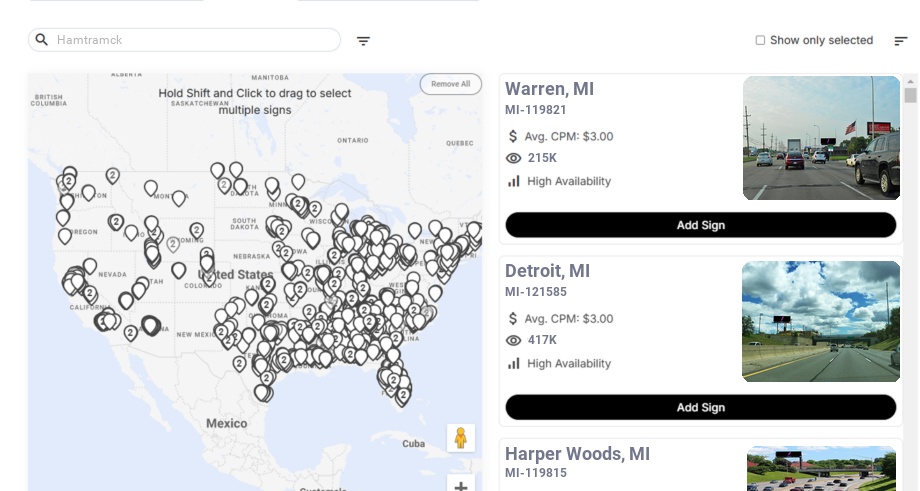



How much is a billboard near Hamtramck?
Why Choose Blip for Billboard Advertising near Hamtramck
Blip lets you launch Hamtramck ads fast on I-75 and I-94 corridors, reaching dense commuter traffic without traditional buy-in.
Set a flexible budget for Hamtramck and scale up during Pączki Day, Labor Day Festival, or Ramadan nights when foot traffic spikes.
Use Blip's dayparting to hit Hamtramck workers on 3-6 p.m. return trips and morning outbound commuters with the right message.
No contracts mean you can test Hamtramck billboards near Joseph Campau, Conant, and Caniff, then shift spend to what performs.
Track Hamtramck campaign results in real time and refine creative for multilingual, value-focused audiences across central Detroit.
Frequently Asked Questions About Billboard Advertising near Hamtramck
How much does a billboard cost near Hamtramck, Michigan with Blip?
With Blip, you control exactly what you spend on Hamtramck billboards by setting a daily budget that can be adjusted at any time, so your ads stay within your comfort zone. Each “blip” is a 7.5 to 10-second ad on digital billboards near Hamtramck, Michigan, and you only pay for the blips you receive. Pricing for each blip varies based on when and where you choose to advertise in the Hamtramck area and on advertiser demand, so you can run cost-efficient campaigns during the times that matter most to you.
Where can I advertise with Blip near Hamtramck, Michigan?
Hamtramck sits at the cultural heart of central Detroit, and our 39 digital billboards near Hamtramck create a powerful way to reach residents, workers, and visitors moving through the Hamtramck area every day. Our digital boards in nearby cities—including Detroit, Hazel Park, Center Line, Madison Heights, Warren, and Oak Park—are well positioned to repeatedly reach people who live, shop, commute, or worship in the Hamtramck area. In many cases, these boards sit within 5–15 minutes’ drive of central Hamtramck, making it possible to generate multiple daily impressions for regular commuters.
Why is Hamtramck, Michigan a good market for billboard advertising with Blip?
Hamtramck is dense, diverse, and young—very different from a typical suburban billboard market. The City of Hamtramck reports a population of about 28,000+ residents in just 2.1 square miles, making it one of the most densely populated cities in Michigan with roughly 13,500 residents per square mile. It is also one of the most diverse small cities in the U.S., with residents tracing roots to over 20 countries and multiple languages commonly spoken at home.
When should I run billboard ads in Hamtramck, Michigan with Blip?
Daily rhythms in and around the Hamtramck area differ from suburb-only commuter patterns, especially with a mix of shift workers, small business employees, and families. Morning, afternoon rush, and late evening are all useful windows, with many freeways seeing their daily peak volumes from 3 p.m.–7 p.m. Because Blip allows flexible budgets, we can concentrate spending on only the dayparts that matter most instead of paying equally for low-value hours.
What kinds of events should I advertise around in Hamtramck, Michigan?
Hamtramck’s calendar is rich with events that drive traffic, local pride, and spending. Key recurring events include the Hamtramck Labor Day Festival, Pączki Day, and the Hamtramck Music Festival, all of which bring in large crowds and boost local activity. With Blip’s flexible scheduling, we can run short, intense bursts of impressions around these events instead of paying for full-month commitments.
Do I need a contract to advertise with Blip near Hamtramck?
No, Blip has no long-term contracts or minimum commitments. You can start, pause, or stop your campaign at any time.
How fast can I launch a billboard campaign with Blip near Hamtramck?
You can have your campaign live in minutes. Create a free account, select your locations, set your budget, upload your design, and start running once approved.
Where can I advertise with Blip near Hamtramck?
Blip has digital billboards near Hamtramck. You can browse available locations on a map, choose the ones that fit your audience, and start advertising right away.
Still have questions? Launch a campaign in minutes — no contracts, no commitments.
Start Your CampaignHamtramck Billboard Advertising Guide
Hamtramck sits at the cultural heart of central Detroit, and our 39 digital billboards near Hamtramck create a powerful way to reach residents, workers, and visitors moving through the Hamtramck area every day. By understanding how people live, commute, shop, and celebrate here, we can design smarter Blip campaigns that turn those Hamtramck billboards into real business results.
Understanding the Hamtramck Area Market
Hamtramck is dense, diverse, and young—very different from a typical suburban billboard market.
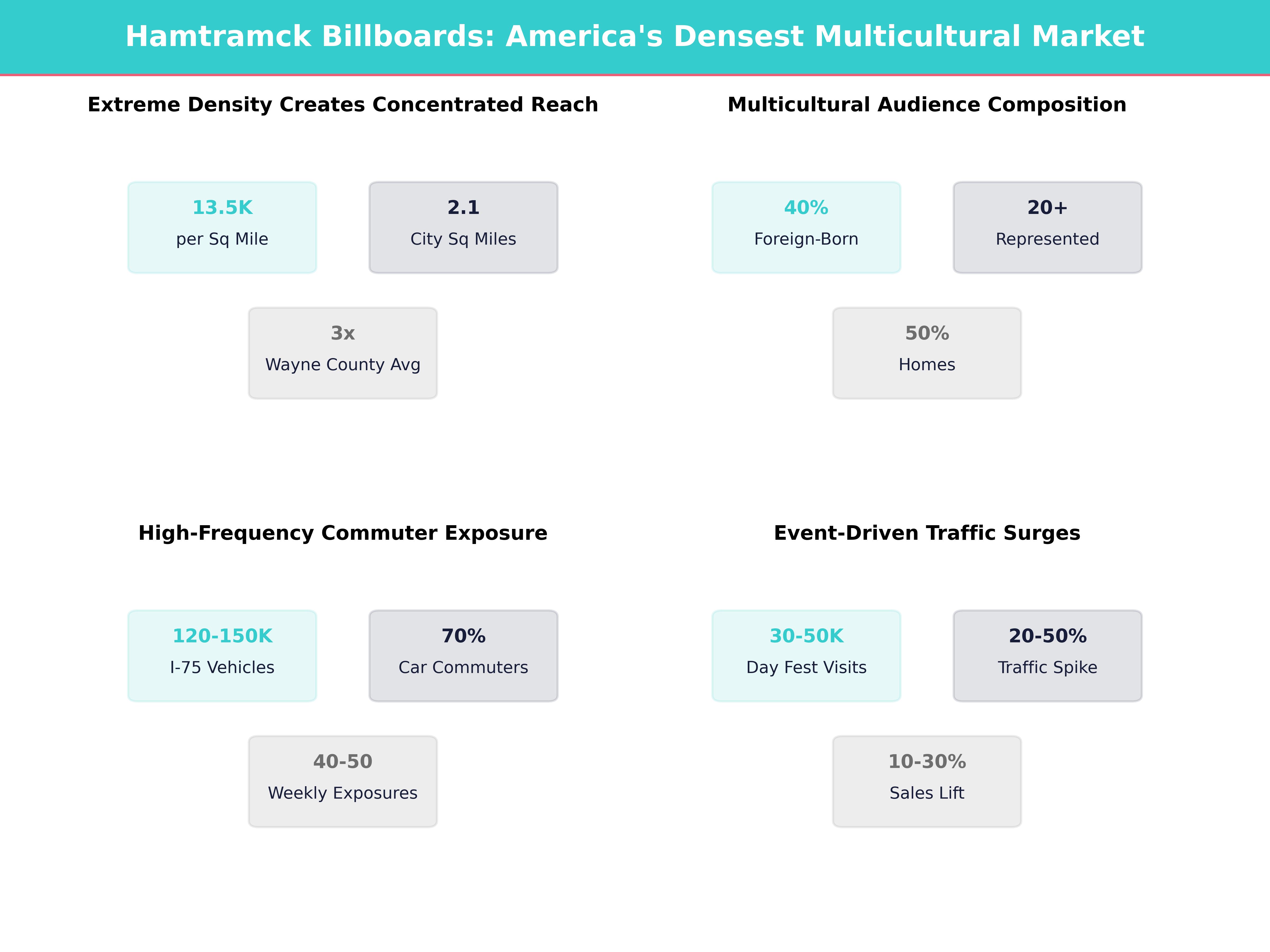
- The City of Hamtramck reports a population of about 28,000+ residents in just 2.1 square miles, making it one of the most densely populated cities in Michigan with roughly 13,500 residents per square mile (more than 3x the overall Wayne County average).
- The broader Detroit metro has about 4.3 million people, with Hamtramck surrounded by City of Detroit, Highland Park, and nearby communities like Warren Hazel Park. The City of Detroit alone has about 630,000 residents, while nearby Warren and Royal Oak add another 200,000+ people within a 15–20 minute drive of Hamtramck along major freeways that also carry traffic past many of our digital billboards near Hamtramck.
- Hamtramck is one of the most diverse small cities in the U.S. City and community sources estimate residents tracing roots to over 20 countries, with especially strong Bangladeshi, Yemeni, Polish, and Bosnian communities. Recent regional planning estimates suggest Asian residents (largely Bangladeshi) and residents of Middle Eastern/North African origin together account for well over one-third of the population.
- A very high share of residents are foreign-born (over 40%, per regional planning estimates), and multiple languages are commonly spoken at home, including Arabic, Bengali, Polish, and English. In some Hamtramck neighborhoods, more than half of households speak a language other than English at home, which has direct implications for billboard language and imagery.
- Median household income in Hamtramck is in the low–$30,000s, which is roughly 40–45% below the U.S. median and 25–30% below the Michigan median. Around 1 in 3 residents lives below the federal poverty line, and a significant share of households are multi-generational, pooling income to manage housing and transportation costs.
Useful local sources to explore the market:
- City government: City of Hamtramck
- County and service context: Wayne County, Michigan
- Regional insight & business climate: Detroit Regional Chamber SEMCOG – Southeast Michigan Council of Governments
- Tourism and visitor trends: Visit Detroit
- Local news and community pulse: Hamtramck Review, Detroit Free Press, The Detroit News, WXYZ Detroit, ClickOnDetroit / WDIV
For billboard advertisers planning campaigns in this dense, diverse environment, this means:
- Messages must be instantly clear and visual, accommodating multilingual audiences. In a city where over 40% of adults may have limited English proficiency in everyday use, visuals often outperform dense copy.
- Campaigns can be tailored to ethnic festivals, religious holidays, and neighborhood events that drive foot traffic; local events can temporarily boost visitors to Hamtramck’s main corridors (Joseph Campau, Conant, Caniff) by 20–50% on peak days according to merchant and city reports.
- Because the local income profile is modest (Hamtramck’s median household income is significantly below the U.S. average), value messaging, promotions, and practical offers often outperform pure branding. Deals such as “meals under $10”, “$0 down” for services, or limited-time discounts of 10–25% tend to resonate strongly in similar income bands.
Our 39 digital boards in nearby cities—including Detroit (about 5.3 miles from Hamtramck), Hazel Park, Center Line, Madison Heights, Harper Woods Oak Park—are well positioned to repeatedly reach people who live, shop, commute, or worship in the Hamtramck area. In many cases, these boards sit within 5–15 minutes’ drive of central Hamtramck, making it possible to generate multiple daily impressions for regular commuters and giving businesses convenient options for billboard rental near Hamtramck.
Key Corridors and Commuter Patterns Near Hamtramck
Although billboards serving the Hamtramck area are located in nearby cities, the road network is tightly interwoven. Drivers who live or work in Hamtramck routinely use major freeways and arterials where our boards appear, so Hamtramck billboards on these routes naturally capture both local and regional traffic. In Hamtramck and Detroit, over 70% of workers commute by car, and typical one-way commute times run 25–30 minutes, often involving at least one major freeway connection.
Important corridors that influence where and when to advertise:
- I‑75 (Chrysler Freeway) – A primary north–south spine. MDOT traffic maps report Average Annual Daily Traffic (AADT) often between 120,000–150,000 vehicles near central Detroit segments, carrying commuters between Detroit, Hazel Park, Madison Heights, and beyond. Peak rush-hour speeds here can drop below 30 mph, increasing dwell time and readability for digital boards.
- I‑94 (Edsel Ford Freeway) – Major east–west route south of Hamtramck. Many Hamtramck residents use I‑94 to reach jobs in Detroit, Dearborn, and Macomb County. MDOT counts often exceed 130,000 vehicles per day on busy segments, with some stretches carrying 140,000+ vehicles.
- I‑696 – Just to the north, connecting Warren, Madison Heights, and Royal Oak, with traffic volumes over 150,000 vehicles per day on some segments, making it one of the highest-volume east–west corridors in metro Detroit.
- M‑10 (Lodge Freeway) and surface routes through Detroit provide additional reach to workers commuting to and from the Hamtramck area. Several urban arterials near Hamtramck carry 20,000–30,000 vehicles per day, supplementing freeway reach with strong local exposure.
MDOT’s traffic volume maps at Michigan Department of Transportation
How this affects your campaign:
- Boards in Detroit, Hazel Park, Madison Heights, Royal Oak, Warren, and Oak Park can be used to target Hamtramck-area commuters at multiple points in their daily journeys. A typical five-day commuting week can generate 40–50 potential billboard exposures per driver when boards are placed both near home and near work.
- Morning-focused ads on northbound routes can speak to residents leaving the Hamtramck area, while afternoon or evening ads on southbound routes reach people returning home from nearby cities. In metro Detroit, traffic volumes during the 3 p.m.–6 p.m. period can be 20–30% higher than midday, making afternoon rotations especially valuable.
- Boards near retail centers in Warren and Madison Heights are ideal for catching Hamtramck shoppers headed to big-box stores and malls; regional retail corridors here can see 15,000–25,000 vehicles per day, especially on weekends.
We can use Blip’s location tools to prioritize boards that align best with your audience—whether that’s daily commuters, regional shoppers, or visitors heading to Detroit attractions who will pass near the Hamtramck area. Pairing MDOT volumes with your own sales data by ZIP code can help identify which corridors deliver the highest return per thousand impressions when you invest in billboard advertising near Hamtramck.
Seasonality, Events, and Cultural Moments to Leverage
Hamtramck’s calendar is rich with events that drive traffic, local pride, and spending. Aligning your creative and flight dates with these can dramatically improve relevance. In many consumer categories, event-linked campaigns can lift sales 10–30% over baseline for the week of the event.
Key recurring events and patterns:
-
Hamtramck Labor Day Festival
- A long-running street festival typically drawing tens of thousands of visitors over a weekend; some years see 30,000–50,000+ total visits across the three days, according to local coverage.
- Festival weekends can more than double foot traffic along key streets compared with an average summer weekend.
- Features music, parades, vendors, and food—perfect for promoting restaurants, retail, entertainment, and local services.
- Watch for updates and dates via City of Hamtramck Hamtramck Review and Detroit Free Press.
-
Pączki Day (Fat Tuesday)
- Hamtramck is one of the most famous pączki destinations in Michigan, with individual bakeries reported to sell 5,000–10,000 pastries in a single morning and community-wide sales reaching tens of thousands.
- Visitors drive in from across metro Detroit; news outlets like WXYZ Detroit and ClickOnDetroit regularly cover the crowds and early-morning lines that can stretch down the block.
- Ads reaching drivers on nearby Detroit and Warren boards in the 2–3 weeks leading up to Pączki Day can drive pre-orders, reservations, and brand awareness. Businesses that actively promote the holiday using billboards near Hamtramck routinely see one of their top revenue days of the year.
-
Hamtramck Music Festival
- Multi-venue events bring in regional music fans and support bars, venues, and restaurants. Festival organizers and local media often estimate dozens of acts performing across 10–20 venues, drawing thousands of attendees over a weekend.
- Ads near Detroit, Royal Oak, and Oak Park can help capture more attendees from across the metro area, especially when paired with simple messages like “No cover before 8 p.m.” or “All-ages daytime shows.”
-
Religious and cultural observances
- Hamtramck has significant Muslim populations (Yemeni, Bangladeshi, Bosnian) and a longstanding Catholic and Eastern European presence. In some census tracts, Muslim residents are believed to form a majority or near-majority of local households.
- Ramadan, Eid, Christmas, and other holidays shape shopping and dining behaviors. For example, evening sales at restaurants and bakeries can spike 20–40% on key nights during Ramadan and in the days before Eid, while grocery and gift spending rises noticeably in the weeks preceding Christmas.
- Value-focused and community-respecting messages around these times can strengthen local relationships and drive repeat visits well beyond the holiday period.
-
Weather and sports seasons
- Winters are long and cold; Detroit averages 42–45 inches of snowfall per year and 130+ days with below-freezing low temperatures. This keeps people in their cars longer and increases reliance on drive-to retail, making winter billboard impressions especially valuable.
-
Detroit’s pro sports seasons (Tigers, Lions, Pistons, Red Wings) bring added cross-town driving and event traffic that spills through freeways around the Hamtramck area.
- Detroit Lions home games at Ford Field draw crowds around 65,000.
- Detroit Tigers games at Comerica Park often attract 20,000–25,000 fans per game across the season.
- Detroit Red Wings and Detroit Pistons at Little Caesars Arena typically see 15,000–20,000 attendees per game.
- Schedules and visitor info are often highlighted on Visit Detroit and team or arena sites such as the City of Detroit events listings.
With Blip’s flexible scheduling, we can run short, intense bursts of impressions around these events—such as a 7–10 day push before Pączki Day or a weekend-focused buy during the Labor Day Festival—instead of paying for full-month commitments. Many advertisers see higher ROI per dollar with these focused bursts compared to always-on monthly schedules, especially when they time their billboard rental near Hamtramck to coincide with these peak traffic moments.
Tailoring Creative to Hamtramck’s Unique Demographics
To connect with the Hamtramck area, artwork should reflect both the visual culture and the linguistic reality of the community.
Key creative strategies:
-
Keep text minimal and readable
- On fast-moving corridors near the Hamtramck area, drivers often have only 3–6 seconds to absorb your message. Transport studies show that recall drops sharply once messages exceed 7–10 words, especially at freeway speeds.
- Aim for 7 words or fewer in the main line and one clear call to action (e.g., “Exit at 9 Mile,” “Order Today,” “Call for a Free Quote”).
- Use large fonts—on many digital boards, keeping text at 18-inch letter height equivalent or larger greatly improves legibility at 400–600 feet.
-
Consider bilingual or culturally resonant elements
- For campaigns aimed at specific segments (e.g., Bangladeshi or Yemeni communities), use simple phrases in Bengali or Arabic, paired with English. In neighborhoods where more than 50% of residents speak a non-English language at home, even one bilingual line can significantly improve recognition.
- Even subtle touches—colors, patterns, or foods tied to Polish, Bangladeshi, or Yemeni culture—signal that your business understands the neighborhood.
- Make sure non-Latin scripts are bold and large enough to be read at a distance; avoid placing small script over busy photos or textures.
-
Lead with value and accessibility
-
Hamtramck’s income levels are lower than many nearby suburbs, so call out:
- Specials, discounts, and everyday low pricing (e.g., “From $49,” “Under $20,” “First month free”)
- Public transit access, walkability, or delivery to the Hamtramck area—about 20–25% of households in and around Hamtramck do not have access to a private vehicle, so emphasizing bus proximity or free delivery can widen your audience.
- Payment flexibility (e.g., sliding scale for services, financing, or installment plans), especially for healthcare, legal, and education services.
-
Hamtramck’s income levels are lower than many nearby suburbs, so call out:
-
Use strong, high-contrast visuals
- Use large product photos, faces, or icons—especially effective on digital boards in Detroit, Warren, and Madison Heights that reach Hamtramck shoppers. Eye-tracking studies show that faces and simple product shots can boost recall by 20–30% compared with text-only designs.
- High-contrast color combinations (dark backgrounds with bright text) improve legibility. Avoid pairing similar luminance colors (e.g., red on dark gray) which lose visibility at distance.
-
Hyper-local references
-
Mention landmarks or neighborhoods the Hamtramck audience will recognize:
- “Minutes from Joseph Campau”
- “Near Conant & Caniff”
- “Next to Hamtramck High
- Promote cross-over with Detroit attractions—e.g., “On your way downtown? Stop at…”—to catch commuters who pass near the Hamtramck area on freeways or arterials feeding the Downtown Detroit core.
-
Mention landmarks or neighborhoods the Hamtramck audience will recognize:
Because digital billboards can rotate multiple creatives, we can test two or three versions tailored to different sub-audiences (e.g., English-only, English + Arabic, English + Bengali) and see which combination produces the most engagement or response. It’s common to see a 10–25% performance difference between top- and bottom-performing creatives in diverse urban markets like Hamtramck, making structured testing especially valuable and helping you refine which Hamtramck billboards deliver the best results for each audience.
Using Dayparting to Match Daily Life in the Hamtramck Area
Daily rhythms in and around the Hamtramck area differ from suburb-only commuter patterns, especially with a mix of shift workers, small business employees, and families. In Detroit and inner-ring suburbs, a sizable share of workers—often 20–30% in some neighborhoods—work non-traditional hours in manufacturing, logistics, health care, and hospitality.
We can use Blip’s scheduling tools to match these patterns:
-
Morning (6 a.m.–10 a.m.)
- Reach workers commuting from the Hamtramck area to Detroit, Warren, and Madison Heights; this window often captures the highest inbound freeway volumes of the day.
- Best for coffee shops, breakfast spots, transit-linked services, and job recruitment (“Now Hiring – Start at $18/hr”).
- Boards along I‑75, I‑94, and connecting arterials in Detroit and Hazel Park are prime.
-
Midday (10 a.m.–3 p.m.)
- Effective for stay-at-home parents, small business owners, and shift workers whose schedules fall outside the traditional 9–5. In some service categories, midday traffic accounts for 30–40% of daily in-store visits.
- Use this slot to promote lunch specials, health clinics, social services, and retail.
- Boards near shopping in Warren, Center Line, and Madison Heights can capture errand traffic and appointments.
-
Afternoon rush (3 p.m.–7 p.m.)
- Heavy school pickup and work commute traffic back toward the Hamtramck area. Many freeways see their daily peak volumes during this period.
- Great for promoting groceries, pharmacies, takeout, after-school programs, and evening events; quick-service restaurants often generate 40–50% of weekday revenue during these hours.
- Increase bids or share of impressions during peak traffic windows to capture more impressions when roads are most congested.
-
Late evening (7 p.m.–11 p.m.)
- Reaches service workers, entertainment seekers, and second-shift employees returning home, as well as late-night shoppers at 24-hour or extended-hours stores.
- Bars, restaurants, streaming services, and nightlife-focused brands can benefit here. In entertainment districts, 20–30% of daily visitor volume can occur after 7 p.m.
Because Blip allows flexible budgets, we can concentrate spending on only the dayparts that matter most instead of paying equally for low-value hours. Advertisers who adopt dayparting commonly see cost-per-response improvements of 15–30% compared with uniform schedules when using billboard advertising near Hamtramck to follow these daily rhythms.
Strategic Use Cases for Local and Regional Advertisers
Digital billboards serving the Hamtramck area can support a wide range of goals, from hyper-local branding to regional customer acquisition. In dense, multicultural markets like Hamtramck and central Detroit, even modest digital billboard budgets (e.g., a few hundred dollars per week) can deliver tens of thousands of impressions along high-traffic routes.
Some common, proven approaches:
-
Local brick-and-mortar businesses in the Hamtramck area
-
Restaurants, bakeries, grocery stores, salons, and repair shops can:
- Use boards in Detroit, Warren, and Hazel Park to drive non-residents into the Hamtramck area, especially for niche foods or cultural products. A well-targeted weekend flight can expose 50,000–100,000 vehicle trips to your message, depending on selected boards.
- Promote weekend specials or festival tie-ins (e.g., Pączki Day pre-orders) that can lift sales 20–50% during key days compared with typical weeks.
- Highlight proximity to popular routes: “10 minutes from Downtown,” “Just off I‑75,” which matches common travel times from nearby freeway exits into central Hamtramck and helps nearby drivers associate your offer with Hamtramck billboards they pass every day.
-
Restaurants, bakeries, grocery stores, salons, and repair shops can:
-
Service providers (healthcare, legal, financial, education)
-
Clinics, attorneys, immigration services, ESL programs, and tutoring centers can:
- Emphasize multilingual staff and culturally informed services—in communities with 40%+ foreign-born residents, this is a significant differentiator.
- Run campaigns around enrollment periods, tax season, or legal amnesty programs. For example, highlighting “Open Enrollment Help” in October–January can tap into a window when health-insurance searches spike.
- Use simple CTAs like “Call Now” or “Walk-Ins Welcome.” Even a 1–2% response rate from billboard-driven calls can be highly profitable for high-value services.
-
Clinics, attorneys, immigration services, ESL programs, and tutoring centers can:
-
Regional brands wanting credibility in the Hamtramck area
-
Banks, grocery chains, telecoms, and auto dealers can:
- Build trust by acknowledging the community directly: “Serving the Hamtramck area since …” or “Proud to support Hamtramck families.”
- Feature localized promotions, such as special financing, local sponsorships, or scholarships. For example, promoting a $500–$1,000 scholarship tied to Hamtramck-area students can generate substantial goodwill and press coverage from outlets like the Hamtramck Review or The Detroit News.
-
Banks, grocery chains, telecoms, and auto dealers can:
-
Recruitment and workforce campaigns
- Manufacturers, logistics companies, healthcare networks, and city agencies can reach job seekers and employed workers considering a change.
- Target inbound and outbound routes between the Hamtramck area and industrial hubs in Warren, Madison Heights, and Detroit—areas where major employers often post starting wages in the $16–25/hour range for in-demand roles.
- Rotate creatives: one focusing on pay rate, another on benefits, another on location or transportation support. Recruitment campaigns that clearly display a pay rate often see higher application volumes than generic “Now Hiring” messages.
-
Arts, culture, and nonprofit campaigns
-
Museums, galleries, educational nonprofits, and civic campaigns can:
- Tie messaging to events highlighted by Visit Detroit or local cultural centers. Major museum or festival exhibitions can add thousands of visitors per weekend from across the metro area.
- Use bold imagery and simple calls like “Free Admission,” “Open House,” or “Volunteer Today.” Nonprofits that add a strong one-line benefit (e.g., “Free citizenship classes”) often see 2–3x higher response than generic branding messages.
-
Museums, galleries, educational nonprofits, and civic campaigns can:
Testing, Measuring, and Optimizing Campaigns
With digital boards, we can continuously refine your strategy based on performance indicators rather than guesswork. Nationally, advertisers who run structured tests and optimize at least once per month often report 10–30% lower cost per acquisition than those who set-and-forget campaigns.
Practical, low-cost ways to measure:
-
Unique URLs or QR codes
- Use a short URL or QR code specific to your billboard campaign.
- Track how many visits or sign-ups they generate compared with other channels. Even a few hundred visits tied directly to a billboard-only URL can justify a modest local budget.
-
Promo codes and offers
- Create a simple code like “HAM10” or “CAMPau” and only show it on your billboard creative.
- Measure redemptions in-store or online. A redemption rate of 1–3% of exposed customers can be very strong for retail or food-service campaigns, especially when average tickets are $20–$40+.
-
Location-based timing analysis
-
If you increase spend around a specific weekend or event, monitor changes in:
- Foot traffic (via POS data or Google Business Profile insights)
- Call volume
- Online inquiries from local ZIP codes
- For many small businesses, even a 10–15% uplift in weekly revenue during a focused campaign window can more than cover billboard costs.
-
If you increase spend around a specific weekend or event, monitor changes in:
Optimization tactics:
-
Start with 2–3 creatives that test:
- Different languages or cultural cues
- Varying discounts or offers
- Distinct calls to action (“Visit Today” vs. “Order Online”)
- After 2–4 weeks, shift impressions toward the top performers. For example, if one design is associated with 30% more promo redemptions than another, allocate more budget to that creative.
- Adjust dayparts or boards based on where you see the most response (for example, stronger redemptions when focusing on evening commuters vs. morning). You might find that 70% of redemptions occur after 3 p.m., suggesting an opportunity to cut low-performing morning impressions.
Because Blip allows us to modify creative and scheduling without re-printing, we can iterate quickly and keep your campaign aligned with what the Hamtramck audience is actually responding to. This agility is especially useful in a community where event calendars, school schedules, and religious observances can significantly shift traffic and spending patterns month to month, and where flexible billboard rental near Hamtramck lets you adapt quickly without long-term commitments.
Community Sensitivity and Regulatory Considerations
Hamtramck and its surrounding cities have active local governments and engaged residents who care about community standards.
Considerations for your messaging:
-
Respect cultural and religious norms
- Avoid imagery or phrasing that could be perceived as disrespectful toward Muslim or Christian observances. In a city where mosques and churches are both highly visible institutions, community feedback travels quickly through social media and local news.
- When in doubt, keep artwork family-friendly and focused on positive, inclusive themes.
-
Stay informed about local policies and initiatives
- Monitor updates from City of Hamtramck City of Detroit, City of Warren City of Royal Oak, and City of Oak Park for public campaigns or major infrastructure changes (road work, detours, new transit).
- Coordinating with local initiatives—such as health campaigns or small-business programs—can increase both impact and goodwill, and may lead to earned media coverage in outlets like ClickOnDetroit or The Detroit News.
-
Support local life
- Message around local school activities, charity drives, and neighborhood events. Even a simple “Good luck to our students” or “Welcome festival visitors” can position your brand as a supportive neighbor.
- Sponsorships mentioned on billboards (e.g., “Proud sponsor of Hamtramck Labor Day Festival”) can raise awareness; sponsor acknowledgments at events often reach thousands of attendees, reinforcing the impressions from your boards.
By aligning creative with community values, you increase the likelihood that residents view your presence on boards serving the Hamtramck area as positive and relevant, reducing complaints and strengthening long-term brand equity. Choosing Hamtramck billboards that speak directly to local priorities can deepen that positive perception even further.
Putting It All Together: A Sample Strategy for the Hamtramck Area
To illustrate how these elements work in practice, here’s an example blueprint for a small-to-medium business aiming to reach customers in the Hamtramck area:
-
Define the goal
- Increase weekend sales by 15–20% at a Hamtramck-area restaurant over a 2‑month period. If current weekend revenue averages $8,000, the goal is to reach $9,200–$9,600 per weekend.
-
Target boards and corridors
- Prioritize digital boards in Detroit, Hazel Park, and Warren that align with commuter routes likely used by Hamtramck residents and visitors. These boards can collectively deliver hundreds of thousands of weekly impressions when scheduled on high-volume corridors.
- Add some presence in Royal Oak and Madison Heights to catch broader metro diners heading toward the Hamtramck area, particularly via I‑75 and I‑696.
-
Creative plan
- Creative A: English-only, strong food photography, “Weekend Special: Family Meals Under $25 – 10 Minutes from Downtown.”
- Creative B: English + Bengali or Arabic headline, emphasizing halal or cultural dishes (e.g., “Halal Family Platters – Just Off I‑75”).
- Creative C: Focus on Pączki Day or a festival tie-in during relevant season (“Pączki Pre‑Orders – Limited Batches, Reserve Now”).
-
Scheduling
- Concentrate spending on Thursday–Sunday, in the afternoon and evening (3 p.m.–10 p.m.), when dining decisions are typically made. Restaurants often see 60–70% of weekly revenue during these days and hours.
- Add heavier rotation during festival weeks or holiday periods when visitor counts can spike 20–50%.
-
Measurement
- Use a promo code like “LABORFEST” or “HAMWEEKEND” only on the billboard creatives.
- Track redemptions, weekend revenue, and reservation volume. Even if only 2–5% of customers use the code, increases in overall traffic and average ticket size may indicate broader brand impact.
- Compare customer ZIP codes before and after the campaign to see if more diners are coming from Detroit, Warren, or Madison Heights.
-
Optimization
- After 3–4 weeks, favor the top-performing creative and cut the lowest. If Creative B (bilingual) drives 30% more redemptions than Creative A, shift a larger share of impressions to Creative B.
- Shift impressions to times and corridors showing higher promo use or reservation spikes; for example, move a portion of budget from Thursday to Friday/Saturday evenings if data shows revenue is growing fastest on those nights.
We can follow similar steps—define, target, test, measure, and refine—for retailers, services, nonprofits, and larger regional brands seeking deeper connections with people in the Hamtramck area, using a mix of billboards near Hamtramck and regional placements to cover all key routes.
By combining the reach of 39 digital billboards in nearby cities with a thoughtful understanding of Hamtramck’s density, diversity, commuter flows, and cultural rhythm, we can build campaigns that do more than just generate impressions. With the right creative, timing, and targeting, those screens become a bridge between your brand and one of Michigan’s most vibrant, distinctive communities—turning high-traffic corridors carrying well over 100,000 vehicles per day into consistent, measurable business growth through smart billboard advertising near Hamtramck.