Billboards near Wayne, MI
No Minimum Spend. No Long-Term Contracts. Just Results.
Trusted by Leading Brands


Billboard advertising
near Wayne has never been easier




How much is a billboard near Wayne?
Why Choose Blip for Billboard Advertising near Wayne
Blip lets Wayne advertisers launch fast on I-94, I-275, and Michigan Ave, reaching daily commuters without the usual billboard hassle.
In Wayne, set flexible daily budgets and pay for the blips you use—ideal for testing local shops, plants, or services.
Use Blip dayparting in Wayne to catch early plant shifts, airport workers, and weekend shoppers in Westland and Plymouth.
No contracts means Wayne brands can start small, pause, or scale around DTW traffic, retail peaks, and seasonal events.
Track Wayne campaigns in real time and shift creative or timing as commuter flows change across Romulus, Allen Park, and Westland.
Blip’s creative tools help Wayne ads stand out with simple, high-contrast messages built for fast reads on busy suburban corridors.
Frequently Asked Questions About Billboard Advertising near Wayne
How much does a billboard cost near Wayne, Michigan with Blip?
With Blip, you set a daily budget that works for you, and your ads run on digital Wayne billboards only as often as your budget allows. Each 7.5–10 second “blip” is individually priced based on when and where it shows, plus real-time advertiser demand, so you only pay for the exposure you actually receive. This flexible, pay-per-blip approach makes billboards near Wayne, Michigan accessible to local businesses of all sizes.
Where can I advertise with Blip near Wayne, Michigan?
Our 21 digital billboards serving the Wayne area are positioned within about 10 miles, in Westland, Romulus, Plymouth, and Allen Park. These locations let us intercept commuters traveling between the Wayne area and Detroit, Dearborn, Livonia, Canton, and Novi. They also help reach shoppers heading to big-box retail and malls, travelers and airport workers around DTW in Romulus, and higher-income leisure visitors and professionals around Plymouth.
Who does Blip reach on Wayne, Michigan billboards?
Digital billboard advertising near Wayne, Michigan gives us an efficient way to reach a dense, working-class, and highly mobile audience at the center of western Wayne County. The City of Wayne has about 17,700 residents, with a median age around 38–39, and a strong base of blue-collar and skilled trade workers. Around 70–75% of workers commute by driving alone, with average commute times of 24–26 minutes, which aligns well with repeated daily billboard exposure.
When should I run Wayne, Michigan billboard ads with Blip?
Weekday commuting, roughly 6–9 AM and 3–7 PM, is ideal for heavy volumes on I‑94, I‑275, and Michigan Ave. Midday, from 9 AM–3 PM, is effective for medical and dental appointments, retail, grocery, errands, and education and training. Evenings and late night are useful around airport and transportation corridors in Romulus and Allen Park, while weekends shift traffic toward shopping, leisure, and events.
What roads and traffic patterns make Wayne, Michigan billboards effective?
The Wayne area is defined by several high-traffic corridors, including I‑94 near Romulus and Allen Park, I‑275 near Westland and Canton, US‑12 / Michigan Avenue through the Wayne area, and Telegraph Road near Taylor and Allen Park. I‑94 near Romulus/Allen Park commonly carries 100,000–130,000 vehicles per day, and I‑275 often sees 120,000–140,000 vehicles per day. Regional transportation plans also project that many of these corridors will see 5–10% traffic volume growth over the next decade.
Do I need a contract to advertise with Blip near Wayne?
No, Blip has no long-term contracts or minimum commitments. You can start, pause, or stop your campaign at any time.
How fast can I launch a billboard campaign with Blip near Wayne?
You can have your campaign live in minutes. Create a free account, select your locations, set your budget, upload your design, and start running once approved.
Where can I advertise with Blip near Wayne?
Blip has digital billboards near Wayne. You can browse available locations on a map, choose the ones that fit your audience, and start advertising right away.
Still have questions? Launch a campaign in minutes — no contracts, no commitments.
Start Your CampaignWayne Billboard Advertising Guide
Digital billboard advertising near Wayne, Michigan gives us an efficient way to reach a dense, working-class, and highly mobile audience at the center of western Wayne County. With 21 digital billboards serving the Wayne area from nearby Westland, Romulus, Plymouth, and Allen Park, we can tap into daily commuter flows, airport traffic, and neighborhood shopping patterns to put our messages in front of the right people at the right times. Typical digital billboard spots in similar Detroit‑area corridors can generate 70,000–150,000 impressions per sign per week, depending on location and daypart, giving even modest budgets meaningful reach when targeted correctly. For many local brands, this makes billboard advertising near Wayne one of the most cost-effective ways to stay visible to residents and commuters day in and day out.
Understanding the Wayne Area Market
Wayne sits in central Wayne County, between City of Detroit and the western suburbs. This position makes audiences in the Wayne area especially attractive for advertisers looking to reach both city-bound commuters and local residents through Wayne billboards and surrounding corridors.
Key context for the Wayne area:
- The City of Wayne has about 17,700 residents, with a median age around 38–39, and a strong base of blue‑collar and skilled trade workers, many connected to auto and manufacturing. Around 70–75% of workers commute by driving alone, with average commute times of 24–26 minutes, which aligns well with repeated daily billboard exposure. City resources and local data are available through the City of Wayne.
- Wayne County as a whole has roughly 1.75 million residents, making it Michigan’s most populous county and the core of the Detroit metro area. The county includes more than 30 municipalities, from Detroit and Dearborn to Westland, Livonia, Canton, and Plymouth. County‑wide economic and transportation data can be explored on the Wayne County website.
- The Wayne area economy is heavily shaped by the auto industry. The Michigan Assembly Plant (Ford Wayne Assembly) employs several thousand workers and anchors a broader industrial corridor that also includes suppliers, logistics operations, and warehouse facilities along I‑94 and Michigan Avenue. Industrial and warehousing jobs account for well over 20% of local employment in many nearby ZIP codes.
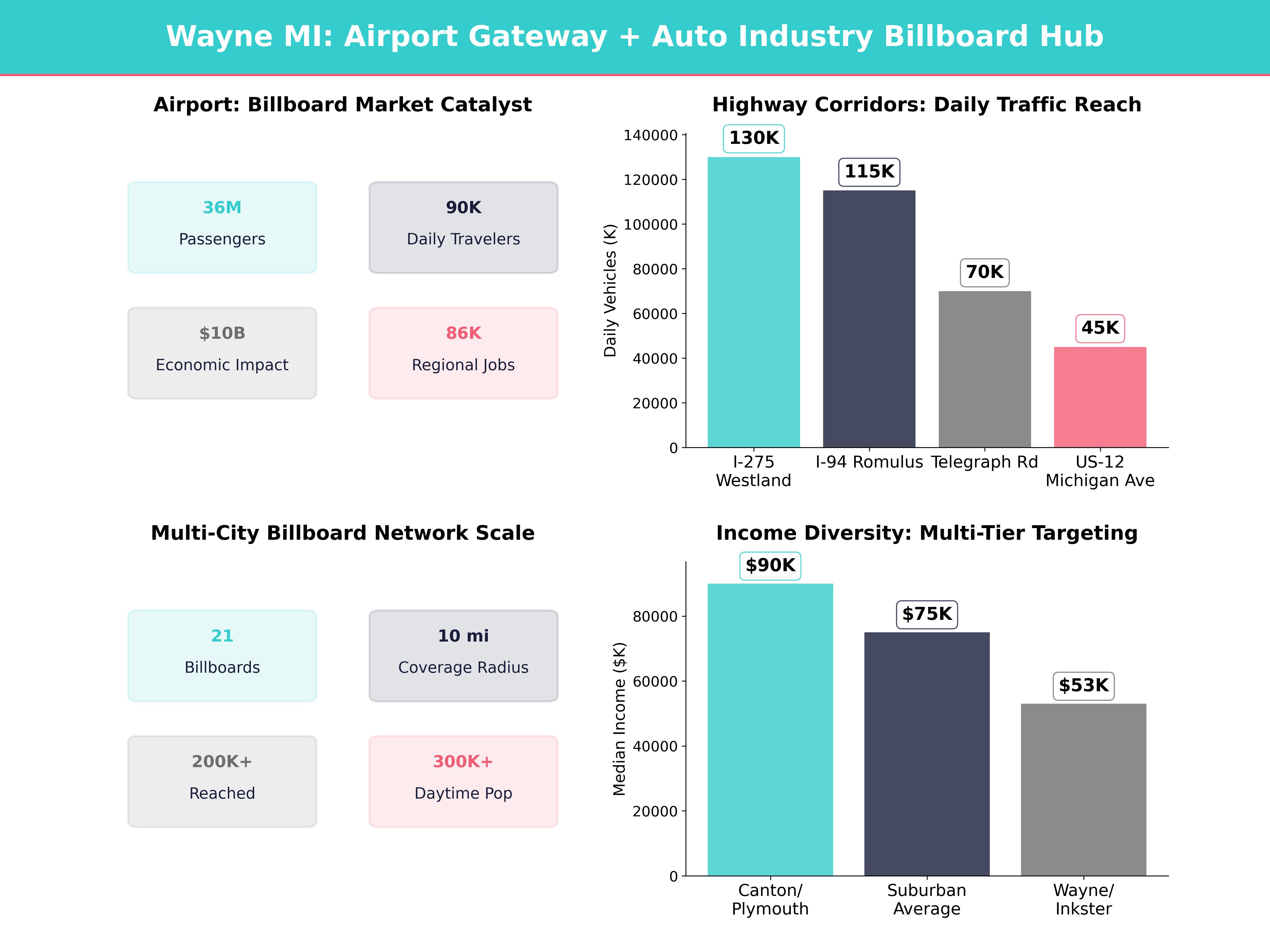
- Median household incomes in nearby suburbs vary significantly, from around $50,000–$55,000 in Wayne/Inkster ranges to $80,000–$100,000+ in parts of Charter Township of Canton and Plymouth, giving us both value-conscious and higher‑income segments within a short drive. Cities like Canton and Plymouth also show bachelor’s degree or higher rates above 45–50%, compared with sub‑25% in some working‑class communities, highlighting very different messaging and price‑sensitivity profiles.
Local information sources we can use to understand and align our messaging include the City of Wayne, Wayne County, regional tourism and business insights from Visit Detroit, and transportation and land‑use reports from agencies such as SEMCOG – Southeast Michigan Council of Governments.
For advertisers, this mix of industrial employment, diverse suburbs, and a large commuter base means:
- Strong opportunity for automotive, trades, and B2B messaging tied to manufacturing and logistics
- Neighborhood-focused campaigns for retail, healthcare, and services
- Regional branding that reaches people living in the Wayne area but working and shopping across multiple suburbs
- Ability to reach multi‑market consumers: surveys in the Detroit region consistently show 65–70% of adults shop in more than one municipality each month, especially for big‑ticket or specialty items.
Where Our Billboards Reach Near Wayne
Our 21 digital billboards serving the Wayne area are positioned within about 10 miles, in:
- Westland (about 3.6 miles from Wayne) – a city of roughly 85,000 residents and a major retail and dining hub for western Wayne County. Westland’s commercial corridors around Ford Road and Warren Road draw shoppers from 40,000+ vehicles per day on key arterials. See city information at City of Westland and business resources from the Westland Chamber of Commerce. These locations effectively function as billboards near Wayne since they intercept many of the same local residents and commuters.
- Romulus (about 4.0 miles) – home to Detroit Metropolitan Wayne County Airport (DTW), which handled about 35–36 million passengers in 2023, according to Detroit Metro Airport. The airport is overseen by the Wayne County Airport Authority and generates more than $10 billion in annual economic impact regionally. Local context and development updates are available through the City of Romulus and Romulus Chamber of Commerce.
- Plymouth (about 8.9 miles) – an affluent suburb and historic downtown destination, with a population around 9,500 in the city and more than 28,000 in the surrounding township. Downtown Plymouth hosts regular events that can attract 5,000–50,000 visitors depending on the festival or concert. The area is promoted by Plymouth Downtown Development Authority and the Plymouth Community Chamber of Commerce.
- Allen Park (about 9.4 miles) – close to I‑94, I‑75, and media-related employers, with a population near 28,000 and strong daytime traffic from retail, light industrial, and office users. More information is available at the City of Allen Park and the Allen Park Chamber of Commerce.
These locations let us intercept:
- Commuters traveling between the Wayne area and Detroit, Dearborn, Livonia, Canton, and Novi. Nearby hubs like City of Livonia, Charter Township of Canton, and City of Novi each add 90,000–100,000+ residents and tens of thousands of jobs to the daily traffic mix.
- Shoppers heading to big-box retail and malls in Westland and Allen Park. Regional centers in these cities often report weekend foot traffic in the tens of thousands of visits.
- Travelers and airport workers around DTW in Romulus, where airport‑area roads carry 60,000–90,000 vehicles per day depending on the segment.
- Higher‑income leisure visitors and professionals around Plymouth, where median household incomes in some neighborhoods exceed $100,000, supporting premium retail, dining, and service offerings.
By selecting the right signs and dayparts in Blip, we can emphasize whichever of these audience flows best matches our goals and build Wayne billboards strategies that match how people actually move through the region.
Key Corridors and Traffic Patterns to Target
The Wayne area is defined by several high‑traffic corridors. Understanding them helps us choose which digital billboards to prioritize and when to run, especially when we’re planning billboard rental near Wayne for specific audience segments.
According to Michigan Department of Transportation (MDOT) traffic count data (Annual Average Daily Traffic, or AADT), typical volumes near the Wayne area are:
- I‑94 near Romulus/Allen Park: commonly 100,000–130,000 vehicles per day, carrying a mix of commuters, trucks, and airport traffic. Peak hours can see 5,000–7,000 vehicles per lane per hour, maximizing impressions for rush‑hour campaigns.
- I‑275 near Westland/Canton: often 120,000–140,000 vehicles per day, linking northern and southern suburbs around Wayne and distributing commuters between I‑96, M‑14, and I‑94.
- US‑12 / Michigan Avenue through the Wayne area and toward Dearborn: frequently in the 35,000–55,000 vehicles per day range, highly relevant for truly local Wayne‑area impressions. This corridor carries a high share of repeat local drivers, ideal for frequency‑based campaigns.
- Telegraph Road (US‑24) near Taylor/Allen Park: typically 60,000–80,000 vehicles per day, connecting south-suburban shoppers and commuters and feeding traffic into I‑94 and I‑75.
Regional transportation plans from SEMCOG project that many of these corridors will see 5–10% traffic volume growth over the next decade, particularly around airport and logistics clusters, making them long‑term strongholds for outdoor visibility.
How this informs our billboard strategy:
-
For broad regional reach:
- Emphasize boards near I‑94 and I‑275 in Romulus, Westland, and Allen Park.
- These are ideal for brand awareness campaigns, franchises, auto dealers, and employers recruiting from a wide radius. National studies of digital out‑of‑home (DOOH) show unaided ad recall often exceeding 45–50% on highway digital boards when frequency is sustained over 4+ weeks.
-
For hyperlocal Wayne‑area impact:
- Focus on boards near Michigan Avenue and key commercial arterials feeding into Wayne from Westland, Garden City, and Inkster. Local context for these neighboring cities can be found via the City of Garden City and City of Inkster.
- Great for local clinics, restaurants, trades, and community events. Hyperlocal campaigns can drive measurable lifts in store visits within 1–3 miles of the advertiser, especially when paired with geo‑targeted mobile ads.
-
For traveler and B2B messaging:
- Romulus boards closest to DTW and major airport access roads work best.
- Airport-related services, hotels, logistics, and conference marketing perform well here. DTW’s worker base of more than 86,000 jobs and passenger volumes above 90,000 travelers per average day strongly support hospitality and transportation offers.
Using Blip’s location filters, we can build a campaign that leans heavier toward highway billboards or local surface‑street boards, depending on whether we want broad reach or tightly local impressions in the Wayne area.
Demographics and Audience Segments in the Wayne Area
To design effective creative, we need to think about who we’re talking to. The Wayne area draws from several overlapping demographic clusters:
-
Working‑class and skilled trade households
- Large share of residents in Wayne, Westland, and surrounding communities work in manufacturing, logistics, construction, and health support roles. In several nearby communities, 20–30% of workers are in production, transportation, and material‑moving occupations.
- Many commute to plants and warehouses along I‑94, I‑275, and Michigan Avenue. Shift‑based work means strong traffic not just at 8–9 AM, but also early morning (5–7 AM) and late evening.
- These audiences are highly responsive to messages about job opportunities, education/training, vehicle maintenance, financial services, and family‑oriented retail. Surveys in similar markets show that over 60% of blue‑collar commuters notice roadside advertising at least weekly.
-
Airport and logistics workforce
- DTW supports more than 86,000 jobs regionally, directly and indirectly (airlines, ground services, logistics, hospitality). Employment detail and tenant listings can be found via the Wayne County Airport Authority.
- Shifts often start early or run late, so traffic spans early mornings, evenings, and weekends more than a typical 9‑to‑5 market. Airport‑area corridors see elevated volumes even on Sundays and holidays.
- Great segment for quick-service restaurants, late‑night services, rideshare, and financial or insurance products. Research in airport markets indicates that 40–50% of workers frequently stop for food or errands on their way to or from work, making directional offers effective.
-
Suburban families and dual‑income households
- Westland, Plymouth, and nearby Canton and Livonia capture large numbers of families with children. In these communities, 25–30% of residents are under age 18, and household sizes commonly average 2.6–3.0 persons.
- Median household incomes in these suburbs frequently range from $60,000 to $90,000+, depending on the neighborhood, with homeownership rates above 60–70% in many subdivisions.
- Highly relevant for schools, healthcare, family entertainment, home services, and regional retail. Family‑focused messages can be coordinated with school calendars from districts such as Wayne-Westland Community Schools, Plymouth-Canton Community Schools, and Livonia Public Schools.
-
Commuters into Detroit and Dearborn
- Many Wayne‑area residents work for major employers like Ford, Henry Ford Health, and downtown Detroit firms. Ford’s nearby facilities and hospital campuses in City of Dearborn and West Bloomfield draw thousands of daily commuters from western Wayne County. Employer and campus details are available from Ford Motor Company – Michigan facilities and Henry Ford Health.
- They use I‑94, Michigan Avenue, and Telegraph daily, creating repeat exposure opportunities. In commuter studies, drivers on fixed work routes can pass the same sign 400–500 times per year, which supports strong message reinforcement.
By matching boards and dayparts to these segments, we can design campaigns with clear audience priorities: workers, families, travelers, or city commuters.
Crafting Creative That Works in the Wayne Area
Once we understand who we’re reaching, we can tailor our creative for maximum impact on Wayne‑area drivers.
1. Visual style and color choices
The Wayne area is visually cluttered with auto-related signs, industrial buildings, and large retail centers. To stand out:
- Use high-contrast pairs (dark blue/yellow, black/white, navy/orange). Visibility studies for digital billboards often show contrast improvements can increase legibility distance by 20–30%.
- Avoid overusing dark reds and deep blues alone, which blend into many existing business signs and sports imagery.
- Opt for large, simple icons that convey message category at a glance (wrench for auto repair, tooth for dentist, bed for hotel, etc.).
2. Text length and readability
At 55–70 mph on I‑94 or I‑275, drivers get only 5–8 seconds to read a message:
- Keep to 6–8 words max on highway‑oriented creatives.
- Use one dominant message, not a list: e.g., “Brakes Today. Pay Later.”
- Use large fonts (ideally equivalent to 14–18% of the sign height for the main headline). Research in roadside readability indicates that each 1 inch of letter height is legible at roughly 30–40 feet; on a 14’x48’ board, ensuring letters are effectively “tall enough” helps reach fast‑moving freeway traffic.
For more local surface streets near shopping centers:
- You can stretch to 10–12 words, but still prioritize clarity and speed. Slower traffic (25–45 mph) offers 8–12 seconds of viewing time, which can support slightly more detail (e.g., “Walk‑In Urgent Care – Open 8AM–8PM Daily”).
3. Locally resonant hooks
Wayne‑area audiences respond well to messages that reflect local realities:
- Reference familiar corridors: “On Michigan Ave, just east of Wayne Rd” or “5 minutes off I‑275.”
- Mention practical benefits: “Same‑day auto repair,” “No credit check,” “Walk‑ins welcome.”
- Tie into regional pride (without overdoing sports trademarks): “Built in the Motor City,” “Proud to serve Wayne & Westland.”
- Consider aligning occasional messages with local event calendars from groups like Wayne Main Street and nearby downtowns promoted by Plymouth DDA and Westland Parks and Recreation.
Local news sites like Hometown Life – Westland and the Detroit Free Press can give us a feel for community concerns and topics that resonate (jobs, schools, public safety, local events). You can also monitor regional headlines via The Detroit News and local coverage from outlets such as WXYZ Detroit and ClickOnDetroit – WDIV.
4. Strong calls to action suited for drivers
Because drivers can’t safely jot down long details:
- Use short URLs or memorable domains (e.g., “WayneBrakes.com”).
- Promote simple actions: “Text WAYNE to 55555,” “Exit 38 – Next Right,” “Search: ‘Wayne Dental.’”
- Make phone numbers only if easy: repeating digits, local area code, and large type. Campaigns with short, action‑oriented CTAs have been shown in DOOH studies to lift response rates by 15–30% compared with awareness‑only messages.
Timing and Dayparting: When to Run Your Blips
Blip’s flexibility lets us align impressions with the specific rhythms of the Wayne area. Typical patterns to consider:
Weekday commuting (approx. 6–9 AM and 3–7 PM)
- Heavy volumes on I‑94, I‑275, and Michigan Ave. On some segments, these peaks can account for 35–40% of daily traffic.
-
Ideal for:
- Employee recruitment (“Hiring Now – $20/hr+ Overtime”)
- Auto service (“Check Engine Light? After-work appointments.”)
- Quick breakfast and dinner options near home or work
Midday (9 AM–3 PM)
- More local residents, retirees, and service workers on surface streets, with lighter but steady highway flows.
-
Effective for:
- Medical and dental appointments
- Retail, grocery, and errands
- Education and training (community college, trade schools). Local institutions like Schoolcraft College and Wayne County Community College District often target these hours for adult learners.
Evenings and late night (7 PM–midnight)
- Useful around airport/transportation corridors in Romulus and Allen Park, where late‑night flights and logistics operations keep traffic above typical suburban levels.
-
Good for:
- Late‑night dining, delivery, and convenience stores
- Entertainment, bars, casinos (where permitted)
- Transportation and rideshare promotions. National mobility data indicates that 15–20% of ride‑hail trips occur during evening/late‑night periods, aligning with these impressions.
Weekends
-
Traffic shifts toward shopping and leisure:
- Westland shopping areas, downtown Plymouth, and dining corridors near Allen Park. Weekend AADT on some retail arterials can spike 20–30% above weekday levels at midday.
-
Strong for:
- Family activities, churches, and community events
- Home improvement, yard services, and furniture
- Festivals, concerts, and sports‑related promotions
Within Blip, we can test combinations like “weekday rush only,” “weekends only,” or “24/7 light presence” to see which pattern drives the best result relative to budget.
Using Blip Tools to Geo-Target the Wayne Area
While our digital billboards sit in Westland, Romulus, Plymouth, and Allen Park, we can use Blip’s controls to effectively reach and saturate the Wayne area.
1. Sign selection
-
Choose boards:
- Closest to main Wayne‑area feeder roads (Michigan Avenue, Wayne Road, I‑94 access points).
- Along commuting routes used by Wayne residents heading toward Detroit, Dearborn, Livonia, and Canton. The City of Dearborn and City of Taylor also serve as key employment and retail draws that shape these routes.
2. Radius-based thinking
Even though we don’t set a radius in the platform, we can:
- Identify signs within about 5 miles of Wayne for hyperlocal outreach (Westland and Romulus boards). A 5‑mile radius around Wayne encompasses 60,000–80,000 residents, depending on direction and inclusion of neighboring cities. This makes these placements function much like true in-town billboards near Wayne in terms of audience relevance.
- Expand to 8–10 miles (Plymouth and Allen Park) for regional businesses drawing from a wider catchment, reaching well over 200,000 residents and a daytime population that can easily surpass 300,000 workers and shoppers.
3. Budget and bid strategy
Blip’s auction-style system lets us define:
- Maximum cost per “blip” (each display), so we can start with modest test budgets and scale where we see traction. Many advertisers in similar markets begin testing with $10–$25 per day across a handful of boards and then scale into the $50–$100+ per day range on proven locations.
-
Priority boards where we’re willing to bid slightly higher, for example:
- High-traffic I‑94 signs during rush hour
- Boards right by major shopping or dining anchors
A practical approach for Wayne‑area campaigns:
- Start with 5–8 carefully chosen boards focused on the audience you care most about.
- Run at modest bids for 2–4 weeks to establish baselines. In many DOOH tests, this duration is enough to observe 10–30% lifts in branded search or website visits when creative and targeting are aligned.
- Then ramp up frequency on the best-performing locations and time windows.
Industry-Specific Strategies for the Wayne Area
Different industries can take particular advantage of the Wayne area’s layout and demographics.
1. Auto dealers, repair shops, and parts
- Use boards on I‑94, I‑275, and Michigan Avenue to target commuter and working‑class vehicle owners. In Wayne County, more than 90% of households have access to at least one vehicle, and many have two or more, amplifying demand for maintenance and sales.
- Prominent offers: “0% APR,” “$99/month lease,” “Free brake inspection,” “Same-day tires.” Price‑point headlines help, as auto‑related search interest in the Detroit region often spikes 20–40% in response to aggressive promotions.
- Emphasize proximity: “10 min from Wayne off I‑275” or “On Michigan Ave in Westland.” Link brand visibility with local wayfinding to capture impulse decisions and make your Wayne billboards directly actionable.
2. Healthcare and dental
- Nearby hospitals and major systems (e.g., Henry Ford Health, Corewell Health – Beaumont Hospitals) draw patients regionally. These systems serve hundreds of thousands of emergency and outpatient visits per year across metro Detroit.
-
Clinics and dental offices can run creatives like:
- “Wayne & Westland’s Same‑Day Urgent Care”
- “Evening Dental Appointments – Book Today”
- Target midday and early evening near residential corridors and shopping areas. Healthcare advertisers often see higher weekday response between 10 AM and 6 PM, when people are booking appointments for themselves and their families.
3. Restaurants and quick-service
- Focus on boards close to shopping clusters and main commuting routes. Many quick‑service brands report that 50–60% of in‑store traffic comes from people who pass by within a 3–5 mile radius.
-
Time campaigns with meals:
- Breakfast: 5–9 AM near I‑94/I‑275.
- Lunch: 11 AM–2 PM near industrial zones and office clusters.
- Dinner: 4–8 PM near residential routes.
- Offer easy CTAs: “Exit now,” “On Wayne Rd just south of Michigan Ave,” etc. Studies of food‑related billboards show that including a simple directional cue (“Next Exit” or “2 Miles Ahead”) can boost visit rates by 10–20%.
4. Education and training
-
Community colleges, trade schools, CDL schools, and apprenticeship programs can:
- Emphasize career advancement and higher wages. For example, promoting trades where median wages locally can exceed $25–35/hour for experienced workers.
- Target early morning and afternoon when shift workers commute.
- Use clear outcomes: “Become a welder in 9 months,” “CDL in 6 weeks.” Many adult learners decide within 30–60 days of first exposure, so campaigns running across two or more enrollment cycles can be especially effective.
5. Hiring and workforce recruitment
For employers at plants, warehouses, or service businesses:
- Highlight pay and benefits in large type: “$22/hr + benefits – Apply Today.” Recruitment campaigns with wages clearly displayed can see click or call‑through rates 1.5–2x higher than generic “Now Hiring” messages.
- Use local pride: “Jobs in the Wayne area – work close to home.” In worker surveys, over half of respondents say a shorter commute is a top reason they would switch jobs.
- Place creatives right along commuting routes to your facility (for example, near I‑94 exits closest to your plant or distribution center). Coordinate with local business groups like the Westland Chamber of Commerce, Romulus Chamber of Commerce, or Southern Wayne County Regional Chamber to align with job fairs or hiring events. These types of billboard advertising near Wayne can quickly boost awareness of open positions among local workers.
Testing, Measurement, and Optimization
To get the most from Wayne‑area billboards, we should approach campaigns as ongoing tests rather than one‑time bets.
1. Use trackable elements
- Create unique URLs or landing pages for billboard viewers (e.g., “/wayne”).
- Use distinct promo codes: “Mention WAYNE20 for 20% off.”
-
Track changes in:
- Direct and branded search volume from ZIP codes in the Wayne area
- Website traffic spikes during periods when your blips run most frequently
- Call volume or form fills tied to billboard-specific offers
Businesses that rigorously track billboard response often report incremental sales lifts of 5–15% in targeted trade areas when campaigns run consistently for 3+ months.
2. A/B test creatives
-
Run two or more versions in rotation, changing only one key element:
- Headline (price vs. benefit)
- Image (person vs. product vs. icon)
- Call to action (“Call now” vs. “Book online”)
- After 2–4 weeks, pause the lower‑performing creative and iterate on the winner. DOOH advertisers that continuously A/B test and refine often achieve 20–30% better performance over time than those that run static creatives.
3. Refine by daypart and location
With Blip, we can shift impressions toward:
- Times that correlate with higher conversions (for example, if calls spike after 4 PM, favor evening displays).
- Specific boards that correlate with more store visits or inquiries (e.g., boards on Michigan Ave outperform the I‑94 boards for a local service business).
- Neighborhood‑specific outcomes: a retailer might find that boards near Westland drive in‑store traffic, while airport‑area boards drive online orders, suggesting different creative and offer strategies by location.
Compliance, Community Fit, and Best Practices
To ensure our campaigns are sustainable and well‑received in the Wayne area:
- Follow all content and safety guidelines established by MDOT and local municipalities, particularly around brightness, animation limits, and prohibited content. Many cities set digital billboard brightness caps around 0.3–0.5 foot‑candles above ambient light at specified distances to reduce glare.
- Avoid cluttered or overly aggressive imagery that could be distracting. Use clean layouts, limited color palettes, and clear focal points.
-
When appropriate, align with community themes:
- Local festivals and events promoted by entities like Wayne Main Street (if active), City of Westland – Events, or City of Romulus – Community Events.
- High‑school sports or charity campaigns that show we’re invested in the community. Schools and civic groups often reach hundreds to thousands of local residents per event, amplifying goodwill when brands participate.
- Be mindful of local ordinances and permitting details posted by municipalities such as City of Allen Park, City of Westland, and City of Wayne, especially if you are combining digital campaigns with on‑premise signage or sponsorship banners. Even if you are only using digital billboard rental near Wayne through Blip, understanding local rules can help ensure your broader marketing stays compliant.
By pairing respect for local norms with smart, data‑driven targeting, we can build campaigns that both perform and enhance brand reputation in the Wayne area.
By understanding the Wayne area’s traffic patterns, demographics, and economic drivers, and by using Blip’s flexible tools for location, timing, and creative testing, we can build digital billboard campaigns that consistently reach the right people near Wayne—whether they’re commuting to the plant, heading to DTW, taking the kids to school, or shopping on the weekend.