Billboards in Wayne, PA
No Minimum Spend. No Long-Term Contracts. Just Results.
Turn heads and spark curiosity with Wayne billboards powered by Blip. Launch eye-catching campaigns on digital billboards in Wayne, Pennsylvania with any budget, full control, and real-time results—so your message shines bright exactly when and where you want it.
Trusted by Leading Brands


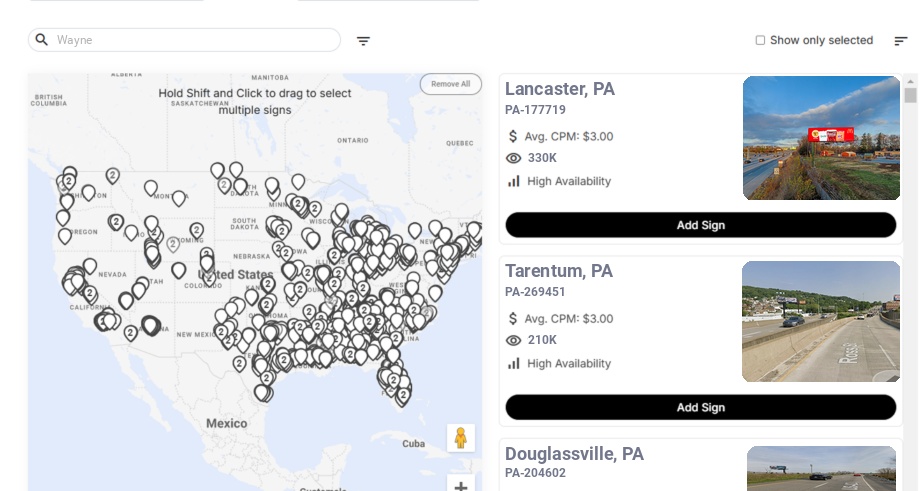
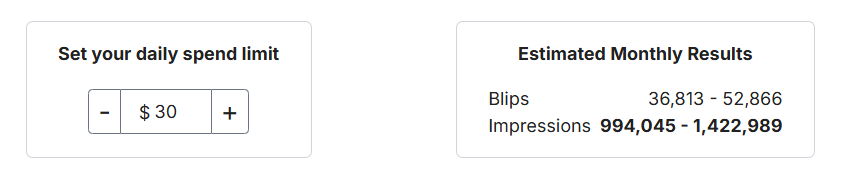
How much is a billboard in Wayne?
Billboards in other Pennsylvania cities
Wayne Billboard Advertising Guide
Wayne, Pennsylvania sits at the heart of Philadelphia’s historic Main Line, combining small-town walkability with big-city earning power and commuter traffic. When we advertise on digital Wayne billboards with Blip, we tap into an audience that is affluent, highly educated, and constantly on the move along Lancaster Avenue and nearby regional corridors.
Understanding the Wayne Market
Wayne itself is an unincorporated community that spans parts of Radnor Township Tredyffrin Township, and Upper Merion Township, but most of its commercial core falls within Radnor Township. Radnor’s 2020 population was about 31,000 residents, and township reports and regional planning studies show:
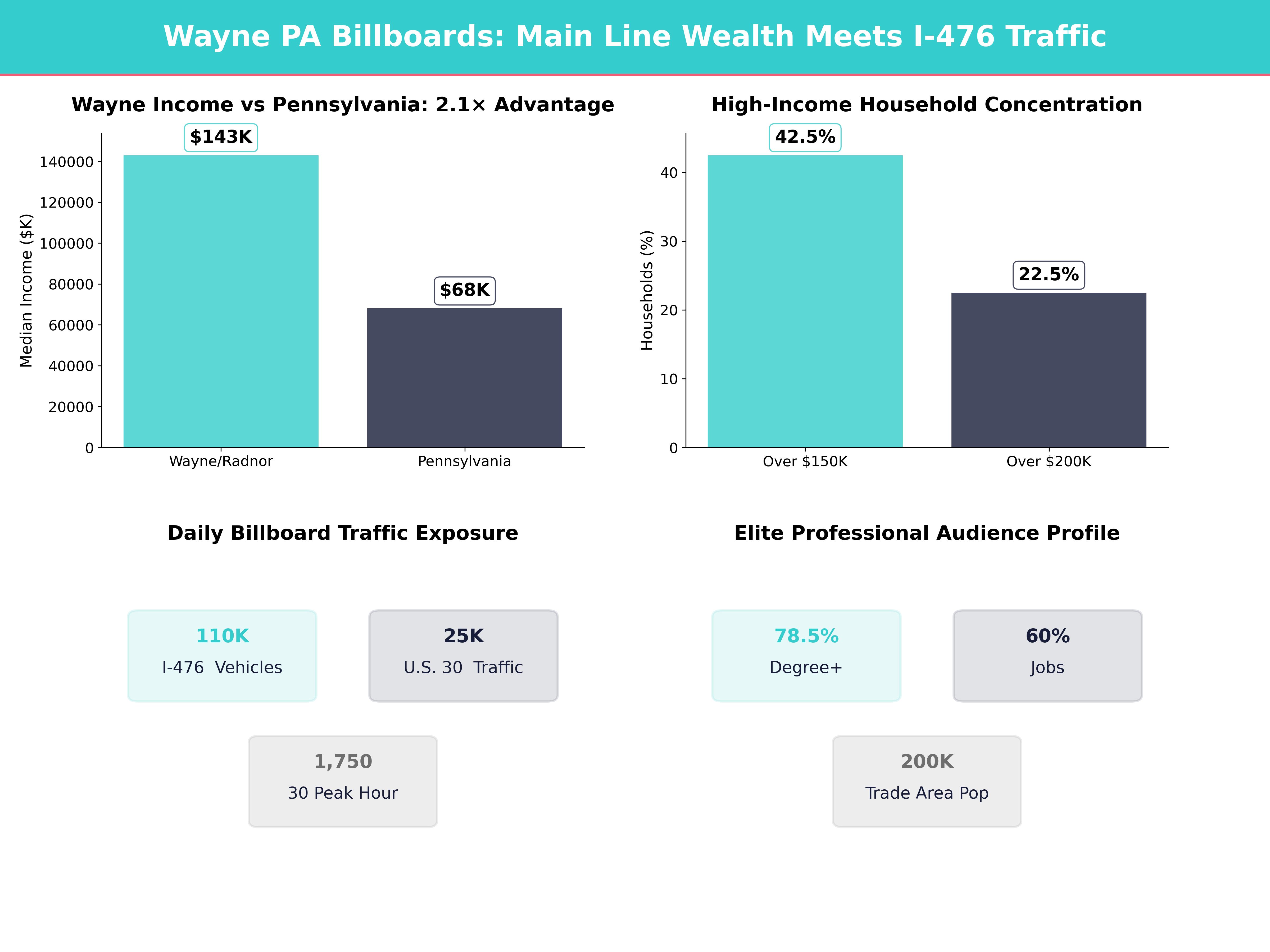
- Median household income around $141,000–$145,000, more than 2.1× Pennsylvania’s state median (roughly $65,000–$70,000).
- Roughly 77–80% of adults holding a bachelor’s degree or higher, compared with about 32–35% statewide.
- A median home value in the $650,000–700,000 range, with many Main Line ZIP codes around Wayne (19087, 19010, 19008) frequently reporting median listing prices above $750,000 in local real estate market data.
Within a 10–15 minute drive of downtown Wayne, the broader Main Line and King of Prussia trade area pulls from 200,000+ residents in Radnor, Tredyffrin, Lower Merion Township Easttown Township, Upper Merion, and surrounding townships, according to county planning commissions in Delaware County, Chester County, and Montgomery County.
Wayne is also surrounded by major employment centers:
- The nearby “Main Line” towns and office parks (Radnor, St. Davids, King of Prussia, Conshohocken), including clusters like the Radnor Corporate Center and Chesterbrook office parks, which together support tens of thousands of jobs.
- A quick connection into Center City Philadelphia 1.6+ million) via train or I‑76, with typical off‑peak rail travel times from Wayne to 30th Street Station of about 30 minutes on the SEPTA Paoli/Thorndale Line (septa.org).
This combination of high income, high education, and dense commuter patterns means digital billboards in Wayne are ideal for:
- Premium retail and services
- Financial and professional services
- Healthcare and elective medical
- Higher education and tutoring
- Restaurants, entertainment, and events
Local business and tourism groups like the Main Line Chamber of Commerce Visit Delco, PA routinely highlight Wayne and Radnor as among the region’s most desired places to live and shop, reinforcing the value of visibility in this market and the impact of Wayne billboard advertising for local brands.
Who You’ll Reach on Wayne Digital Billboards
We should think of Wayne’s audience in three overlapping groups: affluent residents, daily commuters, and students/visitors. Well-placed digital billboards in Wayne allow us to engage each of these groups repeatedly along their daily routes.
Affluent local households
Within Radnor Township and neighboring Main Line communities:
- More than 40–45% of households have incomes over $150,000, and about 20–25% exceed $200,000, based on county tax and planning summaries.
- Household sizes average around 2.5–2.7 people, with roughly 30–35% of households including children under 18.
- The age distribution is barbell-shaped: in Radnor and adjacent townships, 30–40% of residents are ages 25–54, while 20–25% are college-age (18–24), influenced by nearby campuses.
Local school data from Radnor Township School District and neighboring districts show consistently high test scores and graduation rates above 95%, signaling strong family focus and education spending.
This favors billboard messaging for family-oriented services (private schools, camps, healthcare, home improvement) and discretionary spending (fine dining, salons, real estate, luxury auto). For example, regional luxury auto dealers along the Main Line and in King of Prussia often report that 60%+ of their buyers come from ZIP codes within a 10‑mile radius of Wayne.
Commuters on Lancaster Avenue and major corridors
Wayne’s core is centered on U.S. Route 30 (Lancaster Avenue), one of the region’s primary east–west arterials. According to PennDOT traffic counts, similar Main Line segments of U.S. 30 carry approximately 20,000–30,000 vehicles per day, with peak hours often reaching 1,500–2,000 vehicles per hour in each direction.
Just to the east, I‑476 (the Blue Route) handles 100,000–120,000+ vehicles per day near the Radnor and Villanova interchanges, feeding traffic onto local roads that lead directly into Wayne, St. Davids, and Bryn Mawr. Nearby U.S. 202 and I‑76 (Schuylkill Expressway) add another 150,000+ daily vehicles in the broader commuting shed.
Who’s in those cars?
- White-collar commuters heading between suburban office parks and Center City; regional employment data show that more than 60% of Main Line residents work in management, business, science, education, and professional services.
- High-income shoppers traveling between Wayne, King of Prussia, and Ardmore; the King of Prussia District estimates annual retail sales in King of Prussia alone at $1 billion+, drawing 20–25 million visits per year.
- Parents shuttling students to schools, practices, and activities; Main Line private schools and youth sports programs collectively enroll many thousands of children each year.
These traffic volumes make Wayne billboards especially effective for directional and “visit us today” messaging. Even capturing a fraction of 20,000+ daily vehicles on Lancaster Avenue can translate into hundreds of incremental impressions per hour during key dayparts, which is why so many advertisers prioritize Wayne billboard advertising as part of their regional mix.
Students and campus communities
Wayne sits within a 10–15 minute drive of several major institutions:
- Villanova University 10,000+ students, faculty, and staff combined)
- Eastern University – approximately 3,000 students and staff
- Multiple private schools such as The Shipley School, The Haverford School, and Agnes Irwin School along the Main Line, each serving 400–1,000+ students annually.
During the academic year (late August–May), this adds a large, recurring population of:
- Young professionals and graduate students renting apartments in Wayne, Radnor, Bryn Mawr, and King of Prussia; local housing studies estimate that 25–30% of units within immediate campus areas are renter-occupied.
- Parents visiting on weekends; Villanova alone draws thousands of visitors for move‑in weekends, family weekends, and commencement, with home football and basketball games regularly attracting 5,000–20,000 attendees depending on the venue.
- Staff and faculty with stable, high-income positions; regional wage data show higher-education employees in this corridor earning average annual salaries often in the $70,000–100,000+ range.
Targeted billboard messaging can highlight housing, banking, health services, restaurants, and entertainment that fit this campus-centric lifestyle. For example, local tourism groups like Visit Philadelphia
Timing Your Blip Campaign in Wayne
Blip’s ability to schedule campaigns by hour and date is especially powerful in Wayne, where traffic patterns and activity swing with commuter flows and school calendars. Smart timing helps billboard rental in Wayne deliver better results from the same budget.
Weekday dayparts
- Morning commute (6–9 a.m.)
PennDOT peaking analyses indicate that up to 30–35% of daily traffic on regional arterials can occur during morning and evening peaks. Morning is ideal for coffee shops, breakfast concepts, transit services, fitness studios, and “start your day” messaging. Commuter traffic is heavy on Lancaster Avenue as residents head toward Philadelphia and nearby office parks. - Midday (11 a.m.–2 p.m.)
This captures lunch traffic, errands, and professionals moving between meetings. Studies of retail centers in Delaware and Montgomery counties show midday to account for roughly 25–30% of daily customer visits. Use this window for quick-service restaurants, salons, medical offices, and retail call-to-actions: “Walk-ins welcome today,” “Same-day appointments.” - Evening commute (4–7 p.m.)
Evening peaks can match or exceed morning flows, often reaching 1,800+ vehicles per hour on key segments of U.S. 30 and feeder roads. This is strong for restaurants, grocery, family activities, and service businesses open late. Parents are picking up kids from after-school activities and driving to sports practices along the Main Line.
Weekends
Traffic shifts from pure commuting to shopping, recreation, and visiting:
- Local economic reports note that major regional malls like King of Prussia Mall 35–40% of their weekly foot traffic on Saturdays and Sundays.
- Saturdays are prime for retail, home services, and entertainment; home improvement spending typically spikes from March through June, with some retailers reporting 20–30% higher weekend sales versus weekdays in peak months.
- Sundays are strong for brunch, religious/faith-based organizations, and last-chance weekend offers; restaurant industry data often show Sunday brunch accounting for 10–15% of weekly revenue in brunch-focused venues.
With Blip, we can buy heavier weekend visibility for consumer retail and lighter weekday coverage if budgets are tight, or reverse this pattern for B2B and professional services.
Seasonal considerations
Wayne’s rhythm changes across the year:
- September–May (school year): Peak local activity. Academic calendars at Villanova and Eastern drive higher weekday and weekend movement. University housing and local rental markets report occupancy rates in the 95–99% range during these months. Ideal for education-related services, tutoring, test prep, and extracurricular programs.
-
May–August (summer):
- Families focus on camps, travel, and home projects; summer camp operators along the Main Line and in nearby Chester County routinely fill 80–100% of available spots by late spring.
- Wayne and nearby towns host events like the Wayne Music Festival in June (drawing several thousand attendees in a single day) and Radnor’s seasonal events listed on the Radnor Township events calendar Wayne Business Association
Use this period for tourism, outdoor recreation, HVAC and home improvement, and event promotions.
- November–December (holidays):
Wayne’s downtown and nearby King of Prussia Mall (one of the largest shopping centers in the U.S., with over 400 stores and estimated annual sales in the billions of dollars, according to King of Prussia District) drive heavy retail activity. Mall operators and local merchants often see 30–40% of annual sales during the November–December holiday period. Promos, gift guides, and limited-time offers perform well on billboards during this window.
With Blip, we can easily scale up impressions around key dates such as Black Friday, Villanova move-in weekends, or major local festivals, and then scale back afterward. Short “burst” campaigns of 7–14 days around these anchor dates can efficiently capture high-intensity traffic and make Wayne billboard advertising feel timely and relevant.
Crafting Creative That Fits the Main Line
Wayne and the Main Line have a strong visual and cultural identity: historic stone homes, mature trees, walkable downtowns, and a sense of understated affluence. Billboard creative should match that tone so Wayne billboards feel native to the environment rather than intrusive.
Design principles for Wayne
- Sleek and minimal: A simple, upscale look with 5–8 words of copy resonates more than cluttered designs. Outdoor advertising research from national and regional media companies consistently shows that messages with 7 words or fewer have higher recall at highway speeds.
- Highlight quality and expertise: This audience is highly educated and used to premium services. Phrases like “Board-certified,” “Award-winning,” “Family-owned since 19XX,” and “Ranked #1 on the Main Line” (with proof, such as reader polls from Main Line Today or local “Best Of” features in outlets like Main Line Media News) carry weight.
-
Local cues: Mention nearby landmarks or towns:
- “Just off I‑476 in Radnor”
- “Steps from Wayne train station”
- “Serving Wayne, Devon & Villanova”
Anchor your message to familiar reference points such as the Radnor Trail, Wayne train station, or King of Prussia.
- Directional messaging: If we’re near Lancaster Avenue or the Blue Route exits, “Next right,” “2 miles ahead,” or “Turn at Wayne Ave” helps convert impressions into visits. Studies from billboard operators often find that directional phrases can increase response rates by 15–30% compared with generic branding alone.
Align visuals with local interests
Wayne audiences respond well to visuals related to:
- Family and education (students, children, school activities)
- Health and wellness (fitness, medical aesthetics, dentistry)
- Home improvement and real estate (modern kitchens, landscaped yards, luxury interiors)
- Dining and experiences (wine, farm-to-table dishes, live music; the Wayne and Main Line dining scene frequently features in Philadelphia magazine restaurant guides)
We should avoid overly loud or “discount-only” creative unless price is our primary differentiator; value framed through quality and reliability often performs better in this market. In surveys conducted by local business groups such as the Main Line Chamber of Commerce, residents routinely rank “service quality” and “reputation” above “lowest price” when choosing professionals.
Smart Geographic Targeting Around Wayne
Even within a relatively compact geography, location matters. With Blip, we can choose specific boards to match our audience’s daily routes and fine-tune Wayne billboard advertising to the exact corridors that matter most.
Core Wayne & Radnor
Focus on boards that capture:
- East–west traffic along Lancaster Avenue (U.S. 30) through Wayne, St. Davids, and Radnor.
- Local trips between Wayne’s downtown, schools, and suburban neighborhoods, where average local trip lengths are often under 5 miles according to regional travel surveys.
This is ideal for:
- Restaurants, cafes, and boutiques in or near downtown Wayne.
- Healthcare providers in Radnor, Wayne, or St. Davids.
- Real estate offices focusing on Main Line listings, where average sale prices frequently exceed $800,000–900,000 for single-family homes.
I‑476 (Blue Route) and feeder roads
Boards near:
- I‑476 exits for Radnor, Route 30, and Route 1.
- Connecting roads into King of Prussia and Conshohocken.
These reach a broader commuter audience:
- Professionals working in corporate centers along I‑476 or I‑76; employment hubs like Conshohocken and King of Prussia together host tens of thousands of office workers across finance, healthcare, and technology.
- Shoppers heading to King of Prussia or Suburban Square Visit Montgomery County, PA and Visit Delco, PA
- Regional visitors passing through Delaware County and the western suburbs, including weekend travelers headed to and from the Jersey Shore or Poconos.
Use these boards when our target audience is more regional than hyper-local, or when we want to pull high-income visitors into Wayne for dining, entertainment, or services using prominent billboards in Wayne as the first touchpoint.
Train and transit influence
Wayne’s SEPTA Paoli/Thorndale Line station is a major commuter rail stop, with frequent service to Center City Philadelphia. Pre‑pandemic SEPTA ridership data indicated tens of thousands of daily trips on this line, with Wayne among the busier suburban stations. Many drivers on Lancaster Avenue are park-and-ride commuters or are being dropped off/picked up. Billboard placements visible on approach roads can:
- Promote parking services, coffee shops, and grab-and-go food for the 6–9 a.m. and 4–7 p.m. windows.
- Advertise professional services (attorneys, accountants, wealth managers) to commuters who have predictable daily routines and household incomes often exceeding $100,000 in these station catchment areas.
Transit-connected audiences are also more likely to see the same boards multiple times per week, increasing frequency and ad recall.
Using Blip Tools for Local Businesses
Because Blip sells digital billboard space by the “blip” (a single 7.5–10 second display) rather than fixed contracts, we can tailor strategies for Wayne’s smaller and mid-sized businesses. This flexible model makes billboard rental in Wayne accessible even to advertisers who have never used out-of-home before.
Budget control and testing
- Start with a modest daily budget (for example, $10–$30 per day) and limit your campaign to specific hours (e.g., 6–9 a.m. and 4–7 p.m.) to maximize commuter exposure. Concentrating spend into 6–8 high-value hours instead of 24 can increase effective frequency without increasing total budget.
- Rotate 2–3 creative variants that test different offers or headlines (“Book Today,” “Free Consultation,” “New Patient Special”) and watch which earn more engagement via website traffic or calls. Many advertisers find that ongoing A/B tests can improve click-through or call volumes by 20–50% over the first 60–90 days of optimization.
Day-of-week variants
- Promote Sunday brunch separately from weekday lunch, with different imagery and calls-to-action.
- Run “Game Day” specials on Villanova basketball home dates; use the Villanova athletics schedule 15,000+ fans when played at the Wells Fargo Center.
- Emphasize weekend open houses for real estate on Thursdays–Sundays, with different creative than during the week. Agents often see 50–70% of open house traffic on weekends, making short, high-frequency weekend flights especially valuable.
Event-based bursts
Tap into major local events listed by Visit Delco, PA and Radnor Township:
- Wayne Music Festival in June
- Radnor Fall Festival in early fall
- Holiday parades and “Christmas in Wayne”
These events can attract anywhere from 1,000 to 10,000+ attendees in a single day, depending on weather and programming, according to local news coverage from outlets such as Main Line Media News and 6abc Philadelphia. Schedule short, high-intensity campaigns in the 3–10 days before and during these events to intercept attendees as they travel through the area and maximize the impact of your Wayne billboard advertising.
Campaign Ideas by Industry
To make Wayne-specific strategies more concrete, here are tailored approaches for key sectors.
Restaurants, cafes, and bars
- Audience: Local residents, office workers, and visiting families.
-
Strategy:
- Daypart around 11 a.m.–2 p.m. for lunch and 4–8 p.m. for dinner; restaurant industry benchmarks often show dinner accounting for 50–60% of daily revenue.
- Promote “Tonight only,” “Happy hour 4–6,” or “Kids eat free Tuesdays.” Short, time-bound offers can lift same-day visits by 10–20% when paired with strong visuals.
- Use appetizing, close-up food photography and clear directions: “2 minutes off Lancaster Ave in Wayne.”
Healthcare and dental practices
- Audience: Families, professionals, and students.
-
Strategy:
- Highlight pain points: “Same-day urgent care,” “Evening and weekend appointments.” In many suburban markets, 30–40% of patient calls come on Mondays and Tuesdays, making early-week visibility valuable.
- Feature credentials and trust signals: “Top-rated on the Main Line,” “Board-certified pediatric dentists.” Local review data often show that offices with 4.5+ star ratings receive significantly higher click and call volumes.
- Schedule heavier visibility early in the week and during daytime hours when appointment calls are most likely (for example, 8 a.m.–5 p.m.).
Financial and professional services
- Audience: High-income residents, business owners, and executives.
-
Strategy:
- Use professional, understated designs; include simple contact paths such as a short URL or a vanity phone number.
- Lead with specialization: “Wealth management for Main Line families,” “Business law for growing companies.” In affluent suburbs, financial advisors often focus on households with $500,000–$1,000,000+ in investable assets.
- Time campaigns around fiscal milestones: tax season (Jan–April), year-end planning (Oct–Dec), and college planning months (spring). National studies show that 50%+ of IRA contributions and many tax-related inquiries cluster in the 60 days before key deadlines.
Real estate and home services
- Audience: Homeowners and move-up buyers in a high-value market.
-
Strategy:
- Showcase real photos of Main Line-style homes and projects; MLS data for the area frequently report average days-on-market under 30–40 days for well-priced Wayne and Radnor listings.
- For agents: “Over $X million in Main Line sales,” “New listings in Wayne & Radnor.” Top local agents often close $20–50 million+ in volume annually.
- For services (roofing, HVAC, landscaping): run weather-triggered or seasonal messaging (spring cleanups, pre-winter furnace checks) and use directional copy if your showroom or office is close to a board. Home services companies commonly see 20–30% of annual revenue concentrated in spring and fall.
Education, camps, and tutoring
- Audience: Parents, students, and lifelong learners.
-
Strategy:
- Coordinate flight dates with registration windows (e.g., summer camp registration in January–April, SAT/ACT prep in late summer and early fall). Many camps in Delaware and Chester counties reach 80–100% capacity by April.
- Mention proximity to schools and campuses and include age ranges or grade levels clearly; clarity can increase inquiry rates by 10–15%.
- Emphasize outcomes: “95% of students raise scores,” “College acceptances across the Ivy League and beyond.” Local private schools along the Main Line often report college acceptance rates above 98–99%, a powerful benchmark to reference when credible.
Measuring and Optimizing Over Time
Wayne’s relatively compact geography makes it easier to connect billboard exposure with real-world results, and to see which Wayne billboards and corridors truly move the needle.
We can:
- Watch for spikes in direct and branded search traffic during campaign windows. Many advertisers see branded search lift of 10–30% while boards are active.
- Use unique URLs or QR codes on billboards for trackable visits. Even a 1–3% scan or visit rate on a high-impression campaign can translate into dozens or hundreds of measurable leads.
- Run short-term tests (2–4 weeks) on different dayparts to see when conversions rise. For instance, you might find that evening impressions produce 2× as many online orders as morning ones, or vice versa.
- Compare performance in different nearby communities (Wayne vs. King of Prussia vs. Ardmore) by selectively targeting boards in each area. Over 60–90 days, you can build a clear picture of which corridors drive the strongest response for your category.
Local media like Main Line Today, Main Line Media News, and the regional coverage of The Philadelphia Inquirer (inquirer.com) can also provide context on retail trends, new developments, and demographic shifts that help refine our long-term strategy. Township and county planning documents from Radnor, Tredyffrin, and Montgomery and Delaware counties frequently include updated traffic counts, land-use changes, and development pipelines that inform where future demand will grow.
By understanding Wayne’s affluent, education-focused, commuter-heavy profile—and by using Blip’s flexible tools to align timing, locations, creative, and billboard rental in Wayne—we can build digital billboard campaigns that feel native to the Main Line and deliver real, measurable impact for local and regional advertisers.