Billboards in Alton, TX
No Minimum Spend. No Long-Term Contracts. Just Results.
Turn heads and spark curiosity with Alton billboards made easy through Blip. Launch your message on digital billboards in Alton, Texas with any budget, full control, and real-time results—all in just a few fun, simple steps.
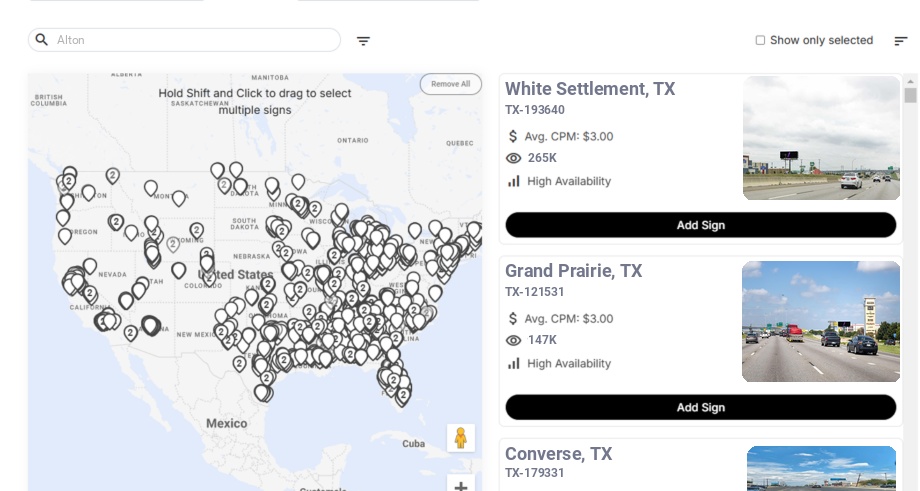
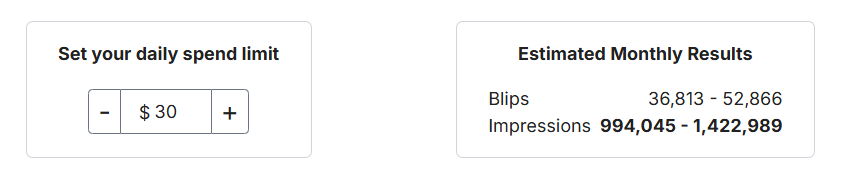
How much is a billboard in Alton?
Billboards in other Texas cities
Alton Billboard Advertising Guide
Alton, Texas sits in the heart of the rapidly growing McAllen–Edinburg–Mission metropolitan area, making it an outsized opportunity for advertisers relative to its small-city footprint. With a young, family-centric, predominantly Spanish-speaking population and heavy daily traffic flowing between Alton, Mission, McAllen, and Edinburg, digital Alton billboards can efficiently reach both local residents and regional commuters. Using Blip’s flexible scheduling and budgeting tools, we can tailor Alton billboard advertising campaigns to this market’s unique rhythms: school schedules, cross–border shopping trips, church and community events, and peak drive times on State Highway 107 and the I‑2/US‑83 corridor.
Understanding the Alton Market
Alton is officially a city of roughly 18,000–19,000 residents (2020 count was just over 18,000), but it functions as part of a much larger urban area:
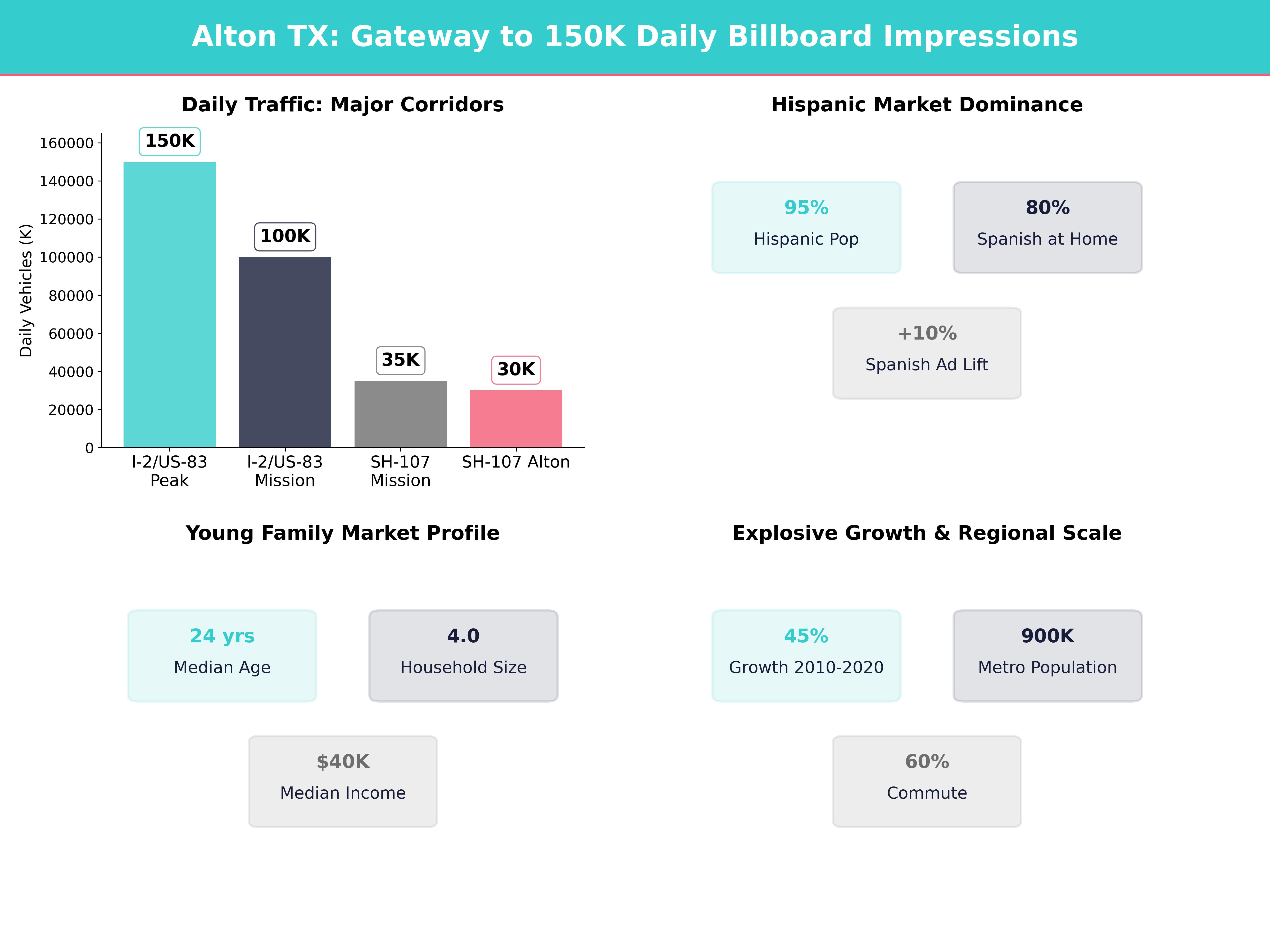
- Alton’s population grew by roughly 45–50% between 2010 and 2020 (from about 12,300 to just over 18,000 residents), making it one of the faster-growing small cities in Hidalgo County. Local projections from the City of Alton and regional planners anticipate the city passing 20,000 residents before 2030 if current growth trends continue.
- The broader McAllen–Edinburg–Mission metropolitan area has around 900,000 residents, according to regional estimates from entities like the Rio Grande Valley Metropolitan Planning Organization
- Hidalgo County government data indicates that more than 90% of the county’s roughly 880,000 residents live in the urbanized corridor stretching from Mission to Edinburg, with Alton embedded in this band of contiguous development.
Local context and resources worth noting when planning billboard rental in Alton:
- City government: City of Alton
- Nearby cities: City of Mission, City of McAllen, City of Edinburg, City of Palmhurst
- County government: Hidalgo County
- Regional planning and transportation: Rio Grande Valley MPO TxDOT Pharr District
- Regional news: The Monitor / MyRGV.com, Progress Times, KRGV Channel 5 News, City of Alton News
In practical terms, when we run a billboard campaign that targets Alton-facing locations, we are not just speaking to 18,000 people—we are participating in the daily flow of 800,000–900,000 residents crisscrossing the Rio Grande Valley for work, school, shopping, and healthcare. Daily cross-city commuting is high: local transportation studies show that more than 60% of workers in Hidalgo County commute to a different city within the county, underscoring how often residents move through Alton’s key corridors and see billboards in Alton.
Who You’re Reaching: Audience & Demographics
Alton’s demographic profile is distinctive and should heavily shape our messaging and creative:
-
Very young population
- Median age is in the mid‑20s (around 24–25 years), versus about 38 years nationally and roughly 35 years for Texas overall, according to regional demographic summaries used by Hidalgo County.
- In many estimates, 35–40% of residents are under 18, and more than 50% are under 30, creating one of the youngest age structures in the state.
- This means parents with school-age children and young adults are our core billboard audience, especially around school, retail, and entertainment hubs in nearby Mission and McAllen.
-
Overwhelmingly Hispanic and bilingual
- More than 95–98% of residents identify as Hispanic/Latino, one of the highest percentages in Texas, aligning with county-wide trends where over 92% of Hidalgo County residents identify as Hispanic/Latino.
- Local school district data from Mission CISD and Sharyland ISD consistently shows over 90% Hispanic enrollment, with 70–80% of students classified as economically disadvantaged and a large share in bilingual or ESL programs—indicating that 80–90% of households speak Spanish at home, and a significant share of adults are bilingual to varying degrees.
-
Family- and faith-driven lifestyles
- Large households are common: average household size in many west Hidalgo County communities is around 4.0–4.5 people, compared to about 2.5 nationally, with 20–25% of households having five or more members.
- Churches and faith communities function as social anchors, with many congregations reporting multiple hundreds of attendees across weekend services and major holidays like Easter, Día de las Madres, and Christmas.
- High engagement with school districts such as Mission CISD (over 15,000 students across more than 20 campuses) and Sharyland ISD (around 10,000 students) around sports, band, UIL competition, and community events means school-related traffic and visibility are consistently strong.
-
Income and value orientation
- Median household incomes in Alton and nearby communities typically fall in the $40,000–$55,000 range, below the Texas median of roughly $70,000 and the U.S. median around $75,000.
- In west Hidalgo County school districts, 70–85% of students qualify for free or reduced-price meals, another indicator of modest household incomes and strong price sensitivity.
- Many families are value-conscious but still spend significantly on groceries, telecom and streaming services, vehicles and repairs, quick-service restaurants, childcare, and healthcare.
Implications for billboard strategy:
- Bilingual creative is not optional—it’s a competitive advantage.
A split-language design (e.g., headline in Spanish, key brand name or call to action in English) works especially well. In practice, advertisers that lead with Spanish in RGV markets often report 10–30% higher response rates versus English-only campaigns, according to local agency case studies and feedback reported in outlets like MyRGV.com. - Family-oriented offers perform strongly.
Promotions that mention “para toda la familia,” “kids eat free,” or “family packs” align with the reality that 1 in 4 households may have five or more members. A single billboard with a clear “family value” message can influence multiple purchasing decisions within each vehicle. - Community and trust matter.
Local faces, local landmarks, and mentions of “Valley pride,” “RGV,” or “Valle del Río Grande” can quickly build recognition and favorability in a region where over 75% of residents have lived in the area for 5+ years. Endorsements or sponsorships of local teams, churches, or charities reinforce this trust signaling and are especially powerful on highly visible Alton billboards along SH‑107.
Traffic Patterns and Optimal Blip Scheduling
While Alton itself has a modest street grid, it feeds directly into major regional routes. Understanding traffic volumes helps us decide where and when to bid more aggressively through Blip for Alton billboard advertising.
Key corridors and patterns:
-
State Highway 107 (University Drive / Main Street)
- SH‑107 is Alton’s spine, connecting it east–west to Mission, Palmhurst, Edinburg, and beyond.
- Texas Department of Transportation (TxDOT) annual average daily traffic (AADT) counts along SH‑107 in the Mission–Palmhurst–Alton stretch often fall in the 20,000–30,000+ vehicles per day range, with some segments near Mission approaching 35,000 vehicles per day, according to TxDOT traffic count reports
- Morning traffic flows east (toward Mission/McAllen/Edinburg) as residents head to work and school, with reverse westbound traffic in late afternoon and evening—a classic “into the city in the morning, home in the evening” commute pattern.
-
I‑2 / US‑83 Expressway (McAllen–Mission corridor)
- Just south of Alton, the I‑2/US‑83 freeway corridor handles well over 100,000 vehicles per day through the Mission–McAllen segment, with some high-volume segments nearing 150,000 vehicles per day, per TxDOT Pharr District data.
- Large numbers of Alton residents use feeder roads and arterials to reach this expressway for work, shopping, and entertainment in Mission, McAllen, and Edinburg. McAllen’s major retail centers, highlighted by Visit McAllen, pull shoppers from across the Valley and even northern Mexico, adding thousands of extra weekend trips.
-
Local arterials and school routes
- Roads like Mile 5, Mile 6, and Los Ebanos, along with connectors into Mission’s retail zones and Mission CISD campuses, see pronounced surges before and after school.
- Local start times (often 7:30–8:00 a.m.) and dismissal (3:30–4:30 p.m.) create highly reliable weekday peaks. With tens of thousands of students across nearby districts being dropped off or picked up, even a small share of parents seeing your message translates into significant exposure for digital billboards in Alton and nearby corridors.
How we can leverage Blip’s scheduling tools:
-
Weekday morning (6–9 a.m.)
- Prioritize eastbound directions heading toward Mission/McAllen/Edinburg on SH‑107 and ramps feeding I‑2/US‑83.
- Ideal for healthcare, education, financial services, and employment messaging such as “Now Hiring,” “Walk‑In Clinic This Morning,” or “Last Day to Enroll,” when commuters are planning their day and still flexible.
- Morning drive-time typically captures 25–35% of daily vehicle trips, so a heavier bid in this window can significantly boost efficient impressions.
-
Afternoon school and work commute (3–7 p.m.)
- Focus on dining, retail, after-school programs, and entertainment offers—“Hoy: Kids Eat Free 4–8 p.m.,” “Descuentos Hasta las 7 p.m.”
- Emphasize westbound units as families return to Alton and surrounding neighborhoods.
- In many commuter corridors, PM peak volumes are 5–15% higher than AM peaks, and dwell times in stop-and-go conditions can be longer, improving billboard visibility.
-
Evenings and weekends
- Optimize for faith-based events, local festivals, nightlife, and big-box retail trips to Mission and McAllen. Shopping centers in McAllen and Mission often report Saturday foot traffic 30–50% above weekday averages, which aligns with higher weekend expressway flows.
- With Blip, we can dial up impressions around Friday payday periods and Saturday afternoon shopping peaks, when discretionary spending is highest. In lower-income, family-heavy markets like west Hidalgo County, card transaction data typically shows 10–20% spending bumps in the 48 hours after paydays.
Because Blip allows fine-grained dayparting, we can create separate ad sets for morning commuters, school traffic, and weekend shoppers—even if we’re using the same billboard faces—and allocate higher bids to the dayparts that prove most responsive in your reporting.
Seasonal & Event-Based Opportunities
Alton’s advertising calendar is strongly influenced by the broader Rio Grande Valley’s climate, school year, and cultural events, which should guide when you increase your billboard rental in Alton.
Key seasonal patterns:
-
Back-to-school (late July–September)
- Local districts like Mission CISD and Sharyland ISD often start earlier than northern states, with classes beginning in early to mid‑August.
- National and regional retail analyses show families can spend $600–900 per child on clothing, shoes, school supplies, and electronics during back-to-school; local spending concentrates in the 4–6 weeks leading up to the first day of school.
- We can run countdown-style creatives: “3 Semanas: Ahorra en Útiles Escolares en [Your Store],” timed to hit parents during supply pickup weekends highlighted on district calendars.
-
Tax refund and bonus season (February–April)
- Federal tax refunds and local agricultural cycles inject extra cash into households. The IRS reports that average refunds often run in the $2,500–$3,000+ range, and local banks and tax preparers in the Valley see a noticeable spike in activity each February and March.
- Big-ticket purchases—used cars, furniture, appliances, home repairs, and down payments—often cluster in this period. Auto dealers across Hidalgo County routinely report double-digit percentage increases in sales during peak refund weeks compared with non-refund months.
- Pair billboard messages with limited-time “tax refund specials”, “$0 Down with Your Refund,” or bonus offers that expire by mid‑April.
-
Summer heat (May–September)
- Average high temperatures in McAllen–Mission–Alton are frequently in the mid‑90s°F, with afternoon heat index values over 100–105°F for many days, according to regional climate summaries from the City of McAllen.
- This supports campaigns for AC services, bottled beverages, snow cones, pools and water parks, indoor entertainment, and healthcare (hydration, urgent care, heat safety).
- Heat-related visuals (“Beat 100° Heat with…”) are both relevant and attention-grabbing, especially when electricity usage and indoor shopping visits spike 10–20% during the hottest weeks.
-
Holiday and faith-based peaks
- Easter, Mother’s Day, Día de las Madres (May 10), and Christmas/New Year’s see strong church attendance and family gatherings. Many local parishes and congregations report attendance increases of 30–50% on major holidays compared to regular Sundays.
- Coordinate messages with church-heavy weekends: invitations for restaurants, catering, floral shops, jewelry stores, and local retailers. Promoting “Order by Friday” or “Reservaciones Limitadas” works well when families plan ahead.
Regional events and tourism:
-
While Alton is not a primary tourist hub, residents regularly visit attractions across Hidalgo County, highlighted by local tourism and city pages such as Visit McAllen, Explore Edinburg Mission Events
- Alton billboard advertising near major routes into these cities can capture both local residents and visitors traveling to these attractions.
- Annual festivals, such as parades and cultural celebrations promoted by cities and covered by outlets like KRGV and MyRGV.com, can significantly spike traffic patterns, especially Thursday–Saturday evenings, with event attendance often in the thousands to tens of thousands.
- High school football playoffs and rivalry games regularly draw 5,000–10,000+ fans to stadiums across the Valley, creating elevated pre- and post-game traffic that can be targeted with short-term creative.
With Blip, we can run short, high-intensity bursts during these windows—e.g., a 10‑day back‑to‑school blitz, a 3‑week tax-refund car sale, or a 4‑day festival promotion—without committing to long-term static contracts.
Crafting Effective Creative for Alton
In a market like Alton, the difference between a good billboard and a great one often comes down to cultural relevance and clarity. This is especially true for billboards in Alton that must quickly speak to bilingual, family-focused drivers.
Design guidelines tailored to this area:
-
Use bilingual or Spanish-dominant copy.
- Consider a 60/40 split: Spanish headline, English brand/URL/phone.
- Example: “Seguro de Auto Desde $39/mes – Call Valley Insurance” with a large, simple phone number.
- In heavily Hispanic markets, local agencies report that Spanish-forward creative can increase recall among Spanish-dominant adults by 20–40% compared with English-only messages.
-
Keep text extremely simple—5–7 words max.
- High traffic speeds on SH‑107 and I‑2 mean drivers have roughly 4–6 seconds to absorb your message.
- Aim for no more than 1 main idea, 1 call to action, and 1 contact point (URL or phone). Avoid dense copy like multiple bullet lists or small fine print.
-
Lean into family and community imagery.
- Photos of local-looking families, school-aged children in sports gear, or Valley landscapes (palms, fields, RGV sunsets) build instant relevance.
- If you sponsor a school or sports team, feature them by name (e.g., “Proud Sponsor of Mission Eagles” or “Apoyando a Sharyland Rattlers”)—school and team pride is strong, and local sports coverage on Progress Times and MyRGV.com gets high community visibility.
-
Make contact details effortless.
- Large phone numbers (7–10 digits at least one-third the width of the board).
- Short URLs or simple phrases like “Salida Conway, hacia el norte” instead of complicated directions.
- If you expect mobile follow-up, use short, memorable domain names, and avoid spelling that could be easily misheard in bilingual contexts.
-
Use color for visibility in intense sun.
- The Rio Grande Valley’s bright sun can wash out low-contrast designs—on summer days, peak sun hours last 6–8 hours.
- Prioritize dark text on light backgrounds or vice versa, with high contrast (e.g., white on dark blue, yellow on black).
- Avoid thin fonts; bold, sans-serif typography has better recognition at 55–75 mph viewing speeds.
Because we can run multiple creatives with Blip, we can:
-
Test a Spanish-dominant version versus a balanced bilingual version and monitor which drives more calls, walk-ins, or website visits.
- Swap in event-specific creative (e.g., “This Weekend Only”) without reprinting costs, adjusting as local news and community calendars change.
- Adapt creative by daypart—family meals in the evening, job recruitment in the morning, healthcare messages on weekday mornings and Sunday evenings.
Local Business Playbooks
Digital billboards in Alton can serve both hyperlocal businesses and regional brands. Here are some concrete strategies by category.
Restaurants & Quick-Service
- Target weekday lunch (11 a.m.–2 p.m.) and family dinner (4–8 p.m.) for nearby SH‑107 and Mission/McAllen-facing boards. Lunchtime and early evening are when quick-service restaurants in the Valley typically see 50–60% of their daily transactions.
- Promote specific deals: “Menú del Día $7.99,” “Kids Eat Free Tuesday,” “Drive‑Thru Abierto Hasta las 11 p.m.” Clear price points (e.g., under $10 per person) resonate strongly with value-conscious families.
- Run payday weekend bursts (1st–5th and 15th–18th of the month), when household spending temporarily spikes. Payment card analyses in similar markets show 10–20% higher restaurant and grocery spending in the 2–3 days after paydays.
Auto Dealers & Repair Shops
- Focus on tax season and back-to-school: “Tax Refund Special – $0 Down,” “Back‑to‑School Oil Change $29.99.” Many Valley dealerships report that 25–35% of annual used-car sales cluster around refund and back-to-school windows.
- Schedule heavier weekday morning and late afternoon impressions for commuters on their way to and from work on SH‑107 and feeder roads to I‑2/US‑83.
- Highlight bilingual staff and easy financing: “Se Habla Español – Aprobación en 30 Minutos.” In a market where over 90% of buyers are Hispanic and many are first- or second-generation, this reassurance can materially improve lead volume.
Healthcare & Dental
- Target young families: pediatric clinics, dental offices, urgent cares, OB/GYN clinics, and vision centers. Local school health data often shows high rates of pediatric visits tied to respiratory illnesses, sports injuries, and dental care, especially between October and March.
- Use urgency and convenience: “Walk‑In Clinic Today – SH‑107 & [Landmark],” “Dental Emergencies Welcome – Llama Ahora.” Clinics that promote walk-in availability commonly see 10–25% bumps in new patient visits during campaign periods.
- Run heavier schedules around flu season (Oct–March) and sports seasons (football, soccer, basketball), when injuries and illness increase. Align messages with school sports calendars from Mission CISD and Sharyland ISD.
Education & Training
- Promote local private schools, charter schools, ESL classes, GED programs, and workforce training including offerings publicized by South Texas College and adult education centers throughout Hidalgo County.
- Run campaigns 4–8 weeks before enrollment deadlines with simple CTAs like “Apply by Aug 1 – Becas Disponibles.” Many programs receive 50–70% of applications in the final month before cutoff, so late-stage reminders are powerful.
- Pair billboards with strong digital/social campaigns to capture applications; track clicks and calls by including vanity URLs on the billboard (e.g., “YourSchoolRGV.com”).
Financial Services & Insurance
- Emphasize trust, convenience, and bilingual service: “Préstamos Rápidos – Se Habla Español,” “Seguro de Auto Desde $39 al Mes.” In communities with lower average incomes and credit challenges, clear, low entry points and quick approval messaging are crucial.
- Increase frequency in the week leading up to major bill due dates (rent, utilities, auto payments) and tax refund season (Feb–Apr), when demand for short-term loans, check cashing, and insurance updates spikes.
- Use location-based copy: “En Mission, junto a [well-known retailer].” Data from local retail centers suggests that 70–80% of shoppers visit the same 2–3 shopping areas each month, making familiar retailer anchors powerful wayfinding cues.
Measuring & Optimizing with Digital Billboards
To truly take advantage of Blip’s flexibility in the Alton area, we should treat billboard campaigns as test-and-iterate efforts rather than one-time buys. This mindset applies whether you’re running a single board or scaling up a broader Alton billboard advertising strategy.
Practical measurement tactics:
-
Track response by time and day.
- Use unique phone numbers or short URLs on different creatives or in different dayparts. For example, use “/am” and “/pm” URL tags or separate call-tracking numbers.
- Compare call volume or website hits during 6–9 a.m. versus 3–7 p.m. to refine your scheduling. Even a 10–15% improvement in response during a specific daypart is a signal to shift more budget there.
-
Align offers with local news and events.
- Follow local outlets like The Monitor, Progress Times, and KRGV to anticipate high-attention moments—big football games, community festivals, severe weather, or regional announcements.
- Launch quick, 3–5 day “micro-campaigns” that reference timely happenings (“Este Fin de Semana: Festival en Mission – Ahorra en…”), capturing attention when local media conversations spike.
-
Rotate creative monthly.
- In a market where commuters may pass the same board 10–20 times per week, creative fatigue can set in quickly. Research on OOH effectiveness indicates recall can drop 20–40% if a message is unchanged for several months.
- Even minor changes—color shifts, new photos, updated offer language or price points—help keep attention high and give you opportunities to test different angles.
-
Compare different corridor performances.
- Test one creative on SH‑107-facing units and another on expressway-adjacent units to see where walk-ins or calls spike. Businesses closer to Alton may find higher conversion rates per impression on SH‑107, while regional brands may see better total volume from I‑2/US‑83.
- Track metrics like cost per call, cost per lead, or incremental in-store traffic per week along each corridor to guide your allocation decisions.
By aligning our creative, scheduling, and budget decisions with Alton’s specific demographic profile, traffic patterns, and cultural rhythms, we can use Blip’s digital billboards to punch well above this city’s population size. The result is efficient, targeted visibility across the broader Rio Grande Valley, with campaigns that feel local, relevant, and timely to the families who call Alton home and regularly interact with Alton billboards along their daily routes.