Billboards in Midland, TX
No Minimum Spend. No Long-Term Contracts. Just Results.
Trusted by Leading Brands


Billboard advertising
in Midland has never been easier
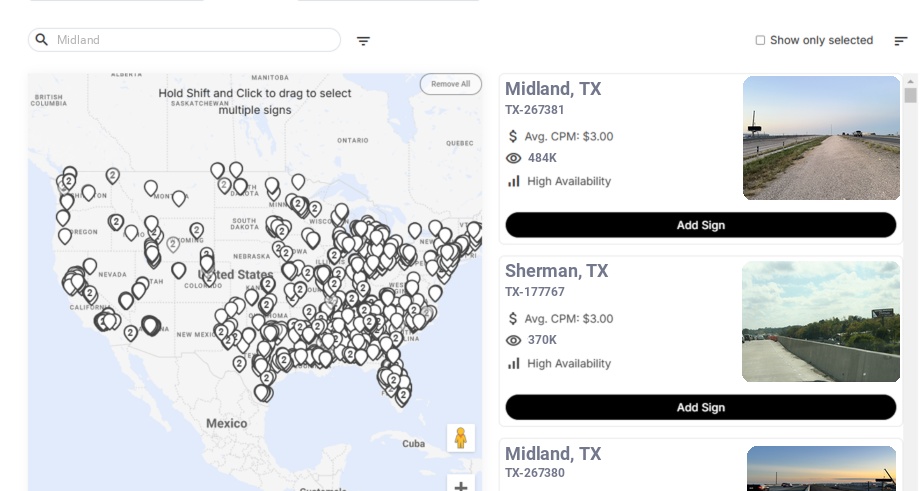



How much is a billboard in Midland?
Why Choose Blip for Billboard Advertising in Midland
Blip lets you launch Midland billboards on I-20 and Loop 250 in minutes, so you catch commuters and oilfield traffic without a long setup.
Use flexible budgets in Midland to focus spend on SH 191, Andrews Hwy, or Business 20 and adjust anytime as traffic patterns shift.
Daypart your Midland campaign to hit 5:30 a.m. crew commutes, lunch runs, or evening shoppers around retail hubs.
No contracts means you can test Midland billboards during oil & gas expo weeks, then pivot fast if the Permian Basin market changes.
Track Midland results in real time and optimize for hotel travelers, truck traffic, and families moving along Loop 250.
Blip's creative tools make it easy to build bold Midland ads that stand out in bright West Texas sun on high-speed corridors.
Frequently Asked Questions About Billboard Advertising in Midland
How much does a billboard cost in Midland, Texas with Blip?
With Blip, you control exactly what you spend on Midland billboards by setting a daily budget that can be as small or as large as you’re comfortable with, and Blip automatically keeps your campaign within that limit. Each “blip” is a brief 7.5 to 10-second ad display, and you only pay for the individual blips you receive, so every dollar goes directly toward putting your message on billboards in Midland, Texas. The cost depends on when and where your ads run and on advertiser demand, but you can start with any budget and adjust it at any time.
Where can I advertise with Blip in Midland, Texas?
Digital Midland billboards can reach residents, transient workers, and travelers as they move along I‑20, Loop 250, SH 191, and the major arterials that tie the city together. I‑20 carries heavy truck traffic, oilfield service vehicles, and long-distance travelers, while Loop 250 is a major commuter and retail corridor. SH 191, Andrews Highway (US 385), TX‑349, and Business 20 also connect to oilfield areas, business parks, and mixed commercial zones.
Why are Midland, Texas billboards effective for reaching local audiences?
Midland sits at the heart of the Permian Basin and behaves like a fast-growing, high-income, highly mobile market. Many people seeing the boards are working-age commuters, young families, high-income workers, and business travelers with disposable income and limited time. Clear, high-impact messages like “exit here,” “call now,” and “book today” perform especially well in this market.
When is the best time to run billboards in Midland, Texas with Blip?
Midland’s economy and commuting patterns are shaped by early shifts and non-traditional hours, so mornings, middays, evenings, nights, and weekends can each be useful depending on your goal. Oilfield and service crews often start before sunrise, while evening traffic on Loop 250 and SH 191 often shows a second peak. With Blip, you can daypart your schedule and buy impressions only during chosen hours or days.
What kind of businesses work well on Midland, Texas billboards?
Midland billboard advertising is especially effective for recruiting, travel-oriented offers, retail and dining, healthcare, housing, and industrial services. The page also highlights strong fits for oil & gas and industrial services, healthcare, dental, wellness, restaurants, hospitality, real estate, education, nonprofits, and community institutions. Messages that emphasize speed, convenience, earnings, family, and safety tend to resonate well.
Do I need a contract to advertise with Blip in Midland?
No, Blip has no long-term contracts or minimum commitments. You can start, pause, or stop your campaign at any time.
How fast can I launch a billboard campaign with Blip in Midland?
You can have your campaign live in minutes. Create a free account, select your locations, set your budget, upload your design, and start running once approved.
Where can I advertise with Blip in Midland?
Blip has digital billboards in Midland. You can browse available locations on a map, choose the ones that fit your audience, and start advertising right away.
Still have questions? Launch a campaign in minutes — no contracts, no commitments.
Start Your CampaignMidland Billboard Advertising Guide
Midland, Texas sits at the heart of the Permian Basin—one of the most productive oil fields in the world—and it behaves like it: fast‑growing, high‑income, and highly mobile. That combination makes digital Midland billboards a powerful way to reach residents, transient workers, and travelers as they move along I‑20, Loop 250, SH 191, and the major arterials that tie the city together. Below, we outline how we can use Blip’s flexible tools to build smart, data‑driven campaigns tailored specifically to Midland.
Understanding the Midland Market
Midland is one of the most economically dynamic smaller metros in the country, with several characteristics that matter directly for billboard strategy and for anyone considering Midland billboard advertising:
-
Population & growth
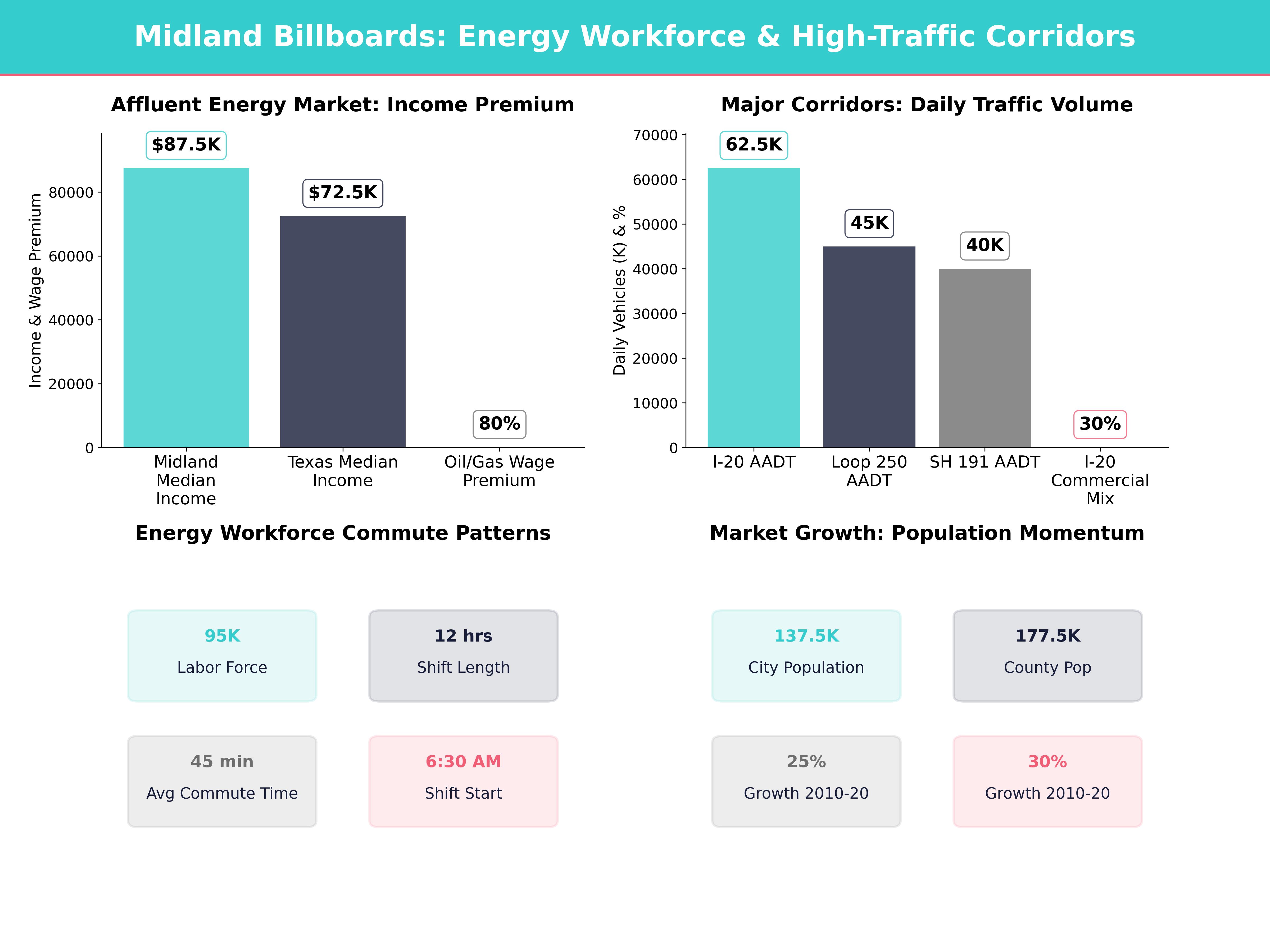
- The City of Midland has roughly 135,000–140,000 residents as of the early 2020s (up from 132,524 in the 2020 census), while Midland County totals around 175,000–180,000 residents.
- Together with neighboring Odessa, the Midland–Odessa combined statistical area is home to roughly 345,000–355,000 people, creating a meaningful regional audience that functions as one economic region.
- Between 2010 and 2020, Midland’s city population increased by more than 25%, and Midland County’s population rose by nearly 30%, making it one of the faster‑growing small metros in Texas during that decade.
- The metro’s median age sits in the low‑to‑mid‑30s, several years younger than the U.S. average, which means a large share of working‑age commuters and young families on the roads each day and regularly exposed to billboards in Midland.
-
Income & spending power
- Midland consistently ranks among the higher‑income communities in Texas due to oil‑and‑gas wages. Recent estimates put median household income in the $85,000–$90,000 range, compared with roughly $70,000–$75,000 statewide.
- In boom years, average weekly wages in the local mining, quarrying, and oil and gas extraction sector can run 60–100% higher than the U.S. all‑industry average.
- High compensation in oilfield, engineering, logistics, and professional services translates into strong demand for new vehicles, housing upgrades, dining out, travel, and leisure purchases—all strong fits for billboard messaging that highlights convenience and premium offerings.
- The Midland Development Corporation cites a labor force of roughly 90,000–100,000 workers in the Midland metro, much of it engaged in energy and energy‑adjacent sectors.
-
Economy & workforce
- Midland brands itself as “The Oil & Gas Capital of Texas,” and crude oil and natural gas production in the Permian Basin underpin local employment. The basin has produced millions of barrels of oil per day in recent years, with Midland County as one of its core producing areas.
- According to the Midland Development Corporation, diversification efforts are growing employment in aerospace, logistics, healthcare, and business services, but oil & gas continues to drive the local boom‑and‑bust cycle and a large share of high‑wage jobs.
- Work schedules are often non‑traditional; a sizable share of field employees and contractors work 12‑hour shifts, start before 6:00 a.m., end late, and commute 30–60+ minutes each way, increasing their daily exposure to roadside media and making Midland billboards particularly effective.
-
Visitor and transient populations
- VisitMidland promotes the city as a regional hub for sports tournaments, youth events, business travel, and oil‑and‑gas conferences. The city’s sports facilities, including the Scharbauer Sports Complex
- The Midland International Air & Space Port (MAF) handled over 1.3–1.4 million passengers annually in the late 2010s and has rebounded into the 1.1–1.2 million passenger range post‑pandemic, feeding a steady stream of business travelers and rotation workers who see billboards in Midland on their way to hotels and job sites.
- Hotel inventory in the Midland–Odessa area runs into the tens of thousands of rooms, supporting a constant flow of out‑of‑town workers on multi‑week rotations.
- Thousands of non‑resident workers cycle in and out each year from other Texas cities, Oklahoma, New Mexico, and beyond, with many commuting daily from neighboring counties along I‑20, US 385, and SH 191.
Implication for billboard advertisers: we are not just talking to residents. Many people seeing our boards are high‑income, commuting workers and business travelers with disposable income and limited time. Clear, high‑impact messages that make decisions easy—“exit here,” “call now,” “book today”—perform especially well in this market and should be core to any Midland billboard advertising plan.
Key Corridors and Traffic Patterns
Midland is built around a few major roadways. Choosing Blip boards along the right corridors lets us align with daily movement patterns and intent, maximizing the effectiveness of billboard rental in Midland.
The Texas Department of Transportation’s Odessa District tens of thousands of vehicles per day, giving digital billboards significant reach.
1. Interstate 20 (I‑20)
- I‑20 runs east‑west along the south side of Midland, connecting the city to Odessa (west), Abilene (east), and, more broadly, Dallas–Fort Worth and El Paso.
- It carries heavy truck traffic, oilfield service vehicles, and long‑distance travelers. In segments near Midland and Odessa, average annual daily traffic (AADT) commonly falls in the 50,000–75,000 vehicles per day range, with freight and commercial vehicles often accounting for 25–35% of that volume.
- Segments near key interchanges such as Midkiff Road, Rankin Highway (TX‑349), and Loop 250 see some of the highest traffic volumes in the Permian Basin corridor.
-
Best uses:
- Recruiting campaigns (oilfield workers, CDL drivers, industrial trades) where every 10,000–20,000 daily impressions can translate into a steady flow of applications.
- Travel‑oriented offers (hotels, restaurants, attractions, auto repair, truck services) that capture the thousands of out‑of‑market drivers moving through each day.
- Brand awareness for regional businesses that serve both Midland and Odessa and want broad reach across the entire I‑20 corridor with high‑impact Midland billboards that reach both local and through‑traffic.
2. Loop 250 (TX Loop 250)
- Loop 250 forms the northern and eastern loop around Midland and is a major commuter and retail corridor linking neighborhoods, business districts, and major shopping centers.
- AADT on busy segments of Loop 250 commonly falls in the 35,000–55,000 vehicles per day range, with spikes during morning and evening commutes and on weekends around retail hubs.
- It connects residential areas in north and northeast Midland to retail centers, office clusters, and highway access points, including major shopping destinations and big‑box retailers.
- As a primary route to major shopping areas, Loop 250 sees consistent daily commuter and shopper traffic; weekend and holiday peaks can push traffic 10–20% above weekday averages around major centers.
-
Best uses:
- Retail and dining (especially “next exit” and “2 miles ahead” style boards) that benefit from high volumes of local shoppers.
- Healthcare, banking, insurance, and professional services targeting households along well‑traveled daily routes.
- Education and family services (private schools, tutoring, after‑school programs) that want to reach parents during school‑run and after‑work hours.
3. SH 191 & Andrews Highway (US 385), TX‑349, Business 20
- SH 191 (between Midland and Odessa) is a high‑speed corridor lined with offices, hotels, and service businesses catering to the energy industry. Typical AADT figures run in the 35,000–45,000 vehicles per day range, much of it white‑truck and fleet traffic.
- Andrews Highway (US 385) and TX‑349 (Big Spring Street) cut through Midland and connect to oilfield areas and smaller communities to the north, carrying significant worker and service‑vehicle flows that can exceed 20,000–30,000 vehicles per day in some segments.
- Business 20 runs parallel to I‑20 and passes more directly through town, hitting mixed commercial zones with a blend of local shoppers, commuters, and through‑traffic.
-
Best uses:
- B2B and industrial services (equipment, safety training, logistics, accounting, legal) that need to reach decision‑makers and supervisors driving between yards, offices, and job sites.
- Housing/apartments for workers commuting into Midland, especially near major arterial intersections.
- Local events, nightlife, and restaurants, especially around hotels and business parks where weekday hotel occupancy can reach 70–80% during active drilling cycles.
With Blip, we can choose specific boards along these corridors and adjust bids by location, ensuring we spend more where our audience is most likely to travel. For instance, a hotel near I‑20 might concentrate 70–80% of its impressions on I‑20 and SH 191 boards, while a family dentist might focus 80–90% on Loop 250 and in‑town arterials where local households dominate traffic. This level of control makes billboard rental in Midland more efficient and performance‑driven than traditional, fixed‑term buys.
When to Advertise: Dayparts and Weekly Rhythms
Midland’s economy and commuting patterns are shaped by early shifts and non‑traditional hours. Blip’s flexible scheduling helps us align with those rhythms and get more impact from billboards in Midland.
Morning commutes (5:30 a.m. – 9:00 a.m.)
- Oilfield and service crews frequently hit the road before sunrise, especially on weekdays. In energy hubs like Midland, a substantial share of field workers start shifts at 6:00–7:00 a.m., meaning the 5:30–7:30 a.m. window has dense work‑related traffic.
- Office workers, teachers, and healthcare staff typically follow between 7:00 a.m. and 9:00 a.m. The Midland ISD bell schedule and the presence of roughly 27,000–28,000 students and thousands of staff generate pronounced school‑run peaks.
-
Use this window for:
- Recruitment (“Now hiring CDL drivers – $X/hr – Apply at …”) aimed at workers already thinking about career changes.
- Coffee, breakfast, and convenience stores (“Breakfast burritos this exit”) that can capture a share of the tens of thousands of morning commuters.
- Urgent services (auto repair, urgent care, dental emergencies) when same‑day help is top of mind.
Midday (11:00 a.m. – 2:00 p.m.)
- Lunch breaks and mid‑shift travel create steady traffic; many field workers and contractors run supply or fuel trips during this window.
- For many corridors in Midland, midday volumes stay within 80–90% of peak commuter traffic, giving advertisers near‑peak reach with less message clutter than rush hour.
-
Use this window for:
- Quick‑serve restaurants and sit‑down lunch spots looking to influence same‑day dining decisions.
- Retail and errands (banks, cell phone providers, car washes) that benefit from “while you’re out” trips.
- Healthcare & wellness (“Same‑day appointments,” “Walk‑in clinic open now”) capturing patients who can step away from work.
Evening commute (3:30 p.m. – 7:30 p.m.)
- Many field workers return earlier in the afternoon; office workers and service staff follow. Traffic counts on key routes like Loop 250 and SH 191 often show a second peak in this window, rivaling morning volumes.
- Families are heading to sports practices, groceries, and dining. MISD’s extensive athletics programs and club sports mean thousands of daily trips to fields, gyms, and venues.
-
Use this window for:
- Family dining, groceries, and entertainment, especially Thursday–Sunday when evening outings spike.
- Gyms and fitness centers (“Join today, no contract”) appealing to commuters making after‑work decisions.
- Home services (HVAC, plumbing, roofing, landscaping), when homeowners are most reachable and able to call.
Nights and weekends
- Night shift workers, long‑haul drivers, and nightlife traffic continue through late evening, especially along I‑20 and near hotel clusters.
- Weekend traffic often spikes around shopping centers, churches, and sports facilities. In a community where a large share of households attend services, Sunday morning traffic around churches and major intersections is significant.
-
Use these windows for:
- Bars, nightlife, and late‑night food, particularly on Fridays and Saturdays.
- Churches and religious events (especially Friday–Sunday morning) that want to reach both members and visitors.
- Recreation, youth sports, and family activities, including messaging tied to tournaments showcased on VisitMidland.
With Blip, we can “daypart” our schedule—only buying impressions during chosen hours or days. For example:
- A quick‑serve restaurant might run 80% of its budget from 10:30 a.m.–2:00 p.m. and 4:30 p.m.–8:00 p.m. on weekdays to match peak meal demand.
- A church can concentrate impressions Thursday evening through Sunday morning, leading into services and special events.
- A 24/7 truck service can pay a premium for overnight impressions along I‑20, when competition and clutter are lower but relevance to long‑haul drivers is high.
Seasonality in Midland: Tying Campaigns to the Calendar
While oil prices drive long‑term cycles, Midland also has strong seasonal patterns we can leverage to improve results from Midland billboard advertising.
1. Oil & gas activity cycles
-
When crude oil prices are high (e.g., above $70–75 per barrel), drilling and completions activity in the Permian Basin historically increases, leading to:
- More incoming workers and higher hotel occupancy.
- Higher demand for housing, transportation, and local services, from truck sales to safety training.
- When prices soften (e.g., prolonged periods under $55–60 per barrel), residents may become more cautious with discretionary spending, and recruitment slows.
- In active drilling periods, local unemployment rates have dropped into the 2–3% range—essentially full employment—intensifying competition for labor.
-
Strategy:
- In boom periods, emphasize recruiting, workforce housing, equipment leasing, and premium services (boats, trucks, RVs, higher‑end retail) that appeal to workers with overtime income.
- During slowdowns, pivot toward value messaging (“Save now,” “0% financing,” “No‑cost consultation”) and retention rather than aggressive hiring, while highlighting stability and long‑term presence in Midland.
2. Weather & climate
- Midland averages about 265–275 sunny days per year, according to regional climate data, making outdoor advertising reliable year‑round with minimal weather‑related downtime.
-
Hot summers (average July highs around 94–96°F, with many afternoons over 100°F) and dust/wind can influence behavior:
- More indoor leisure (movies, shopping, gyms) in peak heat, especially mid‑afternoon.
- High demand for HVAC services in summer and plumbing/pipe protection during winter cold snaps, when nighttime lows can periodically drop below 20°F.
- Severe thunderstorms and hail events, though not daily, create spikes in demand for roofing, auto body repair, and insurance services.
-
Strategy:
- Shift messaging seasonally: HVAC and pool services in late spring/summer; roofing, insulation, and heating checks in fall/winter.
- Use visuals that feel seasonally appropriate (cool blues and water imagery in summer; warm tones in winter).
- After major weather events reported by local outlets such as the Midland Reporter‑Telegram NewsWest 9, quickly rotate in creative for restoration, roofing, and insurance support.
3. School year and youth sports
- Midland ISD serves roughly 27,000–28,000 students across more than 40 campuses, making schools a central part of daily traffic patterns.
-
The school year roughly follows a mid‑August to late‑May calendar, with busy periods around:
- Back‑to‑school (late July–September), when families are shopping for supplies, clothing, and services.
- High school football (August–November), which draws thousands of fans to games each week at local stadiums.
- Spring sports (February–May), when fields and complexes run full schedules of baseball, softball, soccer, and track.
-
Strategy:
- For tutoring, after‑school programs, youth leagues, and family services, concentrate impressions at the start of each semester and during registration windows highlighted on MISD and local league calendars.
- Promote spirit wear, local restaurants, and family entertainment Thursday–Saturday during football season, when game nights significantly increase evening traffic on key corridors.
4. Events and tourism
- VisitMidland promotes attractions such as the Permian Basin Petroleum Museum, the Museum of the Southwest, and local festivals and rodeos that collectively attract tens of thousands of visitors per year.
- The Permian Basin Petroleum Museum Museum of the Southwest and local performing arts venues contribute to a steady calendar of cultural events.
- The city hosts youth and adult sports tournaments, fairs, and industry conferences that bring in large out‑of‑town audiences across the year, often filling hotels and restaurants to near capacity.
-
Strategy:
- For hotels, attractions, and restaurants, increase bids along I‑20 and SH 191 around major events listed on VisitMidland’s events calendar.
- Rotate creative that references specific events (“Welcome Oil & Gas Expo Attendees – Show This Ad For 10% Off”) or tournament weekends to capture visiting families.
- Coordinate campaigns with coverage from local media like the Midland Reporter‑Telegram CBS7 to maximize cross‑channel visibility.
Crafting Creative That Works in Midland
Midland’s audience is busy, practical, and often on the move for work. Billboard creative should reflect that to make the most of billboard rental in Midland.
1. Prioritize clarity and speed
Most drivers in Midland are on high‑speed roads (I‑20, Loop 250, SH 191) where posted limits are often 60–75 mph. We should design for comprehension in 2–3 seconds:
- Limit to 7–10 words of main text so messages can be read at highway speeds.
- Make the brand or offer headline at least 1/3 of the creative height and ensure key text is legible from 500–700 feet away.
- Use one primary call to action (CTA): “Exit 250B,” “Call 432‑XXX‑XXXX,” “Text MIDLAND to 12345,” or a short URL that’s easy to recall while driving.
2. Leverage local identity and pride
Midlanders are strongly tied to the Permian Basin and local sports:
- Use phrases like “Proudly serving the Permian Basin since 19XX” or “Midland‑owned, Midland‑trusted,” echoing the local‑business emphasis promoted by groups like the Midland Chamber of Commerce.
- Reference local teams, where appropriate, such as Midland High Bulldogs, Legacy Rebels, or local college teams, especially around game days.
- Celebrate local culture (rodeo imagery, oil pumpjacks, West Texas sunsets) while maintaining a clean layout and clear CTA.
3. Visual style for high‑sun conditions
With nearly 270 sunny days a year and strong West Texas glare, boards must compete with bright light:
- Favor high‑contrast color combinations (dark backgrounds with bright text, or vice versa). Avoid low‑contrast pairings like light gray on white.
- Avoid thin fonts; choose bold, sans‑serif typefaces with strong stroke width so letters don’t wash out in bright light.
- Use large, simple icons (a tooth, a truck, a house, a burger) that communicate instantly even if text is missed, especially during split‑second glances at 70 mph.
4. Message frameworks that resonate
Based on local demographics and economic drivers, messages that perform well in Midland often fall into these categories:
- Speed & convenience
“Oilfield ready in 24 hours”
“Same‑day dental crowns”
“10‑minute oil change – No appointment” - Earnings & opportunity
“CDL drivers: Up to $X/week + housing”
“Now hiring techs – Paid training + benefits” - Family & community
“Family‑owned in Midland since 1985”
“Kids eat free on Tuesdays – Exit 131” - Safety & reliability
“24/7 roadside service – I‑20 & Loop 250”
“Licensed, insured, and local – Call today”
With Blip, we can easily rotate multiple creatives within a single campaign. For instance, a clinic could run:
- One design for emergencies (“Walk‑in urgent care – Open late”),
- A second for occupational medicine and DOT physicals,
- A third for family medicine,
and track which messages align with appointment trends by monitoring call volumes, online bookings, and form fills.
Using Blip’s Flexibility to Test and Optimize
Digital billboards in Midland are most powerful when they’re treated like an agile campaign, not a static placement. Blip’s model—buying individual “blips” of ad time—lets us optimize in several ways.
1. Start with focused tests
- Launch with 2–4 creatives across 3–6 strategic boards (e.g., two on I‑20, two on Loop 250, two on SH 191).
- Run for 2–4 weeks with a consistent daily budget so patterns are clear.
-
During the test, note:
- Inbound calls or web traffic from the area (track Midland and Odessa ZIP codes, 432 area‑code calls, and regional IP addresses).
- Coupon or promo code redemption if used.
- Any spikes during particular days or times (for example, traffic from I‑20 boards peaking on Sunday evenings as travelers arrive).
2. Concentrate budget where performance is strongest
Once we see patterns:
- Increase bids on boards along corridors where leads or visits appear to spike—for instance, if 60–70% of coupon redemptions mention “the sign on Loop 250,” shift more budget there.
- Shift impressions to the best dayparts (for example, mornings for recruiting; evenings and weekends for restaurants and entertainment).
- Pause boards or hours that show weak return and reallocate toward better‑performing placements.
Because Blip doesn’t require long‑term, fixed contracts, we can fine‑tune monthly or even weekly, matching the city’s fast‑changing energy economy and ensuring our Midland billboard advertising keeps pace.
3. Pair billboards with digital and offline channels
Midland’s drivers are heavy smartphone users, and many industries here rely on word of mouth and local reputation:
- Use the same core headline and visual across billboards, social media, and search ads to reinforce recognition; studies show cross‑channel consistency can lift ad recall by 20–30%.
- Include an easy‑to‑remember URL or keyword on the board that matches your other campaigns (e.g., yoursite.com/MAF for airport‑area offers).
- Encourage customers to mention they “saw the billboard on Loop 250” or “the I‑20 sign” to help you track impact in addition to digital analytics.
Vertical‑Specific Tips for Midland Advertisers
Different industries can take advantage of Midland’s unique dynamics in different ways when planning Midland billboards.
Oil & Gas and Industrial Services
- Focus corridors: I‑20, SH 191, Business 20, US 385 (Andrews Hwy), and TX‑349, all of which serve major yards, staging areas, and industrial parks.
- Dayparts: Early mornings (5:30–9:30 a.m.) and late afternoons (3:00–7:00 p.m.), when supervisors, field crews, and vendors are moving between sites.
-
Messages:
- “Frac sand delivered – Call 432‑XXX‑XXXX.”
- “Safety training – Same‑week classes available.”
- “Field housing & man camps – Move‑in ready.”
- Tie in with major events like oil & gas expos advertised by VisitMidland or local business groups such as the Midland Chamber of Commerce, when decision‑makers from across the region are in town.
Recruiting and Workforce Development
- Highlight starting pay, bonuses, housing, and schedule prominently—these are key decision factors in a market where many roles offer overtime and per‑diem.
- Emphasize trust and longevity: “Serving the Permian Basin for 20+ years.” Local tenure is a strong credibility signal in a boom‑and‑bust market.
- Use boards on routes feeding industrial parks and staging yards where potential applicants already work or pass daily.
- Run heavier during recruitment pushes or new project launches; for example, a two‑week burst reaching hundreds of thousands of impressions along I‑20 and SH 191 when a new rig fleet comes online.
Healthcare, Dental, and Wellness
- Choose in‑town boards and Loop 250 routes that hit residential areas and family‑oriented traffic.
-
Use time‑sensitive CTAs:
- “Same‑day appointments – Call now.”
- “Open until 8 p.m. – Walk‑ins welcome.”
- Consider Spanish‑inclusive or bilingual messaging in areas with significant Hispanic populations; in Midland County, Hispanic/Latino residents represent a substantial share of the population, making bilingual campaigns a strong fit.
- Tie campaigns into awareness months covered by local media (e.g., heart health, back‑to‑school physicals) to leverage free editorial exposure from outlets like the Midland Reporter‑Telegram
Retail, Restaurants, and Hospitality
-
For hotels near I‑20 and SH 191:
- Run 24/7, with emphasis at evening hours when travelers seek lodging; many hotels see check‑in peaks around 5:00–9:00 p.m..
- Use clear “This exit / Next exit” directives and mention key amenities (free breakfast, truck parking, corporate rates, pet‑friendly).
-
For restaurants:
- Target lunch and dinner windows near retail centers and high‑traffic intersections. Weekend evening traffic around major centers can exceed weekday levels by 10–20%.
- Promote daily specials, “kids eat free” nights, or event‑related offers tied to games, tournaments, or concerts.
-
For stores:
- Focus on Loop 250 and SH 191 for shoppers, especially near major centers and big‑box clusters.
- Align promotions with pay cycles and tax refund season, when household discretionary spending typically spikes.
Real Estate and Housing
- Emphasize inventory for incoming workers: apartments, extended‑stay hotels, RV parks, and corporate housing options.
-
Use simple, price‑anchored messaging:
- “1‑bedroom from $X – Exit here.”
- “Furnished oilfield housing – Weekly rates.”
- Schedule heavier during peak hiring periods or when you know major projects are starting—periods that local news (e.g., CBS7 or NewsWest 9) report on.
- Highlight proximity to key employers, schools, and amenities (“5 minutes to Loop 250,” “10 minutes to downtown Midland”).
Education, Nonprofits, and Community Institutions
-
Use billboards to boost registrations, awareness, and donations:
- “Enroll now – Fall classes starting August XX.”
- “Support Midland kids – Donate today.”
- Concentrate impressions near schools, churches, and community centers, as well as high‑visibility corridors like Loop 250 and Big Spring Street.
- Coordinate runs around coverage from local media like the Midland Reporter‑Telegram
- For nonprofits, highlight specific outcomes (“$50 feeds a Midland family for a week”) to make giving tangible and urgent.
Measuring Success and Staying Agile
To get the most from our Midland billboard campaigns, we should treat them like we would any data‑driven marketing channel.
1. Define clear goals
Before launching, decide what success looks like, with specific, trackable numbers:
- X calls per week tied to billboard‑only phone numbers.
- Y incremental website visits from Midland‑area IPs or pages referenced on boards (e.g., /midland, /loop250).
- Z new customers per month mentioning “the billboard” or a specific location (“the I‑20 sign near Rankin Hwy”).
2. Use trackable elements
- Dedicated phone numbers for billboard campaigns (even one unique number for I‑20 vs. in‑town boards).
- Unique promo codes (e.g., “Use code LOOP250 for 10% off”) that let you attribute redemptions to specific creatives or corridors.
- Simple URLs (e.g., yoursite.com/Midland) for landing pages with analytics, allowing you to see how many visitors came from billboard‑specific pages and what percentage converted.
3. Review and optimize regularly
- Check performance at least every 2–4 weeks, and more frequently during major pushes.
- Rotate out under‑performing creatives and test new headlines or visuals, aiming to improve response rates by 10–20% with each iteration.
- Shift budget to the best‑performing boards, locations, and dayparts—if evening impressions on Loop 250 generate twice as many calls as midday on I‑20, reallocate accordingly.
Because Blip’s model lets us scale up or down instantly, we can respond quickly to:
- Oil price changes and project starts/stops affecting local employment.
- Seasonal shifts in consumer demand (back‑to‑school, holiday shopping, tax refund season).
- New competition entering the market, as reported by local outlets like the Midland Reporter‑Telegram Midland Chamber of Commerce.
By aligning our creative, timing, and board selection with Midland’s unique rhythms—its energy‑driven economy, commuter patterns, bright weather, and strong community identity—we can build digital billboard campaigns that genuinely move the needle. With Blip’s flexibility, we’re able to test, learn, and continuously refine our approach so every dollar works harder in the heart of the Permian Basin, and every placement on Midland billboards is tied to clear, measurable business outcomes.