Billboards in Sealy, TX
No Minimum Spend. No Long-Term Contracts. Just Results.
Trusted by Leading Brands


Billboard advertising
in Sealy has never been easier



How much is a billboard in Sealy?
Why Choose Blip for Billboard Advertising in Sealy
Blip's self-serve platform lets you launch fast in Sealy and target I-10 and SH 36 drivers without contracts or delays.
Use Blip in Sealy to set any budget and only pay when your ad plays, perfect for testing on the I-10 corridor.
Let Blip optimize Sealy placements and timing to reach commuters, Houston-bound traffic, and weekend travelers near Brookshire.
Blip dayparting helps Sealy ads hit morning and evening commuters on I-10 and local shoppers on SH 36 when they're most active.
Track Sealy campaign results in real time, then shift spend as traffic changes with school, fair, and holiday travel patterns.
Frequently Asked Questions About Billboard Advertising in Sealy
How much does a billboard cost in Sealy with Blip?
Blip’s billboard advertising in Sealy is designed to be affordable and flexible. You set a daily budget, and Blip’s algorithm uses it to bid for open ad slots on rotating digital billboards, so you only pay when your ad actually appears. That means the cost per blip may be as low as $0.01, and your total cost is simply the sum of the blips you receive.
Where can I advertise with Blip in Sealy?
Sealy sits at the junction of Interstate 10 and State Highway 36, which makes it a gateway rather than a dead-end market. I-10 through Sealy is the backbone of billboard strategy, while SH 36 is Sealy’s main north-south spine and can be especially effective for local businesses. East of Sealy toward Brookshire and Katy, traffic rises above 70,000 AADT in places, creating strong regional reach.
Why is Sealy, Texas a good market for billboard advertising with Blip?
Sealy gives us a rare mix of small-city efficiency and regional highway scale. Sealy had 6,839 residents in 2020, while Austin County reached 30,167, and both sit directly on the I-10 corridor about 50 miles west of Houston. That matters for billboard advertising because daily life here is highly car-oriented, regional commuting is common, and leisure travelers move through the same road network.
What kinds of businesses work best for Blip billboards in Sealy?
The local economy is shaped by manufacturing, logistics, agribusiness, construction, local services, and commuter income, which is exactly the kind of mix that tends to respond well to outdoor advertising. I-10 is especially strong for restaurants, fuel stations, healthcare groups, employers, and tourist attractions, while SH 36 works well for grocery, retail, auto repair, clinics, and local contractors. Sealy is also useful for recruiting, family-facing businesses, and weekend leisure campaigns.
When is the best time to run billboards in Sealy with Blip?
Sealy rewards campaigns that respect the calendar, and some of the best results come when messaging lines up with local events, school rhythms, and Texas travel seasons. Spring is strong for wildflower drives and Round Top market season, summer brings family road trips and back-to-school timing, and fall combines football, county fairs, and the second major Round Top antiques season. From Thanksgiving through New Year’s, freeway traffic also matters more.
Do I need a contract to advertise with Blip in Sealy?
No, Blip has no long-term contracts or minimum commitments. You can start, pause, or stop your campaign at any time.
How fast can I launch a billboard campaign with Blip in Sealy?
You can have your campaign live in minutes. Create a free account, select your locations, set your budget, upload your design, and start running once approved.
Where can I advertise with Blip in Sealy?
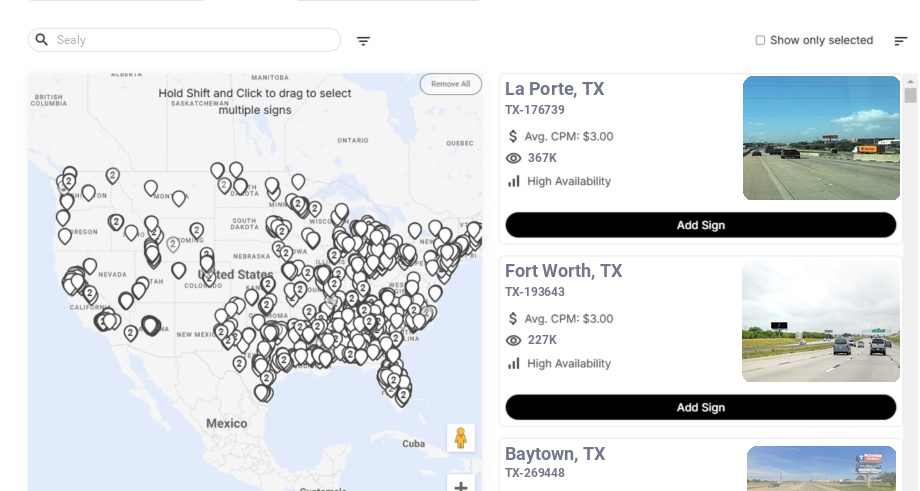
Blip has digital billboards in Sealy. You can browse available locations on a map, choose the ones that fit your audience, and start advertising right away.
Still have questions? Launch a campaign in minutes — no contracts, no commitments.
Start Your CampaignSealy Billboard Advertising Guide
Sealy, Texas, gives us a rare mix of small-city efficiency and regional highway scale. The Texas Demographic Center reports that Sealy 6,839 residents in 2020, while Austin County 30,167, and both sit directly on the I-10 corridor about 50 miles west of Houston, in the 7.1-million-resident Houston metro area. That matters for billboard advertising because daily life here is highly car-oriented, regional commuting is common, and leisure travelers move through the same road network. For brands that want more manageable media costs than central Houston, while still reaching steady traffic and growing western-suburban demand, Sealy is a very practical market.
Market Overview for Sealy, Texas
Sealy’s population, growth, and regional position
Sealy is not just a standalone small town. It is part of Austin County’s western edge of the Greater Houston Partnership orbit, which gives local advertisers access to a broader regional audience than the city’s size alone suggests, with the 7.1-million-resident Houston metro to the east.
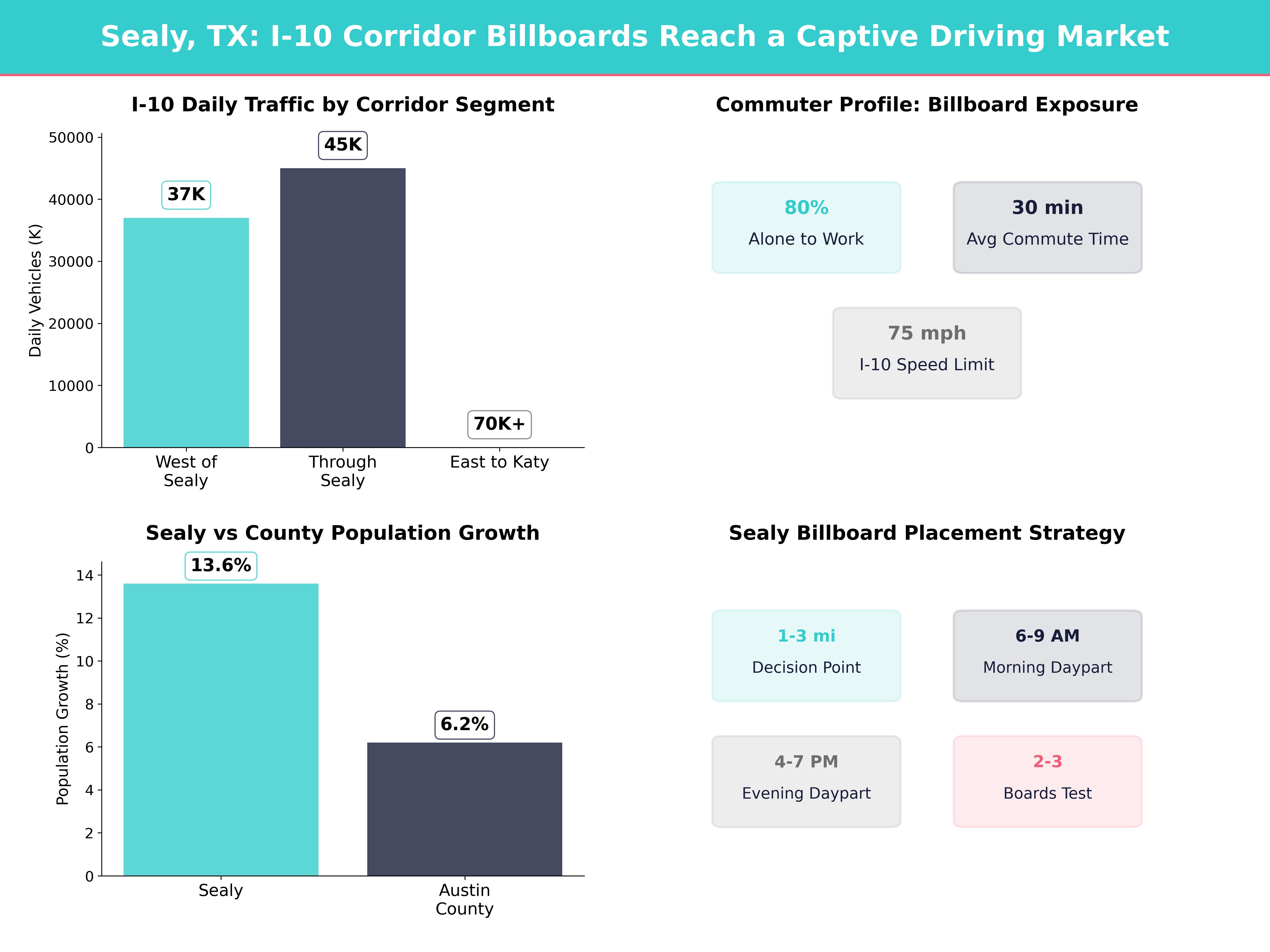
The Texas Demographic Center shows that Sealy grew from 6,019 residents in 2010 to 6,839 in 2020, which is an increase of about 13.6%. Over the same period, Austin County grew from 28,417 to 30,167, or about 6.2%. That faster city growth tells us Sealy is capturing some of the outward movement from Houston and the steady appeal of smaller-town living near a major freeway.
Geographically, Sealy sits at the junction of Interstate 10 and State Highway 36, roughly 15 miles west of Brookshire 20 miles south of Bellville 30 miles west of Katy 35 miles east of Columbus. That location makes Sealy a gateway rather than a dead-end market. We can use it to reach local households, Austin County drivers, Houston-bound commuters, and interstate travelers with one coordinated billboard strategy.
Economic conditions and commuting patterns in Sealy
The local economy is shaped by manufacturing, logistics, agribusiness, construction, local services, and commuter income, which is exactly the kind of mix that tends to respond well to outdoor advertising. The Sealy Economic Development Corporation consistently emphasizes Sealy’s freeway access and industrial appeal, and the local business environment is reinforced by the Sealy Chamber of Commerce, Texas A&M AgriLife Extension Service in Austin County
From a business-health standpoint, the Texas Workforce Commission has kept Austin County in a generally low unemployment environment, often in the 3% to 4% range in recent years. Low unemployment does not mean advertising is less important. It usually means the message shifts toward recruiting, retention, higher-value customer acquisition, and brand preference.
For billboard planning, commute behavior matters even more. Data USA indicates that roughly 4 out of 5 Austin County workers drive alone to work, and the average commute is just under 30 minutes. In practical terms, that means repeated roadway exposure is normal. A Sealy-area digital billboard is not trying to catch a one-time glance from a pedestrian-heavy downtown crowd. It is speaking to drivers who often see the same corridors multiple times per week.
For advertisers, that creates three clear advantages:
- We can build frequency without needing an enormous market population.
- We can target routes that map closely to where purchase decisions happen.
- We can use directional, time-sensitive, and location-based messages because drivers are already in motion.
Key Traffic Corridors for Sealy Billboards
Sealy’s billboard value is concentrated in a few very important travel corridors. When we understand who uses each route, we can choose locations that fit the advertiser’s actual goal instead of just buying the board with the biggest map pin.
Interstate 10 through Sealy
According to recent traffic count maps from TxDOT, I-10 through Sealy generally runs in the mid-40,000s to mid-50,000s in annual average daily traffic, or AADT, around the city. As the corridor moves east toward Brookshire and the western edge of the Katy area, traffic climbs above 70,000 AADT. Even west of Sealy toward Columbus, the freeway still carries roughly the mid-30,000s to around 40,000 vehicles per day.
That is the backbone of Sealy billboard strategy. It combines local trips, Houston commuting, freight movement, and long-distance Texas travel on one corridor. Many nearby rural I-10 segments are posted at 75 mph, so the creative needs to work instantly.
This corridor is especially strong for the following advertisers:
- Restaurants, fuel stations, and convenience stores can intercept drivers before they choose an exit.
- Healthcare groups, urgent care providers, and dental offices can build broad regional awareness among local residents and pass-through families.
- Employers can recruit warehouse staff, CDL drivers, technicians, and industrial workers from both Austin County and the west Houston fringe.
- Tourist attractions, lodging, and event venues can reach weekend travelers heading east or west across Texas.
If we only choose one Sealy-area corridor, I-10 is usually the first place to look.
State Highway 36 in Sealy
State Highway 36 is Sealy’s main north-south spine, and recent TxDOT counts through the Sealy area commonly fall in the 12,000 to 18,000 AADT range. That is far lower than I-10, but it is more locally intentional traffic. Drivers on SH 36 are often shopping, heading to work, traveling to school events, or moving between Sealy, Bellville, Wallis Rosenberg
That makes SH 36 particularly effective for businesses that need action, not just awareness. We generally like this route for:
- Grocery, pharmacy, banking, and everyday retail.
- Auto repair, tire shops, home services, and local contractors.
- Clinics, dentists, chiropractors, and specialty medical practices.
- County events, school-related promotions, churches, and civic campaigns.
Because speeds are usually lower and trips are more local, SH 36 boards can support slightly more detail than interstate boards. We still want brevity, but we can often include a stronger call to action, a local phone number, or a very specific destination cue.
FM 1458, FM 1094, and local connector routes near Sealy
The roads east of Sealy toward San Felipe, Brookshire, and the I-10 frontage system matter more than they first appear to. On these connectors, traffic is generally in the high-thousands to around 10,000 vehicles per day near active development and interchange areas, again based on TxDOT mapping.
These routes are valuable because they catch drivers closer to the point of decision. A family heading to a park, an antiques shopper moving off the freeway, or a local resident making an errand run is often more responsive here than on the main interstate.
We usually consider these connectors for:
- Attractions like Stephen F. Austin State Park and the San Felipe de Austin State Historic Site.
- Real estate and homebuilders serving western-edge growth.
- Local restaurants, bakeries, and specialty retailers.
- Event promotion that depends on “next turn” or “nearby now” messaging.
Audience Segments We Can Reach in Sealy
A good Sealy campaign works because it speaks to multiple overlapping audiences. The city is small enough to feel personal, but the highways around it create audience variety that is unusually useful for advertisers.
Commuters and industry workers in the Sealy area
The first major audience is the daily commuter and workforce traveler. With roughly 80% of workers driving alone in Austin County, roadside visibility becomes part of the everyday media mix. Sealy’s position about 50 miles west of Houston also means many trips are long enough for outdoor ads to register, but short enough for people to act on the message the same day.
This is where recruiting campaigns can perform especially well. The combination of Sealy Economic Development Corporation industrial marketing, local manufacturing and service employers, and eastbound access toward Brookshire, Katy, and western Houston creates a strong labor audience. Hiring messages for trucking, maintenance, healthcare support, skilled trades, warehousing, and retail management can all fit naturally here.
Families, students, and local household decision-makers in Sealy
The second audience is the family-centered local market. In a city of 6,839 and a county of 30,167, schools, youth activities, churches, and community events still strongly shape travel patterns. Sealy ISD
That is why family-facing advertisers often do well in Sealy. Healthcare providers, banks, insurance agencies, grocery stores, quick-service restaurants, after-school programs, and home-service businesses can all benefit from boards that reinforce routine trips. If we want parents to remember a business while they are driving to school pickup, football, errands, or church, this market gives us repeated weekly exposure.
Student audiences are more local here than in a major college town, but they still matter. School-year messaging, sports-season promotions, and teen-and-parent offers can be timed around the Sealy ISD Blinn College.
Tourists, park visitors, and weekend leisure travelers near Sealy
The third audience is the weekend and pass-through leisure traveler. Sealy is not a mega-tourism destination, but it sits near multiple attractions that turn billboard exposure into immediate trip planning.
The most obvious examples are Stephen F. Austin State Park, which covers 663 acres, and the San Felipe de Austin State Historic Site, which interprets a place founded in 1823 and central to early Texas history. Add in the spring and fall draw of the Round Top Area Chamber of Commerce antiques seasons, plus fall traffic for the Austin County Fair, and Sealy becomes a useful intercept point for leisure-driven travel.
This audience is ideal for:
- Restaurants and coffee stops.
- Lodging and RV parks.
- Specialty retail and antiques-related businesses.
- Family attractions and local events.
- Tourism branding tied to history, parks, and outdoor recreation.
Seasonal and Timing Opportunities in Sealy
Sealy rewards campaigns that respect the calendar. Traffic is steady because of daily commuting, but some of the best results come when we line up messaging with local events, school rhythms, and Texas travel seasons.
Spring opportunities in Sealy
Spring is one of the best times to advertise in Sealy because the region picks up both recreational and event-driven traffic. Wildflower drives, spring break movement, weekend park visits, and the spring Round Top market season all support stronger leisure travel on nearby corridors.
For many advertisers, March through May is a strong window for:
- Garden centers, landscapers, and outdoor-living retailers.
- Boutiques, gift shops, and restaurants.
- Tourism, lodging, and event venues.
- Real estate and homebuilders showcasing weekend open houses.
We usually like heavier Thursday-through-Sunday scheduling in spring, especially when the goal is to reach discretionary travelers rather than only weekday commuters.
Summer and back-to-school timing in Sealy
Summer in Sealy brings family road trips, interstate movement, and more heat-driven consumer behavior. That creates demand for restaurants, convenience stores, automotive service, indoor entertainment, healthcare, and HVAC companies. It also keeps attractions near the freeway relevant because families are already moving around by car.
Late July and August add a second major opportunity: back-to-school marketing. The Texas Comptroller annual sales tax holiday runs for 3 days in August, which can sharply increase retail intent. That window is especially useful for apparel, school services, optical care, family healthcare, electronics, and food businesses.
Fall and holiday advertising in Sealy
Fall is another prime season because it combines football, county fairs, festival activity, and the second major Round Top antiques season. The Austin County Fair adds October visibility, and Sealy’s local rhythm becomes even more community-centered as schools, sports, and churches move into full schedule.
This season is strong for:
- Family dining and local entertainment.
- Political and civic campaigns.
- Healthcare checkups and year-end benefits messaging.
- Retail, gift, and service campaigns aimed at holiday spending.
From Thanksgiving through New Year’s, freeway traffic also matters more. Travelers heading across Texas, visiting family, or making holiday shopping trips can make I-10 boards especially productive.
Billboard Design Tips for the Sealy Market
Sealy creative works best when it respects both the interstate environment and the local culture. We want the design to feel clear, grounded, and useful, not overly polished in a way that ignores how people here actually drive and shop.
Design for Sealy’s interstate speed
On I-10, we are often talking to drivers moving at 75 mph. That means the ad needs to communicate one idea very fast. In Sealy, we usually recommend a single dominant message, a strong brand cue, and a very obvious location signal.
For this market, strong interstate creative often includes:
- A headline of roughly 6 to 8 words.
- A large number, price, distance, or offer.
- A simple directional phrase such as “Next Exit,” “2 Miles,” or “On SH 36.”
This is especially important for restaurants, fuel, convenience retail, legal services, and healthcare. If drivers need more than a quick glance to understand the ad, the board is doing too much.
Make the creative feel local to Sealy and Austin County
What resonates in central Houston is not always what resonates in Sealy. This market tends to reward practical messaging, familiar imagery, and visible trust signals. We usually lean toward straightforward value, community credibility, and a tone that feels useful rather than clever for its own sake.
Local cues that can help include:
- A 979 phone number, which feels familiar to Austin County residents.
- Place names such as Sealy, Bellville, Brookshire, or Austin County.
- Texas-oriented imagery, outdoor scenes, trucks, ranch-adjacent visuals, or family activity.
- Seasonal references tied to football, fairs, or local travel.
If we are targeting Houston commuters passing through, a 713, 281, or 832 number can also make sense, but the rest of the creative should still feel geographically grounded. During football season, even color accents that nod to the Sealy ISD
Use bilingual and directional messaging when it fits Sealy’s audience
Sealy and the western Houston fringe include a substantial Spanish-speaking audience, so bilingual creative can make sense for many categories, especially healthcare, retail, recruiting, and public-facing services. We do not need to translate every campaign, but we should consider whether a second-language version can broaden relevance without clutter.
Directional messaging is also unusually effective here. Because Sealy is a route-based market, copy that tells people exactly what to do tends to outperform vague brand slogans. “Exit now,” “East of Sealy,” “On Highway 36,” and “Minutes away” are often more useful than abstract positioning language.
Regional Strategies Around Sealy
A Sealy campaign works best when we think in zones. Different sub-areas around the city serve different advertising goals, and grouping them correctly helps us avoid wasting impressions.
The Sealy core and the I-10/SH 36 interchange
This is the best zone for immediate-action advertisers. If the customer can realistically visit within the next 5 to 10 minutes, the core Sealy interchange area is usually where we want to be. That includes restaurants, convenience retail, pharmacies, banks, clinics, tire stores, and same-day services.
We often like a two-step approach here. One board on I-10 builds urgency before the exit, and a second local placement confirms the turn or reminds the driver after they leave the freeway. That approach can be very effective for brands that depend on fast decisions.
East of Sealy toward Brookshire, Katy, and Houston’s western edge
Heading east, the market changes. Traffic rises, suburban influence increases, and the audience becomes more regional. With Brookshire about 15 miles away and Katy about 30 miles away, this zone helps advertisers reach both Sealy-area residents and the outer growth edge of Greater Houston.
This is where we like billboard strategies for:
- Regional healthcare systems.
- Homebuilders and real estate marketers.
- Staffing agencies and recruitment campaigns.
- Destination retail and entertainment brands.
- Businesses that serve both local and Houston-fringe customers.
Because traffic east of Sealy climbs above 70,000 AADT in places, this zone is especially useful for broader reach.
North and west of Sealy through Bellville, Columbus, and the rural trade area
The north-and-west strategy is different. Bellville 20 miles north, and Columbus, about 35 miles west, help define Sealy’s rural trade relationships. This is a better fit for countywide services, agriculture-adjacent businesses, medical specialists, equipment dealers, and advertisers that depend on trust and repetition over time.
If our customer base is spread across smaller towns and unincorporated areas, we usually do not rely on one flashy interstate board alone. We pair I-10 visibility with a more local route like SH 36 so the same audience sees the brand in both regional and community settings.
Using Blip Tools in Sealy
Blip is especially useful in Sealy because the market has several distinct use cases, but advertisers do not always know which one will work best before they start. The right tool lets us test smartly instead of guessing.
Use Blip optimization when we want broad Sealy-area efficiency
If the goal is regional awareness, we can let Blip’s optimization work across Sealy and nearby connected markets instead of trying to pick every board ourselves at the beginning. That approach is useful when we want to reach a mix of commuters, local families, and pass-through travelers, but we are still learning whether eastbound, westbound, weekday, or weekend delivery is strongest.
In Sealy, this often works well for general branding, recruiting, and multi-location businesses.
Hand-pick Sealy boards when location precision matters
Manual board selection becomes more valuable when the location itself is the message. If we need drivers to take the next exit, find a specific clinic, or remember a business on SH 36, it often makes sense to hand-pick boards on the map and control direction very tightly.
We especially like manual selection when:
- The ad needs to target eastbound and westbound I-10 traffic differently.
- The business depends on customers arriving within 1 to 3 miles of the sign.
- The advertiser wants to support a local event, seasonal push, or narrow service area.
Refine Sealy campaigns with analytics and fast creative changes
Sealy is a good market for dayparting and creative testing. Morning eastbound traffic can behave differently from evening westbound traffic, and Friday-through-Sunday patterns can differ a lot from Tuesday morning commuter patterns.
We usually learn faster by comparing:
- 6 a.m. to 9 a.m. versus 4 p.m. to 7 p.m. delivery.
- Weekday commuting windows versus weekend leisure windows.
- A direct offer versus a directional message.
- An interstate version of the creative versus a local SH 36 version.
Blip’s reporting and artwork tools make those adjustments practical without turning a Sealy test into a long, locked-in media commitment.
Getting Started with Billboard Rental in Sealy
Renting a billboard in Sealy is easiest when we start with the business objective and then work backward into geography, direction, and timing. That sounds simple, but it is the biggest difference between an effective campaign and a board that only looks good on a screenshot.
Start with the goal for our Sealy campaign
We should first decide whether the campaign is trying to do one of three things. It is either trying to drive immediate visits, build regional awareness, or recruit workers. In Sealy, those goals often require different boards even when the business is the same.
If the goal is immediate visits, we usually favor Sealy interchange and SH 36 placements. If the goal is regional awareness, we prioritize I-10. If the goal is hiring, we focus on commute routes and the times when workers are most likely to notice the message.
Evaluate Sealy billboard locations like a local advertiser
Before we choose a board, we should ask a few practical questions.
- Is the audience driving eastbound, westbound, northbound, or southbound?
- Is traffic moving at local-road speed or interstate speed?
- Is the sign close enough to an exit or turn to influence action?
- Is the audience more commuter-driven or weekend-driven?
- Does the board fit a local message or a regional message?
In Sealy, proximity matters a lot. A sign within 1 to 3 miles of the decision point can outperform a theoretically larger board that is too far from the exit to be useful. Direction matters too, because eastbound I-10 often behaves like a Houston-leaning corridor, while westbound traffic can include longer-distance leisure and freight movement.
Launch small in Sealy, then expand with what we learn
For many advertisers, the best first move is to test 2 to 3 well-matched digital billboards for 2 to 4 weeks and watch how the campaign behaves. We can run one version focused on awareness and another focused on action, then compare which route and message combination produces the best response.
That is where Blip is simpler than traditional billboard buying. Instead of committing to a rigid, months-long setup before we know what works, we can start with Sealy, learn from real traffic patterns, and then expand into Brookshire Katy Bellville Columbus if the data supports it.
In a market like Sealy, that flexibility is a real advantage. The city is large enough to matter, connected enough to scale, and route-driven enough that smart billboard placement can become one of the most efficient ways we reach customers.