Billboards near Texas City, TX
No Minimum Spend. No Long-Term Contracts. Just Results.
Trusted by Leading Brands


Billboard advertising
near Texas City has never been easier



How much is a billboard near Texas City?
Why Choose Blip for Billboard Advertising near Texas City
Blip lets you launch Texas City billboards fast near I-45 and FM 2004, reaching refinery workers and commuters without the usual sales cycle.
Set a flexible budget in Texas City and focus on peak rush hours, port traffic, or Galveston-bound weekends—only pay for the blips you use.
No contracts means Texas City advertisers can test ads near SH 146 and La Marque, then scale up when traffic or demand spikes.
Track Texas City campaign results in real time and shift spend as I-45 volumes change with cruise days, summer beach traffic, or refinery turnarounds.
Blip's creative tools make it easy to build quick, bilingual Texas City ads for families, workers, and Gulf Coast visitors on the move.
Frequently Asked Questions About Billboard Advertising near Texas City
How much does a billboard cost near Texas City, Texas with Blip?
With Blip, you choose a daily budget that fits your needs, and your ads display on Texas City billboards only as often as your budget allows. Each “blip” is a brief 7.5 to 10-second spot, and you only pay for the blips you actually receive, so your total cost is simply the sum of those individual displays. Because pricing for billboards near Texas City, Texas changes based on the time of day, location, and demand, you stay in full control by adjusting your budget or schedule whenever you like.
Where can I advertise with Blip near Texas City, Texas?
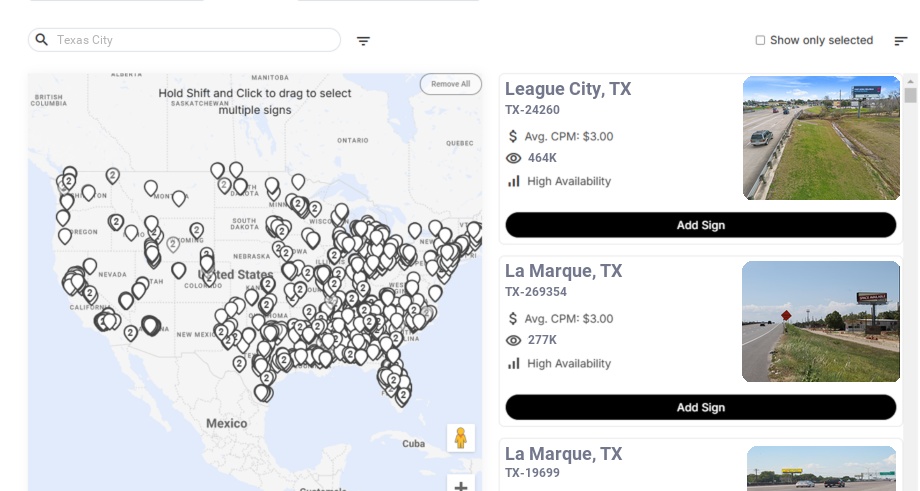
With Blip’s 9 digital billboards near the Texas City area, primarily in La Marque just 3.7 miles away, we can help you tap into a mix of refinery workers, I‑45 commuters, port-related traffic, and coastal visitors moving between Houston and Galveston. We currently have 9 digital billboards serving the Texas City area, all located in nearby La Marque within about 10 miles. Based on TxDOT traffic count data, segments of I‑45 near La Marque typically carry approximately 100,000–130,000 vehicles per day.
What kind of people do Texas City, Texas billboards with Blip reach?
Texas City sits at the intersection of Gulf Coast industry, port logistics, and leisure travel, making it a high-value market for digital billboard advertisers. The Texas City area includes a substantial Hispanic/Latino population, often in the 30–40% range in many neighborhoods, and English and Spanish are both widely used in households and workplaces. In Galveston County broadly, over 80–85% of workers commute by car, truck, or van, with carpooling especially common among industrial workers.
When is the best time to run billboards near Texas City, Texas?
Key peak times to consider include the weekday morning commute from about 5:30–9:00 a.m., midday from about 11:00 a.m.–2:00 p.m., and the evening commute from about 3:30–7:00 p.m. Weekend peaks also include Saturday late morning to afternoon, plus Friday afternoon and Sunday afternoon/evening for Galveston-bound and returning visitors on I‑45. Blip lets us schedule ads in short “blips” and set maximums by time and day, so we can concentrate budget into commuter-heavy windows and boost impressions during summer weekends and holiday periods.
Why are Texas City, Texas billboards a good fit for industrial and tourism traffic?
Texas City is a major industrial and port hub on the northwest shore of Galveston Bay, with major refining, port activity, and tourism nearby. The Port of Texas City handles 60–70 million tons of cargo annually, while Galveston draws more than 7 million visitors annually. This means billboard campaigns near Texas City can reach refinery workers, freight traffic, and seasonal visitors all along the same corridor.
Do I need a contract to advertise with Blip near Texas City?
No, Blip has no long-term contracts or minimum commitments. You can start, pause, or stop your campaign at any time.
How fast can I launch a billboard campaign with Blip near Texas City?
You can have your campaign live in minutes. Create a free account, select your locations, set your budget, upload your design, and start running once approved.
Where can I advertise with Blip near Texas City?
Blip has digital billboards near Texas City. You can browse available locations on a map, choose the ones that fit your audience, and start advertising right away.
Still have questions? Launch a campaign in minutes — no contracts, no commitments.
Start Your CampaignTexas City Billboard Advertising Guide
Texas City sits at the intersection of Gulf Coast industry, port logistics, and leisure travel, making it a high-value market for digital billboard advertisers. With Blip’s 9 digital billboards near the Texas City area, primarily in La Marque just 3.7 miles away, we can help you tap into a mix of refinery workers, I‑45 commuters, port-related traffic, and coastal visitors moving between Houston and Galveston
Understanding the Texas City Area Market
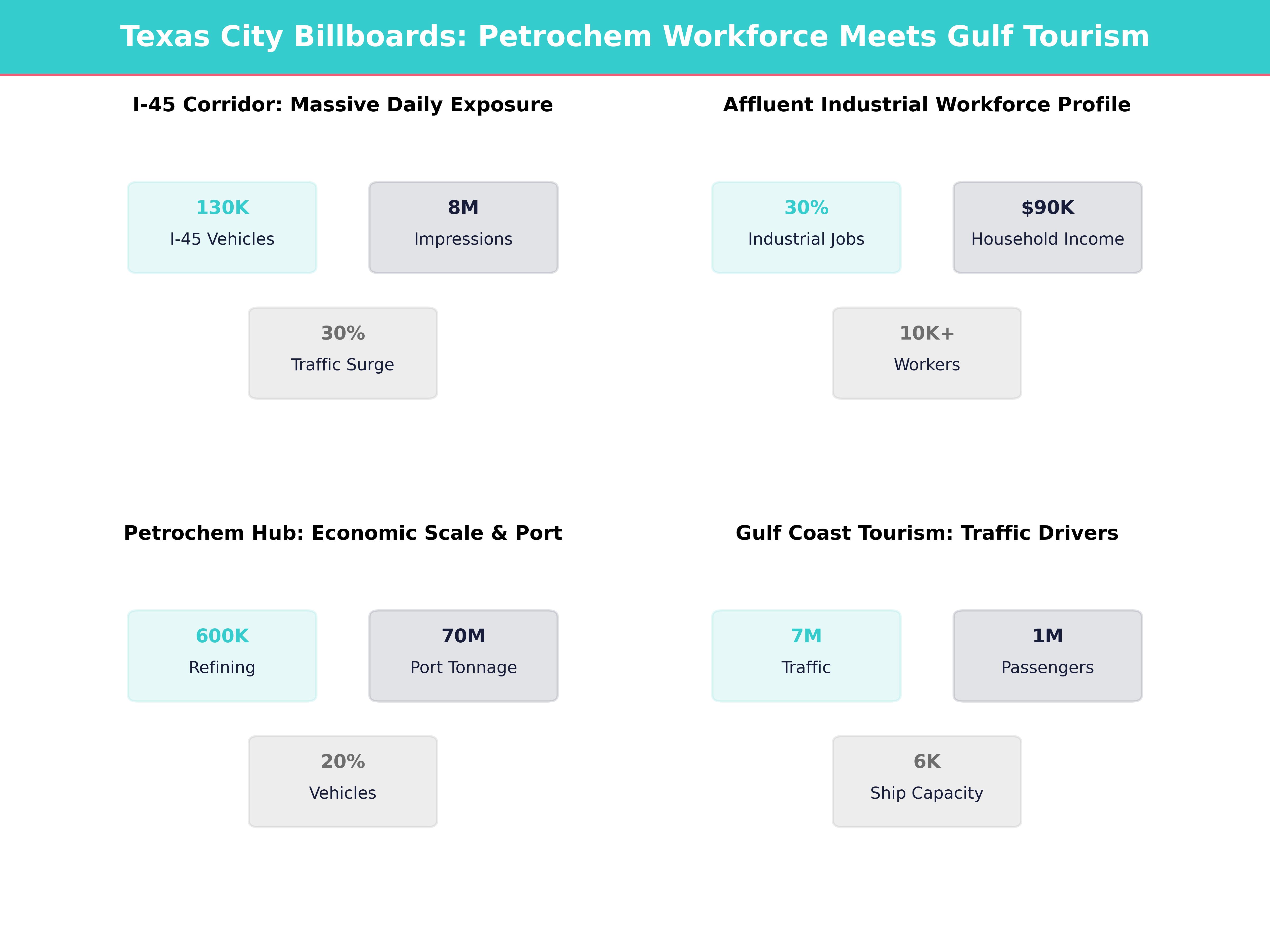
Texas City is a major industrial and port hub on the northwest shore of Galveston Bay. According to estimates cited by the City of Texas City 55,000 residents, while the broader Galveston County 360,000–370,000 people across more than a dozen cities and communities. Local planning documents note that thousands of these residents travel daily along the I‑45 corridor and FM 1764, FM 2004, and SH 146—routes that feed traffic directly past our La Marque billboards near Texas City.
Key economic drivers around the Texas City area:
- Petrochemical and refining: Texas City hosts one of the largest refining and petrochemical complexes in the United States, including major operations by Marathon Petroleum Dow, and others along the industrial corridor. The Marathon Galveston Bay Refinery alone has a refining capacity in the range of 580,000–600,000 barrels per day, placing it among the largest refineries in the nation and supporting several thousand direct and contractor jobs. Local industry profiles from the Texas City‑La Marque Chamber of Commerce indicate that well over 10,000 workers are tied directly to refining, chemical, and related support services in the immediate area.
- Port activity: The Port of Texas City 60–70 million tons of cargo annually—primarily chemicals, petroleum products, and bulk commodities. Together with nearby ports such as the Port of Galveston, which processes 1+ million cruise passengers per year and significant cargo volumes, the Texas City area anchors a logistics and maritime cluster that supports thousands of trucking, warehousing, and maritime service jobs.
- Tourism and recreation nearby: The Texas City Dike and local waterfront draw anglers, boaters, and families from across the Houston metro. The Texas City Dike 5.3 miles into Galveston Bay and can see tens of thousands of visitors on peak holiday weekends. Meanwhile, Galveston—only about 13–15 miles away—draws more than 7 million visitors annually according to Visit Galveston. The Port of Galveston also reports several hundred cruise ship calls per year, sending thousands of vehicles per ship day up and down I‑45, much of which passes signage serving the Texas City and La Marque area.
For advertisers, this means:
- A dense concentration of blue‑collar and technical workers with stable incomes; local labor force estimates suggest that 25–30% of jobs in the immediate Texas City area are tied to manufacturing, refining, logistics, and construction.
- Constant commercial vehicle traffic supplying refineries, the port, and distribution centers. TxDOT truck-count data for nearby corridors shows that 10–20% of daily vehicles on key segments are heavy trucks or commercial vehicles.
- Seasonal spikes in visitor traffic heading to Galveston’s beaches, cruises, and events. On major summer and holiday weekends, I‑45 volumes between Houston and Galveston commonly increase by 15–30% compared with typical non-peak weeks.
Digital billboards near the Texas City area let you talk to all three audiences with flexible, real-time messaging. Whether you’re a local business or a regional brand, well-placed Texas City billboards give you repeated exposure to people who live, work, and vacation along the Gulf Coast.
Where Our Billboards Reach Around Texas City
We currently have 9 digital billboards serving the Texas City area, all located in nearby La Marque within about 10 miles. La Marque Interstate 45 (I‑45), the primary artery between Houston and Galveston that carries a large portion of Texas City’s commuting and visitor traffic. La Marque’s own population is around 18,000–20,000 residents, but its position astride I‑45 means it punches well above its size in drive-by impressions, making it a strategic hub for billboard rental near Texas City.
Based on Texas Department of Transportation (TxDOT) traffic count data, segments of I‑45 near La Marque typically carry approximately 100,000–130,000 vehicles per day, depending on the exact mile marker and direction. Over the course of a month, that equates to roughly 3–4 million vehicle passes per direction, or 6–8 million total viewing opportunities for well‑positioned digital boards.
That gives advertisers repeated daily exposure to:
- Texas City and La Marque residents commuting toward Houston, Galveston, or other parts of Galveston County
- Workers driving to Texas City’s refineries and industrial sites along SH 146, Loop 197, and FM 2004
- Freight and port-related trucking moving between plants, rail, and marine terminals
- Leisure travelers heading to and from the Gulf Coast for cruises, fishing, and beach trips
Because our boards near the Texas City area are digital, we can:
- Rotate multiple advertisers on the same structure, typically cycling through slots every 8–10 seconds
- Schedule your ads by time of day and day of week so your message appears in the highest‑value dayparts for your audience
- Quickly launch campaigns adjusted to traffic peaks, promotions, or weather events, sometimes within 24–48 hours of creative approval
The combination of industrial, commuter, and tourist traffic makes these units particularly efficient for campaigns that need high reach across varied audiences without having to buy multiple disconnected media channels. For many advertisers, this approach to billboard advertising near Texas City delivers a strong balance of reach, flexibility, and cost control.
Audience & Demographics in the Texas City Area
While exact figures vary by source, aggregated local data, school district reports, and regional planning estimates suggest the following characteristics for the Texas City area and broader Galveston County:
-
Population:
- ~55,000 residents in Texas City
- ~360,000–370,000 residents in Galveston County
-
Age distribution (Texas City–La Marque area):
- Roughly 25–28% under age 20, supported by enrollment reports from Texas City ISD and La Marque area schools
- About 55–60% in prime working ages (20–64)
- Around 12–15% age 65+
-
Household income:
- Median household income in the Texas City area is typically reported in the $55,000–$65,000 range.
- Industrial and port-related jobs create pockets where typical household incomes climb to $75,000–90,000+, especially where multiple wage earners work in refineries, skilled trades, or logistics.
-
Employment mix:
- In many tracts around Texas City and La Marque, 20–30% of workers are employed in manufacturing, construction, transportation/warehousing, and utilities—well above national averages.
- The nearby medical sector (including hospitals, clinics, and specialty practices) adds another 10–12% of jobs in some areas, according to regional healthcare profiles from the Galveston County Health District
-
Education:
- A significant share of workers hold technical, trade, or associate degrees, aligning with refinery and industrial staffing needs.
- Regional labor data suggests that over one‑third of adults have some college or an associate-level credential, creating strong demand for continuing education, certification, and career‑advancement programs.
-
Home and family structure:
- Many neighborhoods in and around Texas City have average household sizes around 2.7–3.1 persons, with a substantial share of households including children.
- Homeownership rates in several Texas City and La Marque ZIP codes fall in the 55–65% range, with the remainder renting—an important cue for home services, insurance, and financial advertisers.
-
Commuting:
- In Galveston County broadly, over 80–85% of workers commute by car, truck, or van, with carpooling especially common among industrial workers.
- Average one-way commute times hover around 25–30 minutes, with many residents traveling between the Texas City–La Marque area and employment centers in Houston, League City
- A significant share of these daily trips runs along I‑45 and feeder roads our La Marque boards face, yielding high-frequency exposure for regular commuters.
-
Language and ethnicity:
- The Texas City area includes a substantial Hispanic/Latino population, often in the 30–40% range in many neighborhoods.
- English and Spanish are both widely used in households and workplaces, making bilingual communication a practical advantage for many categories.
What this means for creative and targeting:
- Blue-collar and technical appeal: Messaging that respects hands-on work, shift schedules, and practical value (reliability, durability, safety, family benefits) tends to resonate with the large industrial workforce.
- Bilingual opportunities: Bilingual English/Spanish creatives can expand reach across one‑third or more of local households, improving recall among both workers and families.
- Family-focused themes: With a significant share of households including children and teens—evidenced by enrollment of thousands of students in Texas City ISD—promotions tied to family services, healthcare, education, and local recreation can perform well.
For more local context, advertisers can follow outlets such as The Galveston County Daily News, regional Houston coverage from the Houston Chronicle Galveston Economic Development Partnership to align campaigns with local events and concerns.
Traffic Patterns and Timing Strategy
To get the most from digital billboard campaigns near the Texas City area, we should align buys with real-world traffic patterns.
Key corridors and flows served by our La Marque boards:
- I‑45 Northbound: Toward Texas City, Houston’s southern suburbs, and central Houston—connecting to job centers with a combined workforce in the hundreds of thousands.
- I‑45 Southbound: Toward Texas City, Galveston, cruise terminals, and beach tourism; on peak cruise and summer weekends, traffic counts can rise by 20–30% compared with typical off‑season days.
- Feeder and local roads: Feeding into La Marque, Texas City, Hitchcock, and nearby communities, where daily traffic can range from 10,000 to 30,000 vehicles on key connectors depending on the segment.
Typical peak times to consider:
-
Weekday morning commute: ~5:30–9:00 a.m.
- Refinary, plant, and port shifts often start early; some begin at 6:00 a.m. or earlier, with staggered start times causing two distinct mini-peaks around 6:00–7:00 a.m. and 7:30–8:30 a.m.
- Use these hours to reach workers heading to industrial sites or contractors mobilizing for the day.
-
Midday: ~11:00 a.m.–2:00 p.m.
- Strong window for lunch promotions, retail visits, quick-service restaurants, healthcare visits, and errands.
- Many industrial sites schedule staggered lunch breaks, keeping traffic steady rather than sharply peaking.
-
Evening commute: ~3:30–7:00 p.m.
- Reaches shift changes, school pickups, and commuters returning from Houston or plants.
- Local traffic counts often show a 10–20% increase in volumes compared with late-morning and late-evening non-peak periods.
-
Weekend peaks:
- Saturday late morning–afternoon (10:00 a.m.–4:00 p.m.) for shopping and family activities, when big-box retail and local centers report some of their highest foot traffic of the week.
- Friday afternoon and Sunday afternoon/evening for Galveston-bound and returning visitors on I‑45; cruise arrivals and major events can produce noticeable surges in both passenger vehicles and buses.
Because Blip lets us schedule ads in short “blips” and set maximums by time and day, we can:
- Concentrate budget into commuter-heavy windows, maximizing reach among refinery, port, and construction workers when they are most likely to see the boards.
- Boost impressions during summer weekends and holiday periods when beach and cruise traffic surges, capturing visitors who may spend hundreds of dollars per party on lodging, dining, and entertainment.
- Scale back during low-relevance hours (e.g., late-night weekday periods) to improve cost efficiency while still maintaining a strategic presence.
Seasonal Opportunities Around Texas City
The Texas City area is affected by both industrial cycles and tourism seasons. Smart billboard campaigns should account for:
1. Beach and cruise season (roughly March–August)
- Spring Break, Memorial Day, and summer weekends drive large spikes on I‑45 toward Galveston, with regional tourism statistics indicating double‑digit percentage increases in hotel occupancy and restaurant sales compared with off-season months.
- Galveston hosts multiple large events and festivals promoted through Visit Galveston, including Mardi Gras celebrations, sandcastle competitions, and holiday festivals that each attract tens of thousands of attendees.
- The Port of Galveston’s cruise operations generate hundreds of ship calls per year, with daily ship turnarounds bringing in 3,000–6,000 passengers per vessel, many of whom travel the I‑45 corridor by car or shuttle.
- Ideal for: tourism businesses, restaurants, waterparks, attractions, retail, lodging, and local services that benefit from visitor spending.
2. Industrial shutdowns and turnarounds
- Refineries and petrochemical plants periodically schedule maintenance “turnarounds,” bringing in large numbers of contractors from across Texas and beyond for multi‑week or multi‑month projects.
- These periods can temporarily increase local workforce traffic by several thousand additional workers, swelling hotel occupancy and restaurant sales in Texas City, La Marque, and surrounding communities.
- Typical contractor spending profiles show strong demand for lodging, food, fuel, financial services, and medical/urgent care services during these windows.
- Ideal for: workforce housing, local restaurants, tool/equipment rental, industrial suppliers, healthcare and urgent care, financial services, and auto repair.
3. Hurricane season and severe weather (June–November)
- Along the Gulf Coast, residents and businesses pay close attention to weather updates and preparedness. The Texas hurricane season can bring multiple storm threats per year, even if landfalls are infrequent.
- Digital billboards can quickly pivot to preparedness messaging, insurance promotions, or emergency alerts, synchronized with local authorities such as Galveston County emergency management
- During active storm periods, viewership of news and emergency information surges, and clear, sensitive messaging on roadside digital boards can reinforce brand trust and community commitment.
Using Blip’s flexibility, we can schedule special seasonal creatives that automatically run only during these high-impact windows, ensuring your budget follows real-world demand spikes rather than a flat year-round schedule. This makes seasonal Texas City billboards especially powerful for businesses with cyclical demand.
Creative Strategy for the Texas City Area
To cut through in a heavily traveled corridor, billboard artwork near the Texas City area must be simple, legible, and contextually relevant. Industry research on out-of-home (OOH) suggests that drivers often have 3–6 seconds to absorb a message at highway speeds, which should guide both copy length and design choices.
1. Design for fast-moving traffic
- Limit to 6–8 words of main copy plus a concise call-to-action.
- Use large, bold fonts with strong contrast (e.g., white text on dark background or vice versa).
- Avoid cluttered layouts—one strong image or icon is better than several competing visuals.
- Make logos and URLs simple and readable; consider using short URLs or memorable phrases.
- Keep critical information (brand, offer, location/direction) in the visual center and upper half of the creative, which tends to capture the most attention in the few seconds of viewing time.
2. Speak to refinery, port, and industrial workers
- Emphasize reliability, safety, certifications, and 24/7 availability for B2B and B2C services.
- Use language that aligns with site culture (e.g., “ISNetworld-compliant,” “TWIC-ready,” “24/7 dispatch”).
-
Example angles:
- “Industrial PPE in Stock – 10 Min from the Plants”
- “24/7 Industrial Staffing – Call Now”
- “TWIC-Approved Transportation • Call Today”
- If your business is physically close to major sites in the Texas City area, highlight drive time: “5 Minutes from the Port” or “Exit X off I‑45.” Many workers value services they can reach in 10 minutes or less during breaks or after shifts.
3. Connect with families and local residents
- Highlight local relevance: “Proud to Serve the Texas City Area Since 1995.”
- Feature family-centered benefits: healthcare access, education programs, youth activities, financial stability—especially relevant in a community where over one‑quarter of residents are under 20.
- For service-area businesses, emphasize convenience and response time: “Same-Day AC Repair in the Texas City Area,” “Free Checking – Walk In Today,” or “Urgent Care • Open Late Near I‑45.”
- Consider referencing familiar local landmarks—such as the Texas City Dike, Bay Street Park Texas City High School”)—to increase perceived proximity.
4. Bilingual and cultural relevance
- Consider dual-language creatives (English/Spanish) for broader appeal to the 30–40% Hispanic share of the local population.
- Use clear, modern Spanish copy rather than direct literal translations when possible.
- Keep both languages brief; you may run alternating English and Spanish blips instead of trying to fit both fully on one frame. For example, English during morning and evening commutes, Spanish during midday and weekend daytime.
5. Leveraging multiple creatives
Digital lets us run several designs simultaneously:
- One creative targeting morning shift workers (“Coffee & Breakfast 2 Exits Ahead”)
- Another targeting evening commuters (“Online Check-In Tonight – Avoid the ER Wait”)
- A weekend-only creative targeting beachgoers (“Free Parking • Family Dining Near the Dike”)
- A seasonal creative for hurricane season (“Review Your Coverage Before the Next Storm”)
With Blip, we can upload multiple creatives and set rules for when each runs, all on the same boards, allowing you to match messaging to audience segments without buying additional physical locations. This is one of the advantages of choosing digital billboards near Texas City instead of static signs alone.
Timing, Budgeting, and Optimization With Blip
Blip’s pay-per-“blip” model means you only pay when your ad actually shows. This works especially well for mixed markets like the Texas City area, where daily traffic patterns, seasonal tourism, and industrial cycles all influence who is on the road.
1. Start with focused windows
-
Allocate a test budget over 2–4 weeks targeting:
- Weekday morning and evening commute windows
- Weekend midday for visitor and shopping traffic
- Depending on your category, even a modest daily budget can generate dozens to hundreds of blips per day, adding up to thousands of impressions per week.
- Monitor performance using your own KPIs: web traffic spikes, calls, coupon redemptions, quote requests, or store visits.
2. Use dayparting to match audience
Examples of tailored schedules:
-
Industrial suppliers:
- Heavier on weekdays 4:30–8:30 a.m. and 2:30–6:30 p.m. when plant and contractor traffic is heaviest.
- Add presence around scheduled turnaround periods, which can temporarily increase your target audience by 20–40%.
-
Restaurants near I‑45 or Texas City Dike:
- Lunch focus 11:00 a.m.–2:00 p.m., plus Fri–Sun evenings, which are often the highest revenue periods for casual dining.
- Use directional cues (“Next Exit,” “2 Miles Ahead”) to capture impulse visits from highway travelers.
-
Healthcare and urgent care:
- Evenings (5:00–10:00 p.m.) and weekends when non-emergency needs surface and primary care offices are often closed.
- Emphasize “Walk‑In Welcome” or “Check‑In Online” benefits.
-
Tourism and attractions (seasonal):
- Summer Fridays, Saturdays, Sundays from 9:00 a.m.–6:00 p.m. leading into major holiday weekends or special events promoted by Visit Galveston.
- Highlight travel‑day offers (discounted parking, family bundles, last‑minute hotel deals).
3. Scale what works
Once we see which time blocks and creatives generate the best responses:
- Gradually increase daily caps for those high-performing windows—e.g., shifting 20–30% more budget into the dayparts that correlate with the greatest lift in calls or visits.
- Add more creatives to test variations on offers, images, and calls-to-action (A/B testing).
- Remove underperforming time segments or messages to stretch your budget further, focusing on the top 20–30% of placements that drive the majority of results.
Use Cases: Who Can Win on Billboards Near the Texas City Area
Digital billboards near the Texas City area can serve a wide variety of advertisers. Some high-potential categories include:
Local Services and Retail
- Auto dealers and repair shops serving Texas City and La Marque, where vehicle ownership rates are high and many households maintain two or more vehicles.
- HVAC, plumbing, and electrical contractors responding to weather-driven spikes in demand, especially during summer heat and hurricane season.
- Local banks and credit unions, especially those offering refinery-worker benefits, shift-friendly hours, and digital banking tools.
- Grocery, farm & ranch supply, and hardware stores that serve both residents and contractors staying in local lodging.
Industrial and B2B
- Safety gear, tools, and industrial supply companies addressing thousands of on-site workers across the refinery and petrochemical complex.
- Staffing agencies specializing in refinery and port roles, particularly during turnarounds and major project expansions.
- Training and certification centers (OSHA, safety, technical trades), including programs that help local residents upskill into higher-wage industrial roles.
- Fleet services, fuel cards, and logistics support businesses that benefit from the high volume of trucks serving the Port of Texas City
Healthcare and Wellness
- Hospitals and clinics in the Texas City area, including those serving the broader Galveston County population of 360,000+ residents.
- ER, urgent care, and occupational health providers targeting industrial employers and shift workers.
- Dental, vision, and specialty practices using billboards to reach residents along their daily commute routes.
- Mental health and addiction treatment centers, which can benefit from discreet but high-visibility awareness near residential and employment corridors.
Tourism, Food, and Entertainment
- Restaurants, bars, and family dining near I‑45 or waterfront areas, capturing both locals and millions of annual visitors moving between Houston, Texas City, and Galveston.
- Hotels and short-term rentals around Texas City and Galveston, particularly properties offering parking for cruise passengers or workers on extended stays.
- Attractions, waterparks, fishing charters, and recreational providers leveraging peak-season traffic to boost bookings and reservations.
- Event venues, festivals, and concerts promoted via local calendars and outlets like The Galveston County Daily News and community event calendars from the City of Texas City
Across all of these categories, flexible billboard rental near Texas City lets businesses scale exposure up or down based on season, inventory, and demand.
Compliance, Local Sensitivity, and Best Practices
Advertising near the Texas Gulf Coast means being mindful of local regulations, safety culture, and weather realities.
- Respect local ordinances: While Blip handles placement compliance, advertisers should be aware of community standards and avoid content that could be seen as insensitive during storms, accidents, or industrial incidents. Check for updates from City of Texas City La Marque
- Coordinate with local calendars: Large community events—such as Texas City’s Independence Day celebrations, parades, or waterfront festivals—can increase traffic along key corridors. Aligning your messaging with these dates can improve relevance and recall.
- Emergency-aware messaging: In hurricane season or during major events, be prepared to pause certain creatives or swap in neutral or supportive messages (“We’re Here to Help You Rebuild,” “Open After the Storm”).
- Safety-focused language for industrial audiences: Emphasizing safety, compliance, and reliability aligns with the culture of major employers in the Texas City area and can help your brand be seen as a trusted partner rather than just a vendor.
Measuring Success in the Texas City Area
While billboards are primarily an upper- and mid-funnel channel, we can still measure and optimize performance.
Consider using:
- Unique URLs or QR codes: Drive traffic to landing pages with URLs like
yourbrand.com/texascityto distinguish billboard-generated visits. QR codes can be particularly effective on slower-speed approaches, frontage roads, and city streets. - Custom phone numbers: Track calls that originate from billboard viewers; call tracking data can show which hours and days deliver the most inquiries.
- Offer codes and time-bound promos: “Show this code at checkout” or “This Weekend Only” lets you link redemptions to specific campaign periods. Run different codes for weekday vs. weekend campaigns to see which performs best.
- Geofenced digital campaigns: Run mobile or social ads targeted to users who frequently travel near the Texas City area and compare lift when billboards are active vs. paused. Location data can help confirm that you are reaching I‑45 commuters, refinery workers, and visitors moving along the Gulf Coast corridor.
- Store and site analytics: Watch for patterns such as traffic spikes of 10–30% during weeks your boards are most active, or improved conversion rates for customers who live or work near I‑45 and La Marque.
Over time, patterns will emerge—perhaps weekend blips deliver 40% more redemptions than weekdays, or bilingual creatives generate 20–30% more web visits or phone calls from targeted ZIP codes. Use those insights to refine targeting, creative, and budget allocation, focusing on the combinations of message, time, and location that consistently produce the strongest results.
By understanding the industrial backbone, commuter flows, and tourism cycles that define the Texas City area—and pairing that knowledge with Blip’s flexible scheduling and creative options—we can build digital billboard campaigns that deliver meaningful, measurable impact. Our 9 digital billboards near the Texas City area, centered around La Marque and the I‑45 corridor, are ready to help you reach workers, families, and visitors at the exact moments they’re making decisions, giving you a practical, scalable way to leverage Texas City billboards in your broader marketing mix.