Billboards in Sugar Land, TX
No Minimum Spend. No Long-Term Contracts. Just Results.
Trusted by Leading Brands


Billboard advertising
in Sugar Land has never been easier



How much is a billboard in Sugar Land?
Why Choose Blip for Billboard Advertising in Sugar Land
Blip lets you launch Sugar Land billboards in minutes, perfect for I-69 and Highway 6 commuter traffic without traditional ad-buy hurdles.
Target Sugar Land families around Fort Bend ISD and Town Square with dayparting that hits school runs, lunch, and evening errands.
Set flexible budgets in Sugar Land and scale up for Smart Financial Centre or Constellation Field event traffic when demand spikes.
No contracts means you can test Sugar Land boards near First Colony Mall, then shift fast based on real-time analytics.
Use Blip's creative tools to build bold Sugar Land ads for an affluent, diverse audience on SH-6, US-59, and Grand Parkway corridors.
Frequently Asked Questions About Billboard Advertising in Sugar Land
How much does a billboard cost in Sugar Land, Texas with Blip?
With Blip, you can advertise on Sugar Land billboards on any budget, because you choose a daily amount that works for you and Blip automatically keeps your campaign within that limit. Each “blip” is a short 7.5–10 second display on rotating digital billboards in Sugar Land, Texas, and you only pay for the blips you receive. Prices vary based on when and where you advertise and on advertiser demand, so you stay in control of how often your ad appears.
Where can I advertise with Blip in Sugar Land, Texas?
Sugar Land’s road network is dominated by commuter and shopping corridors that create predictable, high-value impressions. I‑69 / US‑59 is the main freeway through Sugar Land and many segments carry 200,000+ vehicles per day. State Highway 6, US‑90A, and SH‑99 / Grand Parkway are also key areas for billboard placements, along with boards near Sugar Land Town Square, First Colony Mall, Smart Financial Centre, and Constellation Field.
Why is Sugar Land, Texas a strong market for Blip billboard advertising?
Sugar Land gives us a rare mix of affluent households, heavy commuter traffic, and year-round family activities—all inside one of the fastest-growing counties in the country. Median household income is roughly $130,000–$135,000, and more than 55% of households earn over $100,000. The city is also highly educated and diverse, which makes it a strong fit for premium offers and brand-building campaigns.
When is the best time to run billboards in Sugar Land, Texas with Blip?
Weekday mornings from 6–9 a.m. are strong for inbound commuter traffic, while 4–7 p.m. brings the heaviest outbound commute plus youth activities. Midday is effective for lunch, errands, and shift changes, and late evening can work well near dining and entertainment districts. Seasonal peaks like back-to-school, the holiday season, and major local events can also increase response.
What kind of audience do Sugar Land, Texas billboards with Blip reach?
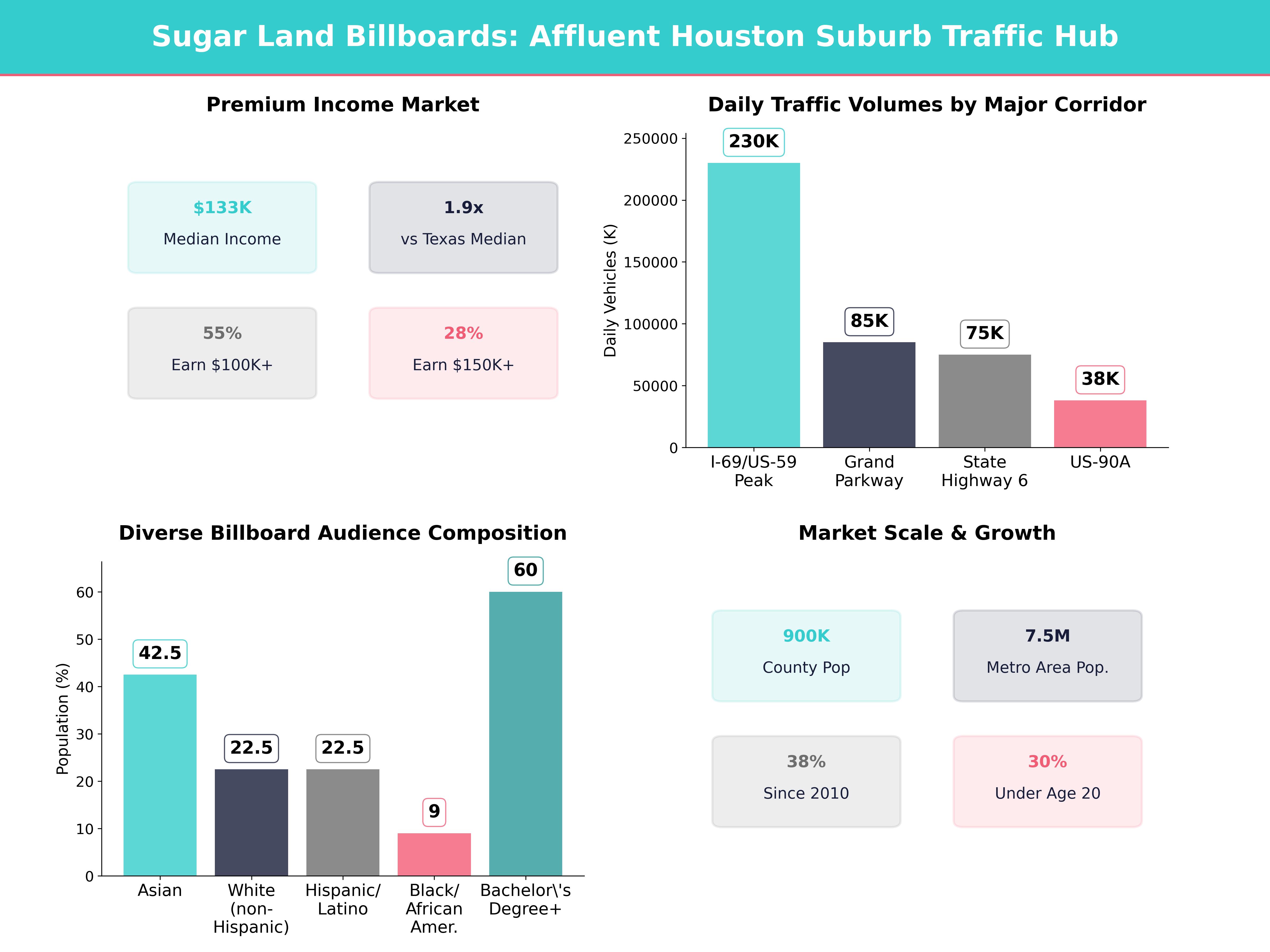
Sugar Land is one of the most diverse and internationally connected suburbs in Texas, and no single ethnic group holds a majority. Roughly 40–45% of residents are Asian, 20–25% are White non-Hispanic, 20–25% are Hispanic/Latino, and 8–10% are Black or African American. The city also has a strong family skew, with nearly 30% of residents under 20 and many parents in their 30s–50s.
Do I need a contract to advertise with Blip in Sugar Land?
No, Blip has no long-term contracts or minimum commitments. You can start, pause, or stop your campaign at any time.
How fast can I launch a billboard campaign with Blip in Sugar Land?
You can have your campaign live in minutes. Create a free account, select your locations, set your budget, upload your design, and start running once approved.
Where can I advertise with Blip in Sugar Land?
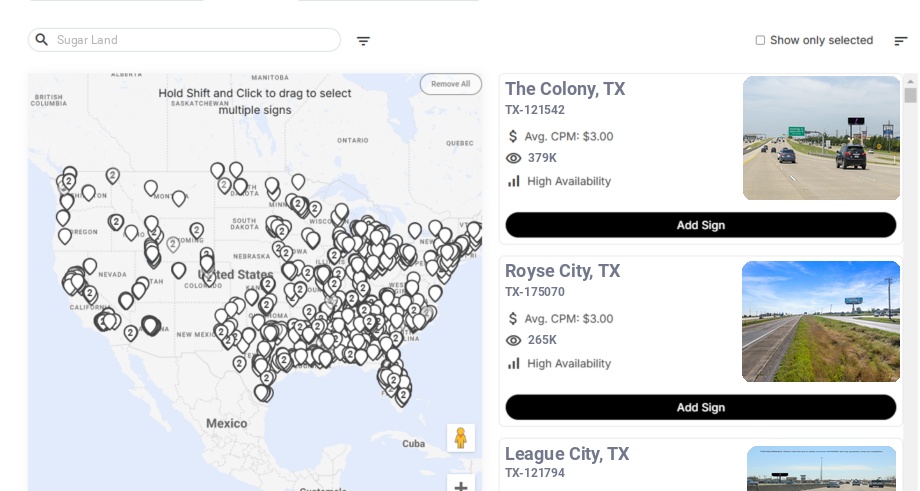
Blip has digital billboards in Sugar Land. You can browse available locations on a map, choose the ones that fit your audience, and start advertising right away.
Still have questions? Launch a campaign in minutes — no contracts, no commitments.
Start Your CampaignSugar Land Billboard Advertising Guide
Sugar Land gives us a rare mix of affluent households, heavy commuter traffic, and year‑round family activities—all inside one of the fastest‑growing counties in the country. When we combine those dynamics with Blip’s ability to target individual boards, dayparts, and budgets, Sugar Land becomes a highly efficient place to run digital billboard campaigns. For brands seeking flexible Sugar Land billboard advertising, this combination of audience quality and targeting control is especially powerful.
Why Sugar Land Is a High‑Value Billboard Market
Sugar Land sits in eastern Fort Bend County, southwest of Houston, and has grown from a company town into a major suburban hub.
Key market facts:
- Population and growth: About 111,000 residents in the city limits (2020) within a Fort Bend County population of more than 860,000, and over 900,000 by mid‑2024 per county estimates. Fort Bend’s population has grown by roughly 35–40% since 2010, making it one of the fastest‑growing large counties in Texas. The Houston–The Woodlands–Sugar Land metro area now tops 7.5 million residents, so Sugar Land billboards tap into a regional audience far beyond city limits.
- Affluence: Median household income is roughly $130,000–$135,000, nearly 1.9× the Texas median (around $70,000) and well above the Houston metro median (around $78,000). More than 55% of households earn over $100,000, and a meaningful share—often cited in local economic reports as 25–30%—earn above $150,000.
- Education: Over 60% of adults hold a bachelor’s degree or higher, compared with roughly 33–35% statewide. Several neighborhoods in and around Sugar Land rank among the most highly educated in the Houston region according to local economic development data from the City of Sugar Land and Fort Bend Economic Development Council
- Consumer spending power: Fort Bend County is consistently ranked among the top‑earning counties in Texas, and local retail reports show annual taxable retail sales in Sugar Land measured in the billions of dollars. High incomes plus high education correlate with higher discretionary spending on travel, healthcare, professional services, dining, and premium retail—making billboards in Sugar Land a strong fit for higher‑end offers.
For advertisers, this means:
- We can justify premium, higher‑value offers—residents are able and willing to spend, supporting higher‑margin products and services.
- Sugar Land is ideal for brand‑building campaigns where reputation, trust, and perceived quality matter, especially in sectors like healthcare, financial services, and education.
- Because the city is part of the broader Houston metro, a Sugar Land footprint can extend awareness into a much larger market while remaining cost‑efficient compared with inner‑loop Houston placements. For many brands, starting with a core cluster of Sugar Land billboards and then scaling into the wider metro gives the best balance of reach and cost.
For additional local context, we recommend reviewing the City of Sugar Land’s economic and demographic information at sugarlandtx.gov and Fort Bend County’s resources at fortbendcountytx.gov. The Fort Bend Economic Development Council fortbendchamber.com
Understanding Sugar Land’s Audience
Sugar Land is one of the most diverse and internationally connected suburbs in Texas, which directly influences how we design messages.
Demographic highlights:
-
Ethnic diversity: No single ethnic group holds a majority. Rough breakdowns are roughly:
- ~40–45% Asian
- ~20–25% White (non‑Hispanic)
- ~20–25% Hispanic/Latino
- ~8–10% Black or African American
In some neighborhood‑level estimates, Asians are the largest single group, with certain ZIP codes exceeding 50% Asian origin. This creates a multicultural, multilingual consumer base and supports businesses ranging from Asian grocers and restaurants to international education and travel services.
-
Age profile: A strong family skew:
- Nearly 30% of residents are under 20
- Median age is in the low‑ to mid‑40s, several years older than the Texas median (around 35), reflecting a high share of established professionals with children
- Large concentration of parents in their 30s–50s with school‑age children; in some master‑planned communities, households with children under 18 exceed 45–50% of all households
- Family orientation: Fort Bend ISD (headquartered nearby) serves more than 80,000 students across 80+ campuses, many from Sugar Land. Combined with nearby districts like Lamar Consolidated ISD, weekday routines are heavily shaped by school start/end times, extracurricular activities, and youth sports. Local rankings often place Fort Bend ISD among the top large districts in the Houston area for academic performance and college readiness.
Implications for creative:
- Show families and community: Images of families, kids, and multigenerational groups resonate strongly, especially for healthcare, education, dining, and entertainment.
- Avoid overly narrow demographics: Inclusive visuals (different ages, ethnicities, and family types) will generally perform better in a city where no demographic group holds more than 45% share.
- Highlight quality and trust: With a highly educated audience, emphasize certifications, years of experience, awards, and social proof such as “Rated 4.8/5 by 500+ local reviews.”
- Consider language carefully: English should remain primary, but for certain categories (healthcare, education, banking), bilingual English/Chinese or English/Spanish can be effective in specific locations—particularly along corridors where local business directories show a high density of Asian or Hispanic‑owned businesses.
For cultural and community insight, browse local outlets like Fort Bend Star, the Sugar Land/Missouri City edition of Community Impact Houston Chronicle’s Fort Bend section
Traffic Patterns and Where to Focus Your Blips
Sugar Land’s road network is dominated by commuter and shopping corridors that create predictable, high‑value impressions. While exact volumes vary by segment and year, Texas Department of Transportation ( TxDOT
-
I‑69 / US‑59: Main freeway through Sugar Land
- Many segments carry 200,000+ vehicles per day between Houston and Fort Bend County; some stretches east of Sugar Land have recorded 220,000–240,000 vehicles per day in recent TxDOT reports.
- Heavy inbound flow toward Houston in the morning; outbound in the evening, with peak congestion often stretching 2–3 hours during rush periods.
-
State Highway 6: The principal north‑south surface arterial
- Commonly in the 60,000–90,000 vehicles per day range across Sugar Land and Missouri City segments, making it one of the busiest surface roads in the southwest metro.
- Connects residential zones with First Colony Mall, Sugar Land Town Square, and numerous shopping centers; traffic often spikes 10–20% on weekends around major retail nodes.
-
US‑90A (Alternate 90): East‑west arterial north of I‑69
- Often in the 30,000–45,000 vehicles per day range.
- Used by local commuters and commercial traffic; TxDOT heavy‑vehicle counts show a significant share of trucks, which is useful for B2B, logistics, or industrial services.
-
SH‑99 / Grand Parkway: Outer loop around the metro
- Segments near Sugar Land can see 70,000–100,000 vehicles per day, with double‑digit percentage increases over the last decade as more master‑planned communities and distribution centers come online.
- Ideal for reaching residents of newer developments like Riverstone and Aliana and for tapping into regional traffic around the southwest loop.
High‑value placement strategies with Blip:
-
I‑69/US‑59 boards for regional reach
-
Ideal for:
- Healthcare systems, universities, and major employers drawing from a multi‑county labor shed
- Attractions that draw from across Houston (e.g., Smart Financial Centre events, Constellation Field games), where single events can bring in 5,000–7,000+ attendees
-
Use Blip to prioritize:
- Morning inbound blips if your location is inside Sugar Land (commuters see your message before work).
- Evening outbound blips to catch them as they head home and are more open to errands and leisure.
-
Ideal for:
-
Highway 6 and local arterials for conversion
-
Perfect for:
- Retail, restaurants, fitness centers, auto services, and medical offices that depend on same‑day or same‑week visits
-
Focus your blips on:
- Rush‑hour windows (7–9 a.m., 4–7 p.m.) when volumes on Highway 6 and feeder roads often hit 70–90% of daily peaks
- Weekend late mornings and afternoons when shopping trips peak near Town Square, First Colony Mall, and grocery‑anchored centers
-
Perfect for:
-
Boards near key destinations
- Sugar Land Town Square (sugarlandtownsquare.com) and First Colony Mall (firstcolonymall.com): Capture shoppers and diners; combined, these hubs attract millions of visits annually according to local retail leasing data.
- Smart Financial Centre at Sugar Land (see smartfinancialcentre.net): A premier performance venue that seats about 6,400 people and routinely hosts 100+ events per year across concerts, comedy, and family shows.
- Constellation Field, home of the Sugar Land Space Cowboys (AAA affiliate of the Houston Astros; see milb.com/sugar-land): Baseball and events attract regional crowds; the ballpark seats roughly 7,500 for baseball and more for concerts and festivals.
-
Strategy:
- Use Blip’s day‑of‑week and time‑of‑day controls to emphasize evenings and weekends when events and leisure activities drive the heaviest localized traffic.
- Increase frequency on event days when venue parking and surrounding streets can experience 2–3× normal traffic during pre‑ and post‑event windows.
For detailed traffic counts and maps, consult the TxDOT Houston District and Fort Bend County mobility resources via txdot.gov fortbendcountytx.gov
Timing Your Campaign With Sugar Land’s Daily and Seasonal Rhythms
Blip lets us align blips with the way Sugar Land residents actually live—commuting, working, shopping, and attending events. Thoughtful timing is a key lever in maximizing the ROI of Sugar Land billboard advertising.
Daily rhythms
Local traffic studies and regional travel surveys for the Houston metro suggest:
-
Weekday mornings (6–9 a.m.): Strong inbound commuter traffic toward Houston and inner Sugar Land employment centers.
- On I‑69, peak‑hour speeds can drop by 30–40% compared with free‑flow, effectively increasing dwell time near boards.
-
Best for:
- B2B services
- Healthcare reminders (flu shots, checkups)
- Education and tutoring (appeal to parents planning after‑school activities)
-
Midday (11 a.m.–2 p.m.): Lunch, errands, and shift changes.
- Retail and restaurant sales data show lunch accounts for 25–35% of daily quick‑service restaurant traffic.
-
Best for:
- Restaurants and quick‑service food
- Medical clinics, dental offices, and salons
- Retail promotions, especially near Town Square and First Colony
-
Evening (4–7 p.m.): Heaviest outbound commute plus youth activities.
- Many local employers observe standard business hours; combined with after‑school pickups, this creates some of the highest hourly traffic volumes of the day on key routes.
-
Best for:
- Family dining, entertainment, sports leagues
- Fitness centers and after‑work services
- Retailers promoting evening or next‑day offers
-
Late evening (7–11 p.m.): Lighter but more attention‑rich impressions, especially near dining and entertainment districts.
- Drivers tend to move more steadily but with less congestion, which can make digital boards more noticeable.
-
Best for:
- Bars, lounges, and event venues
- Streaming, gaming, and app‑based services
Weekly patterns
Regional mobility and retail data consistently show:
-
Monday–Thursday:
- Emphasis on commuting, school, and routine errands.
- Grocery and pharmacy visits skew to weekdays, with some chains reporting 55–60% of weekly traffic Monday–Thursday.
- Highlight necessities and recurring services (healthcare, grocery, auto repair, education).
-
Friday:
- Transition into weekend mindset; traffic to malls and restaurants increases, with some centers seeing 10–20% higher sales than average weekdays.
- Promote weekend‑only offers, entertainment, and events.
-
Saturday–Sunday:
- More family trips, shopping, and recreation. Regional mall data often show weekends accounting for 35–40% of weekly foot traffic.
-
Strong for:
- Home services and remodeling
- Family attractions and kids’ activities
- Big‑ticket retail (furniture, vehicles, appliances)
Use Blip’s day‑part scheduling to load more budget into the specific hours and days that align with your category and the locations where you’ve secured billboard rental in Sugar Land.
Seasonal and event‑driven timing
-
Back‑to‑school (August–September):
- Fort Bend ISD and nearby districts collectively send tens of thousands of students back to class; Fort Bend ISD alone has 80,000+ students, and local news coverage often notes more than 100,000 students across surrounding districts.
- Families typically increase spending on clothing, supplies, and activities; national retail benchmarks show back‑to‑school spending can rise 10–15% above normal monthly levels.
-
Effective for:
- Tutoring centers, after‑school programs, pediatric care
- Clothing, electronics, school supplies
- Run heavier schedules during the 2–3 weeks before and after the first day of school.
-
Holiday season (November–December):
- Retail and entertainment spending surges. Local shopping centers often extend hours and host dozens of events, and Visit Sugar Land thousands of visitors to Town Square and nearby venues.
-
Promote:
- Gift shopping, seasonal menus, holiday events
- “Shop local” messages that lean into community pride
-
Spring and early summer:
- Wedding season, graduations, and travel planning. National surveys indicate that roughly half of annual wedding ceremonies occur between May and October, and a large share of family vacations are booked in spring.
-
Good for:
- Event venues, photographers, jewelers
- Travel agencies and credit unions
-
Major local events:
- Check Visit Sugar Land sugarlandtx.gov for festivals, concerts, and city celebrations like the annual Red, White & Boom Independence Day event, which can draw tens of thousands of attendees according to city reports.
-
Use Blip to:
- Increase frequency during the week leading up to major events
- Concentrate blips within 3–5 miles of the venue where traffic spikes and parking‑related congestion increase visibility
Creative Strategies That Resonate in Sugar Land
Because digital billboards give us only a second or two of viewer attention, our creative needs to be both instantly readable and specifically tuned to Sugar Land’s culture and environment.
Design for fast‑moving commuters
- Big type, short copy: Aim for 7 words or fewer in your main message; eye‑tracking and OOH best‑practice studies show recall drops sharply beyond this.
- High contrast: Bold color combinations (dark backgrounds with light text or vice versa) stand out in bright Texas sun. In summer, Sugar Land can see 100+ days per year with high temperatures above 90°F, increasing glare and reducing readability for low‑contrast designs.
-
One clear call‑to‑action: Examples:
- “Exit Hwy 6 – Next Right”
- “Book Today at YourWebsite.com”
- “Call for Same‑Day Service”
- Location anchors: Use references like “in Sugar Land,” “near Town Square,” or “across from First Colony Mall” to make your ad feel immediately relevant and reduce mental effort for viewers. This is especially effective when you’re running multiple Sugar Land billboards and want drivers to instantly know which location is closest.
Connect with local pride and identity
Residents in Sugar Land and Fort Bend County are notably proud of their community’s safety, schools, and diversity. Local rankings frequently list Sugar Land among the safest midsize cities in Texas, with crime rates significantly below major‑metro averages.
-
Visuals:
- Family‑friendly imagery that reflects the city’s multigenerational, multi‑ethnic character
- Local landmarks like Sugar Land Town Square’s plaza, Constellation Field’s scoreboard, the Imperial Sugar refinery sign, or recognizable skyline elements
-
Messaging ideas:
- “Serving Sugar Land Families Since 2005”
- “Proud to Call Fort Bend Home”
- “Trusted by Sugar Land Parents”
-
Tactics:
- Consider referencing local awards or rankings (e.g., “Voted Best Dentist in Fort Bend 2023” based on local readers’ polls from outlets like Fort Bend Star or Community Impact
Tie specific messages to community stories covered in local news—regularly scanning Community Impact Fort Bend Star can inspire timely hooks and keep your Sugar Land billboard advertising feeling fresh and relevant.
Respect the climate and viewing conditions
-
Sugar Land experiences intense sun, high humidity, and frequent thunderstorms, especially May–September:
- Average summer highs in the mid‑90s°F
- Annual rainfall around 50 inches, with heavy downpours that reduce visibility
-
Use:
- High‑brightness colors and bold imagery that still pops under harsh light.
- Simple visuals that remain legible through rain and windshield glare.
-
Avoid:
- Overly thin fonts or low‑contrast palettes.
- Fine details that won’t be visible at highway speeds or through wet windshields.
Using Blip Tools for Precision in Sugar Land
Blip’s flexibility is especially powerful in a suburban‑urban hybrid market like Sugar Land, where we want both broad reach and micro‑targeting. It also makes billboard rental in Sugar Land more accessible to small and midsize businesses that can’t commit to traditional long‑term contracts.
Choose boards that match your radius
- Local storefronts: Select only boards within 3–7 miles of your location, especially along Highway 6 and I‑69. Local retail studies show that a majority of day‑to‑day shopping trips occur within a 10–15 minute drive, which typically corresponds to this radius in Sugar Land traffic conditions.
- Service‑area businesses (e.g., home services): Expand to 10–20 miles, covering Sugar Land plus key neighboring communities like Missouri City, Stafford, and parts of Houston’s Southwest side. This area can encompass 300,000–400,000 residents, depending on how far into the metro you extend.
- Regional brands: Combine Sugar Land boards with inventory deeper into Houston for layered frequency; metro‑wide campaigns can reach millions of residents while still emphasizing affluent southwest‑corridor audiences.
Bid strategy and budget pacing
-
Start with a daily test budget that lets you gather performance trends by:
- Time of day
- Day of week
- Individual billboard
-
After 1–2 weeks (enough to capture two full weekly cycles):
- Increase bids for the top‑performing time windows (e.g., weekday PM drive on I‑69 or Saturday midday near First Colony).
- Reduce or pause underperforming slots and locations.
- If you have specific sales cycles (e.g., end‑of‑month goals), temporarily increase your maximum bids in the final 3–5 days for an extra visibility push, aiming to boost impression share in your best‑converting windows by 20–50%.
Flighting and always‑on visibility
- Always‑on presence: Run a low‑but‑steady schedule year‑round, especially for professional services, healthcare, and financial institutions, to maintain baseline awareness. OOH research suggests that continuous presence can increase unaided brand awareness by 5–15 percentage points over several months.
-
Flighted boosts:
-
Add heavier “boost” campaigns around:
- Seasonal peaks (holidays, back‑to‑school)
- Product launches or grand openings
- Event sponsorships at Smart Financial Centre or Constellation Field
- During boost periods, increase frequency enough to reach your core audience multiple times per week, which is often correlated with higher response and recall.
-
Add heavier “boost” campaigns around:
Blip’s “blip‑by‑blip” model lets us implement these strategies without committing to fixed, long‑term spends, making it easy to match spend to real‑time business needs and test new billboards in Sugar Land as they become available.
Industry‑Specific Tips for Sugar Land Advertisers
Different categories can capitalize on Sugar Land’s unique makeup in distinct ways.
Healthcare and dental
Sugar Land is a regional medical hub, with major facilities like Houston Methodist Sugar Land Hospital ( houstonmethodist.org/locations/sugar-land Memorial Hermann Sugar Land Hospital (memorialhermann.org/locations/sugar-land), plus numerous specialty clinics and standalone ERs.
-
Market context:
- Houston Methodist Sugar Land has hundreds of beds and offers advanced services from cardiology to oncology.
- Memorial Hermann Sugar Land is part of a health system that treats millions of patient encounters annually across Greater Houston.
-
Focus on:
- Proximity (“5 minutes from Town Square,” “Right off Hwy 6 & 59”)
- Quick access (“Same‑day appointments available,” “Walk‑ins welcome”)
- Specializations (pediatrics, cardiology, oncology, cosmetic dentistry, orthodontics)
-
Timing:
- Weekday daytime and early evenings to reach decision‑makers; for urgent care or after‑hours clinics, add evening and weekend rotations.
-
Creative:
- Stress trust, board certifications, and local testimonials.
- Quantify benefits where possible (e.g., “Open 7 Days a Week,” “Serving 10,000+ Sugar Land Patients a Year”).
- Consider multilingual variants for key language groups if placement is targeted along corridors with high Asian or Hispanic populations.
For multi‑location health systems, coordinating Sugar Land billboard advertising with nearby Houston placements can reinforce your brand as the go‑to choice across the southwest metro.
Restaurants, retail, and entertainment
With high incomes and strong family demographics, this sector has significant opportunity.
-
Market context:
- Local economic reports show restaurant and bar sales in Sugar Land and Fort Bend County growing at mid‑single to low‑double‑digit annual rates over much of the past decade.
- Regional surveys indicate households with incomes above $100,000 are more likely to dine out 3+ times per week, which aligns with Sugar Land’s income profile.
-
Emphasize:
- “Tonight” or “This Weekend” offers for immediacy.
- Visuals of food, ambiance, or shopping experiences; high‑quality photography boosts appeal.
- Clear value propositions—happy hours, kids‑eat‑free nights, or limited‑time menus.
-
Location:
- Boards near First Colony Mall, Sugar Land Town Square, and major intersections on Highway 6 and I‑69.
- Consider boards near Smart Financial Centre and Constellation Field on event days, when nearby restaurants can see revenue jumps of 20–30%.
-
Timing:
- Lunchtime (11 a.m.–2 p.m.) for fast‑casual and QSR.
- 4–9 p.m. and weekends for dine‑in and entertainment.
Check event calendars at Visit Sugar Land sugarlandtownsquare.com/events, and venue calendars at smartfinancialcentre.net and milb.com/sugar-land to sync promotions with concerts, festivals, and sports. Aligning your billboard rental in Sugar Land with these peak demand windows can significantly improve response.
Education and enrichment
Supplemental education is extremely popular among Sugar Land’s highly educated families.
-
Market context:
- In high‑performing suburban districts like Fort Bend ISD, local surveys often show 30–40% of students participating in some form of tutoring or extracurricular academic enrichment.
- College‑going rates and standardized test participation (AP, SAT, ACT) are higher than state averages, driving demand for prep services.
-
Ideal advertisers:
- Tutoring centers, STEM and coding schools, test prep, music schools, and sports academies.
-
Campaign windows:
- Back‑to‑school (July–September), when enrollment spikes and parents are finalizing schedules.
- Midyear (January), when report cards prompt re‑evaluation of academic needs.
- Pre‑exam periods (March–May) for test prep.
-
Creative:
- Feature student success metrics (“Average +200 SAT points,” “95% of our students improve a full letter grade”).
- Show local relevance (“Serving Fort Bend Students Since 2010,” “Near fortbendisd.com campuses”).
- Clear CTAs: “Book a Free Assessment This Week,” “Call to Reserve a Summer Camp Spot.”
Because parents often commute along the same corridors every day, a focused cluster of Sugar Land billboards near schools and major arterials can drive consistent top‑of‑mind awareness throughout the academic year.
Home services and real estate
Rapid growth and high homeownership rates translate into constant demand for maintenance, remodeling, and real estate services.
-
Market context:
- Fort Bend County homeownership rates are often reported above 70%, higher than the U.S. average.
- Many Sugar Land neighborhoods were built in waves from the 1980s through the 2010s, so large segments of the housing stock are entering cycles for major repairs (roofs, HVAC, remodeling).
-
Focus areas:
- Roofers, HVAC, landscaping, pool services, remodeling, realtors, and mortgage/insurance providers.
-
Seasonality:
- Spring and early summer for moving and remodeling—nationally, around 60–70% of home sales close between May and September, and Sugar Land aligns closely with this pattern.
- Pre‑storm seasons for roofing and insurance; the Atlantic hurricane season runs June–November, with the Houston region historically seeing the highest severe‑weather risk in late summer and early fall.
-
Targeting:
- Boards that cover residential neighborhoods radiating from Highway 6, Grand Parkway, and subdivisions around First Colony, New Territory, Greatwood, Telfair, and Riverstone.
- Consider adding boards in neighboring Missouri City and Stafford to reach move‑up buyers who may be considering Sugar Land communities.
For realtors, pairing always‑on Sugar Land billboard advertising with time‑limited messages around open houses and new listings can help capture both impulse interest and long‑term brand recognition.
Measuring Success and Iterating
To make the most of your Sugar Land campaign, we should treat Blip as a continuously optimizable channel.
Define clear, local KPIs
Before launching, decide how you will measure success:
-
Direct KPIs:
- Landing page visits tied to a short, billboard‑specific URL (e.g., YourBrandSugarLand.com) so you can track type‑in traffic.
- Call volume to a unique tracking phone number; many businesses see 10–30% call lifts when effective OOH campaigns go live.
- Coupon redemptions or offer codes exclusive to the billboard (“Mention ‘Billboard 10’ for 10% Off”).
-
Indirect KPIs:
- Increases in branded search volume from the Sugar Land area; monitor via geo‑segmented analytics tools.
- Lift in walk‑in traffic during your scheduled blip windows—track with POS timestamps and simple “How did you hear about us?” prompts.
Run structured tests
-
A/B test:
- Different headlines (e.g., “Free Exam” vs. “Same‑Day Appointments”).
- Different offers (“10% Off” vs. “$50 Off New Patient Visit”).
- Different CTAs (“Call Today” vs. “Schedule Online”).
-
Rotate creatives:
- Run each variation for at least 7–10 days to account for weekly patterns and avoid misreading short‑term noise.
- Ensure each variation receives enough impressions (ideally thousands of plays) to draw meaningful conclusions.
-
Adjust:
- Shift spend toward boards and time windows that correlate with better KPI performance.
- Drop or revise underperforming creatives; in many OOH tests, small copy or design tweaks can drive double‑digit percentage improvements in response.
Integrate with digital channels
-
Mirror messaging:
- Use similar visuals and offers in your social ads, search ads, and email campaigns to amplify recognition.
- Studies of integrated campaigns often show 20–40% higher effectiveness when OOH is combined with digital.
-
Geo‑target:
- Run Google and social campaigns geo‑fenced to Sugar Land while your billboard campaign is live.
- Watch for improved click‑through and conversion rates from ZIP codes where your boards run, such as 77478, 77479, and nearby areas.
-
Local presence:
- Keep your profiles up to date on local directories and maps (Google Business Profile, Apple Maps, Yelp), as many billboard viewers will search immediately on their phones.
By combining local insight—traffic patterns, demographics, community rhythms—with Blip’s precise scheduling and budgeting tools, we can build Sugar Land campaigns that are not only visible but genuinely effective. With the right placements, timing, and creative tailored to this affluent, diverse, and family‑centric market, digital billboards become a powerful driver of both brand and sales in Sugar Land and the broader southwest Houston corridor. Thoughtfully planned Sugar Land billboard advertising gives you a scalable platform for awareness today and growth across the region tomorrow.