Billboards in Tyler, TX
No Minimum Spend. No Long-Term Contracts. Just Results.
Trusted by Leading Brands


Billboard advertising
in Tyler has never been easier



How much is a billboard in Tyler?
Why Choose Blip for Billboard Advertising in Tyler
Blip makes Tyler billboard buying self-serve, so you can launch fast on Loop 323, Broadway, or I-20 and reach car commuters who make up most local workers.
Set flexible daily budgets in Tyler and only pay when your ad plays—perfect for testing South Broadway retail traffic or I-20 regional travelers without contracts.
Use dayparting on Blip to hit Tyler's rush-hour commuters on Loop 323 and SH 155, then shift to midday shoppers near Broadway Square.
Track Tyler campaign results in real time, so you can move spend as Rose Festival, East Texas State Fair, or back-to-school traffic spikes change.
Blip's creative tools help Tyler ads stay bold and local, with quick updates for healthcare, student, and family audiences moving between Tyler's districts.
Frequently Asked Questions About Billboard Advertising in Tyler
How much does a billboard cost in Tyler with Blip?
With Blip, billboard advertising in Tyler is designed to fit a range of budgets. You set a daily budget, and Blip’s algorithm uses it to bid for open ad slots, so you only pay when your ad actually appears. Each “blip” is a 7.5-to-10-second display on a rotating digital billboard, with pricing that can change based on time of day, location, and advertiser demand. That means the cost per display can start as low as $0.01.
Where can I advertise with Blip in Tyler to reach commuters?
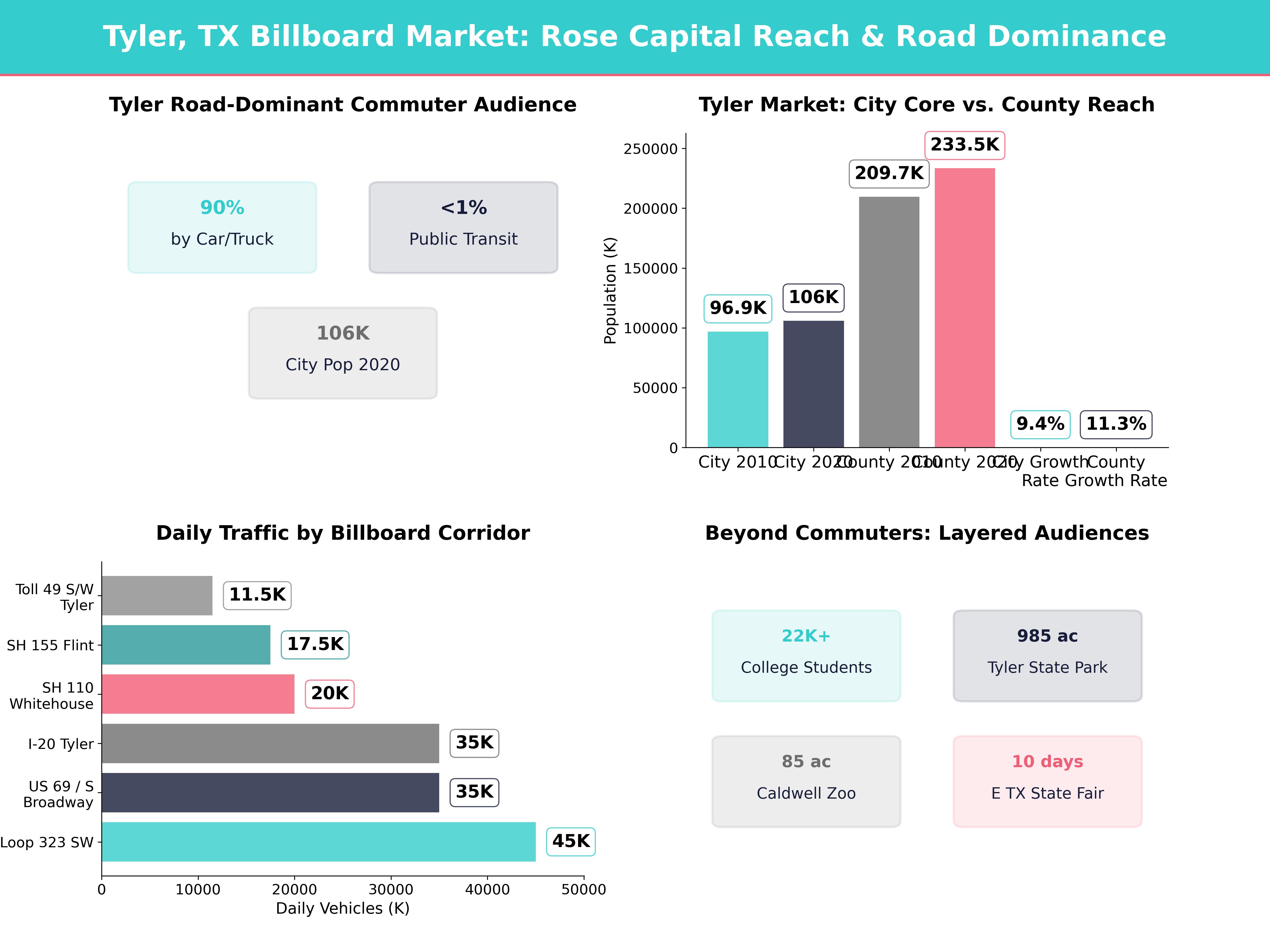
Because roughly 9 in 10 local workers commute by car, truck, or van, billboard advertising can meet people where they actually spend time, namely on Loop 323, I-20, Broadway, and the highways feeding Tyler’s retail, medical, and education districts. Loop 323 is Tyler’s core circulation route and one of the city’s most dependable billboard corridors, with the busiest southwest sections often falling in the 40,000 to 50,000+ vehicles per day range. South Broadway is another signature commercial corridor, with heaviest segments often around 30,000 to 40,000 AADT.
Why is Tyler a strong market for Blip billboard ads?
Tyler works well for billboard advertising because it is not only a city, but also a regional service center. The City of Tyler grew from 96,900 residents in 2010 to 105,995 in 2020, and Smith County grew from 209,714 to 233,479 in the same period. That growth matters because it tells us the market is adding households, workers, students, and shoppers rather than standing still.
What Tyler roads are best for billboard advertising on Blip?
Loop 323 is Tyler’s core circulation route and one of the city’s most dependable billboard corridors, making it valuable for broad citywide awareness. US 69 and South Broadway are strong for retail, dining, and medical traffic, while I-20 gives Tyler’s clearest regional-reach play. SH 110 and SH 155 are important commuter feeders, and Toll 49 captures intentional travel between suburban growth, business parks, and through-routes around Tyler.
When is the best time to run a Blip campaign in Tyler?
Tyler rewards campaigns that align with the local calendar, so we do not need to advertise the same message in the same way all year. Spring is especially strong because of the Azalea & Spring Flower Trail and the city’s rose identity, while fall brings the East Texas State Fair and the 3-day Texas Rose Festival. Back-to-school, holiday shopping, and weekend event traffic are also important windows for Tyler campaigns.
Do I need a contract to advertise with Blip in Tyler?
No, Blip has no long-term contracts or minimum commitments. You can start, pause, or stop your campaign at any time.
How fast can I launch a billboard campaign with Blip in Tyler?
You can have your campaign live in minutes. Create a free account, select your locations, set your budget, upload your design, and start running once approved.
Where can I advertise with Blip in Tyler?
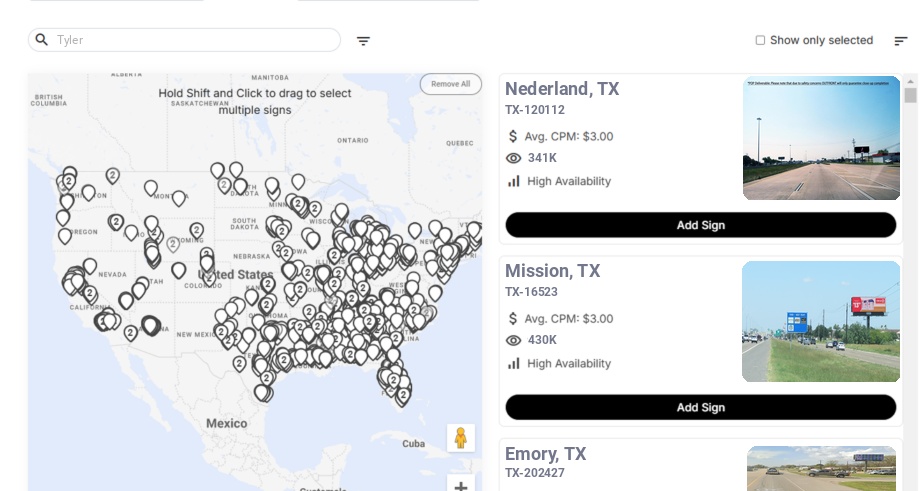
Blip has digital billboards in Tyler. You can browse available locations on a map, choose the ones that fit your audience, and start advertising right away.
Still have questions? Launch a campaign in minutes — no contracts, no commitments.
Start Your CampaignTyler Billboard Advertising Guide
Tyler 105,995 and a broader Smith County population of 233,479, up from 96,900 city residents and 209,714 county residents in 2010. Because roughly 9 in 10 local workers commute by car, truck, or van, billboard advertising can meet people where they actually spend time, namely on Loop 323 I-20 Visit Tyler, the Texas Rose Festival 3 days), the Caldwell Zoo 85 acres), and Tyler State Park (985 acres). That combination of daily commuter repetition and regional visitor traffic makes Tyler a practical, high-visibility market for digital billboards.
Tyler Market Overview for Billboard Advertisers
Tyler works well for billboard advertising because it is not only a city, but also a regional service center. The City of Tyler 96,900 residents in 2010 to 105,995 in 2020, which was an increase of about 9.4%. Smith County grew from 209,714 residents in 2010 to 233,479 in 2020, which was an increase of about 11.3%. That growth matters because it tells us the market is adding households, workers, students, and shoppers rather than standing still.
Population, trade area, and regional pull in Tyler
Tyler sits roughly 95 miles east of Dallas and functions as a practical hub for much of East Texas. We do not have to think only about city residents when we plan a campaign here. We can also reach people driving in from Lindale, Whitehouse Jacksonville for work, healthcare, shopping, and events.
That wider trade area supports a diverse set of advertisers. Tyler Area Chamber of Commerce and Tyler Economic Development Council
Economic activity and commuting patterns in Tyler
Tyler’s economy is especially useful for billboard advertisers because it combines everyday necessity spending with destination spending. Healthcare is a defining local industry, led by CHRISTUS Trinity Mother Frances Health System UT Health East Texas. Education is another strong demand generator, with The University of Texas at Tyler enrolling more than 10,000 students and Tyler Junior College serving more than 12,000 students annually. Even before we add Texas College, that gives us a student audience of 22,000+ between the two largest campuses alone.
Commuting behavior strengthens the case for billboards. In Tyler, about 90% of workers commute by car, truck, or van, while public transportation accounts for well under 1% of work trips. Tyler Transit
Key Traffic Corridors for Tyler Billboards
Tyler’s travel patterns are concentrated on a handful of corridors, which makes location strategy especially important. By using traffic data from the Texas Department of Transportation and the Tyler Area Metropolitan Planning Organization
Loop 323 in Tyler
Loop 323 is Tyler’s core circulation route and one of the city’s most dependable billboard corridors. On the busiest southwest Tyler sections, traffic commonly falls in the 40,000 to 50,000+ vehicles per day range. That level of daily repetition makes Loop 323 valuable for advertisers who want broad citywide awareness rather than a narrow niche audience.
Loop 323 is especially strong for these categories:
- Retail and restaurants can use Loop 323 to reach shoppers moving between residential areas, commercial centers, and major intersections.
- Healthcare brands can use the corridor to stay visible around the medical district and major cross-town travel paths.
- Home services, legal services, insurance, and banking can benefit from frequency because many drivers use the loop multiple times each week.
Because Loop 323 includes signalized intersections and lower urban speeds than the interstate, we can sometimes support slightly more detailed creative here than we would on I-20.
US 69 and South Broadway in Tyler
US 69, especially South Broadway Avenue, is one of Tyler’s signature commercial corridors. TxDOT counts on the heaviest Tyler segments often land around 30,000 to 40,000 AADT, with some nearby intersections feeling even busier because of shopping and turn movements. This corridor connects central Tyler, Broadway Square
This route is ideal for:
- Retail, furniture, apparel, and dining because drivers on Broadway are often already in shopping mode.
- Medical specialists, urgent care, and elective services because South Tyler is closely tied to healthcare traffic.
- Local events and entertainment because drivers on Broadway are more likely to make same-day or same-week decisions.
If we want action-oriented messaging such as “Book Today,” “Now Open,” or “Exit Ahead,” Broadway is often more conversion-friendly than a purely pass-through highway.
I-20 north of Tyler
I-20 gives us Tyler’s clearest regional-reach play. Tyler-area segments of I-20 commonly run in roughly the 30,000 to 40,000 vehicles per day range, depending on the interchange and direction. The interstate connects Tyler to Dallas, Longview, and the broader East Texas travel market.
I-20 boards are especially effective for these advertisers:
- Hotels, travel centers, convenience stores, and quick-service restaurants can capture travelers making immediate stop decisions.
- Colleges, hospitals, and regional attractions can build awareness across a much larger geography than a purely local Tyler board.
- Hiring campaigns for logistics, transportation, healthcare, and industrial employers can reach workers commuting from outside Tyler.
Because I-20 traffic moves faster, we should keep copy shorter and bolder than we would on urban arterial routes.
SH 110, SH 155, and commuter approaches into Tyler
State Highway 110 toward Whitehouse and State Highway 155 toward Flint and Noonday are important commuter feeders. Depending on the segment, these roads often carry about 15,000 to 25,000 vehicles per day on SH 110 and roughly 15,000 to 20,000 vehicles per day on SH 155. Those numbers are lower than Loop 323, but the audiences are often highly relevant because they represent habitual commuters flowing into Tyler’s jobs, schools, and retail base.
These approaches work well for:
- Residential services such as roofing, HVAC, landscaping, and remodeling.
- Community banks, clinics, and family restaurants that want a suburban and family-heavy audience.
- Churches, schools, and local events that benefit from strong local recognition.
If our goal is to dominate a smaller but very qualified audience, these feeders can outperform broader high-volume boards.
Toll 49 and newer regional circulation around Tyler
Toll 49 8,000 to 15,000 vehicles per day range. Those counts are lower, yet the corridor is useful because it captures intentional travel by drivers moving between suburban residential growth, business parks, and through-routes around Tyler.
Toll 49 is a smart fit for:
- Higher-consideration services such as real estate, financial planning, and healthcare specialties.
- Destination retail and lifestyle brands that want to pull traffic into South Tyler.
- Employers recruiting in growth corridors where newer housing and commuter traffic overlap.
Audience Segments We Can Reach in Tyler
Tyler is attractive because one campaign can reach several distinct audiences at once. We have daily commuters, regional shoppers, students, healthcare workers, families, and visitors, and each group moves through the market a little differently.
Tyler commuters and household decision-makers
Commuters are the foundation of billboard reach in Tyler. With about 90% of workers commuting by car, truck, or van, the market favors brands that benefit from repeated visual reminders. We can use that repetition to build top-of-mind awareness for categories such as healthcare, auto repair, banks, attorneys, home improvement, grocery, and restaurants.
Household decision-makers are especially reachable on Loop 323, Broadway, SH 110, and SH 155. Many of these trips are not one-time tourist visits. They are weekly routines, which is exactly what makes billboard frequency valuable.
Students, faculty, and education households in Tyler
Education is a meaningful audience segment in Tyler. The University of Texas at Tyler enrolls more than 10,000 students, and Tyler Junior College serves more than 12,000 students annually. That means the two largest campuses alone represent an education audience of more than 22,000 students, before we count faculty, staff, visiting families, and Tyler ISD households.
This audience is especially relevant for:
- Apartments, internet providers, and furniture retailers because they serve move-ins and semester transitions.
- Healthcare, dental, vision, and urgent care providers because students and young professionals need nearby care.
- Entertainment, food, and part-time employment because college audiences respond well to timely, location-based messaging.
Families, visitors, and leisure travelers in Tyler
Tyler’s visitor profile gives us more than commuter traffic. The city’s famous rose identity is not just branding. The Tyler Rose Garden 14 acres, includes about 35,000 rose bushes, and showcases more than 500 varieties. Every spring, Visit Tyler promotes the Azalea & Spring Flower Trail, which stretches more than 10 miles through Tyler neighborhoods and historic districts.
In the fall, the Texas Rose Festival 3 days, and the East Texas State Fair typically runs for 10 days in late September. We can also reach families visiting the 85-acre Caldwell Zoo Discovery Science Place Tyler Museum of Art, and 985-acre Tyler State Park. These destinations make Tyler a weekend market, not just a weekday commuter market.
Healthcare workers, patients, and regional professionals in Tyler
Healthcare is one of Tyler’s strongest audience clusters. CHRISTUS Trinity Mother Frances Health System UT Health East Texas bring in employees, patients, vendors, and visitors from across the region. Tyler also supports established business brands such as Brookshire Grocery Company, Southside Bank Cavender’s
For advertisers in recruiting, healthcare access, financial services, continuing education, and business services, Tyler’s weekday workforce can be just as important as its residential population.
Seasonal and Timing Opportunities in Tyler
Tyler rewards campaigns that align with the local calendar. We do not need to advertise the same message in the same way all year because the city’s event cycle, school rhythm, and weather patterns create clear windows for different offers.
Spring in Tyler: blooms, gardens, and outdoor traffic
Spring is one of Tyler’s most distinctive advertising seasons. The Azalea & Spring Flower Trail brings attention to the city in March and April, and the rose identity is highly visible even for people who are not attending a formal event. This is an excellent time for:
- Home and garden brands to use floral, landscape, and outdoor-living imagery.
- Restaurants, boutiques, and local attractions to invite same-day stops from leisure travelers.
- Real estate and moving services to reach households active during the traditional spring housing season.
Because Tyler’s spring weather is usually more comfortable than peak summer heat, leisure driving and weekend activity tend to be strong.
Summer and back-to-school timing in Tyler
Summer in Tyler shifts attention toward family outings, cooling products, healthcare, and indoor entertainment. Campaigns for the Caldwell Zoo Discovery Science Place
Back-to-school starts early enough to matter by late July and August. As The University of Texas at Tyler, Tyler Junior College, and Tyler ISD return to session, we can pivot creative toward:
- Student housing and move-in offers.
- Retail, apparel, and technology deals.
- Part-time jobs and hiring campaigns.
- Healthcare checkups, urgent care, and dental appointments.
Fall events and holiday commerce in Tyler
Fall is one of Tyler’s most event-rich periods. The East Texas State Fair and the 3-day Texas Rose Festival
From November into December, Tyler’s main retail corridors become especially valuable. Boards near South Broadway, Loop 323, and major shopping areas can support holiday shopping, gift services, restaurants, healthcare enrollment, and year-end promotions. If we want reach during a period when people are actively making spending decisions, late fall is one of Tyler’s strongest windows.
Tyler Billboard Design Tips for the Local Market
Creative that works in Tyler usually feels grounded, clear, and locally aware. We should not assume that the same billboard style that works in a downtown nightlife district will automatically translate to East Texas commuter traffic.
Use visuals that feel native to Tyler
Tyler is the Rose Capital of America, so rose-red tones, natural greens, and polished floral or outdoor imagery can feel especially native here when they fit the brand. We do not need to force roses into every design, but we can borrow from Tyler’s visual identity in a tasteful way. That is especially effective in spring, during the Texas Rose Festival
Local credibility also matters. In a market shaped by long-standing hometown brands such as Brookshire Grocery Company, Southside Bank Cavender’s
Match message length to Tyler roadway speed
Roadway context should shape our copy. On faster routes such as I-20 and Toll 49, we should usually keep the message to about 3 to 5 words plus a strong brand cue. On slower urban routes such as Loop 323 or South Broadway, we can often stretch to about 5 to 7 words if the design remains bold and uncluttered.
That distinction is important in Tyler because the market mixes high-speed regional travel with urban retail traffic. A board near an interstate interchange should feel different from a board facing slower retail traffic near Broadway Square.
Lead with practical value in Tyler creative
Tyler audiences often respond well to practical benefits rather than abstract branding alone. We should highlight clear outcomes such as:
- “Same-Day Appointments Available.”
- “Now Hiring in Tyler.”
- “South Broadway Grand Opening.”
- “Exit Soon for Lunch.”
That approach works because Tyler’s strongest billboard corridors often capture people already moving toward an errand, a shift, a shopping trip, or a family outing. Useful messaging tends to outperform vague messaging in that environment.
Regional Strategies Across Tyler and Smith County
A good Tyler campaign rarely treats the whole market as one undifferentiated blob. We usually get better results when we match boards to sub-areas with distinct traffic patterns and intentions.
South Tyler and Broadway retail strategy
South Tyler is where we often look first for shoppers, healthcare traffic, and higher-frequency consumer spending. The Broadway corridor, the Broadway Square
If we want actions such as store visits, appointments, or grand-opening traffic, South Tyler often deserves a larger share of the budget than a purely regional highway board.
Central Tyler and Loop 323 frequency strategy
Central Tyler and Loop 323 are ideal when we want broad local reach. This area works well for categories that need steady reminders over time, such as personal injury law, dental care, insurance, HVAC, plumbing, grocery, and local event promotion.
We should think of Loop 323 as Tyler’s repetition engine. One well-placed board here can support citywide familiarity even if the offer itself is not time-sensitive.
North Tyler, I-20, and gateway strategy
North Tyler and the I-20 interchanges are where we focus on regional inflow. This is the best area for travel services, hotels, fuel, truck-oriented businesses, distribution hiring, and attractions drawing from outside the city. Boards here can also support institutions that recruit broadly, including colleges, healthcare systems, and major employers.
If our customer base extends into the wider East Texas region, north Tyler can provide reach that a purely intra-city board cannot match.
Suburban approach strategy for Whitehouse, Lindale, and Bullard
Commuter routes from Whitehouse Lindale, and Bullard
For some advertisers, these outer boards can be more efficient than fighting for the busiest in-town impressions. A smaller corridor with the right audience can outperform a bigger corridor with less relevant traffic.
Using Blip Tools Effectively in Tyler
Tyler’s mix of commuter repetition, shopping traffic, and event surges makes Blip’s flexibility especially useful. We can use the platform’s tools to align spend with how people actually move through Tyler rather than locking ourselves into a static plan.
Dayparting and budget pacing for Tyler traffic
Morning and late-afternoon dayparts make sense on commuter-heavy routes such as Loop 323, SH 110, SH 155, and I-20 approaches. Midday can be especially effective on South Broadway, where shopping, dining, and appointment traffic remain active beyond the standard rush. Evening and weekend schedules can work well near entertainment, dining, and family destinations.
Because Tyler has strong seasonal spikes, we can also shift budget around the Texas Rose Festival East Texas State Fair, back-to-school weeks, holiday shopping, and spring garden tourism. That kind of timing control is useful in a market where different weeks genuinely produce different audience mixes.
Creative testing and map-based selection in Tyler
Tyler is a good market for testing multiple creative versions because the audience segments are so distinct. We can run one message aimed at commuters on Loop 323, another aimed at shoppers on Broadway, and another aimed at regional drivers on I-20. We can also compare inbound and outbound faces to see whether morning or evening traffic responds better to the goal.
Blip’s map-based planning helps us evaluate whether we want:
- Regional reach near I-20 and outer approaches.
- Citywide frequency on Loop 323.
- Retail intent on Broadway and South Tyler.
- Suburban commuter access on feeder highways.
Real-time performance feedback lets us shift budget toward the boards and time windows that best match our Tyler objectives.
Getting Started With Billboard Rental in Tyler
Renting a billboard in Tyler is usually easiest when we start with the audience, not the inventory. We should first decide whether we want commuter frequency, regional reach, retail traffic, hiring visibility, or event awareness. Once the goal is clear, Tyler’s road network becomes much easier to navigate.
How to choose billboard locations in Tyler
We should evaluate Tyler locations with four practical questions:
- Where does the audience begin its trip?
- What road is the audience using when it is most likely to notice the message?
- Is the decision immediate, such as a restaurant stop, or delayed, such as a healthcare appointment?
- Does the creative fit the speed and complexity of that roadway?
A restaurant, for example, may benefit more from Broadway or Loop 323 than from a high-speed I-20 face. A regional hospital or university, by contrast, may gain value from both an in-town board and an interstate board.
What to expect from the Tyler rental process
In Tyler, the most desirable digital boards often sit on the exact corridors we have discussed, which means demand can rise around retail peaks, event periods, and major travel weeks. We should expect high-traffic locations near Loop 323, Broadway, and I-20 interchanges to be more competitive than outer-growth boards. We should also expect directionality to matter. A board facing inbound morning traffic may serve a different purpose than one facing outbound evening traffic on the same corridor.
Starting with a small cluster of locations is often the smartest move. We can launch with a few boards across different Tyler submarkets, measure performance, and then increase investment where the local pattern is strongest.
How Blip simplifies Tyler billboard rental
Traditional billboard buying can feel slow, negotiated, and inflexible, especially if we only want to test Tyler before scaling. Blip makes the process easier by letting us select boards on a map, set the schedule around Tyler traffic patterns, upload creative quickly, and adjust the campaign as local results come in. That matters in a market like Tyler, where timing around commuters, students, and seasonal events can materially change outcomes.
If we are just getting started, the best Tyler approach is usually simple. We should pick the audience, choose the roads that audience actually uses, build creative that feels local and readable, and let live performance guide the next round of decisions. In a road-driven market with a growing population that increased from 96,900 city residents in 2010 to 105,995 in 2020 and from 209,714 county residents to 233,479, a regional trade area, and consistent event traffic, Tyler gives us plenty of room to build that strategy well.