Billboards in Mansfield, TX
No Minimum Spend. No Long-Term Contracts. Just Results.
Trusted by Leading Brands


Billboard advertising
in Mansfield has never been easier



How much is a billboard in Mansfield?
Why Choose Blip for Billboard Advertising in Mansfield
Blip lets you launch Mansfield billboards fast on U.S. 287 or SH 360, reaching North Texas commuters without a long sales cycle.
Set any budget in Mansfield and pay only when your ad plays—ideal for testing Broad Street and Debbie Lane traffic before scaling up.
Use dayparting in Mansfield to hit morning and evening drivers on 287, then switch to family shopping hours near local retail corridors.
No contracts means Mansfield brands can run short bursts for AT&T Stadium or Globe Life Field game weekends and pause anytime.
Track Mansfield campaign results in real time and shift spend toward the corridors reaching the most local households and regional travelers.
Blip’s creative tools help you tailor Mansfield ads for school traffic, sports visitors, or the city’s fast-growing family audience.
Frequently Asked Questions About Billboard Advertising in Mansfield
How much does a billboard cost in Mansfield with Blip?
With Blip, billboard advertising in Mansfield can fit a wide range of budgets because you only pay when your ad actually appears. Each “blip” is a 7.5-to-10-second display on a rotating digital billboard, and pricing starts at just $0.01 per display. Your daily budget is used by Blip’s algorithm to bid for open ad slots, so costs can vary by time of day, location, and advertiser demand while still working to maximize your reach.
Where can I advertise with Blip in Mansfield to reach the most drivers?
For broad reach, U.S. 287 in Mansfield is a backbone route that commonly runs in the 90,000 to 120,000 vehicles per day range. State Highway 360 is another major connector, with nearby segments commonly falling in the 50,000 to 70,000 AADT range. These corridors are useful when you want to reach commuters, regional travelers, and entertainment-bound traffic.
What makes Mansfield a strong billboard market for Blip?
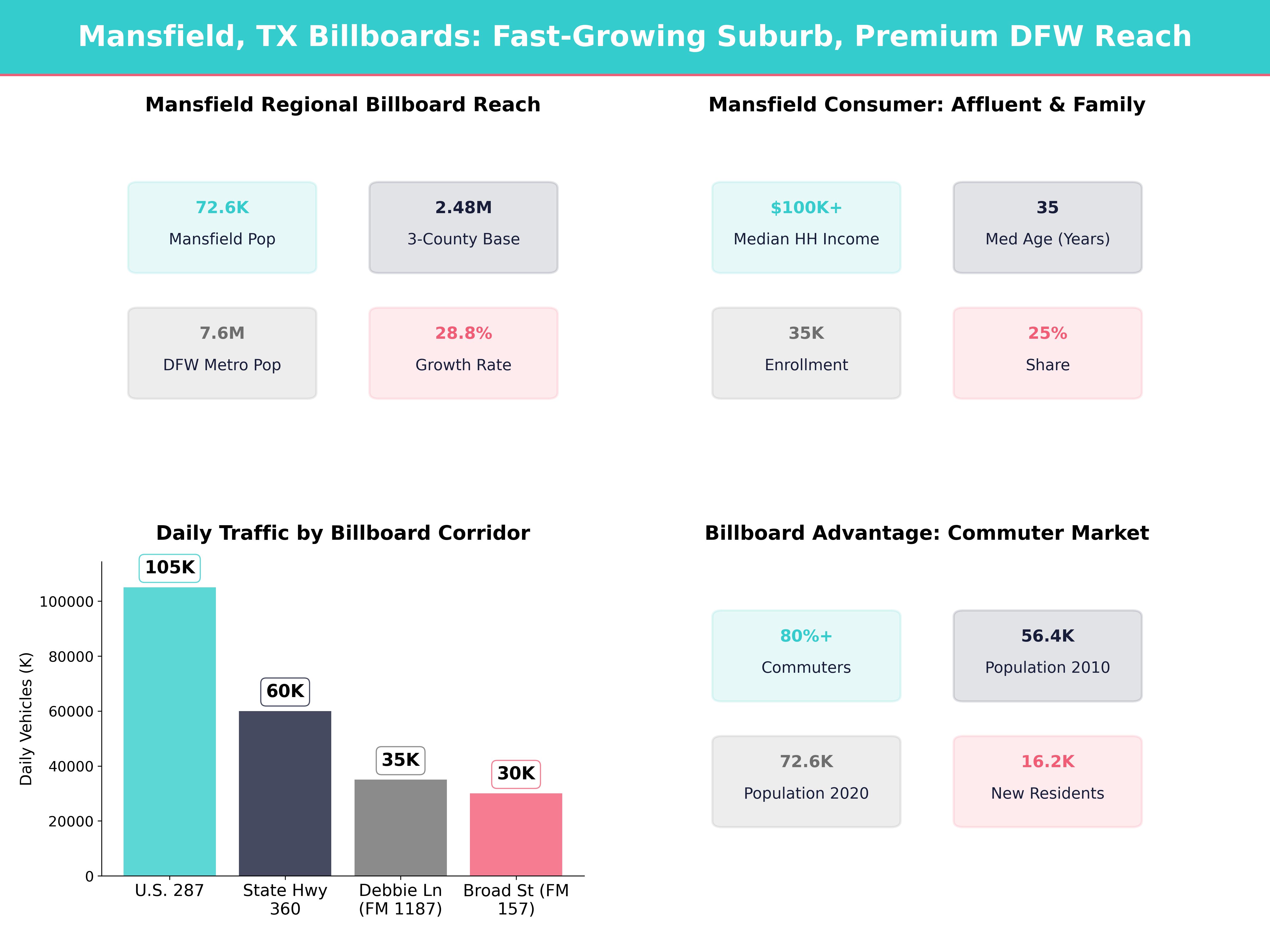
Mansfield sits in the southern growth arc of the Dallas-Fort Worth metroplex and connects Fort Worth, Arlington, Dallas, Burleson, and Midlothian through daily commuting and weekend recreation. The city had 72,602 residents in 2020, up from 56,368 in 2010, an increase of 28.8% in one decade. Because Mansfield stretches across Tarrant, Johnson, and Ellis counties, it can reach a three-county base of 2,483,022 people.
When is the best time to run billboard ads in Mansfield?
Fall is one of the best campaign windows in the market because school resumes, Mansfield ISD routines settle in, football and youth sports intensify, and commuters return to more regular schedules. Summer is also strong because the city is outdoorsy, mobile, and family-oriented, with daytime and early-evening rotations often making sense. Winter stays useful too, since January high temperatures are often in the upper 50s and travel patterns remain relatively normal.
Where should I place a Mansfield billboard with Blip for local shopping and service traffic?
For local buying intent, Broad Street, FM 157, and Debbie Lane, FM 1187 are especially important. Depending on the segment, these roads often carry roughly 20,000 to 40,000+ vehicles per day on Broad Street and about 25,000 to 45,000 vehicles per day on Debbie Lane. They serve shopping centers, schools, medical offices, dining clusters, and residential neighborhoods, so the audience is highly local and highly actionable.
Do I need a contract to advertise with Blip in Mansfield?
No, Blip has no long-term contracts or minimum commitments. You can start, pause, or stop your campaign at any time.
How fast can I launch a billboard campaign with Blip in Mansfield?
You can have your campaign live in minutes. Create a free account, select your locations, set your budget, upload your design, and start running once approved.
Where can I advertise with Blip in Mansfield?
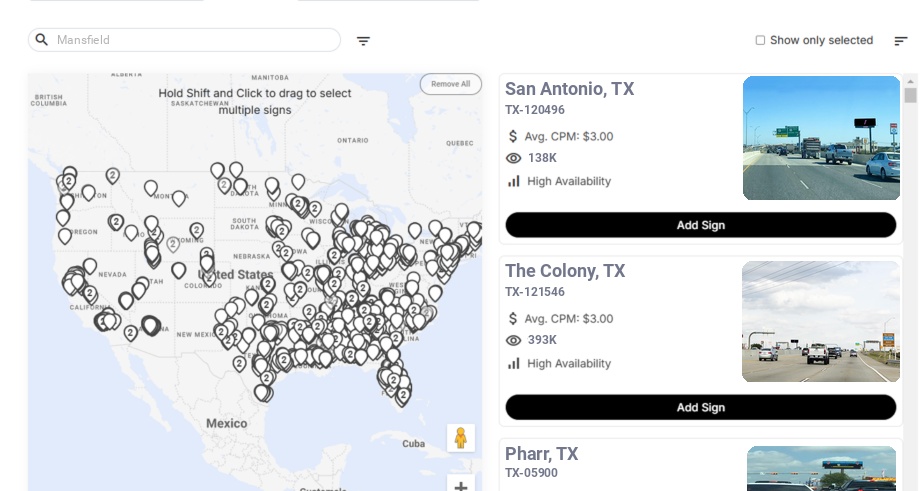
Blip has digital billboards in Mansfield. You can browse available locations on a map, choose the ones that fit your audience, and start advertising right away.
Still have questions? Launch a campaign in minutes — no contracts, no commitments.
Start Your CampaignMansfield Billboard Advertising Guide
When we look at Mansfield City of Mansfield 72,602 residents in 2020, up from 56,368 in 2010, an increase of 16,234 residents that represents 28.8% growth in one decade. Because Mansfield stretches across Tarrant County, Johnson County Ellis County 2,483,022 people while still speaking to a clearly defined suburban community. Mansfield is highly car-oriented, family-heavy, and increasingly connected to tourism, sports, and entertainment traffic, with more than 80% of workers commuting by driving alone and nearby venues like AT&T Stadium Globe Life Field seating 80,000 and about 40,300 spectators, which gives digital billboards consistent visibility all year.
Mansfield Market Overview
Mansfield sits in the southern growth arc of the Dallas-Fort Worth metroplex, and that location matters. We are not advertising in an isolated suburb. We are advertising in a city that connects Fort Worth, Arlington, Dallas, Burleson Midlothian 7.6 million-person Dallas-Fort Worth-Arlington metro.
Mansfield’s growth, geography, and regional pull
Mansfield’s 72,602 residents make it a meaningful standalone market, but its real power comes from adjacency to a much larger regional population. Tarrant County had 2,110,640 residents in 2020, Johnson County 179,927, and Ellis County 192,455. That gives Mansfield a direct position inside a three-county population base of 2,483,022 people, and it also places the city inside the broader Dallas-Fort Worth-Arlington metro, which had about 7.6 million residents in 2020.
For billboard advertisers, that means we can build campaigns that work on two levels at once. We can reach local Mansfield households with highly relevant creative, and we can also reach drivers moving between major employment centers, college campuses, sports venues, and regional shopping districts.
Mansfield’s demographics and spending profile
Mansfield has the demographic profile that many local advertisers want. The city’s median age is about 35, which signals a strong mix of young professionals, established families, and household decision-makers. Median household income is above $100,000, which gives many Mansfield campaigns room to promote higher-value services such as healthcare, home improvement, legal services, financial planning, private education, and elective retail.
Mansfield is also notably diverse. Roughly 1 in 4 residents are Hispanic or Latino, and the city includes substantial Black, White, and multiracial populations as well. That mix gives us room to test mainstream creative, bilingual messaging, and neighborhood-specific offers rather than assuming one message will resonate equally across the whole market.
Why Mansfield’s car dependence matters for billboard advertising
Mansfield is a driving market first. More than 80% of workers commute by driving alone, and transit options are far more limited than in the urban cores served by Trinity Metro or DART. Mansfield does not have passenger rail, and most trips for work, school, errands, dining, and entertainment happen on major roads.
That is exactly the environment where roadside media performs well. When residents spend repeated time on the same routes, frequency builds naturally. We can use that frequency to stay top of mind for urgent-need categories, such as urgent care, auto repair, HVAC, and legal services, and for consideration categories, such as colleges, gyms, entertainment venues, and homebuilders.
What Mansfield’s economy means for advertisers
The local economy is broader than many people expect. Mansfield Economic Development Corporation Mouser Electronics Methodist Mansfield Medical Center, Mansfield ISD, and the city’s expanding retail corridors create a steady base of workers and consumers.
For us, that means Mansfield supports more than one billboard objective. We can run branding campaigns, recruitment campaigns, event campaigns, and direct-response campaigns without forcing the market into a single use case.
Key Traffic Corridors for Mansfield Billboards
Mansfield’s travel patterns are organized around a few important corridors. When we understand which roads carry regional commuters versus local shoppers, we can choose placements that match our audience and our message.
U.S. 287 in Mansfield
According to Texas Department of Transportation traffic data, Mansfield-area segments of U.S. 287 commonly run in the 90,000 to 120,000 vehicles per day range, especially on the higher-volume stretches near major interchanges and the Arlington side of the market. This is the backbone route for drivers moving between Mansfield, Fort Worth, Arlington, and communities farther south.
U.S. 287 is especially useful when we want broad reach and repeated weekday frequency. It works well for categories that benefit from scale, urgency, or household visibility.
- Healthcare providers can use U.S. 287 to stay visible to daily commuters who may not need care today, but will remember a name when they do.
- Auto dealers, repair shops, and tire brands can benefit because roadside relevance is immediate on a commuter-heavy corridor.
- Colleges, trade schools, and employers can use U.S. 287 for recruitment because it reaches working adults during routine travel.
- Home services brands can use U.S. 287 to stay in the consideration set for homeowners with higher incomes and larger-ticket needs.
State Highway 360 near Mansfield
State Highway 360 is one of Mansfield’s most important regional connectors. TxDOT counts on nearby segments commonly fall in the 50,000 to 70,000 AADT range, and the corridor ties Mansfield to north Arlington, the entertainment district, logistics zones, and routes toward DFW International Airport.
That connection makes SH 360 especially attractive for brands that rely on regional movement rather than purely local traffic. We can use it to reach leisure travelers, sports fans, eventgoers, airport-bound drivers, and workers in transportation or distribution.
This corridor is a strong fit for several advertiser types.
- Hotels, attractions, and restaurants can capture visitors heading toward AT&T Stadium Globe Life Field, and Arlington entertainment destinations.
- Staffing firms and industrial employers can reach shift workers and job seekers moving through the southern DFW logistics belt.
- Family entertainment venues can promote weekend plans to Mansfield households before they choose where to spend discretionary time.
Broad Street, FM 157, and Debbie Lane, FM 1187
For local buying intent, few routes matter more than Broad Street, FM 157, and Debbie Lane, FM 1187. Depending on the segment, these roads often carry roughly 20,000 to 40,000+ vehicles per day on Broad Street and about 25,000 to 45,000 vehicles per day on Debbie Lane. They serve shopping centers, schools, medical offices, dining clusters, and residential neighborhoods, so the audience here is highly local and highly actionable.
These are the corridors we should prioritize when we want visits soon rather than general awareness later. Because drivers are often closer to their destination and moving at more local speeds, these routes support stronger location-based calls to action.
They are especially useful for the following categories.
- Quick-service restaurants, coffee brands, and dessert shops can convert same-day traffic with lunch, dinner, and after-school messaging.
- Dentists, orthodontists, pediatricians, and urgent care centers can reach families during routine daily movement.
- Gyms, boutique fitness studios, childcare providers, and tutoring services can align messaging with school pickup, evening routines, and weekend family planning.
- Retailers and service businesses in or near Historic Downtown Mansfield can use these corridors to reinforce local familiarity.
Feeder routes and cross-market movement
Even when our selected billboard is technically in or near Mansfield, we should remember that the city functions as part of a wider network. Drivers often flow between Mansfield and Grand Prairie, Cedar Hill
Mansfield Audience Segments
Mansfield is valuable because it gives us several distinct audiences without requiring us to leave one market. When we match our creative and timing to the right segment, billboard performance improves quickly.
Mansfield commuters and cross-metro workers
The commuter audience is the foundation of the market. With more than 80% of workers driving alone, and with limited transit alternatives, road exposure is part of everyday life. Many Mansfield residents commute north toward Arlington, Fort Worth, or Dallas-area job centers, while others move east and south within the city’s own employment base.
For us, this means morning and late-afternoon dayparts can be especially productive on U.S. 287 and SH 360. Commuter-focused ads should emphasize speed, convenience, trust, and proximity, because those are the decision filters drivers use while planning their day.
Mansfield families and household decision-makers
Mansfield is one of the stronger family markets in southern Tarrant County. Mansfield ISD serves about 35,000 students, which tells us immediately that school calendars, after-school schedules, youth sports, and family spending patterns shape local life. Families are often the audience behind spending on healthcare, restaurants, tutoring, grocery, dental care, athletics, home services, and financial products.
This audience responds well when we sound practical and local. Messaging such as “minutes from home,” “near Debbie Lane,” “after-school appointments,” or “serving Mansfield families” can feel more relevant than broad metro messaging.
Students and education audiences near Mansfield
Mansfield also benefits from nearby college and workforce education demand. The University of Texas at Arlington enrolls more than 41,000 students, and Tarrant County College adds a large two-year college audience across the region. That gives us a blended student market of traditional undergraduates, commuter students, adult learners, and certificate seekers.
Education advertisers, apartment communities, healthcare clinics, technology retailers, and employers can all benefit from this segment. We should be especially active around semester starts, graduation periods, and career-focused months when students and parents are making enrollment and job decisions.
Tourists, sports visitors, and weekend leisure traffic in Mansfield
Mansfield’s visitor profile is not built around one giant convention center. It is built around sports tourism, regional entertainment, and recreation. That mix is excellent for billboard advertising because the trips are often made by car, and many visitors repeat them over multiple weekends.
The local and nearby visitor assets are strong.
- Big League Dreams Mansfield 5 replica baseball fields.
- Stars Center Mansfield features 2 NHL-regulation ice rinks.
- Mansfield National Golf Club offers an 18-hole course.
- Joe Pool Lake 7,400 acres and pulls warm-weather recreation traffic.
- Nearby AT&T Stadium 80,000 for NFL games.
- Nearby Globe Life Field seats about 40,300 for baseball.
- DFW International Airport handled 81.8 million passengers in 2023, which reinforces the broader visitor flow through North Texas.
For us, that means entertainment brands, restaurants, hotels, youth sports services, sporting goods stores, and family attractions all have reason to advertise in the Mansfield area.
Workers in healthcare, logistics, and business services
Mansfield’s employer base includes healthcare workers, school employees, logistics staff, electronics professionals, municipal workers, and small-business owners. Methodist Mansfield Medical Center, Mouser Electronics
That is useful when we want to run recruiting campaigns, B2B messaging, or ads aimed at lunch-hour and shift-change traffic rather than only broad consumer branding.
Seasonal and Timing Opportunities in Mansfield
Mansfield supports billboard advertising year-round, but timing still matters. We can improve efficiency by aligning campaigns with local routines, school schedules, event calendars, and weather-driven needs.
Spring in Mansfield
Spring is a strong season for family services, youth sports, home improvement, healthcare, and local dining. Tournament traffic begins to pick up at venues such as Big League Dreams Mansfield FieldhouseUSA Mansfield Stars Center Mansfield. We also see strong relevance for patio dining, landscaping, tax services, and allergy-related healthcare as residents spend more time out of the house.
This is a smart window for campaigns that want action before summer competition increases.
Summer in Mansfield
Summer is prime billboard season in Mansfield because the city is outdoorsy, mobile, and family-oriented. Average high temperatures are typically in the 95°F to 96°F range in July and August, which raises demand for HVAC, cold beverages, pools, indoor entertainment, and lake-oriented recreation. Joe Pool Lake Cedar Hill State Park add leisure traffic, while school break shifts family movement into more flexible daytime patterns.
We should lean into convenience, cooling, family fun, and weekend plans during this season. Daytime and early-evening rotations often make sense because discretionary travel is higher.
Fall in Mansfield
Fall is one of the best campaign windows in the market. School resumes, Mansfield ISD routines settle in, football and youth sports intensify, and commuters return to more regular schedules after summer travel. This is a prime time for tutoring, dentistry, pediatric care, after-school programs, college recruitment, automotive services, and restaurant promotions tied to Friday nights and weekend games.
It is also a strong season for regional entertainment. Arlington’s stadium district is active, which helps SH 360-oriented campaigns aimed at game-day dining, parking, hotels, apparel, and sports-viewing destinations.
Holiday and winter timing in Mansfield
Winter in North Texas is milder than in many U.S. markets, with January high temperatures often in the upper 50s. That keeps roadside visibility useful and travel patterns relatively normal outside of short weather events. Holiday shopping, giftable services, elective healthcare use, year-end tax planning, and New Year fitness campaigns all fit well here.
We should also remember that year-end is powerful for healthcare, legal, financial, and home services brands because many consumers use the season to catch up on deferred decisions before the new year begins.
Mansfield Billboard Design Tips
Creative that performs in Mansfield usually feels local, practical, and easy to process at speed. We should design with the city’s suburban routines and diverse household mix in mind.
Design for Mansfield’s family-first suburban mindset
Because Mansfield’s median age is about 35 and household incomes are relatively strong, creative should often reflect family life, homeownership, and convenience. We should show clean visuals, relatable people, and offers that feel useful rather than abstract. Messages tied to family schedules, health, home upkeep, school-year planning, and weekend recreation usually land better here than purely image-driven branding.
For example, “After-school appointments,” “Fast service off 287,” and “Weekend fun near Mansfield” are more locally believable than vague slogans.
Use bilingual or culturally inclusive creative when appropriate
With roughly 25% of Mansfield’s population identifying as Hispanic or Latino, bilingual or Spanish-language variants can be worth testing, especially for healthcare, grocery, telecom, legal, education, and community services. Even when we stay in English, we should favor inclusive imagery and clear messaging that does not assume a single cultural profile.
This does not mean every campaign needs two languages. It means Mansfield is a good market for creative testing rather than one-size-fits-all messaging.
Match the message to the road
U.S. 287 and SH 360 are faster roads, so we should keep copy tighter there. In practical terms, 6 words or fewer is a strong discipline for the main message on those corridors. Broad Street and Debbie Lane can support slightly more specificity because they reach drivers in more local, destination-oriented moments.
In Mansfield, that often means we use two creative versions of the same campaign.
- On faster regional corridors, we lead with the brand, the category, and one memorable value point.
- On local retail corridors, we add a sharper location cue, a limited-time offer, or a direct “visit today” prompt.
Use recognizable Mansfield cues
Mansfield creative works harder when it sounds like it belongs in Mansfield. References to Historic Downtown Mansfield
We should not overcomplicate that local feel. One familiar place name or one clearly local visual is often enough.
Regional Strategies Across Mansfield
Not every part of Mansfield behaves the same way. We get better results when we think of the city as a set of submarkets rather than one uniform territory.
North Mansfield and the Arlington connection
North Mansfield is where regional pull is strongest. This area benefits from access to Arlington, SH 360, U.S. 287, and the route network leading toward entertainment venues, university traffic, and airport travel. We should prioritize this zone for broad awareness, destination dining, hotels, sports-related campaigns, education, and brands that want reach beyond Mansfield proper.
This is also the best area for piggybacking on traffic associated with AT&T Stadium Globe Life Field, Texas Live!, and The University of Texas at Arlington.
Central Mansfield and Historic Downtown
Central Mansfield is ideal for local businesses that depend on familiarity, trust, and repeat visits. Restaurants, boutiques, medical offices, salons, insurance agencies, churches, and community services all benefit from regular local exposure here. Campaigns in this area should sound neighborly and specific rather than metro-wide.
If we want residents to think, “That place is close to me,” central Mansfield is where we should work hardest.
South Mansfield and the county-edge growth zones
Southern Mansfield connects to growth moving toward Johnson County and Ellis County. This is where we should think about new rooftops, expanding subdivisions, builder services, moving companies, internet providers, healthcare expansion, and long-consideration household categories.
Because people in these areas often drive farther for work and errands, frequency on major routes matters. These placements are useful when we want to remain visible to households making large spending decisions over weeks or months, not just hours.
Mansfield’s east-west retail belt
The east-west belt along Debbie Lane, Broad Street, and surrounding commercial nodes is where daily intent becomes especially valuable. These are strong placements for same-week results, lunch-and-dinner traffic, local retail promotions, and service businesses that want a customer to act soon after seeing the message.
We should use this zone when our goal is immediate relevance rather than pure market coverage.
Using Blip Tools in Mansfield
Blip’s tools fit Mansfield particularly well because the market has distinct corridor types, strong daypart swings, and multiple audience segments. We do not need one rigid buy. We can build a smarter mix.
How we can apply Blip in the Mansfield market
We can use the map to separate commuter boards from local retail boards instead of treating all Mansfield inventory the same way. We can daypart morning and evening on U.S. 287 and SH 360 for work travel, then shift midday and weekend weight toward Broad Street or Debbie Lane for shoppers and families. We can also create different artwork for different purposes, such as one version for regional awareness, one version for after-school family traffic, and one version for sports-weekend visitors.
Blip’s flexible budgeting is especially useful here because Mansfield gives us several legitimate testing options. We can compare a commuter-heavy corridor against a retail-heavy corridor, monitor performance in real time, and move budget toward the placements that align most closely with our actual goal. We can also react quickly to tournament weekends, school starts, holiday shopping, or major Arlington event stretches without rebuilding a traditional campaign from scratch.
Getting Started with Billboard Rental in Mansfield
Renting a billboard in Mansfield works best when we start with the business objective, not the board itself. This market offers enough variety that the “best” location depends on who we need to reach and when we need to reach them.
A practical way to launch in Mansfield
We should begin by defining whether our primary goal is broad awareness, local store traffic, recruiting, event attendance, or lead generation. Then we should match that goal to the right corridor.
- If we want maximum reach, we should prioritize U.S. 287 and SH 360.
- If we want local shopping or service traffic, we should focus on Broad Street, Debbie Lane, and central Mansfield corridors.
- If we want sports and visitor exposure, we should lean toward north Mansfield and Arlington-bound routes.
- If we want recruiting or B2B visibility, we should target the commute-heavy routes used by healthcare, logistics, and professional workers.
What to expect from the rental process
Traditional billboard buying often involves long lead times, fixed inventory packages, and multiweek commitments that make testing expensive. Mansfield is a market where testing matters, because traffic quality changes noticeably from one road type to another. Blip simplifies that process by letting us select locations, set the schedule we want, adjust budget as we learn, and optimize without waiting on a long sales cycle.
That flexibility is especially helpful for local businesses that may not want to commit to a large static campaign before seeing how the market responds.
How we should evaluate Mansfield billboard locations
When we compare locations, we should judge them on four factors. First, we should look at traffic volume, because higher-volume routes are better for reach. Second, we should consider audience intent, because a local retail corridor can outperform a larger highway if our goal is immediate visits. Third, we should think about direction of travel, because northbound morning traffic and southbound evening traffic can serve different audiences. Fourth, we should measure proximity to our actual destination, because the best billboard is often the one that catches a driver at the moment a decision is still easy to change.
In practical terms, a Mansfield campaign often performs best when we test more than one environment. A two- to four-week mix of one regional commuter placement and one local action-oriented placement can teach us more than a single fixed buy. Once we see which corridor and time windows generate the best response, we can scale with confidence.