Billboards in Willis, TX
No Minimum Spend. No Long-Term Contracts. Just Results.
Trusted by Leading Brands


Billboard advertising
in Willis has never been easier



How much is a billboard in Willis?
Why Choose Blip for Billboard Advertising in Willis
Choose Blip in Willis to launch self-serve on I-45 or SH 75 in minutes—no contracts, no minimums, just quick visibility for local and commuter traffic.
Blip-optimized campaigns in Willis can balance I-45, FM 1097, and Lake Conroe weekend flow, then auto-shift timing to match your goals and budget.
Willis drivers spend long commutes on the road; Blip's dayparting lets you hit southbound mornings and northbound evenings for better recall.
Use Blip in Willis with flexible budgets and pay only when ads run, so you can test lake-season or school-season demand without overspending.
Track real-time analytics in Willis to see what works on I-45, then adjust creative, timing, or spend fast as traffic and seasons change.
Frequently Asked Questions About Billboard Advertising in Willis
How much does a billboard cost in Willis with Blip?
With Blip, billboard advertising in Willis can fit a wide range of budgets because you only pay when your ad actually appears. Each “blip” is a 7.5-to-10-second display on a rotating digital billboard, and prices start at just $0.01 per display. Since pricing is dynamic, the cost per blip can change based on time of day, location, and advertiser demand, but you stay in control the whole time.
Where can I advertise with Blip in Willis for the most traffic?
I-45 is the backbone of the Willis market and is the region’s best corridor for broad awareness. Recent Texas Department of Transportation traffic-count maps generally place I-45 near Willis in the 80,000 to 100,000 AADT range, with higher volumes as we move south toward Conroe. State Highway 75 through Willis is better for repetition among local residents, while FM 1097 and lake-oriented connectors can reach leisure and weekend traffic.
What makes Willis a strong billboard market with Blip?
Willis sits inside a fast-growing regional corridor, and Montgomery County reached 620,443 residents in the 2020 Census after adding 164,697 people since 2010. That 36.1% growth has pushed more households, more commuters, and more spending power up the Interstate 45 corridor. Roughly 93% of county workers commute by car, truck, or van, which means billboards can reach drivers with real consistency.
When is the best time to run a Willis billboard campaign with Blip?
Spring is one of the best launch windows in the Willis area, and summer is when the lake market is at its most active. Thursday afternoon through Sunday evening is usually the highest-value window for lake-oriented advertisers, while fall is strong for school, sports, and routine spending. January and February are usually better for practical categories than for pure leisure.
How should I target local drivers in Willis with Blip?
For pure local awareness, we should prioritize Willis-core routes such as SH 75 and the I-45 interchange area. SH 75 is often a better fit when we need repetition among local residents who are making short trips for groceries, schools, churches, gas, pharmacies, or neighborhood services. Directional targeting also matters, with morning southbound and evening northbound messages helping match the driver’s routine.
Do I need a contract to advertise with Blip in Willis?
No, Blip has no long-term contracts or minimum commitments. You can start, pause, or stop your campaign at any time.
How fast can I launch a billboard campaign with Blip in Willis?
You can have your campaign live in minutes. Create a free account, select your locations, set your budget, upload your design, and start running once approved.
Where can I advertise with Blip in Willis?
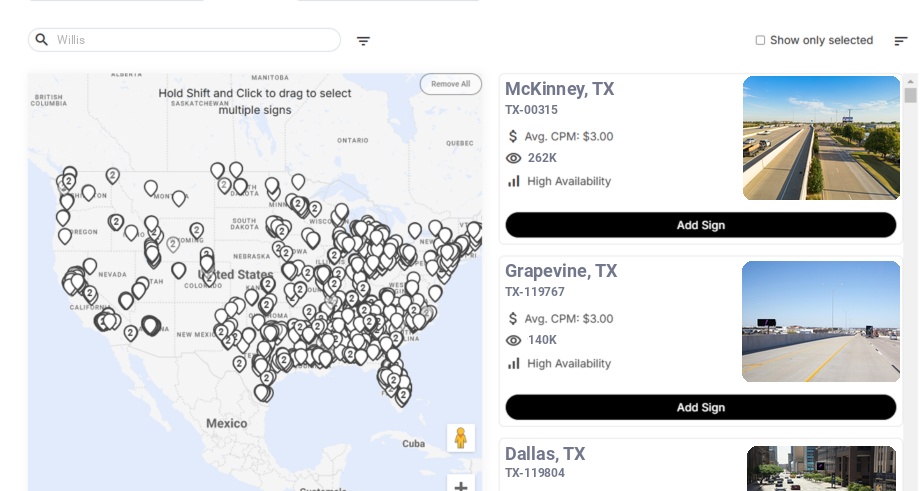
Blip has digital billboards in Willis. You can browse available locations on a map, choose the ones that fit your audience, and start advertising right away.
Still have questions? Launch a campaign in minutes — no contracts, no commitments.
Start Your CampaignWillis Billboard Advertising Guide
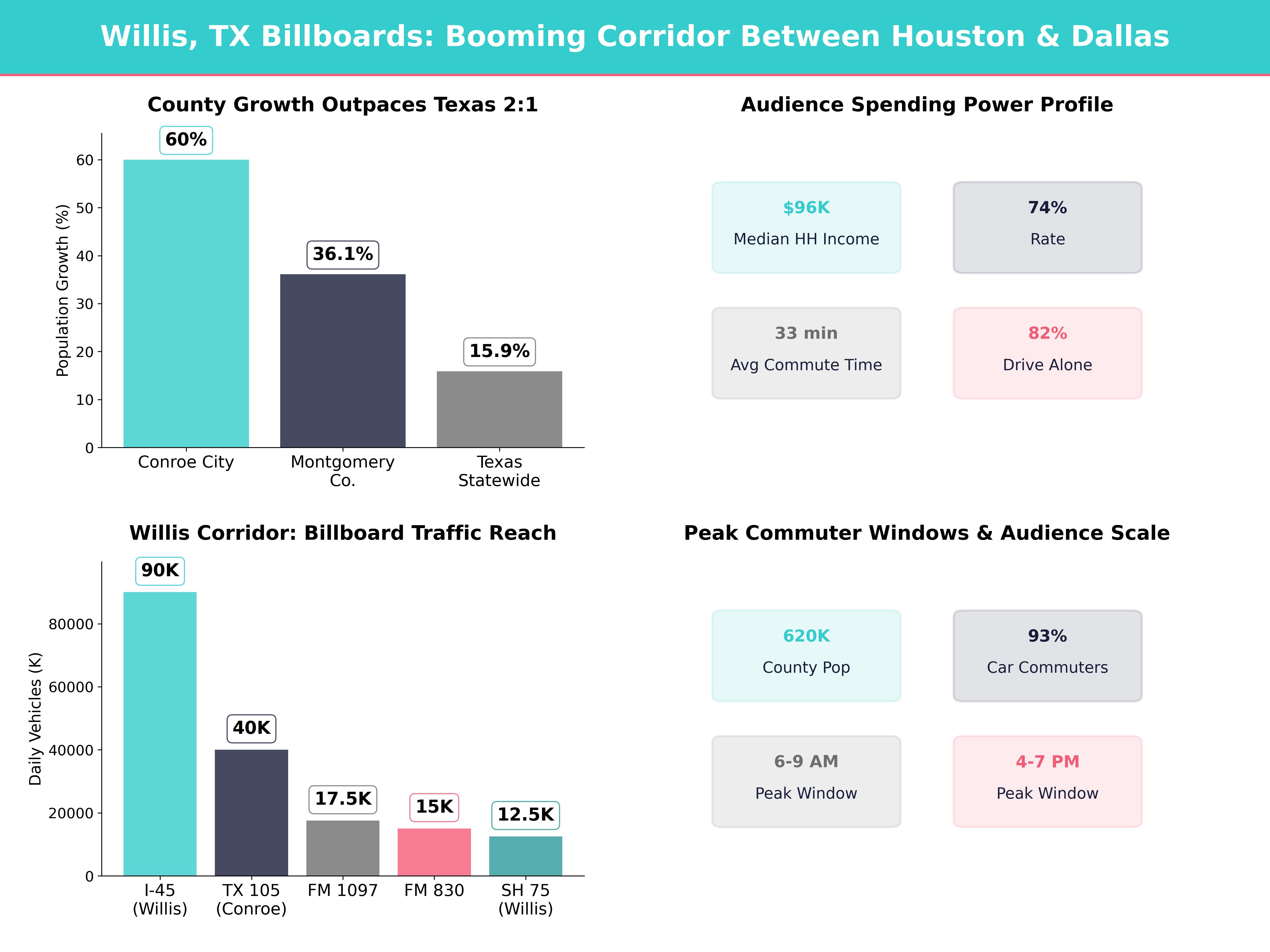
Willis Montgomery County reached 620,443 residents in the 2020 Census after adding 164,697 people since 2010, and that 36.1% growth — more than double Texas’s roughly 15.9% increase over the same decade — has pushed more households, more commuters, and more spending power up the Interstate 45 corridor. We also benefit from a highly car-dependent local lifestyle, because recent estimates show roughly 93% of county workers commute by car, truck, or van. Add in Lake Conroe 21,000 acres and 157 miles of shoreline, and we get a market where billboards can reach both daily drivers and weekend visitors with real consistency.
Market Overview for Willis Billboard Advertising
When we advertise in Willis Conroe, north to Huntsville Lake Conroe The Woodlands Township with roughly 114,000 residents. That geography matters because Willis sits roughly 50 miles north of downtown Houston, about 15 miles north of Conroe, and roughly 20 miles south of Huntsville.
Willis and Montgomery County Growth
According to the Texas Demographic Center, Montgomery County grew from 455,746 residents in 2010 to 620,443 in 2020. That is one of the clearest reasons billboard advertising works here. We are reaching a county that is adding rooftops, retail, schools, and service demand at the same time.
Nearby Conroe shows the same momentum. Conroe grew from 56,207 people in 2010 to 89,956 in 2020, a roughly 60% increase, which means the area just south of Willis has expanded quickly in both population and commercial activity. For advertisers, that creates a powerful pattern. We can use Willis-area boards for local frequency, while still benefiting from regional traffic generated by the larger Conroe market.
Household Economics and Commuting in Willis
The Willis market is especially attractive for advertisers that depend on household spending. Recent Census estimates place Montgomery County median household income at about $96,000, and homeownership is near 74%. Those two numbers are important because they point to a strong audience for home improvement, roofing, HVAC, plumbing, landscaping, insurance, healthcare, automotive, and financial services.
Commuting behavior is equally important. Roughly 93% of workers in Montgomery County travel by car, truck, or van, about 82% drive alone, and the average commute is roughly 33 minutes. That means drivers spend a meaningful amount of time on the road, and that repeated exposure supports strong recall for billboard campaigns. If we want to influence routine decisions such as where to eat, where to schedule care, which dealership to visit, or which contractor to call, Willis gives us the kind of windshield time that outdoor advertising needs.
Economic Drivers Around Willis
Willis benefits from several overlapping economic engines. The Conroe/Lake Conroe Chamber of Commerce, the Lake Conroe Area Chamber of Commerce The Woodlands Area Chamber of Commerce represent a broad business base that includes construction, logistics, healthcare, retail, hospitality, education, and business services. The nearby Conroe-North Houston Regional Airport also supports business travel with a 7,501-foot runway, which reinforces the area’s appeal for industrial and corporate activity.
We also see a healthy small-business environment in Willis itself. That matters because local billboard demand often comes from businesses that need geographic precision, such as dentists, attorneys, urgent care clinics, restaurants, gyms, churches, schools, and service contractors. In a growing exurban market, these advertisers often care less about city boundaries and more about whether drivers are moving through the right daily routines. Willis performs well on that measure.
Key Traffic Corridors for Willis Billboard Campaigns
Willis travel patterns revolve around a few high-value corridors. For digital billboards, these roads matter because they tell us where we can buy mass reach, where we can buy local frequency, and where we can intercept leisure traffic before it arrives at the lake, the school, or the store.
Interstate 45 Through Willis
I-45 is the backbone of the Willis market. It is the only interstate highway that directly connects Houston and Dallas, and its full length is about 284 miles. For Willis advertisers, that means the freeway carries multiple audiences at once, including local commuters, regional shoppers, Houston-bound workers, delivery traffic, and pass-through travelers heading farther north or south.
Recent Texas Department of Transportation traffic-count maps generally place I-45 near Willis in the 80,000 to 100,000 AADT range, with higher volumes as we move south toward Conroe. That is the region’s best corridor for broad awareness. If we are promoting healthcare systems, colleges, large retailers, dealerships, casinos in nearby states, personal injury firms, family attractions, or major events, I-45 is usually the first corridor we evaluate.
Southbound morning positioning is especially useful when we want to reach workers heading toward Conroe, The Woodlands, and greater Houston. Northbound afternoon and evening positioning works well for return commuters, as well as drivers heading home to Willis, New Waverly
State Highway 75 in Willis
State Highway 75 runs parallel to I-45 and functions as Willis’s everyday local spine. In practical terms, it captures a more community-based audience than the interstate does. Recent TxDOT counts generally place SH 75 through Willis in the 10,000 to 15,000 AADT range, depending on the segment.
That lower count is not a weakness. It is a targeting advantage. SH 75 is often a better fit when we need repetition among local residents who are making short trips for groceries, schools, churches, gas, pharmacies, or neighborhood services. We especially like this corridor for dentists, family medicine, independent restaurants, local banks, storage operators, real estate professionals, and municipal or civic messaging tied to the City of Willis
FM 1097 and the Lake Conroe Approaches
FM 1097 is one of the most important east-west connectors for the Willis market because it links I-45 traffic with neighborhoods, commercial areas, and destinations that serve Lake Conroe 15,000 to 20,000 AADT, while lake-oriented connectors such as FM 830 often operate in the 10,000 to 20,000 AADT band on busier segments.
This is where we find some of the best opportunities for leisure, dining, home services, and lake-related spending. Businesses that benefit most here include marinas, waterfront restaurants, resorts, vacation rentals, pool builders, boat dealers, storage facilities, roofers, landscapers, and contractors targeting second-home owners or upscale lake communities. Because these routes handle both daily local traffic and weekend surges, we can build creative that changes with the season and still stays relevant.
TX 105 and Conroe’s Retail Gateways
Although TX 105 is south of Willis, it matters to many Willis campaigns because Conroe is the area’s dominant retail and healthcare hub. Central Conroe segments of TX 105 often exceed 40,000 AADT, and that corridor links shoppers to major retail, medical, and entertainment destinations. When we want countywide reach rather than just Willis frequency, TX 105 boards can complement Willis placements very effectively.
This corridor is especially strong for hospitals, urgent care, furniture, grocery, entertainment, colleges, home improvement, and regional retail brands. It also works well when we want to reinforce a Willis campaign with a larger “down the funnel” retail corridor where consumers are more likely to act immediately.
Audience Segments We Can Reach in Willis
The best Willis billboard campaigns begin with a clear audience definition. This market is not one-dimensional. It blends exurban commuters, lake recreation, family households, students, and working trades in a way that gives advertisers several viable angles.
Commuters Along the I-45 Corridor
The commuter audience is the core Willis billboard segment. With roughly 93% of workers in Montgomery County commuting by car, truck, or van, and about 82% driving alone, we have a very large pool of daily drivers who can see the same message repeatedly during the workweek. That repetition is exactly what we want for categories such as insurance, legal services, healthcare, fast casual dining, auto repair, fuel, and financial services.
We also benefit from the corridor structure itself. Drivers in Willis often travel south for work, shopping, and medical appointments, and they travel north for home, school, and recreation. That gives us useful directional targeting. A morning southbound message can be more action-oriented, while an evening northbound message can focus on dinner, home services, and local errands.
Lake Conroe Visitors and Outdoor Recreation Audiences
Lake Conroe 21,000 surface acres and 157 miles of shoreline support boating, fishing, dining, short-term stays, and resort traffic. Nearby outdoor assets, including the 163,045-acre Sam Houston National Forest, reinforce the area’s recreational identity.
That matters because leisure travelers behave differently from commuters. They are more open to spur-of-the-moment restaurant stops, resort bookings, marina visits, tackle purchases, and family entertainment. Advertisers such as Margaritaville Lake Resort Lake Conroe, local restaurants, campgrounds, real estate brokers, RV dealers, and outdoor outfitters can all benefit from the Thursday-through-Sunday traffic pattern that the lake creates.
Students, Parents, and Education-Focused Households
Education is a major audience driver in and around Willis. Willis ISD serves more than 8,000 students, and nearby Conroe ISD serves more than 70,000 students. To the north, Sam Houston State University in Huntsville enrolls roughly 21,000 students, and Lone Star College-Montgomery extends the region’s higher-education footprint farther south.
For billboard advertisers, that means we can reach parents, teens, young adults, and school employees through one corridor market. Orthodontists, tutoring centers, youth sports organizations, family entertainment venues, quick-service restaurants, apartments, colleges, and mobile phone providers all have relevant audiences here. Timing matters, but the audience is large and dependable.
Family Households and Multicultural Audiences
Willis and Montgomery County have a strong family-household profile, and recent estimates indicate that roughly 1 in 4 county residents is Hispanic or Latino. That makes the market a good fit for brands that want to combine family-oriented visuals with practical value messaging. It also means bilingual creative can be a smart choice for many categories, especially healthcare, telecom, retail, financial services, restaurants, and community events.
We should not assume every board needs dual-language creative. We should, however, recognize that a meaningful share of the market responds well to Spanish-language headlines, bilingual offers, or culturally familiar imagery. In a road-based medium where attention is brief, even a short bilingual element can improve relevance.
Trades, Logistics, and Service Workers
Willis also reaches a practical, work-oriented audience tied to construction, field service, logistics, manufacturing, and related sectors. The I-45 corridor moves contractors, crews, deliveries, and service fleets every day. The Conroe-North Houston Regional Airport and the broader Conroe business base add to that audience.
This segment is valuable for staffing firms, tool brands, workwear, truck accessories, industrial suppliers, fuel cards, and B2B services. Creative that emphasizes speed, reliability, open positions, or local availability tends to resonate well with these drivers.
Seasonal and Timing Opportunities for Willis Campaigns
Willis is not a market where we should run the same billboard creative all year and expect peak performance. Traffic motives change with school calendars, lake season, events, and weather, so our timing strategy should reflect that.
Spring in Willis and Montgomery County
Spring is one of the best launch windows in the Willis area. March and April bring milder weather, spring break travel, home-improvement demand, and major local events such as the Montgomery County Fair and Rodeo. Spring also ramps up traffic to Lone Star Convention & Expo Center
This is a strong time for home services, lawn care, roofing, family entertainment, healthcare, restaurants, and event marketing. We also like spring for brand-building campaigns because people are out driving more often and are beginning to plan summer activities.
Summer Lake Season Near Willis
Summer is when Willis’s tourism angle becomes most obvious. From Memorial Day through Labor Day, the lake market is at its most active, and June through September often bring afternoon highs in the low to mid-90s. That weather pattern increases demand for air conditioning, cold drinks, pools, restaurants, convenience stores, recreation, and indoor attractions.
For lake-oriented advertisers, Thursday afternoon through Sunday evening is usually the highest-value window. That is when we want heavier delivery on I-45, FM 1097, and lake access routes. We also like summer for resorts, marinas, injury law, urgent care, and hospitality because the audience includes both locals and out-of-town visitors.
Fall in Willis for School, Sports, and Routine Spending
August through November shifts the market back toward routine. Willis ISD, Conroe ISD, and Sam Houston State University all bring students and families back into repeat patterns. That makes fall a strong season for after-school food, tutoring, orthodontics, youth programs, automotive service, and healthcare.
We also see fall benefits from football traffic, weekend family outings, and business normalization after the summer vacation period. Brands that need dependable weekly frequency often perform well here because road use becomes more predictable.
Holiday and Winter Opportunities Around Willis
November and December are valuable for retail, gifting, seasonal dining, and family entertainment. South of Willis, Visit The Woodlands, The Cynthia Woods Mitchell Pavilion, and major shopping destinations add regional event traffic, while northbound and westbound movements continue to feed local households and the lake area. The Pavilion’s capacity of 16,500 seats is a useful reminder that regional entertainment can affect corridor traffic patterns far beyond one city.
January and February are usually better for practical categories than for pure leisure. We like those months for tax services, medical appointments, gyms, home repair, insurance, and recruitment. We also keep storm-response flexibility in mind because hurricane season runs from June 1 through November 30, and rapid billboard updates can be useful for preparedness, recovery, and service-response messaging.
Billboard Design Tips for the Willis Market
Willis creative works best when it feels local, useful, and easy to process at speed. The market is not looking for abstract branding alone. It responds well to clarity, credibility, and a visual style that matches the area’s mix of family life, outdoor recreation, and practical spending.
Use Willis-Specific Visual Cues
We generally recommend creative that reflects the actual feel of the region. Lake Conroe
That local grounding is especially important in Willis because the market sits close enough to Houston to feel connected, but far enough away to have a distinct identity. Creative that looks too urban or too generic can feel disconnected from the audience’s daily environment.
Design for Highway-Speed Reading in Willis
On digital billboards, drivers only get 7.5 to 10 seconds per display, and I-45 traffic moves fast. In Willis, we should treat each message like a highway headline. We usually want about 6 words in the core message, one strong visual, and one clear action.
Distance-based cues also work well here. If the business is nearby, we should say so with language such as “Next Exit,” “2 Miles West,” or “In Willis Today.” This market is highly road-oriented, so directional clarity often performs better than abstract slogans.
Match the Tone to Willis Households
Because Montgomery County combines a median household income near $96,000 with homeownership near 74%, Willis is a good market for aspirational products that still look practical. Luxury-only messaging can work for some lake audiences, but many of the strongest local categories are still value-sensitive. We usually get better traction when we combine quality with usefulness, speed, savings, or trust.
Examples of tone that fit this market include family-first healthcare, dependable service, local expertise, fast turnaround, weekend convenience, and easy access from I-45. Those are not generic outdoor best practices. They are a close match to how Willis-area consumers often make decisions.
Consider Bilingual and Seasonal Creative Rotation
Because roughly 1 in 4 county residents is Hispanic or Latino, bilingual or Spanish-language creative can be effective in the right placements. We often see good results when we test multiple versions rather than assuming a single creative approach will fit the whole corridor.
Seasonal rotation also matters. A lake ad in July should not look like a back-to-school ad in September, and a tax-service ad in February should not look like a rodeo-season ad in April. Willis is a market where small creative adjustments can improve local relevance quickly.
Regional Strategies Around Willis
The smartest Willis billboard plans are usually not uniform. Different sub-areas serve different purposes, so we should adapt our strategy by zone rather than expecting one board type to do everything.
Willis Core and Everyday Local Frequency
For pure local awareness, we should prioritize Willis-core routes such as SH 75 and the I-45 interchange area. This strategy is best when we want to build frequency among residents who already live nearby. We like it for dentists, clinics, churches, restaurants, hardware stores, gyms, storage operators, and community organizations.
The main advantage here is repetition. A local resident may pass the same corridor several times a week, which helps our message stick even if the total traffic count is lower than on the interstate.
West Toward Lake Conroe
Westbound routes toward the lake give us a different mix of audiences. Here we are more likely to find weekend travelers, higher-discretionary-spend households, second-home owners, and visitors moving between Willis, the west lake area, Margaritaville Lake Resort Lake Conroe, and the City of Montgomery
This sub-area is often ideal for hospitality, dining, recreation, real estate, boat and RV sales, and premium home services. We usually lean harder into Thursday-through-Sunday delivery in this zone because the traffic intent changes as the weekend approaches.
Southbound to Conroe and The Woodlands
If our goal is larger-scale reach, we should extend south. The Willis-to-Conroe stretch of I-45, plus strategic placements around TX 105 and major Conroe retail nodes, can broaden the campaign from local to countywide. This is the best play for hospitals, colleges, larger retailers, regional entertainment, and multi-location service brands.
Going farther south toward The Woodlands Township can add office commuters and event traffic. We do not always need that extension, but it is valuable when our target customer is willing to travel or when the brand serves a wider footprint than Willis alone.
Northbound to Huntsville and Walker County
Northbound I-45 matters more than many advertisers first assume. Huntsville 45,941 residents in 2020, and Sam Houston State University adds a sizable student population. That makes the northbound strategy useful for apartments, colleges, legal services, food, healthcare, telecom, and automotive brands that want reach beyond Montgomery County.
For Willis businesses, northbound advertising can also be a defensive move. It keeps our brand visible to travelers before they settle into Huntsville-area choices, and it reminds regional drivers that Willis remains a convenient stop for food, fuel, services, and shopping.
Using Blip Tools and Capabilities in Willis
Blip’s flexibility is especially useful in a market like Willis because traffic intent changes by corridor, daypart, and season. We do not need to guess once and stay locked in for months. We can test, learn, and reallocate as local patterns become clearer.
Start Broad in Willis, Then Narrow Fast
A Blip-optimized campaign is often the best starting point when we want to learn the market. We can let the platform spread delivery across Willis, Conroe, lake approaches, and northbound corridor boards, then review which zones actually generate the strongest response. In a geography with commuter traffic, weekend leisure traffic, and school-driven traffic, that early discovery phase is valuable.
After 1 to 2 weeks, we usually know much more about where the budget should concentrate. At that point, we can keep the optimized structure, or we can shift part of the spend into a manual campaign focused on the strongest boards.
Use Manual Selection for Willis Travel Patterns
Manual selection makes sense when we already know our audience. If we need lake traffic, we can favor FM 1097 and nearby westbound routes. If we need local families, we can emphasize Willis-core boards. If we need broad regional scale, we can stay heavier on I-45 and Conroe retail corridors.
Dayparting is particularly effective here. We often separate weekday commuter windows such as 6:00 to 9:00 a.m. and 4:00 to 7:00 p.m. from weekend leisure windows such as Thursday afternoon through Sunday evening. That kind of schedule matching lets us align the message with the reason the driver is on the road.
Rotate Creative by Audience and Season
Willis rewards creative rotation. We can run one message for commuters, another for lake visitors, and another for back-to-school families without rebuilding the whole campaign from scratch. That is useful for local restaurants, healthcare providers, event venues, colleges, and home-service brands that have multiple customer triggers throughout the year.
Blip’s artwork tools also help when we need faster local testing. If one version emphasizes savings and another emphasizes convenience, we can compare them quickly and keep the stronger performer in market.
Use Real-Time Analytics to Improve Willis Efficiency
The biggest operational advantage in Willis is speed of adjustment. If a southbound I-45 board is outperforming a local board, we can shift budget. If summer lake traffic is stronger than expected, we can add weekend weight. If a school-season message starts to outperform a summer message, we can rotate immediately.
That matters because Willis is a seasonal, directional market. The ability to optimize in real time is not just convenient here. It is strategically useful.
Getting Started With Billboard Rental in Willis
Renting a billboard in Willis is usually easier when we start with a narrow objective and build outward. The market offers several valid strategies, but the best one depends on whether we need local repetition, regional reach, weekend visitors, or a mix of all three.
Define the Goal Before We Pick the Board
We should first decide what success looks like. If the goal is local awareness in Willis, we should focus on Willis-core inventory and nearby commuter routes. If the goal is regional market share, we should expand to I-45 and Conroe. If the goal is leisure demand, we should prioritize lake access routes and weekend timing.
A simple planning framework works well here. If we need local frequency, we should usually start with 3 to 5 well-placed boards around Willis and the immediate approaches. If we need countywide scale, we should usually pair Willis boards with Conroe corridor inventory. If we need tourism traffic, we should usually weight the budget toward Thursday through Sunday and rotate seasonal creative.
Evaluate Willis Locations by Travel Behavior
The best billboard is not always the one with the biggest traffic count. We should evaluate each location by the behavior it captures. An I-45 board offers scale, but a SH 75 board may offer more repetition among local residents. A FM 1097 board may reach fewer people overall, but more of them may be lake-bound and ready to act.
We should also think about direction, side of road, proximity to the business, and whether the driver can act soon after seeing the ad. In Willis, those practical details often matter more than map distance alone.
Expect a Simpler Process With Blip
Traditional billboard buying can feel rigid, especially in smaller regional markets where contracts, minimums, and long lead times are common. Blip makes Willis easier to approach because we can launch quickly, test modestly, and refine based on actual delivery rather than committing to one expensive guess.
That is a major advantage for local businesses. A Willis restaurant, clinic, contractor, or event organizer does not need to plan like a national brand. We can start with a focused test, monitor results, and scale only after we see which boards and time windows are doing the most work.
Build, Learn, and Expand From Willis
The most effective Willis campaigns usually grow in stages. We might start with a 2-week test around Willis and I-45, then expand west toward the lake, south toward Conroe, or north toward Huntsville after we identify the best-performing audience. That staged approach lets us build confidence without overspending.
Willis is a strong billboard market because it gives us several demand pools in one geography. We can reach growing households, long-distance commuters, lake visitors, students, and local families without leaving the corridor. When we match the right message to the right route and season, billboard advertising in Willis can become both efficient and highly visible.