Billboards in Atascocita, TX
No Minimum Spend. No Long-Term Contracts. Just Results.
Trusted by Leading Brands


Billboard advertising
in Atascocita has never been easier
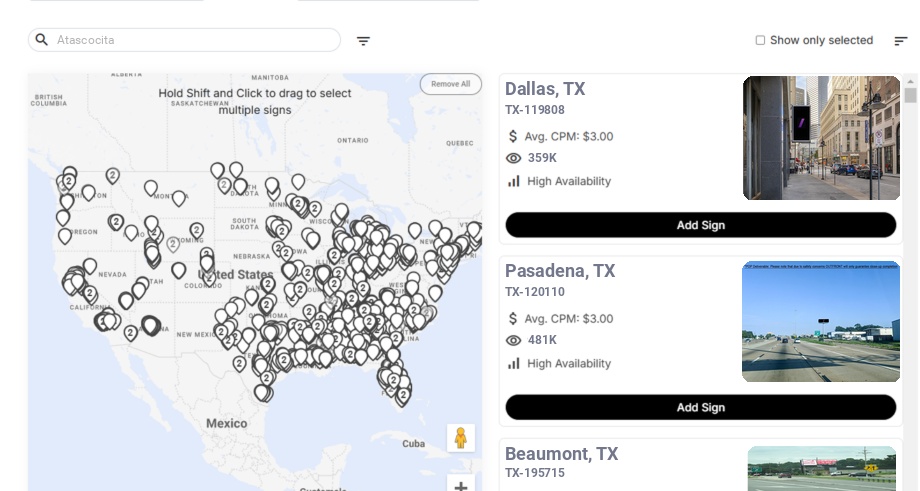



How much is a billboard in Atascocita?
Why Choose Blip for Billboard Advertising in Atascocita
Blip lets Atascocita brands launch fast on I-69 and FM 1960, reaching 30-minute commuters without traditional billboard hassles.
No contracts or minimums in Atascocita make it easy to test ads near Deerbrook Mall, Humble, and Kingwood, then shift budget to what works.
Use Blip dayparting in Atascocita to hit school-run, lunch, or after-work traffic along Atascocita Road and Beltway 8.
Track Atascocita campaigns in real time and adjust for airport rushes, storm weeks, or seasonal Lake Houston traffic patterns.
Blip's creative tools help Atascocita ads stand out for family households, Humble ISD traffic, and airport workers on the move.
Frequently Asked Questions About Billboard Advertising in Atascocita
How much does a billboard cost in Atascocita with Blip?
With Blip, billboard advertising in Atascocita can fit a wide range of budgets because you only pay when your ad actually displays. Each “blip” is a 7.5-to-10-second spot on a rotating digital billboard, starting at just $0.01 per display. Since pricing changes based on time of day, location, and advertiser demand, you get a flexible, pay-as-you-go option instead of a fixed upfront cost.
Where can I advertise with Blip in Atascocita to reach local drivers?
FM 1960, Atascocita Road, and the core suburban retail loop are some of the most practical corridors because they combine frequency with clear purchase intent. West Lake Houston Parkway is also important for connecting Atascocita with Kingwood and nearby residential clusters. For broader awareness, I-69, Beltway 8, and airport-adjacent routes reach larger volumes of commuters and travelers.
Why is Atascocita a strong billboard market?
Atascocita is a strong billboard market because it combines fast suburban growth, heavy roadway dependence, and constant movement between the Lake Houston area and the broader Houston economy. The community grew from 65,844 residents in 2010 to 88,174 in 2020, and more than 80% of commuters in Harris County drive. That creates a road-first audience that sees messages while commuting, shopping, traveling, and handling everyday family routines.
What kind of audience can Blip reach in Atascocita?
Atascocita has a large suburban family base, with about 48,000 students in Humble ISD creating a big ecosystem of parents, guardians, staff, and student activity traffic. The area also reaches commuters, airport and healthcare workers, and leisure visitors headed to places like Lake Houston Wilderness Park, Jesse H. Jones Park & Nature Center, and the Golf Club of Houston. That mix gives advertisers several distinct groups to target on the road.
When is the best time to run billboard ads in Atascocita?
Spring is one of the best windows for local billboard campaigns, and back-to-school plus early fall are also prime for frequency-based local advertising. Summer supports family attractions, HVAC services, home projects, and restaurants, while the final quarter is especially useful for retail, travel, healthcare, and service campaigns. Hurricane season from June 1 through November 30 also makes flexible, short creative valuable.
Do I need a contract to advertise with Blip in Atascocita?
No, Blip has no long-term contracts or minimum commitments. You can start, pause, or stop your campaign at any time.
How fast can I launch a billboard campaign with Blip in Atascocita?
You can have your campaign live in minutes. Create a free account, select your locations, set your budget, upload your design, and start running once approved.
Where can I advertise with Blip in Atascocita?
Blip has digital billboards in Atascocita. You can browse available locations on a map, choose the ones that fit your audience, and start advertising right away.
Still have questions? Launch a campaign in minutes — no contracts, no commitments.
Start Your CampaignAtascocita Billboard Advertising Guide
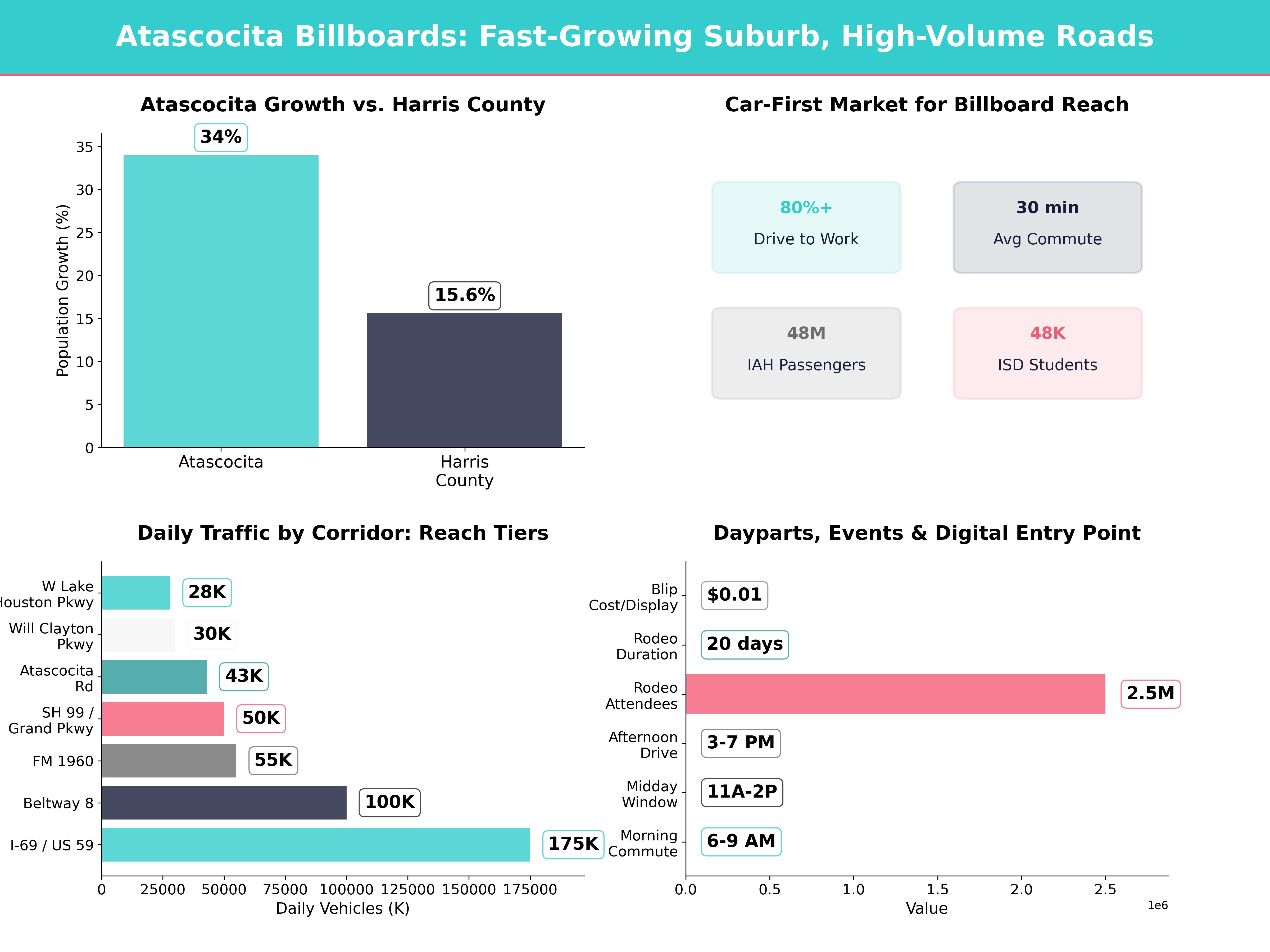
Atascocita is a strong billboard market because it combines fast suburban growth, heavy roadway dependence, and constant movement between the Lake Houston area Houston economy, with more than 80% of commuters in Harris County driving and average one-way commutes of about 30 minutes. The community counted 88,174 residents in 2020, up from 65,844 in 2010, which means it added 22,330 people in one decade, or roughly 34% growth. It also sits inside Harris County, where 4,731,145 people lived in 2020, and it connects naturally to Humble, Kingwood George Bush Intercontinental Airport
Atascocita Market Overview
Atascocita is not a small-town billboard play. It is a large, unincorporated suburban trade area in northeast Harris County with roughly 88,000 residents, and its business ecosystem is shaped less by a city hall and more by institutions like Harris County, Humble Independent School District, the Lake Houston Area Chamber of Commerce Houston Airports, healthcare, logistics, and retail.
A large and growing suburban audience
The headline demographic story is growth. Atascocita’s move from 65,844 residents in 2010 to 88,174 in 2020 shows that the area is attracting households, rooftops, and daily trips at a pace that matters for outdoor media. We should read that growth in context with Harris County’s 4.73 million residents, its gain of about 639,000 people, or roughly 15.6%, from 2010 to 2020, and the continued eastward and northward expansion of the Lake Houston area.
This is also a market where family households matter. Humble ISD serves about 48,000 students, which tells us immediately that school drop-off traffic, youth activities, healthcare decisions, tutoring, family dining, and home-service purchases all have a substantial audience base nearby. That family concentration makes billboard advertising especially useful for brands that depend on repeated local exposure rather than one-time impulse traffic.
What the economy looks like from an advertiser’s perspective
Atascocita benefits from several nearby economic engines rather than a single downtown. George Bush Intercontinental Airport 48.0 million passengers in 2023, and that creates constant flows of travelers, airport workers, hospitality staff, rental car users, and logistics traffic through the northeast side. To the south and west, Generation Park represents a planned 4,000-acre mixed-use employment district, while Deerbrook Mall adds a major regional retail node with roughly 1.2 million square feet of shopping space.
That kind of economic mix is good for billboard advertisers because it supports multiple campaign types at once. We can run branding for consumer businesses, recruiting for employers, traffic-driving creative for retail, and service-oriented messages for healthcare, real estate, education, and home improvement without exhausting the audience.
Why roads matter so much in Atascocita
Atascocita is part of a metro area where driving is the default behavior. In Harris County, commuting by car, truck, or van remains above 80%, and the average one-way commute is about 30 minutes. That matters because roadside media is not competing with rail platforms or dense pedestrian foot traffic here. It is meeting people where their attention already is, which is on the road between neighborhoods, schools, job centers, shopping centers, and the airport.
For us, that means digital billboards work best when we align creative with specific trip purposes. Morning messages can support commuter services, healthcare, coffee, and recruiting. Midday placements can support retail and restaurants. Afternoon and evening rotations can reach parents, errand traffic, and families heading to activities in Atascocita Humble, and Kingwood
Key Traffic Corridors Around Atascocita
Atascocita’s road network is what makes the market so practical for billboard buying. According to traffic count resources from the Texas Department of Transportation, several nearby corridors consistently carry very large daily volumes, especially where suburban neighborhoods feed into regional freeways.
I-69 and US 59 through Humble
The biggest regional spine is I-69, signed locally as US 59. Through the Humble area, TxDOT count stations commonly show mainline traffic in the 150,000 to 200,000-plus vehicles-per-day range, especially near the FM 1960 interchange. That makes this corridor one of the highest-value billboard routes for broad awareness in northeast Harris County.
This corridor is especially useful for several advertiser categories. Retailers and restaurants can use I-69 to intercept drivers headed toward Deerbrook Mall, major shopping centers, and Humble’s commercial strip. Healthcare providers can use the route to reach people traveling toward Memorial Hermann Northeast Hospital, HCA Houston Healthcare Kingwood, and surrounding clinics. Employers can use I-69 for recruiting because it catches both local residents and workers moving between the Lake Houston area, airport jobs, and central Houston.
FM 1960, Atascocita Road, and the core suburban retail loop
FM 1960 is the defining east-west commercial route for the area. Near Humble and east into Atascocita, TxDOT counts typically place many segments in roughly the 45,000 to 65,000-plus AADT range, with some local sections of Atascocita Road and FM 1960 East around 35,000 to 50,000 daily vehicles depending on the segment and the year counted.
For local advertisers, this is often the most practical corridor because it combines frequency with clear purchase intent. Drivers on FM 1960 are not just passing through. They are shopping, taking children to school or sports, visiting medical offices, eating out, and handling the everyday errands that make local businesses go.
We should prioritize this corridor for. Family entertainment, because parents are already in decision-making mode while circulating between neighborhoods and retail centers. Home services, because homeowners in established and newer subdivisions are repeatedly exposed to the same messages. Urgent care, dental, vision, and pediatric services, because proximity and recall matter more than deep branding narratives in this part of the market.
Beltway 8, Will Clayton Parkway, and airport access routes
The Sam Houston Tollway and the airport approach roads create a second major billboard opportunity. Around the north and east sides of George Bush Intercontinental Airport 80,000 to 120,000-plus AADT range. Will Clayton Parkway generally carries lower but still meaningful suburban traffic, often around 20,000 to 40,000 vehicles per day on key segments.
These roads are ideal when we want to reach travelers, hospitality customers, and workers tied to the airport ecosystem. Hotels, off-airport parking, and travel services benefit from airport-bound traffic that is already close to the point of purchase. B2B and recruiting campaigns work well here because airline, maintenance, warehouse, logistics, and service-sector workers use these roads daily. Professional services can also succeed, especially if the creative emphasizes convenience, fast access, or location near the airport and major freeway interchanges.
West Lake Houston Parkway and Kingwood connections
West Lake Houston Parkway is not as massive as I-69, but it is important because it links Atascocita with Kingwood 20,000 to 35,000 AADT range. That is plenty of exposure for businesses that want stronger geographic relevance rather than metro-wide reach.
This route is especially attractive for higher-consideration local categories. Financial services, real estate, elective healthcare, specialty retail, and home remodeling all benefit from the more neighborhood-oriented audience on this corridor.
SH 99 and the broader northeast growth arc
SH 99, the Grand Parkway, extends the market’s reach beyond Atascocita itself and into the broader northeast growth corridor. Nearby regional segments often record roughly 40,000 to 60,000-plus vehicles per day, and those numbers matter because SH 99 helps connect Atascocita-area households to emerging retail, residential, and employment districts farther north and east.
For advertisers, SH 99 is useful when we want to widen the funnel. Auto dealers, regional healthcare systems, colleges, major retailers, entertainment venues, and large employers can use this corridor to reach drivers before they narrow their destination choices.
Audience Segments We Can Reach in Atascocita
One of Atascocita’s strengths is audience variety. Even though it feels like a suburban family market, the road network actually lets us reach several distinct groups at once.
Daily commuters and reverse commuters
The first audience is the everyday commuter. Atascocita residents travel toward Humble, Kingwood Generation Park, Port Houston, the airport district, and central Houston job centers. Because the average commute is about 30 minutes, we have enough time and repetition to build memory over several exposures per week.
Recruiting advertisers should pay special attention here. Healthcare providers, trades employers, warehouse operators, schools, and service businesses can use commuter-facing boards to stay visible to workers who are already accustomed to driving to work rather than relying on transit.
Families, homeowners, and school-centered households
The second audience is the suburban family base. With about 48,000 students in Humble ISD, the district creates a huge daily ecosystem of parents, guardians, staff, coaches, and student activity traffic. Campaigns for childcare, orthodontics, family dining, tutoring, youth sports, dance, music lessons, and home services all fit naturally in this environment.
The residential pattern also supports strong frequency. In a market where many trips repeat on the same roads, even modest budgets can build familiarity if we stay visible near key everyday routes rather than spreading too thinly.
Students and continuing education audiences
Atascocita also connects to a meaningful education audience through Lone Star College-Kingwood, San Jacinto College
This matters for advertisers offering career training, healthcare education, banking, apartment communities, technology services, and affordable dining. The education audience is especially responsive when creative is timed around registration periods, graduation, and back-to-school transitions.
Airport, healthcare, and industrial workers
The airport and logistics audience is larger than many local businesses realize. With roughly 48 million annual passengers moving through IAH Port Houston, medical providers like Memorial Hermann Northeast Hospital, and HCA Houston Healthcare Kingwood, and we get a market where shift workers and essential workers form a dependable billboard audience.
For this segment, practical offers tend to outperform abstract branding. Fast hiring, same-day appointments, extended hours, close-to-home locations, and straightforward pricing usually connect better than broad slogans.
Leisure visitors and local tourism traffic
Atascocita is not a classic destination resort town, but it still has meaningful leisure traffic. Lake Houston Wilderness Park spans 4,786 acres, Jesse H. Jones Park & Nature Center covers 312 acres, and the Golf Club of Houston offers 36 holes. Family destinations like Old MacDonald’s Farm Humble Civic Center & Arena Complex Deerbrook Mall all contribute additional weekend and seasonal movement.
That leisure audience creates opportunities for restaurants, entertainment venues, hotels, attractions, event promotions, and retail campaigns that want to capture people while they are already in outing mode.
Seasonal Opportunities for Atascocita Billboard Campaigns
Timing matters in Atascocita because school schedules, weather, sports, and Houston-area events all change traffic patterns and purchase intent.
Spring in Atascocita and greater Houston
Spring is one of the best windows for local billboard campaigns. Families are active, youth sports are in session, and regional event traffic rises. The Houston Livestock Show and Rodeo 20 days and draws roughly 2.5 million attendees, and even though it takes place farther south in Houston, it still influences travel, entertainment spending, and brand competition across the metro. The Insperity Invitational Golf Club of Houston adds a notable 3-day burst of golf-related traffic and affluent audience attention in the Humble-Atascocita area.
Spring is especially strong for healthcare, home improvement, landscaping, outdoor recreation, higher education, and event marketing.
Summer family movement and park traffic
Summer changes the rhythm of the market. School is out, but roads remain active because families head to camps, parks, pools, shopping, and indoor entertainment. Outdoor recreation also matters more when destinations like Lake Houston Wilderness Park and area golf facilities are in heavier use.
This is a smart season for us to promote family attractions, HVAC services, home projects, restaurants, orthodontics, camps, and moving-related services. We should also remember that summer storms can change travel patterns quickly, so shorter, more direct creative usually performs better than cluttered layouts.
Back-to-school and fall routines
Late July, August, and early fall are prime for frequency-based local campaigns. School resumes, sports calendars restart, and regular commuting patterns snap back into place. That makes back-to-school one of the most efficient times to advertise anything tied to routines, including pediatric care, tutoring, fast casual dining, grocery-adjacent services, auto maintenance, and after-school programs.
Football season also matters. In Texas suburbs, Friday-night and weekend activity around high school athletics can lift traffic around neighborhood commercial corridors. Messaging that feels community-rooted tends to work well here.
Weather-sensitive scheduling
The Gulf Coast climate should influence campaign timing. Hurricane season runs from June 1 through November 30, and Atascocita-area advertisers should stay flexible during that 6-month window. We should use short copy, strong contrast, and fast-turn creative updates when heavy rain or storm coverage dominates attention.
Holiday retail and airport travel
The final quarter is especially useful for retail, travel, healthcare, and service campaigns. Airport traffic rises around Thanksgiving and the December holidays, local shopping activity accelerates, and many consumers enter a decision window for year-end spending, enrollment, and appointment scheduling. For businesses with an airport tie-in or strong giftable offering, this is often one of the highest-value periods of the year.
Billboard Design Tips for the Atascocita Market
Creative should feel like it belongs in the Lake Houston area. We do not need generic “Houston” imagery on every board. We need design that respects how Atascocita drivers actually move and what kinds of decisions they are making.
Use suburban-local cues, not downtown-centric cues
Atascocita is a family-forward, neighborhood-driven market. Creative that shows households, practical services, recreation, schools, or home life usually feels more natural than nightlife-heavy or ultra-urban imagery. References to “Atascocita,” “Lake Houston,” “Humble,” or “Kingwood” can immediately improve local relevance when they are accurate to the offer.
Color palettes can also lean local. Blues and greens often work well here because they echo the area’s lake, tree canopy, golf, and park identity. That approach fits especially well for healthcare, real estate, financial services, and lifestyle brands.
Design for road speed and multilane viewing
Drivers on I-69 and Beltway 8 may be moving at 60 to 70 mph in free-flow conditions, while major suburban arterials like FM 1960 often operate closer to 45 to 55 mph. That means we should simplify aggressively on freeway boards and keep local-arterial boards just as disciplined.
For high-speed locations, we generally want. One clear headline, not multiple competing messages. One memorable visual, not a collage. One action step, such as a short URL, brand name, or location cue.
If we are targeting FM 1960 or neighborhood connectors, we can sometimes support a slightly more local or offer-driven message, but simplicity still wins.
Match the creative to the corridor
Creative on airport and freeway routes should emphasize speed, convenience, and recognition. Creative on Atascocita’s retail corridors should emphasize relevance, proximity, family value, and everyday usefulness. Bilingual English-and-Spanish creative can also be effective in parts of the northeast Harris County trade area, especially for retail, healthcare, and service categories.
Regional Strategies Across Atascocita and the Lake Houston Area
A smart Atascocita billboard plan usually works better when we think in zones rather than treating the whole area as one homogeneous market.
Core Atascocita neighborhoods
In central Atascocita, we should focus on frequency and utility. This is where home services, dentists, urgent care, family restaurants, grocery-adjacent brands, fitness, and schools can stay present in the daily lives of nearby residents. Boards tied to FM 1960, Atascocita Road, and West Lake Houston Parkway are especially useful here.
Humble’s retail and freeway gateway
Humble gives us broader commercial intensity. Boards near I-69, FM 1960, and Deerbrook Mall are ideal for offers, grand openings, recruiting, and high-traffic retail campaigns. If the goal is volume, this is often the first zone we test.
Kingwood and the Lake Houston north side
Kingwood
Airport and Generation Park corridors
The airport zone is where we can layer consumer and business messaging. IAH Generation Park, and Beltway 8 support campaigns for logistics, staffing, hotels, business services, transportation, and traveler-oriented brands. This zone is particularly valuable when our objective is recruiting or regional visibility rather than hyperlocal store traffic.
Using Blip Tools in Atascocita
Blip works well in Atascocita because the market rewards timing, flexibility, and local testing. We do not need to guess blindly. We can start with a focused set of boards, watch performance, and then shift budget toward the routes and times that best match local behavior.
Dayparting around Atascocita routines
We can schedule around the moments that matter most. Morning windows like 6:00 to 9:00 a.m. are strong for commuting, coffee, healthcare, and recruiting. Midday windows like 11:00 a.m. to 2:00 p.m. fit restaurants, retail, and appointments. Afternoon and evening windows like 3:00 to 7:00 p.m. are ideal for family services, errands, and dinner decisions.
That kind of timing matters more in a suburban market than many advertisers expect because different roads serve different trip purposes throughout the day.
Testing creative by corridor
Blip makes it easy for us to run one message on I-69, another on FM 1960, and a third near the airport, then compare what happens. In Atascocita, that is valuable because recruiting creative, retail creative, and family-service creative often need different language even when the advertiser is the same brand.
We can also use Blip’s artwork tools to develop localized versions quickly. A board near the airport might emphasize convenience and speed, while a board deeper in Atascocita might emphasize neighborhood trust and proximity.
Staying efficient with flexible budgets
Because Blip uses short 7.5- to 10-second digital displays and pay-per-play buying that can start at $0.01 per display, we can build a practical test in Atascocita without committing to a large traditional package. That flexibility is useful in a market where weather, school timing, and event traffic can shift demand from one corridor to another.
Getting Started with Billboard Rental in Atascocita
The best way to rent a billboard in Atascocita is to begin with the business goal, not the map. If our goal is local store traffic, we should bias toward FM 1960, Atascocita Road, and neighborhood connectors. If our goal is broad awareness or recruiting, we should lean harder into I-69, Beltway 8, and airport-adjacent inventory.
How to choose the right Atascocita billboard locations
We should evaluate each location with a few practical questions. Are we trying to reach local families, regional commuters, or airport-oriented travelers? Does the board sit on an inbound route, an outbound route, or an all-day commercial corridor? Is the driver likely to be in a decision-making moment, such as shopping, commuting, or looking for services nearby?
In Atascocita, that distinction matters. A board with lower total traffic but better neighborhood alignment can outperform a higher-volume board if the advertiser depends on local conversion.
What to expect from the rental process
Traditional outdoor buying in the Houston area can be slow, package-driven, and harder to adjust once a campaign is live. Blip simplifies that process by letting us choose boards on a map, control timing, update artwork quickly, and monitor campaign activity without negotiating a long static arrangement.
That is especially valuable in a market like Atascocita, where we may want to pivot around school calendars, event weekends, storm periods, or hiring needs.
A practical launch plan for Atascocita advertisers
For many advertisers, the most effective starting point is simple. We can launch with a small cluster of boards across 2 to 4 strategic corridors, run 2 creative versions, and let the early performance tell us where to concentrate. Then we can add frequency in core Atascocita, broaden reach into Humble, or extend toward the airport and SH 99 depending on what the business needs.
If we stay focused on local travel behavior, keep the creative clean, and use Blip’s flexibility to match timing with real Atascocita routines, billboard advertising here can become a highly efficient way to build awareness, drive visits, and stay visible in one of northeast Harris County’s most active suburban markets.