Billboards in Arcola, TX
No Minimum Spend. No Long-Term Contracts. Just Results.
Trusted by Leading Brands


Billboard advertising
in Arcola has never been easier



How much is a billboard in Arcola?
Why Choose Blip for Billboard Advertising in Arcola
Blip lets you launch in Arcola fast and self-serve, reaching SH 6 and SH 288 commuters without calls or contracts.
Use Blip-optimized campaigns in Arcola to auto-place ads for Houston-bound drivers, Medical Center traffic, and local SH 6 shoppers.
Arcola budgets flex easily with Blip, so you can test FM 521 and FM 1462 during back-to-school or rodeo season, then scale what works.
Daypart your Arcola billboard for 6-9 a.m. and 4-7 p.m. to catch the daily Fort Bend commute and repeat drivers.
Track Arcola results in real time and shift spend as traffic changes on SH 6, SH 288, and the south Houston commute.
Blip's creative tools help Arcola ads stay sharp for fast freeway reads, with bold visuals built for commuters at speed.
Frequently Asked Questions About Billboard Advertising in Arcola
How much does a billboard cost in Arcola, Texas with Blip?
With Blip, you set a daily budget and only pay when your ad actually appears, with each 7.5-to-10-second display, or “blip,” starting at just $0.01 per display. Pricing changes based on time of day, location, and advertiser demand, so your cost is designed to stretch further and maximize reach for your budget. There are no minimums or contracts, so you can start small, adjust your spend anytime, and pause whenever you want.
Where can I advertise with Blip in Arcola, Texas?
Arcola’s billboard value comes from roadway function, especially State Highway 6, State Highway 288, FM 521, and FM 1462. The page says Arcola sits in a large trade area that reaches Fort Bend County, Brazoria County, and the south Houston commute shed. It also notes that boards can reach drivers heading toward Missouri City, Pearland, Manvel, the Texas Medical Center, and Downtown Houston.
Why is billboard advertising in Arcola, Texas effective even though the city is small?
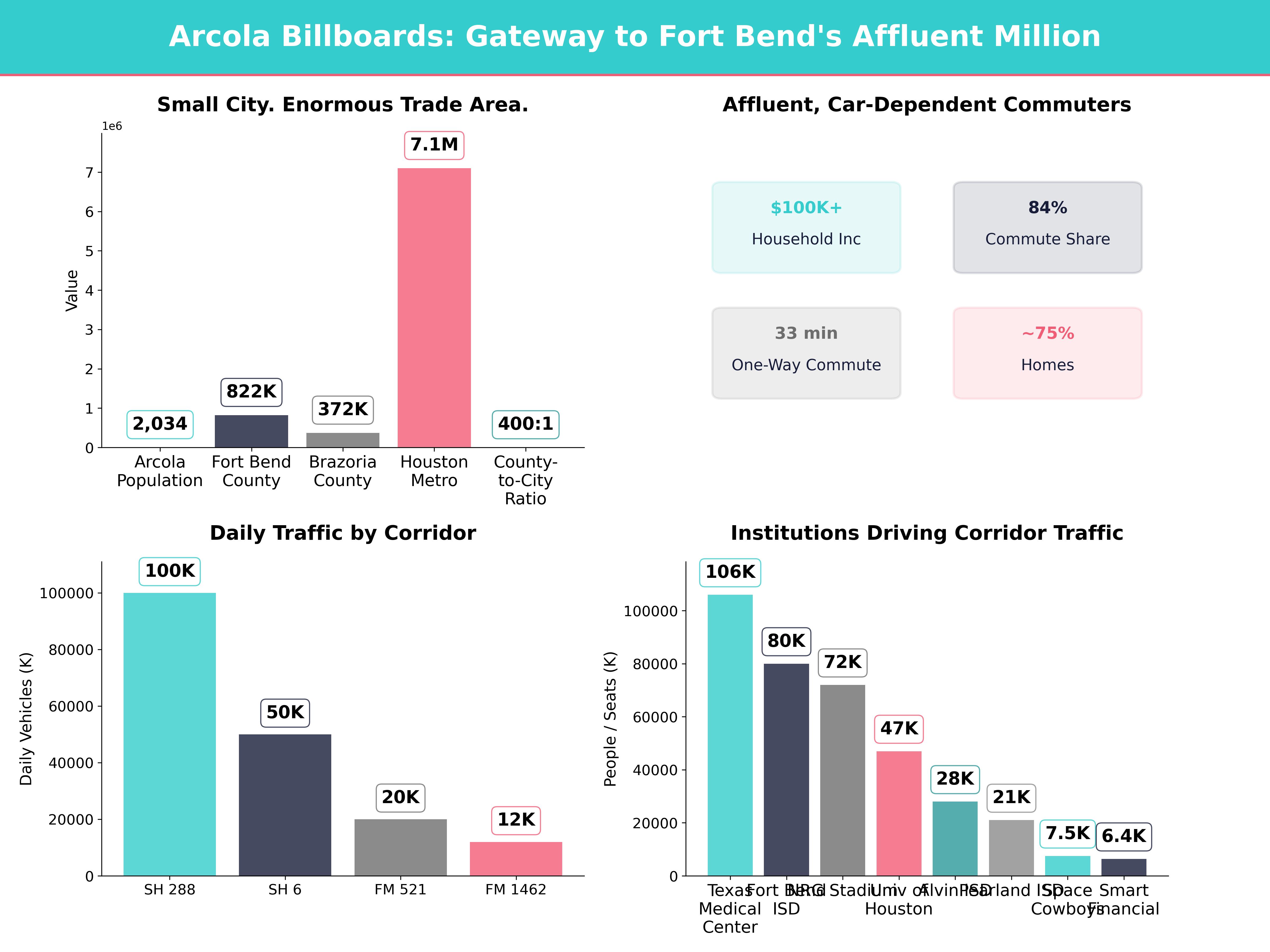
Arcola is a small city, but it sits in a very large advertising trade area where Fort Bend County, Brazoria County, and the south Houston commute shed overlap. The 2020 Census counted 2,034 residents in Arcola, yet it is surrounded by a county of 822,779 people, a neighboring county of 372,031 people, and a Houston metro of roughly 7.1 million. That mismatch between local population and regional traffic is exactly why billboard advertising can work so well here.
What kind of drivers and audiences does Blip reach in Arcola, Texas?
Arcola is described as a commuter market first, with about 84% of workers in Fort Bend County driving to work and an average one-way commute of roughly 33 minutes. The area also reaches families, healthcare workers, patients, students, young professionals, and eventgoers moving along the region’s major corridors. The page emphasizes that repeated exposure on the same routes is ideal for categories like insurance, healthcare, banking, home improvement, and automotive.
When is the best time to run billboard ads in Arcola, Texas?
The page says Arcola campaigns usually perform best when they respect the local calendar, with clear commuter rhythms, strong school-year patterns, and major Houston-area event spikes. Spring is one of the best broad-reach windows, and late July through September is prime time for family-frequency advertising because of back-to-school traffic. It also says holiday timing from early November through the end of December can be especially effective for urgency-driven campaigns.
Do I need a contract to advertise with Blip in Arcola?
No, Blip has no long-term contracts or minimum commitments. You can start, pause, or stop your campaign at any time.
How fast can I launch a billboard campaign with Blip in Arcola?
You can have your campaign live in minutes. Create a free account, select your locations, set your budget, upload your design, and start running once approved.
Where can I advertise with Blip in Arcola?
Blip has digital billboards in Arcola. You can browse available locations on a map, choose the ones that fit your audience, and start advertising right away.
Still have questions? Launch a campaign in minutes — no contracts, no commitments.
Start Your CampaignArcola Billboard Advertising Guide
Arcola Fort Bend County, Brazoria County Houston commute shed overlap. The 2020 Census counted 2,034 residents in Arcola, yet it is surrounded by a county of 822,779 people, a neighboring county of 372,031 people, and a Houston metro of roughly 7.1 million. That mismatch between local population and regional traffic is exactly why billboard advertising can work so well here, with a county-to-city population ratio of more than 400-to-1. We can reach drivers heading toward Missouri City Pearland Manvel Texas Medical Center, and Downtown Houston
Arcola Market Overview
Why Arcola matters beyond its city limits
We should think about Arcola as a corridor market, not just a city-limit market. The 2020 Census recorded Arcola at 2,034 residents, up from 1,642 in 2010, which was a gain of 23.9% in one decade. Over the same period, Fort Bend County grew from 585,375 to 822,779, which was a jump of 40.6%, and Brazoria County grew from 313,166 to 372,031, which was a gain of 18.8%. That countywide growth is what gives Arcola billboard inventory its value, because most impressions come from movement between communities rather than from one small municipality acting alone.
Regional planning from the Houston-Galveston Area Council treats this area as part of the larger Houston commuter system, and the long-run growth trends tracked by the Texas Demographic Center support that view. Arcola sits in the southern part of one of Texas’s fastest-growing suburban belts, with Fort Bend County adding 237,404 residents and Brazoria County adding 58,865 residents from 2010 to 2020, which means our boards can serve local businesses, regional brands, and commuter-driven campaigns at the same time.
What the numbers mean for billboard advertisers in Arcola
For advertisers, the most important number is not Arcola’s city population. The most important numbers are the size, income, and driving habits of the surrounding trade area. Fort Bend County’s median household income is above $100,000, about 84% of workers commute by car, and the average one-way commute is roughly 33 minutes. Roughly three-quarters of occupied housing units in the county are owner-occupied, which usually supports strong demand for healthcare, financial services, home improvement, insurance, education, and automotive categories.
We also benefit from the character of the county itself. Fort Bend County has no racial or ethnic majority, which means one-size-fits-all creative is rarely the smartest approach. We generally perform better when we build messages that feel inclusive, family-aware, and locally grounded. The Fort Bend Chamber of Commerce Greater Houston Partnership both reflect a business climate built on healthcare, logistics, retail, education, professional services, and regional mobility, and those are exactly the categories that tend to benefit from repeated roadside visibility.
Key Traffic Corridors Around Arcola
Arcola’s billboard value comes from roadway function. Some routes deliver broad regional reach, while others deliver high local intent. Traffic volumes vary by segment and count year, so we always confirm the latest maps from the Texas Department of Transportation before choosing individual boards, but the corridor patterns around Arcola are consistent.
State Highway 6 near Arcola
State Highway 6 is Arcola’s most important east-west spine. TxDOT traffic maps commonly place nearby SH 6 segments in the 40,000 to 60,000 AADT range, especially around Fresno, Missouri City Pearland
That pattern makes SH 6 especially useful when we want frequency. Home services, dentists, urgent care, grocery, quick-service restaurants, auto repair, banks, and real estate brands usually fit this corridor well. If our business serves households within a short drive, SH 6 often matters more than the higher-profile freeways because it captures people when they are already in shopping or decision mode.
State Highway 288 and the Houston-bound commute
State Highway 288 is the scale play. Around the SH 6 interchange and north toward Harris County, TxDOT counts are commonly above 100,000 AADT, and busier segments closer to the urban core rise higher still. This corridor feeds Pearland Texas Medical Center, NRG Park Downtown Houston
SH 288 is usually best for categories that need wider market reach. Hospitals, universities, entertainment venues, legal services, auto dealers, and region-wide retail campaigns tend to benefit here. Because many boards are read at roughly 55 to 70 mph, we keep messages especially concise on this corridor and prioritize one dominant takeaway.
FM 521 and Almeda Road local traffic
FM 521, also known as Almeda Road, is one of the most useful local connectors around Arcola. TxDOT counts on developed segments in this area generally fall in the 15,000 to 25,000 AADT band. That is lower than SH 288, but the audience is often more local, more repetitive, and more action-oriented.
We usually like FM 521 for neighborhood-serving businesses. Clinics, childcare, churches, tax services, convenience retail, and family restaurants can all benefit from boards on a route like this. When our goal is to make sure local residents see us several times each week, FM 521 can outperform a higher-volume freeway that delivers less neighborhood relevance.
FM 1462 and the southern growth connectors
FM 1462 matters because it channels development south and west toward Manvel 8,000 to 15,000 AADT, depending on the segment. Those numbers are smaller, but the traffic often includes exactly the people we want for growth-oriented campaigns: new movers, school-related households, contractors, and suburban service buyers.
This is a smart route for builders, mortgage lenders, internet providers, HVAC, pest control, landscaping, storage, and furniture retailers. When we are marketing to people shaping new household routines, the lower-volume growth connectors can be more valuable than the biggest roads in the region.
Fort Bend Parkway and western feeder routes
To the west, the Fort Bend County Toll Road Authority operates the Fort Bend Parkway Toll Road, which helps connect south Fort Bend commuters to the Sam Houston Tollway and central Houston. Even when our board is not on the toll road itself, nearby placements can benefit from the same commuter pattern. This is where we often support campaigns aimed at Missouri City Sugar Land
Audience Segments for Arcola Billboards
Arcola works best when we match the message to the movement. The area is not defined by one single audience. It is defined by overlapping audiences that share roads.
Daily commuters and repeat drivers
Arcola is a commuter market first. In Fort Bend County, about 84% of workers drive to work, and the average trip is about 33 minutes each way. That gives us repeated exposure to many of the same drivers on the same routes, which is ideal for categories that benefit from memory and trust. Insurance, legal services, healthcare, banking, home improvement, and automotive advertisers all tend to gain from that repetition.
The commute pattern also helps us think about timing. Morning boards can introduce a message, and afternoon boards can reinforce it when the driver is closer to decision-making mode. In a market like Arcola, frequency is often as important as pure reach.
Families in Fort Bend and Brazoria growth areas
Families are one of the strongest audience segments around Arcola because south Fort Bend and north Brazoria continue to add rooftops. Fort Bend ISD serves nearly 80,000 students, Pearland ISD enrolls more than 21,000, and Alvin ISD serves roughly 28,000 students. Together, that is roughly 129,000 K-12 students in the wider trade area.
That level of family concentration supports a wide range of billboard categories. Pediatric care, orthodontics, tutoring, childcare, youth sports, family dining, after-school programs, and seasonal retail all have a clear reason to advertise here. When we position boards near school-driven routes, we are often talking to the same households multiple times a week.
Healthcare workers, patients, and professional audiences
SH 288 gives Arcola unusual access to one of the biggest employment centers in Texas. The Texas Medical Center supports more than 106,000 employees and about 10 million patient encounters each year. That is a massive concentration of workers, visitors, and service demand, and many of those trips flow through the south side of the metro.
This audience is valuable well beyond healthcare itself. Apartments, hotels, urgent care, pharmacies, specialty clinics, legal services, and regional retail can all benefit from boards that intercept medical-center-bound traffic. We can also reach white-collar commuters headed to Downtown Houston
Students and young professionals
The south-Houston approach also gives us access to students and early-career professionals. University of Houston enrolls more than 47,000 students, and Texas Southern University adds more than 8,000 more in the same central-city orbit. We do not need to be next to campus to benefit from that audience. Routes that feed Houston from Arcola’s side of the region can still deliver meaningful impressions to students commuting, working part time, attending events, or visiting friends and family.
That makes Arcola-area boards useful for restaurants, entertainment, mobile apps, telecom, financial products, and student-oriented services. The key is to place those messages on the faster regional connectors rather than on the most neighborhood-specific roads.
Eventgoers and weekend leisure travelers
The entertainment map also helps Arcola more than many small Texas cities. NRG Stadium 72,220, Smart Financial Centre in Sugar Land 6,400, and the Sugar Land Space Cowboys play in a 7,500-seat ballpark. Weekend and evening travel to concerts, baseball, festivals, and dining districts creates strong opportunities for restaurants, attractions, ticketed events, and hospitality brands.
We can also benefit from year-round leisure draws such as Brazos Bend State Park, George Ranch Historical Park, Visit Pearland, and Visit Sugar Land
Seasonal and Timing Opportunities in Arcola
Arcola campaigns usually perform best when we respect the local calendar. This market has clear commuter rhythms, strong school-year patterns, and major Houston-area event spikes.
Spring in Arcola
Spring is one of the best broad-reach windows in this market. The Houston Livestock Show and Rodeo 20 days between late February and March at NRG Park 2.5 million attendees. Spring break also typically lands in March, which gives family-focused brands and local attractions another useful push period.
Spring is also home-shopping season. That matters around Arcola because SH 6, FM 521, and FM 1462 all touch communities where builders, lenders, realtors, and moving-related services can benefit from increased visibility. When we want to reach households who are actively changing where they live and how they spend, spring is one of the strongest times to be visible.
Summer in Arcola
Summer changes both behavior and creative. School is out, families make more leisure trips to Pearland Sugar Land June 1 through November 30, which creates clear windows for storm prep, roofing, flood restoration, insurance, generator, and hardware messaging.
In practical terms, summer is a great time to rotate creative quickly. A family-fun message can work early in the season, and a storm-readiness message can take over when forecasts become more active. Arcola’s location gives us a commuter audience that still responds to local needs.
Back-to-school and fall in Arcola
Late July through September is prime time for family-frequency advertising. With more than 120,000 students across Fort Bend ISD, Pearland ISD, and Alvin ISD, the back-to-school cycle is a major economic event for the wider Arcola trade area. Dentists, vision care, tutoring, school apparel, extracurricular programs, and quick-service restaurants all have a strong reason to advertise during this period.
Fall also brings football, band competitions, community events, and heavier suburban errand traffic. For neighborhood services, SH 6 and FM 521 often become even more valuable in this season because families settle back into predictable routines.
Holiday timing in Arcola
From early November through the end of December, our goal usually shifts from broad awareness to urgency. Retailers, restaurants, jewelry stores, toy sellers, and service brands often benefit from tighter, more concentrated bursts around pay periods, Black Friday week, and the final 10 to 14 days before Christmas. January can also be productive because New Year planning tends to lift demand for gyms, tax services, legal services, and home-improvement projects.
Arcola Billboard Design Tips
The right creative in Arcola should feel local, readable, and culturally aware. This is not a place where generic national creative always does its best work.
Design for Arcola’s diverse suburban audience
Arcola sits where Fort Bend diversity, Pearland growth, and Houston commuting overlap. We usually get better results with inclusive visuals, plain-spoken offers, and imagery that reflects families, professionals, homeowners, and multicultural neighborhoods. In some categories, it is smarter to run two versions of creative than to overload one board. An English-first board on SH 288 and a Spanish-friendly variant on a neighborhood-heavy route like FM 521 can be more effective than one cluttered bilingual design.
We also like creative that feels anchored to the region. References to Pearland Missouri City Sugar Land Medical Center can make a board feel immediately relevant.
Keep Arcola freeway messaging short
On SH 288 and SH 6, drivers are moving quickly, and glance time is limited. We usually want one dominant headline, one offer, and one action. A short URL, an exit reference, or a simple directional cue works better than multiple selling points. If we need to explain too much, we usually need a different board or a different creative approach.
Directional relevance is especially powerful in this market. Messages such as “Next Exit on SH 6,” “Minutes from Pearland,” or “On the Way to the Medical Center” match how people actually think while driving these roads.
Use visuals that fit local purchase behavior
For home services, healthcare, and neighborhood retail, local specificity usually beats abstract brand imagery. Product shots, family-centered scenes, before-and-after visuals, and recognizable regional cues tend to perform better than creative that could belong anywhere in the country. Because southeast Texas light can be harsh and weather can change quickly, we also favor high-contrast color palettes, thick fonts, and simple compositions that stay readable in midday sun and on rainy evenings.
Regional Strategies Around Arcola
A strong Arcola campaign usually divides the market into sub-areas. We do not need the same message, or even the same objective, on every route.
Arcola and Fresno
In Arcola and nearby Fresno, we are usually not chasing tourist volume. We are building repeated local familiarity. That makes these placements especially useful for dentists, clinics, childcare, gyms, churches, neighborhood restaurants, and community-oriented campaigns. We often prioritize consistency here, because repeated weekly exposure can matter more than a single large traffic spike.
Missouri City and Sugar Land
To the northwest, Missouri City Sugar Land 74,000 residents in Missouri City and 111,000 in Sugar Land. We generally position premium healthcare, financial services, elective medical, home remodeling, and professional services more aggressively on that side of the market. These boards can also support traffic tied to Smart Financial Centre, Sugar Land Town Square, and the Sugar Land Space Cowboys.
Pearland and the SH 288 corridor
To the east, Pearland 125,828 in the 2020 Census) and SH 288 are where we go for scale. Visit Pearland and the Pearland Economic Development Corporation both position the city as a major regional shopping and business hub, and our billboard strategy should reflect that. This is the best zone for broad awareness, healthcare, university recruitment, entertainment pushes, and regional retail campaigns that need one buy to touch Brazoria, Fort Bend, and Harris County traffic.
Manvel and the southward growth belt
South of Arcola, Manvel
Using Blip in Arcola
Blip works especially well in Arcola because this market has several different route types within a compact geography. We can test broad reach, local frequency, and time-of-day strategies without locking ourselves into one traditional package.
When Blip-optimized campaigns make sense in Arcola
Blip-optimized campaigns are useful when our goal is regional coverage rather than one tightly defined neighborhood. In Arcola, that often means letting the platform spread budget across SH 6, SH 288, and nearby south-Houston inventory so we can learn which corridor is actually driving the best response. This is a smart starting point for healthcare systems, colleges, event marketers, and regional retailers.
When manual Arcola campaigns make more sense
Manual campaigns work better when our business depends on a specific drive-time ring. If we only want households within 5 to 10 miles of Arcola, or if we want to focus on one storefront in Pearland Missouri City Manvel
How we can use dayparting and creative rotation locally
Because Arcola is commuter-heavy, dayparting is one of the simplest ways to improve efficiency. We often emphasize 6 to 9 a.m. and 4 to 7 p.m. on weekdays for healthcare, legal services, recruiting, and professional services, then shift more weight to afternoons, evenings, and weekends for restaurants, attractions, and event marketing. Real-time reporting helps us see whether SH 288 is delivering broader awareness while SH 6 or FM 521 is driving more localized action.
Creative rotation is equally helpful here. We can run a rodeo-themed board in March, a storm-readiness board in August, a back-to-school board in late summer, and a holiday urgency board in December without rebuilding the whole strategy. When we need fast variants, Blip’s artwork tools also make it easier to produce seasonal, language-specific, or submarket-specific creative for Arcola.
Getting Started with Billboard Rental in Arcola
Renting a billboard in Arcola is usually less about the city itself and more about choosing the right route for the audience we want. When we stay focused on movement patterns, the market becomes much easier to evaluate.
Start with the real Arcola trade area
The biggest mistake we can make is treating Arcola like an isolated town. The real market is the flow between Arcola, Fresno, Missouri City Pearland Manvel
Evaluate each board by route logic
When we compare Arcola-area boards, we usually look at four practical factors. We first confirm the direction of travel, because inbound-to-Houston and outbound-to-home audiences behave differently. We then check whether the board appears before the decision point, such as an exit, a shopping-center entrance, or a turn toward a clinic. Next, we match the road speed to the message complexity. Finally, we compare the surrounding land use, because a medical message near commuter routes can perform very differently from a restaurant message near entertainment traffic.
Launch, learn, and scale in Arcola
Arcola is ideal for test-and-learn billboard buying because the corridor mix is so varied. We can start with a 2 to 4 week test on a few boards, watch performance in real time, and then shift spend toward the routes that best match our goals. Traditional billboard buying often comes with long commitments, fixed packages, and slower creative changes. Blip simplifies the Arcola process because we can launch quickly, make adjustments as data comes in, and expand into nearby boards only after we know what is working.
That flexibility matters in a place like Arcola, where one campaign may need local frequency on FM 521 while another needs broad commuter reach on SH 288. When we align our route, timing, and creative with how people actually move through south Fort Bend and nearby Brazoria County, billboard rental in Arcola can deliver far more value than the city’s modest population might suggest.