Billboards in Dayton, TX
No Minimum Spend. No Long-Term Contracts. Just Results.
Trusted by Leading Brands


Billboard advertising
in Dayton has never been easier
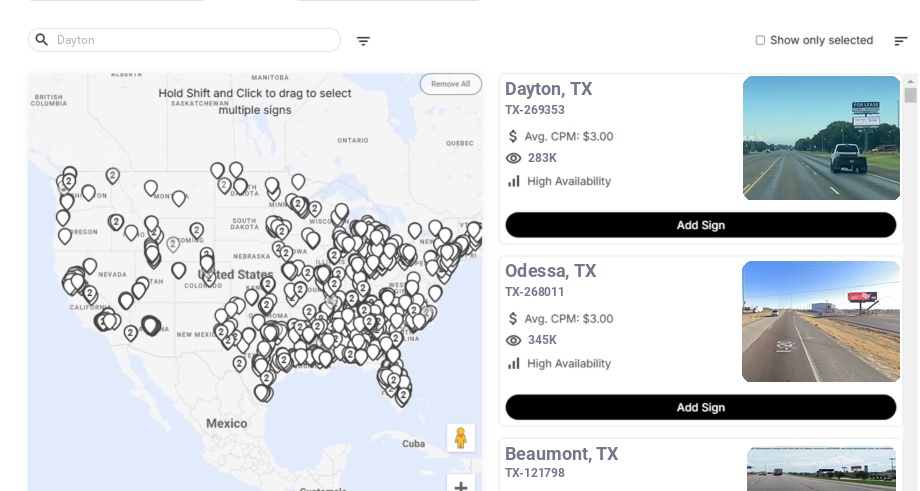



How much is a billboard in Dayton?
Why Choose Blip for Billboard Advertising in Dayton
Blip in Dayton lets you launch fast on U.S. 90 or SH 146, reaching car-heavy commuters without the usual buying hassle.
Dayton businesses can set flexible budgets and only pay when ads blip, ideal for testing routes tied to Liberty County and east Houston growth.
Use dayparting in Dayton to hit 6-9 a.m. school and work traffic, then 3-7 p.m. return trips on U.S. 90 and FM 1960.
No contracts means Dayton advertisers can pause or scale around summer heat, back-to-school, or hurricane season demand.
Track Dayton campaign results in real time and shift spend toward the routes reaching industrial workers on SH 146 or family shoppers on U.S. 90.
Blip’s creative tools help Dayton ads stay bold and simple for drivers moving at speed across the city’s busy highway corridors.
Frequently Asked Questions About Billboard Advertising in Dayton
How much does a billboard cost in Dayton, Texas with Blip?
With Blip, billboard advertising in Dayton can fit a range of budgets because you only pay when your ad actually appears. Each “blip” is a 7.5-to-10-second display on a rotating digital billboard, and pricing starts at just $0.01 per display. You set a daily budget, and Blip’s algorithm uses it to bid for available ad slots, helping maximize your reach based on time of day, location, and advertiser demand.
Where can I advertise with Blip in Dayton, Texas?
In Dayton, the most important corridors include U.S. 90, State Highway 146, FM 1960, and State Highway 321. U.S. 90 is the backbone route for Dayton advertising and commonly sees about 18,000 to 28,000 AADT depending on the segment. SH 146 is also important because it links Dayton south toward Mont Belvieu and Baytown, while FM 1960 helps bridge Dayton with the Lake Houston side of the market.
Why is Dayton, Texas a good market for Blip billboard ads?
Dayton gives advertisers a strong billboard market because it combines small-city familiarity with access to one of the nation’s largest metro economies. The city grew from 7,242 residents in 2010 to 8,777 in 2020, and Liberty County reached 91,628 residents. Roughly 94% of workers in the county commute by car, truck, or van, which makes repeated roadside exposure especially valuable.
What kind of audience can I reach in Dayton, Texas with Blip?
Dayton billboard campaigns can reach commuters, families, industrial workers, and weekend travelers. The area sits close to major industrial zones, while Dayton ISD serves roughly 8,000 students, creating a steady audience of parents, grandparents, educators, and teen drivers. The market also benefits from regional leisure movement across the east Houston corridor, which adds more travel and repeat exposure.
When is the best time to run billboard ads in Dayton, Texas?
Spring is a strong advertising window in Dayton because the weather improves, home-service demand rises, and regional event traffic builds. Summer is also important since average highs regularly rise above 90°F from June through September, making HVAC and generator campaigns especially relevant. Back-to-school season in August and storm season from June 1 through November 30 create additional timely opportunities.
Do I need a contract to advertise with Blip in Dayton?
No, Blip has no long-term contracts or minimum commitments. You can start, pause, or stop your campaign at any time.
How fast can I launch a billboard campaign with Blip in Dayton?
You can have your campaign live in minutes. Create a free account, select your locations, set your budget, upload your design, and start running once approved.
Where can I advertise with Blip in Dayton?
Blip has digital billboards in Dayton. You can browse available locations on a map, choose the ones that fit your audience, and start advertising right away.
Still have questions? Launch a campaign in minutes — no contracts, no commitments.
Start Your CampaignDayton Billboard Advertising Guide
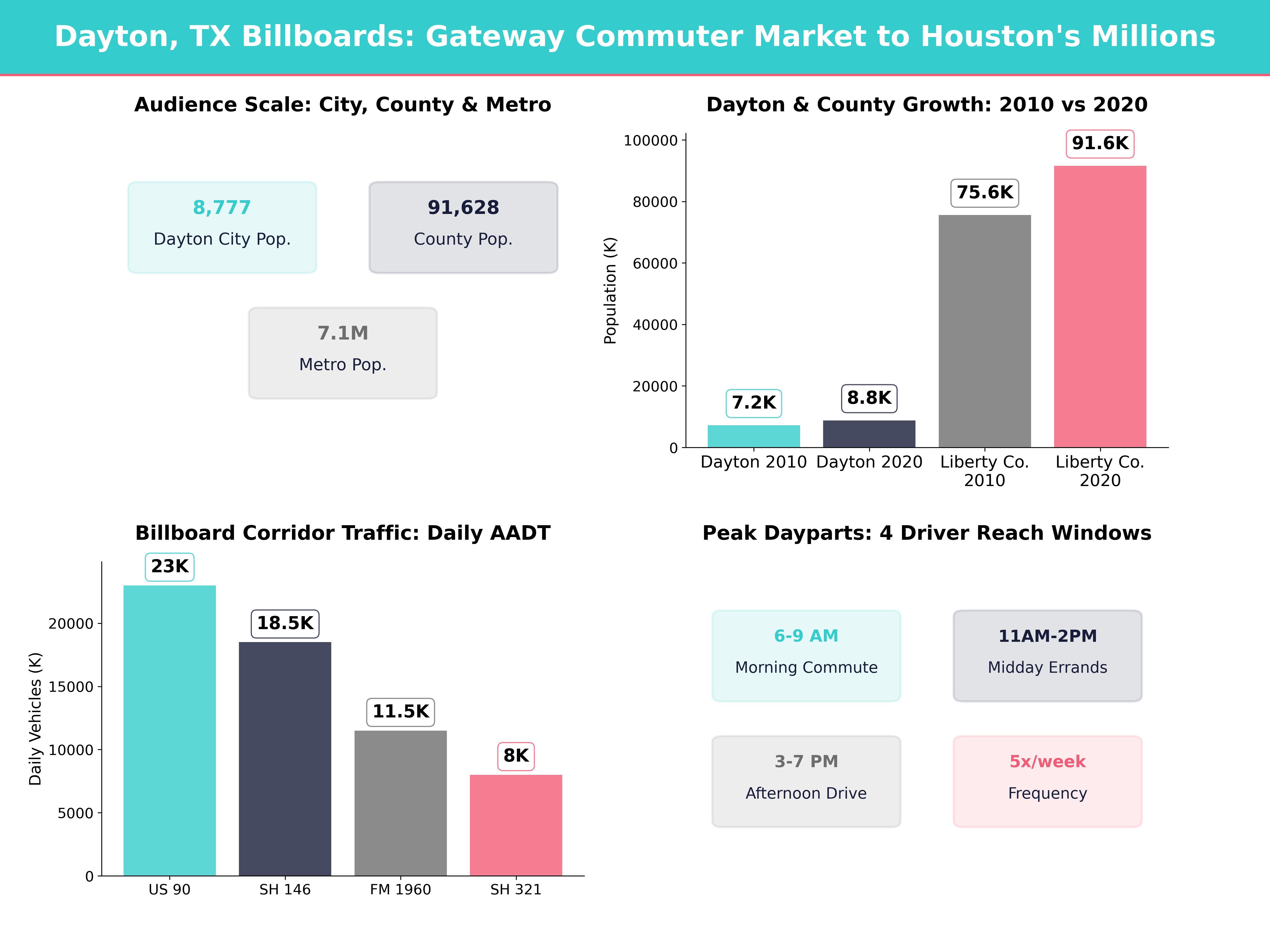
Dayton, Texas gives us a strong billboard market because it combines small-city familiarity with access to one of the nation’s largest metro economies. Dayton counted 8,777 residents in the 2020 Census, but the real advertising trade area is much larger because Liberty County reached 91,628 residents, and the Houston-The Woodlands-Sugar Land metro stood at 7,122,240. We also benefit from a highly vehicle-oriented market, with roughly 94% of workers traveling by car, truck, or van, which makes repeated roadside exposure especially valuable. Add in steady east-of-Houston growth, with Dayton up 21.2% from 2010 to 2020 and Liberty County up 21.1%, industrial employment nearby, and warm-weather weekend travel, and Dayton becomes a smart place to build efficient digital billboard campaigns.
Dayton Market Overview for Billboard Advertisers
Dayton’s growth story is bigger than the city line
Dayton is not just a small standalone town. It sits inside a fast-growing east Houston growth belt that includes Liberty County, Baytown Mont Belvieu Houston-Galveston Area Council region.
The 2020 Census shows that Dayton grew from 7,242 residents in 2010 to 8,777 in 2020. That was a gain of 1,535 people, or 21.2% in one decade. Over the same period, Liberty County grew from 75,643 to 91,628, which was an increase of 15,985 residents, or 21.1%.
Those are meaningful numbers for billboard advertisers because growth creates three reliable demand patterns:
- New household spending increases demand for grocery, dining, healthcare, banking, insurance, and home services.
- Longer commute networks create more recurring road exposure as residents travel between Dayton, west Houston suburbs, and industrial job centers.
- Retail leakage opportunities open up for businesses that want to pull consumers into a nearby store, clinic, dealership, or office.
Dayton’s car-dependent lifestyle favors out-of-home media
For billboard strategy, the most important behavioral fact is that Liberty County is overwhelmingly vehicle-driven. American Community Survey data show that roughly 94% of workers in the county commute by car, truck, or van. That means we are not relying on foot traffic or transit impressions the way we might in a dense downtown market.
In practical terms, this shapes how we buy media in Dayton:
- We should prioritize boards on repeat-use commuter routes, not just destination roads.
- We should value message simplicity because many impressions happen at driving speed.
- We should think in terms of frequency over time, because weekday commuters often see the same route 5 days a week.
That commute pattern is especially useful for advertisers in categories that benefit from repetition, including family medicine, urgent care, legal services, HVAC, plumbing, auto repair, financial services, restaurants, churches, schools, and local retail.
The Dayton economy is tied to both households and industry
Dayton’s local economy blends family spending with industrial employment. To the south and southwest, Baytown Mont Belvieu Port Houston anchor a major energy, logistics, and manufacturing corridor. To the west, the Houston metro supplies additional commuting and purchasing power. To the east and north, Liberty County brings in rural households, landowners, small businesses, and tradespeople.
That mixed economy matters because it gives us multiple advertising audiences in one geography:
- We can target consumer households with offers tied to schools, healthcare, retail, and everyday services.
- We can target blue-collar and industrial workers with hiring, safety, workwear, automotive, and B2B service messaging.
- We can target regional shoppers and visitors moving between Dayton and larger hubs.
Key Traffic Corridors for Dayton Billboard Campaigns
Texas Department of Transportation traffic data make it clear that Dayton’s reach depends on a handful of corridors. These routes do more than move local residents. They connect the city to Houston, Liberty, Baytown, Mont Belvieu, and the wider east Texas trade area.
U.S. 90 in Dayton
U.S. 90 is the backbone route for Dayton advertising. TxDOT traffic maps generally place U.S. 90 segments through and just west of Dayton in the 18,000 to 28,000 AADT range, depending on the exact segment.
This corridor is especially valuable because it captures several behaviors at once:
- Westbound commuters heading toward Crosby, Huffman, and the Houston side of the metro.
- Local Dayton errands tied to shopping, schools, food, and services.
- Regional drivers moving between Dayton, Liberty County communities, and the broader U.S. 90 corridor.
We usually like U.S. 90 for advertisers that need broad consumer reach, including:
- Quick-service restaurants and convenience stores, because drivers make frequent route-based decisions.
- Healthcare providers, because repeated daily exposure can build trust before a patient needs care.
- Retail stores and entertainment venues, because U.S. 90 supports both weekday and weekend trip planning.
State Highway 146 near Dayton
SH 146 is one of the most important industrial and regional connectors in the Dayton area. TxDOT counts around Dayton commonly fall in the 15,000 to 22,000 AADT band.
This route matters because it links Dayton south toward Mont Belvieu Baytown
- Workforce recruitment campaigns, because industrial and logistics workers use the route regularly.
- Auto dealers, tire shops, truck services, and insurance brands, because the audience includes heavy drivers and work vehicles.
- B2B suppliers, because the corridor connects small businesses to larger industrial centers.
If our goal is to reach people who split their time between residential Dayton and industrial employment centers, SH 146 is often one of the best directional buys.
FM 1960 toward Huffman and the west side
FM 1960 is a useful feeder and expansion route for campaigns that want to bridge Dayton with the Lake Houston side of the market. Depending on location, TxDOT volumes often run about 8,000 to 15,000 AADT on the eastern stretches relevant to Dayton.
This corridor is a smart choice when we want to reach:
- Families and homeowners traveling toward west-side shopping and services.
- Weekend recreation traffic tied to parks, lakes, and leisure destinations.
- Home-service buyers who often respond well to repeated suburban-exurban commute exposure.
FM 1960 often works particularly well for roofing, HVAC, pest control, urgent care, dental, childcare, and family entertainment offers.
State Highway 321 and Liberty County connectors
SH 321 is not as heavy as U.S. 90 or SH 146, but it still matters for northern movement into the county. TxDOT counts on relevant segments commonly sit around 6,000 to 10,000 AADT.
This route can be useful when we want to narrow our message to more rural and trade-oriented audiences, including:
- Farm and ranch suppliers, because the audience includes landowners and equipment users.
- Truck dealers and service businesses, because the road supports practical work travel.
- Legal, medical, and financial services, because smaller-market residents often travel into Dayton for appointments and errands.
Dayton Audience Segments We Can Reach
Commuters and mobile households in Dayton
Commuters are the core billboard audience in Dayton. Because 94% of county workers rely on personal vehicles, our campaigns benefit from daily repetition in a way that many online channels cannot match.
This is why commuter-focused messaging performs well in Dayton:
- We can build familiarity with brands that are not yet household names.
- We can reinforce location-based offers such as “on U.S. 90,” “off 146,” or “minutes from Dayton.”
- We can reach decision-makers during routine travel, when they are mentally mapping errands, meals, and appointments.
For many local advertisers, the goal is not a single dramatic conversion. The goal is to become the first brand people remember after 10 or 20 routine drive-bys.
Families, parents, and students around Dayton
Dayton is a family market, and Dayton ISD is a major anchor. The district serves roughly 8,000 students, which creates a steady audience of parents, grandparents, educators, teen drivers, and after-school shoppers.
That makes Dayton billboards especially useful for:
- Pediatric, dental, orthodontic, and urgent care providers that want household recognition.
- Restaurants, snack brands, and family entertainment businesses that benefit from afternoon and early-evening travel.
- Colleges and training providers, including Lee College and the Lee College Education Center at Dayton
If we are targeting family decision-makers, the best timing often clusters around school commute hours, late afternoon activities, and Friday traffic.
Industrial workers and tradespeople in the Dayton area
Dayton sits close enough to major industrial zones that we should not treat it as purely residential. Southbound traffic toward Mont Belvieu Baytown Port Houston logistics ecosystem gives us access to workers in energy, transportation, warehousing, and construction.
This audience responds well to practical billboard categories such as:
- Hiring and recruiting, especially for CDL, skilled trades, plant support, and field service roles.
- Equipment, workwear, and industrial supply messaging, especially when the offer is immediate and concrete.
- Banks, insurers, and healthcare providers, because industrial workers and their families still make everyday consumer decisions close to home.
Weekend travelers and regional leisure traffic
Dayton is not a pure tourism town, but it benefits from leisure movement across the east Houston corridor. Nearby outdoor assets such as Lake Houston Wilderness Park, which spans 4,786 acres, help create warm-weather and weekend trip traffic.
Seasonal travel across the broader Houston area also matters. The Houston Livestock Show and Rodeo 2,533,656 in 2024, which shows how strong regional event-driven mobility can be.
For advertisers, that means we can use Dayton-area boards to reach:
- Weekend diners and retailers looking for pass-through traffic.
- Recreation, auto, and outdoor brands targeting drivers headed to parks, camps, or rural properties.
- Event marketers who want to capture the east-side portion of the Houston travel shed.
Seasonal and Timing Opportunities in Dayton
Spring in Dayton
Spring is a strong advertising window in Dayton because the weather improves, home-service demand rises, and regional event traffic builds. We typically see good fit in this season for:
- Landscaping, lawn care, pest control, and outdoor retail, because homeowners start acting on deferred projects.
- Real estate, mortgage, and moving services, because spring is a common home-shopping period.
- Retail and dining brands, because spring weekends generate more discretionary travel.
Regional event energy also helps. When the Houston Livestock Show and Rodeo
Summer in Dayton
Summer is practical, not theoretical, in Dayton. Average highs regularly rise above 90°F from June through September, so heat-related messaging becomes highly relevant.
This is one of the best times to run:
- HVAC and generator campaigns, because the problem is immediate and expensive.
- Cold beverage, convenience, and restaurant offers, because travelers make fast weather-driven choices.
- Outdoor recreation, truck, and family activity advertising, because school break expands weekday movement patterns.
Summer is also when simple, high-contrast creative matters most. Harsh sunlight and windshield glare punish cluttered designs.
Back-to-school and fall in Dayton
Back-to-school season is one of the most dependable local advertising windows. Dayton ISD, Barbers Hill ISD, Goose Creek CISD, and nearby colleges all push families back into routine by August.
We usually recommend this period for:
- Healthcare, dental, vision, and immunization-related messaging, because families are scheduling appointments.
- Restaurants, tutoring, childcare, and youth programs, because parents are rebuilding weekly routines.
- Retail, apparel, and telecom brands, because household spending rises with the school calendar.
Fall also brings football, community events, and stronger weekend local pride, which gives us a good environment for community-based brands and local sponsorship creative.
Storm season and holiday timing in Dayton
The Gulf Coast weather calendar matters in Dayton. Hurricane season runs from June 1 through November 30, so preparedness messaging can be very timely.
That creates strong windows for:
- Roofing, restoration, insurance, generator, and hardware advertisers, because urgency increases before and after storms.
- Healthcare and pharmacy brands, because preparedness messaging often pairs well with convenience and trust.
- Holiday retail and dining brands, because November and December shift attention toward gifting, gatherings, and travel.
Billboard Design Tips for the Dayton, Texas Market
Use local road language and directional cues
In Dayton, local specificity usually beats abstract branding. Drivers know the importance of U.S. 90, SH 146, FM 1960, and the routes into Liberty County. When appropriate, we should use that familiarity.
Good local creative often includes:
- Directional language, such as “On U.S. 90,” “South on 146,” or “Minutes from Dayton.”
- Distance cues, such as “Next exit,” “2 miles ahead,” or “Near downtown Dayton.”
- Town-name anchors, such as Dayton, Liberty, Baytown, or Mont Belvieu, when the audience spans more than one community.
Those cues reduce mental effort, which is important at driving speed.
Design for working families and working vehicles
Dayton’s audience includes commuters, parents, contractors, industrial workers, and small-business owners. Creative that feels too polished, too urban, or too abstract can miss the tone of the market.
We generally see stronger local fit when creative uses:
- Clear pricing or a concrete offer, because practical shoppers respond to immediate value.
- Direct service language, because categories like healthcare, auto, insurance, and home repair benefit from clarity.
- Imagery tied to real local life, such as family scenes, pickups, jobsite visuals, home exteriors, or outdoor recreation.
If a business serves both English- and Spanish-speaking households, bilingual or bicultural creative can be especially effective in this part of Texas.
Use contrast that survives sun, rain, and speed
Dayton’s bright sun, summer glare, and storm-season weather make readability essential. We should favor high-contrast combinations, large text, and a single dominant idea.
For this market, we usually recommend:
- Bold light-on-dark or dark-on-light palettes that stay legible in midday brightness.
- One headline and one action, because drivers may only have a few seconds.
- A memorable phone number, short URL, or location cue, instead of too many details.
Regional Strategies Around Dayton
Dayton core and in-town traffic
For boards closest to Dayton’s commercial core, we usually focus on immediate-action advertisers. This is where local relevance matters most.
Best-fit categories include:
- Restaurants, banks, pharmacies, and clinics, because they benefit from short driving distance.
- Auto repair, tire, and oil-change shops, because drivers can act quickly after exposure.
- Churches, schools, and community organizations, because geographic familiarity is already high.
In-town Dayton creative should feel local, direct, and specific.
Westbound strategy from Dayton toward Huffman and Houston
Dayton sits roughly 35 to 40 miles from downtown Houston, so westbound messaging can be used to connect a local campaign to a much larger commuter economy. This strategy works well when we want more than small-city reach.
We usually like westbound boards for:
- Regional healthcare systems and colleges, because they serve a wide catchment area.
- Retail and entertainment destinations, because they can pull Dayton-area consumers outward.
- Service-area businesses, because many residential customers move between Dayton and the west side.
Southbound strategy toward Mont Belvieu and Baytown
Dayton is about 20 miles from Mont Belvieu 30 miles from Baytown
We usually recommend this regional strategy for:
- Recruiting campaigns, because workers often travel across city lines.
- Industrial suppliers and B2B services, because route relevance matters.
- Hospitals, specialty care, and legal services, because people often travel south for larger providers.
East and north strategy into Liberty County
Liberty 10 miles east of Dayton, and the wider county brings in rural households with different purchase priorities than inner-metro suburbs. This is where we can lean into practical needs, land ownership, and durable goods.
This strategy often fits:
- Farm, ranch, and outdoor businesses.
- Manufactured housing, land sales, and home-improvement brands.
- Truck, trailer, and equipment advertisers.
Using Blip Tools for Dayton Campaigns
Build Dayton campaigns around corridor testing
In Dayton, location selection matters more than sheer market size. We usually get the best learning when we test 2 to 3 corridor strategies instead of treating the entire area as one audience.
For example, we might compare:
- A U.S. 90 buy for broad household reach.
- A SH 146 buy for industrial and workforce reach.
- A FM 1960 or county connector buy for family and weekend travel.
That kind of split tells us quickly where the strongest response is coming from.
Daypart around how Dayton actually moves
Because Dayton is so vehicle-oriented, timing matters. We can use Blip’s scheduling tools to emphasize the windows when our audience is most likely to be on the road.
For many advertisers, the most useful starting points are:
- 6 to 9 a.m. for work and school commute visibility.
- 11 a.m. to 2 p.m. for lunch, errand, and appointment traffic.
- 3 to 7 p.m. for school pickup, after-work, and dinner decisions.
- Weekend late mornings and afternoons for leisure, shopping, and family outings.
We do not need to buy every hour equally if Dayton’s audience is clearly concentrated in a few daily windows.
Use multiple creative versions for Dayton sub-audiences
We often see better results when we rotate 3 creative variations instead of forcing one message to do everything.
A smart Dayton setup might include:
- One version tailored to commuters.
- One version tailored to families.
- One version tailored to industrial workers or weekend travelers.
Blip’s artwork and analytics tools make it much easier to adapt copy and learn from real delivery instead of waiting through a long traditional contract cycle.
Getting Started with Billboard Rental in Dayton
Start with the goal, not the board
Before we rent a billboard in Dayton, we should define what success looks like. A campaign built for store visits will not be mapped the same way as a campaign built for recruiting, fundraising, or general awareness.
We usually start with one of these questions:
- Do we want the highest reach across Dayton commuters?
- Do we want the best fit audience, such as parents, industrial workers, or westbound commuters?
- Do we want to promote a specific location, event, or limited-time offer?
That first decision narrows the right corridors very quickly.
Evaluate each Dayton billboard for fit
When we compare Dayton-area digital boards, we should look at more than proximity on a map. The best board is the one that matches route behavior and business intent.
We recommend checking:
- Travel direction, because inbound and outbound traffic can behave differently.
- Nearby decision points, such as food, fuel, medical, or retail turns.
- Driving speed and visual clutter, because faster roads require simpler copy.
- Audience match, because a workforce route and a family-shopping route are not the same thing.
A board on U.S. 90 may be perfect for a restaurant or clinic, while a board on SH 146 may be better for recruiting or industrial services.
Use Blip to simplify Dayton billboard rental
Traditional billboard buying can be slow, opaque, and contract-heavy. For Dayton advertisers, that often creates unnecessary risk, especially when we want to test more than one route or message.
Blip simplifies the process because we can launch quickly, adjust placements, change creative, and scale budgets without locking ourselves into a rigid long-term plan. We can start with a 2- to 4-week test, compare response by corridor and time of day, and expand only after we see what is working.
That flexibility is especially useful in a market like Dayton, where small geographic differences can produce very different audiences. It also helps local businesses that want to advertise like larger brands without taking on a large fixed commitment up front.
A practical Dayton launch plan
For many advertisers, a strong first Dayton campaign looks like this:
- We choose 1 primary corridor and 1 secondary corridor.
- We run 2 or 3 creative versions with local route language.
- We prioritize the commute and after-work windows first.
- We watch performance for 2 weeks, then shift budget toward the strongest locations and times.
That process keeps the learning curve short and the spending disciplined. In a market like Dayton, where growth, car travel, and regional movement all matter, that is often the most effective way to turn billboard rental into measurable local momentum.