Billboards near Celina, TX
No Minimum Spend. No Long-Term Contracts. Just Results.
Trusted by Leading Brands


Billboard advertising
near Celina has never been easier
How much is a billboard near Celina?
Why Choose Blip for Billboard Advertising near Celina
Blip lets you launch fast in Celina and target US 380, Preston Road, or FM 423 commuters without traditional billboard hurdles.
Choose a Blip-optimized campaign in Celina and let the system place ads around school runs, weekend retail trips, and growth corridors.
Celina campaigns stay flexible with Blip: set a daily budget, adjust anytime, and never lock into contracts as the market shifts.
Use real-time analytics in Celina to see what's working near Little Elm, McKinney, and Aubrey, then shift spend to the best routes.
Blip's creative tools help Celina brands build bold ads for car-heavy traffic, family audiences, and fast-moving North Texas roads.
Frequently Asked Questions About Billboard Advertising near Celina
How much does a billboard cost in Celina with Blip?
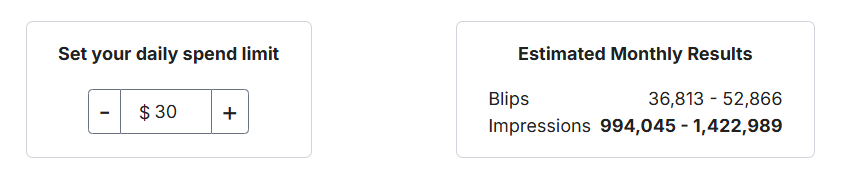
You only pay when your ad actually displays, with each 7.5-to-10-second blip starting at just $0.01 per display. Pricing is dynamic, so cost can vary based on time of day, location, and advertiser demand, but Blip works to maximize your reach for your budget. Because there are no minimums or contracts, you can start small, adjust your spend anytime, or pause when needed.
Where can I advertise with Blip in Celina?
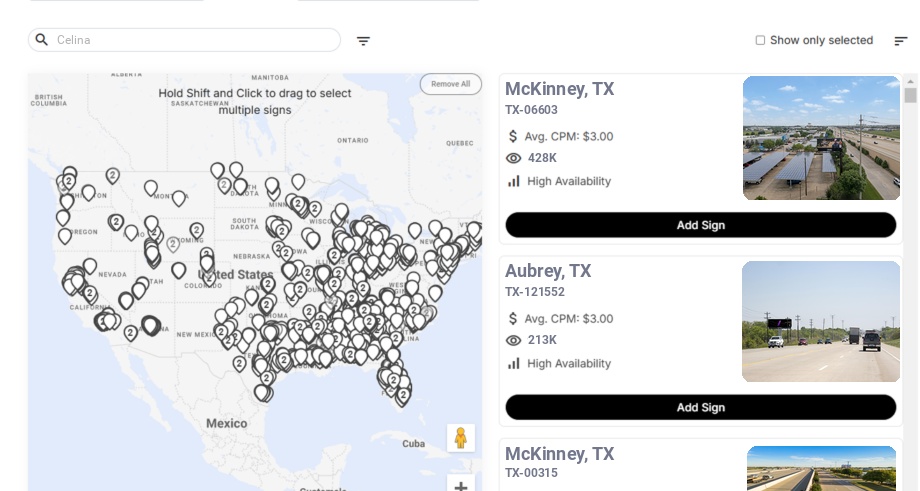
Our 6 digital billboards serving the Celina area are positioned in nearby Little Elm, McKinney, and Aubrey, just 9.4, 9.9, and 10.0 miles from Celina. These placements help reach local residents as they commute, shop, dine, and head toward larger job and retail centers. A corridor-based plan often outperforms a one-location mindset in this market.
Why is billboard advertising in Celina effective for local businesses?
Celina sits on one of the fastest-moving growth fronts in North Texas, climbing from 6,028 residents in 2010 to 16,739 in 2020. The market is highly car-oriented and spread across several suburban corridors, so digital billboard campaigns can build frequency fast without depending on a single downtown placement. That mix of population growth, road usage, and regional shopping patterns gives advertisers a strong platform near Celina.
What roads in Celina should I target for billboard ads?
US 380 is one of the most important roads for any campaign serving the Celina area, with developed segments across Prosper, Frisco, Little Elm, and McKinney often carrying 50,000 to 70,000+ vehicles per day. Preston Road / SH 289 is another defining corridor, and many developed segments south of Celina are in the 20,000 to 40,000+ vehicles per day range. On the western side, FM 423 through Little Elm commonly carries 30,000 to 50,000+ vehicles per day on busier segments.
When is the best time to run billboard ads in Celina with Blip?
From March through June, the market leans heavily into home, move, and outdoor categories, making it a strong window for real estate, builders, storage, lawn care, pest control, and patio-focused retail. From late July through September, back-to-school demand surges, and from August through November, Friday-night-football culture and weekend youth sports keep roads busy. Near Celina, the strongest billboard strategy is usually the one that follows how the market actually moves.
Do I need a contract to advertise with Blip near Celina?
No, Blip has no long-term contracts or minimum commitments. You can start, pause, or stop your campaign at any time.
How fast can I launch a billboard campaign with Blip near Celina?
You can have your campaign live in minutes. Create a free account, select your locations, set your budget, upload your design, and start running once approved.
Where can I advertise with Blip near Celina?
Blip has digital billboards near Celina. You can browse available locations on a map, choose the ones that fit your audience, and start advertising right away.
Still have questions? Launch a campaign in minutes — no contracts, no commitments.
Start Your CampaignCelina Billboard Advertising Guide
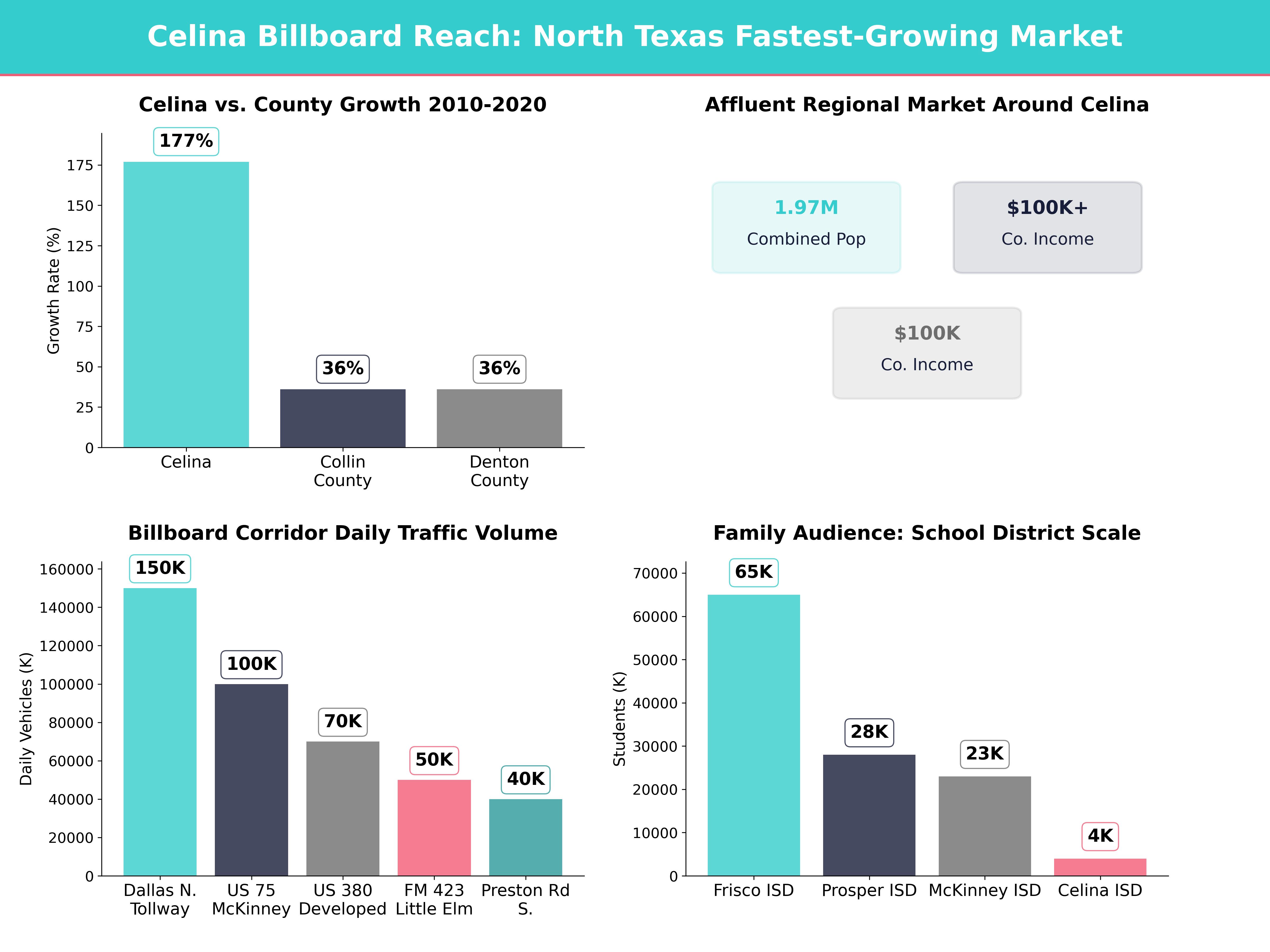
Celina sits on one of the fastest-moving growth fronts in North Texas, climbing from 6,028 residents in 2010 to 16,739 in 2020 (+177%), which makes billboard advertising near Celina especially effective for brands that need to stay visible with drivers. Our 6 digital billboards serving the Celina area are positioned in nearby Little Elm McKinney, and Aubrey 9.4, 9.9, and 10.0 miles from Celina, so we can reach local residents as they commute, shop, dine, and head toward larger job and retail centers. Because this market is highly car-oriented and spread across several suburban corridors, digital billboard campaigns can build frequency fast without depending on a single downtown placement. That mix of population growth, road usage, and regional shopping patterns gives us a strong advertising platform near Celina.
Celina area market overview
The City of Celina is no longer just a small North Texas outpost. It is part of a fast-growing corridor that connects Collin County, Denton County, Prosper Frisco, Little Elm McKinney into one interconnected consumer market.
According to the Texas Demographic Center, Celina had a 2020 census population of 16,739, up from 6,028 in 2010. The city spans 2 counties, and that matters for advertisers because the consumer base around Celina is much larger than the city limit alone suggests. In the same census, Collin County had 1,064,465 residents, and Denton County had 906,422 residents; both counties grew by roughly 36% from 2010 to 2020. Combined, that is 1,970,887 people in the two counties that frame the market serving the Celina area.
That broader context is important because many businesses targeting Celina residents are really targeting northward-moving suburban households across several communities at once. A family may live near Celina, work in Frisco or Plano, shop in McKinney, play sports in Little Elm Visit Frisco attractions or Visit McKinney events. That behavior makes regional billboard coverage far more useful than a narrow city-only mindset.
Recent American Community Survey patterns for Collin and Denton counties show why outdoor advertising works so well here. Roughly 75% to 80% of workers in both counties drive alone to work, another 8% to 10% carpool, and public transit usage remains below 1%. Even after the rise of remote work, drive-alone and carpool commuting still account for roughly 85% of workers in this part of North Texas. When the market is built around cars, repeated roadside visibility matters.
The economic profile is also attractive. Recent county estimates place median household income above $100,000 in Collin County and around $100,000 in Denton County, which supports categories such as healthcare, home services, financial services, auto, real estate, family entertainment, and higher-ticket retail. The Celina Economic Development Corporation and Celina Area Chamber of Commerce both highlight the city’s role in a broader expansion zone, and that is exactly the kind of geography where digital billboard frequency pays off.
What this means for advertisers serving the Celina area
We should think of the Celina area as a growth market with metropolitan habits. Residents make long, frequent driving trips, and they regularly cross municipal boundaries for work, school, shopping, youth sports, healthcare, and dining. That gives us a larger practical audience than the city population alone suggests.
Celina area key traffic corridors
The road network near Celina is the real story. Advertisers do not need a billboard inside the city itself to reach this audience, because the market moves along a handful of very predictable corridors. Our nearby boards in Little Elm, McKinney, and Aubrey help us intercept those daily movements.
US 380 is the east-west spine serving the Celina area
TxDOT traffic maps show that developed segments of US 380 across the Prosper, Frisco, Little Elm, and McKinney side of the market often carry 50,000 to 70,000+ vehicles per day, depending on the segment and year. That makes US 380 one of the most important roads for any campaign serving the Celina area.
US 380 matters because it is not just a through route. It is also a retail and errands corridor. Drivers use it to reach shopping centers, restaurants, medical offices, schools, youth activities, and east-west connections between McKinney, Prosper Little Elm
Preston Road, Dallas North Tollway, and southbound commuter flow
Preston Road / SH 289 is one of the defining north-south corridors for the Celina market. TxDOT counts typically place many developed segments of Preston Road south of Celina in the 20,000 to 40,000+ vehicles per day range, with heavier counts as drivers move toward Frisco and Plano. This is a high-value corridor because it blends commuter traffic with destination retail traffic.
Farther south, the North Texas Tollway Authority operates the Dallas North Tollway, which is one of the region’s strongest commuter channels. Busier Frisco segments can surpass 150,000 vehicles per day. Even if your campaign is aimed at the Celina area, these southern commute paths still matter because they shape where local residents work, shop, and spend weekends.
FM 423, McKinney routes, and western growth access
On the western side of the market, FM 423 through Little Elm 30,000 to 50,000+ vehicles per day on busier segments. That road is especially useful for brands trying to reach families heading south toward Frisco retail, lake recreation, and school or sports destinations.
On the eastern side, McKinney gives us access to the US 75 orbit. Major US 75 segments through McKinney exceed 100,000 vehicles per day, which helps us reach commuters and shoppers whose routines connect Celina-area households with employment centers farther south. Meanwhile, Aubrey
Why these corridors matter more than a single point on a map
The strongest billboard strategy near Celina usually follows travel behavior, not city boundaries. We reach the market by showing up on the roads people already use to connect home, work, school, shopping, and recreation. That is why a corridor-based plan often outperforms a one-location mindset.
Celina area audience segments
One reason billboard advertising near Celina works so well is that the audience is not one-dimensional. We can reach commuters, families, students, shoppers, sports fans, and weekend visitors, often along the same set of roads.
Commuters and everyday errand traffic
Commuters are the foundation. As noted earlier, roughly 75% to 80% of workers in Collin and Denton counties drive alone, and another 8% to 10% carpool. That means the large majority of workers are spending time on roads where repeated digital billboard exposure is possible.
This audience is especially valuable for:
- Healthcare providers that want to stay top of mind during routine drives.
- Restaurants, coffee shops, and convenience brands that can influence same-day decisions.
- Home service companies that need local name recognition before a need becomes urgent.
- Real estate, mortgage, insurance, and financial brands that benefit from frequency over time.
Because our boards serving the Celina area are spread across nearby Little Elm, McKinney, and Aubrey, we can follow the market across several habitual routes instead of relying on one traffic pocket.
Families and students near Celina
Family growth is one of the clearest reasons to advertise near Celina. Nearby school districts are large and still expanding. Frisco ISD enrolls more than 65,000 students, Prosper ISD serves more than 28,000, McKinney ISD serves more than 23,000, and Celina ISD serves more than 4,000 students. That is well over 120,000 students across just four districts, before we even count Little Elm ISD.
Those numbers matter because student life drives parent behavior. Families make recurring trips for drop-off, pickup, after-school programs, sports, tutoring, urgent care, orthodontics, grocery runs, dining, and weekend entertainment. If your brand serves households rather than tourists, this is one of the most reliable audience pools in the Celina area.
Sports, tourism, and weekend destination traffic
The Celina market also connects naturally to major sports and leisure destinations south of the city. Toyota Stadium 20,500. Ford Center at The Star 12,000, and it sits within the 91-acre The Star Omni PGA Frisco Resort 500 rooms, 2 championship golf courses, and a 10-hole short course.
Those destinations pull visitors from across North Texas, and they also shape weekend travel for Celina-area residents. Add shopping and dining trips to Visit Frisco, historic downtown visits through Visit McKinney, and recreation around Little Elm
Who benefits most from this audience mix
We usually see especially strong fit near Celina for these advertiser types:
- Homebuilders, apartment communities, storage operators, and moving services.
- HVAC, roofing, plumbing, pest control, landscaping, and remodeling companies.
- Pediatric, dental, ortho, urgent care, and family medical practices.
- Quick-service restaurants, casual dining, grocery, fuel, and convenience brands.
- Youth sports, tutoring, child enrichment, and family entertainment businesses.
- Auto dealers, tire shops, collision repair, and insurance agencies.
Celina area seasonal and timing opportunities
The Celina market is active year-round, but timing still matters. We get better performance when creative and scheduling match the way North Texas households actually move through the calendar.
Spring and early summer near Celina
From March through June, the market leans heavily into home, move, and outdoor categories. This is a strong window for real estate, builders, apartment communities, storage, lawn care, pest control, pools, and patio-focused retail. It is also a strong time for healthcare and fitness campaigns because families are planning before summer travel and school breaks begin.
From May through August, family entertainment, dining, HVAC, beverages, and recreation perform well. Traffic tied to Little Elm
Back-to-school and fall rhythms serving the Celina area
From late July through September, back-to-school demand surges. This is the right time for pediatric care, orthodontics, after-school programs, tutoring, quick-service dining, and family retail. School calendars across Celina ISD, Prosper ISD, Frisco ISD, and McKinney ISD create very dependable household traffic patterns.
From August through November, Friday-night-football culture and weekend youth sports keep roads busy. That period is ideal for restaurants, sports medicine, urgent care, sporting goods, automotive services, and community brands that want to feel woven into local routines.
Holiday and winter timing near Celina
From mid-November through late December, retail, gifting, dining, events, and service reminders are strong. The Celina area also benefits from holiday draw in nearby McKinney and Frisco, so local campaigns can benefit from heavier evening and weekend traffic.
Then January and February become a practical, lower-clutter window for tax preparation, healthcare, fitness, home services, and financial offers. While tourism is lighter, commuter routines remain consistent, and that can improve message retention for need-based categories.
Celina area billboard design tips
Creative matters even more when we are targeting fast-moving suburban traffic. The strongest designs for the Celina area usually feel direct, modern, and locally aware.
Use high contrast for North Texas light conditions
North Texas sun is bright, and storms can flatten low-contrast designs. We generally recommend dark backgrounds, bright type, and bold color contrast rather than soft beige or low-saturation palettes. Navy, black, deep green, and charcoal tend to hold up well, especially when paired with white, yellow, or bright accent colors.
We also recommend keeping the main line to about 7 words or fewer whenever possible. Drivers on US 380, Preston Road, FM 423, and McKinney connectors do not have time to decode complicated copy. One message, one brand cue, and one call to action usually outperform clutter.
Reflect the aspirations of the Celina area audience
The local audience is suburban, family-oriented, and growth-minded. Imagery that signals convenience, trust, home improvement, healthcare access, family fun, youth sports, or quality dining usually feels more relevant than generic skyline shots or abstract branding.
Creative that often resonates near Celina includes:
- New-home or move-up-home imagery.
- Family or youth activity scenes.
- Clean automotive visuals.
- Patio dining, coffee, or convenience cues.
- Practical service language such as “Book Today,” “Free Estimate,” or “Now Enrolling.”
Use place cues drivers actually recognize
When it is accurate for your business, local geography can strengthen recall. Phrases like “Serving Celina families,” “Near 380,” “South on Preston,” or “Minutes from McKinney” can work well because they match how residents think about the region. We prefer directional language that aligns with real travel habits instead of vague slogans.
If your business serves the whole market, we recommend broader language such as “Serving the Celina area” rather than naming a single neighborhood. That keeps the message inclusive across Little Elm, McKinney, Aubrey, Prosper, and adjacent growth pockets.
Regional strategies serving the Celina area
The best campaigns near Celina usually mix multiple corridor types. Different nearby cities help us solve for different audience behaviors.
Little Elm strategies for the Celina area
Our boards in Little Elm
- Restaurants, coffee, and convenience brands.
- Medical, dental, and urgent care providers.
- Entertainment, events, and youth activities.
- Retailers that draw families on evenings and weekends.
Little Elm placements are especially effective when your customer base lives near Celina but regularly travels south for errands or leisure.
McKinney strategies for the Celina area
Our McKinney inventory is valuable for advertisers who need access to east-side traffic and stronger commuter crossover from US 380 into the US 75 ecosystem. These campaigns often work well for:
- Professional services and financial brands.
- Automotive, collision, and dealership campaigns.
- Healthcare systems and specialist practices.
- Retail and dining brands that pull from a broader trade area.
If your business draws households from the eastern side of the Celina area, McKinney usually deserves a prominent share of the plan.
Aubrey strategies for the Celina area
Our boards near Aubrey
- Home services and contractors.
- Furniture, flooring, appliances, and storage.
- Grocery, fuel, and neighborhood retail.
- Childcare, pediatric, and family-service brands.
Aubrey also helps us stay visible with drivers who may not use the same southbound routes as the Little Elm or McKinney audience.
Combining all three nearby markets
If your goal is broad awareness serving the Celina area, we usually recommend a multi-corridor mix. Little Elm covers southbound family and retail movement. McKinney captures east-side commuter behavior and high-volume connectors. Aubrey extends reach into western growth zones. Together, all 6 boards give us better market coverage than a single nearby city alone.
Blip tools for campaigns serving the Celina area
Blip is especially useful for a market like Celina because the audience is spread across several nearby cities and routes. We can use a manual campaign when we want to select specific boards in Little Elm, McKinney, or Aubrey based on your trade area. We can also use a Blip-optimized campaign when the goal is broader awareness and we want the system to allocate budget across the best opportunities.
Because pricing is pay-per-play and starts at $0.01 per display, we can test the Celina area without the kind of large upfront commitment that traditional billboard buying often requires. Each digital ad display lasts 7.5 to 10 seconds, which is enough time for a simple, bold message to register with drivers.
The most helpful capabilities for this market are usually:
- Time-of-day targeting for commuter, school-run, lunch, or weekend emphasis.
- Easy creative swaps when seasons or offers change.
- Flexible budgeting across all 6 nearby boards.
- Real-time analytics that let us shift spending toward the best-performing corridors.
That flexibility is valuable near Celina because travel patterns change by season, school calendar, and route preference. We do not need to lock ourselves into one static plan.
Getting started with billboard rental near Celina
If you are planning billboard rental near Celina, we recommend starting with geography before budget. First, identify where your customers actually come from. A pediatric clinic, builder, restaurant, or home-service company may all target “Celina,” but their best routes can be very different.
How we recommend evaluating locations serving the Celina area
We usually start with a few practical questions:
- Do most customers come from the south via Prosper Frisco, or Little Elm
- Do they approach from the east through McKinney and US 380?
- Do they live in newer western neighborhoods tied more closely to Aubrey
- Are you trying to build broad name recognition, or are you trying to influence immediate store visits and leads?
Those answers tell us whether to prioritize one nearby city or all 6 boards serving the Celina area.
What to expect from the rental process
Compared with traditional billboard companies, Blip simplifies the process. We can launch without long negotiations, avoid large production commitments, choose specific digital boards on a map, or let optimization handle the mix for us. We can also pause, adjust, or expand quickly if the first round of data shows a better corridor or time slot.
For most advertisers, a smart first test looks like this:
- Run for 2 to 4 weeks so we capture weekday and weekend behavior.
- Start with 1 clear offer and 2 creative variations.
- Focus on the corridor most tied to your customer journey first.
- Review results every 7 days and adjust timing, creative, or location mix.
Matching nearby billboard locations to your goals
If your business sits south of Celina and depends on commuter flow, Little Elm placements may deserve priority. If you draw customers from the east or want heavier-volume crossover, McKinney may be the better lead board set. If you serve west-side residential growth, Aubrey can be especially valuable. If you want broad market awareness, we should usually combine all 6 digital billboards serving the Celina area.
The biggest advantage is that we do not have to guess once and live with that decision for months. We can test, learn, and refine. Near Celina, the strongest billboard strategy is usually the one that follows how the market actually moves.