Billboards in Gainesville, TX
No Minimum Spend. No Long-Term Contracts. Just Results.
Trusted by Leading Brands


Billboard advertising
in Gainesville has never been easier



How much is a billboard in Gainesville?
Why Choose Blip for Billboard Advertising in Gainesville
Blip lets Gainesville advertisers launch fast on I-35 and U.S. 82, reaching local drivers and North Texas pass-through traffic with self-serve control.
No contracts in Gainesville mean you can test weekend Lake Texoma and WinStar traffic, then pause or adjust your Blip budget anytime.
Use dayparting in Gainesville to hit school runs, commuter peaks, and Friday lake travel on the routes that matter most.
Track Gainesville campaigns in real time and shift spend as I-35, California Street, and county traffic patterns change.
Blip's creative tools make it easy to tailor Gainesville billboard copy for NCTC students, families, and regional travelers.
Frequently Asked Questions About Billboard Advertising in Gainesville
How much does a billboard cost in Gainesville, Texas with Blip?
With Blip, billboard advertising in Gainesville can fit a wide range of budgets because you only pay when your ad actually appears. Each “blip” is a 7.5-to-10-second display on a rotating digital billboard, with prices starting at just $0.01 per display. You set a daily budget, and Blip’s algorithm uses it to bid on open ad slots, helping maximize your reach based on time of day, location, and advertiser demand.
Where can I advertise with Blip in Gainesville, Texas?
Interstate 35 is Gainesville’s dominant billboard corridor, with recent TxDOT traffic count maps typically placing it in the 40,000 to 50,000 AADT range. U.S. 82 is the other essential route for Gainesville advertisers, and Business U.S. 82 and California Street capture local decision points inside Gainesville. Secondary corridors around Gainesville also serve audiences heading to Lake Kiowa, school zones, industrial sites, rural communities, and northbound leisure traffic.
Why is Gainesville, Texas a good market for billboard advertising with Blip?
Gainesville gives us a rare small-market combination: a resident base of 17,394 people in the city, a county population of 42,983, and a location directly on Interstate 35. Gainesville captures both everyday local trips and long-distance North Texas traffic, and weekend leisure travel toward Lake Texoma and cross-border entertainment traffic toward WinStar World Casino and Resort add another layer of impressions. For advertisers, that means we can build frequency with local households while also reaching regional drivers who are already in motion and ready to act.
What kinds of businesses work well for Gainesville, Texas billboard ads?
The local economy is supported by healthcare, education, manufacturing, public services, retail, agriculture, and logistics. A Gainesville billboard can work for a dentist, a bank, a truck stop, a local restaurant, a college program, a home-services company, or a regional casino-related hospitality business. Education is especially relevant, with North Central Texas College giving Gainesville a dependable student, faculty, staff, and parent audience.
When is the best time to run billboard ads in Gainesville, Texas?
Spring is one of the best launch periods because the market becomes more active without the full heat or the holiday clutter of later in the year. Summer rewards leisure, food, and destination messaging, while fall brings back routine, school traffic, and local pride. Winter campaigns should focus less on tourism fantasy and more on immediate usefulness, such as holiday dining, retail gifts, healthcare enrollment, heating and plumbing service, tax prep, and entertainment.
Do I need a contract to advertise with Blip in Gainesville?
No, Blip has no long-term contracts or minimum commitments. You can start, pause, or stop your campaign at any time.
How fast can I launch a billboard campaign with Blip in Gainesville?
You can have your campaign live in minutes. Create a free account, select your locations, set your budget, upload your design, and start running once approved.
Where can I advertise with Blip in Gainesville?
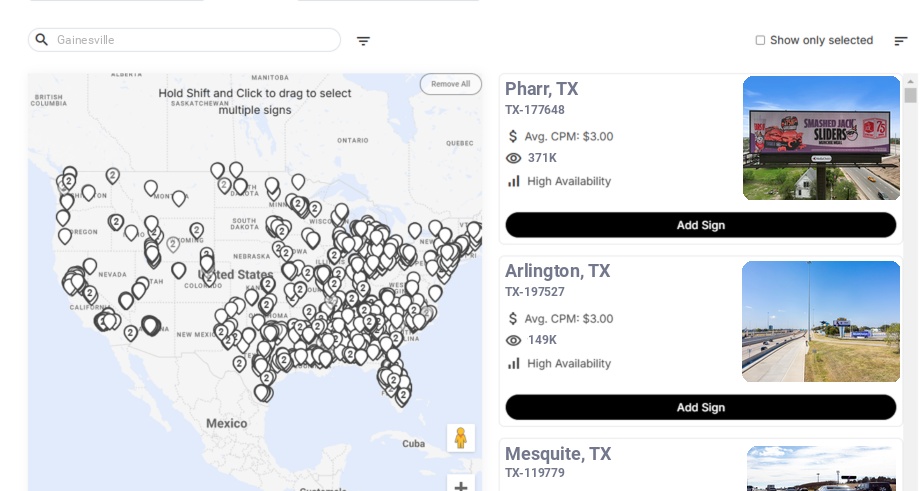
Blip has digital billboards in Gainesville. You can browse available locations on a map, choose the ones that fit your audience, and start advertising right away.
Still have questions? Launch a campaign in minutes — no contracts, no commitments.
Start Your CampaignGainesville Billboard Advertising Guide
Gainesville, Texas 17,394 people in the city, a county population of 42,983, and a location directly on Interstate 35 through the Texas highway system. Set roughly 70 miles north of Dallas, and about 35 miles north of Denton, Gainesville captures both everyday local trips and long-distance North Texas traffic. Weekend leisure travel toward Lake Texoma, with about 89,000 acres of water and roughly 580 miles of shoreline, and cross-border entertainment traffic toward WinStar World Casino and Resort, add another layer of impressions that many towns this size do not have. For advertisers, that means we can build frequency with local households while also reaching regional drivers who are already in motion and ready to act.
Gainesville Market Overview for Billboard Advertising
Gainesville and Cooke County offer steady growth, not just pass-through traffic
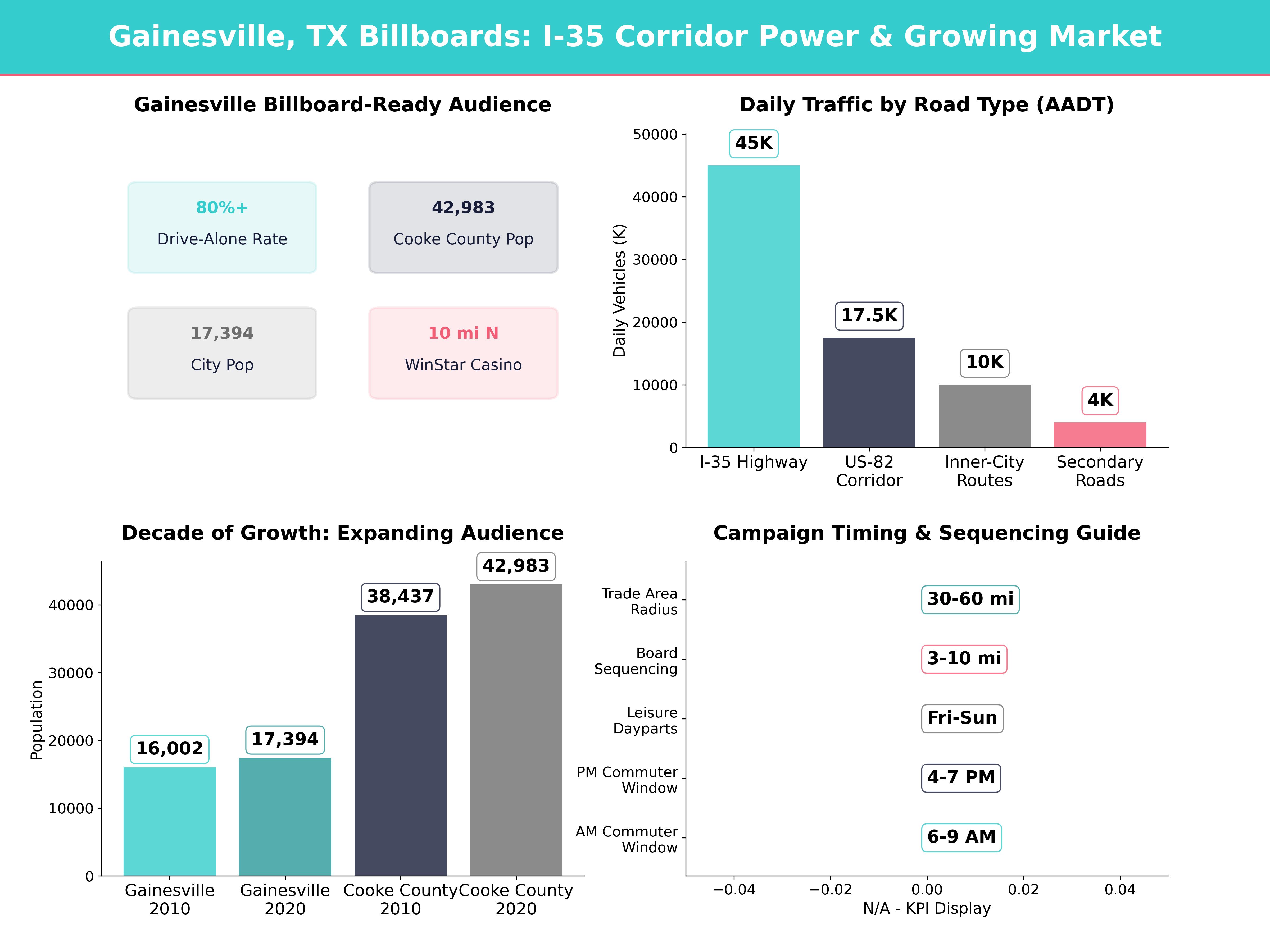
According to the Texas Demographic Center, Gainesville 16,002 residents in 2010 to 17,394 in 2020, which was an increase of 1,392 people, or about 8.7%. Cooke County grew from 38,437 residents in 2010 to 42,983 in 2020, which was a gain of 4,546 people, or about 11.8%. Those are not explosive Sun Belt numbers, but they are meaningful for billboard planning because they signal more rooftops, more local errands, and more repeat daily travel.
As the county seat, Gainesville functions as the service center for much of Cooke County. That matters because our audience is larger than the city limit alone. We are not only speaking to Gainesville residents. We are also speaking to people coming in for healthcare, education, shopping, government services, dining, recreation, and cross-border trips.
Gainesville’s economy is diverse enough to support multiple advertiser categories
The local economy is supported by healthcare, education, manufacturing, public services, retail, agriculture, and logistics. We can see that mix in institutions such as North Texas Medical Center North Central Texas College, the Gainesville Area Chamber of Commerce Gainesville Economic Development Corporation. That diversity is helpful because it gives us more than one ad audience. A Gainesville billboard can work for a dentist, a bank, a truck stop, a local restaurant, a college program, a home-services company, or a regional casino-related hospitality business.
Education is especially relevant. North Central Texas College was founded in 1924, reached its 100-year milestone in 2024, and operates 5 campuses across North Texas, with Gainesville as its historic home. That college presence gives us a dependable student, faculty, staff, and parent audience, especially during the fall and spring semesters.
Mobility in Gainesville strongly favors outdoor advertising
Gainesville is an auto-first market. Recent American Community Survey estimates indicate that well over 80% of local workers commute by driving alone, and local transportation is centered on personal vehicles rather than a large urban transit network. TAPS Public Transit
For advertisers, that is exactly what we want. In a market where people drive to work, drive to school, drive to shop, and drive out of town for entertainment, billboards become part of the local information system. Gainesville is also close enough to the north edge of the Dallas-Fort Worth orbit that regional travel remains routine, especially along I-35.
Key Traffic Corridors in Gainesville and Cooke County
Interstate 35 is Gainesville’s dominant billboard corridor
For reach, TxDOT makes the case clearly. Recent TxDOT traffic count maps typically place I-35 through Gainesville in the 40,000 to 50,000 AADT range, with the busiest segments clustering near the U.S. 82 interchange and major commercial exits. That is a very strong number for a city of Gainesville’s size, and it reflects both local use and through-traffic between North Texas and southern Oklahoma.
This corridor is especially effective for advertisers that benefit from quick decisions and high repetition.
- Convenience stores, fuel brands, truck services, and QSRs benefit because drivers often make stop decisions within minutes of seeing the message.
- Healthcare providers, legal services, and financial services benefit because daily commuters build familiarity over time.
- Tourism, gaming, and hospitality brands benefit because many drivers on I-35 are already moving toward a destination and can still be influenced mid-trip.
- Regional retail and auto dealerships benefit because shoppers from a 30- to 60-mile radius are common in this corridor.
U.S. 82 gives us east-west reach across Texoma
U.S. 82 is the other essential route for Gainesville advertisers. TxDOT counts generally place U.S. 82 in and around Gainesville in the 15,000 to 20,000 AADT range, especially near major commercial nodes and the I-35 connection. This highway links Gainesville with communities to the east and west, and it helps us reach drivers moving between Sherman Wichita Falls.
This corridor usually performs well for advertisers that want regional visibility without paying for a full big-metro footprint.
- Hospitals, clinics, colleges, and workforce training programs can use U.S. 82 to pull from outside Gainesville.
- Furniture, farm-and-ranch, and home-improvement retailers can use it to reach households making destination purchases.
- Auto repair, tire, and insurance brands can use it to stay visible across daily local and county travel patterns.
Business U.S. 82 and California Street capture local decision points
Inside Gainesville, Business U.S. 82 and California Street 8,000 to 12,000 AADT range. Those totals are lower than interstate numbers, but the intent is often higher because these drivers are already in the retail, civic, dining, school, and healthcare core.
This is where local businesses can compete effectively with larger regional brands. A California Street-area board can reinforce a promotion that is only a few minutes away, which is ideal for:
- Restaurants, coffee shops, and specialty retail that need same-day action.
- Medical, dental, and urgent care providers that want local trust and wayfinding support.
- Community institutions such as schools, nonprofits, banks, and public events that rely on name recognition.
Secondary gateways matter because intent can outweigh sheer volume
Secondary corridors around Gainesville usually carry smaller numbers, often in the 2,000 to 6,000 AADT range, but they serve highly useful audiences. Routes feeding Lake Kiowa
We should treat these routes as precision tools. If we are selling lake recreation, RV service, farm equipment, local dining, or community events, a lower-volume road can still outperform a broader highway because the audience is more qualified.
Audience Segments We Can Reach in Gainesville
Gainesville commuters and regional drivers deliver repeat frequency
Because Gainesville sits on I-35 and near the Oklahoma line, we get two useful behaviors at once. We get local repetition from residents handling everyday life, and we get regional movement from people commuting, shopping, or traveling longer distances. Gainesville’s location about 35 miles north of Denton, and roughly 70 miles north of Dallas, means advertisers can influence people before they fully enter the higher-cost media environment of the Metroplex.
This segment is especially valuable for categories that win through repetition, such as healthcare, insurance, banking, legal services, telecom, and home services. In auto-oriented markets, familiarity matters. When drivers see the same brand several times a week on the same route, recall tends to rise.
Gainesville families are a core local audience
Families remain central to the local market. The city population of 17,394, and county population of 42,983, translate into a steady base of school, shopping, dining, recreation, and healthcare trips. Attractions like the 31-acre Frank Buck Zoo
For family-oriented brands, we usually want simple, useful messaging. Offers around pediatric care, family dining, grocery, back-to-school, community banking, mobile plans, tutoring, and weekend events all fit Gainesville’s household rhythms.
Students and education audiences are bigger than they first appear
North Central Texas College gives Gainesville a sustained education audience that extends beyond the city itself. The college’s Gainesville presence is longstanding, and the institution’s 5-campus footprint gives it regional pull. We can also layer in K-12 audiences through Gainesville ISD, Callisburg ISD Valley View ISD, and Lindsay ISD
This audience matters for more than education brands. It is useful for apartments, internet providers, food, banking, healthcare, auto service, and part-time employers. The school-year audience is active for roughly 9 months of the year, which gives us long stretches of dependable weekday traffic.
Tourists and weekenders widen Gainesville’s effective audience
Tourism is not just a summer story here. Gainesville sits near two major trip drivers. First, Lake Texoma offers about 89,000 acres of water and roughly 580 miles of shoreline, which creates a major recreation draw for boating, fishing, cabins, and weekend travel. Second, WinStar World Casino and Resort sits only about 10 miles north of Gainesville in Thackerville, Oklahoma, drawing year-round visitor traffic through the corridor.
That combination gives Gainesville billboards unusual reach for hospitality, restaurants, convenience retail, liquor stores where legal and appropriate, hotels, event venues, car care, and destination entertainment. It also helps local brands intercept nonresident dollars before those dollars leave the area.
Industry workers and service crews are highly targetable by time of day
Cooke County’s mix of manufacturing, logistics, healthcare, agriculture, and public service creates a workforce with early starts and practical purchasing habits. These audiences respond well to messages about durability, convenience, reliability, financing, and immediate availability. If we are advertising diesel service, workwear, industrial suppliers, breakfast offers, or urgent care, Gainesville’s work-trip audience can be very efficient.
Seasonal and Timing Opportunities in Gainesville
Spring in Gainesville is ideal for services, healthcare, and events
Spring is one of the best launch periods because the market becomes more active without the full heat or the holiday clutter of later in the year. Community calendars pick up with school activities, outdoor recreation starts to return, and the city’s Medal of Honor Host City Program
If we are planning a spring campaign, we should usually start before the event or purchase cycle begins. In Gainesville, that often means launching in late February or March rather than waiting until April.
Summer in Gainesville rewards leisure, food, and destination messaging
From Memorial Day through Labor Day, the Lake Texoma effect becomes more visible. Recreational traffic rises, family outings increase, and weekend movement becomes more pronounced. This is when messages tied to boating, lake supplies, cooling, restaurants, attractions, and convenience stops can perform especially well. The 31-acre Frank Buck Zoo also helps keep family leisure traffic active inside town.
Our timing should reflect real travel behavior. In this market, Friday afternoon, Saturday morning, and Sunday afternoon are often higher-value leisure windows than a random midweek overnight schedule. If we can tailor creative by daypart, we should.
Fall in Gainesville brings back routine, school traffic, and local pride
Fall is when regularity returns. K-12 schools and North Central Texas College drive weekday travel back into a stable pattern from August through November. High school sports, local shopping, county events, and cooler weather also support stronger in-town activity. This season tends to work well for banks, healthcare systems, family restaurants, apparel, telecom, auto service, and political or civic messaging.
For many local advertisers, fall is the best season for consistent weekly frequency because routines are strong and attention is local.
Winter in Gainesville favors urgency, gifting, and practical offers
Winter campaigns should focus less on tourism fantasy and more on immediate usefulness. Holiday dining, retail gifts, healthcare enrollment, heating and plumbing service, tax prep, and entertainment all fit well. Cross-border traffic to WinStar World Casino and Resort still gives us an audience even when lake activity softens.
Cold snaps and rain can also heighten driver attention to simple, relevant messages. If road conditions are variable, “open now,” “same-day service,” and “minutes away” language can work better than broad image advertising.
Billboard Design Tips for the Gainesville Market
Gainesville billboards should be built for speed and sunlight
On I-35 and U.S. 82, many impressions happen at full highway speed, often among trucks and long-distance travelers. In Gainesville, we should treat 6 to 8 words as a practical ceiling for primary copy on high-speed boards. We should also use thick fonts, strong contrast, and a clear hierarchy because North Texas sunlight can wash out weak color combinations.
Dark text on light backgrounds, or light text on dark backgrounds, usually performs better than low-contrast palettes. If our audience is interstate traffic, legibility matters more than cleverness.
Local references work when they feel authentic, not forced
Gainesville is not downtown Dallas, and our creative should not feel like generic metro advertising dropped into a rural-regional market. References to Texoma, North Texas, the lake, county pride, or a simple directional cue can make a billboard feel native to the area. Phrases like “On I-35,” “Minutes from Gainesville,” “On U.S. 82,” or “Before the State Line” can be more persuasive here than abstract branding language.
Color and imagery can also follow local context. Blue and white palettes can connect naturally to lake and leisure messaging. Earth tones, green, and red accents often fit home, farm, and service brands better than overly polished luxury palettes. Black and gold, or other premium combinations, can work for casino-adjacent hospitality, nightlife, and upscale dining.
Gainesville creative should match the corridor, not just the brand
A commuter-facing message on I-35 should not look identical to a local retail message on California Street. Interstate creative should emphasize speed, distance, brand recall, and one action. In-town creative can support a sharper offer because the decision window is shorter and the destination is nearby.
If we have multiple boards, we should sequence them. One board can build awareness, and another board 3 to 10 miles later can close the decision with a location cue or offer. That approach is especially useful for restaurants, fuel, healthcare, and attractions.
Regional Billboard Strategies Across Gainesville and Cooke County
Gainesville’s I-35 core should carry the broadest message
If we only choose one Gainesville area strategy, we should start with the I-35 core. This is where local frequency and through-traffic overlap most clearly. Broad-use advertisers usually belong here first. That includes hospitals, colleges, banks, legal services, QSRs, truck services, hotels, major retail, and regional events.
Our creative in this zone should assume a mixed audience. Some viewers know Gainesville well, and some are just passing through. We should keep brand names prominent and location references simple.
East-west Gainesville strategy should focus on trade-area pull
U.S. 82 is where we can reach outside the city without paying DFW rates. This is the right strategy for advertisers that draw from Cooke County, Grayson County edges, and westbound communities. Healthcare systems, furniture stores, equipment dealers, workforce programs, and destination dining often benefit from this pattern.
When we advertise on U.S. 82, we should think in terms of trade area rather than city limit. If a customer is willing to drive 20, 30, or even 40 miles for the purchase, U.S. 82 deserves serious weight.
South Cooke County campaigns should speak to commuter momentum
The southern approach toward Valley View, Denton, and the wider Metroplex orbit is useful for service brands that want repeated weekday exposure. This is where messages about appointments, financing, healthcare, and recurring household needs can stick. Morning and late-afternoon dayparts often matter more here than midday.
We should also remember that southbound traffic is not purely outbound. It includes people with purchasing power who regularly move between small-town North Texas and larger metro job centers.
Northbound and recreation-oriented strategy should capture intent
Northbound boards toward Oklahoma, and boards that intercept leisure traffic near lake routes, should lean into urgency and trip relevance. These are strong placements for dining, fuel, hotels, attractions, liquor-adjacent retail where appropriate, car service, and “stop before you go” messaging.
Locations tied to Lake Kiowa
Using Blip Tools for Gainesville Campaigns
We can use budgeting flexibility to mirror Gainesville’s real traffic patterns
Gainesville is a market where timing matters almost as much as location. Instead of spreading spend evenly across every hour, we can concentrate budget around the windows that matter most to the audience. For commuter campaigns, that often means 6:00 to 9:00 a.m., and 4:00 to 7:00 p.m. For lake and entertainment traffic, we can shift emphasis to Friday 3:00 to 8:00 p.m., Saturday 8:00 a.m. to 2:00 p.m., and Sunday noon to 7:00 p.m.
That approach lets us buy relevance, not just reach.
We can test Gainesville creative by corridor
Blip makes it practical to run one version of creative on I-35, and another on city-serving routes, without building an oversized campaign. We can test a brand-first message against an offer-first message, or compare commuter creative with weekend creative. In a market like Gainesville, those differences matter because the audience purpose changes by route.
We should not assume that one billboard design fits every board in Cooke County. A small test can tell us a lot.
We can optimize quickly when weather, school calendars, or events shift
Gainesville has meaningful seasonal swings in recreation and event traffic. That makes flexibility valuable. If weather boosts lake traffic, if school returns in August, or if an event weekend increases in-town attention, we can adjust timing and creative without rebuilding the entire campaign from scratch.
Real-time reporting is also helpful in a market where frequency matters. We can see which placements are spending efficiently, and we can move budget toward the boards that align best with our objective.
We can use artwork tools to localize without overcomplicating production
For Gainesville campaigns, simple localized variants often outperform a single generic image. We can build one version that says “On I-35,” another that says “On U.S. 82,” and another that references Gainesville or Texoma directly. That kind of localized adaptation is usually more valuable than designing an entirely new visual system.
Getting Started with Billboard Rental in Gainesville
We should define the real draw area before choosing boards
The first question is not “Which billboard is cheapest?” The first question is “How far do customers actually travel for this offer?” If most customers come from within 10 to 15 miles, we should prioritize in-town and near-town frequency. If customers will drive 30 to 60 miles, I-35 and U.S. 82 deserve heavier emphasis.
This is especially important in Gainesville because the city serves both local households and regional pass-through traffic. Our best locations depend on whether we want neighborhood frequency, countywide pull, or interstate interception.
We should evaluate boards by trip purpose, not just by impression count
A higher-traffic board is not automatically the better board. We should ask four practical questions.
- Who is on this road? We should know whether the audience is commuting, shopping, recreating, or traveling long distance.
- How fast are they moving? Highway-speed boards require simpler copy than local-road boards.
- What decision can they still make after seeing the ad? The closer the billboard is to an exit, turn, or destination, the more immediate the call to action can be.
- Which direction matters more? In Gainesville, inbound and outbound traffic can behave very differently by time of day.
We can start small, learn fast, and expand with confidence
One of the biggest advantages in Gainesville is that we do not need to overbuild the campaign on day one. A smart starting structure is often 2 to 3 billboards, 2 creative versions, and a 2- to 4-week learning period. That setup usually gives us enough data to see whether the market responds better to commuter messaging, local retail offers, or destination-oriented calls to action.
Traditional billboard buying often pushes advertisers toward longer commitments before they have enough local insight. A self-serve approach is better for Gainesville because the market has several distinct traffic types, and we can learn by testing rather than guessing.
Gainesville billboard rental works best when we align message, road, and timing
If we keep one principle in mind, it should be this: Gainesville rewards relevance. The market is large enough to create real reach, but focused enough that a well-timed, well-placed message can feel personal. When we match the right road with the right audience and the right week, Gainesville billboards can produce efficient, repeat exposure that would be much harder to replicate in a bigger and more fragmented metro.