Billboards in El Paso, TX
No Minimum Spend. No Long-Term Contracts. Just Results.
Trusted by Leading Brands


Billboard advertising
in El Paso has never been easier



How much is a billboard in El Paso?
Why Choose Blip for Billboard Advertising in El Paso
Blip’s self-serve platform lets you launch on El Paso’s I-10, US 54, or Loop 375 in minutes—no rep required.
Blip-optimized campaigns can auto-shift spend across El Paso corridors like I-10, Joe Battle, and the Border Highway to match your goals.
No contracts means you can test El Paso’s Fort Bliss, UTEP, and East Side audiences, then pause or scale anytime.
Use dayparting in El Paso to hit morning commuters on US 54 and evening shoppers on I-10 and Zaragoza when traffic peaks.
Track El Paso performance in real time and refine fast as school runs, bridge traffic, and Sun Bowl season change.
Blip’s creative tools help you build bold, high-contrast ads that stand out in El Paso’s 302 sunny days.
Frequently Asked Questions About Billboard Advertising in El Paso
How much does a billboard cost in El Paso with Blip?
With Blip, billboard advertising in El Paso can fit a wide range of budgets because you only pay when your ad actually appears. Pricing starts at just $0.01 per display, and each “blip” is a 7.5-to-10-second display on a rotating digital billboard. Your total cost is simply the sum of each blip over time, making billboard advertising in El Paso more flexible and accessible than many people expect.
Where can I advertise with Blip in El Paso on high-traffic roads?
When we buy digital billboards in El Paso, we are really buying into a small set of high-value routes. According to the TxDOT El Paso District, the hierarchy is clear: I-10, US 54, Loop 375, and key connectors do most of the heavy lifting. I-10 is the backbone of the market, and US 54 is the most important north-south commuter spine in El Paso.
Why is El Paso a strong billboard market for Blip?
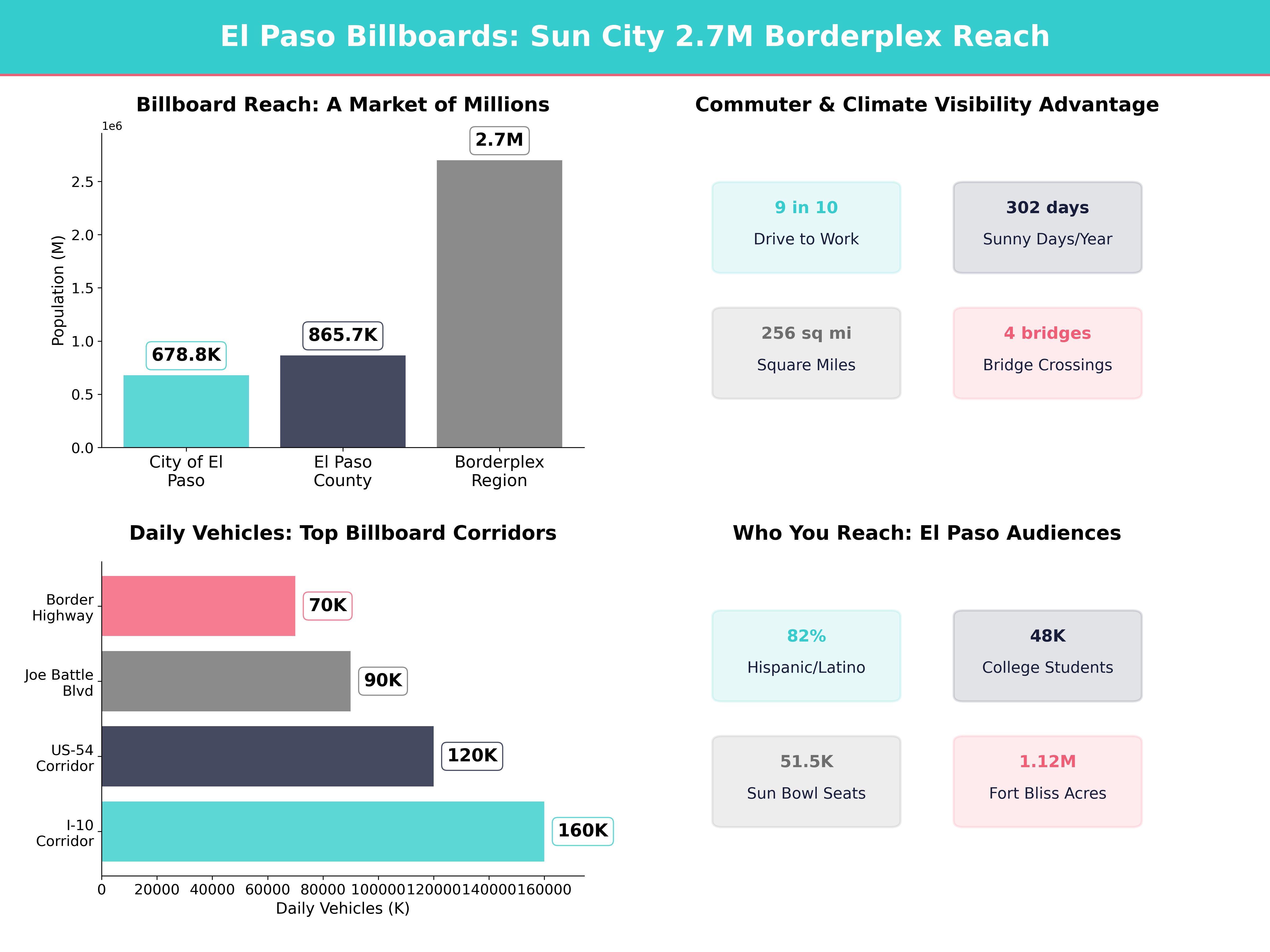
El Paso gives us one of Texas’s clearest billboard opportunities because the market combines a large local population of 678,815 residents in the City of El Paso and 865,657 in El Paso County, a wider 2.7 million-person Borderplex region, strong car dependence, and steady visitor flow from both interstate and cross-border travel through 4 international bridge crossings. Because the city stretches across roughly 256 square miles and sees roughly 9 in 10 commuters travel by car, truck, or van, roadside media earns repeated exposure. We also benefit from El Paso’s “Sun City” identity, with about 302 sunny days a year, which helps digital creative stay visible in every season.
Where are the best El Paso areas to place a Blip billboard for families and shoppers?
The East Side is one of the market’s most dependable billboard zones because it layers commuter traffic, retail traffic, and school-driven household traffic. I-10, Joe Battle, Zaragoza, and Montana all matter here, and this is also where we see strong activity around Cielo Vista Mall, The Fountains at Farah, Socorro, and Horizon City. We usually recommend East Side and Far East strategies when we want families, value shoppers, healthcare users, auto shoppers, and homebuyers.
When is the best time to run billboard ads in El Paso with Blip?
One of El Paso’s best advertising traits is that weather rarely shuts the market down, so we usually plan around calendar moments more than weather interruptions. Spring is one of our strongest local windows, while fall is a major billboard season because school is back, sports return, and business calendars intensify. El Paso’s winter is much milder than in many U.S. markets, so outdoor visibility remains strong late in the year.
Do I need a contract to advertise with Blip in El Paso?
No, Blip has no long-term contracts or minimum commitments. You can start, pause, or stop your campaign at any time.
How fast can I launch a billboard campaign with Blip in El Paso?
You can have your campaign live in minutes. Create a free account, select your locations, set your budget, upload your design, and start running once approved.
Where can I advertise with Blip in El Paso?
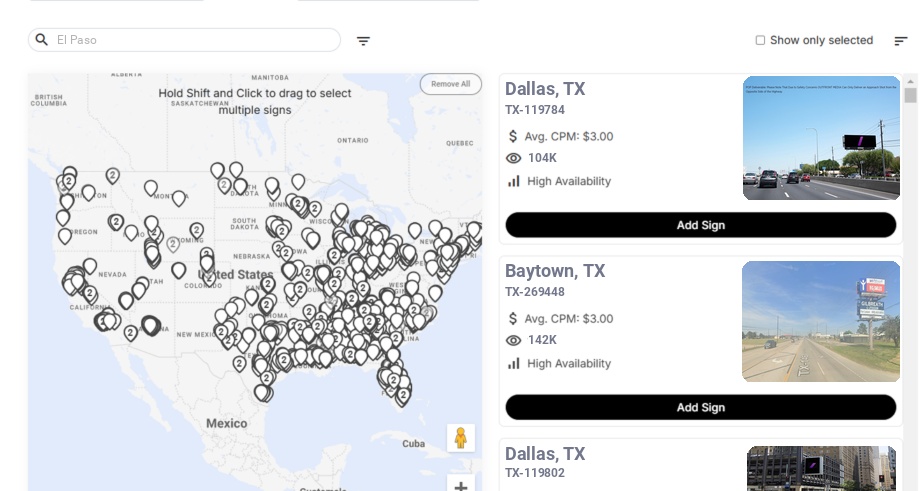
Blip has digital billboards in El Paso. You can browse available locations on a map, choose the ones that fit your audience, and start advertising right away.
Still have questions? Launch a campaign in minutes — no contracts, no commitments.
Start Your CampaignEl Paso Billboard Advertising Guide
El Paso 678,815 residents in the City of El Paso 865,657 in El Paso County 2.7 million-person Borderplex region, strong car dependence, and steady visitor flow from both interstate and cross-border travel through 4 international bridge crossings. The Texas Demographic Center places the City of El Paso 678,815 residents and El Paso County 865,657, while the wider Borderplex Alliance region reaches about 2.7 million people. Because the city stretches across roughly 256 square miles, is shaped by the 24,247-acre Franklin Mountains State Park, and sees roughly 9 in 10 commuters travel by car, truck, or van, roadside media earns repeated exposure. We also benefit from El Paso’s “Sun City” identity, with about 302 sunny days a year, which helps digital creative stay visible in every season.
El Paso Market Overview for Billboard Advertising
When we look at El Paso as an advertising market, we see a city with enough scale for broad reach and enough geographic concentration for smart targeting. The El Paso Chamber, the Borderplex Alliance, and local public agencies consistently frame the region around defense, trade, logistics, healthcare, education, and retail, which creates multiple demand pockets instead of one single-industry economy.
Demographics and growth in El Paso
El Paso is not a small border outpost. It is a major Texas city with 678,815 residents inside city limits and 865,657 residents in the county. From 2010 to 2020, the city added 29,694 residents, which was growth of about 4.6%, and the county added 65,010 residents, which was growth of about 8.1%.
That scale matters for billboard planning because it gives us both frequency and neighborhood diversity. We can reach dense urban drivers near downtown, university traffic near The University of Texas at El Paso, military households tied to Fort Bliss 82% of county residents identifying as Hispanic or Latino, so culturally fluent creative often performs better than one-size-fits-all copy.
Economic drivers and mobility in El Paso
El Paso’s economy is unusually broad for a single metro. We benefit from a large military footprint at Fort Bliss 1.12 million acres, as well as the region’s role in cross-border commerce with Ciudad Juárez. The City of El Paso International Bridges Department 4 international bridge crossings, which continuously feed demand for retail, hospitality, legal services, tax preparation, healthcare, and financial services.
Healthcare and education deepen the audience base. We can target patients, staff, and visitors around University Medical Center of El Paso, The Hospitals of Providence Las Palmas Del Sol Healthcare, and Texas Tech University Health Sciences Center El Paso. We can also reach students and faculty at UTEP and El Paso Community College, which together serve more than 48,000 students.
Mobility is the final reason El Paso works so well for billboards. Roughly 9 in 10 commuters who travel to a workplace use a car, truck, or van. The Franklin Mountains State Park physically divides the city, so daily trips compress into a limited number of east-west and north-south corridors. That route concentration is exactly what we want when our goal is repeated billboard exposure.
Key Traffic Corridors for Digital Billboards in El Paso
When we buy digital billboards in El Paso, we are really buying into a small set of high-value routes. According to the TxDOT El Paso District
Interstate 10 across El Paso
Interstate 10 120,000 to 160,000+ annual-average-daily-traffic range, with some of the heaviest flow near downtown, the US 54 interchange, the airport area, and the Cielo Vista retail district.
This corridor connects Anthony, Texas UTEP, El Paso International Airport Cielo Vista Mall Socorro Horizon City
We usually like I-10 for these categories:
- We can reach daily commuters for healthcare systems, banks, insurance, and home services.
- We can capture shopping intent near Cielo Vista Mall The Fountains at Farah, and airport hotels.
- We can support event and entertainment campaigns for downtown, UTEP, and the Sun Bowl Association.
US 54, Patriot Freeway, and the Northeast
US 54 is the most important north-south commuter spine in El Paso. Near the airport, central city, and Fort Bliss area, key segments often sit in the 100,000 to 120,000 vehicles-per-day range. That makes it one of the best corridors for frequency among military households, airport users, and Northeast residents.
US 54 connects Northeast El Paso, Fort Bliss, the El Paso International Airport
We typically use US 54 placements when we want to reach:
- We reach military personnel, military families, defense contractors, and civilian support workers.
- We reach apartment seekers, auto buyers, urgent care patients, and insurance shoppers.
- We reach airport-bound travelers who still have enough trip time to remember a brand message.
Loop 375, Joe Battle, Border Highway, and Transmountain
Loop 375 is not one road experience. It is a family of strategically different routes. On the East Side, Joe Battle Boulevard often reaches roughly 70,000 to 90,000 AADT on its busiest segments, which gives us reliable exposure in some of the metro’s strongest residential and retail growth zones. Along the south side, the Border Highway commonly runs in the 40,000 to 70,000 range depending on the exact segment.
Joe Battle is especially useful when we want Far East families, retail shoppers, and school-driven traffic. The Border Highway is stronger when we want to reach downtown-adjacent travelers, Lower Valley drivers, and bridge-related service demand. Transmountain traffic is lower than central I-10, but it remains strategically important because it is one of the city’s few mountain crossings between the West Side and Northeast.
We usually prioritize Loop 375 for:
- We support family retail, grocery, dental, and pediatric campaigns on the East Side.
- We support legal, tax, telecom, and medical campaigns near south-side and bridge-serving routes.
- We support homebuilder, storage, furniture, and auto campaigns in developing Far East neighborhoods.
Spur 601, Montana Avenue, Zaragoza Road, Mesa Street, and Dyer Street
Spur 601, also called the Liberty Expressway, is smaller than I-10 or US 54, but it is highly useful. Recent TxDOT counts generally place it in the 30,000 to 40,000 AADT range, and that traffic is disproportionately tied to airport, industrial, cargo, and East Side movement.
Meanwhile, major arterials such as Montana Avenue, Zaragoza Road, Mesa Street, Alameda Avenue, and Dyer Street add valuable local repetition. These streets may not match interstate totals, but they often carry dense, intentional trips to shopping centers, schools, clinics, restaurants, and neighborhood services.
When we want action instead of just awareness, these corridors are often where the message sharpens. A clinic near Zaragoza, a restaurant near Mesa, or a retailer near Montana can use location-specific copy that tells drivers exactly where to turn.
Audience Segments for El Paso Billboard Campaigns
El Paso is effective because we are not talking to one audience. We are talking to overlapping audiences that move through different corridors at different times of day.
El Paso commuters and family households
Family households are a major part of the market. The city’s spread from the West Side to the Far East means parents make repeated trips for work, school, errands, sports, and shopping. The region’s four large public school systems — El Paso Independent School District, Ysleta ISD, Socorro ISD, and Canutillo ISD — together serve roughly 145,000 students.
That school volume creates dependable demand for:
- We promote grocery, quick-service food, dental care, pediatric clinics, and after-school programs.
- We promote tax services, wireless plans, furniture, and value retail.
- We promote family entertainment tied to weekends, holidays, and school breaks.
Military, defense, logistics, and industrial workers in El Paso
Fort Bliss changes the El Paso audience mix in a major way. Its 1.12 million acres create a huge orbit of soldiers, spouses, civilian employees, contractors, and support businesses. Those audiences move heavily along US 54, Dyer Street, Loop 375, Spur 601, and adjoining industrial routes.
This segment is especially strong for housing, auto dealers, storage, colleges, insurance, healthcare, recruiting, and home services. It also favors clear, trust-oriented messaging because many viewers are balancing relocation, deployment cycles, family routines, and time-sensitive decisions.
Students and young adults in El Paso
The student market is bigger than many advertisers expect. UTEP enrolls more than 24,000 students, and El Paso Community College also serves more than 24,000 students. Together, that is a college audience of 48,000+ people before we even count faculty, staff, and visiting families.
We can reach this audience near UTEP, central El Paso, Mesa Street, Dyer Street, and downtown entertainment zones. Student-focused campaigns tend to work well for apartments, food, entertainment, healthcare, mobile services, career programs, and retail promotions.
Shoppers, tourists, sports fans, and cross-border visitors in El Paso
El Paso is not only a commuter market. It is also a shopping and destination market. The Franklin Mountains State Park alone covers 24,247 acres, and the city draws year-round visitors through Visit El Paso, the El Paso Zoo and Botanical Gardens El Paso Museum of Art, and downtown attractions managed by the Downtown El Paso Partnership.
Sports and event audiences are large enough to matter on their own. The Sun Bowl Stadium seats about 51,500, Southwest University Park 9,500, the Plaza Theatre seats 2,050, the Abraham Chavez Theatre seats 2,500, and the Judson F. Williams Convention Center offers more than 130,000 square feet of meeting space.
We also cannot ignore cross-border movement. With 4 international bridges feeding the city, El Paso billboards can support retail, legal, financial, medical, and hospitality businesses that serve both local residents and regular visitors.
Seasonal and Timing Opportunities for El Paso Billboards
One of El Paso’s best advertising traits is that weather rarely shuts the market down. With around 302 sunny days and under 9 inches of annual precipitation, about 8.8 inches, we usually plan around calendar moments more than weather interruptions.
Spring timing in El Paso
Spring is one of our strongest local windows. Outdoor activity increases, tourism becomes more comfortable, and graduation season starts to build. Because UTEP and EPCC together top 48,000 students, and the major K-12 districts educate roughly 145,000 students, spring campaigns for apartments, family dining, beauty, gifts, education, and career services can perform especially well.
This is also a smart window for home improvement, HVAC tune-ups, tax services, and event promotion. We can use commuter-heavy routes in the morning and retail-heavy corridors later in the day.
Summer timing in El Paso
Summer is hot, but it is still highly marketable. El Paso’s sunshine keeps roads active, and family routines shift toward recreation, shopping, indoor entertainment, and cooling-related purchases. The city’s El Paso Water Parks system includes 4 parks, which helps create summer family movement across the metro.
This is the season when we often emphasize:
- We promote air conditioning, beverages, medical care, and home services.
- We promote family attractions, movies, restaurants, and shopping.
- We promote travel-related services near I-10 and the airport area.
Fall timing in El Paso
Fall is a major billboard season in El Paso because school is back, sports return, and business calendars intensify. UTEP football and the Sun Bowl Association put about 51,500 possible seats in play at the stadium, while downtown baseball and soccer traffic continues around 9,500-seat Southwest University Park El Paso Chihuahuas and El Paso Locomotive FC.
Back-to-school also brings parents onto the road more often, so fall works well for healthcare, retail, tutoring, auto service, finance, and community events. We usually see strong value in dayparting around morning school runs, afternoon pickups, and evening retail trips.
Holiday and winter timing in El Paso
El Paso’s winter is much milder than in many U.S. markets, so outdoor visibility remains strong late in the year. Holiday shopping lifts activity around Cielo Vista Mall The Fountains at Farah, The Outlet Shoppes at El Paso, and downtown events.
This is a strong period for jewelry, gifting, family dining, entertainment, healthcare enrollment, financial services, and bilingual retail messaging. We can also align campaigns with downtown holiday programming through El Paso Live and the Downtown El Paso Partnership.
Billboard Design Tips for the El Paso Market
In El Paso, creative works best when it feels local, respectful, and instantly readable from a moving car. We want our boards to look like they belong in the 915, not like recycled artwork from another desert city.
Build for El Paso’s bilingual and bicultural audience
Because roughly 82% of county residents are Hispanic or Latino, bilingual or bicultural messaging often feels more natural here than in many Texas markets. We usually do best when we write in the language people actually use, not when we mechanically translate an English slogan word for word.
A few El Paso-specific creative habits usually help:
- We keep headlines very short, especially on I-10 and US 54.
- We use Spanish strategically when the offer, neighborhood, or category supports it.
- We use local identifiers such as 915, “West Side,” “East Side,” “Northeast,” or “Lower Valley” when they make the location feel immediate.
Use El Paso-specific color, imagery, and landmarks
El Paso has strong visual shorthand. The Franklin Mountains silhouette, desert sunsets, local freeway references, and neighborhood names can all make a board feel more rooted. Generic cowboy imagery is usually less effective than imagery that reflects actual local life, such as family groups, healthcare trust, city views, mountain backdrops, or stadium energy.
Because El Paso gets about 302 sunny days a year, we usually favor high-contrast layouts that hold up against glare. Dark blues, black, white, bright yellow, and sunset orange often read better than pale pastels in the midday sun.
Lead with value, trust, and simple directions in El Paso
On fast roads, our message has to land in a few seconds. In El Paso, location-based copy is especially powerful because the city is route-driven. “Off I-10 at Zaragoza,” “Near UTEP,” “On Mesa,” or “Minutes from Fort Bliss” often works better than abstract branding alone.
We also tend to favor short URLs, memorable 915 phone numbers, and clear offers over QR-heavy creative. On a corridor carrying 100,000+ vehicles a day, clarity wins.
Regional Strategies Across El Paso
El Paso is one market, but it is not one neighborhood. We get better results when we plan by sub-area instead of treating the whole metro the same way.
Downtown and Central El Paso strategies
Downtown and central El Paso are ideal when we want concentration. This area brings together UTEP, the courthouse and civic core, major hospitals, the Judson F. Williams Convention Center, Southwest University Park El Paso Live.
We usually prioritize this zone for:
- We promote law firms, healthcare, education, and professional services.
- We promote conventions, concerts, sports, and downtown dining.
- We promote cross-border services that benefit from proximity to the bridge approaches.
West Side and Northwest El Paso strategies
The West Side and Northwest combine residential strength, established retail, and I-10 commuting. Mesa Street is especially useful for neighborhood services, restaurant traffic, and upper-frequency local repetition. The corridor also captures regional movement toward Canutillo ISD, Anthony, Texas Sunland Park Las Cruces
We often like this side of town for retail, restaurants, healthcare, home improvement, and destination shopping tied to The Outlet Shoppes at El Paso.
East Side and Far East El Paso strategies
The East Side is one of the market’s most dependable billboard zones because it layers commuter traffic, retail traffic, and school-driven household traffic. I-10, Joe Battle, Zaragoza, and Montana all matter here. This is also where we see strong activity around Cielo Vista Mall The Fountains at Farah, Socorro Horizon City
We usually recommend East Side and Far East strategies when we want families, value shoppers, healthcare users, auto shoppers, and homebuyers. If our business serves everyday household demand, this area is often one of the safest places to start.
Northeast El Paso and Fort Bliss strategies
The Northeast has a distinct audience profile. US 54, Dyer Street, and Transmountain carry military, logistics, industrial, and airport-related movement. Fort Bliss makes this side of town especially important for recruiting, storage, apartments, auto, insurance, and urgent care advertising.
Creative here usually works best when it is practical and direct. We often emphasize convenience, financing, same-day service, or proximity.
Lower Valley and border-gateway strategies in El Paso
The Lower Valley and south-side bridge-serving routes are essential for bilingual, family-oriented, and service-based campaigns. This is where messaging for legal services, tax preparation, money transfer, telecom, healthcare, and neighborhood retail can become especially relevant.
When we use boards near the Border Highway, Alameda, or bridge approaches, we want copy that feels immediate and useful. That usually means clear location cues, Spanish-friendly wording, and straightforward offers.
Using Blip Tools and Capabilities in El Paso
El Paso rewards flexibility because the best board mix often changes by season, corridor, and audience. We can use Blip’s tools to match that local rhythm without locking ourselves into one static plan.
Match our El Paso budget to the route hierarchy
If we want broad reach, we can let a Blip-optimized campaign spread budget across I-10, US 54, and Loop 375 based on where inventory and timing are most efficient. If we need precision, we can build a manual campaign around only the East Side, only UTEP and downtown, or only Northeast and Fort Bliss-adjacent routes.
This matters in El Paso because different businesses need different maps. A hospital system may want both I-10 and US 54. A neighborhood restaurant may only need Mesa, Zaragoza, or Montana. A homebuilder may focus almost entirely on Joe Battle and Horizon-area traffic.
Daypart around El Paso’s real traffic patterns
El Paso’s daily rhythm is predictable enough that dayparting can make a real difference. We usually think in four buckets:
- We use morning commuter windows for I-10, US 54, and school-run messaging.
- We use midday windows for medical, downtown, airport, and service-based campaigns.
- We use late afternoon and evening windows for retail, dining, and event traffic.
- We use weekends for family entertainment, shopping, sports, and tourism messaging.
This approach becomes especially useful during graduation season, back-to-school periods, football weekends, and holiday shopping weeks.
Test El Paso-specific creative and optimize quickly
El Paso is an excellent market for creative testing because audience differences are visible across sub-areas. We can compare bilingual versus English-only copy, value-led versus reputation-led headlines, or family imagery versus product imagery. We can also compare whether a “Near Fort Bliss” message outperforms a “Northeast El Paso” message, or whether “Off I-10 at Zaragoza” beats a generic store address.
When we see one corridor or one message pulling ahead, we can shift spend there instead of waiting for a long contract cycle to end.
Getting Started with Billboard Rental in El Paso
Renting a billboard in El Paso is easiest when we start with the business outcome we want, then work backward to the right roads, neighborhoods, and timing.
Start with our El Paso objective
Before we choose a board, we should decide whether we want metro-wide awareness, store visits, event attendance, recruiting, or lead generation. That choice determines the corridor.
A few practical examples usually make the planning easier:
- If we are promoting a restaurant or retailer near Cielo Vista Mall
- If we are promoting healthcare, we often begin with I-10, US 54, and central-city boards near major hospital corridors.
- If we are promoting a homebuilder, storage company, or furniture brand, Joe Battle, Horizon-area routes, and Far East growth corridors often make more sense than downtown.
Evaluate billboard fit in El Paso, not just billboard price
A cheaper board is not always a better board. In El Paso, we want to evaluate each location by traffic pattern, travel direction, surrounding land use, and how well the message fits the route. A board on a fast segment of I-10 needs simpler copy than a board on Mesa or Zaragoza. A board near downtown may support event messaging, while a board near the Northeast may work better for recruiting or military-family services.
We also want to think about the route’s purpose. Is that road mainly a commute road, a shopping road, a school road, or a destination road? The strongest campaigns usually line up the creative with that trip purpose.
Use Blip to simplify El Paso billboard rental
Traditional billboard buying can be slow, rep-driven, and contract-heavy. Blip makes El Paso easier because we can launch quickly, test multiple corridors, adjust our timing, and pause or expand as the market responds. That flexibility matters in a city where I-10 commuters, East Side families, UTEP students, downtown eventgoers, and Fort Bliss households all move differently.
A practical way to begin is to run a 2- to 4-week test across a small set of El Paso boards, watch which routes and times perform best, then expand the winning mix. That approach lets us learn the market with real data instead of assumptions, and it is usually the fastest path to finding the El Paso billboard strategy that fits our goals.