Billboards in Plano, TX
No Minimum Spend. No Long-Term Contracts. Just Results.
Trusted by Leading Brands


Billboard advertising
in Plano has never been easier



How much is a billboard in Plano?
Why Choose Blip for Billboard Advertising in Plano
Blip lets you launch Plano billboards fast, reaching US-75 commuters and Legacy workers with self-serve control.
Choose any budget in Plano and Blip will pace spend for SH 121 and PGBT traffic, so you stay in control.
Daypart your Plano ads for 6-9 a.m. and 4-7 p.m. to catch weekday commuters heading to Legacy and Granite Park.
No contracts means you can test Plano around back-to-school at Plano ISD or holiday shopping near Legacy West, then shift fast.
Track Plano results in real time and adjust creative for high-income families, diverse neighborhoods, and event traffic like the Balloon Festival.
Use Blip's creative tools to build bold Plano ads for sunny freeway views on US-75, with simple copy that drivers can read in seconds.
Frequently Asked Questions About Billboard Advertising in Plano
How much does a billboard cost in Plano, Texas with Blip?
With Blip, you choose your own daily budget and pay only for the digital ad displays, or “blips,” your message receives on Plano billboards. Each blip is a brief 7.5 to 10-second display, and costs vary based on when and where your ad appears and on advertiser demand, so you stay in full control of your spend. Blip automatically keeps your campaign within your budget and lets you adjust it at any time, making billboards in Plano, Texas accessible even if you’re working with a modest marketing budget.
Where can I advertise with Blip on billboards in Plano, Texas?
Plano’s road network channels tens of thousands of commuters and shoppers across a few critical arterials, carrying both local residents and regional visitors. Based on recent counts, US-75, Sam Rayburn Tollway (SH 121), Dallas North Tollway, and President George Bush Turnpike consistently see very high daily volumes. At the local level, arterials like Preston Road, Coit Road, Independence Parkway, Spring Creek Parkway, and Plano Parkway capture dense neighborhood and retail traffic.
Why are Plano billboards a good fit for Blip campaigns?
Plano, Texas, sits at the heart of one of the fastest-growing and most affluent corridors in the country. With a population of roughly 290,000 residents and part of a Dallas–Fort Worth metro area exceeding 8 million people, Plano offers billboard advertisers a powerful mix of high household incomes, heavy commuter traffic, diverse demographics, and a strong base of corporate employers. This professional base makes billboards in Plano especially attractive for brands seeking high-value, white-collar audiences throughout the week.
What kind of audience can I reach with Plano billboards on Blip?
Plano is an upper-middle-income, family-oriented, and highly educated city. Median household income is in the $100,000–$110,000 range, more than 55–60% of adults hold at least a bachelor’s degree, and roughly 24–26% of residents are under 18 while about 10–12% are 65 and older. In addition, nearly 30% of residents are foreign-born, and more than 40% speak a language other than English at home.
When is the best time to run Plano, Texas billboards with Blip?
With Blip, we can raise bids during peak travel windows—morning (6–9 a.m.) and evening (4–7 p.m.)—on major corridors and run lower bids during midday for frequency and cost efficiency. Plano’s event calendar also creates predictable peaks in local attention and visitor traffic, including back-to-school, holiday shopping, spring and fall events, and year-round sports and youth activities. Short, intense campaigns timed around these periods can be especially powerful.
Do I need a contract to advertise with Blip in Plano?
No, Blip has no long-term contracts or minimum commitments. You can start, pause, or stop your campaign at any time.
How fast can I launch a billboard campaign with Blip in Plano?
You can have your campaign live in minutes. Create a free account, select your locations, set your budget, upload your design, and start running once approved.
Where can I advertise with Blip in Plano?
Blip has digital billboards in Plano. You can browse available locations on a map, choose the ones that fit your audience, and start advertising right away.
Still have questions? Launch a campaign in minutes — no contracts, no commitments.
Start Your CampaignPlano Billboard Advertising Guide
Plano, Texas, sits at the heart of one of the fastest‑growing and most affluent corridors in the country. With a population of roughly 290,000 residents and part of a Dallas–Fort Worth metro area exceeding 8 million people, Plano offers billboard advertisers a powerful mix of high household incomes, heavy commuter traffic, diverse demographics, and a strong base of corporate employers. Recent regional estimates show the Dallas–Fort Worth–Arlington metro adding more than 120,000 residents per year, keeping traffic and new‑customer flow consistently high. When we pair these conditions with the flexibility of Blip’s digital billboard platform—controlling budgets, dayparts, and locations in real time—we can build Plano billboard advertising campaigns that are both efficient and highly targeted.
Understanding the Plano Market
Plano is an upper‑middle‑income, family‑oriented, and highly educated city. According to recent city and regional estimates:
- Plano’s population is approximately 285,000–295,000 residents, making it one of the largest cities in North Texas and one of the top 10 most populous cities in Texas.
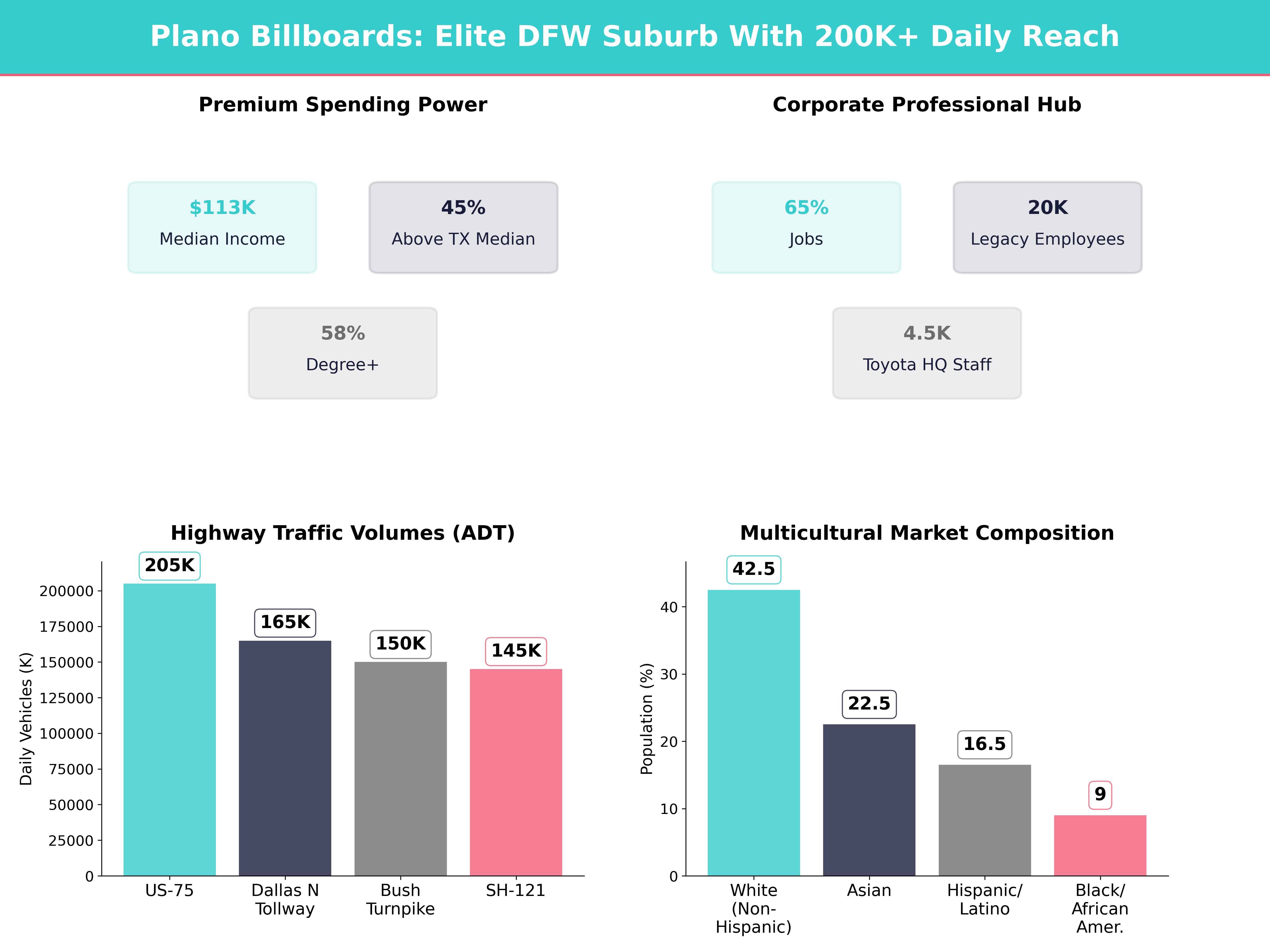
- Median household income is in the $100,000–$110,000 range (commonly cited at around $110,000–$115,000 in recent years), roughly 40–50% higher than the Texas median and about 30–40% above the U.S. median.
- More than 55–60% of adults hold at least a bachelor’s degree, almost double the statewide rate.
- Roughly 24–26% of residents are under 18, while about 10–12% are 65 and older, creating strong opportunities to speak to both families and multigenerational households.
- The average household size sits around 2.7–2.8 people, and owner‑occupied housing rates are typically in the 55–60% range—indicating a stable, established base of homeowners.
The city’s economic profile is anchored by major employers and corporate campuses clustered around Legacy and Granite Park. The Legacy area alone hosts more than 20,000 corporate employees on a typical weekday. Large operations for companies such as Toyota Motor North America (with an estimated 4,000–5,000 employees at its Plano headquarters), JPMorgan Chase, Liberty Mutual, FedEx Office, and Frito‑Lay draw tens of thousands of workers into Plano every weekday from across Collin, Dallas, Denton, and surrounding counties. Corporate and professional jobs represent a significant share of local employment, with roughly 60–70% of workers in management, business, science, and office‑based occupations. This professional base makes billboards in Plano especially attractive for brands seeking high‑value, white‑collar audiences throughout the week.
Key takeaways for messaging:
- Affluent consumers:
A high‑income base means a larger share of households with annual incomes above $150,000 and substantial discretionary spending on travel, dining, home upgrades, and education. Price‑insensitive offers, premium products, and brand‑building creative can do well. Rather than leading with discounts, lead with quality, convenience, or exclusivity. - Professional audience:
Plano’s workforce skews white‑collar, with average commute times in the 25–30 minute range and many employees traveling in from neighboring suburbs. B2B messaging, financial services, tech, healthcare, and professional services are strong fits for Plano billboards that target decision‑makers on their daily drive. - Family orientation:
Plano consistently ranks as one of the safest cities in America, and its schools are a key draw for families. Schools, extracurricular programs, healthcare providers, entertainment venues, and family‑friendly restaurants should emphasize safety, quality, and family value.
For background on city demographics and growth patterns, we recommend reviewing the City of Plano and Plano Chamber of Commerce resources as you plan. The City of Plano Economic Development office also publishes data on employers, jobs, and investment that can inform your targeting and help you choose where Plano billboard advertising will have the most impact.
Traffic Patterns and High‑Impact Corridors
Digital billboard success in Plano starts with understanding how people move through the city. Plano’s road network channels tens of thousands of commuters and shoppers across a few critical arterials, carrying both local residents and regional visitors. Choosing billboard rental in Plano along these routes lets you tap into consistent, high‑frequency exposure.
Based on recent counts from the Texas Department of Transportation, the North Central Texas Council of Governments, and regional planning agencies, the following corridors consistently see very high daily volumes:
-
US‑75 (Central Expressway)
- Common average daily traffic (ADT) volumes exceed 200,000 vehicles in segments near Plano, with several stretches between 190,000 and 220,000 vehicles per day.
- This is the backbone north–south commuter route connecting Plano with Dallas to the south and Allen/McKinney to the north.
- Many Plano workers who commute into Dallas and Richardson use this route twice daily, producing millions of monthly impressions.
- Ideal for: commuter‑focused messaging (coffee, gyms, car services, express healthcare), brand awareness for regional businesses, and time‑sensitive morning/evening campaigns using highly visible billboards in Plano.
-
Sam Rayburn Tollway (SH 121)
- ADT often ranges from 120,000–160,000 vehicles per day where it passes Plano’s Legacy and Granite Park areas; some nearby segments approach or exceed 170,000.
- Connects Plano to Frisco, The Colony, and DFW Airport, channeling shoppers to major retail and entertainment hubs such as Legacy West, Stonebriar Centre, and Grandscape
- Ideal for: retail, auto dealerships, entertainment, and weekend promotions; strong for destination‑driven advertisers drawing from the broader North Dallas suburbs.
-
Dallas North Tollway (DNT)
- While the tollway itself runs just west of Plano’s boundaries, it is a major access route for Plano workers and shoppers heading from Dallas and Addison to Plano’s west side employers and retail.
- ADT generally exceeds 150,000 vehicles per day in nearby segments between I‑635 and SH 121, with some locations topping 180,000.
- Ideal for: campaigns targeting higher‑income commuters, luxury services, and upscale retail/restaurant districts in and around Legacy West and The Shops at Legacy. For context, Legacy West alone spans more than 250 acres of mixed‑use development and draws thousands of visitors per day on peak weekends.
- Reference local info and visitor context via Legacy West.
-
President George Bush Turnpike (PGBT)
- East‑west corridor along Plano’s southern edge, often registering 130,000–160,000 vehicles per day in nearby segments, with some locations carrying more than 170,000 vehicles daily.
- Important for cross‑suburb travel and connecting Plano to Richardson, Garland, and beyond.
- Ideal for: regional businesses drawing from multiple cities; healthcare systems, higher education, and big‑box retail.
At the local level, arterials like Preston Road, Coit Road, Independence Parkway, Spring Creek Parkway, and Plano Parkway capture dense neighborhood and retail traffic, typically in the 25,000–50,000 vehicles‑per‑day range depending on the segment. These corridors are strong for reinforcing messages close to restaurants, grocery stores, shopping centers, and service businesses, and they are often where billboard rental in Plano can translate most directly into same‑day visits.
How this informs Blip strategy:
- We can prioritize high‑volume commuter corridors (US‑75, SH 121, PGBT, DNT) for broad awareness, easily reaching hundreds of thousands of vehicle trips per day, and use neighborhood arterials to reinforce messaging closer to your point of sale.
- We can deploy different creatives on boards facing inbound (toward Plano job centers like Legacy, Granite Park, and the US‑75 corporate corridor) versus outbound (toward residential areas) traffic.
- With Blip, we can raise bids during peak travel windows—morning (6–9 a.m.) and evening (4–7 p.m.)—on these corridors and run lower bids during midday for frequency and cost efficiency.
To better understand specific roadway projects and traffic changes that may affect visibility and congestion, keep an eye on TxDOT’s Collin County resources City of Plano Transportation Engineering updates, and local coverage from outlets such as Community Impact – Plano
Demographics, Diversity, and Tailored Messaging
Plano is one of the most diverse cities in North Texas. Recent local estimates suggest the racial and ethnic makeup is roughly:
- 40–45% White (non‑Hispanic)
- 20–25% Asian
- 15–18% Hispanic or Latino
- 8–10% Black or African American
- The remainder includes multiracial and other racial/ethnic groups.
In addition, nearly 30% of residents are foreign‑born, and more than 40% speak a language other than English at home. In some neighborhoods, non‑English‑at‑home rates rise closer to 50%. This has direct implications for creative and copy and should shape how you use Plano billboards to speak authentically to different communities:
- Multilingual opportunities:
For campaigns targeting specific communities (for example, Korean, Chinese, Indian, or Spanish‑speaking audiences), consider short bilingual phrases or culturally resonant imagery. Plano’s sizable Asian community—often cited at more than 60,000 residents—supports specialty grocers, restaurants, and professional services that respond well to tailored messaging. Even a few words in a second language can increase relevance. - Inclusive visuals:
Use imagery that reflects Plano’s ethnic diversity, family structures, and professional mix. People tend to respond more positively when they see themselves—or their aspirations—represented. Including diverse age groups is important as well, with more than one‑third of residents falling into prime working ages (25–54). - Education‑oriented messaging:
With high educational attainment and a strong emphasis on school quality, messaging that stresses expertise, credentials, and quality assurance (“board‑certified,” “award‑winning,” “top‑rated”) resonates particularly well. Plano’s public schools regularly rank among the top in Texas, and local families invest heavily in tutoring, test prep, and enrichment—spending hundreds to thousands of dollars per year per child in many upper‑income households.
Local institutions such as Plano ISD and Collin College shape the family and education environment; aligning messaging with school calendars and major academic milestones can be particularly effective for tutors, enrichment programs, and family services. For broader context on community makeup and neighborhood trends, the City of Plano Neighborhood Services and Collin County resources are useful reference points when refining your Plano billboard advertising strategy.
Seasonality and Event‑Based Opportunities
Plano’s event calendar creates predictable peaks in both local attention and visitor traffic that we can leverage with nimble digital billboard campaigns. The city hosts dozens of permitted events annually, and major festivals can each draw tens of thousands of attendees, which makes well‑timed billboard rental in Plano particularly powerful.
Key seasonal patterns:
-
Back‑to‑school (late July–September)
- Plano ISD serves more than 49,000 students across over 70 campuses, generating strong demand for school supplies, clothing, extracurriculars, healthcare checkups, and family services. District‑wide, back‑to‑school communications reach tens of thousands of households at once.
- Strategy: ramp up campaigns 2–3 weeks before the first day of school; daypart toward afternoon/evening when families are out shopping. Consider heavier frequency around major shopping hubs along US‑75 and SH 121.
-
Holiday shopping (November–December)
- Major retail areas—Legacy West, The Shops at Legacy, Preston Park Village, and big‑box clusters along US‑75 and SH 121—see significant traffic spikes. Regional surveys often show November–December accounting for 20–25% of annual retail sales for many categories.
- Plano’s hotels record higher occupancy around shopping weekends and holiday events, adding out‑of‑town visitors to the local audience.
- Strategy: rotate creatives to reflect Black Friday, holiday gifting, and last‑minute offers. Use proximity targeting to boards near major shopping centers and along feeder roads. Refer to Visit Plano
-
Spring and Fall events
- Events such as the Plano Balloon Festival routinely attract tens of thousands of visitors over a single weekend; some years, total attendance has approached or surpassed 90,000 across three days. Art fairs, food festivals, and sports tournaments similarly bring in large regional crowds.
- Strategy: run short, intense campaigns 1–2 weeks before and during events to capture both residents and out‑of‑town guests, with calls to action like “tonight,” “this weekend,” or “5 minutes from the festival.” Tailor maps and copy to specific venues highlighted on City of Plano Events.
-
Sports and youth activities (year‑round)
- Youth leagues, club sports, and high school athletics drive regular family travel across the city, especially evenings and weekends. Plano ISD supports multiple large high schools with stadiums that can hold thousands of spectators, plus numerous middle‑school and youth facilities.
- Strategy: schedule higher impression density on Friday evenings and Saturdays near sports complexes or main routes to them. Use family‑oriented creative emphasizing convenience (“on your way home from the game”).
Use local sources like Visit Plano Plano Parks & Recreation calendar, and City of Plano Events to build a promotional calendar. With Blip, we can easily switch creative for specific dates, hours, and boards as events approach and end, ensuring your Plano billboards always match what’s happening in the city.
Tailoring Creative for Plano’s Commuters and Shoppers
Because we are targeting drivers moving at 45–70 mph on major corridors, our creative must be simple, bold, and immediately understandable. In Plano’s environment—wide highways, multi‑lane arterials, and many clear, sunny days—specific best practices stand out:
-
Lead with one clear value proposition
- For US‑75 commuters: “Beat traffic with mobile tire service,” “Same‑day urgent care in Plano,” or “Drive‑thru coffee 1 exit ahead.” US‑75 peak‑hour speeds often drop well below posted limits, keeping drivers in view of boards longer but also increasing message clutter; clarity wins.
- For SH 121 retail: “New at Legacy West,” “50% off this weekend,” or “Now open in Frisco/Plano.” High weekend traffic toward shopping and dining destinations means strong response to event‑ and offer‑based messages.
-
Use localized identifiers
Rather than just listing an address, refer to landmarks or intersections that Plano residents recognize:- “Next to Legacy West”
- “At Spring Creek & Coit”
- “Across from Plano Senior High”
- “Just off Parker & US‑75”
This helps drivers quickly relate the ad to their mental map and can increase recall, especially for new locations or time‑sensitive promotions.
-
Design for sun and distance
- Use high contrast (light text on dark background or vice versa); Plano averages well over 200 sunny days per year, which can wash out low‑contrast designs.
- Limit copy to 6–8 words and avoid more than one call to action.
- Use large, simple fonts and a single focal image or logo.
- Ensure key information (brand, offer, location cue) is legible at 500–700 feet.
-
Time‑specific offers
With Blip’s dayparting, we can align copy with the time of day and trip purpose:- Morning: “Breakfast burritos on your way to work”
- Midday: “Lunch specials until 2 p.m.”
- Evening: “Happy Hour off PGBT, 4–7 p.m.”
- Late evening/weekend: “Open late after the game” or “Brunch near Legacy West”
-
QR codes only when appropriate
On high‑speed corridors like SH 121 or US‑75, QR codes provide limited value; drivers cannot safely scan them. Instead, use short URLs or simple search prompts (“Search: Plano Orthodontics”). For boards where speeds are lower, such as along certain surface roads or near shopping center entrances, QR codes can be more viable and can be measured via unique URLs or UTM codes.
Matching Creative to Key Local Verticals
Different types of advertisers can leverage Plano’s unique landscape in specific ways. Plano’s combination of high incomes, dense employment centers, and active families creates a strong foundation for both brand‑building and direct‑response campaigns, and for getting maximum return from billboard rental in Plano.
Retail, Dining, and Entertainment
- Plano’s major retail and entertainment districts—Legacy West, The Shops at Legacy, The District at Willow Bend, Downtown Plano Arts District
-
Strategy ideas:
- Run “2 exits away” or “Next right” messaging on SH 121 and Dallas North Tollway boards to direct regional shoppers.
- Highlight limited‑time menus, events, or store openings, rotating creative by day of week (weekday lunch vs. Friday night vs. Sunday brunch).
- Use evening and weekend dayparts, when leisure trips peak and when regional visitors are most likely to be in the car heading toward Plano destinations.
- Coordinate with event listings on Visit Plano Downtown Plano Arts District
Healthcare and Wellness
- Plano is a healthcare hub, with major systems such as Medical City Plano, Baylor Scott & White The Heart Hospital – Plano, Texas Health Presbyterian Hospital Plano, and Children’s Health Plano
-
Strategy ideas:
- Emphasize speed and convenience: “Walk‑in urgent care, open 8–8,” “Same‑day appointments,” “ER wait times under 10 min (check website).”
- Target US‑75 and PGBT for broader catchment, while using more localized boards near facilities for reinforcement and way‑finding (“Next right for urgent care”).
- Schedule campaigns around flu season (typically peaking between December and February), spring allergy season, or open enrollment windows (October–December) when health‑related search and appointment volume spikes.
Education, Camps, and Family Services
- With tens of thousands of students in Plano ISD plus a strong private‑school and after‑school market, families constantly seek enrichment and childcare solutions. Summer camps, for instance, can book hundreds of participants per session.
-
Strategy ideas:
- Run heavy bursts 4–6 weeks before summer and winter breaks and 2–3 months before the new school year, when parents are actively searching and enrolling.
- Use kid‑friendly visuals and clear calls to action like “Enroll now,” “Spots filling fast,” or “Free trial class.” Scarcity messaging can be powerful in a high‑demand, high‑income market.
- Target boards on routes families travel to schools and sports facilities, leveraging local knowledge of routes to major campuses and complexes listed on Plano ISD Athletics Plano Parks & Recreation.
Real Estate and Home Services
- Plano’s housing stock includes both established neighborhoods and newer upper‑end communities. In many Plano ZIP codes, median home values are well above the Texas average, and a high share of households invest regularly in remodeling, landscaping, and maintenance.
-
Strategy ideas:
- For real estate agents and brokerages: brand‑building campaigns with consistent name, face, and neighborhood identifiers. Given that typical homeowners stay in their homes 7–10 years, long‑term presence can pay off as households enter the move cycle.
- For home services (HVAC, roofing, landscaping, solar, pool services): weather‑triggered or seasonal creatives (“Storm damage? Call us today,” “Prepare for Texas summer heat,” “Leaf cleanup & winter prep”). Plano regularly sees summer highs in the upper 90s°F, making A/C and energy‑efficiency messages highly relevant.
- Focus boards near residential corridors like Preston, Coit, Independence, and Custer, as well as along PGBT and US‑75 where homeowners commute to and from work.
Using Blip’s Tools Strategically in Plano
Digital billboards through Blip allow us to adjust how, when, and where we appear across Plano and the broader North Dallas area, matching spend to high‑value audiences and time periods. This flexibility is central to making Plano billboard advertising both measurable and scalable.
Key tactics tailored to this market:
-
Dayparting by trip purpose
- Weekday mornings (6–9 a.m.): commuters into Plano’s employment centers; promote coffee, convenience, healthcare, and B2B brands.
- Lunchtime (11 a.m.–2 p.m.): local workers near Legacy, Granite Park, The Shops at Legacy, and office parks along US‑75; push quick‑service restaurants, fast casual dining, and mid‑day retail.
- Evenings (4–7 p.m.): both outbound commuters and local errands; strong for fitness, family activities, after‑school programs, and retail.
- Late evenings and weekends: entertainment, dining, nightlife, hotels, and events, particularly around Legacy West, Downtown Plano, and major shopping areas.
-
Location clustering
- Combine boards along US‑75, SH 121, and PGBT to form a “belt” around Plano that repeatedly exposes commuters who live in one suburb and work in another (for example, Frisco residents working in Plano or Plano residents working in Dallas/Richardson).
- Add a few boards closer to your storefront or service area to reinforce recall right before purchase—for example, placing boards near the Shops at Willow Bend or along arterial roads feeding your location.
-
Flexible budgeting
- Increase your per‑blip bid or overall budget during peak seasons (back‑to‑school, holidays, major festivals like the Plano Balloon Festival). During these periods, traffic counts, consumer spending, and ad competition all rise.
- Scale back during slower periods but maintain a light always‑on presence for brand familiarity, especially if you operate in a high‑consideration category (healthcare, real estate, financial services) where decisions unfold over weeks or months.
-
Testing multiple creatives
- In a data‑rich market like Plano, we can run A/B tests: alternate two or more creatives on the same boards and compare which generates more website visits, calls, or store traffic. Even a small difference—say, a 10–20% higher click‑through or call rate—can translate to meaningful revenue over a campaign.
- Try different messaging angles (price vs. quality vs. convenience vs. location), then double down on the best performer.
- Align tests with external factors tracked through local sources like Dallas Morning News – Plano and Community Impact – Plano
Measuring Impact and Improving Over Time
To get the most from Plano billboard campaigns, we should connect impressions to meaningful outcomes and use local data to refine our strategy. The same principles apply whether you are running a single test board or a broad network of billboards in Plano.
Practical measurement approaches:
- Before/after comparisons
Track website sessions, calls, and store traffic before and during a campaign focused on specific boards and time windows. Many advertisers aim for and often observe a 10–30% lift in key metrics during well‑timed, high‑frequency billboard flights. - Geographic filters
If you draw customers from Plano, Frisco, Allen, McKinney, Richardson, and similar suburbs, segment your data by city or ZIP code to see where lift is strongest. In many Plano‑centered campaigns, 60–80% of incremental traffic may come from a core set of nearby ZIP codes. - In‑store prompts
Use simple questions like “How did you hear about us?” or special billboard‑only offers (“Mention ‘Plano 10’ for 10% off”) to attribute foot traffic more precisely. Even capturing responses from 10–20% of customers can yield statistically useful insight over a few weeks. - Custom URLs and call tracking
Incorporate easy‑to‑remember vanity URLs or dedicated phone numbers on your billboards so you can directly quantify response. Track calls, form fills, and sales tied to these assets to estimate return on ad spend. - News and event alignment
Monitor local coverage from outlets like Dallas Morning News – Plano, Community Impact – Plano Plano Magazine for stories about corporate relocations, school rankings, transportation projects, and major events. Aligning your messaging to current topics (for example, promoting home services during widely covered storm seasons or advertising job openings during headlines about local hiring) can meaningfully boost relevance and response.
As Plano continues to grow, with ongoing corporate expansions and infrastructure improvements documented by the City of Plano and regional agencies, its roads will only get busier and its consumer base more valuable. By matching Plano’s demographic profile, commuter flows, and event calendar with Blip’s flexible digital billboard capabilities, we can create Plano billboard advertising campaigns that are precisely targeted, cost‑efficient, and capable of scaling alongside your business, no matter how many billboards in Plano you ultimately choose to include in your media mix.