Billboards in Vidor, TX
No Minimum Spend. No Long-Term Contracts. Just Results.
Trusted by Leading Brands


Billboard advertising
in Vidor has never been easier



How much is a billboard in Vidor?
Why Choose Blip for Billboard Advertising in Vidor
Blip lets you launch in Vidor fast, with self-serve control for I-10 and SH 105 commuters who pass daily between Beaumont, Orange, and Louisiana.
In Vidor, Blip-optimized campaigns auto-shift spend to the best times and boards, matching I-10's 50k-70k daily drivers and local errand traffic.
No contracts or minimums in Vidor mean you can start small, scale up for storm season or back-to-school, and pause anytime.
Use Blip dayparting in Vidor to hit 6-9am commutes, lunch runs, or 3-6pm return traffic along SH 12 and I-10.
Track Vidor results in real time, then refine creative for refinery commuters, families, and east-west travelers heading to Beaumont or Orange.
Blip's creative tools make it easy to build fast-read ads for Vidor roads, with bold, local messages that stand out to Southeast Texas drivers.
Frequently Asked Questions About Billboard Advertising in Vidor
How much does a billboard cost in Vidor with Blip?
With Blip, billboard advertising in Vidor is built to fit your budget. You set a daily amount, and Blip’s algorithm spends it on open ad slots only when your ad actually appears, so you pay on a pay-per-play basis starting at just $0.01 per display. Each “blip” is a 7.5-to-10-second ad shown on a rotating digital billboard, and the cost can change based on time of day, location, and advertiser demand.
Where can I advertise in Vidor with Blip?
In Vidor, Interstate 10 is the backbone of billboard strategy, with segments commonly running in the 50,000 to 70,000 vehicles per day range. State Highway 105 is one of Vidor's most important local-commercial routes, and State Highway 12 is another useful route for neighborhood access and east-west local travel. These corridors can work together to reach both local households and regional traffic.
Why is Vidor a good place for billboard advertising?
Vidor gives us a compact hometown market with outsized regional traffic because it sits on the main east-west path between Beaumont, Orange, and the Louisiana line along Interstate 10. State demographic profiles place Vidor at 9,687 residents in 2020, but the practical audience is much larger when we include nearby markets across Orange County, Beaumont, and Port Arthur. Southeast Texas is highly auto-oriented, which means everyday errands, refinery commutes, school runs, and interstate travel all translate into repeated billboard impressions.
What kind of traffic does Blip reach in Vidor?
In the Vidor-Orange County area, Interstate 10 commonly carries 50,000 to 70,000 vehicles per day. Orange County commuting profiles generally show that more than 90% of workers travel by car, truck, or van, which reinforces how important roadway visibility is for awareness. A well-placed board can build long-term familiarity with local residents and capture mobile audiences while they are driving.
When is the best time to run billboard ads in Vidor?
Storm season is a real planning factor in Vidor, and the Atlantic hurricane season runs from June 1 through November 30. Summer travel from Memorial Day through Labor Day can also be valuable, along with back-to-school timing in August and event windows across Southeast Texas. The page also notes that concentrated flights for 7 to 14 days before regional events can be a strong approach.
Do I need a contract to advertise with Blip in Vidor?
No, Blip has no long-term contracts or minimum commitments. You can start, pause, or stop your campaign at any time.
How fast can I launch a billboard campaign with Blip in Vidor?
You can have your campaign live in minutes. Create a free account, select your locations, set your budget, upload your design, and start running once approved.
Where can I advertise with Blip in Vidor?
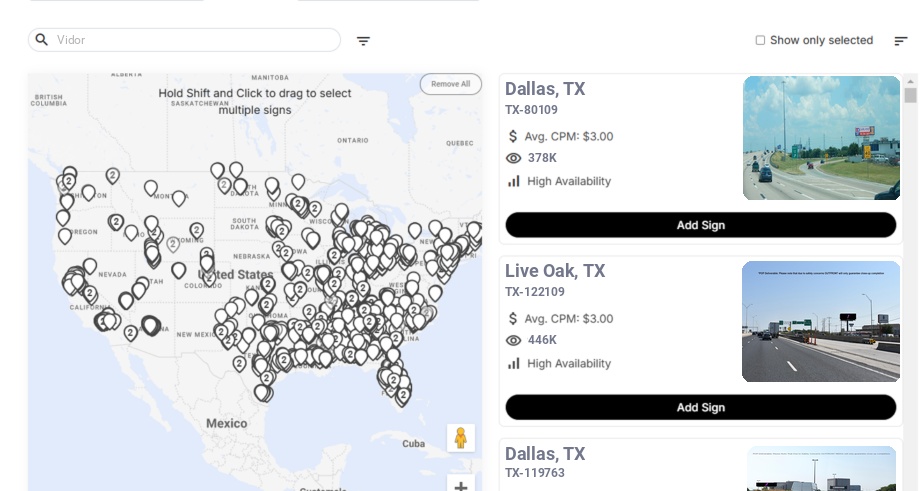
Blip has digital billboards in Vidor. You can browse available locations on a map, choose the ones that fit your audience, and start advertising right away.
Still have questions? Launch a campaign in minutes — no contracts, no commitments.
Start Your CampaignVidor Billboard Advertising Guide
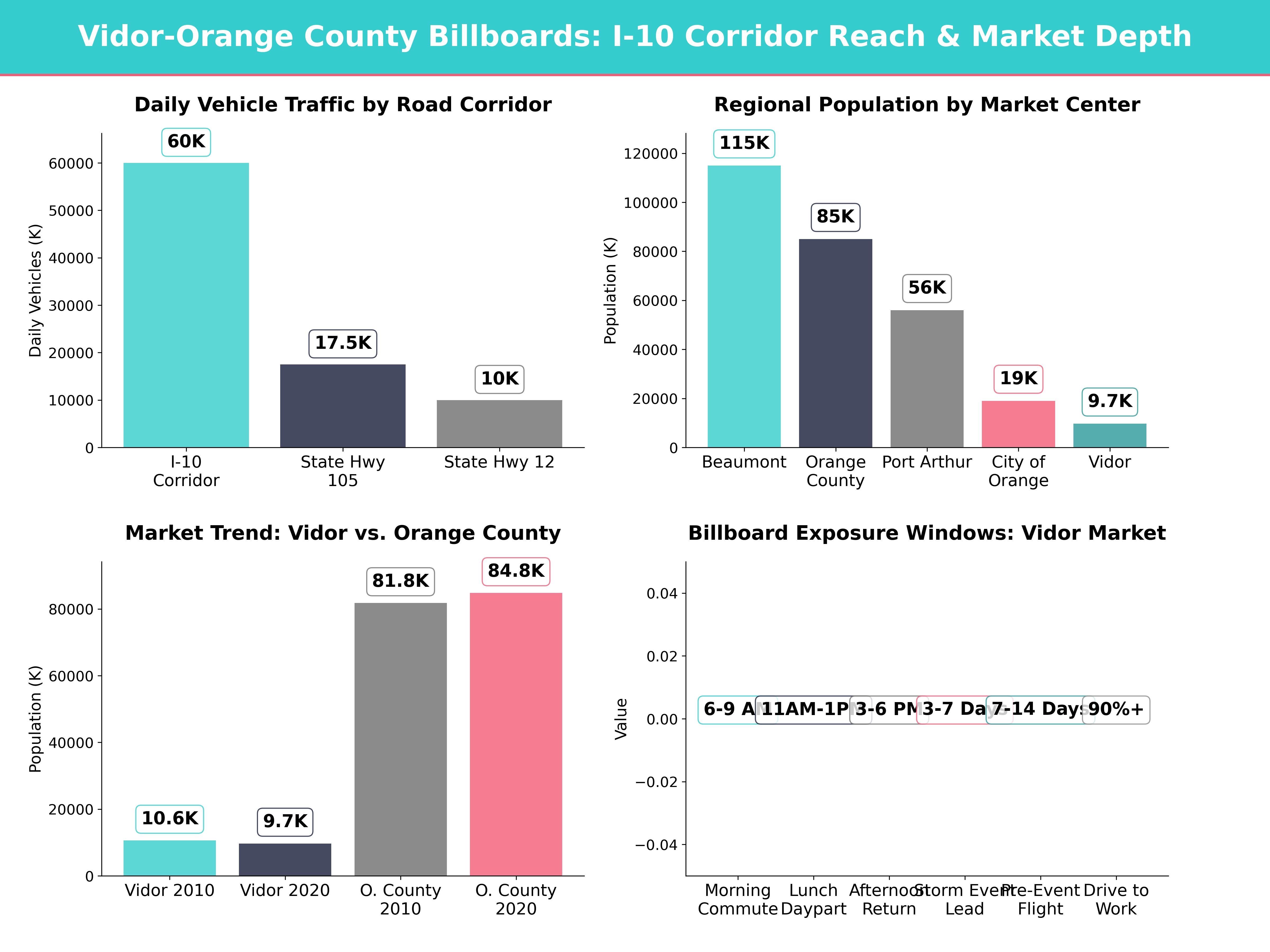
Vidor gives us a compact hometown market with outsized regional traffic because it sits on the main east-west path between Beaumont, Orange Interstate 10, where counts in the Vidor-Orange County stretch commonly run 50,000 to 70,000 vehicles per day. State demographic profiles from the Texas Demographic Center place Vidor at 9,687 residents in 2020, but the practical audience is much larger when we include 84,808 residents in Orange County, 115,282 in Beaumont, and 56,039 in Port Arthur 256,129 people across those nearby markets. Southeast Texas is highly auto-oriented, which means everyday errands, refinery commutes, school runs, and interstate travel all translate into repeated billboard impressions. When we match local relevance with regional mobility, Vidor becomes a strong place to advertise retail, healthcare, restaurants, home services, attractions, and travel-driven offers.
Market Overview for Vidor Advertising
Vidor works best when we think beyond city limits and treat it as part of the larger Southeast Texas movement pattern. The city itself is modest in size, but its position inside the Beaumont-Orange-Port Arthur corridor gives our campaigns far more scale than the municipal population alone suggests, within a combined market of more than 256,000 residents across Orange County, Beaumont, and Port Arthur.
Vidor's Size, Reach, and Trade Area
According to state demographic profiles, Vidor had 9,687 residents in 2020, down from 10,579 in 2010, which is a decline of about 8.4%. That number matters, but it does not tell the whole advertising story. Orange County grew from 81,837 residents in 2010 to 84,808 in 2020, which is an increase of about 3.6%. Nearby population centers add even more weight, including 18,643 residents in Orange, 115,282 in Beaumont, and 56,039 in Port Arthur.
That regional structure is important for billboard planning because many businesses in Vidor do not rely only on Vidor households. They also draw customers from Jefferson County 256,526 residents in 2020, plus travelers moving between Texas and Louisiana. In practical terms, that means a board near Vidor can serve both local frequency and regional reach.
What the Economy Means for Billboard Advertisers in Vidor
Southeast Texas is anchored by energy, petrochemicals, logistics, healthcare, education, construction, and small business services. Regional institutions such as the Port of Beaumont, CHRISTUS Southeast Texas Health System Baptist Hospitals of Southeast Texas, and Lamar University help sustain daily movement across the market. The Southeast Texas Regional Planning Commission also reflects how integrated the region is for commuting, freight, and housing patterns.
For advertisers, this means Vidor supports several strong categories at once:
- Local service brands can build repetition among residents who pass the same corridors every week.
- Regional brands can reach households that regularly travel to Beaumont, Orange, and Port Arthur for work, school, healthcare, and shopping.
- Travel-oriented brands can intercept eastbound and westbound interstate traffic at decision points, including I-10 segments that commonly carry 50,000 to 70,000 vehicles per day in the Vidor-Orange County area.
Car Dependence and Commuting in Vidor
Like much of Southeast Texas, Vidor is fundamentally a drive market. Orange County commuting profiles generally show that more than 90% of workers travel by car, truck, or van, which reinforces how important roadway visibility is for awareness. Even when people live in one city and work in another, they often rely on a small number of recurring routes, and that pattern is exactly what makes billboard frequency valuable.
For our campaigns, that means a well-placed board can do two jobs at once. It can build long-term familiarity with local residents, and it can also capture mobile audiences who are already in decision mode while driving.
Key Traffic Corridors Around Vidor
The Vidor market is shaped by a few roads that matter far more than the rest. When we understand those routes, we can choose placements that align with local errands, regional commuting, and through-travel.
Interstate 10 Through Vidor and Orange County
TxDOT's Traffic Count Database System and the TxDOT Beaumont District show why Interstate 10 is the backbone of Vidor billboard strategy. Depending on the count station and year, I-10 segments in the Vidor-Orange County area commonly run in the 50,000 to 70,000 vehicles per day range, with heavier volumes as the route approaches Beaumont.
This corridor is especially effective for:
- Restaurants, convenience retailers, and travel stops that need fast decision-making from pass-through drivers.
- Legal, insurance, and healthcare advertisers that benefit from repeated commuter impressions.
- Casinos, hotels, and attractions that want to influence eastbound and westbound leisure traffic moving toward Louisiana, Lake Charles, or back toward Houston.
Because I-10 carries both local and regional traffic, it usually gives us the broadest reach in the Vidor market.
State Highway 105 in Vidor
State Highway 105 is one of Vidor's most important local-commercial routes. TxDOT counts on segments through Vidor often fall in the 15,000 to 20,000 AADT range, depending on the exact location. That volume is lower than I-10, but the audience is often more locally intent and more relevant for community-based businesses.
SH 105 works well for:
- Auto repair, tire shops, and oil change brands.
- Grocery, discount retail, and pharmacy traffic.
- Clinics, dentists, and urgent care providers.
- Home improvement, HVAC, plumbing, roofing, and other service categories.
When we want Vidor households rather than broad pass-through traffic, SH 105 often becomes the smarter corridor.
State Highway 12 and Local Connectors
State Highway 12 is another useful Vidor route, especially for advertisers focused on neighborhood access and east-west local travel. TxDOT counts typically place SH 12 in the 8,000 to 12,000 vehicles per day range around the market, again depending on segment and year.
That makes SH 12 a practical fit for:
- Local dining and quick-service restaurants.
- Family entertainment and youth-oriented promotions.
- Banks, schools, churches, and community events.
- Retailers that depend on repeat exposure rather than one-time traveler traffic.
The smaller counts can actually be an advantage when we need a more concentrated local audience and less wasted regional reach.
Regional Commuter Routes West of Vidor
If our goals extend beyond Vidor, the strongest expansion move is often west toward Beaumont. Major segments of the US 69, US 96, and US 287 system in Beaumont routinely exceed 100,000 vehicles per day, making them some of the highest-visibility billboard corridors in the wider region. Those routes connect job centers, Ford Park, university traffic, healthcare campuses, and major retail clusters.
For advertisers with larger service areas, a Vidor board plus one or two Beaumont commuter boards often creates a better full-funnel plan than a Vidor-only campaign.
Audience Segments We Can Reach in Vidor
The best Vidor campaigns start with audience selection, not just location selection. This market gives us a useful mix of commuters, industrial workers, students, families, and interstate travelers.
Commuters and Cross-Market Shoppers
The core Southeast Texas cities function as one connected consumer region. Residents regularly move among Beaumont, Orange, Port Arthur, and Vidor for work, medical care, school, dining, and shopping. With 115,282 residents in Beaumont, 56,039 in Port Arthur, 18,643 in Orange, and 84,808 in Orange County overall, even a small Vidor business can justify messaging that speaks to a wider audience.
For these drivers, billboard advertising helps with recall and direction. A commuter who sees the same message 5 days a week may not act immediately, but repeated exposure often wins later when a need becomes urgent.
Industrial, Logistics, and Skilled-Trade Workers
Southeast Texas has a strong industrial identity. The regional economy is tied to refinery activity, petrochemical operations, marine shipping, fabrication, trucking, and contractor services. Institutions such as the Port of Beaumont, the healthcare systems in Beaumont, and the industrial base around Port Arthur create a large blue-collar and skilled-trade audience that moves by road at predictable times.
This segment responds especially well to:
- Clear pricing.
- Practical offers.
- Extended hours.
- Fast service claims.
- Route-based copy such as "Next Exit," "Open Late," or "Same-Day Service."
When we advertise products or services that solve workday problems, Vidor's commuter corridors become very efficient.
Students and Young Adults in the Wider Southeast Texas Market
Vidor is not a college town, but it sits close enough to several campuses that student traffic matters in regional buys. Lamar University enrolls more than 17,000 students, Lamar State College Orange serves more than 3,500 students, and the wider Lamar system, including Lamar Institute of Technology and Lamar State College Port Arthur, reaches well over 25,000 students across Southeast Texas.
That audience supports categories such as:
- Apartments and student housing.
- Affordable dining.
- Wireless, banking, and quick-turn services.
- Entertainment and event promotion.
- Career training and transfer programs.
When we pair Vidor boards with Beaumont placements, we can reach both hometown residents and college-connected consumers.
Families, Recreation Seekers, and Event Attendees
Family travel and weekend leisure are also meaningful here. Sea Rim State Park covers 5,141 acres, and Shangri La Botanical Gardens & Nature Center 252 acres, giving the region recognizable recreation anchors. Ford Park adds major event traffic with an arena capacity of 9,737 and stadium seating of 14,000.
For us, that creates strong opportunities for:
- Weekend dining and entertainment.
- Attractions and ticketed events.
- Hotels and short-stay lodging.
- Automotive, sporting goods, and outdoor retailers.
Louisiana-Bound and Texas-Bound Interstate Travelers
Vidor also benefits from border-adjacent pass-through traffic. Drivers moving between Texas and Louisiana often pass through this area with clear intent and limited time. That makes directional, time-sensitive copy highly effective, especially for Delta Downs Racetrack Casino Hotel, regional attractions, roadside food, and travel services.
Seasonal and Timing Opportunities in Vidor
Vidor campaigns perform best when we align timing with how Southeast Texas actually lives, works, and travels. Weather, school calendars, events, and holiday traffic all change demand.
Hurricane and Storm Season in Vidor
Storm season is a real planning factor here. The Atlantic hurricane season runs from June 1 through November 30, and Southeast Texas residents take preparedness seriously. That creates natural demand windows for roofing, generators, flood cleanup, insurance, HVAC service, tree removal, and hardware-related categories.
This is where flexibility matters. We can increase spend for 3 to 7 days ahead of major weather events, update creative quickly, and then shift back to standard brand messaging once conditions normalize. Brands tied to preparedness can gain relevance fast when copy is timely and practical.
Summer Travel and Weekend Leisure
From Memorial Day through Labor Day, interstate and recreation traffic usually becomes more valuable. Visitors look for dining, hotels, gaming, attractions, and family stops. Organizations such as Visit Beaumont, Visit Port Arthur Sea Rim State Park, and Shangri La Botanical Gardens & Nature Center
For summer campaigns, we usually do well with:
- Eastbound directional offers for travelers approaching Louisiana.
- Westbound reminders for return traffic.
- Weekend-heavy schedules from Friday afternoon through Sunday evening.
Back-to-School, College, and Community Timing
School calendars create another reliable cycle. Vidor ISD brings a predictable back-to-school push in August, while the Lamar campuses create traffic spikes in August and January around move-in, enrollment, and schedule changes. The spring semester close in May also supports graduation, dining, gift, and event messaging.
This timing works especially well for:
- Family retail.
- Medical and dental checkups.
- Tutoring and enrichment.
- Quick-service dining.
- Banking, wireless, and auto services.
Event Windows Across Southeast Texas
Regional events can temporarily widen the audience available to Vidor-area campaigns. The Mardi Gras of Southeast Texas Heritage Festival of Nederland, and the Southeast Texas State Fair
We often get the best value by running concentrated flights for 7 to 14 days before these events, then emphasizing directional, ticketing, dining, or overnight-stay messaging during the event window itself.
Billboard Design Tips for the Vidor Market
Creative that works in downtown Houston does not automatically work in Vidor. Here, we need messaging built for roadway speed, practical buyers, and a Southeast Texas tone.
Design for Fast Reads on Vidor Roads
Because so much of the audience is driving at highway or arterial speed, our creative should stay tight. Headlines of roughly 6 to 8 words usually work better than longer copy, especially on I-10. If we need a call to action, a simple location cue such as "Next Exit," "2 Miles Ahead," or "In Beaumont" usually beats a cluttered offer.
Use Visuals That Feel Local to Southeast Texas
The local audience generally responds to practical, familiar imagery. Trucks, families, worksites, food, outdoor recreation, boats, and service crews often feel more authentic here than abstract lifestyle art. Color palettes with bold contrast, such as deep blue, bright white, strong red, or safety orange, usually hold up well against the green roadside landscape and changing Gulf Coast weather.
Make Directional Messaging Do More Work
Vidor is a route-driven market, so directional language is especially powerful. When we tell drivers exactly what to do next, we reduce friction. That approach is useful for restaurants, fuel stops, attractions, casinos, healthcare providers, and service businesses with a clear geographic advantage.
Strong local examples include:
- "Exit Now for Hot Breakfast."
- "Westbound Drivers, Next Right."
- "Fast ER Care in Beaumont."
- "Roof Repair Before the Next Storm."
Each of those examples respects the way people move through this market.
Match the Region's Workday Rhythm
Because Southeast Texas includes many industrial, healthcare, and service workers, convenience matters. Messaging such as "Open at 6 AM," "After-Shift Appointments," "24/7 Service," or "Same-Day Estimates" often fits the real pace of local life better than softer brand-only copy.
Regional Strategies for Vidor and Southeast Texas
A strong Vidor campaign rarely uses one-size-fits-all geography. We usually get better results when we tailor our plan by sub-area.
Vidor Core Strategy
Inside Vidor itself, we should focus on SH 105, SH 12, and nearby connectors for local relevance. This is where hometown brands, schools, clinics, churches, family restaurants, and home-service companies can build repetition. The goal here is usually frequency rather than sheer reach.
West Toward Beaumont Strategy
When we need larger scale, Beaumont is the natural extension. Adding westbound and eastbound placements toward Beaumont helps us reach a city of 115,282 residents, plus major employers, hospitals, Lamar University, and Ford Park. This move is especially useful for healthcare, education, legal services, entertainment, and metro retail.
East Toward Orange and Louisiana Strategy
For travel, hospitality, casinos, and attractions, the eastbound side matters. Boards closer to Orange
Southeast Texas Industrial Belt Strategy
If our service area includes Port Arthur, the refinery corridor, or contractor-heavy business, we should think in terms of a Vidor-plus-industrial-belt plan. That means pairing Vidor visibility with stronger commuter routes serving Port Arthur Nederland, and nearby job centers. For B2B services, staffing, tools, workwear, safety products, and medical services, that wider strategy can materially improve relevance.
Using Blip Tools Effectively in Vidor
Blip is most useful in Vidor when we use it to mirror local movement instead of buying billboards as static geography. The platform gives us room to test, adjust, and localize without overcommitting.
Build Either a Vidor-Only Plan or a Wider Southeast Texas Plan
If we are a true local business, we can use a manual campaign to stay tight around Vidor corridors. If we need broader market coverage, we can let a Blip-optimized campaign spread budget across Vidor, Beaumont, Orange, and other nearby inventory. That approach is especially helpful in a market where the best audience often lives in one place, works in another, and shops in a third.
Daypart Around Real Traffic Behavior
Dayparting is especially useful here. We often see the most relevance during 6:00 to 9:00 a.m. commute hours, 11:00 a.m. to 1:00 p.m. lunch periods, and 3:00 to 6:00 p.m. afternoon return traffic. Weekend leisure brands may shift spend toward Friday evenings and Saturdays, while restaurants and healthcare providers may prefer weekday concentration.
Rotate Creative by Direction and Audience
Because Vidor sits on a directional corridor, we can make creative work harder by changing the message based on where drivers are headed. Eastbound boards can emphasize travel stops, gaming, and lodging. Westbound boards can emphasize return-trip food, shopping, or appointment-based services. We can also create one version for Vidor households and another for broader Southeast Texas commuters.
Use Analytics to Refine the Market Quickly
Vidor is a good place to test because the geography is understandable and the major routes are clear. If a specific corridor drives stronger response, we can shift budget there quickly. If one message works better for commuters and another works better for weekend travelers, we can separate them instead of forcing one creative to do everything.
Getting Started with Billboard Rental in Vidor
Renting a billboard in Vidor is easiest when we define our real market first. The city itself is small, but the road network gives us access to a much larger audience, so our first job is deciding whether we want local saturation, regional commuting reach, or interstate traveler traffic.
Start with Our Objective, Not Just the Map
Before we choose boards, we should decide what success means. A local dentist may want Vidor frequency. A casino may want eastbound I-10 traffic. A healthcare system may want both Vidor and Beaumont reach. Once we know the goal, the route choice usually becomes clearer.
Evaluate Billboard Fit by Traffic Behavior
In this market, board quality depends on how people move. We should look at direction of travel, distance from the next exit, likely driving speed, nearby retail or service nodes, and whether the board is serving a local errand pattern or a through-travel pattern. A lower-volume local board can outperform a bigger corridor if the audience is more qualified.
Expect the Best Plans to Combine Local and Regional Inventory
Because Vidor is a smaller city, many advertisers will get stronger results by combining 2 or 3 corridors instead of relying on one location. A local board in Vidor, a commuter board toward Beaumont, and a travel board on I-10 can work together to cover awareness, frequency, and intent.
Use Blip to Simplify What Traditional Buying Often Complicates
Traditional billboard buying often pushes us toward fixed commitments, limited flexibility, and long booking windows that can feel out of step with a market like Vidor. Many conventional buys are structured around 4-week blocks, even when we only need a short seasonal burst or a corridor test. With Blip, we can start smaller, compare locations, change creative, and adapt our schedule as the market changes.
For Vidor, that flexibility matters. We can launch around storm season, college move-in, fair season, or a new store opening without waiting for a long planning cycle. We can also test a Vidor-only approach first, then expand into Beaumont, Orange, or Port Arthur once the results show us where the strongest response is coming from.
When we approach Vidor with regional awareness, route-specific creative, and a flexible digital strategy, we put ourselves in position to win both hometown attention and Southeast Texas drive-by reach.