Billboards in Rosenberg, TX
No Minimum Spend. No Long-Term Contracts. Just Results.
Trusted by Leading Brands


Billboard advertising
in Rosenberg has never been easier



How much is a billboard in Rosenberg?
Why Choose Blip for Billboard Advertising in Rosenberg
Blip’s self-serve setup gets your Rosenberg billboard live fast on I-69 and SH-36, reaching commuters, freight, and Houston-bound drivers.
Set a flexible daily budget in Rosenberg and Blip keeps you in control while your ad plays near Brazos Town Center and busy local connectors.
Daypart your Rosenberg campaign for school drop-off, rush hour, or weekend shopping to match traffic on FM 2218, FM 762, and I-69.
No contracts in Rosenberg mean you can test billboards around Fort Bend County Fair season, then scale up when event traffic spikes.
Track Rosenberg results in real time with Blip analytics, then shift spend toward the corridors and times that drive the most response.
Use Blip’s creative tools to make bilingual Rosenberg ads that speak to young families, industrial workers, and long-haul travelers.
Frequently Asked Questions About Billboard Advertising in Rosenberg
How much does a billboard cost in Rosenberg, Texas with Blip?
With Blip, advertising on Rosenberg billboards is flexible enough for nearly any budget. You choose a daily budget, and Blip automatically keeps your campaign within that limit while showing your 7.5–10 second “blips” on rotating digital billboards in Rosenberg, Texas. Because Blip uses pay-per-blip pricing, you only pay for the actual ad displays you receive, and you can adjust your budget at any time.
Where can I advertise with Blip on billboards in Rosenberg, Texas?
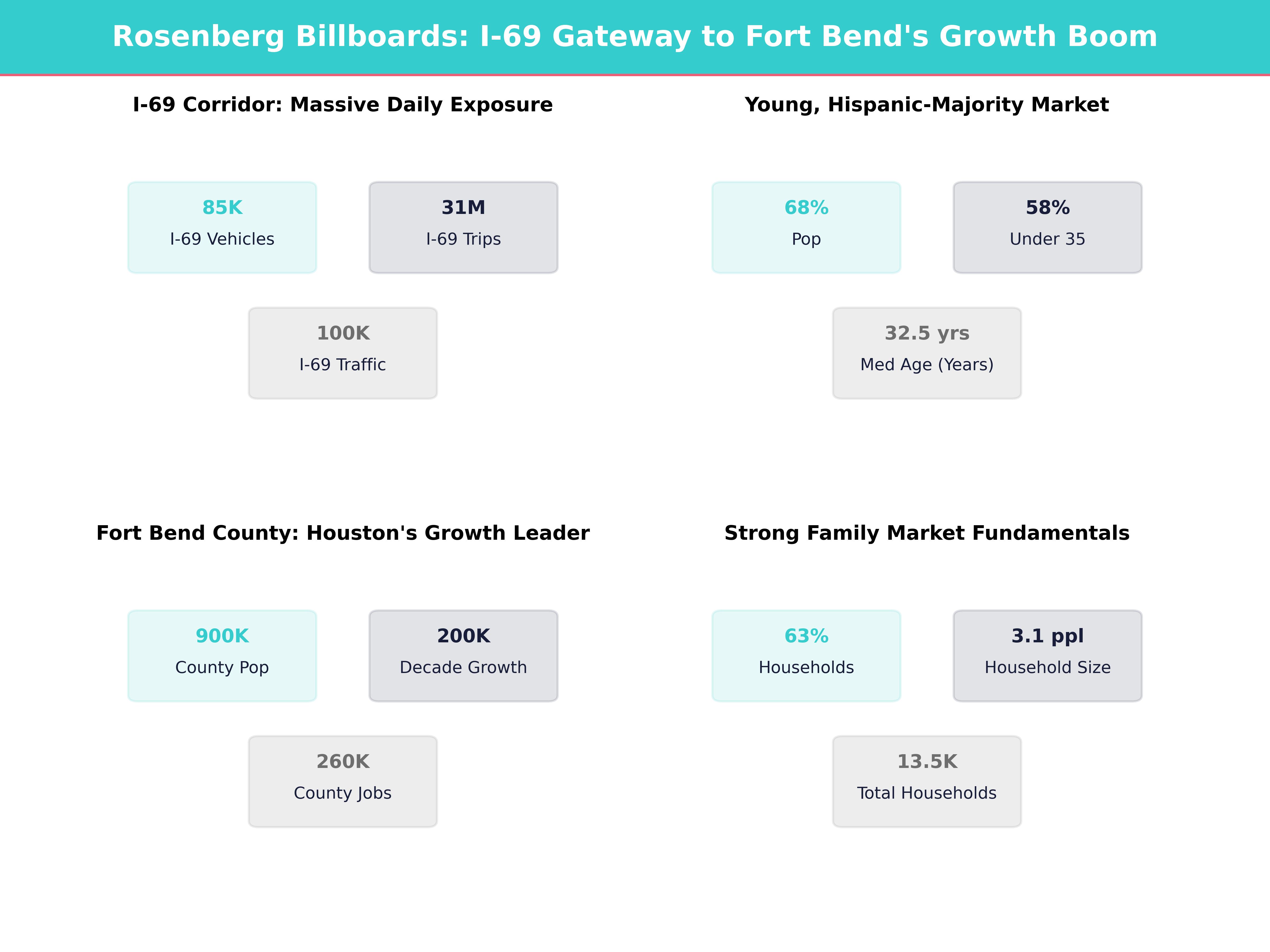
Rosenberg’s outdoor advertising power comes from a handful of high-traffic highways and retail arteries. I‑69 / US‑59 carries around 80,000–90,000 vehicles per day through the Rosenberg area, while SH‑36, FM 2218, FM 762, and US‑90 Alternate all serve local and regional traffic. Shopping and entertainment magnets like Brazos Town Center and Historic Downtown Rosenberg also drive recurring traffic.
Who sees Rosenberg, Texas billboards powered by Blip?
Rosenberg sits at the fast-growing southwest edge of the Houston metro, where suburban families, industrial workers, and long-haul travelers all share the same major corridors. The city’s median age is roughly 32–33 years, and more than 55–60% of residents are under age 35. Rosenberg also has a significant Hispanic/Latino population, frequently estimated at 65–70% of residents.
When is the best time to run a Blip billboard campaign in Rosenberg, Texas?
Rosenberg’s traffic ebbs and flows with both daily commuting and the school calendar. Morning peak runs from 6:30–9:00 a.m., and afternoon peak runs from 4:00–7:00 p.m., with weekends bringing increased traffic to Brazos Town Center and downtown Rosenberg. Blip strategy recommends ramping impressions in the 2–4 weeks preceding major events or seasonal peaks, then tapering to a maintenance level.
Why is Rosenberg, Texas a good market for billboard advertising with Blip?
Rosenberg has transformed from a small railroad town into a key growth node along the I‑69 corridor. Fort Bend County has grown to more than 900,000 residents, and the broader Houston region has surpassed 7.4 million residents. That means a Rosenberg billboard campaign can reach both local residents and regional traffic moving between Houston, the Gulf Coast, South Texas, and the Rio Grande Valley.
Do I need a contract to advertise with Blip in Rosenberg?
No, Blip has no long-term contracts or minimum commitments. You can start, pause, or stop your campaign at any time.
How fast can I launch a billboard campaign with Blip in Rosenberg?
You can have your campaign live in minutes. Create a free account, select your locations, set your budget, upload your design, and start running once approved.
Where can I advertise with Blip in Rosenberg?
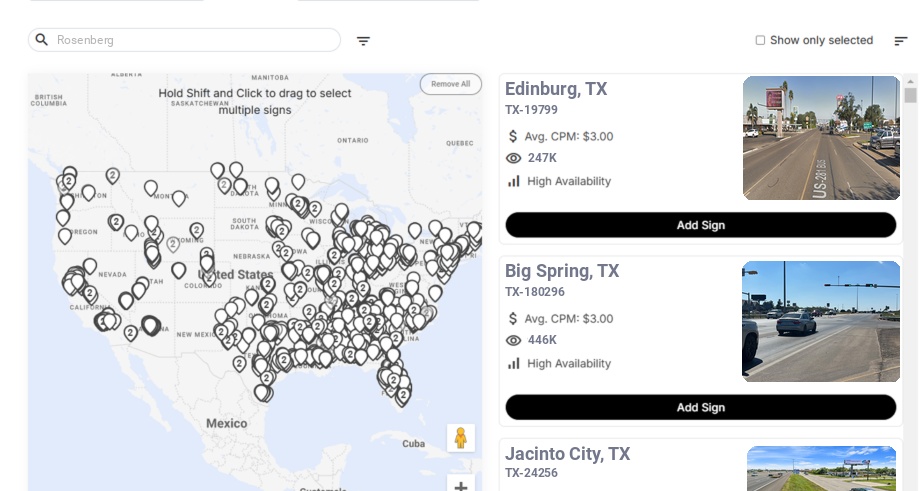
Blip has digital billboards in Rosenberg. You can browse available locations on a map, choose the ones that fit your audience, and start advertising right away.
Still have questions? Launch a campaign in minutes — no contracts, no commitments.
Start Your CampaignRosenberg Billboard Advertising Guide
Rosenberg, Texas sits at the fast-growing southwest edge of the Houston metro, anchored by the City of Houston, where suburban families, industrial workers, and long-haul travelers all share the same major corridors. With steady population growth, strong commuter traffic, and a mix of blue‑collar and white‑collar employers, digital billboards in and around Rosenberg can deliver meaningful reach on realistic budgets—especially when we use Blip’s flexibility to time, target, and rotate creative strategically across multiple Rosenberg billboards.
Understanding the Rosenberg Market
Rosenberg has transformed from a small railroad town into a key growth node along the I‑69 corridor.
-
The City of Rosenberg reports a population of roughly 40,000 residents (recent city estimates place it in the 39,000–41,000 range), while Fort Bend County overall has grown to more than 900,000 residents, adding well over 200,000 people in the last decade and remaining one of the fastest‑growing counties in Texas.
- City data and planning documents are available through the City of Rosenberg Fort Bend County.
- The county’s economic and growth trends are summarized by the Fort Bend Economic Development Council
- Rosenberg is part of the greater Houston–The Woodlands–Sugar Land metropolitan area, which has surpassed 7.4 million residents and has been adding roughly 120,000–140,000 new residents per year in recent years, according to regional planning data from the Houston-Galveston Area Council.
-
Major nearby communities:
- Richmond 13,000–14,000 residents
- Sugar Land 10–15 minutes east via I‑69, with roughly 110,000–115,000 residents
- Smaller but fast‑growing areas like Needville, Beasley, and Pleak feeding into Rosenberg for work, healthcare, and shopping
Economic context that matters for advertisers:
-
Fort Bend County’s employment base has grown by roughly 20–25% over the last 10 years, with more than 260,000 jobs across the county, spanning energy, logistics, healthcare, education, and professional services.
- Regional workforce and industry details can be explored via the Greater Fort Bend Economic Development Council
- The broader Houston region’s economy exceeds $500 billion in gross regional product, ranking among the top 10 U.S. metros by economic output, as highlighted by the Greater Houston Partnership.
From an advertising standpoint, this means a Rosenberg billboard campaign does double duty: it reaches local residents and captures regional traffic moving between Houston, the Gulf Coast, South Texas, and the Rio Grande Valley. Well-placed billboards in Rosenberg can introduce your brand to new audiences before they ever enter inner-loop Houston.
Key implications for advertisers:
- We can position creative to speak both to everyday local needs (grocery, healthcare, education, home services) and high-intent pass-through travelers (restaurants, hotels, fuel, quick services).
- Because Rosenberg anchors the southwest edge of the metro, it’s an ideal place to introduce brands to Houston‑bound drivers before they hit the denser, more expensive inner‑loop markets, making Rosenberg billboard advertising a cost-effective complement to campaigns inside Houston.
- Fort Bend continues to permit thousands of new housing units each year; some recent years have seen 4,000–6,000 new single‑family permits countywide, driving sustained demand for schools, retail, and home services that can be reached efficiently via outdoor media and targeted billboard rental in Rosenberg.
Traffic Patterns and High-Value Corridors
Rosenberg’s outdoor advertising power comes from a handful of high-traffic highways and retail arteries. According to Texas Department of Transportation (TxDOT) traffic counts and local planning documents:
-
I‑69 / US‑59 (the primary Houston–Victoria–Laredo corridor)
- Carries around 80,000–90,000 vehicles per day through the Rosenberg area, depending on the specific segment; in some stretches approaching Sugar Land, daily counts exceed 100,000 vehicles.
- Annual traffic volumes in this corridor translate into 29–33 million vehicle trips per year passing Rosenberg.
- Heavy mix of commuters, freight trucks, and long-distance travelers; TxDOT freight data indicate that trucks can account for 15–20% of traffic on key I‑69 segments in Fort Bend County.
- Access corridor details and traffic maps are available from the TxDOT Houston District
-
State Highway 36 (SH‑36)
- Carries roughly 20,000–30,000 vehicles per day as it moves north‑south through Rosenberg and into neighboring communities.
- Important for local and regional traffic heading to Brazoria County, West Columbia, and coastal industry; on some days, industrial peaks can push truck share into the 20% range.
-
FM 2218 and FM 762
- Each see in the range of 15,000–25,000 vehicles per day, acting as key connectors between subdivisions, schools, and retail centers.
- Together, these corridors support well over 10 million vehicle trips annually, much of it composed of repeat, locally based drivers—ideal for frequency and brand recall.
-
US‑90 Alternate
- Serves as an additional east‑west option with strong local and regional traffic, with typical volumes in the 15,000–20,000 vehicles per day range through parts of Rosenberg and Richmond.
Shopping and entertainment magnets that drive recurring traffic:
- Brazos Town Center (just off I‑69) anchors a major cluster of big box stores, restaurants, and services. With more than 100 acres of mixed-use development and millions of annual shopper visits, it’s one of the primary retail destinations in southwest Fort Bend. Learn more via the center’s site at Brazos Town Center.
- Historic Downtown Rosenberg, promoted through Historic Downtown Rosenberg/Main Street dozens of independent shops and eateries plus regular events that can push weekend visitation into the thousands.
- Regional draws like the Fort Bend County Fairgrounds in the nearby Rosenberg/Richmond area pull significant event traffic. The Fort Bend County Fair & Rodeo alone consistently draws 70,000–100,000+ attendees over its run, according to the Fort Bend County Fair Association.
How we can use this with Blip:
- Concentrate spend on I‑69 boards during peak commute and weekend shopping hours to maximize impressions per dollar; at 80,000+ daily vehicles, even a modest share of plays on Rosenberg billboards can yield hundreds of thousands of weekly impressions.
- Use SH‑36 and FM connectors for more locally focused messaging—perfect for schools, clinics, local restaurants, and home services—where repeat exposure to the same 10,000–20,000 local drivers builds strong frequency.
-
Daypart creative to match traffic intent:
- Morning/afternoon drive: commuters and school traffic
- Midday: shoppers, retirees, and service calls
- Evenings/weekends: dining, entertainment, retail, and faith-based audiences
Demographics: Who We’re Talking To
Rosenberg’s demographics differ from higher‑income nearby suburbs like Sugar Land, and that should influence our creative approach.
Using the latest local and regional estimates from city planning and regional demographic profiles:
-
Age
- Median age in Rosenberg is roughly 32–33 years, younger than both the Texas and U.S. averages, which sit closer to the mid‑30s.
- More than 55–60% of residents are under age 35, with large cohorts of young families and working‑age adults (25–44).
-
Households and families
- Rosenberg has around 13,000–14,000 households, with 60–65% classified as family households.
- Average household size in Fort Bend County is near 3.1 people, higher than the national average, which supports messaging around family services, multi‑line plans, and value bundles.
-
Income
- Rosenberg’s median household income is in the low‑ to mid‑$60,000s (often reported in the $62,000–68,000 range).
- Fort Bend County as a whole is much higher, commonly estimated near or above $100,000 median household income, placing it among the higher‑earning counties in Texas.
- This split means many Rosenberg residents are price-conscious, while commuter traffic includes higher‑income professionals from surrounding suburbs like Sugar Land, Richmond, and Katy.
-
Education & occupations
- Educational attainment in Rosenberg includes a strong mix of high school graduates, technical training, and some college, with a smaller but meaningful share holding bachelor’s and advanced degrees—reflecting the combination of industrial, logistics, and professional jobs in the region.
- Occupationally, the area leans into service, industrial, logistics, healthcare, and education jobs, plus white‑collar roles tied to the broader Houston economy and medical centers.
-
Ethnicity & language
- Rosenberg has a significant Hispanic/Latino population, frequently estimated at 65–70% of residents.
- In many neighborhoods, 40–50% of households speak a language other than English at home, primarily Spanish.
- Bilingual households are common, and Spanish‑influenced or bilingual creative can materially increase resonance.
Advertising implications:
- Emphasize value, savings, and practicality for locals (e.g., “No credit check,” “Same-day service,” “Under $XX per month”).
- Consider bilingual or Spanish-first creative for key messages, especially for family‑oriented products, grocery, education, and healthcare.
- For commuters from higher‑income areas, highlight quality, convenience, and time savings instead of just low price.
- The relatively young median age and high share of families mean strong potential for kids’ activities, youth sports, childcare, quick‑serve restaurants, and family healthcare campaigns that are promoted via billboards in Rosenberg.
Timing Your Campaign: Commuter Flows and Seasonality
Rosenberg’s traffic ebbs and flows with both daily commuting and the school calendar.
Daily patterns
Local counts and mobility data show typical weekday peaks:
-
Morning peak (6:30–9:00 a.m.):
- Eastbound I‑69 toward Houston and Sugar Land
- Northbound traffic on SH‑36 and FM 2218 toward workplaces and schools
- School-related trips can account for 10–15% of morning traffic volumes during the school year, according to typical regional patterns shared by the Houston-Galveston Area Council
-
Afternoon peak (4:00–7:00 p.m.):
- Westbound I‑69 returning from Houston/Sugar Land
- Strong school dismissal and after‑school activity traffic on local connectors
-
Late evening:
- Restaurant, entertainment, and shift‑change traffic, including industrial and logistics workers.
- Many industrial and warehouse operations in Fort Bend and southwest Houston run two or three shifts, creating smaller peaks around 10–11 p.m. and 5–6 a.m.
With Blip, we can:
- Increase bids and frequency during drive times if we’re targeting commuters (auto dealers, financial services, higher ed, staffing).
- Focus on midday and evening if we’re targeting shoppers, retirees, or restaurant patrons.
Weekly and seasonal shifts
-
Weekends:
- Increased traffic to Brazos Town Center, big box retailers, and downtown Rosenberg. Larger centers can see 20–30% higher foot traffic on Saturdays compared with weekdays.
- Ideal for retail, events, tourism, and dining messages.
-
School year (Lamar Consolidated ISD):
- Lamar CISD, headquartered nearby and serving over 40,000 students, drives consistent morning and afternoon flows around campuses.
- The district operates 40+ campuses (elementary, middle, high, and specialty schools), spreading school traffic across Rosenberg, Richmond, and surrounding areas.
- Perfect for family and kid‑focused advertisers, after‑school programs, tutoring, and healthcare.
-
Summer:
- More daytime shopping and leisure trips, with families moving around later in the day.
- Many local families plan sports physicals, dental cleanings, and checkups in late summer, creating a 4–6 week window of elevated demand for healthcare and back‑to‑school retail.
- Strong window for summer camps, home improvement, healthcare (sports physicals), and tourism.
-
Key event windows:
- Fort Bend County Fair & Rodeo (typically late September): draws tens of thousands of visitors—often 70,000+ across the full event; check dates via Fort Bend County Fair Association.
- City events like Christmas in Rosenberg, hot rod or car shows, and seasonal downtown festivals, featured on the City of Rosenberg events calendar thousands on a single day.
- Major retail dates: back‑to‑school (late July–August), Texas tax‑free weekend (early August), Black Friday, and the December holiday shopping season, when many retailers see 20–40% of annual sales.
Blip strategy: ramp impressions in the 2–4 weeks preceding major events or seasonal peaks, then taper to a maintenance level for general brand presence with ongoing Rosenberg billboard advertising.
Message and Creative Strategy for Rosenberg
Digital billboards in Rosenberg work best when we pair bold, simple creative with local relevance.
1. Keep it fast and clear
Drivers on I‑69 are moving at highway speeds—typically 65–75 mph. We should assume 3–5 seconds of viewing time. Design for that:
- 7 words or fewer in the main headline.
- One focal image or icon, not a collage.
- High contrast colors (e.g., dark background with light text or vice versa).
- Large, legible fonts (sans serif; avoid thin weights).
- Aim for no more than 1–2 key messages or offers per creative.
2. Localize the message
Rosenberg residents respond well to brands that feel “from here,” not “dropped in from Houston.”
Examples:
- “Serving Rosenberg & Richmond Since 2008”
- “5 Minutes from Brazos Town Center”
- “Exit SH‑36, Next to H‑E‑B”
- Include local landmarks visually when possible (e.g., stylized Brazos Town Center, downtown street scenes, or nods to the Brazos River and railroad heritage highlighted by the Rosenberg Railroad Museum).
3. Speak to bilingual audiences
Given the large Hispanic population:
- Consider fully bilingual creative (English + Spanish) when the message is short.
-
For limited space, even a few Spanish words can signal inclusion, such as:
- “Same-Day Care – Atención Hoy”
- “Sin Crédito – Drive Today”
- If running multiple Blip creatives, we can rotate an English version and a Spanish version to cover both audiences.
- Use clear, neutral Spanish that can be understood across different Latin American backgrounds, which matches the diversity seen in Fort Bend County.
4. Highlight value and convenience
For many Rosenberg households, budget and time are key decision drivers:
-
Emphasize:
- “$0 Down”
- “Free Estimates”
- “Open 7 Days”
- “Walk-Ins Welcome” / “Sin Cita”
-
Tie into commute patterns:
- “On Your Way Home on I‑69”
- “Beat Houston Traffic – Shop Rosenberg”
-
When possible, quantify the benefit:
- “Save Up to 30% vs. Houston Prices”
- “Service in Under 30 Minutes”
Using Blip’s Flexibility: Targeting by Place, Time, and Audience
Blip allows us to buy digital billboard space by the “blip” (a single play of your ad), giving us precise control over when and where our message appears. That flexibility is especially useful for testing different Rosenberg billboard advertising strategies without committing to long-term static placements.
Location strategy
For Rosenberg, we typically think in three zones:
-
I‑69 zone (regional reach)
-
Use for:
- Auto dealers
- Quick‑serve restaurants
- Hotels and travel services
- Medical systems serving multiple communities
- Messaging: directional (“Exit X”), brand awareness, cross‑city promotions.
- With daily volumes around 80,000–100,000 vehicles, even a conservative 0.5–1% share of daily impressions can still mean 400–1,000 exposures per day to your target drivers.
-
Use for:
-
Local connector zone (SH‑36, FM 2218, FM 762)
-
Use for:
- Local clinics, dentists, and urgent care
- Home services (HVAC, roofing, landscaping)
- Schools, colleges, and training programs
- Churches and non‑profits
- Messaging: community roots, testimonials, neighborhood convenience.
- These corridors primarily serve residents within a 5–10 mile radius, increasing the percentage of impressions that can realistically convert to visits or calls.
-
Use for:
-
Retail adjacency (near Brazos Town Center and key shopping clusters)
-
Use for:
- Retail sales and promotions
- Restaurants and entertainment venues
- Gyms and personal services (salons, barbers, spas)
- Messaging: offers, time‑sensitive specials, “Today Only” or weekend deals.
- Shopper surveys in similar regional centers suggest that 50–70% of visitors live within a 15‑minute drive, which aligns closely with Rosenberg’s and Richmond’s residential base.
-
Use for:
Time-of-day and day-of-week targeting
With Blip, we can select specific hours and days to run. Some examples tailored to Rosenberg:
-
Healthcare clinic
- 6:30–9:00 a.m. and 4:00–7:00 p.m. weekdays, plus Saturday mornings.
- Messaging: “Walk‑In Urgent Care – 10 Min from This Exit.”
- Consider heavier presence in August–October for back‑to‑school and early flu season.
-
Restaurant near Brazos Town Center
- 11:00 a.m.–2:00 p.m. (lunch) and 4:30–9:00 p.m. (dinner), heavier on Friday–Sunday.
- Rotate specials by day (e.g., “Taco Tuesday,” “Kids Eat Free Thursday”).
- Weekend campaigns can coincide with major shopping days that often show 20–30% more center visits than weekdays.
-
Recruiting for industrial & logistics jobs
- Early morning (5:00–7:30 a.m.) and late night (9:00 p.m.–midnight) to catch shift workers.
- Messaging: “Hiring Now – Up to $XX/hr – Apply Today.”
- Fort Bend’s industrial and logistics sectors have added thousands of jobs in recent years, with logistics and warehousing showing double‑digit percentage growth in some periods—making recruitment messaging especially timely.
Industry-Specific Tips for Rosenberg Advertisers
Different sectors can leverage Rosenberg’s patterns in distinct ways, and local billboard rental in Rosenberg can be adapted to fit each industry’s goals.
Auto Dealers and Service Centers
Rosenberg and nearby communities host multiple dealerships and a high car‑ownership rate—regional estimates routinely show 90%+ of households owning at least one vehicle in suburban Fort Bend.
-
Focus creative on:
- “Exit Now” directional messages on I‑69.
- Limited‑time offers (0% APR, trade‑in bonuses).
- Service deals for commuters: “Oil Change While You Shop Brazos Town Center.”
-
Use dayparting:
- Commute times for awareness.
- Weekends for “Visit Us Today” calls to action.
-
Consider highlighting:
- “Pre‑Owned Under $20,000”
- “Approval in 10 Minutes”
- “Se habla español – Aprobación Fácil”
Healthcare, Dental, and Vision
Local families often seek care close to home rather than driving into Houston, especially for pediatric care, urgent care, and routine visits.
-
Highlight:
- Same‑day or walk‑in availability.
- Bilingual staff or “Se habla español.”
- Insurance acceptance and financing (“Most Major Insurance Accepted,” “Plans from $XX/Month”).
-
Align with:
- Back‑to‑school season (checkups, vaccines).
- High‑allergy seasons or flu season—timely messages like “Flu Shots Available Today.”
-
Data points to emphasize:
- Fort Bend County’s population under 18 is commonly estimated around 27–30%, indicating a strong youth and family base.
- Many urgent care centers see 20–30% volume spikes during peak flu months (typically December–February), making those windows ideal for targeted billboard messaging.
Education and Training
Lamar CISD, private schools, and nearby higher education options all compete for attention.
-
Promote:
- Open houses, enrollment deadlines, and program highlights.
- Career‑oriented training tied to local industries (logistics, healthcare, energy, petrochemical).
-
Schedule heavier:
- Late winter–early spring for fall enrollment (many schools fill 50–70% of seats before summer).
- Late summer for final‑push registrations and last‑minute transfers.
-
Use geography:
- Boards on SH‑36 and local FMs can reach parents doing school drop‑off and pick‑up, which can account for several trips per week for each family.
Home Services and Contractors
Rapid housing growth in Fort Bend County means strong demand.
- The county has consistently ranked among the top 10 Texas counties for new home starts, with thousands of permits annually.
-
Use local connector boards to:
- Target neighborhoods and commuters returning home on I‑69.
- Emphasize quick response times (“24/7 Emergency Service in Rosenberg”).
-
Consider seasonal pushes:
- Spring for roofing and exterior work (storm and hail season).
- Summer for HVAC and landscaping (when daily highs regularly hit the 90s and heat index climbs above 100°F).
- Fall for insulation, windows, and interior remodeling as families prepare for the holidays.
Local Retail, Dining, and Entertainment
Downtown Rosenberg and Brazos Town Center offer a growing mix of local and chain options.
-
Tie campaigns to:
- Events promoted by the City of Rosenberg
- Holiday shopping periods and tax‑free weekends.
- Cultural and arts events featured by the Rosenberg Arts Alliance and local organizations.
-
Creative ideas:
- “Before You Hit Houston Traffic, Grab Dinner Here.”
- “Antiques & Boutiques – Historic Downtown Rosenberg, 2 Miles Ahead.”
- “Live Music Tonight – Historic Downtown Rosenberg.”
- Fort Bend tourism materials note that day‑trip and regional visitors are an important segment, often traveling 30–60 minutes for unique dining and shopping experiences—ideal for billboards that intercept visitors along I‑69 and SH‑36.
Leveraging Local Media and Community Signals
To integrate billboards into a broader marketing ecosystem, we can tap into Rosenberg’s local media and civic resources:
-
Local news and information
- Fort Bend Herald
- Houston Chronicle’s Fort Bend coverage
- Community-focused outlets like Community Impact – Fort Bend
-
City and county
- City of Rosenberg
- Fort Bend County for countywide initiatives and infrastructure updates.
- Visit Sugar Land
Practical ways to use this:
- Align billboard messaging with news cycles (e.g., promoting flood mitigation products after heavy rains, or security services after relevant local stories). Fort Bend has experienced multiple major rain and flood events in the past decade, which regularly generate heightened homeowner interest in drainage and insurance.
- Coordinate billboard pushes with sponsored events or community involvement (sponsoring a booth at a festival, then driving attendance with a board on I‑69 or SH‑36).
- Mirror headlines or themes from local outlets—such as growth, new openings, or school achievements—to make creative feel timely and locally grounded.
Measuring Success in a Rosenberg Campaign
To keep our campaigns accountable and optimized, we should plan how to measure impact from day one.
Recommended tactics:
-
Unique calls-to-action
- Use Rosenberg‑specific URLs (e.g., “/rosenberg”) or promo codes (“ROSENBERG10”) in billboard creative.
- Track which codes or URLs correspond to which boards or time windows.
- Watch for lifts of 10–30% in traffic to those URLs during active flight periods versus baseline.
-
Call tracking
- Use dedicated phone numbers displayed only on billboards in Rosenberg.
- Monitor call volume and lead quality by time-of-day and day-of-week.
- For many local service businesses, adding a well‑targeted billboard can drive 10–20% increases in inbound calls when paired with other local marketing.
-
Foot traffic and sales lift
-
For retail and restaurants:
- Compare sales and foot traffic during active billboard periods against baseline weeks (look for week‑over‑week or year‑over‑year changes).
-
For service businesses:
- Ask new customers “How did you hear about us?” and log “Billboard – Rosenberg” as a selectable source.
- Even modest lifts—such as a 5–10% increase in weekend checks or service calls—can more than cover Blip spend in many categories.
-
For retail and restaurants:
-
Blip analytics
- Track total impressions served, average bid cost, and time-of-day performance within the Blip platform.
- Shift budget toward the corridors and dayparts that generate the highest lead or sales response.
-
Over time, compare cost per lead or cost per sale across:
- I‑69 versus SH‑36/connector boards
- Commute versus weekend/daytime schedules
- English-only versus bilingual creatives
Putting It All Together
Rosenberg’s combination of fast-growing population, strong commuter flows, and regional through‑traffic makes it a powerful and cost‑efficient market for digital billboards. When we:
- Choose boards strategically along I‑69, SH‑36, and key connectors,
- Tailor messaging to younger, price‑conscious, and often bilingual local families,
- Time our campaigns to commute patterns, school calendars, and local events, and
- Use Blip’s flexible buying and scheduling tools to test and optimize,
we can build billboard campaigns that not only reach a lot of people, but also connect with the way Rosenberg residents and visitors actually live, drive, and make decisions—turning Rosenberg’s tens of thousands of daily drivers into measurable, profitable attention for your brand. Thoughtful Rosenberg billboard advertising and scalable billboard rental in Rosenberg can anchor your broader Houston-area strategy and keep your message in front of the right drivers day after day.