Billboards near Alamo, TX
No Minimum Spend. No Long-Term Contracts. Just Results.
Trusted by Leading Brands


Billboard advertising
near Alamo has never been easier
How much is a billboard near Alamo?
Why Choose Blip for Billboard Advertising near Alamo
Blip helps you launch Alamo billboards in minutes and reach I-2/US-83 commuters heading through Pharr and McAllen.
Set flexible budgets on Alamo campaigns and tap bilingual families, students, and cross-border shoppers near the Pharr-Reynosa bridge.
Daypart Alamo ads for morning Edinburg commuters or evening retail traffic on I-69C/US-281.
No contracts means you can test Blip in Alamo during back-to-school, Winter Texan season, or UTRGV event spikes.
Track Alamo performance in real time and shift spend fast when Pharr and Edinburg routes drive more clicks or calls.
Use Blip's creative tools to make clear, bilingual Alamo billboards that stand out for PSJA families and Valley drivers.
Frequently Asked Questions About Billboard Advertising near Alamo
How much does a billboard cost near Alamo, Texas with Blip?
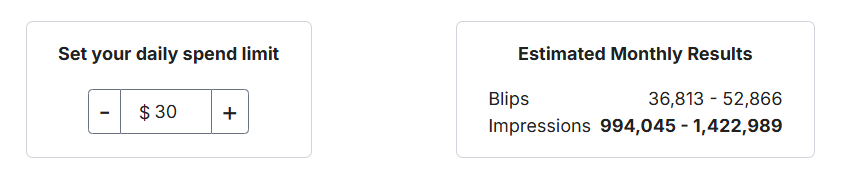
With Blip, you control exactly what you spend on Alamo billboards by setting a daily budget that can be adjusted anytime, so you only pay for the digital ad “blips” you receive. Each blip is a 7.5 to 10-second display on billboards near Alamo, Texas, and costs vary based on when you choose to run your ads and current demand. Blip’s pay-per-blip model makes advertising in the Alamo area accessible, measurable, and low-risk, so you can start reaching local drivers and refine your strategy as you go.
Where can I advertise with Blip on billboards near Alamo, Texas?
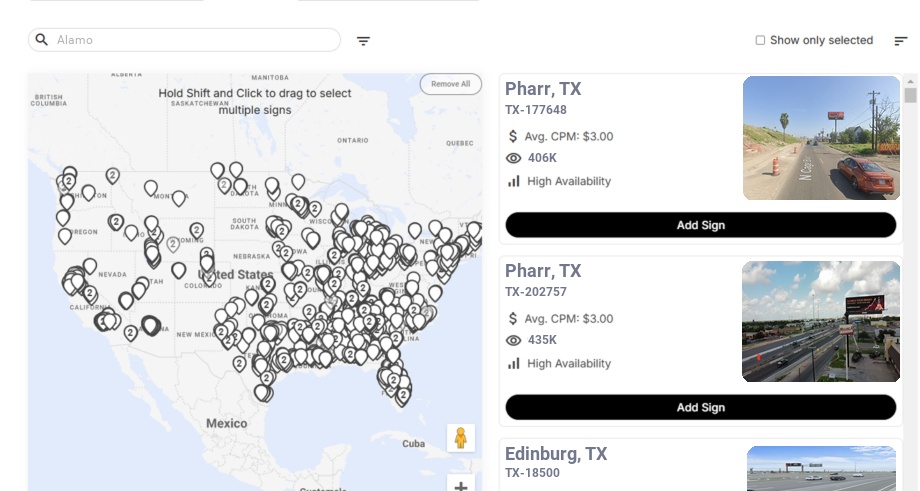
Our 10 digital billboards serving the Alamo area are strategically placed in Pharr and Edinburg, which function as major commuting and shopping corridors for Alamo residents. The Pharr boards sit about 4.3 miles from Alamo at the intersection of I-2/US-83 and I-69C/US-281, while the Edinburg boards are about 7.6 miles away and reach the city’s employment and education hub. These locations let advertisers treat the inventory as a single network of Alamo billboards, even though the structures sit just outside city limits.
Who do Alamo billboards with Blip reach in the Rio Grande Valley?
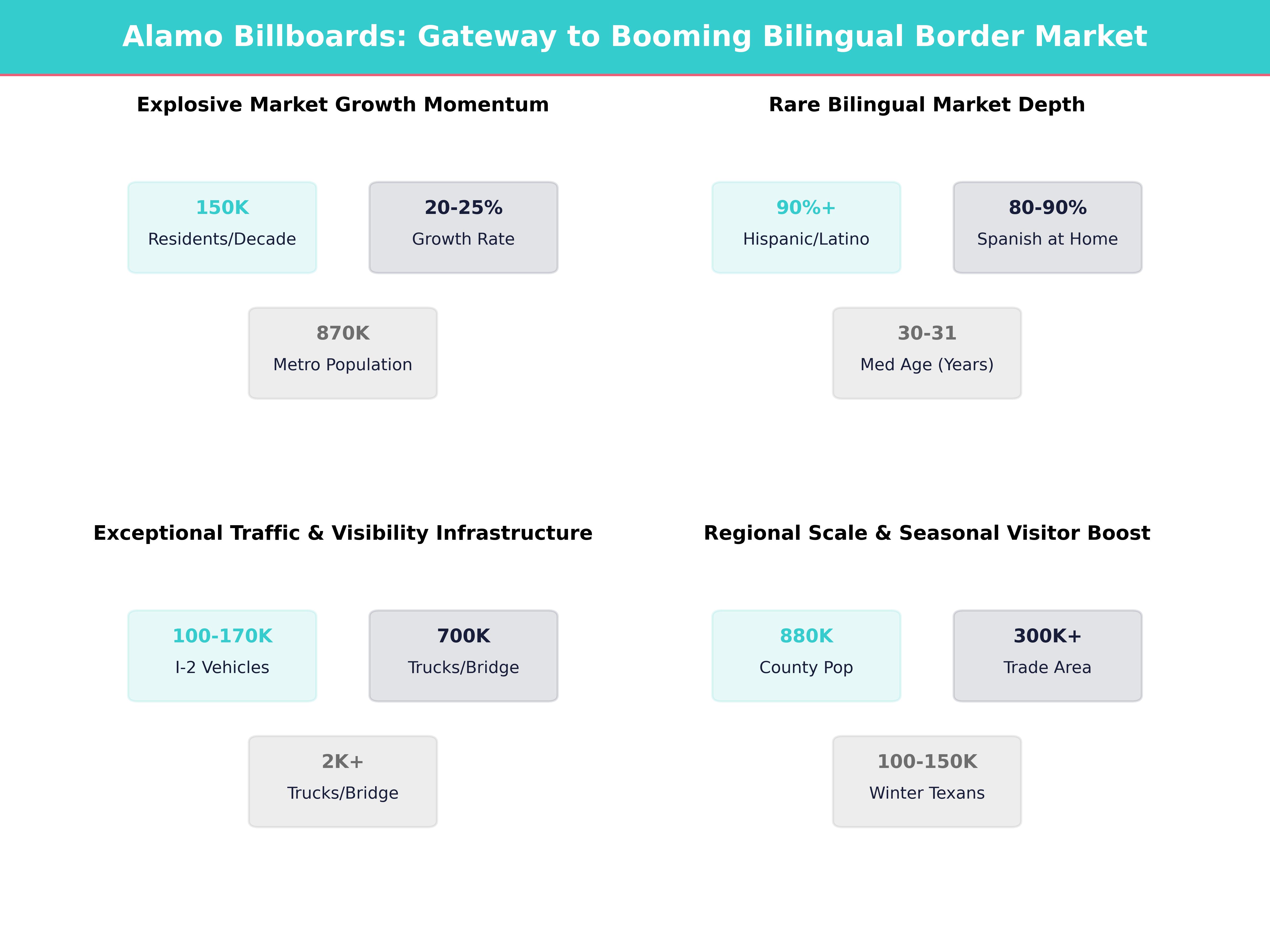
The Alamo area is predominantly Hispanic/Latino, strongly bilingual, and relatively young, with a median age around 30 to 31 years. The broader market includes family-heavy households, students, workers, and cross-border visitors, and local school districts report that Spanish is spoken at home in the large majority of homes. This makes bilingual and bicultural messaging especially important for billboard advertising near Alamo.
When is the best time to run billboards near Alamo, Texas with Blip?
Morning peak is approximately 6:30–9:00 a.m. and is heavy northbound toward Edinburg and westbound toward McAllen, while evening peak from 4:30–7:00 p.m. reverses this flow. On the busiest stretches of I-2 and I-69C, these peak windows can account for 35–40% of total daily traffic. You can also schedule blips for specific dayparts like morning, midday, afternoon, evening, or late night depending on your audience.
What seasonal billboard opportunities are there near Alamo, Texas?
The Alamo area sees strong seasonal patterns, including Winter Texans from roughly November through March, when thousands of seasonal visitors spend time across the Rio Grande Valley. Back-to-school, football season, graduations, and local festivals also create spikes in traffic and demand. Advertisers can ramp up campaigns at the start of the season, run short bursts around events, and use Blip’s flexible scheduling to match those peaks.
Do I need a contract to advertise with Blip near Alamo?
No, Blip has no long-term contracts or minimum commitments. You can start, pause, or stop your campaign at any time.
How fast can I launch a billboard campaign with Blip near Alamo?
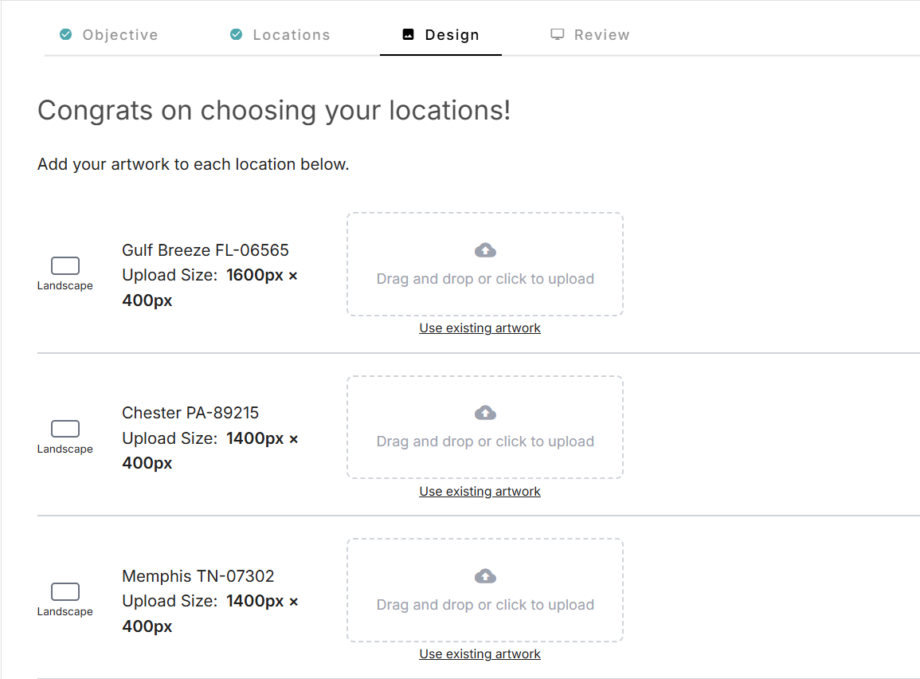
You can have your campaign live in minutes. Create a free account, select your locations, set your budget, upload your design, and start running once approved.
Where can I advertise with Blip near Alamo?
Blip has digital billboards near Alamo. You can browse available locations on a map, choose the ones that fit your audience, and start advertising right away.
Still have questions? Launch a campaign in minutes — no contracts, no commitments.
Start Your CampaignAlamo Billboard Advertising Guide
The Alamo, Texas area sits at the heart of the rapidly growing Rio Grande Valley, with fast highway connections, daily cross‑border shoppers, young bilingual families, and seasonal visitors all passing through nearby corridors. With 10 digital billboards near Alamo—located on high‑traffic routes in Pharr (about 4.3 miles away) and Edinburg (about 7.6 miles away)—we can help advertisers tap into this dynamic market using flexible, data‑driven campaigns. These Alamo billboards give brands an efficient way to extend their reach beyond online channels and capture real‑world impressions along the region’s busiest roads.
Understanding the Alamo Area Market
The Alamo area is part of the McAllen–Edinburg–Mission metropolitan region, one of the fastest‑growing metros in Texas, anchored by cities like McAllen Edinburg, and Mission
-
The City of Alamo reports steady residential growth and a family‑oriented community, supported by strong connections to Pharr, San Juan
- City site: City of Alamo
- Local business/community info: Alamo Chamber of Commerce & Visitor Center
-
The broader Hidalgo County region has surpassed 880,000 residents, with the McAllen–Edinburg–Mission metro area now exceeding 870,000 people according to regional planning and local government sources such as the Rio Grande Valley MPO Hidalgo County
- County site: Hidalgo County
- The Alamo area population is predominantly Hispanic/Latino (well above 90% in many nearby census tracts), strongly bilingual (local school districts report 80–90% of students come from homes where Spanish is spoken), and relatively young (median age around 30–31 years, compared with about 35–36 statewide). This aligns with Rio Grande Valley regional demographics reported by local agencies, public schools, and the University of Texas Rio Grande Valley.
Why this matters for billboard advertisers:
- Messages must resonate with bilingual and bicultural audiences that regularly consume media in both English and Spanish.
- The young demographic means strong demand for education, quick‑service restaurants, retail, wireless, entertainment, and auto—categories that over‑index with adults under 40 and respond well to billboard rental near Alamo and its neighboring cities.
- Proximity to Mexico, including the busy Pharr–Reynosa International Bridge, adds a layer of cross‑border shopping and logistics traffic. The bridge processes more than 190,000 northbound passenger vehicles and over 700,000 northbound commercial trucks per year, or roughly 2,000+ trucks per day, according to bridge operator reports—creating constant exposure opportunities for brands targeting freight, produce, and binational shoppers.
Local information sources worth tracking for trends include The Monitor (regional news), KRGV Channel 5 (local TV news), ValleyCentral City of Alamo
Regional tourism and visitor trend information is available from Explore RGV, Visit McAllen, and the McAllen Chamber of Commerce
Where Our Billboards Reach Drivers Near Alamo
Our 10 digital billboards serving the Alamo area are strategically placed in Pharr and Edinburg, which function as major commuting and shopping corridors for Alamo residents. These locations give advertisers a way to treat the inventory as a single network of Alamo billboards, even though the structures sit just outside city limits:
-
Pharr (about 4.3 miles from Alamo)
- Sits at the intersection of I‑2/US‑83 (east–west) and I‑69C/US‑281 (north–south). The City of Pharr has grown to more than 80,000 residents, and its retail corridors serve a trade area of well over 300,000 people when nearby communities are included.
- According to the Texas Department of Transportation (TxDOT) traffic count data and Rio Grande Valley MPO McAllen
- I‑69C/US‑281 north of Pharr toward Edinburg typically sees 80,000–110,000 vehicles per day, providing consistent daily impressions for commuter‑focused campaigns.
- TxDOT traffic maps: TxDOT Traffic Count Maps
-
Edinburg (about 7.6 miles from Alamo)
- Seat of Hidalgo County and a major employment and education hub (including the University of Texas Rio Grande Valley main campus). The City of Edinburg lists its population at more than 100,000 residents, and daytime population swells significantly because of commuters and students.
- Traffic on US‑281/I‑69C through Edinburg routinely exceeds 70,000–100,000 vehicles per day, according to TxDOT counts, with peaks during university semesters and major events at UTRGV and H‑E‑B Park
- Heavy weekday commuter flow between Edinburg, Pharr, San Juan, Alamo, and McAllen means your boards can reach the same local residents multiple times per week, reinforcing brand recall and maximizing the efficiency of billboard rental near Alamo.
This means your campaign can reach:
- Daily commuters traveling between Alamo, Pharr, Edinburg, San Juan, and McAllen, a corridor that collectively represents well over 250,000 residents.
- Shoppers filling regional stores, including major retail corridors along I‑2 in Pharr and McAllen where anchors like national department stores, warehouse clubs, and regional grocers draw tens of thousands of weekend visits.
- Logistics and commercial vehicles moving between the Pharr–Reynosa International Bridge, industrial areas, and regional warehouses. Regional data shows that more than 60% of all fresh produce entering the U.S. from Mexico by truck passes through the Rio Grande Valley, with Pharr as a principal crossing, making this a critical market for logistics and B2B advertisers looking for billboards near Alamo to reinforce their brands.
By selecting specific boards and time slots, we can focus impressions on east–west local shoppers along I‑2 or north–south commuters and students along I‑69C/US‑281, depending on your goals.
Who You’re Reaching: Audience & Demographics
The Alamo area blends families, students, workers, and cross‑border visitors, all of whom can be effectively reached via Alamo billboards placed on nearby commuter arteries:
-
Young, family‑heavy population
- School district data from Pharr‑San Juan‑Alamo ISD (PSJA ISD)—which serves a large portion of the Alamo area—shows more than 30,000+ students across the district on over 40 campuses, signaling a large base of households with children and teens. In many PSJA schools, 80%+ of students qualify for free or reduced‑price lunch, underscoring the importance of value‑oriented messaging.
- PSJA ISD site: PSJA ISD
- The median age in many Alamo‑area neighborhoods hovers just above 30, several years younger than both the Texas and U.S. averages, meaning a high share of millennial and Gen Z parents, plus young professionals.
-
Bilingual & bicultural
- Local governments and school districts consistently report that the large majority of residents speak Spanish at home, often in the 80–90% range across Hidalgo County communities, while also being proficient in English.
- PSJA ISD and nearby districts report English learner or bilingual program participation rates commonly above 35–45% of enrollment.
- Advertising that acknowledges both languages and cultures—switching seamlessly between English and Spanish on billboards near Alamo—tends to drive higher engagement and brand affinity.
-
Income & price sensitivity
- Regional data for Hidalgo County indicates median household incomes often in the $40,000–$50,000 range, compared with Texas statewide medians that are closer to the upper $60,000s. In some Alamo‑area tracts, median income falls in the low‑to‑mid $40,000s.
- This gap means value messaging, promotions, and financing options are especially effective. National retail and grocery brands commonly report stronger performance in the region when they highlight weekly specials, bundle deals, and no‑interest payment plans.
-
Students & university community
- The University of Texas Rio Grande Valley (UTRGV) Edinburg campus serves more than 24,000 students in Edinburg alone (out of a system‑wide enrollment topping 30,000 students), making Edinburg a major education hub connected to the Alamo area via US‑281.
- UTRGV employs thousands of faculty and staff, and attracts visitors for athletics, conferences, and performances, creating spikes in traffic along I‑69C/US‑281.
- UTRGV site: UTRGV Edinburg
Implications for your billboard creative and targeting:
- Emphasize clear value: discounts, bundles, “from $X/month,” “kids eat free,” “back‑to‑school specials.”
- Consider bilingual or Spanglish headlines where appropriate, especially for family, food, retail, and services.
- Use imagery that reflects local culture: families, students, regional landmarks, Valley lifestyle rather than generic stock photos.
Traffic Patterns & Optimal Placement Strategy
Understanding how and when people move around the Alamo area helps us time and place your Blip campaign for maximum impact and get more from your billboard advertising near Alamo.
Morning & Evening Commuters
- Many Alamo area residents commute toward Pharr, Edinburg, McAllen, and nearby industrial zones. Local travel surveys and MPO modeling show that a majority of Hidalgo County workers travel 10–29 minutes to work, which aligns closely with commutes from Alamo into surrounding cities.
- Morning peak (approximately 6:30–9:00 a.m.) is heavy northbound (toward Edinburg) and westbound (toward McAllen), while evening peak (4:30–7:00 p.m.) reverses this flow.
- On the busiest stretches of I‑2 and I‑69C, these peak windows can account for 35–40% of total daily traffic, concentrating impressions into a few critical hours for Alamo billboards.
Use this pattern to your advantage:
-
Service providers & appointments (clinics, dental, salons, repair shops):
- Emphasize morning spots encouraging same‑day or next‑day bookings.
- Use action‑oriented CTAs such as “Call before 10 a.m. for same‑day service.”
-
Restaurants & quick service:
- Run heavier evening and late‑afternoon blips for dinner traffic and drive‑thru promotions, when restaurant demand can rise 25–40% over mid‑afternoon baselines.
- For breakfast‑focused concepts, emphasize 6–9 a.m. on weekdays to capture commuters.
Retail & Weekend Shoppers
- Weekends bring increased traffic to regional retail centers in Pharr, Edinburg, and McAllen, along with family outings to parks, entertainment venues, and restaurants.
- TxDOT data consistently shows high Saturday volumes, sometimes on par with or exceeding mid‑week peaks on retail‑heavy corridors, particularly near major shopping centers along I‑2.
- Local mall operators and chambers of commerce often report double‑digit percentage increases in visitor counts during key retail periods such as back‑to‑school, Black Friday, and the December holiday season.
For retail campaigns:
- Increase budgets and frequency on Fridays, Saturdays, and holiday weekends, when purchase intent is highest.
- Highlight promotions tied to paydays (1st and 15th of the month), school events, and holidays.
- Run short, high‑impact bursts around tax refund season (February–April) when many families make large purchases like furniture, electronics, and vehicles.
Cross‑Border & Logistics Traffic
- The Pharr–Reynosa International Bridge is one of the busiest commercial ports of entry on the U.S.–Mexico border, handling a major share of produce and freight crossing between the two countries. Local bridge statistics show that Pharr is consistently among the top ports for fresh fruits and vegetables, with seasonal peaks during winter when northern U.S. production is low.
- Daily truck volumes number in the thousands, contributing to continuous traffic along critical corridors near our boards. Even modest estimates of 2,000–3,000 commercial trucks per day, plus employee and support traffic, create a sizable professional driver audience.
This is a strong audience for:
- Logistics, customs brokerage, cold storage, warehousing, trucking, insurance, and commercial auto services that benefit from continuous visibility on billboards near Alamo and the Pharr crossing.
- Industrial real estate and workforce recruitment, especially when promoting new distribution centers or manufacturing facilities along the I‑2 and I‑69C corridors.
Seasonal & Event‑Driven Advertising Opportunities
The Alamo area has several seasonal patterns that work well with Blip’s ability to adjust schedules and budgets any time, giving advertisers precise control over when and where they use billboard rental near Alamo.
Winter Texans & RV Visitors
- From roughly November through March, thousands of “Winter Texans” (seasonal visitors from colder states and Canada) spend time across the Rio Grande Valley, including parks and RV resorts in and near the Alamo area. Studies conducted for regional tourism groups have estimated 100,000–150,000 Winter Texans visiting the Valley in a typical season, collectively spending hundreds of millions of dollars on lodging, medical care, dining, and shopping.
- This boosts demand for restaurants, medical services, entertainment, retail, and tourism attractions. RV parks near Alamo and adjacent communities often report near‑full occupancy during peak winter months.
Strategy with Blip:
- Ramp up campaigns at the start of the season (late October/early November).
- Run daytime blips targeting retirees out and about between 10:00 a.m. and 4:00 p.m., when traffic counts in retail and medical corridors are strong.
- Use larger fonts and simple offers—this audience responds well to clarity, convenience, and trust cues such as “locally owned since 19XX.”
School & Sports Seasons
-
With PSJA ISD and nearby districts, plus UTRGV, school activities structure much of the calendar.
- Back‑to‑school (late July–August), when local retailers often see 20–30% sales lifts in school‑related categories.
- Football and sports seasons (fall), with Friday‑night games drawing thousands of spectators per week across PSJA stadiums and UTRGV events.
- Graduations and promotions (late April–June), which drive spikes in demand for photography, florists, event venues, and restaurants.
Good fits for billboard pushes:
- Back‑to‑school sales (apparel, shoes, school supplies, electronics).
- After‑school services (tutoring, childcare, extracurricular programs) when parents are commuting home.
- Event venues & photography around graduation and prom season, with clear calls to “Book Early” as capacity fills.
Local Attractions & Nature Tourism
-
The Santa Ana National Wildlife Refuge, located near the Alamo area, is a key eco‑tourism asset, attracting birdwatchers and nature enthusiasts from across Texas and beyond. Annual visitation has been reported in the tens of thousands, with peak birding seasons bringing substantial out‑of‑town traffic along local roads.
- Refuge site: Santa Ana National Wildlife Refuge
-
Local festivals and community events promoted through the City of Alamo City of Pharr, City of Edinburg, and regional tourism sites like Explore RGV or Visit McAllen bring periodic spikes in visitor traffic. Major events such as food festivals, parades, marathons, and cultural celebrations can draw thousands to tens of thousands of attendees over a weekend.
- Explore RGV: Explore RGV
- Visit McAllen: Visit McAllen
Advertisers can:
- Promote lodging, dining, tours, and local shops with campaigns tuned to event dates.
- Use short, high‑frequency bursts (3–7 days) timed ahead of events to catch inbound visitors.
- Coordinate creative with event themes (e.g., birding, culture, sports) to feel hyper‑relevant on Alamo billboards and adjacent markets.
Crafting Effective Creative for the Alamo Area
To stand out on digital billboards serving the Alamo area, creative must be:
-
Simple & high‑contrast
- Use 2–3 main colors, large fonts, and strong contrast (e.g., white or yellow on dark backgrounds). Outdoor effectiveness studies show that creatives with fewer than 7 words and strong contrast can improve ad recall by 20–30% compared with cluttered designs.
- Aim for 7 words or fewer in your headline; drivers have only a few seconds at 60–70 mph.
-
Localized & culturally relevant
- Integrate phrases that resonate locally, like “Valley families,” “cerca de ti,” or references to nearby landmarks or cities (Pharr, San Juan, Edinburg, McAllen).
- Reference known destinations such as Santa Ana National Wildlife Refuge, UTRGV, or local high schools and stadiums when appropriate.
- Showcase real people—families, workers, students from the region—rather than generic stock imagery to build authenticity.
-
Bilingual where strategic
-
For mass‑market products (grocery, QSR, retail, community services), consider:
- Spanish‑primary headline with English sub‑line, or
- Split creatives: some 100% Spanish, some 100% English.
- Local marketers frequently see improved response rates—often 10–20% higher engagement—when they tailor Spanish‑language messaging specifically rather than simply translating English lines.
- Keep each version simple; don’t overload a single frame with two full languages.
-
For mass‑market products (grocery, QSR, retail, community services), consider:
-
Offer‑driven
-
Include clear calls to action:
- “Salida X en 2 millas”
- “Order online at [short URL]”
- “Call 956‑XXX‑XXXX”
- Price points, percentages off, and time‑bound specials work particularly well with value‑conscious households. In many categories (retail, QSR, auto service), adding a specific price or discount has been shown to lift response by 15–25% versus generic branding alone.
-
Include clear calls to action:
-
Optimized for digital flexibility
- Create multiple versions for different times of day (breakfast vs. dinner), days of week (weekday vs. weekend), or audience segments (families vs. students).
- Because Blip charges only for the time and locations you choose, it’s easy to A/B test creatives and quickly shift spend to the highest performers, then pause underperforming versions in a matter of hours instead of weeks.
Using Blip’s Tools to Zero In on the Alamo Area
With Blip, we don’t have to buy broad, inflexible campaigns. Instead, we can use the platform’s controls to fine‑tune how you reach the Alamo area and structure billboard rental near Alamo around your budget and timing needs.
Board Selection
-
Focus on digital billboards along:
-
I‑2/US‑83 corridors near Pharr for:
- Retail, restaurants, auto dealers, and services drawing shoppers from the Alamo area.
- Campaigns targeting visitors heading to major shopping districts in Pharr and McAllen, where weekend traffic can rise 15–25% over weekday levels.
-
I‑69C/US‑281 corridors near Edinburg for:
- University‑related services, healthcare, professional services, and recruitment campaigns.
- Reaching the 24,000+ UTRGV students plus thousands of staff, faculty, and campus visitors.
-
I‑2/US‑83 corridors near Pharr for:
-
Combine Pharr and Edinburg boards to create a coverage “loop” hitting most commuters who live near Alamo but travel to work, school, or shopping in surrounding cities. Daily commuting patterns mean many residents will pass your boards 10–20 times per month, supporting strong frequency for billboard advertising near Alamo.
Dayparting
We can schedule blips to run only at certain hours:
-
Morning (6–10 a.m.)
- Healthcare, coffee and breakfast, radio shows, job opportunities.
- Capture the work and school rush, which represents a large share of daily traffic.
-
Midday (10 a.m.–3 p.m.)
- Senior‑focused, Winter Texan offers, shopping, mid‑day services.
- Ideal for medical appointments and errands, as many clinics in the area report heavier visit volumes late morning through early afternoon.
-
Afternoon & evening (3–9 p.m.)
- Restaurants, family entertainment, retail promotions, after‑school programs.
- Aligns with after‑school and after‑work decision windows when families pick dining and shopping options.
-
Late night (9 p.m.–midnight)
- Bars, take‑out, entertainment, and brand visibility at a lower cost per blip.
- While total traffic is lower, cost‑per‑impression can be very efficient, especially for frequency‑driven branding.
Budget Flexibility
- Blip allows campaigns starting at just a few dollars per day, scaling up as needed.
-
You can:
- Increase bids during peak dates (e.g., tax refund season, back‑to‑school, holidays, and major events promoted by Explore RGV and Visit McAllen).
- Lower spend during quieter times without canceling the campaign.
- Run short “bursts” (2–5 days) around sales events, grand openings, or recruiting drives, then pause or shift spend once the event ends.
Strategy Ideas by Business Type
Here are some tailored approaches for common advertiser categories in the Alamo area that frequently use billboards near Alamo as a core part of their media mix:
Retail & Grocery
- Target: Families and value‑conscious shoppers traveling along I‑2 between Alamo, Pharr, and McAllen. Local grocers and big‑box retailers in the Valley rely heavily on repeat visits; many households shop 2–3 times per week, providing multiple chances to influence behavior.
-
Tactics:
- Boost impressions Thursday–Sunday for weekend shopping, when household spending on groceries and discretionary items is highest.
- Rotate creatives: “3‑Day Sale,” “Back‑to‑School Deals,” “Holiday Specials.”
- Feature specific price points (e.g., “Pollo asado $X/lb,” “School shoes from $19.99”), and call out loyalty programs or fuel rewards that appeal to cost‑sensitive shoppers.
Restaurants & Quick Service
- Target: Commuters and families near Alamo heading through Pharr and Edinburg.
-
Tactics:
- Run breakfast promos 6–10 a.m., lunch deals 11 a.m.–2 p.m., and dinner offers 4–8 p.m. Studies of QSR patterns show that each of these dayparts can account for 25–35% of daily transactions when marketed effectively.
- Add a distance cue: “Next right,” “2 miles ahead on I‑2,” etc., especially when your location is directly off an interstate exit.
- Promote limited‑time items with high urgency: “This week only,” “Ends Sunday,” or “Hoy solamente” to drive immediate trial.
Healthcare, Dental & Clinics
- Target: Residents who might not see your digital ads online but regularly use regional highways.
-
Tactics:
- Position clinics as trusted, nearby, bilingual providers for the Alamo area and feature simple, reassuring messages on Alamo billboards that highlight accessibility.
- Emphasize same‑day appointments, extended hours (e.g., “Open until 8 p.m.”), and accepted insurance plans.
- Run heavier during open enrollment, back‑to‑school vaccination periods, and Winter Texan season, when demand for preventive care often rises.
Education & Training
- Target: Parents and students in PSJA and surrounding districts, plus UTRGV‑bound commuters.
-
Tactics:
- Promote registration periods, open houses, and scholarship deadlines for K‑12, charter schools, colleges, technical training, and ESL programs.
- Use youth‑oriented design and bold CTAs like “Apply Today” or “Matricúlate Ahora.”
- Time campaigns around semester starts (August and January), summer programs, and key deadlines advertised by schools and UTRGV.
Auto Dealers & Services
- Target: Drivers across I‑2 and I‑69C corridors near Pharr and Edinburg, where daily traffic routinely exceeds 70,000–150,000 vehicles.
-
Tactics:
- Promote low down‑payments, in‑house financing, and Spanish‑friendly sales teams to align with local income and language profiles.
- Focus on tax season (February–April) and holiday sales (Memorial Day, Labor Day, year‑end), which are traditionally high‑volume auto buying periods nationwide.
- For services (oil change, tires), combine price, speed, and location—for example, “Oil change in 15 minutes, 2 miles ahead on I‑2.”
Measuring and Improving Your Campaign
To make sure campaigns serving the Alamo area keep improving over time, we recommend:
-
Track store or web lift
- Compare foot traffic or sales during live weeks vs. baseline. Many retailers in similar markets have seen 5–15% lifts in store traffic during focused OOH flights when paired with in‑store promotions.
- Use simple call‑to‑action tags like “Mention this billboard for 10% off” to measure response from billboard advertising near Alamo.
-
Use short URLs or unique phone numbers
- Create easy‑to‑read links (e.g., brand.com/Alamo) for billboard‑specific landing pages. Track visits, form fills, and online orders that originate from these pages.
- Use call tracking numbers to attribute calls to outdoor campaigns and measure which dayparts (morning vs. evening) generate the most responses.
-
Test multiple creatives
- Run 2–3 versions at once and monitor which correlates with more calls, visits, or web traffic. In many OOH tests, the top‑performing creative can outperform the weakest by 30–50%.
- After 2–4 weeks, shift more impressions to top performers and retire or revise underperforming designs.
-
Adjust by time and location
- If evening redemptions are higher, increase evening daypart bids.
- If Edinburg boards drive more form fills (for example, for UTRGV‑related services or professional offices), shift more budget north on US‑281/I‑69C.
- Use ongoing data from your POS, web analytics, and call logs to refine geographic and temporal targeting over time.
By combining local knowledge about the Alamo area with Blip’s precise controls—board selection, dayparting, creative rotation, and flexible budgets—we can build campaigns that not only reach large numbers of drivers but also align closely with how people live, work, shop, and travel near Alamo, making the most of every dollar you invest in billboard rental near Alamo and its surrounding corridors.