Billboards near Cedar Hill, TX
No Minimum Spend. No Long-Term Contracts. Just Results.
Trusted by Leading Brands


Billboard advertising
near Cedar Hill has never been easier
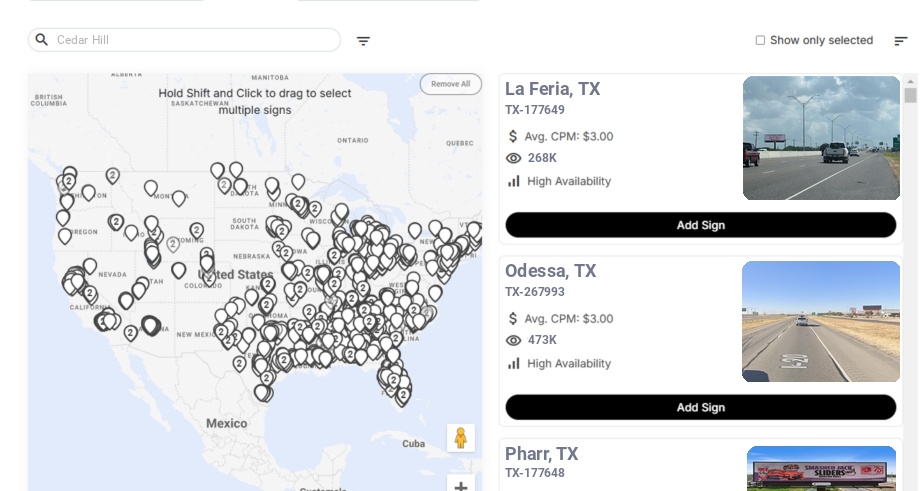



How much is a billboard near Cedar Hill?
Why Choose Blip for Billboard Advertising near Cedar Hill
Blip lets you launch fast in Cedar Hill with self-serve digital ads for drivers on US 67, I-20, and FM 1382.
Set flexible budgets in Cedar Hill and reach suburban commuters, shoppers, and weekend lake traffic without a big upfront buy.
No contracts means Cedar Hill advertisers can test Hillside Village, Joe Pool Lake, and school-run traffic, then pause anytime.
Use dayparting in Cedar Hill to hit 6-9 a.m. commuters and 3-7 p.m. families moving on SH 360 and US 287.
Blip's real-time analytics help Cedar Hill campaigns adapt as traffic shifts across the Dallas-Fort Worth corridor.
Build and tweak creative fast for Cedar Hill with Blip tools, perfect for short 7.5-second messages on busy local roads.
Frequently Asked Questions About Billboard Advertising near Cedar Hill
How much does a billboard cost in Cedar Hill, Texas with Blip?
With Blip, you can set your own budget and only pay when your ad actually appears on digital billboards serving the Cedar Hill area. Pricing can change based on time of day, location, and advertiser demand, and costs can start as low as $0.01 per display. Your total spend is simply the sum of each blip over time, and there are no minimums or contracts.
Where can I advertise with Blip near Cedar Hill, Texas?
Blip can launch digital billboard ads serving the Cedar Hill area, and the nearby inventory includes 4 digital billboards in Mansfield, about 8.4 miles from Cedar Hill. Those screens help advertisers stay visible on routes that serve Cedar Hill and the surrounding southern DFW area. The market also includes key corridors like US 67, FM 1382, I-20, US 287, and SH 360.
What kind of drivers and traffic does the Cedar Hill, Texas market have?
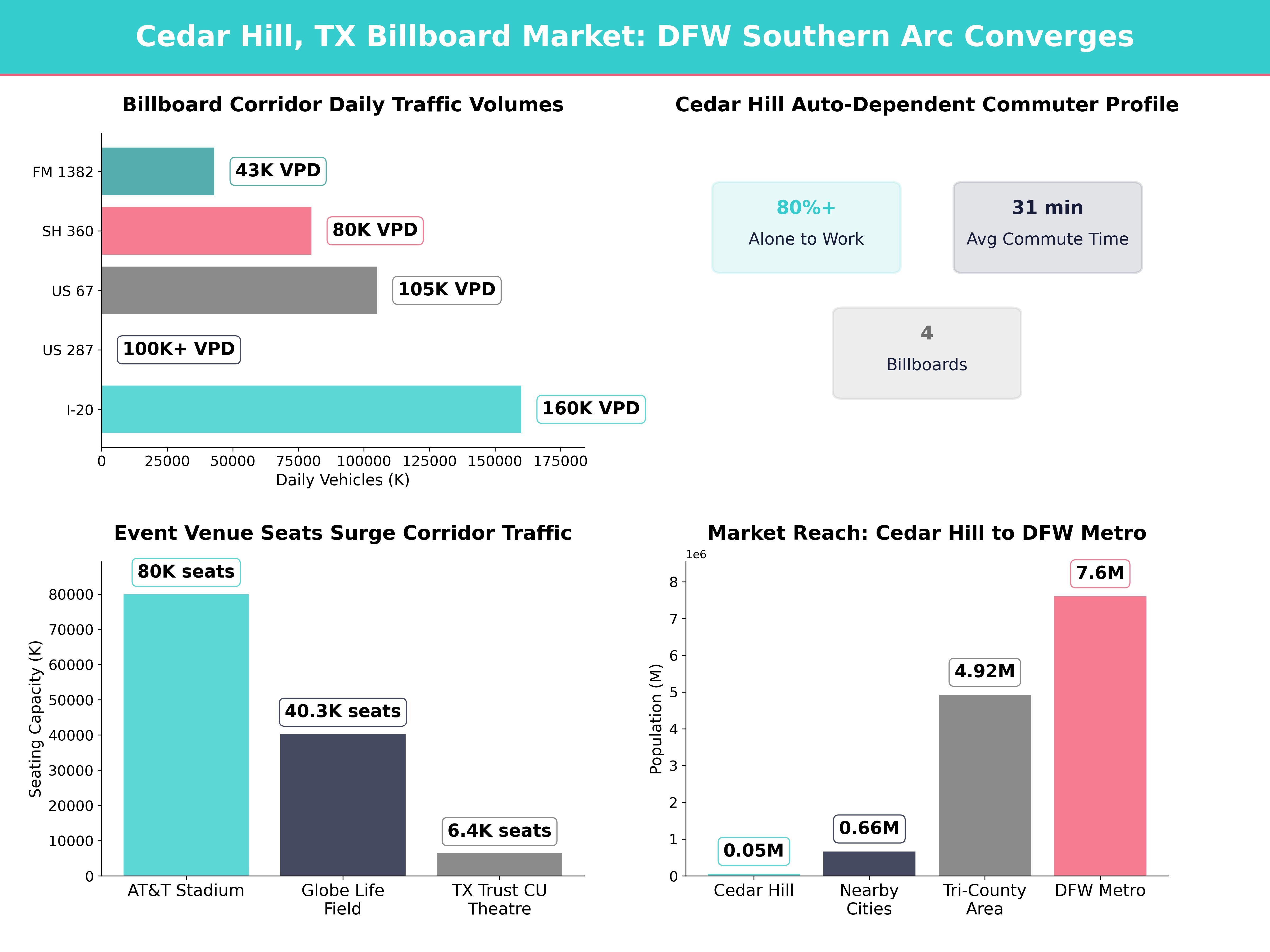
Cedar Hill is an auto-oriented market where more than 80% of workers drive alone, with an average commute of about 31 minutes. Major road segments in the area include I-20 at 150,000 to 170,000 vehicles per day, US 67 at about 90,000 to 120,000, and FM 1382 at roughly 35,000 to 50,000. That mix creates strong exposure for commuter, shopping, and weekend travel campaigns.
Why is Cedar Hill, Texas a good market for Blip billboard ads?
The Cedar Hill area combines suburban households, regional shopping traffic, and cross-metro commuting in a metro of about 7.6 million residents. It sits near Dallas County, Ellis County, and Tarrant County, with several key corridors carrying 100,000-plus vehicles per day. That makes it a practical fit for local businesses, regional brands, schools, healthcare groups, retailers, and event marketers.
When is the best time to run a billboard campaign in Cedar Hill, Texas with Blip?
Spring and summer are especially strong because families spend more time at parks, trails, and the lake, and there is more midday movement and recreation travel. Fall also brings back-to-school demand, while the holiday season is often strongest during the 5- to 6-week period from mid-November through late December. For dayparting, the page recommends 6 a.m. to 9 a.m. for commuters, 11 a.m. to 1 p.m. for restaurants and retail, and 3 p.m. to 7 p.m. for school pickup and errands.
Do I need a contract to advertise with Blip near Cedar Hill?
No, Blip has no long-term contracts or minimum commitments. You can start, pause, or stop your campaign at any time.
How fast can I launch a billboard campaign with Blip near Cedar Hill?
You can have your campaign live in minutes. Create a free account, select your locations, set your budget, upload your design, and start running once approved.
Where can I advertise with Blip near Cedar Hill?
Blip has digital billboards near Cedar Hill. You can browse available locations on a map, choose the ones that fit your audience, and start advertising right away.
Still have questions? Launch a campaign in minutes — no contracts, no commitments.
Start Your CampaignCedar Hill Billboard Advertising Guide
The market near Cedar Hill 7.6 million residents. Cedar Hill sits at a strategic point between Dallas County, Ellis County Tarrant County, so billboard campaigns near Cedar Hill can influence drivers moving through the southern Dallas-Fort Worth arc, where several key corridors carry 100,000-plus vehicles per day. Our 4 digital billboards in nearby Mansfield 8.4 miles from Cedar Hill, help advertisers stay visible on routes that serve the Cedar Hill area. That combination of commuter volume, destination travel, and repeat local errands makes billboard advertising near Cedar Hill a practical fit for local businesses, regional brands, schools, healthcare groups, retailers, and event marketers.
Cedar Hill area market overview
Population, geography, and regional scale
We like the Cedar Hill area because it combines a defined local identity with access to a much larger metro economy. The City of Cedar Hill 2020 population of 49,148, and it sits about 16 miles southwest of downtown Dallas and roughly 23 miles southeast of downtown Fort Worth. Cedar Hill also spans parts of Dallas and Ellis counties, which means brands serving the Cedar Hill area are not limited to one county line or one consumer pattern.
The surrounding population base is substantial. Dallas County had 2,613,539 residents in 2020, Ellis County 192,455, and Tarrant County had 2,110,640. Together, those three counties totaled about 4.92 million residents in 2020. The broader Dallas-Fort Worth-Arlington metro counted about 7.6 million residents in 2020, and the North Central Texas Council of Governments continues to plan for long-term regional growth.
Nearby cities add even more buying power around Cedar Hill. Mansfield 72,602 residents in 2020, Arlington had 394,266, and Grand Prairie had 196,100. Together, those nearby cities totaled about 662,968 residents in 2020. For advertisers, that means the Cedar Hill area is part of a large, connected suburban trade zone rather than an isolated small city market.
Economic activity and commuting behavior
We also see a healthy mix of economic drivers serving the Cedar Hill area. Local spending is supported by neighborhood services, homeownership-based demand, schools, retail destinations such as Hillside Village, recreation around Joe Pool Lake, job access to Dallas, Arlington, Grand Prairie, Mansfield, and other southern DFW employment centers. That creates strong opportunity for categories such as healthcare, legal services, home improvement, automotive, colleges, dining, entertainment, financial services, and family retail.
Mobility patterns are especially important for out-of-home advertising near Cedar Hill. Community commute data consistently shows more than 80% of Cedar Hill workers driving alone, with roughly 1 in 10 commuting by carpool, and the average trip to work is about 31 minutes. In other words, this is a deeply auto-oriented market where people spend meaningful time on arterial roads and regional highways. When we build campaigns serving the Cedar Hill area, we can lean into that routine repetition and reach the same households multiple times each week.
Key traffic corridors serving the Cedar Hill area
The highways and arterials that matter most
The most important road network serving the Cedar Hill area includes US 67, FM 1382, I-20, US 287, and SH 360. These are the routes that connect Cedar Hill with DeSoto, Duncanville, Arlington, Grand Prairie, Mansfield, Midlothian, and the larger Dallas-Fort Worth commuter shed.
On nearby Texas Department of Transportation traffic count maps, major segments of I-20 in this part of Dallas County commonly run in the 150,000 to 170,000 vehicles-per-day range. US 67 near Cedar Hill is often in roughly the 90,000 to 120,000 vehicles-per-day range, depending on segment. FM 1382, which is one of the most important local connectors for Cedar Hill households and shopping trips, typically lands around 35,000 to 50,000 vehicles per day on busy stretches. To the west, US 287 through Mansfield is a 100,000-plus corridor on major segments, and SH 360 often carries about 70,000 to 90,000 vehicles per day depending on location.
Those numbers matter because Cedar Hill-area travel is not confined to one road or one purpose. Weekday drivers use these corridors for commuting, school runs, appointments, and errands. Weekend drivers use them for shopping, youth sports, dining, entertainment, and recreation.
Why nearby Mansfield screens can serve Cedar Hill well
Our digital inventory is in Mansfield I-20, US 67, US 287, SH 360, and FM 1382. Drivers from Cedar Hill regularly head west and southwest toward Mansfield, Arlington, and Grand Prairie for retail, restaurants, work, events, and family activities. They also use the regional system in reverse when coming back toward Cedar Hill from employment and entertainment centers.
We usually think about Cedar Hill-area traffic in three practical layers. Northbound and eastbound commuters use US 67 and I-20 connections to reach jobs and services in southern Dallas County and the wider metro. Westbound crossover traffic moves toward Mansfield, Arlington, and Grand Prairie via US 287, SH 360, and connected arterials. Local retail and recreation traffic concentrates around FM 1382, Hillside Village, Joe Pool Lake access points, and neighborhood service corridors.
That is why a billboard strategy near Cedar Hill should be built around travel behavior, not just city limits. If your customers live in Cedar Hill but spend time in Mansfield, Arlington, or Grand Prairie, nearby screens can still influence purchase decisions at the right moment.
Audience segments near Cedar Hill
Commuters and household decision-makers
We see commuters as the foundation of most Cedar Hill-area campaigns. The local drive-alone rate is above 80%, the average commute is about 31 minutes, and regional job access extends across multiple counties. That makes the Cedar Hill area a strong fit for businesses that need repeated exposure, including healthcare providers, dental groups, personal injury firms, insurance agencies, banks, home service companies, and auto-related brands.
For many advertisers, the real target is not just “drivers.” The target is the household decision-maker who chooses where to shop, who to call, and where to spend on weekends. In suburban markets like Cedar Hill, that audience often overlaps with commuters, parents, and errand traffic.
Recreation and weekend visitors
Cedar Hill has an unusual outdoor identity for North Texas, and we recommend that advertisers use it. Cedar Hill State Park covers 1,826 acres, Joe Pool Lake spans about 7,400 acres, Cedar Ridge Preserve 600 acres, and Dogwood Canyon Audubon Center 205 acres. Those destinations help make the Cedar Hill area a real weekend draw for hikers, campers, boaters, cyclists, and families.
That outdoor pull expands the audience beyond residents alone. Restaurants, hotels, event venues, outdoor retailers, family attractions, and regional service brands can all benefit when they time creative to weekend recreation patterns. We often recommend a different message for Thursday through Sunday than for Monday through Wednesday when a campaign is targeting the Cedar Hill area’s leisure economy.
Students, parents, and school-linked households
Families are a major audience near Cedar Hill. Cedar Hill ISD serves roughly 8,000 students, and nearby Mansfield ISD serves about 35,000. Those districts create steady traffic for back-to-school promotions, tutoring, youth programs, urgent care, orthodontics, quick-service restaurants, and family retail.
Higher education also expands the reachable audience around Cedar Hill. The University of Texas at Arlington enrolls more than 40,000 students, Dallas Baptist University enrolls about 4,300, and the University of North Texas at Dallas serves more than 4,000 students. Together, those schools serve well over 48,000 students. Not all of those students live in Cedar Hill, but many commute through the same southern DFW corridors that serve the Cedar Hill area.
Sports and entertainment audiences
The western side of the Cedar Hill trade area also benefits from major event traffic. AT&T Stadium 80,000, Globe Life Field holds about 40,300, and Texas Trust CU Theatre 6,350. Together, those venues represent more than 126,000 seats. That means campaigns near Cedar Hill can also reach event-goers heading toward Arlington and Grand Prairie, especially when they travel through Mansfield-area routes.
For entertainment, dining, hospitality, and impulse-purchase brands, those event-driven trips can be just as valuable as weekday commutes.
Seasonal and timing opportunities for the Cedar Hill area
Spring and summer opportunities near Cedar Hill
Spring is one of the best times to advertise near Cedar Hill because local behavior widens beyond home-work-home routines. Warmer weather lifts visitation to parks, trails, and the lake, and families begin planning spring break, graduation, and early summer activities. A 1-week spring break window can be especially useful for family attractions, restaurants, tourism offers, youth camps, and health-and-wellness promotions.
Summer also matters because the school break lasts roughly 8 to 10 weeks for many families. That creates more midday movement, more recreation travel, and more family spending decisions. We often recommend that summer campaigns serving the Cedar Hill area emphasize convenience, fun, heat relief, and destination messaging. Creative tied to lake days, air-conditioned entertainment, summer sales, quick meals, or weekend escapes usually fits the season well.
Fall, football, and holiday timing
Fall brings a different rhythm. Back-to-school buying accelerates from late July through September, school sports build frequency from late August through November, and family schedules become more structured again. For advertisers near Cedar Hill, that is a strong window for healthcare, tutoring, school services, apparel, automotive, grocery, and community events.
The holiday season is another major opportunity. The most important retail stretch is often the 5- to 6-week period from mid-November through late December. Around Cedar Hill, that demand is supported by local gift shopping, dining, entertainment outings, and westbound travel toward Arlington and Grand Prairie destinations. If we are promoting a retailer, restaurant, service business, or event venue, we usually want holiday creative live before Thanksgiving rather than after it.
Dayparting recommendations
When budget efficiency matters, we usually prioritize the highest-intent windows first. We like 6 a.m. to 9 a.m. for commuter categories such as healthcare, legal, automotive, colleges, and home services. We like 11 a.m. to 1 p.m. for restaurants, retail, and appointment-driven businesses. We like 3 p.m. to 7 p.m. for school pickup traffic, errands, dining, and household decision-making. We like Thursday through Sunday for recreation, shopping, events, and entertainment-heavy campaigns.
Billboard design tips for the Cedar Hill market
Visual themes that match local identity
Cedar Hill stands out in North Texas because of its hills, green space, lake access, and family-oriented suburban character. We recommend creative that reflects that identity when it fits the brand. Blues and greens can work especially well for healthcare, recreation, home services, and family offers because they echo Joe Pool Lake, parks, and trail culture. Rich reds, blacks, and bold contrast can work better for sports, entertainment, retail urgency, and commuter offers.
We also suggest using local cues that feel natural to the Cedar Hill area. References to US 67, FM 1382, lake weekends, game days, and family convenience tend to be more relatable than generic metro-wide copy. A message such as “Off 67,” “Near the Lake,” or “Game Day Specials” is often easier for a local driver to process quickly than abstract branding language.
Layout and copy for fast-moving roads
Because the roads serving Cedar Hill include high-speed regional routes, simplicity matters. We recommend 6 to 8 words of primary copy, 1 focal image, and 1 clear call to action. That structure is especially important on digital boards because each ad appears for only 7.5 to 10 seconds in rotation.
A few practical design rules usually help in this market. We keep the main offer readable at a glance, because drivers on US 287, SH 360, I-20, and US 67 do not have time to decode cluttered layouts. We use large type and strong contrast, because afternoon sun and fast-moving traffic can punish subtle design. We avoid tiny URLs, long taglines, and multi-offer layouts, because each extra element reduces recall. We often create separate versions for weekdays and weekends, because commuter intent and recreation intent are not the same audience mindset.
If bilingual messaging is important, we usually prefer alternating creatives rather than trying to fit two full languages into one short billboard message.
Regional strategies near Cedar Hill
South Dallas County commuter strategy
If your goal is daily repetition, we recommend building around commuter behavior in the broader Cedar Hill area first. That means messaging for people traveling between Cedar Hill, DeSoto, Duncanville
Westbound crossover strategy through Mansfield
Our 4 digital billboards in Mansfield 8.4 miles from Cedar Hill, are especially useful when your audience travels west for shopping, sports, dining, or work. We often recommend this approach for entertainment brands, colleges, restaurants, medical groups, auto dealers, family attractions, and retail destinations that draw from multiple suburbs. The Mansfield Area Chamber of Commerce market is not separate from the Cedar Hill area in practice; many consumers move between the two as part of normal weekly life.
Retail and recreation cluster strategy
Another strong approach is to align your campaign with destination behavior rather than pure commuting. The Cedar Hill area has meaningful pull from Hillside Village, Joe Pool Lake, Cedar Hill State Park, Arlington entertainment venues, and Grand Prairie attractions. That strategy tends to work best for restaurants, event marketers, furniture stores, home improvement brands, tourism offers, fitness businesses, and family entertainment.
Geographic segmentation we often recommend
When we plan campaigns serving the Cedar Hill area, we usually separate messaging into these zones. The local household zone focuses on Cedar Hill families, schools, and repeat errand traffic. The regional commute zone focuses on drivers moving between Cedar Hill and Dallas County employment corridors. The westbound destination zone focuses on travel toward Mansfield, Arlington, and Grand Prairie. The southward growth zone can include Midlothian
Blip tools for campaigns serving the Cedar Hill area
Planning around actual travel behavior
We use Blip’s map-based buying tools to match boards with the roads and behaviors that matter most for the Cedar Hill area. Instead of buying a generic package, we can choose the specific digital billboards near Cedar Hill that line up with commuter flows, westbound destination trips, or weekend recreation traffic. That is especially helpful in a market like this one, where a short geographic distance does not always mean the same audience behavior.
We can also schedule around local patterns instead of running one flat plan all day. If your audience is parents and commuters, we can lean into morning and late-afternoon windows. If your audience is entertainment seekers or diners, we can shift weight toward afternoons, evenings, and weekends.
Testing, optimizing, and staying flexible
Because pricing is pay-per-play and starts at $0.01 per display, we can test creative, timing, and board mix without the heavy commitment often associated with traditional out-of-home buying. We can also rotate offers by season, pause underperforming schedules, and compare performance across messages aimed at commuters versus weekend travelers.
That flexibility matters in the Cedar Hill area because consumer behavior changes by season. A spring outdoor message, a summer family offer, a fall school-related campaign, and a holiday retail push should not all look identical. With digital boards, we can adjust quickly instead of locking into one idea for months.
Getting started with billboard rental near Cedar Hill
What advertisers should expect
When we rent a billboard near Cedar Hill, we recommend starting with goals, not inventory. Are you trying to drive store visits, generate calls, build awareness, support an event, recruit students, or promote a service area? Once that is clear, we can choose the nearby boards that best match your audience’s routes.
Traditional billboard buying often involves phone calls, rep-led proposals, longer reservations, and less day-to-day flexibility. We simplify the process by letting advertisers choose digital inventory directly, set a daily budget, upload artwork, and adjust timing as needed. That is especially useful for the Cedar Hill area because many advertisers want to test the market, support a short event window, or align spending with seasonality rather than commit to a rigid schedule.
How we recommend evaluating locations
We usually evaluate billboards serving the Cedar Hill area with five practical questions. Is the board on a route your target customer already uses regularly? Is the traffic pattern commuter-heavy, retail-heavy, or recreation-heavy? Does the direction of travel match the action you want the audience to take? Is your message simple enough for a 7.5- to 10-second digital display? Can you support the campaign with a relevant landing page, offer, or local call to action?
For this market, proximity alone is not the best filter. A board 8.4 miles away in Mansfield can be more valuable than a theoretically closer option elsewhere if it sits on the right path between Cedar Hill households and the destinations they actually visit.
A practical launch plan
If we were launching a new campaign near Cedar Hill today, we would usually follow this sequence. We would define the primary audience, such as commuters, families, event-goers, or weekend recreation traffic. We would choose creative with 1 clear offer and 6 to 8 words of headline copy. We would start with the nearby Mansfield screens that best serve the Cedar Hill area’s travel pattern. We would daypart the campaign around the most relevant hours rather than spreading budget thinly across the entire day. We would review performance after 7 to 14 days, then shift budget toward the best times, messages, and boards.
That process keeps the campaign measurable and manageable from the start. For advertisers who want efficient, flexible billboard rental near Cedar Hill, that is usually the fastest path to learning what resonates and scaling what works.