Billboards in Forest Hill, TX
No Minimum Spend. No Long-Term Contracts. Just Results.
Trusted by Leading Brands


Billboard advertising
in Forest Hill has never been easier
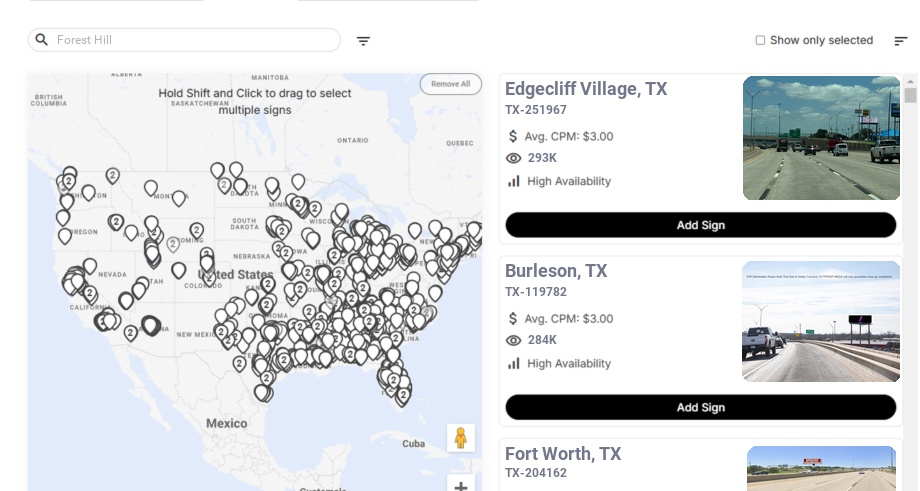



How much is a billboard in Forest Hill?
Why Choose Blip for Billboard Advertising in Forest Hill
Blip lets you launch Forest Hill billboards in minutes and hit I-20, I-35W, and I-820 commuters without traditional barriers.
Set a flexible daily budget for Forest Hill and stay in control while reaching dense neighborhoods and the South Fort Worth commute.
Use dayparting on Blip to catch Forest Hill drivers at 6:30-9 a.m. or 3:30-7 p.m., when school and work traffic peaks.
No contracts means you can test Forest Hill billboards during back-to-school, tax season, or Fort Worth event spillover, then pivot fast.
Track Forest Hill campaign results in real time and shift spend toward the I-20 corridor, Mansfield Hwy, or other routes that perform best.
Blip's creative tools make it easy to run bold, bilingual ads for Forest Hill families and working households on high-speed roads.
Frequently Asked Questions About Billboard Advertising in Forest Hill
How much does a billboard cost near Forest Hill, Texas with Blip?
With Blip, you control exactly what you spend on Forest Hill billboards by setting a daily budget that can be as small or as large as you like, and Blip automatically keeps your campaign within that limit. You pay per “blip,” a brief 7.5–10 second ad on rotating digital billboards near Forest Hill, Texas, so your total cost is simply the sum of all the blips you receive in the Forest Hill area. Because pricing depends on when and where your ads run and real-time advertiser demand, you only pay for the exposure you choose.
Where can I advertise with Blip near Forest Hill, Texas?
Blip’s digital billboards serve the Forest Hill area from nearby Edgecliff Village and Fort Worth. These locations are positioned near major arterials and freeways, including the I‑20, I‑35W, and I‑820 triangle. For advertisers seeking billboards near Forest Hill without paying downtown premiums, these boards offer strong value.
Who can I reach with Forest Hill, Texas billboards?
The Forest Hill area is compact but dense, with roughly 13,000–14,000 residents in about 4 square miles. It is diverse, working-class, and family-oriented, with strong ties to the Fort Worth and Arlington employment bases. Many surrounding tracts have a large Hispanic/Latino population alongside African American and white residents, plus growing immigrant communities.
When should I run Blip ads in Forest Hill, Texas for the most traffic?
Weekday commuter peaks in the Forest Hill area are strongest from 6:30–9:00 a.m. and 3:30–7:00 p.m. Morning traffic is especially heavy between 7:00–8:30 a.m., while evening commute volumes can be 10–15% higher than mid-day traffic. Midday can also work well for retail and healthcare advertisers, especially from 10:00 a.m.–2:30 p.m.
What kind of creative works best on billboards near Forest Hill, Texas?
Keep copy short and value-oriented, ideally 6–8 words or fewer. Use large, high-contrast visuals and avoid clutter, since drivers on I‑20 or I‑35W may be traveling 60–70 mph. Messaging that recognizes busy lives in the Forest Hill area tends to resonate, along with bilingual or culturally relevant creative.
Do I need a contract to advertise with Blip in Forest Hill?
No, Blip has no long-term contracts or minimum commitments. You can start, pause, or stop your campaign at any time.
How fast can I launch a billboard campaign with Blip in Forest Hill?
You can have your campaign live in minutes. Create a free account, select your locations, set your budget, upload your design, and start running once approved.
Where can I advertise with Blip in Forest Hill?
Blip has digital billboards in Forest Hill. You can browse available locations on a map, choose the ones that fit your audience, and start advertising right away.
Still have questions? Launch a campaign in minutes — no contracts, no commitments.
Start Your CampaignForest Hill Billboard Advertising Guide
The Forest Hill area sits at a powerful crossroads of commuter, local, and regional traffic in southeast Tarrant County, making it a strong candidate for flexible, targeted digital billboard campaigns. With six digital billboards serving the Forest Hill area from nearby Edgecliff Village

Understanding the Forest Hill Area Market
Forest Hill is a compact but dense suburb just southeast of downtown Fort Worth. According to the City of Forest Hill, the Forest Hill area includes roughly 13,000–14,000 residents, with the city covering about 4 square miles. That translates to a residential density in the ballpark of 3,300–3,500 people per square mile—high for a Tarrant County suburb—ideal for broad, neighborhood-focused messaging and consistent visibility on Forest Hill billboards for local brands.
Key regional context:
- Tarrant County's population surpassed 2.2 million by 2024, with Fort Worth alone estimated over 950,000 residents and adding roughly 15,000–20,000 people per year over the last several years, according to county and city planning documents.
- The broader Dallas–Fort Worth–Arlington metro area now exceeds 7.9 million residents, with regional agencies such as the North Central Texas Council of Governments (NCTCOG) projecting the region to top 10 million by the early 2040s.
- The Forest Hill area sits about 8–10 miles southeast of downtown Fort Worth, just off the I‑20 corridor, meaning many residents commute into Fort Worth or Arlington for work. Local and regional plans show that more than 60% of workers in southeast Tarrant County travel to another city for their job, with a sizable share heading to major employment nodes near downtown Fort Worth, the Medical District Arlington.
Commuting and traffic dynamics are crucial for billboard strategy:
- TxDOT traffic counts show average annual daily traffic (AADT) on I‑20 through southeast Tarrant County typically above 150,000 vehicles per day, with I‑35W south of downtown Fort Worth exceeding 130,000 vehicles per day and I‑820 near Forest Hill typically in the 100,000–120,000 range. You can explore specific counts via the TxDOT Traffic Count Map
- Across these three corridors alone, advertisers can realistically touch a combined 350,000–400,000 vehicle trips per weekday, before adding in major surface roads such as Mansfield Highway/Business 287 and Forest Hill Drive.
- These volumes mean our six digital billboards near Edgecliff Village (about 3.8 miles from Forest Hill) and Fort Worth (about 9.7 miles from Forest Hill) can consistently impact Forest Hill–area drivers, especially on daily commute paths. Local media usage research in the Dallas–Fort Worth market indicates that over 70% of adults report seeing roadside advertising in a typical week, giving digital billboards strong baseline reach and making billboard advertising near Forest Hill a cost‑effective way to build frequency.
In practice, this combination of dense local population and heavy commuter traffic makes the Forest Hill area well‑suited for both:
- Broad awareness campaigns (retail, healthcare, political, community institutions) that can reach tens of thousands of unique drivers in a matter of days.
- Precision campaigns (recruiting, high‑ticket services, events) using Blip’s daypart and location controls to zero in on ideal moments and audiences, often reducing wasted impressions by 20–40% compared with all‑day, citywide buying.
Who You’re Reaching Near Forest Hill
The Forest Hill area is diverse, working‑class, and family‑oriented, with strong ties to the Fort Worth and Arlington employment bases. This means billboards near Forest Hill can effectively speak to a wide mix of households, from long‑time locals to newer commuter families.
From regional and local sources such as Tarrant County government, Fort Worth ISD, Everman ISD, and Visit Fort Worth, we can infer several important audience characteristics:
1. Age and family structure
- Tarrant County’s median age is in the mid‑30s (about 34–36), and Forest Hill–area neighborhoods tilt slightly younger with a high share of children and teens. In many south and southeast Fort Worth ZIP codes that include or border Forest Hill, roughly 25–30% of residents are under age 18.
- Household sizes regularly exceed 3 persons in the Forest Hill area, compared with around 2.6–2.8 persons per household countywide, reflecting a high share of family and multigenerational homes.
- Local school district data from Fort Worth ISD and Everman ISD reflect this family focus: combined, the two districts serve well over 100,000 students, with several campuses drawing directly from Forest Hill and adjacent neighborhoods.
- Implication: Offer‑driven creative for family services—childcare, healthcare, education, entertainment, quick‑service restaurants—performs well when scheduled around school and work routines. Campaigns timed to school days can intersect with tens of thousands of daily student‑related trips across nearby corridors and take full advantage of Forest Hill billboards on primary school routes.
2. Income & employment
- Median household incomes in southeast Tarrant County neighborhoods surrounding Forest Hill and Edgecliff Village frequently range from about $50,000 to $70,000 per year, depending on the specific census tract and school catchment area—below some north‑Tarrant suburbs but in line with many working‑class Fort Worth neighborhoods.
-
Local workforce data from the county and NCTCOG show that top employment sectors for Tarrant County residents include:
- Trade, transportation, and utilities (roughly 20–22% of jobs).
- Professional and business services (about 15–17%).
- Education and health services (around 13–15%).
- Leisure, hospitality, and other services (roughly 10–12%).
-
Major employment centers nearby include:
- Healthcare and medical services in Fort Worth’s hospital districts (e.g., JPS Health Network and Texas Health Resources), which collectively employ tens of thousands of workers across Tarrant County.
- Logistics, distribution, and manufacturing hubs along I‑20 and I‑35W, including facilities that support DFW International Airport, one of the busiest airports in the world with more than 73 million passengers in a typical pre‑pandemic year and a major freight presence.
- Service and retail sectors across Fort Worth and Arlington, including large retail centers, automotive corridors, and entertainment districts.
- Local unemployment in Tarrant County has recently hovered in the 3–5% range, indicating a relatively tight labor market and steady consumer spending power even in working‑class neighborhoods.
- Implication: Price‑sensitive and value‑oriented messaging resonates strongly. Clear calls to action—“$0 down,” “payments as low as $X,” “free consultation,” or “kids eat free Tuesdays”—can be especially effective, particularly on paydays and during tax refund season. For many advertisers, this makes digital billboard advertising near Forest Hill an efficient way to highlight deals to budget‑conscious commuters.
3. Cultural & language mix
- South and southeast Tarrant County neighborhoods typically include a large Hispanic/Latino population alongside African American and white residents, plus growing immigrant communities. In many Forest Hill–adjacent tracts, Hispanic/Latino residents account for 45–60% of the population, with African American communities often making up another 20–30%.
- Local school data back this up: multiple campuses serving the Forest Hill area report that 40–70% of students identify as Hispanic/Latino, and 20–40% qualify as bilingual/ESL learners.
- Implication: Bilingual English/Spanish creative or simple Spanish call‑outs often outperform monolingual campaigns for broad‑based products and services near Forest Hill. Even a short Spanish line (“¡Ahorra hoy!” “Sin cita”) can significantly increase engagement and brand favorability, especially for family‑oriented services.
4. Education & schools
- Forest Hill–area families are served by large districts such as Fort Worth ISD and, depending on exact location, nearby districts like Everman ISD and Kennedale ISD. Altogether, these districts educate well over 120,000 students.
- Across these districts, high school graduation rates are typically in the 85–90% range, with several campuses offering early‑college or career and technical programs linked to Tarrant County College.
- Public school calendars and activities drive much of the local routine: drop‑offs, pick‑ups, extracurricular activities, and sports programs. On school days, traffic counts on key collector roads can spike 10–20% around the start and end of the school day.
- Implication: Education‑linked timing works. Promote tutoring centers, after‑school programs, youth sports, or back‑to‑school sales in sync with local school calendars and weekday peaks. Messaging that references local mascots, school colors, or “back‑to‑school ready” themes will feel especially relevant.
Traffic Patterns and When to Run Your Blips
Because our six digital billboards serve the Forest Hill area from nearby Edgecliff Village and Fort Worth, timing your campaign around actual traffic behavior is one of the highest‑leverage decisions you can make. Well‑timed billboard rental near Forest Hill ensures your message appears when local drivers are most likely to be on the road.
Based on regional commuting patterns, TxDOT data, and local coverage from outlets like the Fort Worth Star‑Telegram NBC 5 DFW, we typically see:
Weekday commuter peaks
- Morning: 6:30–9:00 a.m. along I‑20, I‑35W, and I‑820, with the heaviest 60–90 minutes often between 7:00–8:30 a.m. During this window, major freeway segments near Forest Hill regularly operate at 80–100% of capacity.
- Evening: 3:30–7:00 p.m., with a pronounced peak between 4:30–6:30 p.m. Evening commute volumes in the south Fort Worth/Forest Hill area can be 10–15% higher than mid‑day traffic.
Midday and off‑peak
- 10:00 a.m.–2:30 p.m.: Strong presence of service workers, retirees, and stay‑at‑home parents running errands. For certain retail and healthcare advertisers, this window can account for 30–40% of daily walk‑in business.
- After 8:00 p.m.: Lighter volumes but more attention from leisure and shift‑work drivers. Late‑evening traffic is especially important near restaurant clusters, entertainment venues, and 24‑hour services.
Here’s how we recommend using Blip’s time‑of‑day scheduling in the Forest Hill area:
-
Retail & restaurants near I‑20 / I‑35W
- Emphasize lunch specials from 10:30 a.m.–1:30 p.m., when restaurant corridors near the freeways see a clear uptick in visits.
- Push dinner offers from 4:30–7:30 p.m. on weekdays and slightly later on Fridays. Many casual dining and quick‑service concepts report that 50–60% of daily revenue comes from this evening window.
-
Healthcare, dental, and family services
- Focus on 6:30–9:30 a.m. and 3:00–7:00 p.m. when parents and caregivers are commuting or managing school schedules. Local clinics often see same‑day appointment calls spike 20–30% during these commute windows.
-
Hiring & recruitment
- Run from early morning through mid‑afternoon, especially Monday–Thursday. Rotate “Now Hiring” messages during morning peaks to capture decision‑makers and job‑seekers commuting to industrial or logistics employment centers along I‑20 and I‑35W, where many large warehouses and plants employ hundreds to thousands of workers each.
-
Events, churches, and community organizations
- Promote Wednesday and Friday evenings, plus Saturday afternoon and Sunday morning dayparts aligned with service or event times. In many churches across south Tarrant County, Wednesday evening and Sunday morning account for 70–80% of weekly on‑site activity.
Blip’s flexibility allows advertisers to concentrate budgets into these high‑value windows rather than spreading impressions thin across 24 hours, improving effective cost‑per‑thousand impressions (eCPM) and return on ad spend.
Where Our Boards Serve the Forest Hill Area
While our digital billboards are not physically inside Forest Hill city limits, they are positioned in nearby Edgecliff Village and Fort Worth to effectively serve the Forest Hill area and function as practical Forest Hill billboards for many local businesses:
-
Edgecliff Village
- Suburban neighborhoods with quick access to I‑35W and I‑20, plus surface routes like Altamesa Boulevard and Granbury Road. Edgecliff Village itself is home to roughly 3,000–4,000 residents, but its trade area includes tens of thousands of nearby households.
- Ideal to reach Forest Hill–area residents heading to and from work, school, and retail centers to the west and north, including key corridors into south and central Fort Worth. For advertisers seeking billboards near Forest Hill without paying downtown premiums, these boards offer strong value.
-
Fort Worth (about 9.7 miles from Forest Hill)
- Boards situated near major arterials and freeways (I‑20, I‑35W, I‑820, and primary surface roads) capture a mix of commuters, hospital and university staff, and regional shoppers.
- Fort Worth draws more than 9 million annual visitors according to Visit Fort Worth, and many of those trips involve travel along or near the same corridors Forest Hill residents use every day.
- These locations are perfect when your target includes both Forest Hill–area residents and the wider Fort Worth consumer base, including visitors to hot spots such as the Fort Worth Stockyards, Cultural District museums Sundance Square
When selecting boards through Blip, we suggest:
-
Start with boards closest to the I‑20 / I‑35W / I‑820 triangle serving the Forest Hill area.
This maximizes impressions among residents traveling between Forest Hill, Edgecliff Village, Fort Worth, and Arlington. On a typical weekday, this triangle handles several hundred thousand vehicle trips, so even a modest Blip budget can generate thousands of daily ad plays. -
Add Fort Worth boards when you want regional lift.
For example, car dealers, regional events, and healthcare providers often benefit from layering in boards near downtown Fort Worth and key medical, entertainment, or retail districts. Regional campaigns can pull customers from a 10–20 mile radius, not just from Forest Hill itself. -
Use directional and proximity messaging.
Since many drivers will be passing through from Fort Worth toward Forest Hill and vice versa, simple geo‑cues work well:- “Just 8 minutes south of I‑20”
- “Next exit toward Forest Hill”
- “Only 3 miles ahead on Mansfield Hwy”
These short, clear messages help capitalize on the limited 5–8 seconds of viewing time a typical freeway driver has at 60–70 mph and make your billboard advertising near Forest Hill easier to act on.
Crafting Effective Creative for the Forest Hill Area
Forest Hill–area drivers often travel at highway speeds and juggle daily responsibilities, so billboard creative needs to be bold, clear, and culturally attuned. Whether you’re exploring your first billboard rental near Forest Hill or scaling an established campaign, the same fundamentals apply.
1. Keep copy short and value‑oriented
Aim for 6–8 words or fewer. In high‑speed environments like I‑20 and I‑35W, multiple industry studies show that boards with fewer than 7 words can achieve 20–30% better recall than more text‑heavy boards.
For this market, we typically see best results from:
- A strong value or benefit statement:
“$49 Brake Check Today” or “Same‑Day Dental Appointments.” - A clear next step:
“Exit Mansfield Hwy” or “Call Today – 817‑XXX‑XXXX.” - Optional secondary Spanish line:
“Walk‑Ins Welcome – ¡Sin Cita!”
2. Use large, high‑contrast visuals
- Drivers on I‑20 or I‑35W may be traveling 60–70 mph. High contrast (dark text on light background or vice versa) and large fonts are essential; legibility tests suggest that each inch of letter height is readable for about 25–30 feet of viewing distance.
- Use one main image: a product close‑up, a friendly face, or a simple icon (tooth, car, house key, church cross, etc.).
- Avoid clutter—no small logos, bullet lists, or multi‑paragraph offers. Limiting your design to 1 headline, 1 visual, and 1 logo can increase comprehension and recall by 20% or more compared with busier layouts.
3. Speak to families and working households
Messaging that recognizes busy lives in the Forest Hill area tends to resonate:
- “Open Late & Saturdays”
- “Same‑Day Service Before Work”
- “Drive‑Thru Pharmacy Near Forest Hill Area”
If your business serves kids or teens (tutoring, sports, after‑school care), feature youth imagery plus clear parent‑oriented reassurance: “Safe • Local • Affordable.” In districts like Fort Worth ISD, more than 70% of students qualify for free or reduced‑price lunch, so affordability language is especially powerful.
4. Consider bilingual or culturally relevant creative
Given the area’s diversity:
- A/B test English‑only vs bilingual templates; in many south Tarrant campaigns, bilingual boards have shown double‑digit percentage lifts in call volume and web visits from mobile devices.
-
Use straightforward phrases like:
- “Se habla español”
- “Pagos bajos”
- “Aceptamos la mayoría de los seguros”
- Keep translations short and easy to read at a glance; aim for the same 6–8 word maximum across both languages combined.
With Blip, you can upload multiple creatives and rotate them, using performance data to favor the designs that drive measurable results on your end (calls, site visits, store traffic).
Seasonal and Event‑Driven Opportunities
The Forest Hill area lives on the same calendar rhythms as Fort Worth and Tarrant County, which we can exploit for timely campaigns and smartly timed billboard rental near Forest Hill.
1. School year & back‑to‑school
- Late July–September: Promote school supplies, clothing, medical and dental checkups, and youth programs. Local districts collectively send tens of thousands of students back to class in mid‑August, creating a strong 4–6 week window for family spending.
- Align with district calendars from Fort Worth ISD and neighboring districts such as Everman ISD and Kennedale ISD.
- Campaigns that reference “back‑to‑school physicals,” “immunizations,” or “after‑school care” often see meaningful uplifts in appointment requests and inquiries during this period.
2. Tax season
- January–April: Ideal for tax preparation, financial services, used cars, and big‑ticket purchases. Local and national data suggest that 70–80% of refunds are issued by early May, with a concentration in February and March.
- Use pain‑point and benefit copy: “Maximize Your Refund,” “File Fast – Walk‑Ins Welcome,” or “Use Your Refund – $0 Down Today.” Auto dealers and furniture stores along the I‑20 corridor often see 10–25% sales bumps during peak refund weeks.
3. Summer heat & weather
- North Texas summers often sit above 95°F, with frequent heat advisories from entities like Tarrant County Public Health and local outlets such as WFAA Weather and FOX 4 Weather.
- Triple‑digit days (100°F+) are common; recent summers have produced 20–40 such days, generating high demand for air conditioning, vehicle maintenance, and indoor activities.
- HVAC, auto repair, indoor entertainment, and water‑related activities can lean into the heat theme: “Beat the 100° Heat – A/C Check $79” or “Cool Play for Kids – Indoor Fun Near Forest Hill.”
4. Local events and tourism spillover
- The Forest Hill area benefits from spillover traffic to Fort Worth destinations—Sundance Square, the Stockyards, major concerts, and sporting events. Check listings via Visit Fort Worth and local news sources like the Fort Worth Star‑Telegram Community Impact
- Large events at venues like Dickies Arena Globe Life Field in Arlington, or AT&T Stadium
- Event‑driven ads can focus on pre‑ and post‑event spending: restaurants, bars, rideshare promotions, and late‑night services along return routes through the Forest Hill area.
5. Holidays and shopping peaks
- Black Friday to New Year’s: Emphasize retail, furniture, car sales, and year‑end promotions. Many retailers generate 20–30% of annual revenue in this period, with Freeway‑visible locations at a premium.
- Spring (March–May): Home services (roofing, landscaping, remodeling) as homeowners respond to storms and plan upgrades. The Dallas–Fort Worth region is one of the country’s most active hail and severe‑weather markets, and local contractors often see inquiry volumes spike 50–100% after major storm events.
- Tie creative to local observances, such as Main Street Arts Festival Fort Worth Stock Show & Rodeo, to ride existing awareness.
By using Blip’s scheduling tools, you can ramp up impressions around these peaks instead of paying the same rate year‑round.
Using Blip’s Flexibility to Your Advantage
Digital billboards serving the Forest Hill area provide a level of control that traditional static billboards cannot match. We recommend advertisers leverage several specific Blip capabilities when planning billboard advertising near Forest Hill:
1. Budget control and testing
-
Start with a modest daily budget to test:
- 2–3 different creatives
- 2–3 daypart strategies (e.g., morning commute vs all‑day vs evening only)
- Many advertisers find that even $10–$20 per day can generate dozens to hundreds of daily ad plays in this corridor, depending on competition and targeting.
- After 1–2 weeks, compare your own KPIs (calls, store traffic, web sessions) to allocate more of your budget toward the best‑performing combination. Simple A/B tests can improve cost‑per‑lead by 15–30%.
2. Geographically strategic board selection
-
Prioritize boards:
- Closest to the Forest Hill area for local services and retail.
- Along I‑20 and I‑35W when your audience travels widely across the metro, including toward Arlington attractions like Choctaw Stadium Six Flags Over Texas.
- For hyperlocal campaigns (e.g., a Forest Hill–area restaurant, clinic, or church), emphasize boards on the primary commute paths residents already use, such as routes toward downtown Fort Worth, the Medical District, or south Tarrant employment clusters.
3. Time‑sensitive messaging
- Use time‑limited offers to build urgency: “This Week Only,” “Ends Sunday,” or “New Patients This Month.” Campaigns with deadlines often see 10–20% higher response rates than evergreen promotions.
- Update creative frequently at no additional media cost—perfect for weekend‑only sales, special events, or seasonal changes. Many local businesses successfully swap creative 2–4 times per month to stay fresh and relevant.
4. Coordinating with other channels
Forest Hill–area audiences are heavily mobile‑centric. In the Dallas–Fort Worth region, smartphone ownership is estimated above 85–90% of adults, and local media outlets like WFAA and NBC 5 DFW report strong mobile traffic for news, weather, and traffic updates.
When you combine billboards with search, social, and local listings:
- Use consistent keywords and phrases across billboards, landing pages, and ads.
- Encourage memorable short URLs or phone numbers to connect offline exposure to online behavior: “Visit MyClinic817.com” or “Call 817‑XXX‑XXXX.”
- Track branded search volume and direct traffic around the areas and times your Blip ads are running to estimate lift.
Compliance, Local Context, and Practical Tips
When running campaigns near Forest Hill, it helps to stay aligned with local governments, regulations, and community norms.
- The City of Forest Hill provides information on local business licensing, zoning, and community guidelines—useful if your creative references on‑site promotions or new locations.
- The City of Fort Worth and Tarrant County sites offer additional information on sign regulations, right‑of‑way issues, and public safety campaigns that may shape your messaging.
- For safety and emergency‑related campaigns (hospitals, clinics, public health, or public service announcements), referencing resources like MedStar Mobile Healthcare, Tarrant County Public Health, or local hospital systems can lend credibility.
- Avoid overly complex or controversial political messaging; if you run political campaigns, ensure compliance with Tarrant County and Texas election laws and include clear disclaimers. Local news outlets such as the Fort Worth Report and Star‑Telegram
Practical creative and campaign tips specific to the Forest Hill area:
- Use simple exit‑based directions (“Exit Mansfield Hwy”) instead of long addresses.
- Consider local landmarks drivers know well (“Near I‑20 & Mansfield Hwy” or “Just south of I‑820”).
- For service businesses that draw from multiple cities (Forest Hill, Everman Kennedale, Fort Worth), list the broader area you serve: “Serving the Forest Hill & South Fort Worth Area.”
- If your location is near a major corridor to DFW Airport or key Fort Worth attractions, mention that in directional language to help out‑of‑area visitors orient quickly.
Example Campaign Strategies Near Forest Hill
To tie it all together, here are a few example approaches tailored for the Forest Hill area that show how to use billboards near Forest Hill effectively:
1. Local Family Clinic
- Goal: Increase new patient visits from Forest Hill–area families.
- Boards: Focus on boards in Edgecliff Village and south Fort Worth on primary commuter routes from Forest Hill.
-
Schedule:
- Weekdays: 6:30–9:30 a.m. and 3:00–7:00 p.m.
- Saturdays: 9:00 a.m.–2:00 p.m.
-
Creative:
- “Same‑Day Appointments Near Forest Hill Area”
- “Most Insurance Accepted – Se habla español”
-
Why it works (by the numbers):
- Taps into tens of thousands of daily commuters, many of whom have children in nearby districts where over half of students are from low‑ to moderate‑income households and rely on convenient, affordable care.
- Bilingual messaging aligns with neighborhoods where 40–70% of students are Hispanic/Latino or bilingual.
2. Auto Repair Shop Near I‑20
- Goal: Capture commuters with urgent repair or maintenance needs.
- Boards: High‑traffic boards along I‑20 and I‑35W.
- Schedule: Heaviest on Monday–Friday, 6:30–10:00 a.m. and 3:00–7:00 p.m.
-
Creative:
- “Check Engine Light? Exit Now for $39 Diagnosis”
- Rotating version in Spanish: “¿Luz de motor? Diagnóstico $39 – Próxima salida”
-
Why it works (by the numbers):
- Positions the shop in front of 150,000+ daily I‑20 drivers and over 130,000 I‑35W drivers, many commuting long distances where dependability and same‑day service are crucial.
- Simple price‑anchored offers speak directly to households in the $50,000–$70,000 income range where cost certainty matters.
3. Church or Community Organization
- Goal: Increase awareness and attendance from local families.
- Boards: Boards serving Forest Hill, Edgecliff Village, and south Fort Worth.
-
Schedule:
- Wednesday: 3:00–7:00 p.m.
- Saturday: 2:00–7:00 p.m.
- Sunday: 7:00–11:00 a.m.
-
Creative:
- “You’re Invited – Sunday 10 AM – Forest Hill Area”
- “Family‑Friendly • Come As You Are”
-
Why it works (by the numbers):
- Aligns with known peak travel patterns for worship and community activities; many churches report that 70–80% of weekly attendance occurs in the Sunday‑morning window.
- Speaks to a local audience where larger‑than‑average household sizes and a strong culture of faith and community provide natural demand for family‑oriented spiritual and social spaces.
By combining strong local knowledge of the Forest Hill area with the precision and flexibility of Blip’s digital billboards near Edgecliff Village and Fort Worth, advertisers can efficiently reach thousands of residents and commuters every day. With data‑driven scheduling, tailored creative, and strategic board selection rooted in real traffic counts and demographic patterns, campaigns can be tuned to the unique rhythms and characteristics of this growing corner of southeast Tarrant County, making billboard advertising near Forest Hill a practical, scalable part of your marketing mix.