Billboards near Universal City, TX
No Minimum Spend. No Long-Term Contracts. Just Results.
Trusted by Leading Brands


Billboard advertising
near Universal City has never been easier
How much is a billboard near Universal City?
Why Choose Blip for Billboard Advertising near Universal City
Blip lets you launch in Universal City fast and self-serve, reaching I-35, Loop 1604, and Pat Booker Road commuters without sales calls.
Use flexible budgets in Universal City to test ads near Randolph AFB and The Forum, then scale what works for military and shopper traffic.
Daypart your Universal City Blip campaigns for 6-9 a.m. base traffic, school pickup, or evening retail rush on FM 78 and Loop 1604.
No contracts make Universal City billboard buys easy to pause or pivot during Randolph air shows, holidays, or back-to-school spikes.
Track Universal City results in real time and use Blip's creative tools to tailor messages for families, soldiers, and commuters on the go.
Frequently Asked Questions About Billboard Advertising near Universal City
How much does a billboard cost near Universal City, Texas with Blip?
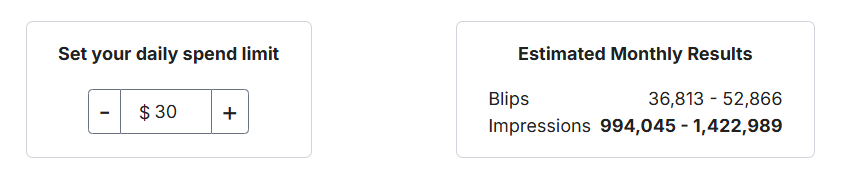
With Blip, you control exactly what you spend on Universal City billboards by setting a daily budget that can be as small or as large as you want, and Blip automatically keeps your campaign within that limit. Each ad is a 7.5 to 10-second “blip,” and you only pay for the individual blips you receive, so your total cost is simply the sum of those brief displays. Pricing for billboards near Universal City, Texas is based on the times you choose, the locations serving the Universal City area, and advertiser demand, giving you flexible options at a variety of price points.
Where can I advertise with Blip near Universal City, Texas?
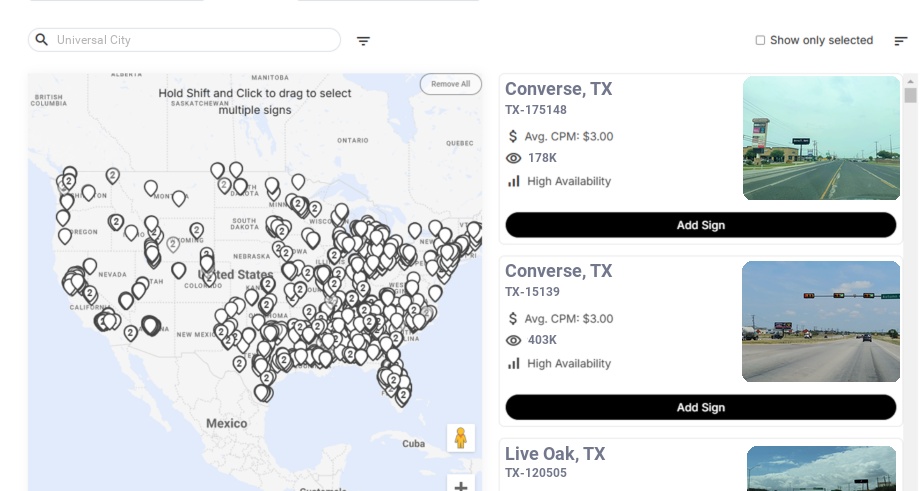
With 13 digital billboards serving the Universal City area from nearby Live Oak and Converse, brands can tap into the daily routines of residents, soldiers, and visitors moving between Randolph Air Force Base and surrounding communities. Our digital billboards in nearby Live Oak and Converse are positioned to intercept major traffic flows that directly serve the Universal City area, making them some of the most strategically located billboards near Universal City. Because our boards are within about 2–4 miles of Universal City, campaigns can reach both local residents and regional pass-through traffic efficiently.
What kind of audience does Universal City, Texas billboards reach?
The Universal City area gives advertisers a rare combination of military, suburban family, and commuter audiences in a compact, highly trafficked corridor. Universal City is best known as a gateway to Randolph Air Force Base, part of Joint Base San Antonio, and the northeast San Antonio/Universal City area skews family-oriented. For advertisers, this means creative that speaks to families, military households, and daily commuters tends to perform especially well on digital billboards serving the Universal City area.
When is the best time to run Universal City, Texas billboards with Blip?
Local transportation data and traffic studies across the San Antonio metro consistently show two primary weekday peaks and a strong midday plateau. The morning commute from 6:00–9:00 a.m. is best for coffee shops, breakfast restaurants, fitness studios, child care, auto repair, and service businesses, while the afternoon school and base release from 2:30–5:00 p.m. is best for after-school programs, tutoring, youth sports, family dining, and local attractions. Using flexible dayparting, you can allocate more of your budget to the specific windows when your core audience is on the road.
What messages work best on Universal City, Texas billboards?
Because of the Universal City area’s unique mix of military households, suburban families, and regional shoppers, certain approaches tend to perform particularly well on Universal City billboards and nearby digital units. Effective creative includes military discount or thank you messaging where appropriate, along with clear value propositions like zero-down offers, special financing, and flexible scheduling for shift workers. Family-centric, community-minded campaigns and clear, location-anchored messaging also work well, such as “Minutes from Randolph,” “Near The Forum,” or “Off FM 78 in Converse.”
Do I need a contract to advertise with Blip near Universal City?
No, Blip has no long-term contracts or minimum commitments. You can start, pause, or stop your campaign at any time.
How fast can I launch a billboard campaign with Blip near Universal City?
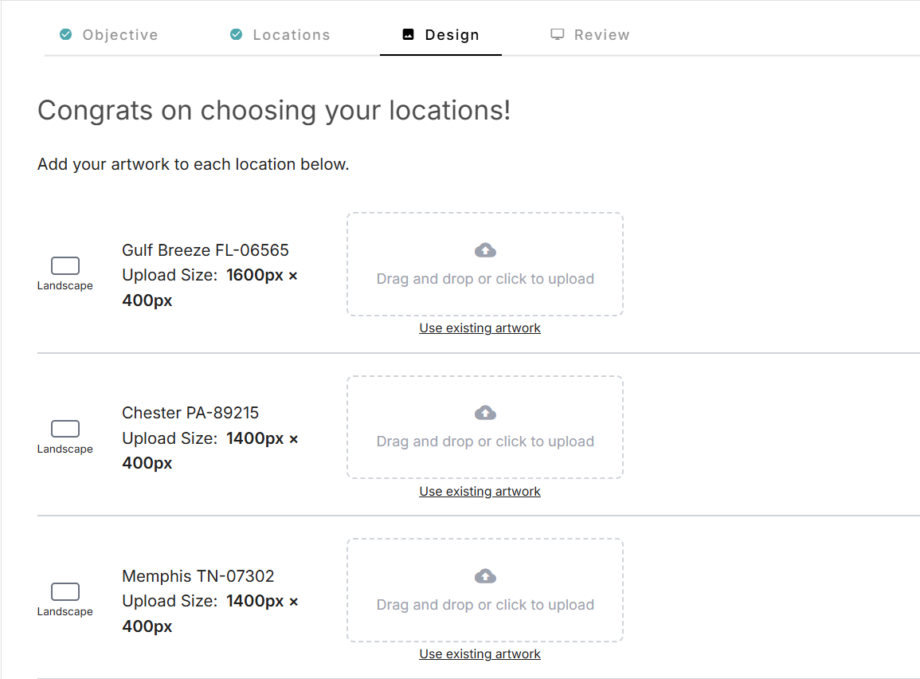
You can have your campaign live in minutes. Create a free account, select your locations, set your budget, upload your design, and start running once approved.
Where can I advertise with Blip near Universal City?
Blip has digital billboards near Universal City. You can browse available locations on a map, choose the ones that fit your audience, and start advertising right away.
Still have questions? Launch a campaign in minutes — no contracts, no commitments.
Start Your CampaignUniversal City Billboard Advertising Guide
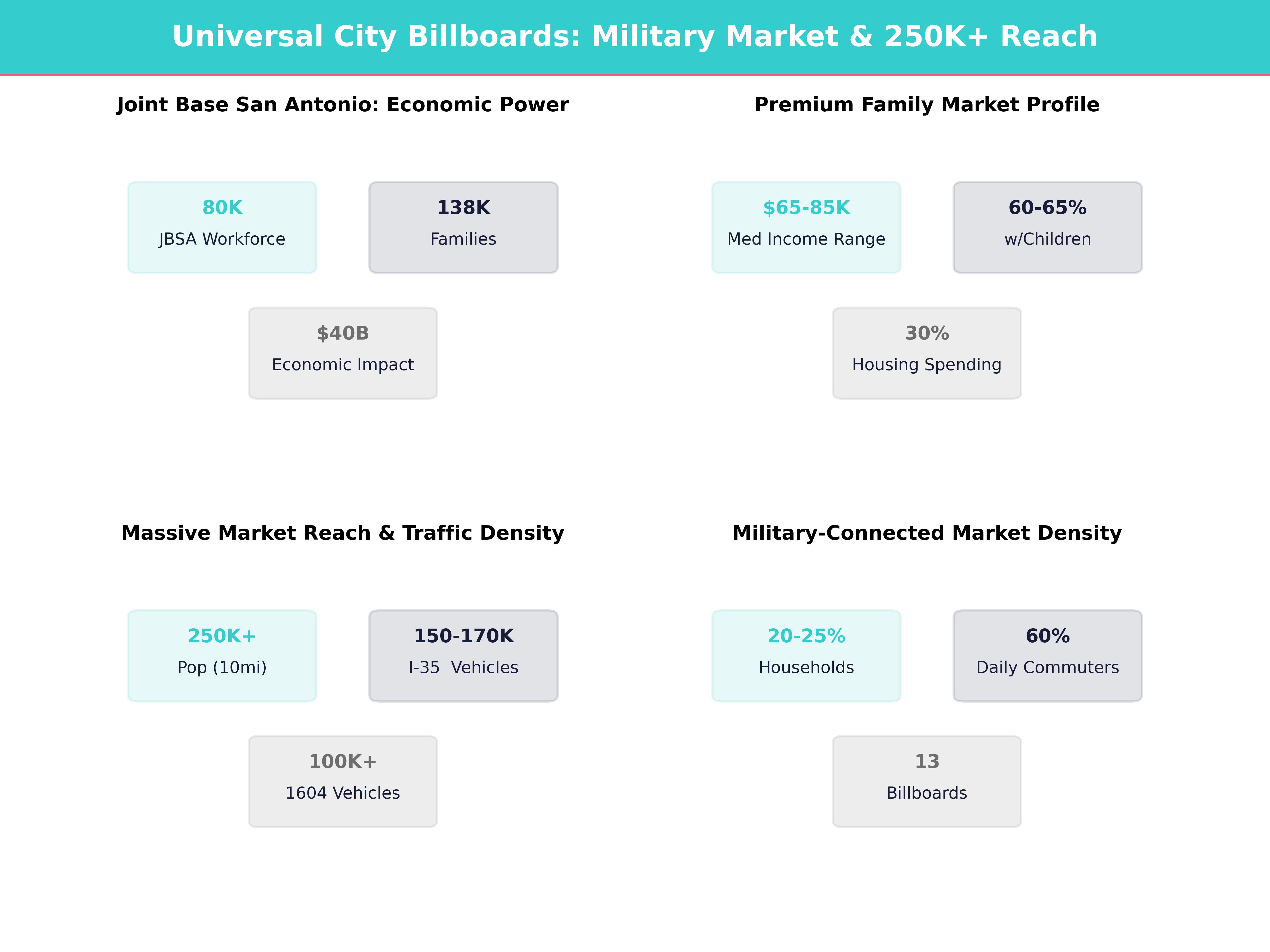
Nestled on the northeast side of Greater San Antonio, the Universal City area gives advertisers a rare combination of military, suburban family, and commuter audiences in a compact, highly trafficked corridor. With 13 digital billboards serving the Universal City area from nearby Live Oak Converse, we can help brands tap into the daily routines of residents, soldiers, and visitors moving between Randolph Air Force Base
Understanding the Universal City Area Audience
The Universal City area sits at a powerful crossroads of demographics and travel patterns, which makes Universal City billboards especially effective for regional, local, and base‑oriented campaigns:
-
Population & growth
- Universal City itself has roughly 27,000 residents, and the City of Universal City reports that its population has increased by more than 10% over the last decade, driven largely by military and suburban growth.
- Within a 10‑mile radius (including Live Oak, Converse, Schertz, and portions of northeast San Antonio), the population climbs well above 250,000 people, with the broader I‑35 northeast corridor adding thousands of new residents annually as one of the San Antonio region’s fastest‑growing suburban belts.
- Nearby Converse has grown rapidly, exceeding 30,000 residents, while Live Oak, though smaller (around 16,000 residents), punches above its weight as a retail and medical hub, with the city noting more than 1,000 businesses in just a few square miles.
- Schertz, immediately to the northeast, now tops 43,000 residents, according to the City of Schertz, helping fuel sustained demand for retail, services, and entertainment along I‑35 and Loop 1604.
-
Military presence
- Universal City is best known as a gateway to Randolph Air Force Base, part of Joint Base San Antonio (JBSA). JBSA collectively supports more than 80,000 active‑duty personnel, Guard, Reserve, civilians, and contractors, plus an estimated 138,000 military family members and retirees across the region, according to Joint Base San Antonio.
- JBSA is one of the largest joint bases in the Department of Defense, contributing roughly $40+ billion in economic impact annually to the San Antonio area, a figure often cited by regional economic development agencies.
- A significant share of households in the Universal City area are military or veteran families, with a steady influx of trainees and rotating personnel—Randolph alone graduates tens of thousands of trainees and students annually, creating a constantly renewing audience for financial, housing, auto, and lifestyle offers that can be reached efficiently through billboard advertising near Universal City.
-
Household profile
- The northeast San Antonio/Universal City area skews family‑oriented. Local ISD data show that more than 60–65% of households in nearby zip codes include children under 18, and many are dual‑income families balancing work in San Antonio, on base, or in regional distribution and healthcare hubs.
- Median household incomes in nearby suburbs like Schertz, Live Oak, and portions of Converse regularly fall in the $65,000–$85,000 range, with some newer subdivisions and master‑planned communities pushing household incomes above $90,000.
- Consumer spending data for the corridor indicate that households within a short drive of Universal City allocate a significant share of their budgets to housing and home improvement (30%+ of total spending), transportation and auto (15–20%), and food/restaurant spending (10–15%), making billboards especially effective for home services, auto, and dining.
-
Education & institutions
- The Judson Independent School District and Schertz‑Cibolo‑Universal City ISD (SCUCISD) serve large student populations; SCUCISD alone enrolls over 15,000 students across multiple campuses, while Judson ISD educates more than 23,000 students across northeast San Antonio and Converse.
- Combined, these districts operate 40+ campuses (elementary, middle, and high schools), sending tens of thousands of parents through pickup lines and local streets every school day—prime moments for billboard visibility.
- St. Mary’s University, the University of the Incarnate Word, and Northeast Lakeview College are an easy drive, adding a layer of college‑age traffic through the area. Northeast Lakeview alone serves more than 6,000 students each semester in the nearby Live Oak/Universal City area.
For advertisers, this means creative that speaks to families, military households, and daily commuters tends to perform especially well on digital billboards serving the Universal City area. Well‑planned billboard advertising near Universal City can connect with these diverse segments during their daily routines.
Useful local sources to keep a pulse on community priorities include the City of Universal City, Live Oak, Converse, and the regional coverage by San Antonio Express‑News / mySA and KSAT 12 News. You can also track regional trends and events through Visit San Antonio and the Universal City Chamber of Commerce to time your billboard rental near Universal City to local happenings.
How People Move Through the Universal City Area
Our digital billboards in nearby Live Oak and Converse are positioned to intercept major traffic flows that directly serve the Universal City area, making them some of the most strategically located billboards near Universal City:
-
Highway backbone
- Interstate 35 (I‑35) is one of the busiest freight and commuter corridors in Texas. TxDOT traffic counts near the Live Oak/Schertz segment regularly show 150,000–170,000 vehicles per day, with peak weekday hours carrying 7,000–8,000 vehicles per hour in each direction.
- Loop 1604, especially its northeast arc near Live Oak and Universal City, regularly sees 100,000+ vehicles per day on some segments, according to TxDOT’s San Antonio District. Several interchanges near The Forum rank among the region’s highest‑volume non‑downtown junctions.
- These highways collect daily commuters from New Braunfels, Schertz, Cibolo, and Garden Ridge heading toward central San Antonio, plus shoppers heading to The Forum and other retail nodes. Regional planning data indicate that more than 60% of employed residents in the corridor commute out of their home city daily, underscoring the value of highway‑visible media.
-
Key local arteries near Universal City
- Pat Booker Road is the classic Universal City commercial spine, funneling thousands of vehicles each day between residential neighborhoods, Randolph AFB gates, and local retail. City engineering reports often cite 15,000–20,000 vehicles per day on some segments.
- FM 78 runs east‑west through Converse and to the southern edge of the Universal City area, linking to San Antonio’s east side. Average daily traffic along FM 78 in Converse and Universal City segments often exceeds 20,000–25,000 vehicles per day.
- Toepperwein Road and Judson Road connect residential subdivisions to shopping and dining clusters in Live Oak and Converse, with many segments carrying 10,000–18,000 vehicles per day, depending on proximity to major intersections.
-
Retail & activity centers
- The Forum at Olympia Parkway in Live Oak/Universal City is one of the largest shopping centers in the region, with more than 1.2 million square feet of retail space and 70+ stores and restaurants. During peak periods (back‑to‑school, holidays), foot traffic can reach 20,000–30,000 visitors per day, creating powerful synergy between roadside impressions and in‑center visits.
- The nearby IKEA and surrounding retail cluster have drawn millions of visits since opening, with annual visitor counts for the wider I‑35/1604 retail node estimated in the 8–10 million visits per year range.
- Major employers (healthcare systems, distribution facilities, government agencies) within a short drive fuel steady daytime traffic. The northeast San Antonio/Universal City area supports tens of thousands of jobs, including roles at Randolph AFB, regional logistics centers, and medical campuses.
Because our boards are within about 2–4 miles of Universal City (1.8 miles to Live Oak, 3.8 miles to Converse), campaigns can reach both local residents and regional pass‑through traffic efficiently. For many drivers, this corridor is part of a 5–7 day‑per‑week routine, creating repeated exposure and strong frequency for Universal City billboards that sit along their everyday paths.
When to Run Your Campaign: Timing and Seasonality
With digital billboards, we can dial in timing to match when your audience is most likely to see and act on your message, making billboard advertising near Universal City more cost‑effective and results‑driven.
Daily patterns
Local transportation data and traffic studies across the San Antonio metro consistently show two primary weekday peaks and a strong midday plateau:
-
Morning commute (6:00–9:00 a.m.)
- High concentration of military personnel heading to Randolph AFB and commuters using I‑35 and Loop 1604. In many segments, 35–40% of daily traffic occurs before 10:00 a.m.
- Best for: coffee shops, breakfast restaurants, fitness studios, child care, auto repair, and service businesses emphasizing “Before work” or “Start your day” messaging.
-
Midday (11:00 a.m.–2:00 p.m.)
- Office workers, base personnel, and local residents running errands or going to lunch; many corridors see steady flows of 4,000+ vehicles per hour.
- Best for: quick‑service restaurants, medical/dental offices, banks, and retail promotions.
-
Afternoon school & base release (2:30–5:00 p.m.)
- Parents in pickup lines, after‑school activities, and shift changes, with school dismissals sending thousands of vehicles onto neighborhood roads in 30‑ to 60‑minute bursts.
- Best for: after‑school programs, tutoring, youth sports, family dining, and local attractions.
-
Evening (5:00–8:00 p.m.)
- Return commute, dinner outings, and shopping trips to The Forum and nearby centers. On key segments of I‑35 and Loop 1604, 30% or more of weekday traffic passes during the late‑afternoon/evening window.
- Best for: restaurants, entertainment venues, events, churches, and fitness centers.
-
Late night (after 8:00 p.m.)
- Lower volume but less cluttered screen time, often with 20–30% fewer competitive ads in the rotation.
- Best for: bars, late‑night dining, streaming and delivery apps, and campaigns seeking efficient, lower‑cost impressions.
Using flexible dayparting, we can allocate more of your budget to the specific windows when your core audience is on the road, and scale back in lower‑value dayparts without sacrificing reach.
Weekly and seasonal trends
-
Weekdays
- Heavier commuter and base traffic; more predictable patterns. Weekdays typically account for 70–75% of weekly vehicle trips on major corridors.
- Ideal for B2B, professional services, healthcare, and workday‑related offers.
-
Weekends
- More shopping, dining, church attendance, and family outings. Retail centers around The Forum often see 20–30% higher visitor counts on Saturdays compared with typical weekdays.
- Ideal for retail promotions, events, attractions, and big‑ticket consumer purchases.
-
Back‑to‑school (July–September)
- SCUCISD, Judson ISD, and other districts return to class; SCUCISD and Judson together send nearly 40,000 students back to campuses each fall.
- National retail surveys show back‑to‑school spending routinely exceeds $850 per household for K‑12 families, with a significant portion going to clothing, electronics, and activities—much of it spent in regional centers like The Forum.
- Promote school supplies, clothing, extracurriculars, tutoring, and healthcare (physicals, vaccines).
-
Military cycles
- Training classes and rotations at Randolph AFB create continual surges of newly arrived personnel. JBSA training pipelines bring in tens of thousands of students each year, many arriving with immediate needs for housing, banking, auto, and mobile services.
- Good windows for banks/credit unions, auto dealers, apartments, and insurance providers to highlight military‑friendly offers and PCS‑ready services.
-
Holiday and travel seasons
- November–December shopping is intense at The Forum and nearby shopping centers. National benchmarks regularly show 20–25% of annual retail sales occur in this period, and local centers mirror that pattern with extended hours and weekend traffic spikes.
- Long weekends and holidays bring more road trips along I‑35 and Loop 1604; AAA and state travel data often show 10–20% increases in highway volumes around major holidays.
- Perfect for gift promotions, attractions, and hospitality.
-
Event‑driven spikes
- Air shows at Randolph AFB, community festivals, and school sports dramatically increase traffic on key corridors. A single air show weekend can draw 100,000+ visitors to the area, according to historic JBSA estimates.
- Local calendars from the City of Universal City, City of Live Oak, and City of Converse offer a good roadmap for planning time‑sensitive campaigns. Regional event listings on Visit San Antonio can also help identify high‑traffic weekends and guide when to increase your billboard rental near Universal City.
What Messages Work Best Near Universal City
Because of the Universal City area’s unique mix of military households, suburban families, and regional shoppers, certain approaches tend to perform particularly well on Universal City billboards and nearby digital units.
Military‑aware, not military‑only
- Roughly 1 in 5–4 households in the immediate area has some direct connection to active duty, Guard, Reserve, or veterans when you factor in Randolph AFB personnel, retirees, and dependents living off base. JBSA‑related residents and retirees together make up well over 10% of the total population of Greater San Antonio, with particularly high concentrations near Universal City.
-
Effective creative:
- “Military discount” or “Thank you for your service” messaging where appropriate, with clear value (e.g., 10–20% off, waived fees, or bonus perks).
- Clear value propositions: zero‑down offers, special financing, and flexible scheduling for shift workers, which align with common military pay structures and rotating shifts.
- Rapid‑understanding visuals – service members are often driving pre‑dawn or post‑shift and need to process the message in 2–3 seconds at highway speeds.
Avoid over‑complicated military references or jargon that might confuse non‑military residents; inclusive messages that welcome military and civilian audiences perform best.
Family‑centric, community‑minded campaigns
The Universal City area population is packed with:
- Families juggling school, activities, and errands—local recreation department data show thousands of youth sports participants annually across soccer, baseball, and football leagues in Universal City, Live Oak, Converse, and Schertz.
- Households with strong ties to local churches, youth leagues, and community organizations; many congregations in northeast Bexar and Guadalupe Counties count hundreds to thousands of weekly attendees.
Best practices:
- Emphasize convenience, safety, quality, and value, particularly important for households managing two working parents and multiple children’s activities.
- Use imagery of families, kids in sports, or group activities to resonate with local weekend routines.
- Reference local geography: “Minutes from Randolph,” “Near The Forum,” or “Off FM 78 in Converse” to help viewers orient quickly and tie your brand to familiar landmarks that they already associate with billboards near Universal City.
Clear, location‑anchored messaging
Because drivers are often transitioning between multiple suburbs and bases, location clarity is crucial:
-
Include one clear location cue:
- “At The Forum”
- “On Pat Booker Road”
- “Off Loop 1604 at O’Connor”
- “Near Randolph AFB”
- Use big, high‑contrast fonts and no more than 7–8 words of main text, which aligns with industry research suggesting that recall drops quickly past 7 words on roadside digital units.
- Consider directional arrows (→ or ←) when appropriate and legible; simple cues can improve wayfinding and lift in‑store traffic, especially for businesses within 1–2 miles of the board.
Designing Effective Creative for the Universal City Area
The mix of highways and surface streets near the Universal City area requires creative that reads instantly at 55–70 mph and still looks compelling at 35–45 mph. Thoughtful design makes your investment in billboard rental near Universal City work harder.
Visual style
- High contrast: Light text on dark backgrounds or vice versa; avoid busy photos behind text. Eye‑tracking studies on digital OOH show that high‑contrast designs can increase message comprehension by 20–30%.
- Large, bold fonts: Sans‑serif typefaces at large point sizes (think 18–24 inches in physical terms), which translates to letters at least 12–18 inches tall on a 14’x48’ board.
- One key visual element: A product, logo, or strong symbol; too many elements reduce legibility and can cut recall by up to half.
- Brand consistency: Use the same core colors and logo you use on your website and social media for recognition—cross‑channel consistency has been shown to improve brand lift by up to 20% in multi‑media campaigns.
Copy strategy
- Aim for 5–7 words of primary message.
-
Focus on a single promise:
- “Fast ER Care Near Randolph”
- “Military Savings on New Trucks”
- “Family Pizza Night in Universal City Area”
-
Use a short call to action:
- “Exit at Pat Booker”
- “Order Online Today”
- “Book Free Estimate”
Because our billboards can rotate multiple creatives, we encourage:
- Creative sequencing (e.g., different product highlights in different spots), which can increase engagement and brand recall compared to a single static message.
- A/B testing: run two versions with different headlines or images to see which drives more web or in‑store activity; many advertisers see 10–30% performance differences between creative variants.
Matching Message to Board Location
Our 13 digital billboards serving the Universal City area are primarily positioned in Live Oak and Converse, each with distinct strengths. Choosing the right Universal City billboards and nearby units ensures your message aligns with driver intent and travel patterns.
Live Oak‑oriented boards (approx. 1.8 miles from Universal City)
Ideal for:
- Retail & dining: Especially businesses in and around The Forum, IKEA‑adjacent retail, and nearby shopping centers. The Live Oak/Forum area draws shoppers not only from Universal City, but also from Schertz, Cibolo, New Braunfels, and northeast San Antonio, extending your reach to a multi‑city audience.
- Healthcare: Urgent care, dental, vision, and specialty practices targeting insured suburban families; regional health data show that families with children have 2–3x more annual medical and dental visits than single adults.
- Home services: HVAC, roofing, landscaping, and remodelers seeking mid‑ to upper‑income homeowners in subdivisions where home values have risen 30–50% over the last 10 years, increasing equity and renovation budgets.
Sample targeting strategies:
- Morning: “Same‑Day Urgent Care Near The Forum – Walk‑Ins Welcome”
- Midday: “Lunch in 10 Minutes – Exit Now for [Restaurant Name]”
- Evening/weekends: “Shop Late at The Forum – Sales Through Sunday”
These locations are particularly valuable for billboard advertising near Universal City that aims to influence shoppers just before they reach major retail destinations.
Converse‑oriented boards (approx. 3.8 miles from Universal City)
Ideal for:
- Neighborhood‑based services: Childcare, veterinary clinics, auto repair, and local restaurants serving Converse, Kirby, and southeastern Universal City neighborhoods.
- Budget‑conscious offers: Promotions that resonate with value‑oriented households, where marketing response often increases sharply when discounts reach 15–25% off.
- FM 78 corridor businesses: Retailers and services wanting visibility to both Converse and Universal City traffic. FM 78 connects tens of thousands of daily drivers between San Antonio’s east side, Converse, and Universal City.
Sample targeting strategies:
- Afternoon: “After‑School Tutoring on FM 78 – Enroll Today”
- Evening: “Family Dinner Under $30 – Just off FM 78”
- Weekends: “Oil Change While You Shop – Near Randolph”
By pairing the right creative with the right boards, we can make sure each impression feels relevant to where the driver is headed, improving both recall and conversion and maximizing the value of your billboard rental near Universal City.
Using Digital Flexibility to Your Advantage
Digital billboards serving the Universal City area let us adjust campaigns by time, budget, and creative much more dynamically than traditional static boards. This flexibility is a key advantage when planning billboard advertising near Universal City, where traffic patterns can shift with base operations and retail events.
Budget control
- Allocate more budget during peak traffic windows (e.g., weekday rush hours, weekend shopping peaks) and less during off‑peak, aligning spend with the 60–70% of impressions that occur in higher‑value dayparts.
- Increase share of voice around high‑value dates (grand openings, sales weekends, registration deadlines), where short‑term SOV increases can deliver noticeability gains of 20–40%.
- Start with conservative spending to test messages, then scale up on the best performers based on store visits, call volume, or web analytics.
Creative rotation
-
Rotate between:
- Brand awareness creatives (logo + slogan).
- Promotion creatives (specific deals, deadlines).
- Directional creatives (how to find you from Universal City, Live Oak, or Converse).
-
For example, a restaurant might run:
- Morning: coffee and breakfast shot.
- Lunch: quick‑service meal.
- Evening: family‑style dinner platter.
Advertisers who use 3–5 creative variations in rotation often see higher engagement and longer campaign “staying power” than those running a single design for months.
Fast updates
-
Adjust messaging to:
- Reflect breaking news or weather (e.g., HVAC specials during heat waves when San Antonio temperatures routinely top 95–100°F in summer).
- Capitalize on local sports wins, holidays, or school milestones (graduation weekends, playoff runs, etc.).
- Address inventory changes for auto dealers, retailers, or real estate.
Local outlets like KSAT 12 and KENS 5 can inspire timely, topical hooks that keep your billboards feeling current to residents, while city and school calendars help you sync creative with community moments.
Industry‑Specific Tips for the Universal City Area
Here are some tailored ideas for key verticals that tend to thrive in the Universal City area and regularly benefit from billboards near Universal City and the surrounding suburbs.
Auto dealers & automotive services
- Audience: Military buyers, commuting professionals, and multicar families. In the San Antonio region, household vehicle ownership averages around 2+ vehicles per household, with high rates of daily commuting.
-
Strategies:
- Highlight military rebates, easy financing, and same‑day approvals. Many auto brands offer $500–$1,500 military incentives that can be spotlighted in simple billboard messaging.
- Use simple offers: “$0 Down,” “Oil Change $XX,” or “Free Alignment Check.” Clear numeric offers are easier to process at 55–70 mph.
- Add geographic cues: “10 Minutes from Randolph,” “Near The Forum on I‑35,” or “Just Off FM 78,” aligning your message with known routes between base, home, and shopping.
Healthcare & wellness
- Audience: Families, military dependents, retirees, and shift workers. In a household mix like Universal City’s, urgent care and pediatric visits are particularly frequent.
-
Strategies:
- Promote urgent care, pediatric services, and dental with wait‑time or “open now” messaging. Digital billboards can be updated quickly to reflect changing hours or seasonal services (e.g., flu shots, sports physicals).
- Emphasize proximity: “5 Minutes from Universal City Area Homes” or “Across from The Forum.” Surveys consistently show that location and convenience rank among the top drivers of provider selection.
- Use calm, reassuring imagery with clear benefits: “Walk‑In X‑ray,” “Same‑Day Appointments,” or “Tricare Accepted,” which resonates strongly with military families.
Restaurants & entertainment
- Audience: Shoppers, families, base personnel, and teens. Restaurant industry data show that nearly half of food spending in many suburban areas goes to dining out.
-
Strategies:
- Leverage time‑based offers: “Kids Eat Free Tonight,” “Happy Hour 4–7 p.m.,” “Lunch Specials Under $12,” aligned with the heaviest dining windows.
- Align creative with big events: playoff games, fiestas, school graduations, and major concerts that drive above‑average evening and weekend traffic along I‑35 and Loop 1604.
- Include visuals that pop at night: neon‑style art, bold food photography, and high‑saturation colors that stand out in the illuminated nighttime environment.
Local services (home, legal, financial, education)
- Audience: Homeowners and long‑term renters, many with stable military or government paychecks. Homeownership rates in the surrounding suburbs often exceed 60–65%, supporting strong demand for home services and financial products.
-
Strategies:
- Emphasize trust and stability: “Serving the Universal City Area Since [Year],” “Locally Owned & Operated,” or “Trusted by Military Families.” Local‑credibility cues can significantly improve response for legal, financial, and home services.
- For schools, tutoring, and training: promote enrollment periods, limited‑time discounts, and outcomes (“Raise Grades in 60 Days,” “Career Training in 6 Months”).
- For banks and credit unions: feature VA loans, auto loans, mobile banking, and base‑accessible branches; credit unions and community banks often find double‑digit increases in new accounts when they pair billboard exposure with local event sponsorships and digital campaigns.
Measuring and Optimizing Campaign Performance
Even though billboards serve primarily as an upper‑funnel medium, there are practical ways to measure and refine performance in the Universal City area:
-
Track web and search activity
- Watch for traffic spikes from the northeast San Antonio region (Universal City, Live Oak, Converse, Schertz) after your campaign starts; many advertisers see 10–30% uplifts in branded search volumes when OOH is added.
- Use unique, short URLs or QR codes (readable on slower roads, less so on highways) to segment traffic originating from billboard exposure.
-
Use location‑specific promo codes
- Codes like “UCITY10” or “FORUM15” on your boards can identify redemptions driven by local billboard exposure. Track redemption counts, average ticket size, and new vs. returning customers tied to each code.
-
Compare store traffic
- Align campaign dates with POS data from locations near Universal City, Live Oak, and Converse.
- Look for increases in visit counts, average ticket size, or new customer sign‑ups of 5–15% or more during active flight periods, compared with baseline weeks.
-
A/B test creatives
- Run two versions of a headline or offer in rotation; check which correlates with more calls, clicks, or store visits. It’s common to see one variant outperform the other by 20%+ on key metrics.
- Once you identify a winner, weight your budget more heavily toward that version and continue testing secondary elements (colors, imagery, CTA wording).
Bringing It All Together
The Universal City area may not be the geographic giant of San Antonio, but it sits at the center of some of the region’s most valuable traffic flows—military personnel, suburban families, and high‑intent shoppers moving between home, base, and major retail centers. For advertisers seeking billboards near Universal City, this convergence makes the area a high‑impact choice for both brand awareness and direct response.
By:
- Understanding who travels these roads and when, using local data from cities, schools, and JBSA.
- Crafting simple, high‑impact creative tuned to military‑friendly, family‑oriented messaging.
- Matching each message to the strengths of billboards in nearby Live Oak and Converse, and to specific corridors like I‑35, Loop 1604, FM 78, and Pat Booker Road.
- Using digital flexibility to refine timing, offers, and creative based on real‑world performance data.
…we can help you build a billboard campaign that doesn’t just generate impressions, but drives real business outcomes in the Universal City area.
When you’re ready, we can work together to turn that daily flow of vehicles on I‑35, Loop 1604, and the local surface streets into a consistent stream of new customers for your brand—rooted in local data, aligned with community rhythms, and amplified by trusted regional media like San Antonio Express‑News / mySA, KSAT, and Visit San Antonio—all supported by smart, targeted billboard advertising near Universal City.