Billboards in Selma, TX
No Minimum Spend. No Long-Term Contracts. Just Results.
Trusted by Leading Brands


Billboard advertising
in Selma has never been easier



How much is a billboard in Selma?
Why Choose Blip for Billboard Advertising in Selma
Blip lets you launch Selma billboards fast and self-serve, reaching I-35 commuters and The Forum shoppers in minutes.
Set a daily budget for Selma and stay in control while your ads hit peak traffic on I-35, Loop 1604, and FM 78.
Use dayparting in Selma to run breakfast, lunch, or evening ads for commuters, military households, and retail visitors.
No contracts means you can test Selma billboard creative, then scale around back-to-school, holiday, or Retama Park traffic.
Track Selma campaign results in real time and shift spend as commuter peaks and shopping patterns change.
Blip's creative tools make it easy to build bold Selma ads with clear offers, directions, and The Forum or Randolph AFB cues.
Frequently Asked Questions About Billboard Advertising in Selma
How much does a billboard cost near Selma, Texas with Blip?
With Blip, advertising on Selma billboards is flexible and affordable because you choose a daily budget that works for you, and Blip automatically keeps your campaign in the Selma area within that limit. Each “blip” is a 7.5–10 second ad display on digital billboards near Selma, Texas, and you only pay for the blips you receive. Costs per blip vary based on time, location, and advertiser demand, so you stay in control by adjusting your budget whenever you like.
Where can I advertise with Blip near Selma, Texas?
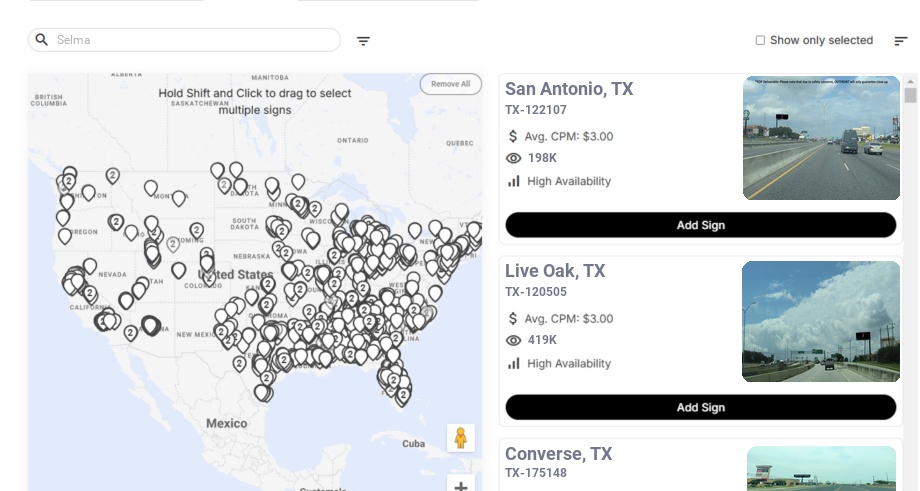
Blip offers 14 vibrant digital billboards near Selma, Texas, with placements serving the Selma area from nearby Live Oak and Converse. The Live Oak boards are about 2.2 miles from Selma and are positioned near I-35 and Loop 1604, while Converse boards are about 6.2 miles away and reach commuters, residents, and workers moving between Converse, Universal City, Randolph AFB, and Selma. These locations are designed to capture both retail traffic and daily commuter flows.
What kind of traffic reaches Selma, Texas billboard locations?
Selma sits at one of the most powerful retail and commuter crossroads in the greater San Antonio metro. TxDOT traffic counts in recent years show stretches of I-35 near the Selma/Live Oak area carrying in the range of 160,000–180,000 vehicles per day, with Loop 1604 near The Forum also seeing well over 100,000 vehicles per day. This creates multiple high-exposure billboard approaches for advertisers.
When is the best time to run Blip billboards in Selma, Texas?
Traffic and behavior patterns point to several high-value windows in the Selma area, especially weekday commute periods and busy shopping times. The morning commute runs from 6:30–9:00 a.m., midday from 11:00 a.m.–2:00 p.m., and the evening commute from 4:00–7:00 p.m. Weekends often see elevated mid-morning to evening traffic driven by shopping, dining, and recreation.
Who do billboards near Selma, Texas reach?
Advertisers can use the 14 digital billboards in nearby Live Oak and Converse to reach a concentrated mix of middle-income families, young professionals, military households, and daily commuters moving through the Selma area. Nearby communities and job centers, including Randolph Air Force Base and the broader northeast San Antonio suburbs, contribute to a large and diverse audience. The area also includes shoppers and diners drawn to The Forum and surrounding retail corridors.
Do I need a contract to advertise with Blip in Selma?
No, Blip has no long-term contracts or minimum commitments. You can start, pause, or stop your campaign at any time.
How fast can I launch a billboard campaign with Blip in Selma?
You can have your campaign live in minutes. Create a free account, select your locations, set your budget, upload your design, and start running once approved.
Where can I advertise with Blip in Selma?
Blip has digital billboards in Selma. You can browse available locations on a map, choose the ones that fit your audience, and start advertising right away.
Still have questions? Launch a campaign in minutes — no contracts, no commitments.
Start Your CampaignSelma Billboard Advertising Guide
Selma sits at one of the most powerful retail and commuter crossroads in the greater City of San Antonio metro. With fast-growing neighborhoods, heavy traffic along I‑35, and major retail draws like The Forum at Olympia Parkway Live Oak Converse, we can help you tap into this high-traffic corridor with flexible, data‑driven campaigns that can deliver thousands of daily impressions on a modest budget. Whether you’re a small business testing billboard advertising near Selma for the first time or an established brand seeking more efficient reach, these placements give you scalable options.
Understanding the Selma Area Market
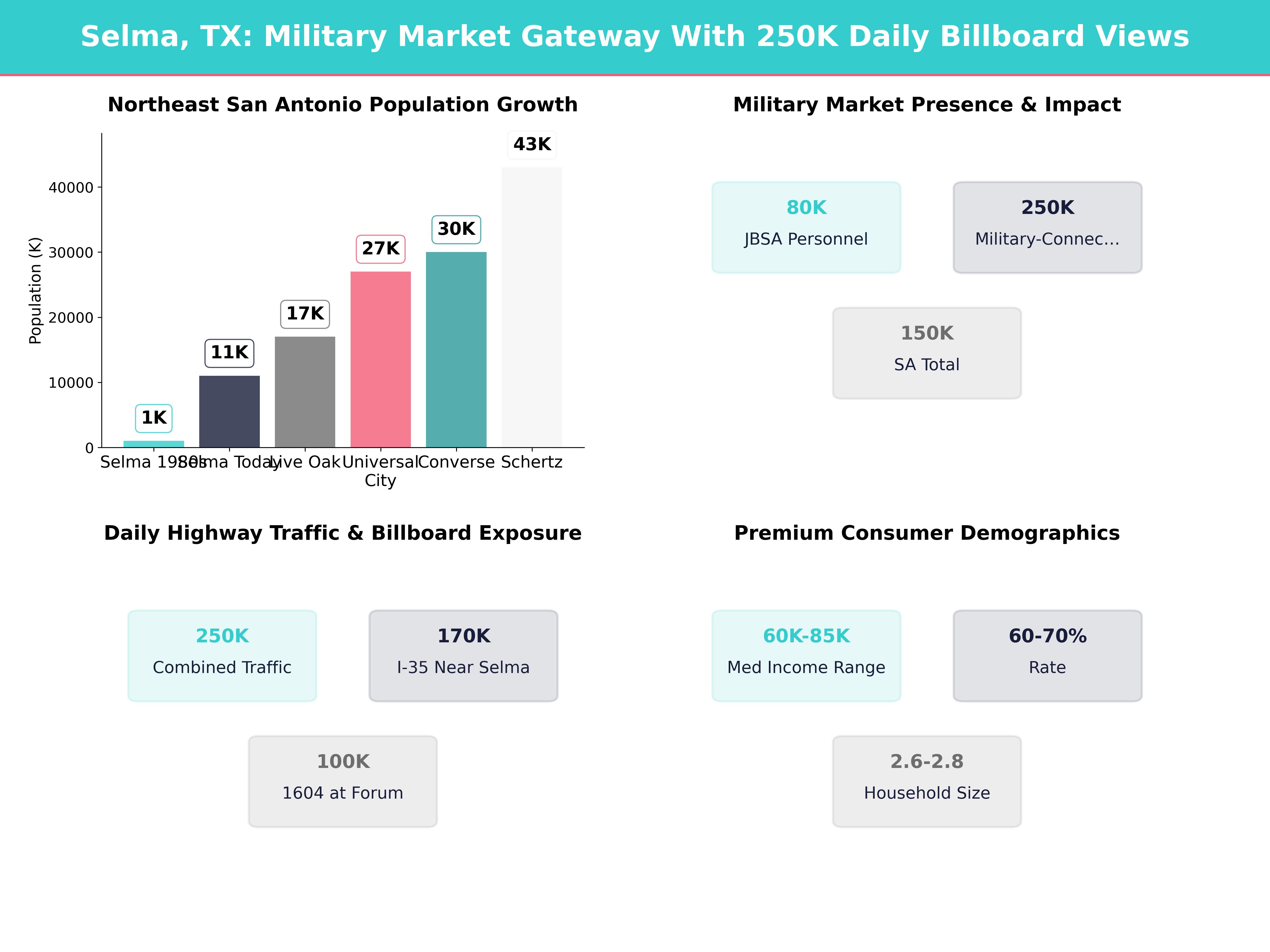
Selma is a small city with outsized commercial influence. According to the City of Selma, the community has grown from under 1,000 residents in the 1980s to more than 11,000 today, a more than tenfold increase in roughly four decades. Neighboring cities such as Live Oak Converse (about 30,000 residents), Schertz (over 43,000 residents), and Universal City (roughly 27,000 residents) bring the immediate northeast San Antonio area to well over 150,000 people within a short drive of Selma’s retail core.
Key market characteristics:
- Explosive population growth: Bexar County has surpassed 2 million residents, and the San Antonio–New Braunfels metro has climbed above 2.7 million, adding tens of thousands of new residents annually. Recent estimates show the metro growing around 1.4–1.8% per year in the early 2020s—among the fastest‑growing large metros in the country. Suburban cities along I‑35 and Loop 1604 near Selma have posted double‑digit percentage growth over the past decade, continually feeding new households into the corridor.
- High retail density: The Forum at Olympia Parkway
- Military presence: Nearby Randolph Air Force Base Joint Base San Antonio (JBSA)
- Commuter corridor: I‑35 between San Antonio and New Braunfels is one of the busiest stretches of highway in Texas. Texas Department of Transportation (TxDOT) traffic counts in recent years show stretches of I‑35 near the Selma/Live Oak area carrying in the range of 160,000–180,000 vehicles per day on the main lanes, with weekday peak‑hour volumes commonly topping 8,000–10,000 vehicles per direction. Loop 1604 near The Forum also sees well over 100,000 vehicles per day, creating multiple high‑exposure billboard approaches.
All of this means advertisers can use our 14 digital billboards in nearby Live Oak (about 2.2 miles from Selma) and Converse (about 6.2 miles from Selma) to reach a concentrated mix of middle‑income families, young professionals, military households, and daily commuters moving through the Selma area. With typical digital billboard rotation, a well‑funded campaign can generate tens of thousands of impressions per day across this cluster, and even small campaigns can secure hundreds to thousands of daily plays focused on key drive times. For many brands, this makes Selma billboards one of the most efficient ways to extend their San Antonio‑area presence without overspending.
Where Our Billboards Reach the Selma Area
Our digital boards serving the Selma area sit along key commuter and retail corridors in:
-
Live Oak (2.2 miles from Selma)
- Positioned near I‑35 and Loop 1604, connecting to neighborhoods in Live Oak
- Ideal for reaching shoppers visiting The Forum at Olympia Parkway
- Captures commuters traveling between central San Antonio, Selma, and New Braunfels, many of whom have average one‑way commute times of 25–30 minutes and see the same boards repeatedly each week.
-
Converse (6.2 miles from Selma)
- Located along major arterials and FM roads serving Converse, Universal City, and Randolph AFB, which together account for more than 85,000 residents.
- Positioned to reach residents and workers moving between Converse, Universal City, Randolph AFB, and the Selma area.
- Great for speaking to military households and suburban commuters accessing I‑10, I‑35, and Loop 1604, with key corridors like FM 78 carrying tens of thousands of vehicles per day.
Because Blip sells time on these boards by the “blip” (a single 7.5–10 second display), we can concentrate your impressions on the specific arteries, directions, and times that matter most for your business. For example, a focused campaign might schedule 500–1,000 blips per day during peak hours, while a broader awareness campaign could spread several thousand daily blips across all dayparts. This flexibility means you can treat billboard rental near Selma almost like a digital ad buy—dialing impressions up or down and testing different locations without long‑term commitments.
Key Audience Segments Near Selma
1. Suburban Families and Homeowners
Northeast San Antonio suburbs are dominated by single‑family homes, master‑planned communities, and townhomes. In many tracts near Selma, homeownership rates exceed 60–70%, and median household incomes in nearby Live Oak, Converse, and Universal City often land between $60,000 and $85,000, with several newer neighborhoods surpassing $90,000. Average household sizes in the area typically exceed 2.6–2.8 people, reflecting a large share of family households with children.
These residents:
- Commute daily along I‑35, Loop 1604, and FM 78, with many logging 10–20 miles per trip and passing key billboard locations twice a day.
- Take frequent retail trips to The Forum and surrounding big‑box centers, where regional studies suggest weekly visit frequencies of 1–3 trips per household for groceries, dining, and general merchandise.
- Spend heavily on home improvement, healthcare, dining, kids’ activities, and automotive services—categories that collectively account for a large share of household budgets in middle‑income suburbs.
Implication for creatives: Use family‑oriented imagery, clear value propositions (e.g., “Save $300 on your new AC this weekend”), and location cues such as “5 minutes from The Forum” or “Just off I‑35 at Exit ___” to immediately situate your business in their mental map. Since drivers typically have 3–6 seconds of readable exposure at highway speeds, the message should be focused on one benefit and one directional cue.
2. Military and Defense‑Connected Households
Joint Base San Antonio is one of the largest joint bases in the U.S., with JBSA
- Approximately 80,000 full‑time personnel (active‑duty, Guard, Reserve, and civilian) work on base installations.
- Total direct economic impact is commonly estimated in the tens of billions of dollars annually for the San Antonio region.
- Annual student throughput at Randolph often reaches into the tens of thousands, bringing a continuous stream of new trainees and visiting families.
This brings:
- A young, transient population—many under 35, often with young families and steady pay.
- Steady demand for housing, auto, banking, and off‑base services such as dining, entertainment, healthcare, and childcare.
- Interest in discounts and clear, straightforward offers, with many businesses in the corridor offering 5–15% military discounts or special financing.
Implication for creatives: Highlight military‑friendly messaging such as “Military discounts available” or “TRICARE accepted.” Ensure pricing or offer details are bold and easy to read at a glance. Including subtle nods like “JBSA‑Friendly” or “Minutes from Randolph” can increase relevance for the estimated tens of thousands of vehicles per day flowing between base gates and surrounding suburbs.
3. Shoppers and Diners Drawn to The Forum and Nearby Retail
The Forum at Olympia Parkway
These visitors are:
- Often already in a buying mindset, with average shopping trips ranging from 45 minutes to 2 hours and multiple store visits per trip.
- Comparing choices for restaurants, apparel, electronics, and entertainment in real time as they drive past billboards and exit ramps.
- Responsive to last‑mile cues like “Turn right at the next light” or “Across from The Forum,” particularly when they are within 1–2 miles of their destination.
Implication for creatives: Promote proximity (“2 minutes ahead on your right”), limited‑time deals (“This Weekend Only – 25% Off”), and category differentiators (e.g., “Selma area’s only ___ showroom”). Because around 60–70% of purchase decisions for fast‑casual dining and many impulse retail buys are made same‑day, simple, urgent calls‑to‑action can convert Forum traffic into immediate store visits. When paired with high‑visibility Selma billboards, these last‑minute prompts can significantly influence where shoppers choose to stop.
4. Commuters Between San Antonio and New Braunfels
The I‑35 corridor moves large numbers of commuters through the Selma area each weekday:
- TxDOT data shows I‑35 main lanes near Selma/Live Oak supporting roughly 160,000–180,000 vehicles per day, with peak congestion in morning (6:30–9:00 a.m.) and afternoon (4:00–6:30 p.m.) windows when speeds can drop below 40 mph, increasing billboard dwell time.
- Many of these commuters pass the same billboards 2 times per day, 5 days per week—up to 40+ weekly exposures for a well‑scheduled digital campaign.
- Average regional commute times around 25–28 minutes create a predictable window in which commuters encounter repeat messaging across multiple days.
Implication for creatives: Repetition builds recall. Use simple, high‑contrast layouts with a single key message—brand awareness, a memorable tagline, or a clear offer—and rely on frequency rather than overstuffed designs. A sequence of 3–4 rotating creatives, each seen multiple times per week, can significantly improve brand recall compared to a single static design.
Traffic Patterns and When to Run Your Blips
Blip’s scheduling tools let us selectively bid on specific days and times. For the Selma area, traffic and behavior patterns point to several high‑value windows. In practice, advertisers often see better response when 60–80% of their budget is focused on the top commute and shopping periods. This is especially true for businesses that rely on billboard advertising near Selma to reach customers at specific decision moments.
Weekday Patterns
-
Morning commute (6:30–9:00 a.m.)
- Heavy inbound traffic toward San Antonio, Randolph AFB, and industrial job centers.
- I‑35 and Loop 1604 volumes ramp quickly after 6:30 a.m., with thousands of vehicles per lane per hour.
-
Ideal for:
- Coffee shops, breakfast restaurants
- Traffic/commute‑related services (auto repair, insurance, fuel)
- Brand awareness for banks, healthcare, and real estate
-
Midday (11:00 a.m.–2:00 p.m.)
- Lunch traffic and retail trips to The Forum and nearby centers; many workers have 30–60‑minute lunch windows and choose destinations within 5–10 minutes of their route.
-
Great for:
- Quick‑serve and fast‑casual restaurants
- Retail promotions
- Medical clinics, dentists, and same‑day services
-
Evening commute (4:00–7:00 p.m.)
- Strong volumes of outbound commuters back to Selma‑area neighborhoods and surrounding suburbs, often matching or exceeding morning volumes.
-
Best for:
- Restaurants and entertainment
- Gyms and fitness studios
- Family services (tutoring, after‑school programs, childcare)
By aligning bids with these windows, advertisers can maximize the number of impressions per dollar during periods when local residents are most likely to make purchase decisions, call for services, or stop at retailers on the way home.
Weekend Patterns
Weekends often see:
- Elevated mid‑morning to evening traffic (10:00 a.m.–8:00 p.m.) driven by shopping, dining, and recreation, with Saturday often rivaling or exceeding weekday peak volumes near The Forum.
- Visitors attending events at Retama Park
- Families running errands and visiting big‑box stores, with average weekend shopping trips tending to be longer and higher‑spend than weekday stops.
We often recommend weekend‑heavy schedules for:
- Retailers and showrooms
- Recreation/entertainment concepts (trampoline parks, escape rooms, bowling)
- Real estate open houses and model home tours
Because Blip allows you to adjust budgets daily, you can bid more on weekends and during peak commuter windows, while scaling back on lower‑value hours like late nights or mid‑afternoons when traffic volumes and purchase intent are comparatively lower.
Seasonality in the Selma Area
The Selma area follows broader San Antonio seasonal patterns, but a few local nuances matter for billboard strategy. San Antonio tourism and local government data routinely show billions of dollars in annual visitor spending and strong seasonal swings, which spill into the Selma corridor as travelers move along I‑35.
-
Spring (March–May)
- Strong home‑buying and home‑services season as temperatures rise; regional housing markets often see a 20–30% increase in listings and closings compared to winter months.
- Outdoor events and festivals region‑wide; more discretionary spending on landscaping, outdoor dining, and weekend entertainment.
- School‑year activities at a peak for families in districts like Northeast ISD and Judson ISD, driving additional evening and weekend trips.
-
Summer (June–August)
- Hot weather—often with many days above 95°F—drives demand for HVAC, indoor entertainment, and water‑related activities.
- Military training cycles at Randolph and other JBSA installations can bring waves of new arrivals and visiting families, increasing demand for lodging, dining, and local services.
- Back‑to‑school shopping surges July–August in retail clusters near Selma, with local families spending hundreds of dollars per student on apparel, supplies, and electronics.
-
Fall (September–November)
- Continued retail strength with holiday prep beginning in October; many retailers see weekly sales start to climb 10–20% ahead of November.
- High school and college football seasons drive local spirit and gatherings, boosting restaurant and sports‑bar traffic on Thursdays, Fridays, and weekends.
- Good window for big‑ticket items (autos, furniture, home improvement) as temperatures moderate and homeowners tackle projects before winter.
-
Holiday/Winter (November–December)
- Major retail promotions and large foot traffic at The Forum and nearby centers; regional data show holiday sales can account for 20–30% of annual retail revenue for some categories.
- Strong dining and entertainment demand from office parties, family gatherings, and out‑of‑town visitors.
- Year‑end healthcare, insurance, and tax planning opportunities, as residents use remaining benefits or flexible‑spending funds before deadlines.
With Blip, we can shift spend to these high‑impact periods—like concentrating budget around holiday shopping weekends, back‑to‑school weeks, or the first major heat waves of summer—so your ads appear when demand naturally spikes.
Creative Best Practices for Selma‑Area Billboards
Digital billboards near the Selma area must cut through fast‑moving, high‑volume traffic. A vehicle traveling 65 mph covers roughly 95 feet per second, leaving only a few seconds to absorb your message; at 70 mph, that drops to just over 3 seconds of effective reading time for an average board. We encourage:
-
One Core Message
- Aim for 7–10 words or fewer. Campaign testing across multiple markets shows shorter messages can improve recall by 20–40% versus dense copy.
- Example: “Braces from $99/Month – 5 Minutes Ahead” rather than multiple offers.
-
Large, Bold Typography
- Use fonts thick enough to be read at distance and high speeds—letters at least 18–24 inches tall in design can translate to legible copy at highway distances on most boards.
- Keep body copy to a minimum; prioritize your brand name, offer, and directional cue.
-
High Contrast Colors
- Pair light text on dark backgrounds or dark text on light backgrounds; studies on outdoor readability show high‑contrast color pairings can increase legibility distance by 25–50%.
- Avoid low‑contrast combinations (e.g., red on dark blue) that wash out in sun or rain.
-
Local Cues and Landmarks
- References like “near The Forum,” “by Retama Park,” or “across from ___” help drivers immediately locate you and can increase navigation‑driven visits.
- For military‑oriented campaigns, a subtle nod to Randolph AFB or “JBSA‑friendly” language can resonate with the tens of thousands of base‑connected drivers in the corridor.
-
Directional Messaging
- Use “Next Exit,” “Exit ___,” or “1 Mile Ahead” if you are close to a major interchange.
- Directional messages can significantly improve response for destination‑based businesses, especially when boards are within 2–3 minutes’ drive of your door.
-
Rotating Creative Sets
-
With digital, you can upload multiple creatives and rotate them:
- Brand awareness slide
- Offer or promotion slide
- Seasonal or event‑specific slide
- This keeps content fresh for daily commuters who see your message repeatedly. Campaigns that rotate 3–5 creatives often see higher engagement and store‑visit lift than those running a single static design for months.
-
With digital, you can upload multiple creatives and rotate them:
Leveraging Blip’s Flexibility Near Selma
Blip’s platform is designed for precision and control, which fits the diverse patterns of the Selma area:
-
Budget Control
- Set daily budgets, sometimes as low as a few dollars per day, and scale up for peak weeks or months. Even a $10–$20 daily budget can translate into dozens to hundreds of blips, depending on demand and time of day.
- Adjust bids based on demand; for example, bid higher for peak Friday‑evening blips during holiday shopping season, and lower for mid‑day slots in slower periods.
-
Daypart Targeting
- Run breakfast or coffee ads only in the morning hours when thousands of commuters are choosing where to stop.
- Promote happy hours or dinner specials from 3:30–7:30 p.m. on weekdays, aligning with the heavy outbound traffic from downtown San Antonio, Randolph AFB, and industrial hubs.
-
Geographic Focus
- Emphasize boards closer to Live Oak to reach Forum‑area shoppers and residents of nearby neighborhoods where household incomes commonly exceed $70,000.
- Add more Converse boards when targeting military families and neighborhoods east of Selma, where a higher share of households have direct ties to Randolph AFB and JBSA.
-
Event and Weather Reactivity
- Increase blips during major events, sales, or openings, or when local news and social media attention focus on the Selma area.
- Swap in heat‑weather creatives (“AC Tune‑Up Today”) as temperatures spike, or rain‑weather creatives for car washes and indoor entertainment. During heat waves with multiple days above 100°F, HVAC and indoor entertainment advertisers often see noticeable upticks in response when messaging is timely.
This level of control makes billboard rental near Selma accessible for businesses of many sizes, from single‑location retailers to regional franchises.
Sample Strategies for Common Advertisers
Local Restaurants and QSRs
-
Targets: Commuters, Forum shoppers, base personnel, and local families within a 5–10‑minute drive.
- Selma billboards along I‑35 and Loop 1604 can catch these diners at multiple decision points during the day.
-
Timing:
- Breakfast: 6:30–9:30 a.m.
- Lunch: 10:30 a.m.–2:00 p.m.
- Dinner: 4:00–8:00 p.m.
-
Creative:
- One hero image (dish or logo), one main offer (“Kids Eat Free Tuesdays”), and a direction (“Off I‑35 at Exit ___”).
- Use different slides by daypart—breakfast vs. lunch/dinner. Campaigns that tailor creative to daypart can see significantly higher redemption rates than all‑day generic messages.
Automotive Sales and Service
- Targets: Commuters along I‑35 and Loop 1604, plus military buyers and nearby homeowners, many of whom own multiple vehicles per household.
- Timing: Heavier on weekdays and Saturdays, 7:00 a.m.–7:00 p.m., when service bays and showrooms are open.
-
Creative:
- Emphasize easy access (“Near The Forum – Same‑Day Service”) and key benefits (“Oil Change in 30 Minutes,” “Military Pricing Available”).
- Rotate seasonal messages—AC checks in summer, tire specials in fall, and “No Payments for 90 Days” or year‑end clearance offers in winter.
Healthcare, Dental, and Vision
- Targets: Families and professionals in nearby neighborhoods, base families, and workers at major employers along the I‑35 corridor.
- Timing: All‑day presence, with peaks around 7:00–9:00 a.m. and 4:00–7:00 p.m. when people are thinking about appointments around work and school.
-
Creative:
- Clear call to action (“Accepting New Patients – Call Today”), insurance highlights (“TRICARE / Medicare Accepted”), and short URLs or phone numbers.
- For urgent‑care or walk‑in clinics, highlight “Open Late” or “Open 7 Days.” Clinics that clearly advertise extended hours often capture after‑work and weekend patients who see the board on their drive.
Home Services (HVAC, Roofing, Landscaping)
- Targets: Homeowners in Selma‑area subdivisions and nearby suburbs, where owner‑occupied rates exceed 60–70% in many neighborhoods.
-
Timing:
- Early mornings and evenings when homeowners think about home issues and can call for estimates.
- Heavier spending during severe weather seasons (hail, heat waves) when service calls spike sharply.
-
Creative:
- Strong, trust‑focused messages (“Local, Veteran‑Owned,” “Free Estimates”) that speak to long‑term reliability for big‑ticket projects.
- Weather‑triggered offers (“Book Today – Beat This Weekend’s Heat,” “Free Roof Inspection After Last Night’s Storm”).
Tying In Local Media and Community Context
To deepen your connection with the market, consider how your billboard messaging relates to what locals are seeing in news and online channels:
- Local news outlets such as KSAT 12, KENS 5, and San Antonio Express‑News
- Regional tourism and visitor information from Visit San Antonio highlights events and attractions that pull visitors up and down the I‑35 corridor near the Selma area. In recent years, San Antonio has welcomed well over 30 million visitors annually, generating tens of billions of dollars in economic impact. If your business benefits from out‑of‑town traffic, synchronize campaigns with major festivals, conventions, or sports events that drive hotel occupancy along the northeast corridor and increase traffic volumes past Selma‑area boards.
- City and county sources like the City of Selma, City of Live Oak City of Converse, City of Schertz, and Bexar County regularly publish updates on new subdivisions, infrastructure projects, and business developments. Tying your creative or timing to these local milestones can help position your brand as part of the community’s growth story.
Blip’s speed of creative swapping allows you to update your artwork in sync with these local storylines, sometimes within the same day, so your billboard presence can respond almost as fast as digital and social media channels.
Measuring Success and Optimizing
While billboards don’t provide direct click data like digital ads, we can still track performance and refine your Selma‑area campaigns:
-
Promo Codes & Phrases
- Use Selma‑specific or board‑specific promo codes (“SELMADRIVE10”) in your creatives and track redemptions. Reviewing redemption data by week can reveal which schedules and creatives are driving action.
-
Vanity URLs & Landing Pages
- Create simple URLs (e.g., “BrandNameSelma.com”) used only on billboards and monitor traffic. A spike of even a few dozen extra visits per week from a localized URL can represent a strong return for service‑based or high‑ticket businesses.
-
Call Tracking
- Use unique phone numbers for billboard campaigns and review call volumes by week. Comparing call volume to impression estimates from your Blip schedule can help you approximate cost‑per‑lead.
-
Schedule Testing
- Run A/B tests on dayparts (e.g., morning‑heavy vs. evening‑heavy) and compare store traffic or online conversions. Many advertisers find that reallocating just 20–30% of impressions from low‑value times to top‑performing windows measurably improves results.
-
Creative Rotation
- Test different messages: one focused on price, another on speed or quality, and adjust budget toward the better‑performing theme. Tracking which billboard messages correlate with higher coupon use or web traffic can guide future creative decisions.
Bringing It All Together
The Selma area sits at a powerful intersection of growth: suburban neighborhoods, a major military installation, regional retail destinations, and one of Texas’s busiest interstates. With 14 digital billboards in nearby Live Oak and Converse serving the Selma area, we can craft campaigns that:
- Target the precise corridors your customers travel most, reaching segments that collectively represent well over 150,000 nearby residents and hundreds of thousands of daily vehicle trips.
- Focus spending on the hours and days that drive results, from commuter peaks to high‑spend weekend shopping windows.
- Adapt quickly to seasons, events, and promotions driven by local government, military, tourism, and school‑year calendars.
- Deliver clear, localized messages that speak directly to Selma‑area drivers, shoppers, and military families in the moments just before they make decisions.
By pairing strong, simple creatives with smart scheduling and ongoing measurement, advertisers of all sizes can use Blip to turn the everyday traffic and shopping patterns around Selma into consistent new business and long‑term brand presence in one of the San Antonio region’s most dynamic growth corridors. When you’re ready to explore billboards near Selma or expand existing campaigns, Blip’s flexible approach to billboard advertising near Selma makes it easy to scale your visibility alongside the market’s rapid growth.