Billboards in Midlothian, TX
No Minimum Spend. No Long-Term Contracts. Just Results.
Trusted by Leading Brands


Billboard advertising
in Midlothian has never been easier
How much is a billboard in Midlothian?
Why Choose Blip for Billboard Advertising in Midlothian
Blip lets you launch fast in Midlothian and reach U.S. 287/U.S. 67 commuters without contracts or minimums.
Set flexible budgets in Midlothian and only pay when your ad blips—ideal for testing family and industrial traffic.
Use dayparting to hit Midlothian's 6-9 a.m. and 4-7 p.m. drive times, plus Friday-Sunday event traffic.
Track real-time results in Midlothian and shift spend toward the U.S. 287 or FM 663 routes that perform best.
Blip's creative tools help tailor Midlothian ads for school families, plant workers, and Waxahachie-bound shoppers.
Frequently Asked Questions About Billboard Advertising in Midlothian
How much does billboard advertising in Midlothian with Blip cost?
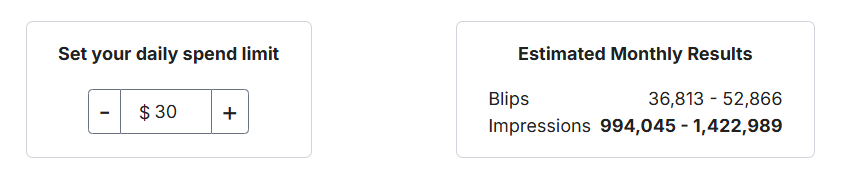
Pricing starts at just $0.01 per display. Your daily budget tells Blip’s algorithm how much to bid for open ad slots, and the cost per blip changes based on time of day, location, and advertiser demand. That means you get a flexible, pay-per-play approach that helps maximize reach without locking you into a contract or minimum spend.
Where can I advertise with Blip in Midlothian for the most traffic?
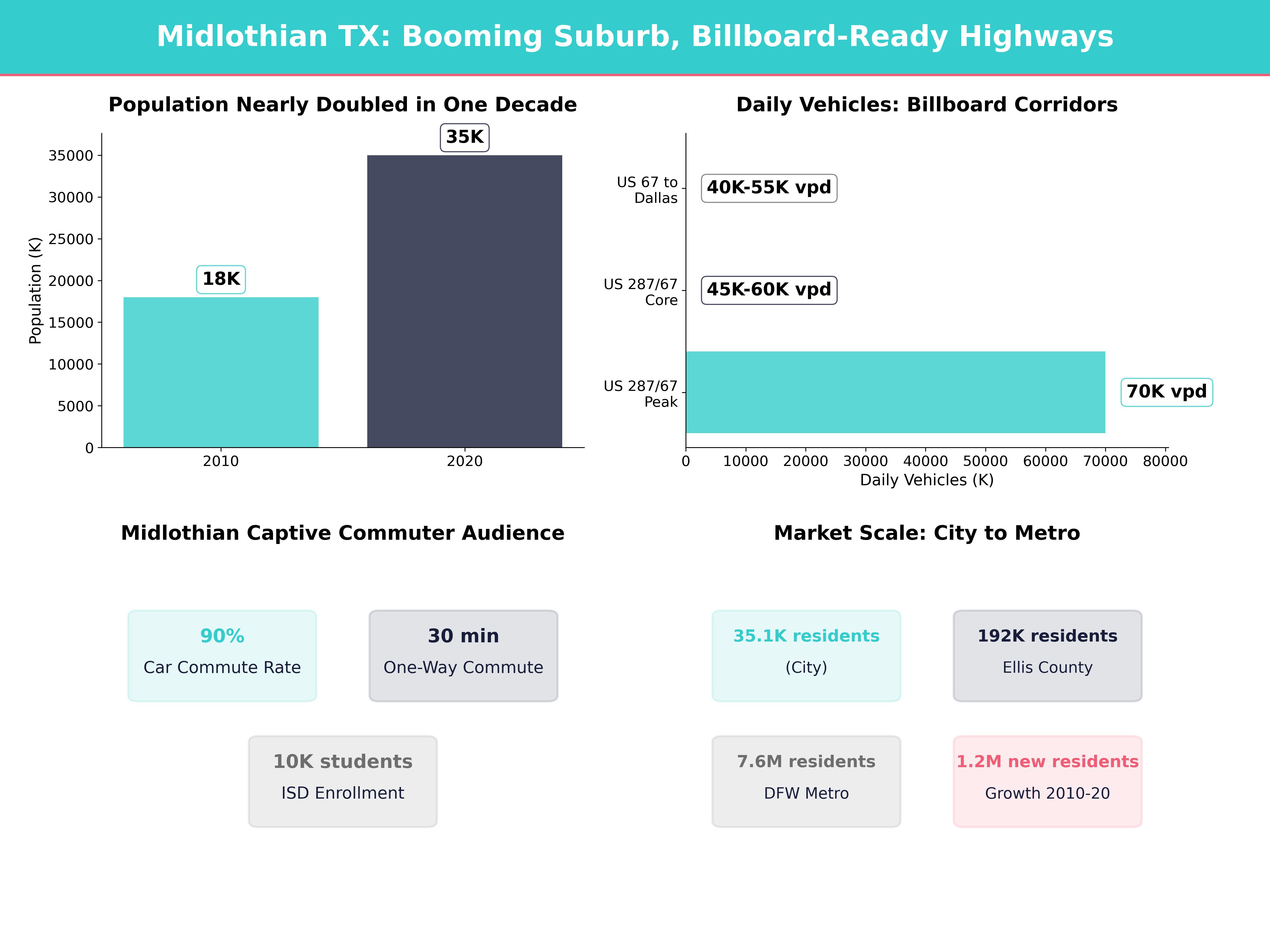
Midlothian-area segments of U.S. 287 and the shared U.S. 67/U.S. 287 corridor generally carry about 45,000 to 60,000 vehicles per day. On busier approaches toward Mansfield, some segments rise above 70,000 AADT. This is the backbone corridor for Midlothian billboard reach.
Who are the main billboard audiences in Midlothian?
The first audience we should think about in Midlothian is the commuter, with roughly 90% of workers traveling by car and average one-way commutes around 30 minutes. Midlothian is also a family-heavy city with strong school identity, and Midlothian ISD serves roughly 10,000 students. The city’s industrial employers create a second major audience that includes shift workers, contractors, engineers, suppliers, and trade-oriented job seekers.
When is the best time to run a Midlothian billboard campaign with Blip?
Spring is one of the best seasons for Midlothian billboard campaigns because families are active, sports calendars fill up, weather improves, and event traffic increases. Late summer is a prime window for family-focused advertising, and fall brings football, community events, and renewed commuter regularity. November and December are also useful for local gift retail, restaurants, churches, and service businesses that want to stay visible during heavy shopping periods.
Which Midlothian roads are best for Blip billboards near local neighborhoods?
Midlothian's feeder roads matter because they help us move from broad market reach to neighborhood relevance. Near the major highway connections, FM 663 often carries about 15,000 to 20,000 vehicles per day, FM 1387 typically falls in the 10,000 to 20,000 AADT range on growth-oriented north-side segments, and FM 875 commonly lands around 8,000 to 12,000 AADT on city-edge segments. These roads are valuable when we want stronger local intent.
Do I need a contract to advertise with Blip in Midlothian?
No, Blip has no long-term contracts or minimum commitments. You can start, pause, or stop your campaign at any time.
How fast can I launch a billboard campaign with Blip in Midlothian?
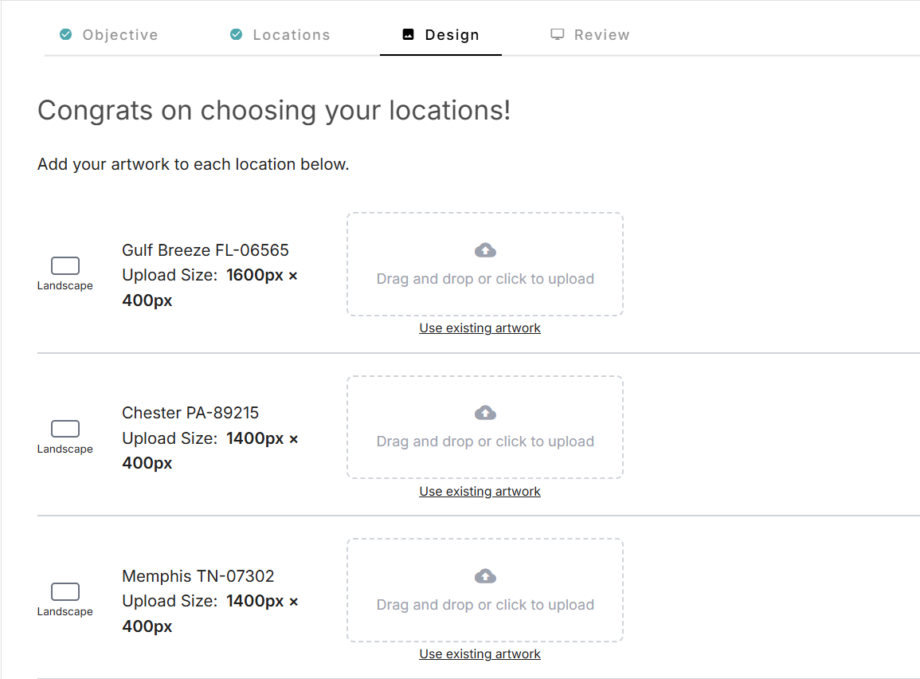
You can have your campaign live in minutes. Create a free account, select your locations, set your budget, upload your design, and start running once approved.
Where can I advertise with Blip in Midlothian?
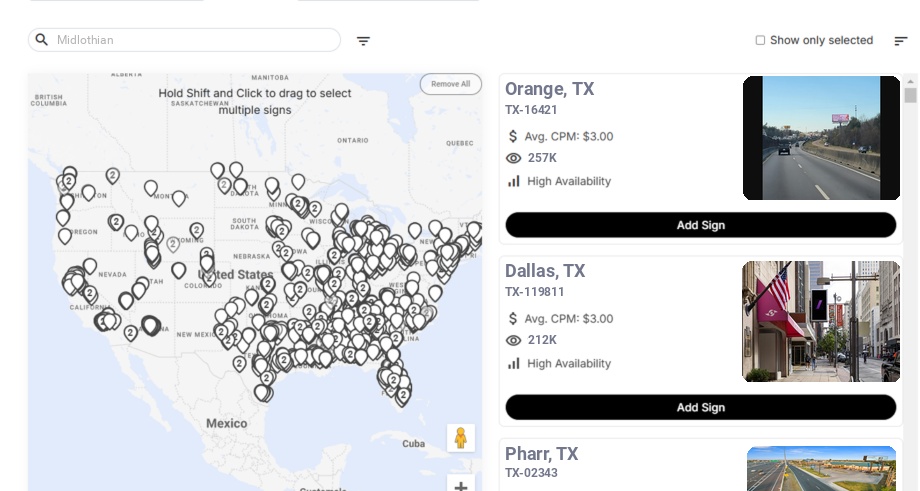
Blip has digital billboards in Midlothian. You can browse available locations on a map, choose the ones that fit your audience, and start advertising right away.
Still have questions? Launch a campaign in minutes — no contracts, no commitments.
Start Your CampaignMidlothian Billboard Advertising Guide
Midlothian Dallas-Fort Worth economy. The city counted 35,125 residents in 2020, up from 18,037 in 2010, which is a remarkable 94.7% increase in just one decade. It also sits inside Ellis County 192,455 residents in 2020 after adding 42,845 people since 2010, and within a metro area of more than 7.6 million people (7,637,387 in the 2020 Census). Because most local trips happen by car, we can use digital billboards in Midlothian to build frequency with commuters, families, industrial workers, and regional visitors moving through the city every day.
Midlothian Market Overview
Midlothian sits in one of Texas' strongest growth paths
Midlothian is part of the 16-county planning region served by the North Central Texas Council of Governments, and that regional context matters. While Midlothian itself grew by 17,088 residents from 2010 to 2020, Ellis County added 42,845 residents over the same period. The broader Dallas-Fort Worth-Arlington metro added more than 1.2 million residents between 2010 and 2020 (1,222,548), which means Midlothian is not growing in isolation. We are advertising in a city that benefits from both local household formation and metro-wide spillover.
This growth matters for billboard strategy because fast-growing suburban markets usually create several overlapping demand pools at the same time. We can reach new residents who are still choosing doctors, banks, restaurants, gyms, churches, and contractors. We can also reach long-time residents who are seeing more retail, more medical options, and more local competition. In practical terms, that means out-of-home advertising in Midlothian can work for both brand building and immediate-response offers.
Midlothian's economy is broader than many small cities
Midlothian Economic Development, the City of Midlothian Midlothian Chamber of Commerce position the city as both family-oriented and industrially significant. Midlothian is widely known as the "Cement Capital of Texas," and that reputation is grounded in its 3 major cement plants, including facilities connected to Holcim US, Ash Grove Cement, and Buzzi Unicem USA. The city also has the Gerdau steel mill and a Google data center campus.
For advertisers, that industrial base changes the audience mix. Midlothian is not only a bedroom community. It is also a job center with plant employees, contractors, suppliers, logistics traffic, and business decision-makers moving through town. That gives us room to market consumer services, workforce recruiting, B2B offerings, and local retail all within the same geography.
Midlothian is highly car-dependent, which supports billboard frequency
Midlothian is still a drive-first market. Local and regional travel is dominated by personal vehicles, and roughly 9 in 10 workers commute by car when we combine drive-alone and carpool travel. The typical one-way commute is around 30 minutes, which is long enough for repeated billboard exposure to matter. Midlothian also sits roughly 30 to 35 miles from the urban cores of Dallas and Fort Worth, which reinforces its role as a commuter-connected suburb rather than an isolated small town.
That combination of growth, roadway dependence, and regional accessibility is exactly what we want in digital billboard planning. We can build repetition during weekday commute windows, then pivot to weekend shoppers and event visitors without changing markets.
Midlothian Key Traffic Corridors
Midlothian's travel patterns are concentrated on a relatively small number of highways and feeder roads. That makes placement strategy especially important, because the right board can intercept both local residents and regional pass-through traffic.
U.S. 287 and the U.S. 67/U.S. 287 overlap in Midlothian
According to traffic maps from the Texas Department of Transportation, Midlothian-area segments of U.S. 287 and the shared U.S. 67/U.S. 287 corridor generally carry about 45,000 to 60,000 vehicles per day. On busier approaches toward Mansfield 70,000 AADT. This is the backbone corridor for Midlothian billboard reach.
This route works especially well when we want scale. It connects Midlothian to Mansfield, Fort Worth-side commuters, Waxahachie traffic, and regional shoppers. It is a strong fit for several advertiser categories.
- Retail and restaurants benefit because they need broad frequency across daily commuters and evening errand traffic.
- Healthcare providers benefit because they can reach families heading between work, school, and appointments.
- Home services benefit because repeated highway exposure helps us stay top-of-mind until a repair or remodel need appears.
- Employers benefit because this corridor reaches both local workers and job seekers commuting in from neighboring cities.
U.S. 67 toward Cedar Hill and Dallas
U.S. 67 is one of Midlothian's most important regional connections, especially for travel toward Cedar Hill Dallas County. Midlothian-area U.S. 67 segments commonly run in the 40,000 to 55,000 AADT range, depending on location and whether traffic is measured on the shared corridor or on approach segments.
We should treat U.S. 67 as a commuter and destination route. It is especially useful for advertisers that want to pull consumers north or capture northbound household traffic before it reaches denser retail options closer to Dallas. Local medical groups, financial services firms, legal services, auto dealerships, and family entertainment brands can all use this route effectively. If our business depends on people planning a stop after work, this is one of the first corridors we should evaluate.
FM 663, FM 1387, and FM 875 in Midlothian
Midlothian's feeder roads matter because they help us move from broad market reach to neighborhood relevance. Near the major highway connections, FM 663 often carries about 15,000 to 20,000 vehicles per day. FM 1387 typically falls in the 10,000 to 20,000 AADT range on growth-oriented north-side segments. FM 875 commonly lands around 8,000 to 12,000 AADT on city-edge segments.
These roads are valuable when we want stronger local intent. A board near FM 663 can help us speak to residents who are already close to Midlothian retail, schools, churches, and medical services. FM 1387 is useful for north-side growth and commuter spillover from Mansfield. FM 875 can support campaigns aimed at local shopping, hometown services, agricultural-adjacent audiences, and industrial access routes.
How we should match corridors to advertiser goals in Midlothian
When we choose Midlothian billboards, the road should match the decision cycle. We can use this to guide where we place each creative message.
- If we need mass awareness, we should prioritize U.S. 287 and the U.S. 67/U.S. 287 overlap.
- If we need northbound commuter relevance, we should lean into U.S. 67.
- If we need hyperlocal household traffic, we should consider FM 663, FM 1387, and similar feeders.
- If we need industrial recruiting or B2B visibility, we should focus on corridors used by plant traffic, contractor vehicles, and supplier routes.
Midlothian Audience Segments
Midlothian commuters are the core audience
The first audience we should think about in Midlothian is the commuter. With roughly 90% of workers traveling by car and average one-way commutes around 30 minutes, the city produces a steady stream of repeat impressions. This makes Midlothian especially good for categories that benefit from familiarity, such as healthcare, banking, insurance, legal services, home improvement, HVAC, pest control, and automotive care.
Because Midlothian is tied into the southern DFW commuter web, our billboards can do more than reach city residents. They can also reach people who live in Midlothian, work in Mansfield Arlington, Dallas, or Fort Worth, and then make purchasing decisions close to home.
Midlothian families and school households are highly valuable
Midlothian ISD serves roughly 10,000 students, which tells us a lot about the market even before we look at broader demographics. Midlothian is a family-heavy city with strong school identity, youth sports participation, and parent-driven purchasing. That makes billboard advertising especially effective for pediatric care, orthodontics, family restaurants, tutoring, extracurricular programs, seasonal events, churches, and home services.
Family audiences in Midlothian often respond well to practical value and local trust. When we mention convenience, same-day availability, or a short drive from home, we match how these households actually make decisions. This is also a market where local references matter. A message that says "Midlothian," "Waxahachie," or "Mansfield" can feel more immediate than a generic metro-wide pitch.
Midlothian industrial and skilled-trade workers create a distinct billboard audience
Midlothian's industrial employers create a second major audience that many suburban cities do not have. With 3 cement plants, the Gerdau mill, and a Google data center presence, we have a meaningful pool of shift workers, maintenance teams, contractors, engineers, suppliers, and trade-oriented job seekers.
This audience is ideal for:
- Workforce recruiting, especially when we can highlight shifts, certifications, benefits, or hiring urgency.
- B2B services, including industrial suppliers, safety providers, equipment rental, fleet maintenance, staffing, and training.
- Consumer essentials, such as quick-service restaurants, workwear, urgent care, and financial services.
If we are recruiting in Midlothian, billboards are particularly useful because many potential applicants are already driving fixed routes every day.
Midlothian visitors and leisure traffic expand the audience on weekends
Midlothian is not a classic tourism city, but it benefits from nearby and local draw. TexPlex Park 1,000 acres and brings motorsports and event traffic into the market. The nearby Scarborough Renaissance Festival 8 weekends plus Memorial Day Monday each spring, creating a reliable seasonal wave of leisure travel. Regional attractions such as Texas Motorplex in Ennis
That leisure audience is a strong fit for restaurants, family entertainment, lodging, fuel and convenience, event promotion, and impulse-oriented retail. Weekend boards can work very differently from weekday commuter boards in Midlothian, and we should plan for both.
Midlothian Seasonal and Timing Opportunities
Spring in Midlothian is excellent for events, home services, and local discovery
Spring is one of the best seasons for Midlothian billboard campaigns. Families are active, sports calendars fill up, weather improves, and event traffic increases. The Scarborough Renaissance Festival April and May, and local community programming typically becomes more visible in the same stretch.
This is the season when we should emphasize:
- Home improvement, landscaping, roofing, and HVAC tune-ups before summer heat arrives.
- Weekend dining, entertainment, and family outings.
- Health, wellness, and elective-care services that people often book after winter.
Because spring traffic mixes commuters with discretionary travelers, it is a good time to run both awareness creative and direct-response creative.
Summer in Midlothian rewards convenience and heat-related messaging
North Texas summers regularly bring 90°F-plus afternoons, and that changes purchase behavior. Consumers become more responsive to air conditioning, cold drinks, indoor entertainment, auto A/C service, pool services, pest control, and urgent repair messages. Summer is also a strong season for quick-turn campaigns because families move around more unpredictably between camps, trips, and local errands.
In Midlothian, summer messaging works best when we keep it immediate. Phrases that emphasize same-day help, nearby locations, or short drive times feel especially relevant when people are making fast decisions in hot weather.
Back-to-school and fall sports are major Midlothian timing windows
Classes in Midlothian ISD typically begin in August and run through May, so late summer is a prime window for family-focused advertising. August and September are strong months for pediatric care, back-to-school retail, tutoring, after-school programs, orthodontics, and family dining.
Fall also brings football, community events, and renewed commuter regularity. From September through November, frequency becomes even more valuable because households settle into school-week routines. If we want consistent repetition with parents and working adults, fall is one of Midlothian's best periods.
Holiday retail and year-end services can perform well in Midlothian
November and December are useful for local gift retail, restaurants, churches, healthcare enrollment, and service businesses that want to stay visible during heavy shopping periods. Midlothian residents often split their holiday activity between local errands and regional trips to Waxahachie, Mansfield, Arlington, Dallas, and Fort Worth, so roadway exposure remains important.
We should also remember January. New-year campaigns for gyms, wellness, tax services, job recruitment, and medical scheduling can work well because consumers are resetting routines after the holidays.
Midlothian Billboard Design Tips
Midlothian creative should feel local, trustworthy, and easy to process
Midlothian is suburban, family-oriented, and proudly local, but it is also industrial and practical. That means our creative should usually lean toward clarity and credibility rather than abstract branding. When we reference Midlothian directly, mention a nearby city such as Waxahachie, Mansfield Cedar Hill
For this market, we should usually prioritize:
- Strong local nouns such as "Midlothian," "Waxahachie," "Mansfield," and "DFW South."
- Family-friendly imagery for healthcare, restaurants, schools, and community services.
- Skilled-trade or industrial visuals for recruiting and B2B campaigns.
- Offer-led copy for practical categories such as home services, auto care, and urgent care.
Midlothian boards need high contrast for fast roads and bright light
Many of Midlothian's best billboard opportunities sit on fast suburban highways where drivers are moving at 65 mph or more. That means our ads should be bold enough to read quickly and simple enough to remember after a brief glance. High-contrast color combinations usually work best in the bright, high-glare conditions common in North Texas.
In Midlothian specifically, we should think about context. Earth tones, strong blues, reds, and clean whites tend to read well against highway surroundings, industrial landscapes, and summer sky brightness. If we are advertising to families, warm and trustworthy visuals usually outperform nightclub-style creative. If we are advertising jobs, we should lead with the most motivating point first, whether that is pay, benefits, schedule, or local pride.
Midlothian messaging should match how people travel
A Midlothian driver often sees a board while commuting, running errands, or heading to a specific destination. That means directional and practical messaging can work very well. Statements like "Next Exit," "Minutes Away," "Now Hiring in Midlothian," or "Near U.S. 287" fit the way this audience moves through the market.
Midlothian Regional Strategies
North Midlothian should focus on Mansfield-bound and DFW-edge commuters
The north side of Midlothian, especially along routes feeding Mansfield Tarrant County, is ideal for weekday reach. Adjacent submarkets are often only 15 to 25 minutes apart by car, so northbound placements can capture local residents before they spread into broader DFW traffic patterns.
We should use this area for commuter-heavy categories, including healthcare, banks, legal services, auto dealerships, education, and home services. Morning and evening dayparts are especially valuable here.
Central Midlothian should emphasize local retail and everyday services
Closer-in Midlothian placements are better for all-day local relevance. This is where we should advertise urgent care, dentists, grocery-adjacent retail, restaurants, fitness, family entertainment, childcare, and community events. These boards are especially effective when we want to reinforce that a business is nearby, open now, and part of the local routine.
If our goal is repeated household exposure rather than pure regional reach, central Midlothian often gives us the best fit.
East and southeast of Midlothian should connect with Waxahachie and Ellis County movement
The Midlothian-to-Waxahachie relationship is important because residents regularly move between the two cities for healthcare, shopping, education, and events. This strategy becomes even more useful during spring festival traffic and during large regional weekends tied to Scarborough Renaissance Festival Texas Motorplex.
We should use this side of the market when we want to pull traffic from across Ellis County, not just from within Midlothian city limits.
West and industrial Midlothian should support recruiting and B2B marketing
Industrial corridors in and around Midlothian are ideal for employers and business-service advertisers. This is where messages about hiring, certification programs, equipment, safety, maintenance, and industrial supply can feel most relevant. If our audience includes plant workers, contractors, or fleet operators, we should prioritize boards that match those daily routes rather than relying only on retail-facing placements.
Midlothian Campaign Execution with Blip
We can daypart Midlothian campaigns around how the city actually moves
Midlothian is a strong market for time-based strategy because the audience changes meaningfully across the day. We can emphasize 6 a.m. to 9 a.m. and 4 p.m. to 7 p.m. for commuters on U.S. 287 and U.S. 67. We can shift toward 10 a.m. to 6 p.m. for local service businesses that want to catch parents, retirees, errand traffic, and daytime decision-makers. We can also weight Friday through Sunday for entertainment, dining, and event-driven campaigns.
That flexibility matters in Midlothian because weekday industrial traffic, school-driven family traffic, and weekend leisure traffic are not the same audience.
We should test multiple Midlothian messages instead of assuming one creative fits all
Blip makes it easy for us to test more than one version of a Midlothian campaign. We can run 2 or 3 creative variations for different corridors, compare results, and shift spend toward the stronger message. For example, a recruiting advertiser might test one board with wage-led copy, another with schedule-led copy, and a third with a local-pride message such as "Build Your Career in Midlothian."
This approach is especially useful in Midlothian because the market mixes family households, industrial workers, and regional pass-through drivers. One message rarely speaks equally well to all of them.
Midlothian campaigns benefit from ongoing optimization
Because Midlothian has both commuter rhythm and seasonal surges, we should watch performance in real time and adjust. If a spring event weekend lifts traffic, we can lean in. If a northbound commuter board outperforms a local feeder board, we can rebalance. If one creative gets better traction with family audiences, we can keep the stronger concept in rotation longer.
Getting Started with Billboard Rental in Midlothian
We should start by matching our goal to the right Midlothian location type
The best Midlothian billboard is not always the busiest one. First, we should define whether our objective is broad awareness, store visits, event attendance, recruiting, or B2B visibility. Then we should choose placements that match that goal.
- If we want broad visibility, we should begin with U.S. 287 or the U.S. 67/U.S. 287 corridor.
- If we want local household action, we should look at feeder roads and in-town approaches.
- If we want workforce recruiting, we should prioritize industrial commute routes.
- If we want weekend traffic, we should evaluate boards influenced by event and leisure movement.
We should evaluate Midlothian boards based on context, not only traffic
Traffic volume is important, but context is just as important. A board works best when it appears before a decision point, along the correct direction of travel, and near the type of destination our audience actually uses. A restaurant may need a board close to an exit. A medical group may benefit more from repeated commuter exposure. An industrial employer may care most about routes used by plant workers at shift change.
This is where Blip simplifies the Midlothian rental process. Instead of navigating the slower, negotiation-heavy process that often comes with traditional billboard buying, we can review locations on a map, choose the ones that fit our objective, and adjust as we learn.
We should launch small, learn quickly, and then scale in Midlothian
For many advertisers, the smartest Midlothian starting point is a 2- to 4-week test using a small set of boards and 2 creative versions. That gives us enough time to learn which corridor, message, and time window produce the best response. Once we see what works, we can scale into more boards, longer flighting, or more targeted dayparts.
Midlothian is a market where local relevance and repetition can outperform oversized spending. If we choose locations thoughtfully, use local messaging, and optimize as data comes in, we can build efficient billboard campaigns that fit both the city's growth and the way people actually travel through it.