Billboards near Hurst, TX
No Minimum Spend. No Long-Term Contracts. Just Results.
Trusted by Leading Brands


Billboard advertising
near Hurst has never been easier



How much is a billboard near Hurst?
Why Choose Blip for Billboard Advertising near Hurst
Blip lets you launch Hurst billboards fast and self-serve, reaching SH-183, SH-121, and I-820 commuters without traditional buying delays.
Set a flexible budget for Hurst and stay in control—ideal for testing messages near Northeast Mall and DFW-bound traffic.
Daypart your Hurst ads for rush hour, weekends, or Cowboys game nights in Arlington to match real traffic patterns.
No contracts means you can try Hurst billboard campaigns, pause anytime, and shift spend toward Grapevine, Arlington, or Fort Worth as needed.
Track Hurst performance in real time and adjust as traffic surges around DFW Airport, Six Flags, and holiday shopping events.
Use Blip's creative tools to build clear Hurst ads with local cues like Northeast Mall or SH-121, made for fast-moving drivers.
Frequently Asked Questions About Billboard Advertising near Hurst
How much does a billboard cost near Hurst, Texas with Blip?
With Blip, you choose your own daily budget for Hurst billboards, and our pay-per-blip model means you only pay each time your 7.5–10 second ad appears on digital billboards near Hurst, Texas. The price of each blip automatically adjusts based on when and where you advertise and on advertiser demand, so your campaign stays within the budget you set. You’re always in control—pause, restart, or change your budget whenever you like, making it easy to test new messages or timing in the Hurst area.
Where can I advertise with Blip near Hurst, Texas?
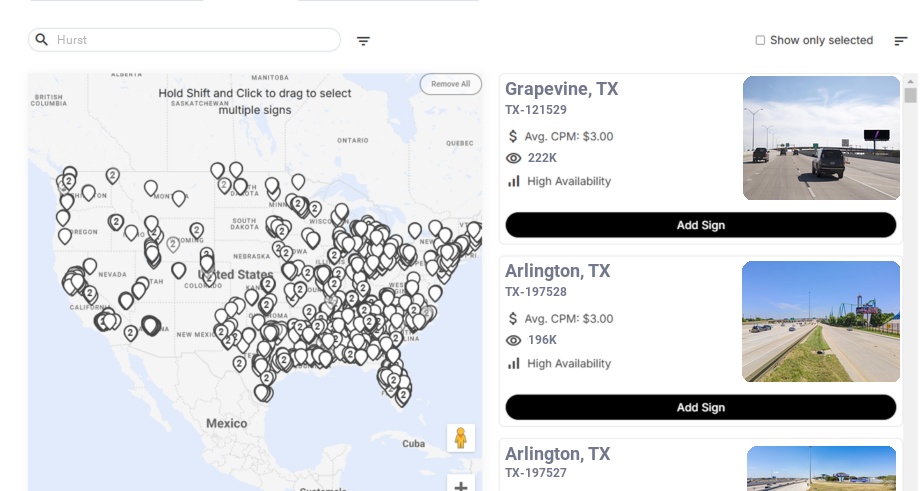
We have 11 digital billboards near Hurst, located in Grapevine, Arlington, and Fort Worth. The Hurst area sits in the heart of the Dallas–Fort Worth region, surrounded by some of North Texas’s busiest freeways, retail destinations, and entertainment hubs. This cluster offers broad regional coverage while still feeling local to Hurst households.
Why is Hurst, Texas a strong billboard market?
Hurst is part of the Mid-Cities between Dallas and Fort Worth, giving advertisers access to both local households and regional traffic. Hurst itself has about 40,000–41,000 residents in just under 10 square miles, with more than 4,000 residents per square mile. Key Hurst-area freeway segments frequently carry 130,000–180,000 vehicles per day, putting your message in front of millions of monthly impressions.
What kind of people do Hurst billboards with Blip reach?
The Hurst area has a large share of suburban families and homeowners, daily commuters across the Mid-Cities, retail and entertainment shoppers, sports and event attendees, and travelers via DFW International Airport. Nearby draws like Northeast Mall, Grapevine Mills, AT&T Stadium, Globe Life Field, and Six Flags Over Texas help create steady traffic and audience diversity. This makes billboard advertising near Hurst useful for both local businesses and brands seeking regional exposure.
When should I run billboard ads in Hurst, Texas?
Weekday commuting patterns are strong, with heavy inbound traffic in the morning and congestion often rising again from 4:00–7:00 p.m. Weekend and shopping peaks are also important, especially Saturday and Sunday from late morning through evening, and Friday afternoon–evening, Saturday 10 a.m.–7 p.m., and Sunday 11 a.m.–6 p.m. Event-driven spikes from Cowboys and Rangers games, Six Flags season, and Grapevine and Fort Worth festivals can also move tens of thousands of additional vehicles through nearby corridors.
Do I need a contract to advertise with Blip near Hurst?
No, Blip has no long-term contracts or minimum commitments. You can start, pause, or stop your campaign at any time.
How fast can I launch a billboard campaign with Blip near Hurst?
You can have your campaign live in minutes. Create a free account, select your locations, set your budget, upload your design, and start running once approved.
Where can I advertise with Blip near Hurst?
Blip has digital billboards near Hurst. You can browse available locations on a map, choose the ones that fit your audience, and start advertising right away.
Still have questions? Launch a campaign in minutes — no contracts, no commitments.
Start Your CampaignHurst Billboard Advertising Guide
The Hurst area sits in the heart of the Dallas–Fort Worth region, surrounded by some of North Texas’s busiest freeways, retail destinations, and entertainment hubs. With 11 digital billboards near Hurst—located in Grapevine, Arlington, and Fort Worth—we can help you reach residents, commuters, and visitors moving through this densely traveled part of the metroplex with flexible, data-informed campaigns. For advertisers comparing options for billboard advertising near Hurst, this cluster offers broad regional coverage while still feeling local to Hurst households.

Why the Hurst Area Is a High-Value Billboard Market
Hurst is part of the Mid-Cities between Dallas and Fort Worth, giving advertisers access to both local households and regional traffic:
- Population density: Hurst itself has about 40,000–41,000 residents in just under 10 square miles, with more than 4,000 residents per square mile according to recent city demographic summaries from the City of Hurst 120,000+ residents within a 10–15 minute drive, creating a tight cluster of suburban households that can be efficiently reached with Hurst billboards and nearby placements.
- Regional scale: The broader Dallas–Fort Worth–Arlington metro has roughly 7.9 million residents and has added around 1 million people in the last decade, with many new residents settling in suburbs like Hurst, North Richland Hills, and Grapevine. Regional planning agencies such as the North Central Texas Council of Governments project the DFW population to surpass 10 million by the 2040s, sustaining long-term traffic growth.
- Income and spending power: Hurst’s median household income is in the $70,000–$75,000 range, with the surrounding Tarrant County area near $76,000–$80,000, providing solid disposable income for dining, retail, entertainment, and home services. Local economic profiles from the City of Hurst Economic Development Office 60–65% of households are owner-occupied, and typical consumer spending on retail, food, and entertainment can exceed $25,000 per household per year.
- Retail gravity: Hurst is home to Northeast Mall, one of the largest shopping centers in North Texas, managed by Simon Property Group 8–10 million+ visits per year and can generate hundreds of millions of dollars in annual sales. The Northeast Tarrant Chamber of Commerce highlights this corridor as a key employment and retail hub for the Hurst–Euless–Bedford area, making nearby Hurst billboards especially valuable for retail and restaurant campaigns.
- Central location and traffic volume: Hurst connects quickly to SH-183, SH-121, and I-820, with nearby access to I-30 and SH-114, bringing consistent commuter and commercial traffic through the surrounding corridor. According to traffic data compiled by the Texas Department of Transportation, key Hurst-area freeway segments frequently carry 130,000–180,000 vehicles per day, putting your message in front of millions of monthly impressions.
All of this makes billboard advertising near the Hurst area effective not only for local businesses but also for brands seeking regional exposure in the center of the DFW metroplex. Whether you’re testing your first billboard rental near Hurst or scaling a multi-market strategy, these fundamentals support strong visibility and frequency.
Key Audience Segments in the Hurst Area
Understanding who you’re reaching helps shape your creative and flight strategy. Based on local government and school district data, plus regional patterns reported by organizations like Hurst-Euless-Bedford ISD and Tarrant County, several key segments stand out:
-
Suburban families and homeowners
- The Hurst area has a large share of households with children and significant single-family housing stock. Local summaries show that roughly 30–35% of households include children under 18, and 60–70% of housing in nearby neighborhoods is single-family.
- Family-oriented services—healthcare, education, kids’ activities, home improvement, financial services—tend to perform well with straightforward, benefits-focused creative. Area schools and youth programs regularly engage tens of thousands of children and teens each year, providing a constant need for family-focused services.
- Emphasize convenience (“10 minutes from Northeast Mall”), safety, and value when planning billboard advertising near Hurst for this segment.
-
Daily commuters across the Mid-Cities
- Thousands of residents commute along SH-183, SH-121, I-820, and I-30 toward Fort Worth, Dallas, or DFW Airport. Commuting profiles for Tarrant County show that more than 75% of workers drive alone to work, and average one-way commute times typically fall between 25 and 30 minutes.
- TXDOT’s traffic count maps show many of these corridors carrying 100,000+ vehicles per day near interchange points in Grapevine, Arlington, and Fort Worth (Texas Department of Transportation). On some stretches near SH-183/SH-121 and I-820, volumes exceed 150,000 vehicles per day, translating to 3–4.5 million vehicle trips per month.
- Use commuter-focused messaging: quick calls-to-action, time-saving offers, and location-based language (“Exit at …”, “Next right for…”).
-
Retail and entertainment shoppers
- Beyond Northeast Mall, nearby hubs like Grapevine Mills in Grapevine (City of Grapevine) and the Entertainment District in Arlington (Arlington Convention & Visitors Bureau) draw tens of thousands of visitors on peak weekends. Grapevine Mills alone typically sees several million shopper visits per year, and Arlington’s attractions area can attract 20,000–60,000+ visitors per major event day.
- Regional tourism reports from organizations like Visit Fort Worth show visitor spending in Tarrant County reaching into the billions of dollars annually, with per-visitor trip spending often in the $300–$600 range on lodging, dining, and shopping.
- Ideal for fashion, dining, electronics, family entertainment, and seasonal promotions (back-to-school, Black Friday, tax-free weekend, holiday events) that can be promoted via billboards near Hurst and adjacent shopping corridors.
-
Sports and event attendees
- In Arlington, AT&T Stadium (Dallas Cowboys) and Globe Life Field (Texas Rangers) host NFL, MLB, concerts, and major events. Cowboys home games alone draw about 90,000+ attendees per game (Dallas Cowboys).
- Rangers games attract 20,000–30,000 fans on typical nights (Texas Rangers), with sellout and playoff crowds exceeding 40,000.
- Nearby attractions like Six Flags Over Texas regularly host hundreds of thousands of visitors during peak seasons (Six Flags Over Texas).
- Target these surges with special event-based dayparts and creative tailored to fans (food, bars, rideshare, apparel, hospitality).
-
Travelers via DFW International Airport and regional tourism
- DFW International Airport—north of the Hurst area near Grapevine—handled 80+ million passengers in 2023, ranking among the world’s busiest hubs (DFW Airport). The airport supports 60,000+ on-site jobs and hundreds of daily departures, feeding steady traffic along SH-114 and SH-121.
- Grapevine positions itself as the “Christmas Capital of Texas” and a wine and convention destination, bringing in hundreds of thousands of visitors annually (Visit Grapevine). Many of these visitors pass through or stay in hotels within a 10–15 minute drive of Hurst.
- Hotels, attractions, rental cars, and destination marketing benefit significantly from boards near Grapevine and Arlington that funnel visitors through the Hurst corridor.
Where Our Boards Are and How They Serve the Hurst Area
Our 11 digital billboards serving the Hurst area are placed in nearby, high-traffic cities: Grapevine, Arlington, and Fort Worth. Each cluster offers distinct strategic advantages. Digital units typically display 6–8 advertisers in rotation, with spots lasting 6–10 seconds, so a single creative can appear hundreds of times per day per board, depending on your schedule and share of voice. This structure makes billboard rental near Hurst flexible and budget-friendly, since you can dial impressions up or down by time of day and location.
Grapevine (about 8.3 miles from Hurst)
- Major arteries: SH-114, SH-121, and corridors that connect directly to DFW Airport and the Hurst area. TXDOT counts along these segments near the airport often range from 120,000 to 200,000 vehicles per day, driven by airline passengers, hospitality workers, and freight.
-
Key draws:
- DFW Airport passengers and employees
- Grapevine Mills visitors
- Historic downtown Grapevine tourism and events, including seasonal festivals that can attract tens of thousands of attendees over a single weekend (Visit Grapevine)
-
Use Grapevine-facing inventory to:
- Capture travelers heading to and from Hurst-area hotels, restaurants, or attractions
- Promote family entertainment, outlets, and services appealing to both residents and visitors
- Highlight “on your way home” offers for commuters returning toward Hurst and the Mid-Cities
Arlington (about 9.4 miles from Hurst)
- Major arteries: I-30, SH-360, and connections back toward SH-183 / Hurst. AADT (Average Annual Daily Traffic) on I-30 through Arlington commonly sits in the 150,000–190,000 vehicles per day range according to TXDOT corridor maps.
-
Key draws:
- AT&T Stadium, Globe Life Field, Choctaw Stadium, and Six Flags Over Texas
- University of Texas at Arlington campus and related housing; UTA enrollment is around 40,000+ students, adding a large student and young professional population to the area (University of Texas at Arlington)
-
Use Arlington-area boards to:
- Piggyback on event traffic for sports, concerts, and theme parks
- Promote pre- and post-game dining, entertainment, and lodging accessible from the Hurst area
- Reach East–West traffic moving between Fort Worth, Arlington, and Dallas that frequently passes near Hurst interchanges
Fort Worth (about 9.4 miles from Hurst)
- Major arteries: I-35W, I-30, and connections toward Loop 820 and SH-121. Key segments of I-35W and I-30 near downtown Fort Worth routinely carry 130,000–180,000 vehicles per day, feeding everyday commuter and leisure traffic.
-
Key draws:
- Downtown Fort Worth, the Sundance Square area
- Fort Worth Stockyards and cultural district attractions (Visit Fort Worth), which together draw millions of visitors per year
-
Use Fort Worth boards to:
- Reach urban professionals who live or shop in the Hurst area
- Promote services that are based in Hurst but serve a broader Tarrant County audience (healthcare, legal, education, real estate)
- Build brand visibility across the county while still being top-of-mind for Hurst residents and commuters
By strategically combining impressions in Grapevine, Arlington, and Fort Worth, we can build a “halo” around the Hurst area that repeatedly touches your audience as they commute, shop, and attend events—often generating dozens of exposures per month per frequent commuter. This is the foundation of an efficient billboard advertising near Hurst strategy.
Timing Your Campaign Around Local Traffic Patterns
Digital billboards with Blip allow you to choose when your ads appear so that you can align impressions with the Hurst area’s real-world traffic flows.
Weekday commuting patterns
-
Morning drive: 6:30–9:00 a.m. on SH-183, SH-121, and I-820 sees heavy inbound traffic toward employment centers in Fort Worth, the airport, and other business hubs. In many corridor studies, this time block can account for 20–25% of total weekday traffic.
- Focus on coffee, breakfast, quick-service food, morning news, and last-minute appointment reminders.
-
Evening drive: 4:00–7:00 p.m. often shows equal or higher congestion as commuters return through the Mid-Cities, sometimes creating average speeds below 30 mph on busy segments.
- Promote retail (Northeast Mall and nearby shopping), grocery, fitness, and home services with “tonight” or “on your way home” messaging.
Weekend and shopping peaks
- Northeast Mall and surrounding retail corridors see pronounced peaks on Saturday and Sunday from late morning through evening, with many retailers reporting weekend days as 30–40% of their weekly sales.
- Grapevine Mills and Arlington attractions create similar weekend surges on I-30, SH-121, and connecting highways. On holiday weekends and during major sales periods (like tax-free weekend), parking utilization and traffic volumes can spike 20–40% above typical weekends, according to local retail and tourism reports.
-
For retailers and restaurants, we recommend concentrating a larger share of impressions:
- Friday afternoon–evening (payday, weekend planning)
- Saturday 10 a.m.–7 p.m.
- Sunday 11 a.m.–6 p.m. (after-church and pre–work week errands)
Event-driven spikes
- Cowboys and Rangers home games, Six Flags season, and festivals in Grapevine and Fort Worth can move tens of thousands of additional vehicles through nearby corridors on specific days. For example, a sold-out NFL game plus a major concert weekend can push area hotel occupancy into the 80–90% range, increasing demand for food, transportation, and entertainment.
-
By scheduling extra Blips on those dates and times, you can:
- Welcome visitors (“Heading to the game? Stop by…”)
- Offer special game-day discounts
- Increase brand exposure during periods of unusually high out-of-town traffic
Local news outlets such as Fort Worth Star-Telegram, Dallas Morning News, and regional broadcasters like NBC 5 DFW and WFAA regularly publish event calendars and traffic advisories that can inform your scheduling.
Creative Strategies That Resonate Near Hurst
The Hurst area’s audience is fast-moving and diverse. Creative must be instantly clear and relevant to local behavior.
1. Design for quick comprehension
- Use 6–8 words or fewer in your main headline. Studies of roadside readability commonly show that drivers have only 3–6 seconds to process a message at highway speeds.
- Prioritize a single, bold visual: recognizable product, logo, or face.
- High-contrast colors (dark text on light background or vice versa) work best against Texas sunlight.
- Include one clear call-to-action: “Exit …”, “Text HURST to …”, “Order at [short URL]”.
2. Lean into local landmarks and directions
-
Use location cues that Hurst-area drivers know:
- “Near Northeast Mall”
- “Off SH-183 & Precinct Line”
- “10 minutes from the Hurst area”
- Localizing creative increases relevance and trust, especially for service businesses like medical offices, auto repair, and real estate. Local branding research frequently shows that including local landmarks and directional cues can lift response rates by 10–20% compared with generic creative. When you’re investing in Hurst billboards or nearby digital units, these simple local touches help maximize your return.
3. Speak to family-centric lifestyles
-
Families in the Hurst area respond well to:
- Value messaging (“$0 enrollment this month”, “Kids eat free Tuesday”)
- Safety and reliability (healthcare, financial services, insurance)
- Convenience (childcare, tutoring, after-school activities)
- Consider images of families that reflect the region’s broad diversity; Tarrant County is ethnically and culturally mixed, with no single group comprising an overwhelming majority of the population, and inclusive visuals improve resonance. School and community participation rates in youth sports, music, and extracurriculars are consistently high, giving family-focused brands multiple touchpoints to reinforce their message.
4. Use urgency and rotation
Because you can upload multiple creatives and control when they run, we encourage:
-
Rotating seasonal offers:
- Back-to-school (August)
- Tax refund season (February–April)
- Holiday shopping (November–December)
-
Countdowns and limited-time promotions:
- “3 days left to save”
- “Ends Sunday”
-
A/B testing headlines:
- Version A: “Dental Implants Near Northeast Mall”
- Version B: “Missing Teeth? Hurst-Area Implants Financing Available”
- Compare performance by tracking web traffic or offer redemptions during each rotation window. Even simple A/B tests can reveal 15–30% differences in response, allowing you to concentrate budget on top-performing messages.
Using Local Events and Seasonality to Your Advantage
Tying your creative calendar to the Hurst area’s recurring events and seasons can significantly boost campaign performance.
School year and education cycle
- The Hurst area is served by Hurst-Euless-Bedford ISD, which enrolls about 22,000+ students across dozens of campuses. Including private and charter schools in the broader corridor, the total student population within a short drive of Hurst easily exceeds 30,000.
-
Key windows:
- July–August: back-to-school supplies, clothing, extracurriculars, tutoring, healthcare checkups. Retailers often see 20–30% sales lifts versus non–back-to-school months.
- Fall football season: youth sports, school fundraisers, and local restaurants offering post-game specials. High school stadiums across HEB ISD and nearby districts can draw 3,000–10,000 spectators on Friday nights.
- Spring: graduation, prom, and summer program promotions. Demand spikes for formalwear, photography, event venues, and travel.
Sports and entertainment seasons
- NFL season (Sept–Jan) and MLB season (March–Sept) create recurring traffic waves around Arlington. With 8–10 Cowboys home games plus preseason, and 80+ Rangers home games each year, there are nearly 100 high-impact sports dates to build campaigns around.
- Six Flags Over Texas peaks during spring break, summer, and holiday events like Holiday in the Park, adding thousands of extra visitors per day to the I-30 and SH-360 corridors.
-
Align your schedule to:
- Increase weekend and game-day impressions for bars, restaurants, hotels, rideshare, and fan merchandise.
- Promote special packages (“Game Day Wing Platter”, “Stay & Play Weekend Rate”).
Holiday and tourism calendar
- Grapevine’s “Christmas Capital of Texas” events draw large regional audiences from mid-November through December, with some seasons attracting over a million visitors to the city’s holiday activities (Visit Grapevine).
- Hurst’s own community events—highlighted by the City of Hurst Hurst Conference Center hundreds of events per year, from trade shows to banquets, bringing in thousands of attendees.
-
Use this period to:
- Push gift cards, retail promotions, and year-end services (tax planning, elective medical procedures, home improvement).
- Highlight proximity (“Shop local near the Hurst area”) and convenience to stand out from Dallas and Fort Worth core competitors.
Budgeting, Testing, and Optimizing With Blip
One of the Hurst area’s advantages for digital billboard advertisers is the ability to test and scale efficiently.
Start with focused pilots
- Choose 1–2 primary corridors (e.g., Grapevine near SH-121 for Hurst-area commuters plus one Fort Worth board).
- Set a modest daily budget to gather initial impressions and response data (website visits, calls, coupon scans). Many advertisers begin with $10–$30 per day per corridor, then scale up once they see which boards and messages perform best.
- Run 2–3 creative variations at the same time to quickly identify the best-performing messages and understand which billboards near Hurst deliver the strongest engagement for your audience.
Use dayparting to match business needs
- Service businesses (healthcare, repair, B2B) often see better ROI when focusing on weekday daytime, when decision-makers are at work or handling errands.
- Restaurants, entertainment, and retail typically benefit from evenings and weekends near the Hurst area. Allocating 60–70% of impressions to your highest-revenue dayparts can materially improve cost-per-response.
- Combine different dayparts across Grapevine, Arlington, and Fort Worth to ensure Hurst-area residents encounter your brand in multiple contexts (commuting, shopping, nights out).
Measure and refine
-
Watch short-term indicators:
- Direct traffic spikes to your URL or Google Business Profile during active weeks
- Inbound calls mentioning “saw your billboard”
- Redemptions of billboard-specific promo codes
-
Use local media and events to amplify results:
- Coordinate your Blip flights with features or ads in outlets like the Fort Worth Star-Telegram or Dallas Morning News.
- Time promotions around coverage of local sports, school news, or city initiatives, which often drive search interest and social media activity.
As patterns become clear, shift more of your impressions to the best-performing locations, dayparts, and creative. Over time, you’ll build a sustained presence near the Hurst area that keeps your brand top-of-mind for residents, commuters, and visitors moving through this pivotal part of North Texas, while making the most of your billboard rental near Hurst.