Billboards in Stafford, TX
No Minimum Spend. No Long-Term Contracts. Just Results.
Trusted by Leading Brands


Billboard advertising
in Stafford has never been easier



How much is a billboard in Stafford?
Why Choose Blip for Billboard Advertising in Stafford
Blip lets you launch Stafford, Texas billboards fast on the Southwest Freeway corridor, reaching 190K+ daily drivers without traditional barriers.
Use Stafford, Texas dayparting to hit weekday commuter peaks on I-69, 90A, and Murphy Road, when workers and shoppers are on the move.
No contracts in Stafford, Texas means you can test ads near Sugar Land and Missouri City, then shift spend based on what performs.
Track Stafford, Texas campaigns in real time and adjust for event surges around Stafford Centre and Smart Financial Centre.
Create and rotate fresh Stafford, Texas billboards with Blip’s creative tools, including bilingual messages for Fort Bend’s diverse audience.
Frequently Asked Questions About Billboard Advertising in Stafford
How much does a billboard cost in Stafford, Texas with Blip?
With Blip, you control exactly what you spend on Stafford billboards by setting a daily budget that can be as low or high as you like, and Blip will automatically keep your campaign within that amount. Each 7.5–10 second “blip” is a brief ad display on rotating digital billboards in Stafford, Texas, and you only pay for the blips you receive. Prices per blip vary based on time, location, and advertiser demand, so you can stretch your budget during off-peak hours or bid more when visibility matters most.
Where can I advertise with Blip on Stafford billboards?
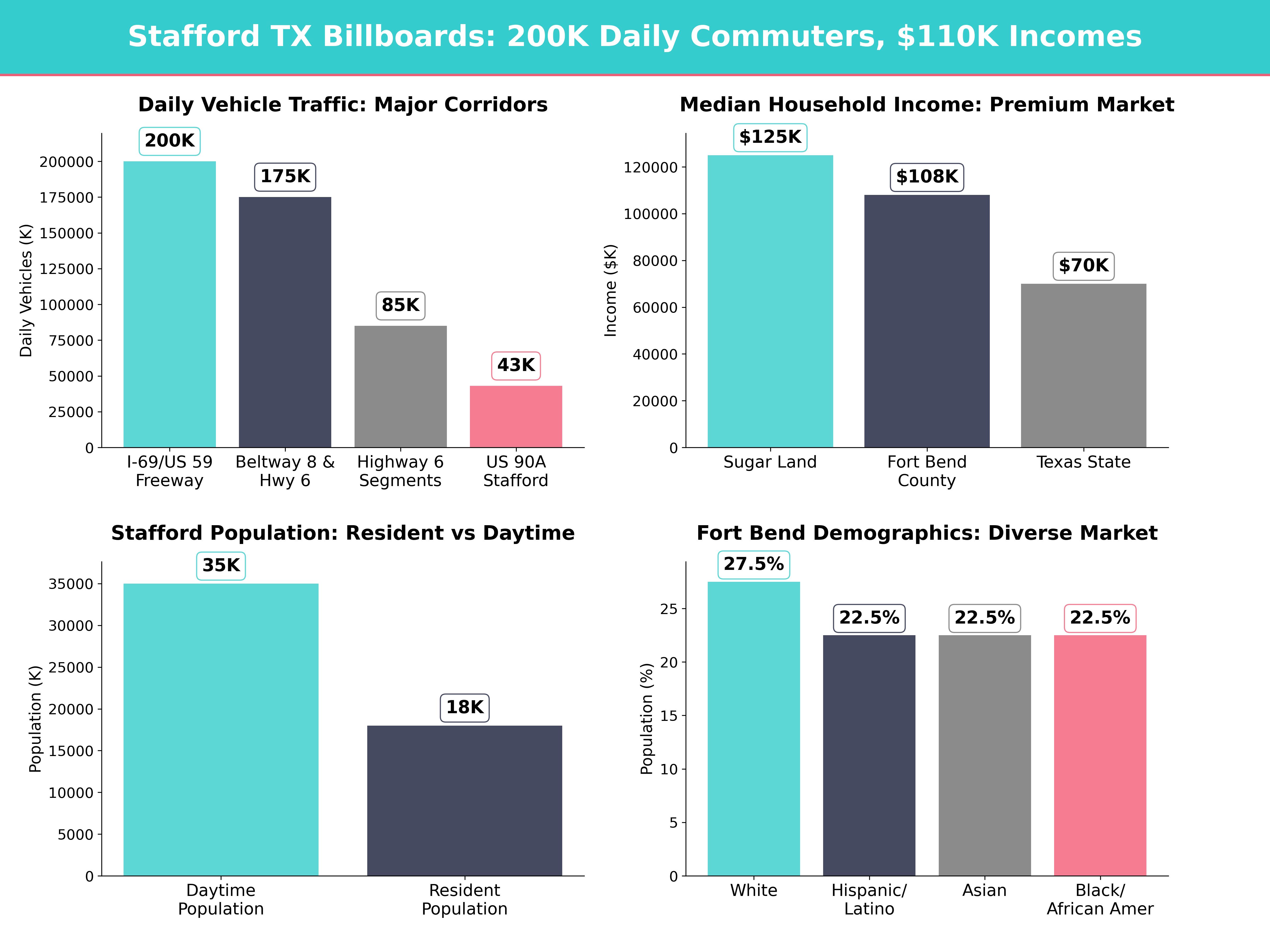
Stafford sits at the crossroads of Fort Bend and Harris counties, right along the Southwest Freeway corridor, giving advertisers access to Houston-area scale with a hyper-local budget. I‑69 / U.S. 59 near Stafford commonly sees 190,000–210,000 vehicles per day, while U.S. 90A through Stafford typically ranges from 35,000 to 50,000 vehicles per day. Nearby commuter arteries such as Beltway 8 and Highway 6 add another 150,000–200,000+ vehicles per day on key segments around Sugar Land, Missouri City, and southwest Houston.
What kind of audience does Stafford, Texas give Blip advertisers?
Stafford has just under 18,000 residents, but local officials estimate the daytime population climbs into the 30,000–40,000 range because of its business parks and big-box retail. The city is home to more than 2,000 businesses across manufacturing, distribution, energy services, and retail, and it sits inside Houston’s sprawling metro area of more than 7.3 million residents. That means Stafford billboards can reach commuters, shoppers, and regional visitors all in one market.
When is the best time to run Stafford, Texas billboards with Blip?
Weekdays are strongest during the morning peak from about 6:30–9:00 a.m. and the evening peak from about 3:30–7:00 p.m., when traffic on 90A, I‑69, and Murphy Road slows down. Weekends spread out later in the day, with 11 a.m.–8 p.m. particularly strong for shopping and dining corridors, and Saturday midday volumes on I‑69 often reach 85–95% of weekday peaks. For many advertisers, service businesses should bias spend toward weekday peaks while retail, dining, and entertainment should lean harder into Friday–Sunday.
Which Stafford, Texas roads are best for Blip billboard campaigns?
Billboards facing I‑69 / U.S. 59 between Beltway 8 and Highway 6 give you massive daily volume and exposure to commuters traveling between Houston, Stafford, Sugar Land, Rosenberg, Richmond, and beyond. U.S. 90A and Highway 6 are ideal for reaching commuters and shoppers, while Murphy Road, West Airport, and other local arterials are best for direct-response, hyper-local offers. The page recommends matching the route to your goal, from broad regional awareness on I‑69 to storefront-driving messages closer to your location.
Do I need a contract to advertise with Blip in Stafford?
No, Blip has no long-term contracts or minimum commitments. You can start, pause, or stop your campaign at any time.
How fast can I launch a billboard campaign with Blip in Stafford?
You can have your campaign live in minutes. Create a free account, select your locations, set your budget, upload your design, and start running once approved.
Where can I advertise with Blip in Stafford?
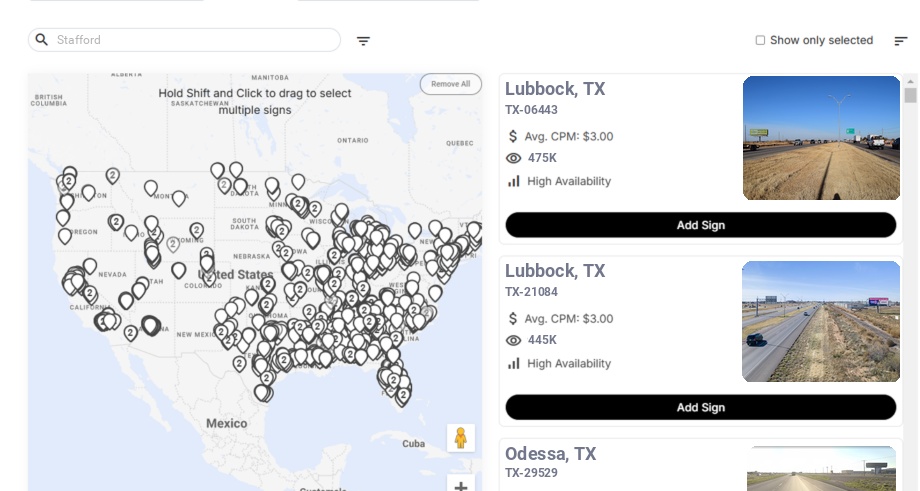
Blip has digital billboards in Stafford. You can browse available locations on a map, choose the ones that fit your audience, and start advertising right away.
Still have questions? Launch a campaign in minutes — no contracts, no commitments.
Start Your CampaignStafford Billboard Advertising Guide
Stafford, Texas sits at the crossroads of Fort Bend and Harris counties, right along the Southwest Freeway corridor. With just under 18,000 residents but a daytime population that local officials estimate climbs into the 30,000–40,000 range because of its business parks and big‑box retail, Stafford punches well above its weight for out‑of‑home visibility. When we combine this with Blip’s flexible, pay‑per‑display buying model, advertisers can tap into Houston‑area scale with a hyper‑local budget using Stafford billboards positioned on some of the region’s busiest corridors.
Below, we’ll walk through how to think about digital billboard campaigns in and around Stafford, which audiences you can reach, how to time your message, and what kinds of creatives tend to succeed on the major roadways that cut through this compact, business‑heavy city. Together, these tactics form a practical playbook for Stafford billboard advertising that works for both local and regional brands.
Understanding the Stafford Market
Stafford is officially home to about 17,666 residents according to the 2020 decennial count, but it functions essentially as a regional commercial hub:
- The city famously has no municipal property tax, which has attracted more than 2,000 businesses across manufacturing, distribution, energy services, and retail, according to the City of Stafford
- Stafford spans only about 7 square miles, yet contains multiple retail and industrial parks along U.S. 90A, FM 1092 (Murphy Road), and West Airport Boulevard.
- It sits immediately north of Sugar Land Missouri City Houston's sprawling metro area of more than 7.3 million residents.
Key local sources such as the City of Stafford Fort Bend County, and the Fort Bend Economic Development Council
On the roadways that matter for billboards, the numbers are even bigger (using counts reported by TxDOT’s Houston District
- I‑69 / U.S. 59 (Southwest Freeway) near Stafford commonly sees 190,000–210,000 vehicles per day between Beltway 8 and Highway 6.
- U.S. 90A through Stafford typically ranges from 35,000 to 50,000 vehicles per day, depending on the segment.
- Nearby commuter arteries such as Beltway 8 (Sam Houston Tollway) and Highway 6 add another 150,000–200,000+ vehicles per day on key segments around Sugar Land, Missouri City, and southwest Houston, according to Houston TranStar.
Digital billboards along these routes provide access not only to Stafford residents, but also:
- Daily commuters traveling between Fort Bend County and Houston
- Shoppers moving among Stafford, Sugar Land, and Missouri City
- Regional visitors heading to entertainment venues such as the Stafford Centre and the nearby Smart Financial Centre at Sugar Land, which alone hosts 100+ events per year and seats up to 6,400 guests.
For advertisers, that means we can buy “small city” while getting “major metro” exposure—precisely where Blip’s flexible bidding, scheduling, and location selection are most powerful for billboards in Stafford.
Audience Segments You Can Reach in Stafford
Because of Stafford’s unique land‑use mix, we should plan creatives and schedules around distinct audience groups.
1. Commuters and Industrial Workers
A large share of vehicles on U.S. 90A and Murphy Road are everyday commuters and shift workers:
- Fort Bend County adds 10,000–15,000 new jobs per year in a typical pre‑pandemic year, and more than 60% of workers commute to jobs outside their home city, concentrating traffic on corridors like I‑69, 90A, and Highway 6.
- Stafford’s industrial and office parks host hundreds of firms in logistics, fabrication, petrochemicals support, and warehousing—industries that rely heavily on early‑morning and shift‑based labor.
- Many drivers are traveling between Stafford and major employment centers in Houston, Sugar Land’s corporate campuses (such as those highlighted by Visit Sugar Land
Messaging tips for this audience:
- Focus on practical value: “Save 20 minutes,” “Same‑day service,” “Open late tonight,” “Near 90 & Murphy.”
- Use clear directional cues like “Next right,” “2 miles ahead,” or “Exit 90A” when your business is close by.
- Consider time‑of‑day rotation: worker‑oriented messages (breakfast, coffee, auto repair, industrial supplies) in early morning and late afternoon.
With Blip, we can daypart these messages to show primarily weekdays 5–9 a.m. and 3–7 p.m., when commuter traffic is heaviest according to speed and volume data tracked by Houston TranStar. This is where targeted Stafford billboard advertising can efficiently reach blue‑collar and white‑collar workers on their daily routes.
2. Shoppers and Families
Stafford’s retail corridors and big‑box nodes pull from a wide radius:
- Regional shopping centers along I‑69 and 90A attract residents from Missouri City (≈75,000 residents), Sugar Land (≈110,000 residents), and southwest Houston neighborhoods.
- Fort Bend County households have strong spending power; median household income is over $100,000, compared with a Texas median in the low $70,000s, supporting robust discretionary spending on dining, entertainment, and services.
- Local tourism and events groups like Visit Sugar Land Fort Bend County’s tourism office
Key nearby family attractions and community hubs include:
- The Stafford Municipal School District campus area, serving roughly 3,500–4,000 students on a single 127‑acre campus
- The Stafford Centre for performances, conferences, and city events, including a 1,100‑seat performing arts theatre and more than 90,000 square feet of convention space
- Regional malls and power centers along I‑69 in Stafford and Sugar Land (frequently covered by local news outlets such as Community Impact – Sugar Land & Stafford
Messaging tips:
- Emphasize family offers, weekend events, and limited‑time promotions.
- Lean into convenience and proximity: “5 minutes from Stafford Centre,” “Next to [landmark retailer].”
- Use weekend‑heavy schedules (Friday–Sunday) and early evening rotations (4–9 p.m.) when families are out—these windows often capture 30–40% more retail‑oriented trips than mid‑day weekdays on surrounding arterials.
3. Young Professionals and Higher‑Income Households
Fort Bend County routinely ranks among the highest‑income large counties in Texas:
- Countywide median household income is around $105,000–$110,000, and nearby Sugar Land’s median is often reported above $120,000–$130,000.
- Professional, scientific, and technical services, healthcare, and finance make up a significant share of white‑collar employment, according to the Fort Bend Economic Development Council
- Homeownership rates in Sugar Land and Missouri City are typically 70–80%, indicating a large base of stable, higher‑income households that regularly travel through Stafford for work and shopping.
Opportunities:
- Financial services, insurance, and healthcare
- Auto dealerships and luxury services
- Home improvement, furniture, and real estate
For this group:
- Highlight quality, trust, and time savings more than raw price.
- Use clean, minimal creative with brand emphasis and short, benefit‑driven lines (“Expert care, minutes away”).
- Consider weekday daytime rotations, as many are on the road during mid‑day errands and flexible work schedules, when traffic on arterials like Highway 6 remains strong but slightly less congested than at peak.
4. Multicultural and Bilingual Audiences
Stafford and surrounding Fort Bend County are notably diverse; local officials often cite the county as one of the most ethnically diverse in the United States:
- Rough county‑level estimates show populations that are about 20–25% Hispanic/Latino, 20–25% Asian, 20–25% Black/African American, and 25–30% non‑Hispanic White, with no single group holding a majority.
- In many Fort Bend communities, 40–50% of residents speak a language other than English at home, including Spanish, Vietnamese, Mandarin, Urdu, Hindi, and others.
- Local media like the Houston Chronicle Fort Bend Star frequently highlight this diversity in coverage of Fort Bend.
Creative implications:
- Consider bilingual creatives, especially English/Spanish, for mass‑access consumer products and services; even simple dual‑language lines can lift recall in mixed‑language households.
- If your product is heavily used by a specific community, explore culturally relevant visuals or holidays (Diwali offers, Lunar New Year promotions, Hispanic Heritage Month sales).
- With Blip, we can rotate creatives by time or location, showing English‑only messages on boards aimed at commuters, and bilingual messages on boards closer to residential and retail areas with higher Hispanic and Asian household concentrations.
Timing Your Campaign: When to Run Your Blips
Digital billboards shine when we align scheduling with real movement patterns. In Stafford, traffic and behavior break down roughly as follows, drawing on patterns reported by Houston TranStar and local transportation plans from the Houston‑Galveston Area Council.
Weekday vs. Weekend
-
Weekdays
- Morning peak: ~6:30–9:00 a.m. on 90A, I‑69, and Murphy Road, when travel speeds can drop by 25–40% versus free‑flow.
- Evening peak: ~3:30–7:00 p.m., with extended congestion toward Sugar Land and southwest Houston.
- Strong impressions from commuters, industrial/office workers, and school traffic; school‑related trips alone can account for 10–15% of vehicle movements in the morning peak near campuses like Stafford MSD.
-
Weekends
- Traffic spreads out later in the day, with 11 a.m.–8 p.m. particularly strong for shopping and dining corridors; Saturday mid‑day volumes on I‑69 often reach 85–95% of weekday peaks.
- Entertainment traffic spikes around events at Stafford Centre and Smart Financial Centre, generating noticeable pre‑ and post‑event surges on I‑69, 90A, and Highway 6.
How to use this with Blip:
- Service businesses (auto repair, quick‑serve restaurants, staffing agencies) should bias spend toward weekday peaks, where each impression is more likely to reach a time‑pressed commuter.
- Retail, dining, and entertainment should set heavier budgets for Friday–Sunday with extended evening hours, when family and leisure trips dominate.
- If your budget is tight, concentrate on one or two high‑impact windows (e.g., weekday PM rush + Saturday mid‑day), instead of spreading thinly across all hours.
Seasonal Patterns
Stafford shares Houston’s subtropical climate and event rhythms:
- August–May (school year): Strong school‑year patterns; more consistent commuter traffic, especially around the Stafford MSD campus and nearby neighborhoods in Missouri City and Sugar Land.
- June–August (summer): Commutes may ease slightly—morning peaks can be 5–10% lower in volume—but shopping, entertainment, and travel increase, especially around major holidays and vacation periods.
- Holiday season (November–December): Heavy retail and freeway traffic as shoppers move among Stafford, Sugar Land, and Houston; local news outlets such as Community Impact
Seasonal tactics:
- Back‑to‑school (late July–September): ideal for education services, tutoring, healthcare checkups, and retail; Texas families typically spend several hundred dollars per child on supplies and clothing, creating strong promotional opportunities.
- Tax season (February–April): CPAs, financial services, and auto dealers can time promos around refunds; IRS and state data show billions in refunds flowing into the Houston region each spring, often driving auto, furniture, and electronics purchases.
- Holiday season: use Blip to scale up spend for a few key weeks and rotate multiple seasonal creatives to keep your message fresh while capturing the 20–30% jump many retailers see in year‑end sales.
Creative Best Practices for Stafford Roadways
Across I‑69, U.S. 90A, and arterial streets, drivers typically have 3–7 seconds to process a billboard, depending on speed and congestion. To maximize impact:
Keep Copy Short and Bold
- Aim for 6–8 words max. Research on roadside legibility shows comprehension drops sharply beyond 8–10 words at highway speeds.
- Prioritize one clear message: a single offer, benefit, or call to action.
- Use large, high‑contrast fonts (e.g., white or yellow on dark backgrounds); avoid thin scripts or light pastels that can wash out under Texas sun.
Examples tuned for Stafford drivers:
- “Same‑Day Brakes – 1 Mile Ahead on 90A”
- “Stafford’s Fastest Oil Change – Exit Murphy Rd”
- “Houston‑Level Care, Stafford‑Level Prices”
- “Weekend Fun Near Stafford Centre – Book Now”
Use Geography in Your Favor
Stafford’s size lets us be very concrete:
- Reference local anchors: “Near Stafford Centre,” “Across from Walmart on 90A,” “Next to [major retailer].”
- Mention travel time: “5 minutes from here,” “Just off 90A & 59.” Studies show that adding a concrete time (“5 minutes”) can improve perceived convenience versus only listing a distance.
- When you’re truly close to a particular board, directional copy (“Next Exit,” “Turn Right at Murphy”) performs especially well, especially on approaches where 70–80% of traffic is local, not through‑traffic.
Reflect the Local Community
Because the area is diverse and family‑oriented:
- Feature families and groups in visuals for retail, healthcare, and dining; nearly 40% of Fort Bend households include children under 18.
- Use imagery that reflects multicultural Stafford and Fort Bend residents—showing multiple ethnicities and age groups can help increase relevance across the county’s mixed demographics.
- For bilingual campaigns, keep both languages minimal: one short line in English, one in Spanish, rather than full translations of paragraphs, so both remain legible at speed.
Rotate Multiple Creatives
With Blip, there’s no cost penalty for loading several designs. Consider:
- A brand anchor creative always in rotation (logo, tagline, website).
- A promo creative with time‑sensitive offers.
- A directional creative only on boards within a few miles of your location.
- A bilingual or community‑focused creative for boards nearer residential clusters.
We can then watch which messages correlate with upticks in website traffic or store visits and adjust the rotation mix. Even a 10–20% improvement in response from better‑performing creatives can materially improve your cost per lead and raise the ROI of your Stafford billboard advertising.
Geographic Strategy: Where to Focus Around Stafford
Think of your Blip placement strategy as building a “funnel” from regional awareness to local action. Choosing where to place billboards in Stafford matters just as much as what they say.
Top‑of‑Funnel: I‑69 / Southwest Freeway
Billboards facing I‑69 / U.S. 59 between Beltway 8 and Highway 6 give you:
- Massive daily volume, often 190,000–210,000 vehicles per day on some segments, per TxDOT
- Exposure to commuters traveling between Houston, Stafford, Sugar Land, Rosenberg, Richmond, and beyond.
Best for:
- Regional brands (healthcare systems, banks, auto groups, universities).
- E‑commerce and app‑based services targeting a wide metro audience.
- Major promotions, openings, or hiring campaigns that draw from multiple cities.
Use clean, brand‑forward creative here; you’re often planting a mental seed rather than driving an immediate turn. Consider including a simple URL or app icon rather than complex directions.
Mid‑Funnel: U.S. 90A and Highway 6
These routes serve both commuters and shoppers connecting Stafford with Sugar Land and Missouri City:
- U.S. 90A links older commercial corridors and newer residential neighborhoods, with 35,000–50,000 daily vehicles and high proportions of local drivers.
- Highway 6 carries 70,000–100,000 vehicles per day in key segments north and south of I‑69, serving dense residential pockets and big‑box clusters, as documented in regional mobility plans from the Houston‑Galveston Area Council.
Ideal for:
- Retail and dining that serve a 5–10 mile radius.
- Medical practices, gyms, and personal services drawing from multiple suburbs.
- Education and childcare near the Stafford MSD campus.
Creatives can blend brand + directional messaging (“Now Open – 3 Miles Ahead on 90”).
Bottom‑of‑Funnel: Murphy Road, West Airport, and Local Arterials
Localized boards closer to your storefront are perfect for:
- Direct response: “Turn Right for Free Estimate,” “Walk‑Ins Welcome Today.”
- Hyper‑local offers valid for residents in a 3–5 mile radius; keep in mind that many everyday errands—groceries, dry cleaning, quick‑service dining—are done within this distance.
- Short‑term pushes (grand openings, weekend‑only events).
Because these boards reach people already near your business, they pair especially well with geo‑targeted digital ads and local SEO, strengthening cross‑channel impact. Local news coverage in outlets like Community Impact
Using Blip’s Flexibility in the Stafford Area
Blip’s model—buying billboard “blips” a few seconds at a time—lets us behave much more tactically than with traditional fixed boards. For many advertisers, this is the most accessible form of billboard rental in Stafford because you can start small, test, and then scale.
Here’s how to apply that in Stafford:
1. Start Hyper‑Local, Then Expand
- Begin with 1–3 boards within a tight radius of your location (e.g., nearest 90A or Murphy Road boards).
- Run for 2–4 weeks to build familiarity and tune your creatives. At typical impression levels, that can mean tens of thousands of exposures to the same drivers who pass your location multiple times per week.
- Once you see response (store visits, calls, site traffic from nearby ZIP codes), expand out to I‑69 and Highway 6 boards for broader reach.
2. Daypart Aggressively
Use dayparting to match audience behavior:
- Auto and service businesses: weekday mornings and evenings, when commuter traffic is densest and car trouble is top‑of‑mind.
- Food and beverage: lunch windows (11 a.m.–2 p.m.) + dinner (4–9 p.m.), heavier rotation Thu–Sun; these windows often align with 60–70% of daily restaurant revenue.
- B2B and industrial: weekday business hours (7 a.m.–5 p.m.) targeting workers in Stafford’s business parks.
- Event venues: the week leading up to shows at Stafford Centre or Smart Financial Centre, emphasizing afternoon and early evening when people finalize plans.
3. Adjust Bids by Location and Time
Because not every timeslot and location costs the same, we can:
- Bid higher for prime commuter slots on high‑volume freeways, where each impression has a higher likelihood of reaching employed, time‑sensitive audiences.
- Drop bids or pause during overnight hours if your audience is less active then; late‑night slots can still work for certain categories (24‑hour gyms, emergency rooms) but are less critical for most.
- Allocate a larger share of budget to the two or three most important boards for your business goal, rather than spreading evenly across all inventory.
Example Campaign Ideas for Stafford Advertisers
Local Restaurant Near 90A
Goal: Increase weekend dine‑in traffic.
Strategy:
- Focus on 90A and West Airport boards within 3 miles.
- Run Friday–Sunday, 11 a.m.–10 p.m., when dining and shopping trips peak.
-
Rotate 3 creatives:
- “Family Dinner Tonight? Kids Eat Free – Exit 90A.”
- “Live Sports. Cold Drinks. 5 Minutes Ahead.”
- Brand creative with logo, website, and “Stafford, TX.”
Measurement tips:
- Track weekend covers or ticket averages versus a 4‑week pre‑campaign baseline.
- Use a “Mention this billboard” offer code to estimate that at least 10–30% of responders were directly influenced by OOH.
Industrial Supplier in a Stafford Business Park
Goal: Reach maintenance and operations managers working nearby.
Strategy:
- Target boards along Murphy Road and West Airport heavily trafficked by industrial workers.
- Daypart weekdays 6 a.m.–3 p.m., aligning with shift starts and mid‑day runs for parts.
-
Creative focus:
- “Industrial Parts in Stock. 10 Minutes from This Sign.”
- “Need It Today? Stafford Warehouse – Call [Short Phone].”
- Use unique short URLs or QR codes for tracking; even a 1–3% scan or visit rate from impressions can translate into valuable B2B leads.
Healthcare Clinic Serving Stafford & Missouri City
Goal: New patient acquisition within 7–10 miles.
Strategy:
- Mix of I‑69, Highway 6, and 90A boards.
- Always‑on presence but with heavier budget Mon–Sat, 7 a.m.–7 p.m.
-
Creatives:
- Brand: “Same‑Day Appointments – Stafford Family Clinic.”
- Offer: “School Physicals $X – Book Today.”
- Bilingual: short English/Spanish line emphasizing “Citas el mismo día.”
Measurement tips:
- Track new‑patient forms with “Billboard” as a referral source.
- Watch for changes in appointment volume from ZIP codes tied to Stafford, Missouri City, and Sugar Land.
Compliance and Local Considerations
When advertising in and around Stafford, we need to observe local and state standards:
- Outdoor advertising is governed in part by TxDOT regulations and local sign ordinances. The City of Stafford
- Avoid any content that could be interpreted as unsafe or deceptive (e.g., emergency‑like wording, misleading directions, or copy that distracts drivers for more than a few seconds).
- Healthcare, legal, and financial advertisers should include any required disclaimers in a way that’s legible but still concise; Texas professional boards may specify minimum font sizes or wording.
- If you coordinate with city‑sponsored events at the Stafford Centre or with school‑related campaigns across Stafford MSD, be sure to align with their branding and sponsorship guidelines.
Blip’s platform and designers (if you engage them) can help ensure that your creatives meet size, readability, and content guidelines for the specific boards you select, making it simpler to manage compliant billboard rental in Stafford even if you are new to out‑of‑home.
Measuring and Optimizing Your Stafford Campaign
To get full value from your Blip spend, we recommend a simple measurement framework:
-
Define a primary metric before launch
- In‑store visits (tracked via POS counts or manual tallies)
- Calls from local area codes (281, 713, 832, 346)
- Website sessions from target ZIP codes (e.g., 77477, 77478, 77479, 77459)
- Coupon or promo code redemptions tied to the billboard
-
Align tracking tools
- Use unique URLs (e.g.,
yourbrand.com/stafford) or QR codes on the billboard; even a modest 0.1–0.3% visit rate on total impressions can be meaningful for local businesses. - Track Google Analytics location data to watch for increases from Stafford, Sugar Land, and Missouri City.
- Ask “How did you hear about us?” at checkout or on forms, with “Billboard” as an option, and monitor the percentage over time.
- Use unique URLs (e.g.,
-
Run for a clear test period
- Commit to at least 4–8 weeks of relatively consistent impressions on a core set of boards; shorter tests can be noisy, especially for lower‑volume businesses.
- Avoid changing too many variables at once (e.g., don’t swap creatives and locations and schedule all in the same week). Aim to test one major change at a time.
-
Optimize based on early signals
- If one location’s time slots drive more web traffic or calls, increase your bid or share of budget there by 20–50% and watch results.
- Pause underperforming creatives and test new versions with tighter copy or clearer offers—simple changes (bigger font, fewer words) can improve recall by 20–30% in OOH studies.
- Consider shifting more spend to the dayparts that correlate with response (e.g., if 60% of tracked calls come from impressions shown during evening rush, overweight that window).
By combining Stafford’s unique geography—a compact, business‑heavy city embedded in a booming, diverse metro corridor—with Blip’s granular control over where, when, and how often your message appears, we can build billboard campaigns that feel “custom‑fit” instead of one‑size‑fits‑all.
When we use the data about local traffic patterns, demographics, and behavior to inform creative and scheduling decisions, digital billboards in Stafford become an agile, high‑visibility channel that can scale with your goals and budget while reaching hundreds of thousands of Houston‑area drivers every week.