Billboards near Red Oak, TX
No Minimum Spend. No Long-Term Contracts. Just Results.
Trusted by Leading Brands


Billboard advertising
near Red Oak has never been easier
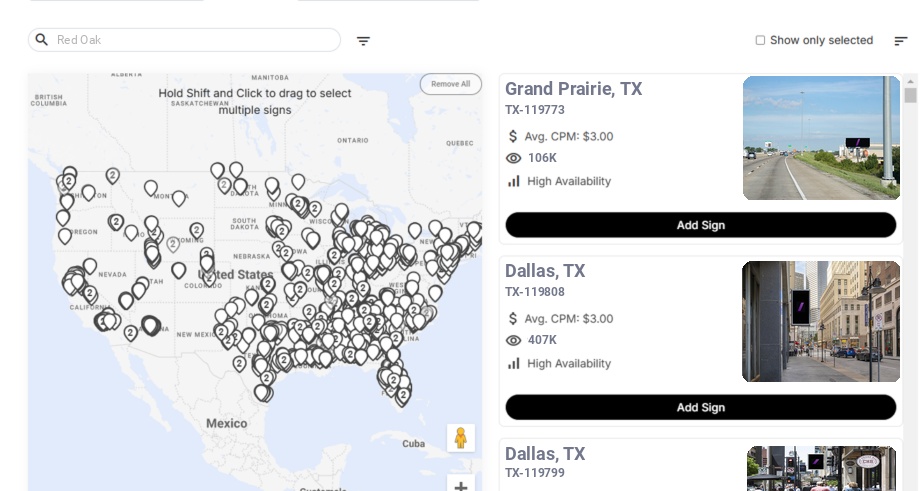



How much is a billboard near Red Oak?
Why Choose Blip for Billboard Advertising near Red Oak
Blip lets Red Oak advertisers launch fast and self-serve, hitting I-35E commuters near Lancaster in minutes—no rep, no hassle.
Use Blip to daypart Red Oak ads for rush hour or weekends, matching I-35E’s 100,000+ vehicles and local errands.
No contracts or minimums in Red Oak: test a flexible budget, then pause or scale as your Ellis County campaign works.
Blip-optimized buying helps Red Oak reach commuters, families, and shoppers across I-35E and I-20 without manual guesswork.
Track Red Oak performance in real time, then tweak creative for school traffic, spring events, or summer heat on the go.
Blip creative tools make Red Oak billboards easy to build—keep it bold for fast reads on car-heavy corridors.
Frequently Asked Questions About Billboard Advertising near Red Oak
How much does a billboard cost in Red Oak, Texas with Blip?
Blip makes billboard advertising in the Red Oak area flexible and budget-friendly. You choose a daily budget, and Blip’s algorithm uses it to bid for open ad slots on digital billboards serving the Red Oak area. Pricing can vary by time of day, location, and advertiser demand, but each 7.5-to-10-second display starts at just $0.01 per display.
Where can I advertise with Blip near Red Oak, Texas?
We currently serve the Red Oak area with 2 digital billboards in nearby Lancaster, about 6 miles from Red Oak, so we can reach many of the same commuters, shoppers, and families who define the market. Because Lancaster is only 6 miles from Red Oak, our Lancaster boards are the most direct way we currently serve the Red Oak area. This approach works especially well when the goal is to reach people who live near Red Oak but travel north for work, shopping, healthcare, education, or entertainment.
Why is Red Oak, Texas a strong market for billboard advertising with Blip?
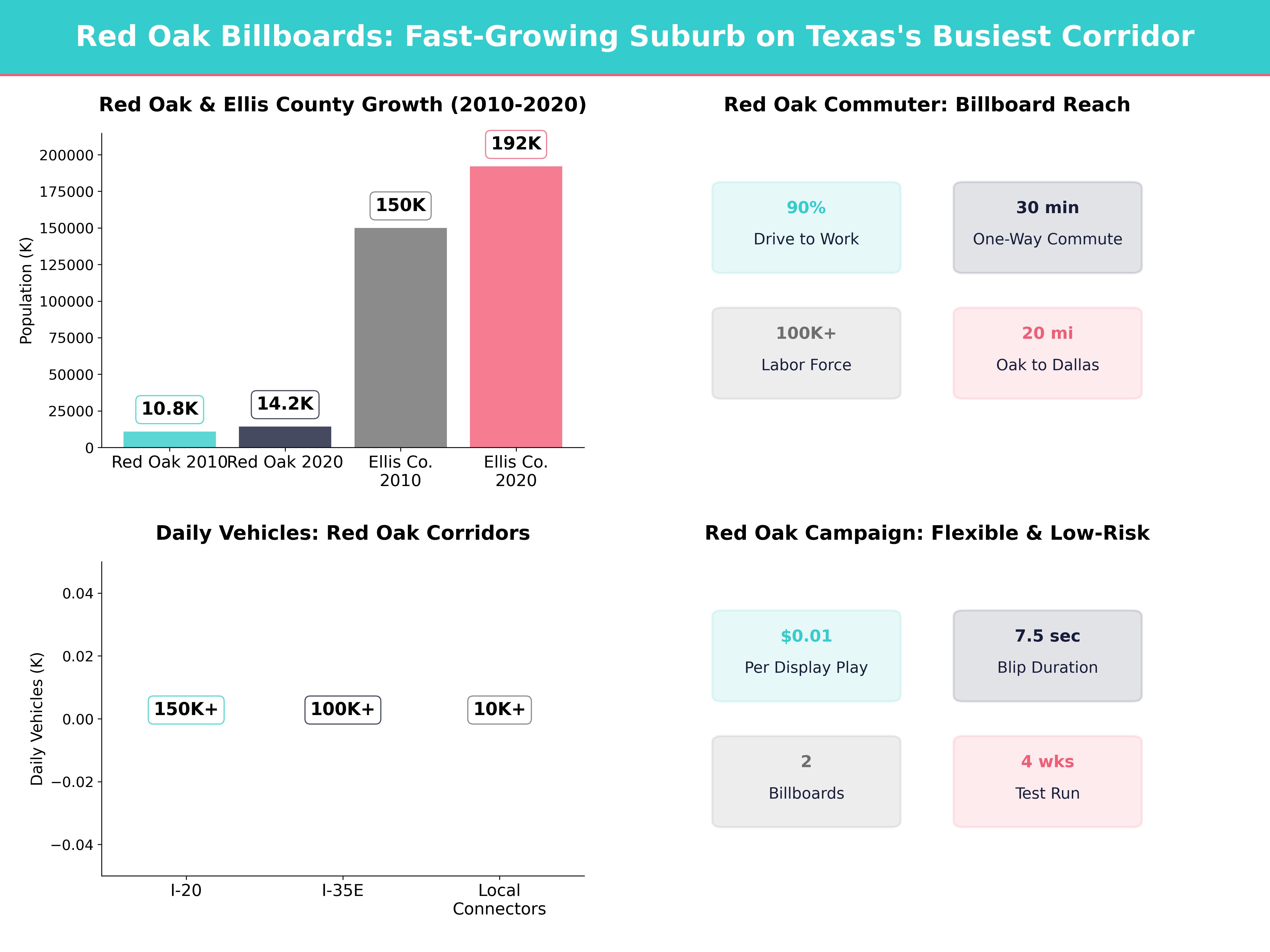
Red Oak combines suburban household growth, a heavily car-based lifestyle, and reliable north-south travel patterns on I-35E. The 2020 Census counted 14,222 residents in Red Oak, up from 10,769 in 2010, and Ellis County reached 192,455 residents in 2020. That growth helps explain why the Red Oak area keeps attracting new rooftops, new retail demand, and new service businesses.
What traffic corridors should I target for Red Oak, Texas billboard ads with Blip?
If we are planning billboard advertising near Red Oak, I-35E is the first corridor we study. According to TxDOT, heavily traveled I-35E segments serving the Red Oak area and southern Dallas County regularly post 100,000-plus vehicles per day. The second major corridor is I-20, and busy sections near Lancaster carry 150,000-plus vehicles per day.
When is the best time to run billboard ads in Red Oak, Texas?
Back-to-school season is one of the best windows near Red Oak, especially from August through May when school routines keep household travel highly predictable. Spring is also ideal from March through May for home services, outdoor spending, and event traffic. From June through August, simple, urgent, heat-aware messaging often works best.
Do I need a contract to advertise with Blip near Red Oak?
No, Blip has no long-term contracts or minimum commitments. You can start, pause, or stop your campaign at any time.
How fast can I launch a billboard campaign with Blip near Red Oak?
You can have your campaign live in minutes. Create a free account, select your locations, set your budget, upload your design, and start running once approved.
Where can I advertise with Blip near Red Oak?
Blip has digital billboards near Red Oak. You can browse available locations on a map, choose the ones that fit your audience, and start advertising right away.
Still have questions? Launch a campaign in minutes — no contracts, no commitments.
Start Your CampaignRed Oak Billboard Advertising Guide
The City of Red Oak Ellis County Dallas County, and the broader Dallas-Fort Worth economy, including a 16-county region with more than 8 million residents. We currently serve the Red Oak area with 2 digital billboards in nearby Lancaster 6 miles from Red Oak, so we can reach many of the same commuters, shoppers, and families who define the market. This is a strong place to advertise because Red Oak combines suburban household growth (32.1% growth from 2010 to 2020), a heavily car-based lifestyle (about 9 in 10 workers commute by car), and reliable north-south travel patterns on I-35E, which regularly carries 100,000-plus vehicles per day on major segments. When we advertise near Red Oak, we are speaking to people on their way to work, school, errands, dining, and weekend activities, which is exactly where billboard media performs best.
Red Oak area market overview
Population growth gives the Red Oak area real advertising momentum
Red Oak is not a static small-town market. The 2020 Census counted 14,222 residents in Red Oak, up from 10,769 in 2010. That was an increase of 3,453 residents, or 32.1% growth in a single decade. The surrounding county story is just as important. Ellis County 192,455 residents in 2020, up from 149,610 in 2010. That was a gain of 42,845 residents, or 28.6% growth, which helps explain why the Red Oak area keeps attracting new rooftops, new retail demand, and new service businesses.
To the north, Dallas County had 2,613,539 residents in 2020, which gives the Red Oak area access to one of the largest consumer and employment bases in Texas. At the regional level, the North Central Texas Council of Governments plans for a 16-county region with more than 8 million residents, so Red Oak benefits from being tied into a much larger metro economy rather than operating as an isolated local market.
The Red Oak area sits in a practical, commuter-driven economy
Geography matters here. Red Oak is roughly 20 miles south of downtown Dallas
The local economy is also shaped by nearby employment nodes in Lancaster DeSoto Duncanville Waxahachie, and Dallas. Industrial, logistics, distribution, construction, education, and healthcare all influence daily travel through the Red Oak area. We also see overlap with the southern Dallas County business cluster and with growing Ellis County communities that rely on highway access.
Car commuting is the rule, not the exception, near Red Oak
For billboard strategy, the most important behavioral fact is simple. The Red Oak area is overwhelmingly a drive market. Community survey profiles for suburbs like Red Oak consistently show about 9 in 10 workers commuting by car, whether driving alone or carpooling, and typical one-way travel times are around 30 minutes. That pattern is reinforced by the broader labor market. Texas Workforce Commission data place the civilian labor force above 100,000 in Ellis County and above 1.4 million in Dallas County. That means a substantial share of the people we want to reach near Red Oak are on the road every weekday, often at the same times, on the same corridors, and with the same daily routines.
For advertisers, that consistency is valuable. Repeated exposure works well when drivers see the same message on the same commute several times per week.
Key traffic corridors serving the Red Oak area
I-35E is the backbone of reach near Red Oak
If we are planning billboard advertising near Red Oak, I-35E is the first corridor we study. It is the main north-south spine connecting the Red Oak area to Lancaster DeSoto Waxahachie, and the rest of the interstate system.
According to TxDOT, heavily traveled I-35E segments serving the Red Oak area and southern Dallas County regularly post 100,000-plus vehicles per day. That kind of volume matters because it delivers both scale and repetition. Morning northbound flows reach workers headed toward Dallas County job centers, and afternoon southbound flows catch them on the way home.
Our 2 digital billboards in Lancaster are well positioned for this pattern because Lancaster is only 6 miles from Red Oak. In practical terms, that means the boards are close enough to serve many of the same daily commute and shopping trips that define the Red Oak area.
I-20 adds major east-west traffic into the Red Oak trade area
The second major corridor is I-20. Near Lancaster, busy sections of I-20 carry 150,000-plus vehicles per day, based on TxDOT count data on major southern Dallas County segments. That east-west movement expands reach beyond Red Oak residents alone.
This corridor matters because it brings in shoppers, service customers, and workers from multiple directions. A campaign serving the Red Oak area can benefit from traffic entering from east-west routes and then connecting into I-35E, local arterials, and suburban retail zones.
For regional businesses, I-20 helps turn a Red Oak-area campaign from purely neighborhood awareness into corridor awareness.
Local connectors shape the errand economy near Red Oak
Interstates build scale, but local connectors build intent. Routes such as SH 342, FM 664 / Ovilla Road, and nearby U.S. 287 regularly generate 10,000-plus daily vehicle counts on many segments, depending on location and development patterns. These roads connect neighborhoods, schools, local retail, healthcare offices, restaurants, and service providers.
That matters because different advertisers need different kinds of motion: Freeway audiences are ideal when we want broad awareness and repeated commuter exposure; Arterial audiences are ideal when we want to influence errands, appointments, dining, or same-day service decisions; Interchange areas are ideal when we want to catch drivers while they are already making route and stop decisions.
For the Red Oak area, the best campaigns usually respect both layers. We use Lancaster freeway inventory to build awareness, and we design the message so it aligns with the destinations and errands people already have planned.
Audience segments we can reach near Red Oak
Daily commuters are the largest and most dependable audience
The first audience near Red Oak is the weekday commuter. With about 90% of workers traveling by car and I-35E carrying 100,000-plus vehicles on major segments, this market gives us reliable weekday repetition.
These commuters include office workers, healthcare staff, warehouse employees, teachers, field-service crews, contractors, and logistics drivers. Many of them move between Red Oak, Lancaster, DeSoto, southern Dallas County, and Ellis County on a fixed routine. That makes billboard media especially useful for: Healthcare brands that want appointment awareness; Restaurants that want lunch and dinner traffic; Auto, tire, and oil-service businesses that want practical response; Home-service companies that want to stay top of mind until a need appears.
Families are a core household-spending audience in the Red Oak area
The Red Oak area has strong family-market characteristics. Red Oak’s 32.1% population growth since 2010 and the continued residential growth across Ellis County
Red Oak ISD serves more than 6,000 students, which is a useful indicator of family density and parent routines. When we advertise near Red Oak, we are often reaching parents making decisions about groceries, fast casual dining, pediatric care, orthodontics, tutoring, childcare, furniture, mattresses, car maintenance, and home improvement.
For many local businesses, this is the audience that matters most. These households drive often, notice practical offers, and respond well to brands that feel nearby, trustworthy, and useful.
Students and workforce learners expand the reach beyond K-12 households
The Red Oak area is also connected to higher education and workforce training audiences. Dallas College Cedar Valley Campus UNT Dallas enrolls more than 4,000 students to the north.
That creates opportunities for advertisers in education, apartments, food, retail, banking, telecom, healthcare, and employment. It also supports campaigns for certification programs, continuing education, and hiring events, especially during semester transitions.
This audience is useful because it mixes traditional students, working adults, dual-credit households, and first-generation college families, which broadens the kinds of messages that can work near Red Oak.
Weekend visitors and event travelers also matter
The Red Oak area is not only about weekday commuting. Weekend travel adds another layer of opportunity. Scarborough Renaissance Festival near Waxahachie Texas Motorplex in Ennis drives regional travel during major race weekends, especially in October.
Northbound leisure traffic also matters because residents from the Red Oak area head toward Visit Dallas, the Dallas Zoo, and events at the Kay Bailey Hutchison Convention Center Dallas. That means campaigns for entertainment, dining, family attractions, hotels, and event services can benefit from timing around weekends and regional activity peaks.
Seasonal timing opportunities for the Red Oak area
Back-to-school season is one of the best windows near Red Oak
From August through May, the school calendar keeps household routines highly predictable. Parents are commuting, dropping off students, buying meals, booking appointments, and managing after-school activities.
We especially like this period for campaigns focused on: Dentists, orthodontists, and pediatric care; Tutoring, childcare, and extracurricular programs; Quick-service and family dining; Grocery, retail, and seasonal promotions.
Texas football season strengthens that pattern. From late August through November, Friday night community attention rises, and brands tied to food, spirit wear, injury care, and local sponsorship can benefit from higher local awareness.
Spring is ideal for home services, outdoor spending, and event traffic
From March through May, the Red Oak area enters one of its best seasonal advertising periods. Weather improves, event calendars fill up, and homeowners begin spending on repairs and upgrades.
This is a strong window for: Roofing and gutters; HVAC tune-ups and replacements; Lawn care, pest control, and landscaping; Windows, fencing, pools, and outdoor living; Real estate, mortgage, and moving services.
Spring also aligns with traffic tied to Waxahachie
Summer rewards simple, urgent, heat-aware messaging
From June through August, North Texas heat changes consumer behavior. In this period, simple offers often outperform brand-heavy creative.
Cold drinks, air conditioning, indoor entertainment, automotive reliability, urgent service, and fast meals all become more relevant. This is when we like to shorten copy, increase contrast, and focus on immediate utility. Messages such as “AC Repair Today,” “Kids Eat Free,” or “Oil Change Off I-35E” match the urgency of summer driving and errand behavior near Red Oak.
Holiday and year-end timing can drive strong reminder frequency
From November through December, shoppers, churchgoers, nonprofit supporters, and event attendees are moving more often and making faster decisions. Holiday retail, catering, gift cards, seasonal entertainment, healthcare reminders, and year-end fundraising can all work well near Red Oak.
We also like the January reset period for tax services, gyms, hiring campaigns, higher education, and self-improvement offers. That month often works well because routines return and people are paying attention to practical next steps.
Billboard design tips for advertisers near Red Oak
We design for freeway speed and bright North Texas daylight
Near Red Oak, many impressions happen at full driving speed on I-35E or nearby high-volume corridors. That means we usually recommend 6 to 8 words of primary copy, one dominant image, and one clear takeaway.
High-contrast color combinations tend to perform best in bright daylight. Black on yellow, navy on white, red on white, and dark green on cream often read more cleanly than low-contrast pastel combinations. Thick fonts and large numerals also help when drivers are scanning quickly.
If an advertiser wants to include a phone number, we prefer a short, familiar number pattern or a memorable vanity URL. In this market, even local area-code cues such as 972 can reinforce familiarity when they fit the creative.
Practical, family-oriented messaging usually fits the Red Oak area
The Red Oak area is suburban, family-driven, and highly practical. We usually see stronger results from useful messages than from abstract brand language.
Creative themes that often fit this geography include: Family meals and convenience; Home repairs and home pride; Reliable vehicles and local service; Healthcare access and appointment urgency; Value, speed, and trust.
Imagery that feels grounded in real life usually works better here than imagery built around nightlife, luxury minimalism, or hyper-urban references. Pickups, SUVs, rooftops, school spirit, smiling staff, family dining, and service crews feel more native to the Red Oak area than downtown lifestyle cues.
Directional relevance can improve local response
When a business wants nearby customers, specificity helps. A location cue such as “Off I-35E,” “Near Ovilla Rd,” or “Serving Ellis County” gives drivers a mental shortcut. That is especially valuable for restaurants, clinics, churches, urgent care, auto repair, and home-service brands.
We also prefer one message per creative. If we have multiple offers, we would rather rotate 2 or 3 separate designs than cram everything into one board file. Digital rotation makes that easy, and cleaner creative usually reads better.
Short bilingual tests can make sense in this corridor
Southern Dallas County and Ellis County include a broad mix of households, and some advertisers benefit from concise bilingual creative. The key is keeping both versions short enough to work within a 7.5- to 10-second display window.
We usually avoid full-sentence translations if they overcrowd the board. A short headline, a simple benefit, and a clear brand mark are usually enough.
Regional strategies for campaigns serving the Red Oak area
We use Lancaster for direct Red Oak-area commuter capture
Because Lancaster is only 6 miles from Red Oak, our 2 Lancaster digital billboards are the most direct way we currently serve the Red Oak area. This approach works especially well when the goal is to reach people who live near Red Oak but travel north for work, shopping, healthcare, education, or entertainment.
For many advertisers, that alone is enough to justify the campaign. If the customer’s day naturally includes Lancaster or the I-35E approach to it, the overlap is strong.
We separate suburban service strategies from broad-awareness strategies
Not every advertiser needs the same type of reach. We usually divide Red Oak-area campaigns into three practical buckets: We use broad-awareness strategy for hospitals, colleges, retailers, legal services, and regional brands that want to stay visible across the corridor; We use suburban-service strategy for HVAC, roofing, plumbing, urgent care, dentists, gyms, and family restaurants that rely on nearby households; We use event strategy for churches, festivals, race weekends, grand openings, and limited-time promotions.
That distinction matters because the right message for a dentist is different from the right message for a regional entertainment venue. The closer the offer is to a quick decision, the more direct and directional the creative should become.
We treat the Red Oak area as part of a wider decision radius
People near Red Oak do not limit their lives to one city boundary. For higher-consideration categories, we often think in terms of a 15- to 25-mile decision radius. Consumers may live near Red Oak, work in Lancaster DeSoto Waxahachie or Midlothian
That broader movement pattern is why billboard advertising near Red Oak can support businesses that are not right next door. Awareness built on the commute often converts later through branded search, map lookups, direct visits, or word of mouth.
We adapt creative by corridor context
Even within one Red Oak-area campaign, the emphasis can shift by audience: Northbound commuter messaging should emphasize convenience, schedule, and readiness for the workday; Southbound afternoon messaging should emphasize dinner, errands, family needs, and same-day service; Weekend messaging should emphasize events, shopping, entertainment, and community activity.
This kind of regional thinking helps a small billboard footprint work harder.
Blip tools and capabilities for the Red Oak area
Manual selection is useful when we want the closest boards serving Red Oak
For this market, manual buying is often a smart starting point because we can select the 2 Lancaster boards that most directly serve the Red Oak area. That gives us tight geographic control and makes it easier to align spend with commuter-heavy times of day.
If a local advertiser knows that its customers move between Red Oak and Lancaster on a regular basis, manual selection keeps the strategy focused.
Optimized buying helps when we want efficiency and flexibility
When we want the system to help manage pacing and placement decisions, a Blip-optimized campaign can allocate spend based on demand, timing, and efficiency. That is useful for advertisers who care more about reaching the wider Red Oak-area audience than about hand-picking every board.
This can be especially effective for campaigns with broader goals such as recruiting, education, healthcare, or regional retail.
Flexible digital buying matches the way this market actually moves
The Red Oak area is not a one-speed market. Morning commute behavior is different from lunch behavior, and school-season behavior is different from summer behavior. Flexible digital buying lets us respond to that reality.
We can work with pay-per-play pricing starting at $0.01 per display, use short 7.5- to 10-second blips, change creative quickly, and watch performance trends in real time. That flexibility is valuable when an advertiser wants to push weekday lunch, focus on after-school traffic, or intensify messaging during the 10 to 14 days before an event or sale.
Getting started with billboard rental near Red Oak
Start by defining the real trade area
Before we rent a billboard serving the Red Oak area, we define the trade area honestly. Some advertisers need only a 5- to 10-mile radius around their storefront. Others need to reach commuters who may live near Red Oak but spend most of their day farther north.
If the business draws from households throughout the Red Oak area, our Lancaster boards are a logical first test because they sit close to the market and intercept shared travel patterns.
Match the campaign length to the buying cycle
For local service brands, we often recommend a 4- to 6-week test. That usually gives enough time to build repetition across weekday routines and see whether branded search, calls, or foot traffic begin to move.
For events, grand openings, flash sales, and limited-time offers, a shorter 7- to 14-day flight can make more sense. In those cases, urgency matters more than long-term repetition.
For brands with a long sales cycle, such as healthcare systems, colleges, or legal services, an always-on approach with periodic creative updates may be the better fit.
Evaluate billboard locations by behavior, not just distance
The closest board is not always the best board. We evaluate Red Oak-area billboard locations using a few simple questions.
Does the board sit on a route our audience already uses several times per week? Does the traffic pattern match the action we want, such as commuting, dining, shopping, or event attendance? Does the creative fit the speed and mindset of that corridor? Does the board help us reach the customer before the decision point?
That approach is one reason digital outdoor can outperform assumptions. A board 6 miles away in Lancaster can be more valuable than a theoretically closer location if it captures the dominant route people actually drive.
Blip simplifies the rental process compared with traditional outdoor buying
Traditional billboard buying often involves slower proposals, fixed terms, rep-managed schedules, and less flexibility once a campaign is live. Our approach is simpler. We can choose boards on a map, set a budget, upload creative, control timing, and adjust the campaign without committing to a long contract.
That is particularly useful for small and midsize advertisers near Red Oak. They can test messaging, shift budgets between commuter and weekend periods, and scale up only after they see what works.
We recommend a practical first test for the Red Oak area
A strong starting plan usually looks like this: We begin with the 2 Lancaster boards that serve the Red Oak area most directly; We run a clear, high-contrast creative set with 1 main message and 1 call to action; We focus first on weekday commuter periods, then expand if the category also benefits from weekends; We measure branded search, direct traffic, calls, booked appointments, coupon use, or store visits by week.
That process keeps the test disciplined and easy to evaluate. For advertisers who want visible, flexible reach near Red Oak without the friction of traditional outdoor contracts, it is a very practical way to get started.