Billboards in Houston, TX
No Minimum Spend. No Long-Term Contracts. Just Results.
Trusted by Leading Brands


Billboard advertising
in Houston has never been easier
How much is a billboard in Houston?
Why Choose Blip for Billboard Advertising in Houston
Blip lets you launch Houston billboards fast on I-10 West or I-45 without contracts, so you can reach commuters and Energy Corridor traffic on your terms.
Use Houston's peak 6-10 a.m. and 3-7 p.m. rushes with Blip dayparting to catch Med Center staff, downtown workers, and Beltway 8 drivers when they're stuck in traffic.
Houston's huge, car-heavy market rewards flexibility—set any budget, test, and scale as I-610, SH-288, and I-69 impressions prove out.
Track Houston campaigns in real time and shift creative during rodeo, Astros games, or storm season to match spikes in downtown and NRG Park traffic.
Blip's creative tools make bilingual Houston ads easy, helping you tailor messages for the city's diverse audience along the East End, Gulfton, and Asiatown corridors.
Frequently Asked Questions About Billboard Advertising in Houston
How much does a billboard cost in Houston, Texas with Blip?
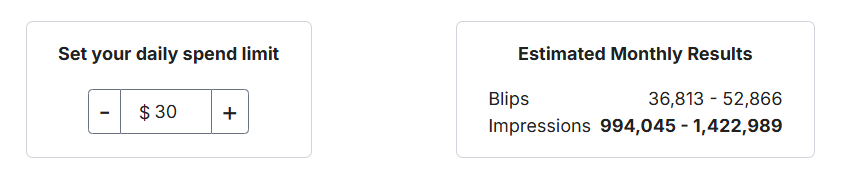
With Blip, you control exactly what you spend on Houston billboards by setting a daily budget that can be adjusted at any time. Each “blip” is a 7.5 to 10-second ad display, and you only pay for the blips you receive, so your total cost is simply the sum of these brief, targeted impressions. Pricing for billboards in Houston, Texas varies based on when and where you choose to appear and current advertiser demand, but you never have to commit to a large, fixed contract.
Where can I advertise with Blip on Houston billboards?
Houston’s travel patterns are structured around rings and spokes: inner and outer loops and interstate corridors stretching in all directions. Key areas include the Inner Loop, Energy Corridor & West Houston on I-10 West, North Houston & The Woodlands on I-45 North, and South & Southeast along I-45 South, SH-288, and the Port area. Using Blip’s location filters, we can target luxury and professional services on I-10 West and I-69 Southwest, value and bilingual brands on Beltway 8, SH-249, and US-59 North, and logistics, industrial services, staffing, and training around east Houston and port-adjacent routes.
Who do Houston billboards reach with Blip?
Houston is one of the most dynamic advertising markets in the United States, with more than 2.3 million residents in the city and over 7.5 million people in the metro area. Roughly 90% of commuters use a car, truck, or van as their primary mode, while fewer than 3% rely on transit. Nearly half of residents in the metro are under age 35 and more than 75% identify as non-White, making the market both large and highly diverse.
When is the best time to run Blip billboard ads in Houston?
Traffic here is dense throughout the day, and we often recommend heavy weekday dayparts for B2B, commuting workforce, legal, healthcare, and education-related campaigns. Midday and evening can work well for dining, events, museums, and nightlife messaging, while Friday afternoon/evening, Saturday midday, and Sunday afternoon/evening are strong windows for hospitality, attractions, retail, and restaurant campaigns. Houston’s weather and event calendar also create seasonal opportunities, including spring and fall, hurricane season, RodeoHouston, and major sports games.
Why should I use Blip for Houston billboard advertising?
Houston’s scale, diversity, and car-centric lifestyle make it one of the most powerful markets for digital billboards in the country. With Blip, we can start small, test quickly, and scale what works instead of locking into long-term static buys. We can also target specific corridors, commuter flows, and neighborhood demographics with precision and adjust creative and schedules around weather, events, sports, tourism, and seasonal sales cycles.
Do I need a contract to advertise with Blip in Houston?
No, Blip has no long-term contracts or minimum commitments. You can start, pause, or stop your campaign at any time.
How fast can I launch a billboard campaign with Blip in Houston?
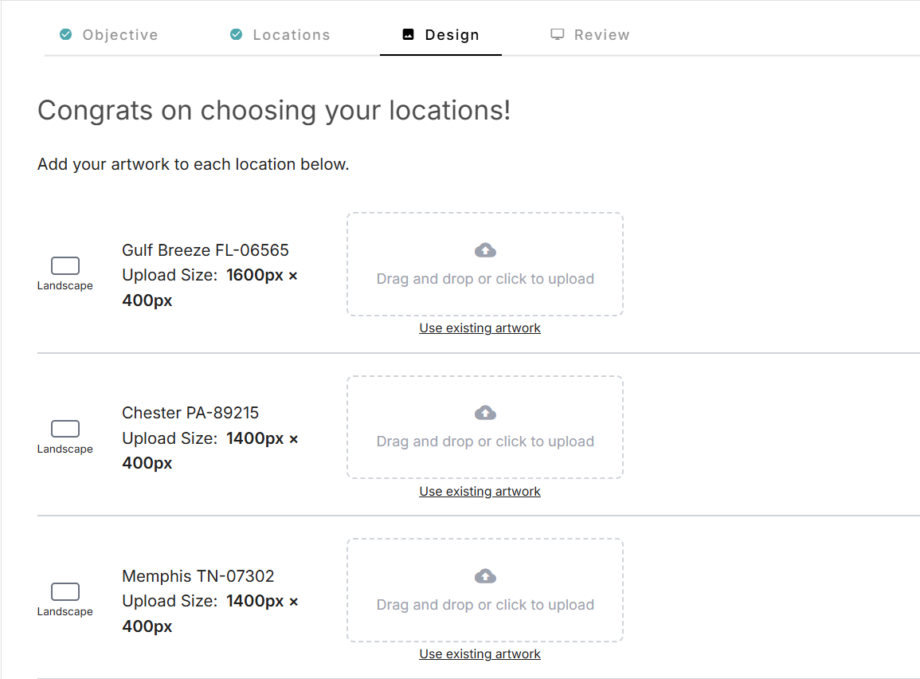
You can have your campaign live in minutes. Create a free account, select your locations, set your budget, upload your design, and start running once approved.
Where can I advertise with Blip in Houston?
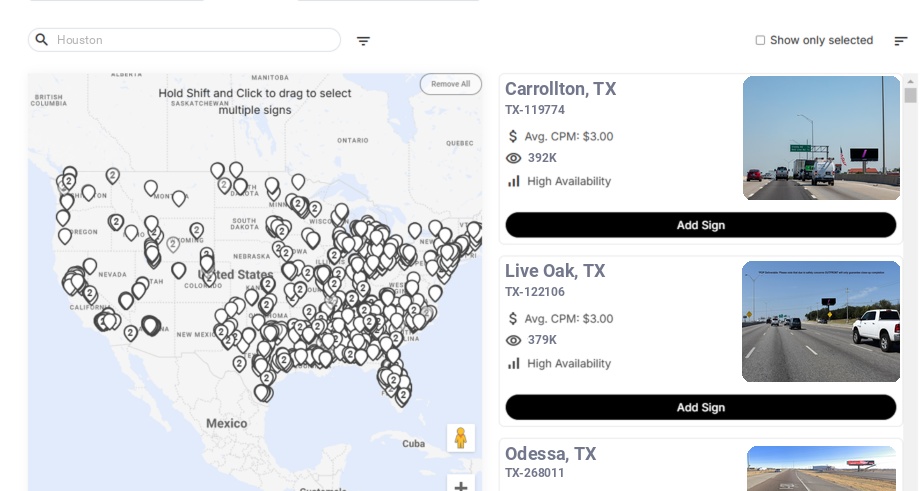
Blip has digital billboards in Houston. You can browse available locations on a map, choose the ones that fit your audience, and start advertising right away.
Still have questions? Launch a campaign in minutes — no contracts, no commitments.
Start Your CampaignHouston Billboard Advertising Guide
Houston is one of the most dynamic advertising markets in the United States: more than 2.3 million residents in the city and over 7.5 million people in the metro area move daily across a vast highway network, past hundreds of high-traffic billboard faces. Regional transportation data from Houston-Galveston Area Council (H-GAC) and TxDOT show the Houston area generating well over 200 million vehicle miles traveled (VMT) per day and more than 70 billion VMT per year, putting it among the most heavily driven metros in the country. When we pair that with Blip’s ability to buy by the “blip” (a single 8–10 second slot), schedule by time of day, and rotate creative in real time, we get a powerful toolkit for brands of every size to tap into Houston billboards without committing to long-term static leases.
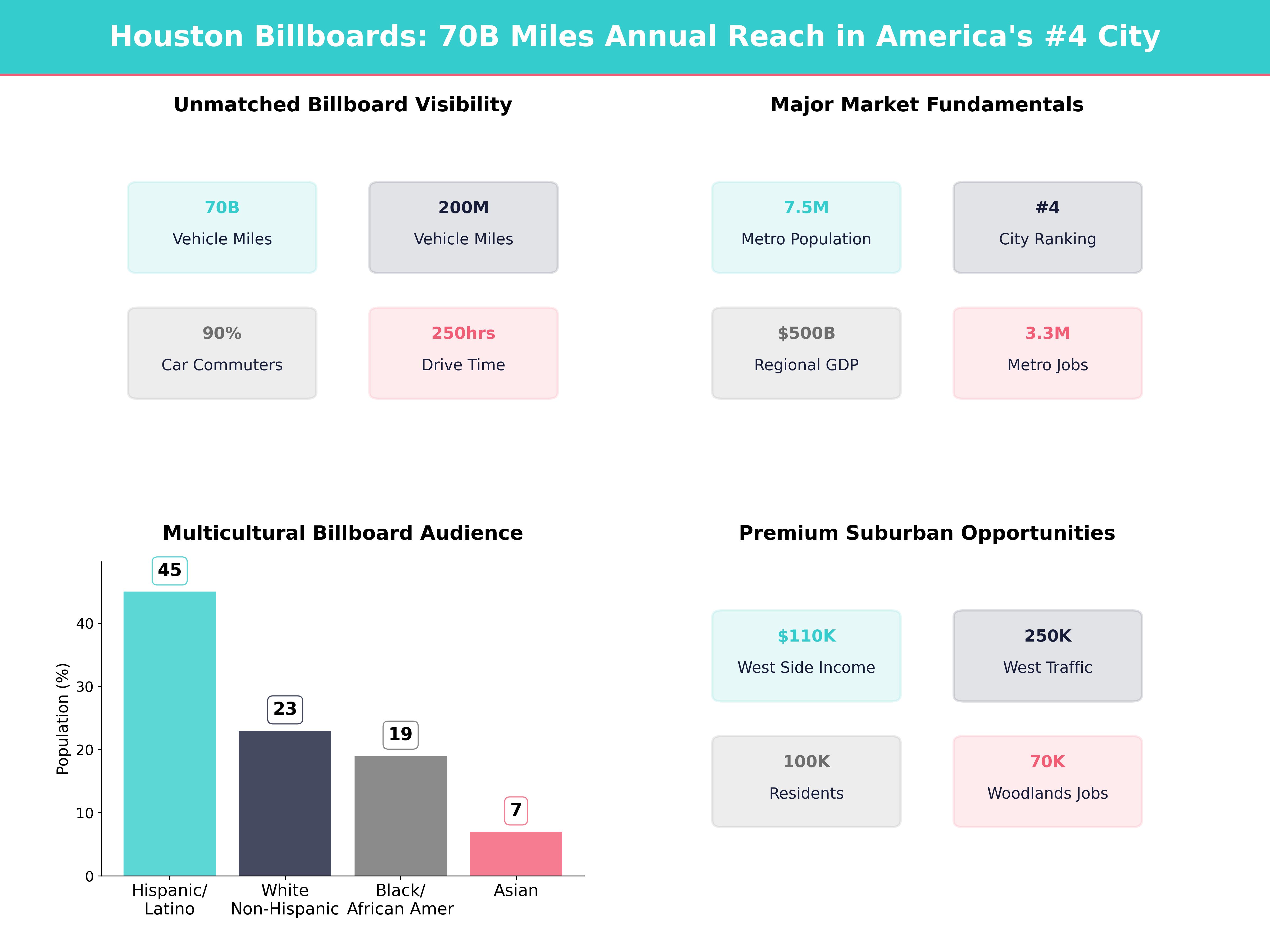
Below, we walk through how to think about digital billboards in Houston—who is on the road, where they’re going, and how to use Blip’s tools to reach the right people at the right moments.
Understanding the Houston Market
Houston is the fourth-largest city in the U.S. by population, and the City of Houston estimates that over 145,000 people were added to the metro area in a single recent year, with some recent years exceeding 200,000 net new residents across the 9‑county region. The broader Houston–The Woodlands–Sugar Land region consistently ranks among the nation’s fastest-growing large metros, pulling in people from across Texas, Latin America, and Asia.
Key high-level stats relevant to advertisers and anyone considering Houston billboard advertising:
-
Population density & sprawl: Houston covers more than 650 square miles within city limits and over 10,000 square miles in the broader 9‑county metro. That makes the city proper larger in land area than cities like New York (about 300 square miles) or Chicago (about 230 square miles). This sprawl contributes to:
- Daily VMT above 200 million, according to H-GAC
- More than 8,000 lane-miles of freeways and principal arterials across the metro.
- Multiple concentric loops (I‑610, Beltway 8, SH‑99) that each carry segments with 150,000+ vehicles per day.
-
Driving culture: According to regional planning data from the Houston-Galveston Area Council, roughly 90% of commuters use a car, truck, or van as their primary mode, while fewer than 3% rely on transit. Average one-way commute times hover around 30 minutes, with many corridors regularly above 35 minutes during peak periods. That translates into:
- Over 60 minutes per day spent commuting for a typical worker.
- More than 250 hours per year in the car for regular full-time commuters.
-
Economic diversity: The Greater Houston Partnership reports that the metro supports more than 3.3 million non-farm jobs and generates a gross regional product exceeding $500 billion annually, ranking it among the top 10 U.S. metros by total economic output. No single industry accounts for a majority of jobs:
- Trade, transportation, and utilities: roughly 600,000+ jobs.
- Professional and business services: 500,000+ jobs.
- Education and health services: 450,000+ jobs.
- Manufacturing, construction, and mining (including energy): 400,000+ jobs combined.
-
Youthful and diverse: Regional demographic snapshots show nearly half of residents in the metro under age 35 and more than 75% of residents identifying as non‑White. No single racial or ethnic group holds a majority:
- Roughly 45% Hispanic/Latino.
- Around 23% White non‑Hispanic.
- Roughly 19–20% Black/African American.
- Roughly 7–8% Asian, with strong growth in Indian, Vietnamese, Chinese, and Pakistani communities.
For billboard advertisers, this means:
- We can reach enormous audience volume with focused geographic targeting: single freeway corridors can easily deliver daily traffic counts of 200,000–300,000 vehicles, giving billboards in Houston the ability to generate significant daily impressions.
- Commuters spend significant time on the road, making frequency achievable even with modest budgets—especially during peak congestion windows.
- Diverse audiences reward localized, culturally aware creative—especially in English/Spanish and in areas near cultural hubs like Asiatown, the East End, and Gulfton.
Mapping the City: Key Corridors and Submarkets
Houston’s travel patterns are structured around rings and spokes: inner and outer loops and interstate corridors stretching in all directions. Understanding these patterns helps us choose the right Blip boards and set smart dayparting for Houston billboard advertising campaigns.
Here are the core zones to think about:
Inner Loop (I-610)
The 610 Loop encircles central Houston and touches many of the city’s most valuable advertising environments:
- Downtown: Home to major employers like energy companies, law firms, and corporate HQs, plus entertainment venues such as Minute Maid Park and Toyota Center. On weekdays, more than 150,000 workers commute into downtown. TxDOT and H-GAC
- Midtown & Museum District: High concentrations of young professionals, students, and visitors to institutions like the Houston Museum of Natural Science Museum of Fine Arts, Houston Houston Zoo alone draws 2 million+ visitors per year, adding to off-peak and weekend traffic.
- Texas Medical Center: The Texas Medical Center is the world’s largest medical complex, with more than 100,000 employees, over 50 million square feet of clinical and research space, and 10+ million patient encounters per year. Daily traffic volumes on SH‑288 and surface streets like Main, Holcombe, and Fannin are consistently high as staff rotate across multiple shifts.
Traffic here is dense throughout the day. We often recommend:
- Heavy weekday dayparts (6–10 a.m., 3–7 p.m.) for B2B, commuting workforce, legal, healthcare, and education-related campaigns, when inbound and outbound flows surge above 8,000–10,000 vehicles per hour on major approaches.
- Midday and evening (11 a.m.–9 p.m.) for dining, events, museums, and nightlife messaging, capturing both central-city residents and visitors.
Energy Corridor & West Houston (I‑10 West)
West Houston along I‑10 (Katy Freeway) and the “Energy Corridor” is one of the most trafficked stretches in Texas. TxDOT data show segments of I‑10 west of downtown carrying well over 250,000 vehicles per day, with certain elevated segments topping 300,000.
Who you reach here:
- White-collar energy, engineering, and professional services workers in one of the largest concentrations of energy firms in the world.
- Affluent suburban households from Katy, Memorial, and west side master-planned communities, where median household incomes in many ZIP codes exceed $110,000–$130,000.
- Heavy retail shoppers near destinations like Memorial City and CityCentre, plus The Galleria
Blip tips:
- Use weekday morning and late afternoon blips to reach commuters with professional or financial-service messages, when speeds often drop below 35 mph and dwell time on each board increases.
- Run weekend and evening blips focused on retail, dining, and family entertainment tied to malls and lifestyle centers; Saturdays on I‑10 West routinely show mid‑day peaks of 200,000+ vehicles across key segments, making this corridor especially valuable for flexible billboard rental in Houston.
North Houston & The Woodlands (I‑45 North)
I‑45 North links downtown to the airport and on to The Woodlands. Two huge nodes anchor this corridor:
- George Bush Intercontinental Airport (IAH): Houston Airports reports more than 40 million passengers annually at IAH alone in recent pre‑pandemic years, with total system traffic (IAH + Hobby) exceeding 55 million passengers in strong years. Rental car centers, park‑and‑fly lots, and airport hotels depend heavily on freeway visibility.
- The Woodlands: A large master-planned community with over 100,000 residents and more than 70,000 jobs. The Woodlands Area Chamber of Commerce notes that major employers include healthcare systems, corporate headquarters, and petrochemical firms. Retail centers like The Woodlands Mall and Market Street attract millions of visitors from surrounding counties every year.
We can use Blip to:
- Focus on flight banks (early morning and late afternoon/evening) with flexible schedules if we’re promoting airport services, hotels, or rideshare; many long‑haul international flights arrive or depart in tight windows.
- Run weekday daytime for B2B and recruiting messages aimed at office workers north of the city, where a large share of households earn $90,000+ and commute on I‑45, Hardy Toll Road, and the Grand Parkway.
South & Southeast (I‑45 South, SH‑288, Port Area)
Southbound I‑45 connects Houston to Clear Lake and Galveston, while SH‑288 funnels traffic to Pearland and coastal communities. To the east, the industrial and maritime zone built around Port Houston is one of the largest freight hubs in the nation.
According to Port Houston
This corridor is ideal for:
- Industrial suppliers, staffing/recruiters, and trucking/logistics firms targeting the thousands of trucks that move in and out of port terminals every day via I‑10 East, SH‑225, and Loop 610 East, where strategically placed billboards in Houston can influence purchasing and hiring decisions.
- Family and leisure messaging aimed at travelers headed to NASA’s Johnson Space Center—which draws roughly 1 million visitors per year—and Galveston Island, which reports millions of beach and cruise visitors annually through Port of Galveston.
- Bilingual outreach to large Hispanic communities throughout southeast Houston, Pasadena, and Galena Park, where Hispanic/Latino residents often account for 60–80% of the local population.
Who You’re Talking To: Audience Insights
Houston’s demographic and economic profile should heavily shape billboard art and copy for any Houston billboard advertising strategy.
Income & Occupations
- The Greater Houston metro’s total economic output exceeds $500 billion, placing it firmly among the top 10 U.S. metros by GDP according to the Greater Houston Partnership.
- The region has added more than 700,000 jobs over the past decade, with several years posting annual job growth above 70,000 positions.
- Energy and energy-related industries account for tens of thousands of high-paying jobs concentrated in the Energy Corridor, Greenspoint/North Belt, and Downtown. Median pay in oil and gas extraction and related engineering roles frequently exceeds $100,000–$120,000.
- The Greater Houston Partnership regularly reports median household incomes in the metro above $70,000, with numerous suburban submarkets—such as Katy, Sugar Land, and The Woodlands—showing medians above $100,000.
- At the same time, Houston has significant service, logistics, and industrial workforces, particularly along the port, Beltway 8, and outer suburbs. Manufacturing, construction, and logistics together employ more than 500,000 workers in the region.
Practical implications:
- High-end brands, financial services, healthcare, and education have headroom for premium messaging, particularly in west and north corridors where new-home prices and per‑capita spending outpace metro averages.
- Value-focused or bilingual campaigns perform well in outer Beltway corridors, where households are younger, more family-oriented, and often more budget-conscious, with median incomes closer to $55,000–$65,000.
Language & Culture
Houston is widely recognized as one of the most diverse metros in the country:
- Roughly 40–45% of residents identify as Hispanic or Latino.
- Around 20%+ identify as Black or African American.
- Large and growing Asian communities are concentrated in southwest Houston, including the Asiatown
- More than 140 languages are spoken in homes across the metro, according to local school districts and city diversity reports.
How this should guide our creative:
- Consider bilingual English/Spanish billboard designs along I‑45, I‑69, Beltway 8, and in south/southeast corridors, where Spanish-speaking households in many neighborhoods exceed 50%.
- Incorporate culturally inclusive visuals—diverse families, professionals, and students—rather than generic stock imagery. Local surveys reported by outlets such as the Houston Chronicle
- For campaigns targeting specific communities (Vietnamese, Chinese, Indian, etc.), pair digital targeting (online, social) with boards near Asiatown, Sharpstown, and west/southwest suburbs, where Asian-origin residents can account for 20–40% of local populations.
Commuter Behavior and Traffic Patterns
According to regional mobility reports from Houston-Galveston Area Council
- Average one-way commute: around 30 minutes, with some outer‑suburb to Inner Loop commutes exceeding 45–60 minutes during peak times.
- Many workers leave home between 6:00–8:30 a.m. and return between 4:00–7:00 p.m.; traffic volumes often remain elevated until after 7:30 p.m. on major freeways.
- Travel times increase significantly—by 20–40% on some routes—on rain days and during major construction phases, which can further boost billboard impressions by slowing vehicles near boards.
We can take advantage by:
- Emphasizing brief, bold messaging sized for drivers crawling at 10–30 mph, using no more than 6–10 words and large fonts.
- Using Blip’s scheduling to buy heavy frequency only in the peak 2–3 hour windows when your target audience is most likely on the road, rather than paying for lower‑yield overnight impressions.
- Shifting spend to alternate corridors temporarily if TxDOT construction projects reroute or slow traffic in specific areas.
Seasonality: Timing Your Campaigns in Houston
Houston’s climate, event calendar, and storm season create strong seasonal patterns in both consumer behavior and traffic, all of which matter when planning billboard rental in Houston.
Weather & Hurricane Season
- Summer temperatures routinely exceed 90°F with high humidity from May through September; heat index values above 100°F are common on 60–70 days per year.
- Hurricane season runs June 1 to November 30, peaking in August–September. Recent storm years have seen multiple significant events (e.g., Harvey, Imelda, Nicholas) that prompted large spikes in home repair, insurance, and auto demand.
- Heavy rain days can drop freeway speeds by 15–30% and increase travel times by 20–40%, stretching exposure to roadside media.
Advertising implications:
- Spring (March–May) and fall (October–November) are prime periods for outdoor activities, home improvement, auto, and local attractions, with more comfortable temperatures and strong event calendars.
-
For storm-related products (insurance, generators, roofing, home repair), we can:
- Ramp up frequency during early hurricane season and during named storm monitoring windows when local outlets like Click2Houston (KPRC 2) and ABC13 intensify coverage.
- Use reactive campaigns that go live quickly following named storms or heavy weather alerts, leveraging Blip’s ability to update creatives without printing delays and reach residents deciding on repairs, temporary housing, or replacement vehicles.
Event-Driven Opportunities
Houston hosts major recurring events that dramatically spike travel and spending:
- Houston Livestock Show and Rodeo: According to RodeoHouston
- Sports seasons: The Houston Astros, Houston Rockets Houston Texans drive heavy gameday traffic into downtown, Midtown, and the NRG Park area. A full season of home games across baseball, football, and basketball can bring well over 2 million total in‑person spectators.
- Conventions & medical conferences: The George R. Brown Convention Center
We can:
- Concentrate blips along I‑69, 610, and near NRG Park
- Run gametime-specific schedules (e.g., 3–7 p.m. on home game days) for sports bars, parking, rideshare, and merchandise when traffic around venues surges above normal levels.
- Align conference-focused campaigns—like medical devices, healthcare recruiting, or B2B services—with anticipated convention calendars published by Visit Houston and Houston First Corporation
Tourism and Weekend Travel
The Visit Houston tourism bureau reports tens of millions of domestic and international visitors annually when including overnight and day-trip visitors; some recent years have approached or exceeded 20 million total visitors. Many drive in from Dallas–Fort Worth, San Antonio, Austin, and Louisiana via I‑10, I‑45, and US‑290.
High-impact weekend and tourism windows:
- Friday afternoon/evening: Incoming leisure travelers and weekend shoppers arriving between 3–8 p.m., when outbound commuter traffic overlaps with inbound visitors.
- Saturday midday: Shopping districts, Houston Zoo and Museum District, Galleria, and other major attractions report some of their highest foot traffic; freeway segments near these destinations often see sustained volumes above 150,000 vehicles per day.
- Sunday afternoon/evening: Return traffic, last-minute retail, and restaurant decisions peak between 3–8 p.m. as visitors head home.
Use Blip to:
- Shift spend to Friday–Sunday for hospitality, attractions, retail, and restaurant campaigns when leisure travel dominates.
- Run different creative on weekends (e.g., “Stay this weekend?” or “Brunch today”) versus weekday messaging (“Happy Hour 5–7 p.m.” or “Book your weekday consult”) to match intent and timing.
Creative Best Practices for Houston Billboards
Digital billboards in a high-traffic, fast-moving market like Houston demand clean, high-contrast messaging. We should tailor design choices to local conditions so Houston billboards remain readable and compelling in all weather and traffic conditions.
Keep It Short and Legible in Traffic
- Aim for 6–10 words total, plus logo/contact element. Commuter studies cited by H-GAC
- Use large, bold fonts and high-contrast color combinations that pierce Houston’s bright sunlight and highway glare; remember that annual sunshine exceeds 200–220 days per year.
- Avoid thin scripts or low-contrast colors, especially during midday along east–west corridors like I‑10 where sun angles can be harsh and reflections from concrete can wash out subtle palettes.
Examples:
- “Beat Houston Heat – $0 Down A/C Install” (HVAC)
- “Same-Day Injury Care – Med Center & Katy” (Urgent care)
- “New Homes in Katy From $3XXk – Exit 742” (Homebuilder)
Localize Your Message
Houston audiences respond well to local references and neighborhood cues:
-
Reference well-known landmarks or districts:
- “5 Minutes from Galleria – Next Exit”
- “Steps from NRG Park – Free Parking”
- “Off 1960 Near Deerbrook – Walk‑Ins Welcome”
- Use relevant local language: “Beltway 8,” “The Loop,” “Inside the Loop,” “Energy Corridor,” “Med Center,” “The Woodlands,” “Bay Area,” “Clear Lake,” “Northside.”
When we’re buying Blip inventory near these destinations, location-specific copy can dramatically increase relevancy and conversion, as supported by case studies from local agencies and business testimonials reported in outlets like the Houston Business Journal
Bilingual & Multicultural Creative
Given the large Spanish-speaking population, consider:
- Fully bilingual boards (headline in English, subline in Spanish or vice versa) in corridors where Spanish is spoken in 40–70% of households.
- Rotating English and Spanish creatives on the same boards at different times of day or in different neighborhoods (e.g., Spanish-heavy in southeast Houston, English-heavy in the Energy Corridor).
- Using trusted phrases like “Se habla español” for service businesses, which surveys from local chambers and Hispanic business associations show can significantly increase inquiry rates.
Example pairs:
- Morning (commuter-heavy): “Accidentes? Llama al Abogado [Brand] – 24/7”
- Evening (family-oriented): “Clínica Familiar Abierta Hasta las 9 p.m.”
Using Blip’s Flexibility to Target Houston Smartly
Blip’s platform lets us adjust when, where, and how often our messages appear. Houston’s size and complexity make this flexibility especially valuable for advertisers exploring billboard rental in Houston for the first time or optimizing existing campaigns.
Dayparting by Audience and Corridor
We can schedule different creatives for different times of day and corridors:
-
Morning rush (6–9 a.m.):
- Employment, B2B, education, professional services.
- Coffee, breakfast, and quick-service restaurants near major exits.
- School-related messaging along routes near large districts such as Houston ISD, Katy ISD, and Fort Bend ISD, where buses and parent traffic add to morning volume.
-
Midday (10 a.m.–3 p.m.):
- Retail, healthcare appointments, home services; targeting stay-at-home parents, retirees, shift workers, and remote workers.
- Medical and dental campaigns near clinics and hospitals when appointment slots are most available.
-
Afternoon & evening (3–8 p.m.):
- Dining, entertainment, grocery, youth sports, and family activities, especially along corridors leading to shopping centers and sports complexes.
-
Late night (8 p.m.–12 a.m.):
- Bars, nightlife, delivery, 24-hour services, urgent care, and towing/roadside assist.
By setting different bid levels for each daypart, we can prioritize the windows that give us the highest return for each campaign objective while avoiding lower‑value, low‑traffic periods.
Corridor-Based Targeting
We should think of each major freeway and loop as its own mini-market:
- I‑10 West / Energy Corridor: Corporate and affluent suburban households; strong fit for financial, luxury auto, homebuilding, and B2B energy services.
- I‑45 North: Airport and suburban commuters (Spring, The Woodlands, Conroe); ideal for travel, hospitality, healthcare, and residential communities.
- I‑45 South & SH‑3: NASA, Clear Lake, Galveston-bound visitors; good for attractions, cruise parking, insurance, and hospitality.
- I‑69 / US‑59: Connects southwest suburbs (Sugar Land, Missouri City, Stafford) to downtown; these suburbs include some of the region’s highest-income and most educated households.
- SH‑288: Links Pearland and southern suburbs with the Med Center and downtown; ideal for healthcare, higher education, and family services.
- Beltway 8 and Grand Parkway (SH‑99): Outer-ring commuters and logistics hubs; segments near the port, Bush IAH, and major distribution centers are perfect for logistics, warehousing, staffing, and industrial sales.
Using Blip’s location filters, we can:
- Run luxury and professional services more heavily on I‑10 West and I‑69 Southwest, plus key interchanges near The Galleria and Uptown.
- Emphasize value, bilingual, and service brands on Beltway 8, SH‑249, and US‑59 North where demographics skew younger and more price-sensitive.
- Focus logistics, industrial services, staffing, and training around east Houston and port-adjacent routes such as SH‑225, I‑10 East, and 610 East.
Budget Efficiency for Small and Mid-Sized Advertisers
Because Blip sells inventory by individual ad plays instead of static month-long leases:
- We can start campaigns for local businesses with very modest daily budgets—often comparable to a few boosted social posts—then scale what performs best.
- We can use A/B testing of creatives: for example, run two versions of a roofing ad (“$0 Down” vs. “Lifetime Warranty”) across the same boards and time windows, then track which phone number or URL path generates more leads.
- We can “pulse” campaigns: heavy bursts (e.g., 2–3 weeks) around key sales periods like back-to-school (August), tax refund season (February–April), Black Friday/holiday season (November–December), or hurricane preparation season (May–June).
This approach gives small and mid-sized brands access to premium Houston billboards that were historically reserved for large advertisers with long-term contracts.
Industry-Specific Strategies in Houston
Different sectors can exploit Houston’s geography and demographics in unique ways.
Healthcare & Medical Services
Houston’s Texas Medical Center alone hosts more than 60 member institutions, including leading hospitals and research centers. Add community hospitals in Katy, Sugar Land, The Woodlands, Clear Lake, and the suburbs, and healthcare is one of the region’s largest employers and marketing spenders, supporting well over 300,000 jobs across the metro.
Billboard strategies:
- Proximity-based targeting: Focus boards along 610 and SH‑288 for Med Center, I‑10 for Memorial City and Katy hospitals, I‑45 North and South for hospital campuses in The Woodlands and Clear Lake, and Beltway 8 for suburban hospitals and specialty centers.
- Service-line campaigns: Promote ER wait times, orthopedic and sports medicine, cardiology, pediatrics, maternity, oncology, and urgent care. Local patient surveys often show that ease of access and perceived wait times are top reasons for choosing facilities.
- Recruiting: Nursing and allied health staffing campaigns targeting rush-hour commuters around large medical complexes and along Beltway 8 can highlight sign‑on bonuses (e.g., “RNs Up to $20k Bonus”) and flexible schedules; hospital systems across Houston routinely advertise thousands of open positions.
Energy, Engineering, and Industrial
Houston is widely known as the “Energy Capital of the World,” with thousands of energy and oilfield service firms:
- The region hosts more than 4,600 energy-related firms, from upstream exploration and production to downstream petrochemicals and equipment manufacturers.
- Billions of dollars in petrochemical and LNG projects along the Ship Channel and Gulf Coast create steady demand for skilled labor, specialty contractors, and safety/compliance services.
Use billboards to:
- Run B2B campaigns targeting industry professionals in the Energy Corridor (I‑10), Galleria area (US‑59/I‑69), and Greenspoint/North Belt area, emphasizing thought leadership, new technologies, or safety records.
- Promote safety programs, specialty equipment, and training along port-adjacent highways and industrial zones where plant managers, contractors, and truck operators travel daily.
- Recruit for skilled trades and plant operations with clear pay and benefits messages; schedule around shift changes (e.g., 5–7 a.m. and 5–7 p.m.) near refineries and plants in east and southeast Houston.
Education and Workforce Training
Houston’s large youth population and immigrant communities create huge demand for education:
- Colleges and universities like the University of Houston, Rice University, Texas Southern University, and Houston Community College collectively enroll well over 100,000 students each year.
- Local community colleges and technical schools serve tens of thousands more, focusing on healthcare, trades, IT, and logistics.
Strategy:
- Run deadline-focused campaigns around enrollment periods and FAFSA timelines—January to March for fall enrollment, plus August “last chance” pushes.
- Emphasize short program durations and job outcomes, e.g., “HVAC Career in 9 Months – Enroll Now” or “CDL in 4 Weeks – Hiring Partners Ready.”
- Use boards near campuses and student housing zones with simple URLs and QR codes; local surveys show students are highly responsive to mobile-friendly calls to action.
Restaurants, Retail, and Local Services
From the Galleria to Asiatown to neighborhood strip centers, Houston is saturated with dining and shopping options:
- Major destinations like The Galleria Baybrook Mall First Colony Mall
- Houston regularly ranks near the top of national lists for restaurants per capita and diversity of cuisines, making competition for attention fierce.
Tactics:
- Use proximity callouts: “Next Exit,” “1 Mile Ahead on Westheimer,” or “Across from NRG.” Studies from the outdoor advertising industry show that boards with clear directional cues can lift foot traffic by 15–30%.
- Run lunch and dinner-only schedules for restaurants and QSR chains, especially along commuter corridors leading to employment centers and near dense residential areas.
- For local services (auto shops, dentists, salons), use hyper-local boards and highlight phone, URL, or simple map-based directions—“On FM 1960 at Aldine Westfield,” “Across from H-E-B
Measuring and Optimizing Your Houston Campaign
While billboards are a top-of-funnel medium, we can still track impact and continuously improve performance.
Tracking Tactics
- Vanity URLs: Use simple, billboard-only URLs such as “BrandNameHouston.com” or “/HoustonRodeo” landing pages to track visits and distinguish billboard traffic from search or social.
- Promo codes: “Mention ‘Houston10’ for 10% off” in-store or online; track redemption counts and correlate them with Blip schedules.
- Call tracking numbers: Use unique phone numbers for specific campaigns or corridors (e.g., one number for I‑10 West, another for I‑45 North).
-
Lift analysis: Correlate time periods of heavy Blip activity with:
- Increases in web traffic, as measured in Google Analytics.
- Higher branded search volume in the Houston DMA (via Google Trends).
- Spikes in inbound calls or form fills, especially in the days immediately following campaign launches or frequency increases.
Iteration with Blip
Because creatives and schedules can be adjusted quickly:
- Start with 2–3 versions of your core message tailored to Houston (e.g., “Near the Med Center,” “By The Galleria,” “In Katy”).
- Run them in parallel for at least 1–2 weeks across your priority corridors to gather statistically meaningful response data.
- Compare downstream metrics (calls, form fills, redemptions, store traffic) by creative and corridor.
- Shift budget toward the top performer and retire or rework lower-performing creative; update copy to reflect real-world learnings (e.g., which offers resonate in which neighborhoods).
- Expand to new corridors or dayparts once we’ve found a winning combination that performs reliably across several weeks.
Bringing It All Together
Houston’s scale, diversity, and car-centric lifestyle make it one of the most powerful markets for digital billboards in the country. With Blip, we can:
- Start small, test quickly, and scale what works instead of locking into long-term static buys.
- Target specific corridors, commuter flows, and neighborhood demographics with precision, informed by local data from H-GAC, TxDOT, and city and county planning agencies.
- Adjust creative and schedules around weather, events, sports, tourism, and seasonal sales cycles, capitalizing on peak traffic windows tied to RodeoHouston, major games, conventions, and holiday shopping.
By understanding who is on each freeway, when they’re traveling, and what drives their decisions, we can build Houston billboard campaigns that deliver real, measurable value—whether we’re a neighborhood startup or a regional brand with big growth goals—and make Houston billboard advertising an efficient, data-informed part of your overall marketing strategy.