Billboards in Socorro, TX
No Minimum Spend. No Long-Term Contracts. Just Results.
Trusted by Leading Brands


Billboard advertising
in Socorro has never been easier



How much is a billboard in Socorro?
Why Choose Blip for Billboard Advertising in Socorro
Blip lets you launch fast in Socorro and target I-10, Loop 375, or Alameda traffic without sales calls or contracts.
Use Blip-optimized campaigns in Socorro to auto-shift spend toward school runs, work commutes, and Mission Trail weekend traffic.
Set flexible daily budgets in Socorro and only pay when your ad plays, so you can scale with East El Paso demand.
Daypart your Socorro ads for 6-9 a.m. school traffic or 4-7 p.m. commute returns on I-10 and Zaragoza corridors.
Track real-time results in Socorro, then move budget from broad freeway reach to local Alameda repetition as you learn what works.
Blip’s creative tools make it easy to build bilingual ads for Socorro’s family-driven, 95% Hispanic market.
Frequently Asked Questions About Billboard Advertising in Socorro
How much does a billboard cost in Socorro, Texas with Blip?
With Blip, billboard advertising in Socorro is built to fit your budget. You choose a daily spend, and Blip’s algorithm uses it to bid for open ad slots on rotating digital billboards. You only pay when your ad actually runs, with each 7.5-to-10-second display, or “blip,” starting at just $0.01.
Where can I advertise with Blip in Socorro, Texas?
The strongest starting point is usually one clear message, one clear audience, and a corridor that naturally fits how that audience already drives. In Socorro, the page highlights I-10 for the highest reach, Alameda or Socorro Road for repeated local visibility, and Loop 375 and Zaragoza for logistics workers, industrial buyers, or cross-border traffic. You can also use manual campaigns to select specific East Side boards on I-10, Alameda, Loop 375, or Montana.
Who do Socorro, Texas billboard ads reach?
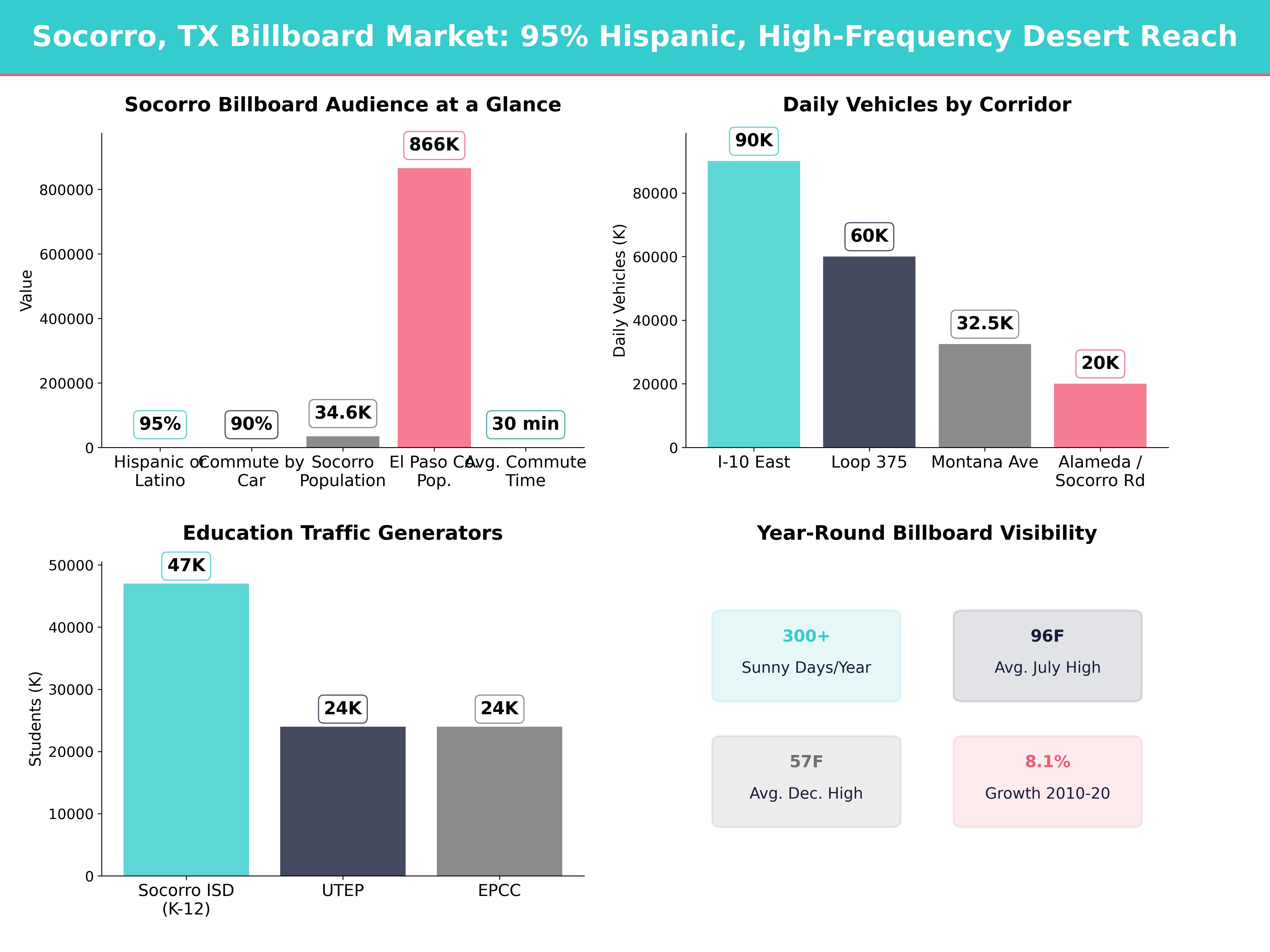
Socorro sits inside El Paso County, where the population reached 865,657, and it is only about 20 miles from Downtown El Paso. The city is about 95% Hispanic or Latino, which means creative that feels bilingual, family-oriented, and community-aware usually lands better than generic national messaging. Socorro is also a windshield market, with roughly 90% of workers commuting by car and average travel times near 30 minutes.
When is the best time to run billboard ads in Socorro, Texas with Blip?
Late July through September is one of the best windows because Socorro ISD brings more than 47,000 students back into daily travel patterns, and the state’s 3-day August sales tax holiday amplifies shopping trips. The page says school-oriented dayparts such as 6:00 to 9:00 a.m. and 2:00 to 4:00 p.m. are often the most valuable. Summer also favors afternoon and early evening windows, such as 4:00 to 7:00 p.m., when families are finishing work and heading to stores or activities.
What kind of billboard creative works best in Socorro, Texas?
Because Socorro is about 95% Hispanic, the page recommends strongly considering bilingual or Spanish-first creative when the brand and audience fit. It also says the market has more than 300 sunny days a year and summer highs near 96°F, so pale colors, thin fonts, and low-contrast layouts are risky. Strong contrast, bold type, and local imagery tied to Socorro Mission, desert skies, or East Side family life will usually feel more credible.
Do I need a contract to advertise with Blip in Socorro?
No, Blip has no long-term contracts or minimum commitments. You can start, pause, or stop your campaign at any time.
How fast can I launch a billboard campaign with Blip in Socorro?
You can have your campaign live in minutes. Create a free account, select your locations, set your budget, upload your design, and start running once approved.
Where can I advertise with Blip in Socorro?
Blip has digital billboards in Socorro. You can browse available locations on a map, choose the ones that fit your audience, and start advertising right away.
Still have questions? Launch a campaign in minutes — no contracts, no commitments.
Start Your CampaignSocorro Billboard Advertising Guide
Socorro gives us unusual advertising leverage because it combines local loyalty with regional reach. The City of Socorro 34,608 residents in 2020, yet it sits inside El Paso County 865,657, and it is only about 20 miles from Downtown El Paso. In a metro where daily life still runs heavily through I-10, Loop 375, Montana Avenue, and Alameda Avenue, billboard messages gain repeated exposure during work, school, shopping, and family trips. We also benefit from a market shaped by families, logistics, border commerce, and Mission Trail 3-site, 9-mile Mission Trail corridor, which makes Socorro a strong fit for both local brands and regional advertisers.
Market Overview for Socorro
When we look at Socorro, we should think beyond the city limits. We are advertising into the fast-growing East El Paso trade area, where local residents, county commuters, and regional shoppers overlap every day, and where El Paso County added 65,010 residents from 2010 to 2020.
Population, growth, and demographics in Socorro
Socorro grew from 32,013 residents in 2010 to 34,608 in 2020, which was an increase of 2,595 people, or 8.1%. Over the same decade, El Paso County added 65,010 residents and reached 865,657 people, which reinforces that our billboard audience is much larger than Socorro alone. The City of El Paso 678,815 residents in 2020, so a campaign placed on the East Side can touch city, county, and suburban traffic at the same time.
Socorro is also culturally distinctive. The city is about 95% Hispanic or Latino, or roughly 33,000 residents, which means creative that feels bilingual, family-oriented, and community-aware usually lands better than generic national messaging. When we tailor offers, imagery, and language to that reality, we are matching the market instead of forcing the market to adjust to us.
Mobility, economy, and what they mean for billboard advertisers in Socorro
Socorro is a windshield market. American Community Survey estimates indicate that roughly 90% of workers commute by car, and average travel times are near 30 minutes, which gives us repeated roadside exposure during both the morning and evening drive. While Sun Metro
That matters because billboards work best where habits are routine. In Socorro, those routines revolve around school runs, warehouse shifts, retail trips, medical appointments, and cross-county commutes. We also benefit from the economic diversity promoted by the El Paso Chamber, including logistics, healthcare, education, construction, and retail. For advertisers, that means we can run the same regional campaign for categories such as urgent care, legal services, restaurants, auto sales, home services, insurance, colleges, and community events, while still tailoring creative by corridor.
Education adds another important layer of demand. Socorro Independent School District serves more than 47,000 students across 49 campuses, which creates reliable school-day traffic peaks and a very large family audience. On the higher-education side, The University of Texas at El Paso enrolls more than 24,000 students, and El Paso Community College serves more than 24,000 students, so the broader market includes well over 48,000 college students and adult learners. That combination makes Socorro especially attractive for brands that want to reach parents, first-time renters, job seekers, students, and young families.
Key Traffic Corridors Around Socorro
Our best billboard strategy in Socorro starts with travel behavior. According to the Texas Department of Transportation traffic count database and planning work from the El Paso Metropolitan Planning Organization, a few major corridors dominate how people move through the East Side.
I-10 through East El Paso and the Socorro area
I-10 is the region’s backbone, and east-side segments commonly report about 80,000 to 100,000-plus vehicles per day. The strongest counts are generally closer to Loop 375, Zaragoza Road, and major retail nodes, where regional commuting, shopping, and airport traffic overlap.
For us, I-10 is the best broad-reach buy in the market. It connects Socorro with central El Paso, East Side shopping, El Paso International Airport, major hospital zones, and large employment centers. This corridor is especially effective for categories that need mass awareness across multiple ZIP codes.
- Retail brands perform well on I-10 because we can reach daily commuters before they choose where to shop after work.
- Healthcare providers do well here because patients often travel across the county for specialty care at systems such as Del Sol Medical Center The Hospitals of Providence
- Auto dealers, financial services, and telecom brands benefit because freeway visibility supports both repeated frequency and regional scale.
Loop 375, the César Chávez Border Highway, and the Zaragoza gateway
Loop 375 is critical on the East Side, especially near Zaragoza Road and industrial districts. Recent count stations in this part of the corridor commonly land in the 50,000 to 70,000 AADT range, and the route ties directly into freight movement, warehouse activity, and cross-border commerce near the Ysleta-Zaragoza International Bridge
This is where we should advertise when we want to reach workers, logistics buyers, and business decision-makers. It is also strong for staffing agencies, truck services, quick-service restaurants, convenience retail, and bilingual service providers. The audience here is not just local residents. It includes shift workers, industrial supervisors, delivery fleets, and regional drivers moving between Socorro, far East El Paso, and border facilities.
US 62 and US 180 on Montana Avenue
Montana Avenue is one of the most important non-interstate corridors on the East Side. Recent TxDOT counts on developed eastern segments generally run in the 25,000 to 40,000 AADT range, depending on the segment and the surrounding retail intensity.
Montana is valuable because it mixes commuter traffic with residential growth. It helps us reach newer neighborhoods, value-conscious families, and shoppers headed to large retail clusters. If we are advertising furniture, home improvement, apartments, schools, urgent care, or family entertainment, Montana can deliver a strong balance between scale and neighborhood relevance.
We should also remember that Montana captures audiences who may not use I-10 for every trip. That makes it useful for frequency-building when we want to reinforce a freeway campaign with a second touchpoint.
SH 20, Alameda Avenue, and Socorro Road
Alameda Avenue and Socorro Road are slower, more local, and often more repetitive. In and around Socorro, recent counts on Alameda corridors often fall in the 15,000 to 25,000 AADT range. That is lower than I-10, but the traffic is more community-based and the viewing conditions are usually better for local message absorption.
This corridor is ideal when we want to own the neighborhood rather than the metro. It is especially useful for:
- Local restaurants and retailers because nearby residents pass these roads repeatedly during errands and meal decisions.
- Clinics, dentists, and legal services because familiarity and trust matter in community-based categories.
- Schools, churches, city programs, and event promoters because Alameda ties into the El Paso Mission Trail
Alameda also works well for bilingual and hyperlocal creative. Drivers here are more likely to recognize references to Socorro, the Lower Valley, and nearby destinations immediately.
Audience Segments We Can Reach in Socorro
The value of Socorro billboard advertising comes from how many distinct audiences we can reach with one geographic strategy. We are not speaking to just one kind of driver.
Socorro commuters and cross-county households
Most working households in Socorro depend on daily car travel, and commute times near 30 minutes create repeated weekday exposure. That makes the market especially good for brands that need frequency rather than one-time impressions. Insurance, primary care, banks, home services, and grocery-adjacent retail all benefit from seeing the same households multiple times each week.
Because Socorro sits inside a county of 865,657 people, our message can also travel outward. A board that appears local to Socorro residents may still reach people from East El Paso, Horizon City
Families, parents, and school communities in Socorro
Family marketing is a major strength here. Socorro ISD serves more than 47,000 students across 49 campuses, which creates dependable traffic before school, after school, and around extracurricular events. That makes Socorro particularly attractive for:
- Pediatric, orthodontic, and urgent care advertisers that want to stay visible to parents.
- Tutoring, childcare, and after-school programs that need awareness before enrollment deadlines.
- Quick-service restaurants, grocery stores, and family entertainment that depend on habitual local decision-making.
If we are planning around school calendars, we should think in waves rather than months. Enrollment, football season, testing periods, graduation, and summer programming each change what families care about and when they are on the road.
Students and young adults in the broader El Paso market
Even though Socorro itself is family-heavy, it also connects to a large student and workforce-development audience. UTEP has more than 24,000 students, and EPCC serves more than 24,000 students. Together, that gives us a regional higher-education audience of well over 48,000 learners, many of whom commute from the East Side or pass through East Side corridors.
This audience responds well to messages about affordability, convenience, jobs, apartments, wireless plans, trade programs, and flexible healthcare. If we pair Socorro-area boards with placements closer to central El Paso, we can follow these consumers through more than one part of their week.
Visitors, cultural travelers, and recreation audiences near Socorro
Tourism in Socorro is more heritage-driven than resort-driven, but it is still meaningful. The El Paso Mission Trail 3 historic mission sites, including Socorro Mission Ysleta Mission San Elizario Presidio Chapel 9 miles of historic corridor.
We also have nearby recreation draws such as Ascarate Park 400 acres, and Rio Bosque Wetlands Park 372 acres. Add destinations tied to Ysleta del Sur Pueblo and Speaking Rock Entertainment Center, and we get weekend and event traffic that extends beyond routine commuting.
Regional entertainment also matters. The El Paso Chihuahuas play 75 home games in a typical season at Southwest University Park El Paso International Airport handled nearly 4 million passengers in 2023. Even if those destinations are not inside Socorro, the East Side road network still carries many of the consumers moving to and from them.
Seasonal and Timing Opportunities in Socorro
Socorro is a year-round market, but we can improve results when we align our campaigns with local rhythms instead of running the same schedule every month.
Back-to-school and fall timing in Socorro
Late July through September is one of our best windows. Socorro ISD brings more than 47,000 students back into daily travel patterns, and the state’s 3-day August sales tax holiday promoted by the Texas Comptroller amplifies shopping trips. We should expect strong demand for ads related to uniforms, shoes, phones, tutoring, dentists, pediatric care, fast food, and family retail.
For timing, we usually get the most value from school-oriented dayparts such as 6:00 to 9:00 a.m. and 2:00 to 4:00 p.m. Those windows are ideal for messages tied to parents’ immediate decisions.
Holiday shopping and year-end campaigns around Socorro
From November through December, East El Paso retail corridors become much more active. Regional destinations such as Cielo Vista Mall The Fountains at Farah The Outlet Shoppes at El Paso pull traffic from all over the county, including Socorro and the Lower Valley.
This is when we should emphasize gifts, promotions, financing, food, and event attendance. Because winter in El Paso is relatively mild, with an average December high near 57°F, outdoor shopping and event traffic remain strong compared with colder markets.
Spring culture, baseball, and community activity in Socorro
Spring gives us several thematic angles. Heritage travel picks up along the Mission Trail Ascarate Park Rio Bosque Wetlands Park 75 Chihuahuas home games spread across the warmer months.
This is a good time for restaurants, local events, attractions, community colleges, and healthcare screening campaigns. We can also refresh creative to feel more active and social after winter.
Summer heat and travel strategy in Socorro
Summer in the El Paso region is visually intense. Average July highs are around 96°F, annual precipitation is only about 8.8 inches, and the area is often described by Visit El Paso as having more than 300 sunny days a year. That combination changes both creative strategy and scheduling.
On the creative side, we need extremely high contrast and simple layouts because glare is real. On the media side, we often see strong use cases for HVAC companies, beverages, shaded attractions, summer camps, water-related promotions, and travel brands. We should also lean into afternoon and early evening windows, such as 4:00 to 7:00 p.m., when families are finishing work, making meal decisions, and heading to stores or activities.
Billboard Design Tips for the Socorro Market
Creative in Socorro should feel like it belongs here. We will usually perform better with market-specific choices than with a generic statewide ad.
Use bilingual or culturally fluent messaging for Socorro
Because Socorro is about 95% Hispanic, or roughly 33,000 residents, we should strongly consider bilingual or Spanish-first creative when the brand and audience fit. That does not mean cramming two full ads onto one board. It means deciding whether one concise bilingual line, or separate English and Spanish creative versions, will feel more natural to the audience on a given corridor.
Alameda and Socorro Road are especially good places for local, community-oriented, and culturally fluent messaging. I-10 can carry broader regional branding, but it still benefits from culturally relevant imagery and tone.
Design for intense sun, glare, and fast East Side travel
In a market with 300-plus sunny days and summer highs near 96°F, pale colors, thin fonts, and low-contrast layouts are risky. We should use strong contrast, bold type, and very clear hierarchy. Deep blues, blacks, strong reds, saturated yellows, and clean white type tend to hold up better than dusty neutrals under bright desert light.
We should also think about direction of travel. Westbound afternoon drivers often face harsh sun, so simple shapes and heavy fonts matter even more on those approaches.
Show local relevance instead of generic stock visuals
Socorro drivers know what their market looks like. Imagery tied to the Socorro Mission
Lean into family, value, and convenience in Socorro offers
Because the area is family-oriented and commute-heavy, value propositions work well. Messages like same-day care, low monthly payments, local locations, free estimates, registration deadlines, and meal deals often fit the reality of how people use the roads here. We should also localize our copy with place cues such as Eastlake, Horizon, Zaragoza, Lower Valley, or Socorro whenever the board location supports that level of specificity.
Regional Strategies Across Socorro and East El Paso
We can get better performance when we divide the market into practical sub-areas instead of treating all east-side inventory the same.
Socorro core and the Lower Valley
When we want neighborhood trust and repetition, we should prioritize Alameda Avenue, Socorro Road, and nearby local routes. This is where we can win for clinics, schools, restaurants, legal services, churches, public outreach, and local retail. The pace is slower, the audience is more local, and repeated weekly exposure is easier to build.
Eastlake, Horizon, and the I-10 growth band
If our goal is household growth and broad suburban reach, we should look at the I-10 corridor serving Socorro, Eastlake, and Horizon City
Zaragoza, Loop 375, and industrial gateways
For workforce, B2B, and logistics advertisers, we should focus on Loop 375, Zaragoza Road, and routes connected to the Ysleta-Zaragoza International Bridge
Using Blip Tools in Socorro
Blip works especially well in Socorro because this market rewards flexibility. We often want to test more than one corridor, more than one daypart, and more than one creative style before we scale.
How we can apply Blip features to Socorro strategy
If we know exactly which roads matter to us, we can use a manual campaign to select specific East Side boards on I-10, Alameda, Loop 375, or Montana. That approach is useful when we want to compare a neighborhood-frequency board against a broader-reach freeway board.
If we want regional efficiency, we can use a Blip-optimized campaign and let the platform spread budget across Socorro, East El Paso, and nearby commuter routes. That is often the fastest way to discover whether our category performs better with local repetition or metro-scale reach.
Dayparting is especially valuable here. We can concentrate spend during 6:00 to 9:00 a.m. for work and school commutes, 11:00 a.m. to 2:00 p.m. for lunch and errands, and 4:00 to 7:00 p.m. for return trips and dinner decisions. We can also switch creative seasonally, such as back-to-school in August, football in fall, gift promotions in December, and heat-related offers in summer.
Because Blip supports flexible budgets and pay-per-play buying, with displays starting at $0.01 each, we can test Socorro without overcommitting. Real-time reporting also helps us see where our budget is actually going, so we can shift emphasis from I-10 reach to Alameda frequency, or from weekday commuting to weekend traffic near Mission Trail and entertainment zones. If we need fresh creative, Blip’s artwork tools make it easy to build bilingual versions and localized variations quickly.
Getting Started with Billboard Rental in Socorro
Renting a billboard in Socorro is easiest when we begin with the audience, not the board. We should first decide whether we want metro awareness, neighborhood frequency, school-family reach, industrial-worker exposure, or tourist visibility.
What to expect when we rent a billboard in Socorro
Traditional billboard buying in markets like El Paso has often required long sales cycles, fixed packages, and more commitment than local advertisers actually need. Blip simplifies that process by letting us launch faster, adjust budgets as needed, and refine locations based on real performance instead of waiting through a long contract term.
When we evaluate Socorro-area billboards, we should ask a few practical questions.
- We should choose I-10 when we need the highest reach and the broadest county-wide awareness.
- We should choose Alameda or Socorro Road when we need repeated local visibility and stronger neighborhood familiarity.
- We should choose Loop 375 and Zaragoza when our audience includes logistics workers, industrial buyers, or cross-border traffic.
- We should look closely at direction of travel, approach speed, nearby exits, and the businesses or destinations drivers are heading toward.
In most cases, it is smart to begin with 2 creative versions and either a small hand-picked board set or an optimized regional mix. We can then review results after the first 7 to 14 days, refine dayparts, and expand into the corridors that best match our goals. That process is much more efficient than buying a static package and hoping every location serves the same purpose.
For Socorro specifically, the strongest starting point is usually simple. We begin with one clear message, one clear audience, and a corridor that naturally fits how that audience already drives. From there, Blip makes it easy for us to scale across the East Side, the Lower Valley, and the broader El Paso market as momentum builds.