Billboards in Longview, TX
No Minimum Spend. No Long-Term Contracts. Just Results.
Trusted by Leading Brands


Billboard advertising
in Longview has never been easier



How much is a billboard in Longview?
Why Choose Blip for Billboard Advertising in Longview
Blip lets you launch Longview billboards in minutes, hitting I-20 and Loop 281 commuters without sales calls or delays.
Set a flexible budget for Longview and scale up during Balloon Race or holiday shopping on US 80 when traffic spikes.
Daypart your Longview ads for morning commutes, lunch runs, or evening family drives near hospitals and retail corridors.
No contracts means you can test Longview on US 259 and Loop 281, then shift spend to what drives the best results.
Track Longview campaign performance in real time and fine-tune creatives for East Texas families, shoppers, and truck traffic.
Frequently Asked Questions About Billboard Advertising in Longview
How much does a billboard cost in Longview, Texas with Blip?
With Blip, you control exactly what you spend on Longview billboards by setting a daily budget that can be adjusted at any time, so your campaign always stays within your comfort zone. Each “blip” is a brief 7.5–10 second ad on rotating digital billboards in Longview, Texas, and you only pay for the individual blips you receive. Your total cost is simply the sum of those blips over time, which means you can start small, test what works, and scale up when you’re ready.
Where can I advertise with Blip in Longview, Texas?
Choose specific faces along I‑20, US 80, US 259, and Loop 281 based on your audience’s commute or shopping routes. I‑20 and US 259 are strongest for regional reach, while Loop 281 and US 80 are better for retail shoppers, families running errands, and local diners. By selecting boards on the inbound routes, you can intercept shoppers as they head into the city for big-box stores, medical appointments, and entertainment.
When is the best time to run Longview, Texas billboards with Blip?
Blip’s ability to schedule ads down to specific hours and days is especially powerful in a commuter market like Longview. Typical rush periods are morning from 6:30–9:00 a.m., midday from 11:00 a.m.–1:30 p.m., and evening from 4:30–7:00 p.m. Late-night boards can still serve healthcare recruitment, emergency services, and 24-hour services, and demand for impressions is lower so budgets often go further.
What kind of people do Longview, Texas billboards reach?
Longview is a family-oriented, value-conscious, commuter-heavy market with a sizable healthcare and industrial workforce. The city has roughly 82,000–83,000 residents, a broader trade area of 280,000–300,000 people, and a median age in the mid-30s. Messages that speak to family life, home services, affordability, community, faith, and education tend to resonate strongly.
How can Blip help me advertise during events in Longview, Texas?
Longview has a robust calendar of festivals, sports, and tourism events that can be turned into billboard moments. For the Great Texas Balloon Race, the page suggests running a two-week flight before the event with directional messaging and then switching creatives during the event to capture walk-in traffic. Because Blip sells exposure in small increments, advertisers can test seasonal bursts and ramp up if results are strong.
Do I need a contract to advertise with Blip in Longview?
No, Blip has no long-term contracts or minimum commitments. You can start, pause, or stop your campaign at any time.
How fast can I launch a billboard campaign with Blip in Longview?
You can have your campaign live in minutes. Create a free account, select your locations, set your budget, upload your design, and start running once approved.
Where can I advertise with Blip in Longview?
Blip has digital billboards in Longview. You can browse available locations on a map, choose the ones that fit your audience, and start advertising right away.
Still have questions? Launch a campaign in minutes — no contracts, no commitments.
Start Your CampaignLongview Billboard Advertising Guide
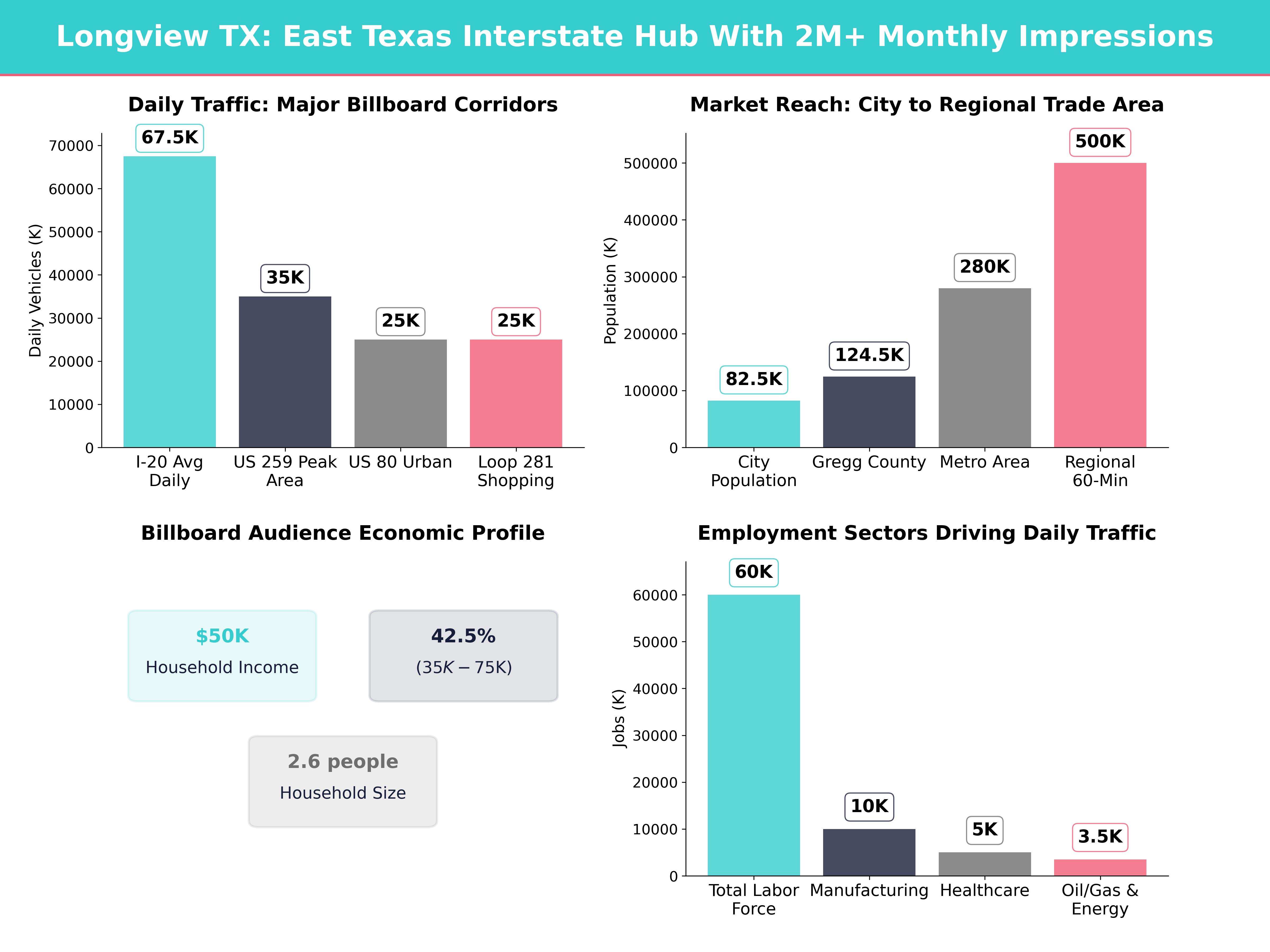
Longview, Texas, sits at the heart of the East Texas “Piney Woods,” and it punches well above its weight as an advertising market. With a city population of roughly 82,000–83,000 residents and a broader trade area of 280,000–300,000 people spread across Gregg, Harrison, Rusk, Upshur, and surrounding counties, Longview combines busy commuter corridors, a strong regional healthcare and education presence, and major events that pull visitors from across Texas and neighboring states. The City of Longview reports that more than 2,500 businesses operate within city limits, and Gregg County’s labor force tops 60,000 workers in a typical year, reinforcing Longview’s role as a regional hub. When we pair these dynamics with Blip’s flexible, pay-per-“blip” platform, we can build highly focused digital billboard campaigns and Longview billboard advertising strategies that reach East Texans at exactly the right times and places.
Longview Market Snapshot: Who We’re Reaching
Understanding Longview’s people and economy helps us shape the right creative and targeting strategy for Longview billboards.
-
Population scale
- City of Longview: about 82,000–83,000 residents inside city limits, with daily service usage well above that due to regional traffic.
- Gregg County: around 124,000–125,000 residents, with roughly 70% living in or around Longview.
- Longview metro (Gregg, Rusk, Upshur counties and surrounding area): 280,000+ residents, with the broader East Texas region (within a 60‑minute drive) exceeding 500,000 people.
- According to local planning data, daytime population in key commercial corridors can increase by 20–30% over residential counts due to commuters into healthcare, industrial, and education centers, which enhances the reach of billboards in Longview.
-
Age and household structure
- The median age in Longview sits in the mid‑30s (roughly 35–37 years), slightly younger than the statewide median for many rural counties but older than major metros like Dallas or Houston. This signals a balanced mix of young families, mid‑career professionals, and older adults.
- Family households make up roughly 65–70% of occupied housing units in the Longview area, and average household size hovers around 2.5–2.7 people.
- About 25–28% of residents are under age 18, which reinforces the importance of family-oriented messaging, education, and youth activities in campaigns.
- This means messages that speak to family life, home services, and affordability resonate strongly.
-
Income and cost of living
- Median household income in the Longview area is in the mid‑$50,000s per year, with some neighborhoods above $70,000 and nearby small towns dipping into the $40,000s.
- Roughly 40–45% of households fall into the $35,000–$75,000 income band, a prime target for value-focused retail, dining, automotive, and healthcare services.
- Longview’s cost of living index typically runs around 10–15% below the U.S. average, with housing costs often 20–25% lower than national norms. That frees up disposable income for vehicles, outdoor recreation, dining out, and home improvement that can be captured through Longview billboard advertising.
- Positioning offers as value‑forward (“Save on…” “More for your family…”) rather than ultra‑luxury tends to match the market’s preferences.
-
Economic drivers
- Longview was historically built on oil, gas, and manufacturing, and those sectors are still visible in the workforce—Gregg County routinely reports 3,000–4,000 jobs tied to mining, quarrying, and oil/gas extraction plus related manufacturing.
-
Today, major sectors include:
- Healthcare (e.g., CHRISTUS Good Shepherd Medical Center – Longview 2,000 associates across its Longview operations, and Longview Regional Medical Center, which reports 200+ beds and hundreds of clinical staff)
- Education (LeTourneau University, Kilgore College – Longview several thousand teachers, professors, and staff)
- Manufacturing & distribution, with dozens of plants and warehouses clustered near I‑20 and key rail lines
- Retail & services along Loop 281, US 259, and I‑20, where the Longview Economic Development Corporation highlights more than 6 million square feet of retail, industrial, and office space
- Employers in these sectors pull commuters from surrounding towns like Kilgore, Hallsville, Marshall, Gladewater, White Oak, and Gilmer, increasing regional reach for Longview billboards.
-
Local information sources
- City of Longview and Gregg County provide useful planning, permitting, capital projects, and event information that often drive traffic spikes around construction zones, new developments, and civic events.
- Visit Longview (the city’s tourism arm) reports that Longview attracts hundreds of thousands of visitors annually, and its site outlines major events and visitor attractions that can be tied into campaigns.
- The Longview News‑Journal is a core local news outlet, averaging hundreds of thousands of pageviews per month and reflecting local concerns and seasonal interests we can tap into.
Implication for campaigns: Longview is a family‑oriented, value‑conscious, commuter-heavy market with a sizable healthcare and industrial workforce. Messages that highlight savings, community, faith, education, and practical services tend to deliver strong brand lift and response, especially when paired with well-placed billboards in Longview.
Traffic Patterns and High-Impact Corridors
To maximize impressions with Blip, we align campaigns with Longview’s busiest roadways and peak drive times, ensuring Longview billboard advertising is visible when residents and visitors are most likely to be on the road.
The Texas Department of Transportation (TxDOT) publishes detailed traffic counts showing that Longview’s key corridors routinely handle tens of thousands of vehicles per day, translating to millions of monthly impressions when boards are positioned correctly.
Major highways and loops
-
Interstate 20 (I‑20)
- I‑20 runs east–west south of Longview, connecting Dallas (~125 miles west) and Shreveport (~60 miles east).
- Recent TxDOT Average Annual Daily Traffic (AADT) data show I‑20 segments around Longview typically carrying 60,000–75,000 vehicles per day, with some stretches exceeding 80,000 during peak seasons. That equates to roughly 1.8–2.3 million vehicles per month passing a single location.
- Long‑haul trucks can make up 20–30% of this volume, making I‑20 particularly valuable for B2B and logistics messaging.
-
Ideal for:
- Regional campaigns (Dallas–Shreveport corridor)
- Travel‑oriented businesses (hotels, restaurants, attractions)
- Logistics, trucking, and industrial services
-
US Highway 80 (US 80)
- Runs roughly parallel to I‑20 through the city, functioning as a major east–west arterial through central Longview.
- Urban stretches typically see 20,000–30,000+ vehicles per day, with some intersections near downtown and retail clusters reaching 35,000.
- This means a well-placed digital board can reasonably see 600,000–900,000 passing vehicles per month, dominated by commuters and local shoppers.
-
Strong for:
- Retail and restaurants
- Auto services
- Healthcare and local services
-
US Highway 259 (US 259)
- Runs north–south through Longview, linking to Kilgore and Nacogdoches to the south and Henderson and other communities to the north.
- Volumes near retail and industrial clusters often reach 30,000–40,000 vehicles per day, with TxDOT counts showing higher peaks near major intersections with Loop 281.
- Roughly 60–65% of vehicles on these segments are personal passenger vehicles, with the rest split between light trucks and commercial traffic—ideal for both consumer and trade messages.
-
Useful for:
- Reaching commuters from smaller outlying communities
- Energy and industrial services
- Big-box retailers and regional shopping
-
Loop 281
- Acts as Longview’s primary commercial loop, circling the city and intersecting major corridors.
- Traffic includes a high share of shopping, dining, and service trips; segments commonly exceed 20,000 vehicles per day, and in some shopping-heavy areas the counts approach or surpass 30,000.
- With an estimated 70–75% of trips tied to retail, dining, and services, Loop 281 is uniquely powerful for purchase-intent messaging.
-
Prime for:
- Retail, QSR, and grocery
- Entertainment venues and gyms
- Healthcare clinics and urgent care centers
-
State Highway 31, FM 2208, and arterials
- These connect to residential areas, industrial parks, and suburban growth zones where new subdivisions are adding hundreds of new housing units over multi‑year periods.
- Weekday traffic volumes on select arterials often range from 10,000–18,000 vehicles per day, with school‑adjacent segments spiking during drop‑off and pick‑up times.
- Great for neighborhood-focused campaigns: local HVAC, landscaping, home services, churches, and schools.
We can reference up-to-date volumes using the TxDOT Traffic Count Database via TxDOT’s online tools 20,000 or 70,000 vehicles per day, we can size budgets and impression goals more precisely, often targeting a minimum of 200,000–300,000 weekly impressions per key corridor for effective billboard rental in Longview.
Implication for campaigns:
- Use I‑20 and US 259 when we want regional reach, larger vehicle counts, and a high proportion of commuters and truck traffic.
- Use Loop 281 and US 80 to reach retail shoppers, families running errands, and local diners who are closer to purchase decisions.
- Match creative tone and calls-to-action (CTAs) to the likely mindset of drivers on each corridor: long‑haul, commute, or shopping.
When Longview Moves: Timing and Dayparting Strategy
Blip’s ability to schedule ads down to specific hours and days is especially powerful in a commuter market like Longview and lets us fine-tune Longview billboard advertising to local movement patterns.
Local travel surveys and traffic signal timing plans from City of Longview Traffic Division show clear weekday peaks and strong Friday–Sunday shopping patterns.
Commute patterns
- Many Longview workers commute within 10–20 miles, often from smaller towns such as Hallsville, White Oak, and Kilgore.
- Roughly 75–80% of workers in the region drive alone to work, with average one-way commute times around 20–23 minutes, which creates repeat daily exposure to the same boards.
-
Typical rush periods:
- Morning: 6:30–9:00 a.m.
- Midday: 11:00 a.m.–1:30 p.m. (lunch traffic and shift changes, especially near hospitals and industrial areas)
- Evening: 4:30–7:00 p.m.
- Friday traffic volumes on retail-heavy segments can run 10–15% higher than early-week days, and Saturday midday pulses often rival weekday commuter peaks.
Strategic dayparts:
-
Morning drive (6–9 a.m.)
- Best for: coffee shops, breakfast QSR, radio stations, schools, churches (“Join us this Sunday”), daily deals, job recruitment (“Now Hiring for Today’s Interviews”).
- Messaging style: simple, upbeat, and time-bound (“Today Only,” “This Morning”).
- Aim for 5–8 word headlines to match the 3–5 second viewing window at 45–60 mph on urban arterials.
-
Midday (11 a.m.–2 p.m.)
- Best for: restaurants, healthcare clinics, auto services (“Walk‑ins Welcome”), quick‑errand retailers.
- In retail corridors, 30–40% of daily trips can occur during this window on weekends.
- We often emphasize proximity and convenience: “5 Minutes from Loop 281,” “Next Right off US 80.”
-
Evening (4:30–7 p.m.)
- Best for: big-ticket purchases (cars, furniture, appliances), entertainment, extracurriculars, and fundraising events.
- Also effective for brand awareness — families tend to be together in the vehicle, and evening boards can produce higher ad recall because trip purposes are often more discretionary (shopping, dining, family activities).
-
Late night (after 9 p.m.)
-
Longview is not a 24/7 urban market, but late-night boards can still serve:
- Hospital staffing and healthcare recruitment
- Emergency services (ER, urgent care)
- 24‑hour services (towing, emergency plumbing, roadside assistance)
- Because demand for impressions is lower, Blip budgets often go further at these times, sometimes delivering 20–30% more impressions per dollar than peak commute periods.
-
Longview is not a 24/7 urban market, but late-night boards can still serve:
With Blip, we can concentrate spend into the highest-value dayparts rather than paying for low-value times. For example, a family restaurant off Loop 281 might run 80% of its blips between 11 a.m.–1:30 p.m. and 4:30–7:30 p.m. on Thursday–Sunday, while a staffing agency could lean into early mornings and late evenings Monday–Friday to match healthcare and industrial shift changes.
Seasonal and Event-Driven Opportunities
Longview has a robust calendar of festivals, sports, and tourism events that can be turned into billboard “moments.” The Visit Longview team highlights that major signature events can each attract 5,000–20,000+ visitors, with aggregate annual visitor spending in the area measuring in the tens of millions of dollars.
Anchor events and tourism
-
Great Texas Balloon Race
- Held annually in Longview, this event has drawn tens of thousands of spectators over typical three‑day weekends, with some years reporting 15,000–20,000+ attendees.
- Visitors travel from across Texas, Louisiana, Arkansas, and beyond, and local hotels often see strong occupancy during the event period.
- See schedules and event details via Great Texas Balloon Race information at Visit Longview.
- Timed billboard campaigns can highlight parking options, local dining, and event-related offers.
-
AlleyFest
- A downtown Longview arts, music, and food festival that typically draws thousands of attendees over a weekend—often 8,000–12,000 visitors for music stages, vendors, and family activities.
- Perfect for campaigns promoting downtown businesses, artists, breweries, and restaurants.
- Event updates often appear on Visit Longview’s events calendar and through the Longview Main Street program.
-
East Texas outdoor and sports tourism
- Lakes like Lake Cherokee and Lake O’ the Pines and nearby parks managed by regional authorities generate year‑round fishing, boating, and camping traffic. Summer holiday weekends can bring thousands of additional vehicles along I‑20 and US 259.
- High school football games (Longview Lobos, Pine Tree Pirates, Spring Hill Panthers, Hallsville Bobcats, and others) can draw 5,000–10,000+ fans on Friday nights, with rivalry games occasionally exceeding that.
- Tournaments at facilities promoted by Longview Parks & Recreation and other venues bring weekend families from around East Texas, boosting Saturday/Sunday traffic.
Seasonal patterns to leverage
-
Back‑to‑school (late July–August)
- With multiple school districts—including Longview ISD, Pine Tree ISD, Spring Hill ISD, and nearby Hallsville ISD—plus colleges like LeTourneau University and Kilgore College – Longview, back‑to‑school touches tens of thousands of students and families.
- Merchants can highlight clothing, tech, dorm goods, tutoring, and healthcare (physicals, vaccinations). School-season spending often rises 10–20% above summer baselines for family‑oriented retail.
-
Holiday retail (November–December)
- National data and local sales tax reports from the City of Longview Finance Department show November–December sales tax collections can run 15–25% higher than slower months, reflecting strong local and regional shopping.
- Shopping spikes at large retailers near Loop 281, I‑20 exits, and downtown boutiques.
- We can rotate gift-themed messaging and run heavier frequency on Friday–Sunday, when foot traffic surges.
-
Tax refund season (February–April)
- Many auto dealerships, furniture stores, and home improvement businesses around Longview report double-digit percentage bumps in inquiries during refund season.
- Ideal for auto dealers, furniture stores, home improvement, and financial services emphasizing “Use Your Refund” or “Zero Down with Refund” creative.
-
Summer (May–August)
- Travel routes along I‑20 and US 259 see vacation traffic heading to lakes, Dallas, Shreveport, and regional attractions.
- Hotel occupancy and tourism-related spending typically increase 10–15% over spring baselines.
-
Great for:
- Attractions and hotels
- Summer camps and kids’ activities
- Home services (HVAC, roofing, landscaping) responding to rising temperatures
With Blip, we can create event-specific flights:
- Example: For the Great Texas Balloon Race, we might run a two-week flight before the event with directional messaging and offers, then switch creatives during the event to capture walk‑in traffic (“Show this ad for 10% off today”).
- Because Blip sells exposure in small increments, advertisers can test seasonal bursts (e.g., a $10–$20/day budget for two weeks) and then ramp up if results are strong, adjusting quickly based on hotel bookings, reservations, or ticket sales.
Audience Segments and Messaging Approaches
Longview’s mix of demographics allows us to focus on several key audience clusters. Local school enrollment totals, hospital staffing levels, and university headcounts confirm that each segment represents thousands to tens of thousands of potential impressions each week.
Working families and commuters
- Significant share of workers in manufacturing, healthcare, education, and services, with local industry reports indicating 10,000+ jobs in manufacturing and logistics and 5,000+ in healthcare within the trade area.
- Many travel 10–30 minutes to work, often along US 80, US 259, and Loop 281.
- Approximately 60–65% of households own two or more vehicles, which supports frequent multi-car household trips.
-
Effective messages:
- “On Your Way Home? Swing by for Dinner.”
- “Save on Tires Before Your Next Trip.”
- “After‑School Programs Near You.”
Healthcare consumers and professionals
- With two major hospitals and multiple clinics, healthcare is a top employer and service need. Combined, CHRISTUS Good Shepherd Medical Center – Longview and Longview Regional Medical Center serve tens of thousands of ER and inpatient visits each year.
- Healthcare and social assistance jobs often account for 15–20% of total employment in the metro area.
-
Messaging ideas:
- For patients: “ER Wait Times Low,” “Same‑Day Appointments,” “Walk‑In Urgent Care.”
- For recruitment: “RNs: Up to $X/hr + Sign‑On Bonus in Longview,” “Now Hiring Respiratory Therapists.”
- Placing boards near medical corridors and major intersections feeding the hospitals, then dayparting early mornings and evenings, captures both shift workers and visiting families. Shift changes typically occur around 7 a.m., 3 p.m., and 7 p.m., ideal times for job-recruitment and service messages.
Students and young adults
-
LeTourneau University has more than 3,000 students (including online) and several hundred faculty and staff.
- Kilgore College – Longview and trade schools add another thousand-plus post‑secondary learners, especially in technical and healthcare fields.
- Roughly 15–20% of Longview’s population is in the 18–29 age range, when including traditional students and young workers.
-
Creative for this audience:
- Apartment leasing (“Walk to Campus from…”)
- Food and entertainment (pizza, coffee, nightlife where applicable)
- Employment and internships (“Flexible Student Jobs in Longview”)
- Boards near campus routes and student housing—combined with evening and weekend dayparting—work especially well, particularly on corridors connecting campus to Loop 281 and downtown.
Faith and community audience
- East Texas has a strong churchgoing population, with hundreds of congregations across Gregg and surrounding counties.
- In many local surveys, 40–50% of residents report weekly or near-weekly church attendance, making faith‑based and community messaging especially potent.
-
Churches, nonprofits, and community organizations can:
- Promote sermon series, special services, and holiday events.
- Advertise fundraisers and volunteer opportunities.
- Blip’s flexible budgets allow small nonprofits to run campaigns during key church seasons (Easter, Christmas, VBS) without long-term contracts, even starting at just a few dollars per day.
Rural and small-town shoppers
- Many in the region live in smaller communities but shop and work in Longview. The Longview Economic Development Corporation notes that Longview serves as a retail hub for residents from at least 6–8 surrounding counties.
- Regional trade area data indicate that as much as 30–40% of retail sales tax in Longview can be attributed to shoppers who live outside city limits.
-
Messaging that emphasizes easy access, parking, and regional presence can attract these audiences:
- “Worth the Drive from Gilmer”
- “Your East Texas Ford Headquarters – Longview”
- By selecting boards on the inbound routes (US 259, US 80, and I‑20 exits), we intercept these shoppers as they head into the city for big-box stores, medical appointments, and entertainment, maximizing the regional pull of Longview billboards.
Creative Best Practices for Longview Digital Billboards
Digital boards give us flexibility, but we still need strong creative fundamentals tailored to Longview’s conditions.
Visual style and readability
- Traffic speeds on I‑20 and parts of US 259 often reach 65–70 mph. Drivers typically have 3–7 seconds to process a message, and eye‑tracking studies show that legible copy and bold imagery can improve recall by 20–30%.
-
We recommend:
- No more than 7–9 words of main copy.
- A large, high-contrast logo and one primary call-to-action.
- Avoid long URLs; use short domains or simple search cues (“Search: ‘Smith Plumbing Longview’”).
- For retail corridors with slower speeds (30–45 mph), you may have 1–2 extra seconds of viewing time, but concise copy still performs best.
Color and contrast tips:
- Bright, saturated colors often stand out against the green Piney Woods backdrop and neutral building colors along Loop 281 and US 80.
- Use high contrast (e.g., white/yellow text on dark backgrounds or dark text on light, non‑busy backgrounds).
- Nighttime readability is crucial on high-speed corridors; avoid overly thin fonts and low-contrast color combinations, which can reduce legibility by up to 50% at distance.
Localized messaging
We can increase relevance by referencing:
- Local landmarks: “Next to the Maude Cobb Convention Center
- Local sports and schools, when appropriate: “Go Lobos!” or “Proud Sponsor of Pine Tree ISD.”
- Community values: family, faith, and East Texas pride (“Serving East Texas Since 1985”).
- References to local initiatives promoted by the Longview Chamber of Commerce and community drives can also build trust.
Local news outlets like the Longview News‑Journal and event pages on Visit Longview can inspire timely references (e.g., weather shifts, big games, festivals) that keep billboard rental in Longview feeling current and relevant.
Creative rotation with Blip
Blip allows multiple creatives in the same campaign. We can use this to:
- Test headline variations (Offer A vs. Offer B) and track which drives more calls, clicks, or coupon redemptions.
- Run bilingual English/Spanish ads if targeting specific neighborhoods or corridors; in many East Texas communities, 15–20% of residents identify as Hispanic or Latino, making bilingual creative a powerful differentiator.
-
Switch creatives automatically based on:
- Day of week (e.g., “Friday Fish Fry Tonight” vs. “Sunday Brunch”)
- Time of day (breakfast vs. dinner offers)
- Lead time until an event (“3 Days Left to Register,” “Event Today!”)
We often see better results when we limit each creative to one core idea and adjust only 1–2 variables at a time, so we can clearly identify what’s working and quickly reallocate spend toward higher‑performing messages.
Using Blip’s Tools to Target Longview Effectively
Blip’s platform lets us buy digital billboard time like digital ads—highly flexible and measurable, and ideal for scalable billboard rental in Longview.
Key tactics for Longview:
-
Board selection by corridor
- Choose specific faces along I‑20, US 80, US 259, and Loop 281 based on your audience’s commute or shopping routes.
- For a local restaurant, we might prioritize boards within 3–7 driving minutes of the location; for a regional auto dealer, we might focus on I‑20 boards that catch 20,000–30,000 unique vehicles per day headed toward key exits.
- Use address and route planning tools provided by the City of Longview and local mapping services to validate how customers actually approach your business.
-
Dayparting aligned to behavior
- Retailers can run heavier during lunch and evening, when transaction rates per vehicle are highest.
- Churches can emphasize Thursday–Saturday evenings and Sunday morning blocks, aligning with times when a large share of weekly attendance decisions are made.
- Car dealers might focus on Thursday–Monday, aligning with typical shopping behaviors where weekend foot traffic can be 30–40% higher than weekdays.
-
Geographic testing
- Launch one set of boards on Loop 281/US 259 (shopping-heavy) and another on I‑20 (regional travelers).
- Compare website traffic, calls, or coupon redemptions by region over a 2–4 week test; aim for a minimum of tens of thousands of impressions per week on each cluster to gather meaningful data.
- Use differences in performance (e.g., 20% more calls from one corridor) to shift budget toward the more effective cluster.
-
Budget ramp-up
- Many Longview advertisers start at $5–$20 per day and increase spend on the best-performing boards and time windows.
- It’s common to see businesses double or triple daily budgets during key periods (e.g., balloon race weekend, Black Friday week, tax refund season) once positive early results are confirmed.
- Because we’re not locked into fixed contracts, we can shift budgets quickly to respond to events, weather, or promotions and keep Longview billboard advertising closely aligned with demand.
-
Attribution and tracking
-
Pair billboards with:
- Unique phone numbers or extensions.
- Vanity URLs or landing pages.
- Simple promo codes (“Mention ‘Billboard’ for 10% Off.”)
- Monitor performance during specific Blip campaigns and adjust. Local businesses that systematically track responses often discover that 10–30% of new customers first learned about them through outdoor ads, even when final conversions occur online or in‑store.
-
Pair billboards with:
By treating billboard placements like a testable digital channel, we can steadily refine our Longview presence over time and tie campaigns back to measurable outcomes.
Local Rules, Context, and Community Fit
Even though digital billboards are regulated primarily at the state and local level, we also want to consider community expectations.
- The City of Longview planning and zoning resources outline sign and development rules within city limits, including maximum sizes, locations, and lighting requirements.
- TxDOT governs outdoor advertising along state and federal highways, including I‑20, US 80, and US 259. Their regulations address spacing, permits, and content limitations along controlled highways.
- The Gregg County Commissioners Court and related departments also influence development patterns and right‑of‑way decisions that can affect future billboard placements.
-
We should avoid:
- Overly aggressive or misleading offers.
- Content likely to be viewed as insensitive in a family- and faith-oriented community.
-
We also often see positive response to community support messaging:
- Sponsorships of local events and youth sports.
- Messages of support during storms or emergencies.
- Recognition of teachers, first responders, and healthcare workers.
Aligning with local values is not only good citizenship but also good marketing—it helps build trust and long-term affinity, improving word of mouth and repeat visits from audiences who regularly see billboards in Longview.
Putting It All Together: A Sample Longview Strategy
To illustrate how these pieces fit, consider three example advertisers and how we might structure their Blip campaigns in Longview, using realistic traffic and budget numbers.
-
Family Mexican Restaurant off Loop 281
- Boards: Near Loop 281 and US 259 intersections, where combined AADT can exceed 40,000–50,000 vehicles per day.
- Dayparts: 11 a.m.–2 p.m. and 4:30–8 p.m., Thursday–Sunday, when family dining trips peak.
-
Creative:
- “Kids Eat Free Tuesday After 5 – Exit Loop 281 at [Street].”
- “Fajitas Tonight? 3 Minutes Ahead on Right.”
- Budget: Start at $15/day and increase to $25–$30/day during football season or holidays when Friday–Sunday traffic and restaurant visits surge.
- Goal: Achieve 150,000–250,000 weekly impressions across 2–3 key boards and track coupon redemptions or “How did you hear about us?” responses.
-
Regional Auto Dealer near I‑20
- Boards: On I‑20 near Longview exits and along US 259, targeting segments with 60,000–75,000 AADT.
- Dayparts: Morning and evening commutes, plus Saturday daytime, when shopper intent is highest. Saturdays can account for 20–25% of weekly foot traffic at dealerships.
-
Creative:
- “0% APR for 60 Months – East Texas Ford HQ, Exit [#].”
- “Trade‑In Values at All‑Time High – Visit This Weekend.”
- Seasonal push: Tax refund season (Feb–Apr) and year‑end clearance (Nov–Dec) with budgets scaled to $40–$75/day for limited windows.
- Goal: Lift website traffic and lot visits by 10–20% versus baseline months, measured via lead tracking and unique URLs.
-
Local Hospital Recruiting Nurses
- Boards: Near hospital corridors and high-commute routes like US 80 and Loop 281, ensuring repeated exposure to clinical staff who may pass the same boards 10+ times per week.
- Dayparts: Early mornings (5–8 a.m.) and evenings (6–10 p.m.) to hit shift changes; limited daytime runs for family decision‑makers.
-
Creative:
- “RNs: Up to $X/hr + $Y Sign‑On – Apply Today at [Short URL].”
- “Work Where You Live – Nursing Careers in Longview.”
- Flight: 6–8 week recruiting push with rotating benefit-focused creatives (pay, schedule flexibility, tuition assistance).
- Goal: Increase qualified applications by 15–30% over previous recruitment cycles that did not use billboards, tracked by a dedicated landing page or application code.
In each case, we use local traffic data, commuter behavior, and community culture to guide where, when, and how we show each message—and Blip’s on-demand model lets us adjust quickly as we learn what works best.
By leveraging Longview’s unique blend of commuter corridors, family-focused culture, and event-driven tourism—and by using Blip’s tools for precise location and time targeting—we can build billboard campaigns that deliver measurable impact for businesses of every size. Whether we’re driving weekend traffic from I‑20, speaking directly to local families on Loop 281, or amplifying a major community event featured by Visit Longview or the Longview News‑Journal, digital billboards in Longview give us a powerful, flexible way to stay visible in the hearts and minds of East Texans and to create sustainable Longview billboard advertising programs that grow with your business.