Billboards in Lancaster, TX
No Minimum Spend. No Long-Term Contracts. Just Results.
Trusted by Leading Brands


Billboard advertising
in Lancaster has never been easier
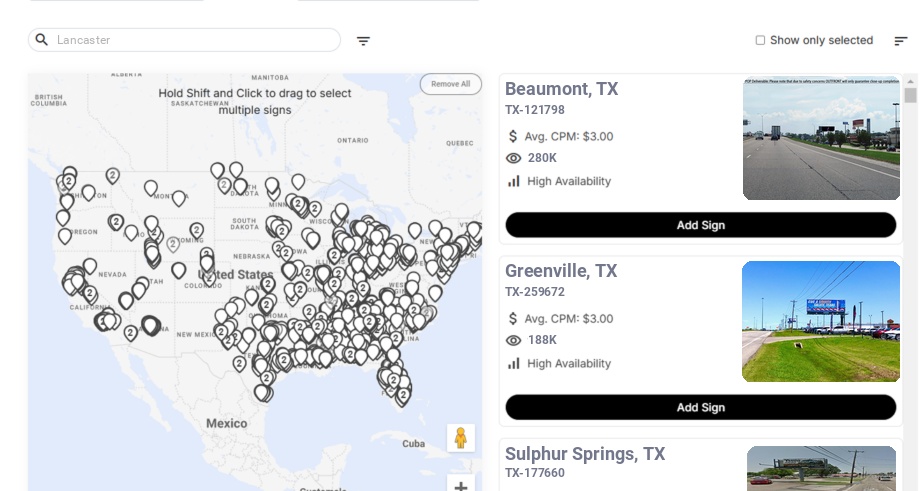



How much is a billboard in Lancaster?
Why Choose Blip for Billboard Advertising in Lancaster
Launch in Lancaster with Blip's self-serve platform and reach I-35E and I-20 commuters without sales calls or contracts.
Blip-optimized campaigns fit Lancaster's 120,000-190,000 AADT freeway flow, auto-selecting boards and timing to your goal and budget.
Use flexible daily budgets in Lancaster to test ads near the Dallas County Inland Port and shift spend as results come in.
Daypart Blip in Lancaster for 6-9 a.m. and 3:30-6:30 p.m. when commuters, families, and logistics workers are on the road.
Track real-time results in Lancaster and tweak creative fast for school traffic, Best Southwest shoppers, or State Fair spillover.
Blip's creative tools help Lancaster ads pop on fast-moving digital boards with bold, simple messages that read at 65+ mph.
Frequently Asked Questions About Billboard Advertising in Lancaster
How much does a billboard cost in Lancaster with Blip?
With Blip, billboard advertising in Lancaster can be surprisingly affordable because you only pay when your ad actually runs. Each “blip” is a 7.5-to-10-second display on a rotating digital billboard, and pricing starts at just $0.01 per display. You set a daily budget, and Blip’s algorithm uses it to bid on open ad slots, with costs that can change based on time of day, location, and advertiser demand.
Where can I advertise with Blip in Lancaster on the busiest roads?
Lancaster’s strongest billboard opportunities sit on a few high-volume corridors that connect the city to Dallas, the Best Southwest cities, and the southern logistics belt. According to TxDOT traffic counts, I-35E through Lancaster generally carries about 120,000 to 150,000 vehicles per day, and segments closer to the I-20 interchange rise above 170,000 AADT. I-20 is also one of the best regional-reach billboard corridors near Lancaster, with counts around the I-35E and US 67 area typically in the 150,000 to 190,000 AADT range.
Why is Lancaster, Texas a good market for Blip billboard ads?
Lancaster gives advertisers an unusually practical billboard market because it combines a growing local population with heavy regional vehicle flow through southern Dallas County. The city sits only about 15 miles south of downtown Dallas, and daily movement here is overwhelmingly road based, shaped by I-35E, I-20, and major local arterials rather than rail transit. For advertisers, that mix creates steady exposure to commuters, logistics workers, families, students, and visitors moving across the wider North Texas economy.
What kinds of businesses work best for Lancaster Blip billboards?
Lancaster is part of a household-driven community where healthcare, quick-service restaurants, home services, legal services, auto repair, education, and local retail can all benefit from repeated roadside impressions. The nearby Dallas County Inland Port also makes the city relevant for warehouse staffing, trucking services, industrial suppliers, and B2B recruiting. This combination means both consumer brands and workforce-focused advertisers can find a strong fit in Lancaster.
When should I run billboard ads in Lancaster with Blip?
Spring is one of the best windows for home services, healthcare, moving services, real estate, lawn care, and community event promotion, while fall is one of the most important billboard seasons in this market. Back-to-school campaigns ramp in late July and August, and the State Fair of Texas creates a major regional travel spike with more than 2 million visits over 24 days. For daily timing, the page recommends 6:00 to 9:00 a.m., 11:00 a.m. to 2:00 p.m., and 3:30 to 6:30 p.m. around Lancaster’s real movement patterns.
Do I need a contract to advertise with Blip in Lancaster?
No, Blip has no long-term contracts or minimum commitments. You can start, pause, or stop your campaign at any time.
How fast can I launch a billboard campaign with Blip in Lancaster?
You can have your campaign live in minutes. Create a free account, select your locations, set your budget, upload your design, and start running once approved.
Where can I advertise with Blip in Lancaster?
Blip has digital billboards in Lancaster. You can browse available locations on a map, choose the ones that fit your audience, and start advertising right away.
Still have questions? Launch a campaign in minutes — no contracts, no commitments.
Start Your CampaignLancaster Billboard Advertising Guide
Lancaster](https://www.lancaster-tx.com/), Texas gives us an unusually practical billboard market because it combines a growing local population with heavy regional vehicle flow through southern Dallas County, where key freeway segments run in the 120,000 to 190,000 AADT range. The Texas Demographic Center reports 41,275 residents in Lancaster in 2020, and the city sits only about 15 miles south of downtown Dallas. Daily movement here is overwhelmingly road based, shaped by I-35E, I-20, and major local arterials rather than rail transit. For advertisers, that mix creates steady exposure to commuters, logistics workers, families, students, and visitors moving across the wider North Texas economy.
Lancaster Market Overview
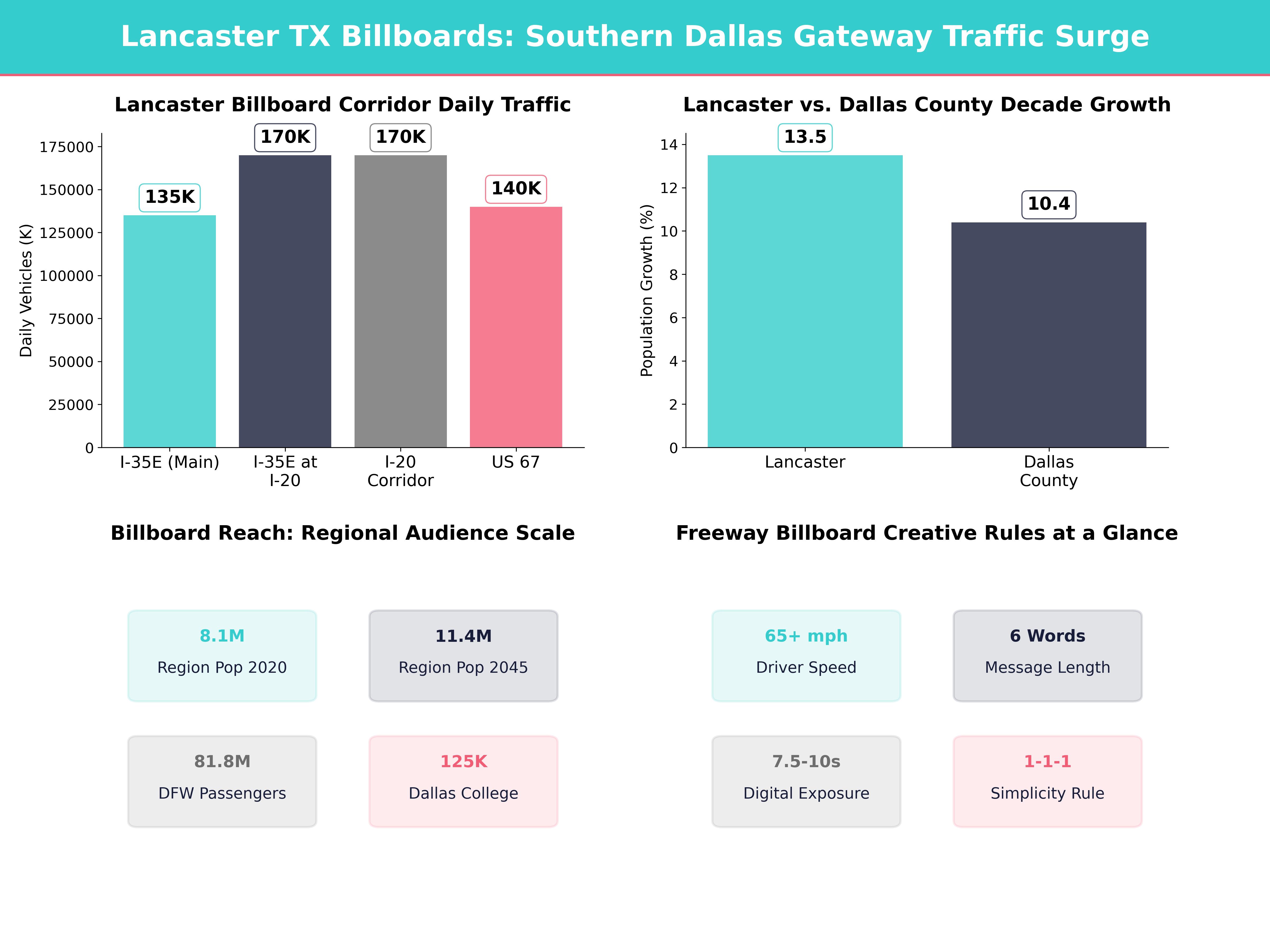
Lancaster is large enough to support local targeting and well placed enough to support regional targeting. According to the Texas Demographic Center, Lancaster grew from 36,361 residents in 2010 to 41,275 in 2020, which is a gain of about 13.5% in one decade, or nearly 4,900 additional residents. That pace matters because growing suburbs usually generate new housing demand, new retail demand, and more habitual commute traffic.
The same state source shows Dallas County growing from 2,368,139 residents in 2010 to 2,613,539 in 2020. That is a jump of roughly 10.4%, or about 245,400 people, and it reinforces that Lancaster is not an isolated small city buy. It is part of a dense urban county where households, employers, schools, and shopping destinations spill across city lines every day.
Lancaster also benefits from its position inside the North Central Texas Council of Governments region. NCTCOG has estimated the 16-county region at about 8.1 million residents in 2020 and projects growth to roughly 11.4 million by 2045. For billboard advertisers, that forecast means southern Dallas County should remain a long-term traffic and visibility market, not a short-lived pocket of growth.
Why Lancaster Works for Outdoor Advertising
Lancaster is part of the Best Southwest Partnership, which connects 4 closely linked cities, Lancaster DeSoto, Duncanville Cedar Hill
Economically, Lancaster sits near one of North Texas’s strongest industrial and distribution belts. The nearby Dallas County Inland Port 6,000 acres (9.4 square miles), and the city’s access to I-35E and I-20 makes it relevant for warehouse staffing, trucking services, industrial suppliers, and B2B recruiting. At the same time, Lancaster remains a household-driven community where healthcare, quick-service restaurants, home services, legal services, auto repair, education, and local retail can all benefit from repeated roadside impressions.
What the Drive-First Environment Means
Lancaster is not a member city of DART, so advertisers cannot rely on rail station saturation the way they might in some parts of Dallas. Instead, we should think in terms of driveways, freeway entrances, school drop-offs, shift changes, and regional shopping trips. In a market where consumers spend so much of their day in vehicles, billboards align tightly with actual movement patterns.
Key Traffic Corridors for Lancaster Billboards
Lancaster’s strongest billboard opportunities sit on a few high-volume corridors that connect the city to Dallas, the Best Southwest cities, and the southern logistics belt. TxDOT traffic maps are the right starting point because they show where daily volume is concentrated and where ad categories can match traveler intent.
I-35E Through Lancaster
According to TxDOT traffic counts, I-35E through Lancaster generally carries about 120,000 to 150,000 vehicles per day, and segments closer to the I-20 interchange rise above 170,000 AADT. That is the market’s signature corridor. It connects Lancaster southward to Red Oak Ellis County Dallas.
This corridor is especially useful for advertisers that need repeat weekday frequency.
- Quick-service restaurants, convenience stores, and fuel brands benefit because they can intercept habitual morning and evening commuters.
- Healthcare providers, urgent care clinics, and dental groups benefit because they can reach households making recurring regional trips.
- Staffing agencies, trade schools, and employers benefit because they can speak to workers traveling into industrial and logistics zones.
- Churches, community colleges, and service businesses benefit because they can build familiarity over many exposures rather than a single visit.
I-20 Near Lancaster and Southern Dallas
I-20 acts as the east-west spine for southern Dallas County. TxDOT counts around the I-35E and US 67 area typically fall in the 150,000 to 190,000 AADT range, making I-20 one of the best regional-reach billboard corridors near Lancaster. It ties together Cedar Hill DeSoto, Duncanville Dallas, and eastward freight movement.
We should favor I-20 when we want broader household reach rather than Lancaster-only reach.
- Hospitals, specialty clinics, and legal services can use I-20 to capture consumers willing to travel across several cities for high-consideration services.
- Furniture, mattress, flooring, and home improvement brands can use I-20 because shoppers often make destination trips for those categories.
- Auto dealers and repair chains can use I-20 because drivers on long cross-town trips are highly relevant prospects.
- Entertainment and event marketers can use I-20 to pull audiences from multiple suburbs into one destination.
US 67 in the Best Southwest Trade Area
US 67 does not run through Lancaster itself, but it is strategically important because it carries regional traffic through nearby DeSoto, Duncanville Cedar Hill TxDOT counts on heavily traveled sections of US 67 commonly range from about 120,000 to 160,000 AADT. For many Lancaster advertisers, that corridor expands reach westward into a closely connected consumer base.
US 67 is especially helpful when our advertiser wants to be seen as a south-Dallas-area brand rather than a single-city brand. Regional healthcare groups, colleges, family entertainment centers, and large retail destinations can all benefit from that wider impression field.
Lancaster’s Local Arterials
Freeways deliver mass reach, but local arterials help us win on frequency and intent. Roads such as Belt Line Road, Pleasant Run Road, Wintergreen Road, and Lancaster-Hutchins Road funnel neighborhood traffic to schools, shopping centers, churches, and service businesses. These routes often matter most for advertisers operating inside a 5- to 10-mile trade area.
We should use these local corridors when the goal is to move nearby consumers from awareness to action. That strategy works especially well for:
- Primary care, pediatric, and family dentistry brands.
- Childcare, tutoring, and school enrollment campaigns.
- Home services, including HVAC, plumbing, roofing, and pest control.
- Local restaurants, gyms, and financial services brands.
Lancaster Audience Segments We Can Reach
Lancaster is valuable because it lets us reach several overlapping audiences instead of just one. The strongest campaigns usually identify which segment matters most, then choose corridors and dayparts accordingly.
Lancaster and South Dallas County Commuters
Our first audience is the daily commuter. Lancaster’s 41,275 residents sit inside a county of 2,613,539, and many work, shop, or seek services outside the city. Because the market is car dependent and freeway connected, commuters see the same boards repeatedly across the workweek, which is ideal for frequency-sensitive categories like insurance, healthcare, banking, restaurants, and retail.
The Best Southwest cluster also matters here. The 4-city linkage among Lancaster DeSoto, Duncanville Cedar Hill
Families, Parents, and Students
Lancaster is a strong family market, and that changes what billboard messaging should emphasize. Campaigns tied to school calendars, youth activities, tutoring, healthcare, childcare, and back-to-school shopping can perform well because the audience is routine driven.
Education reach extends beyond K-12. Dallas College serves more than 125,000 students annually across its system, and the nearby Cedar Valley Campus University of North Texas at Dallas enrolls about 4,000 students. That creates opportunities for apartment marketing, career programs, food brands, financial services, mobile providers, and employer recruiting.
Industrial, Warehouse, and Logistics Workers
Lancaster’s location near the 6,000-acre Dallas County Inland Port
This audience is especially responsive to billboard messages that are direct and practical. Shift-based commuters do not need abstract brand language. They respond to wages, hiring urgency, service availability, hours, and location clarity.
Visitors, Eventgoers, and Regional Leisure Travelers
Lancaster is not a tourism-only city, but it benefits from the vast Dallas visitor economy around it. DFW Airport handled 81.8 million passengers in 2023, and many regional visitors continue southward into Dallas County by car. The Kay Bailey Hutchison Convention Center Dallas offers about 1 million square feet of exhibit space, which supports year-round business travel. The State Fair of Texas 2 million visits over its 24-day run, creating a major fall surge in regional movement.
Leisure traffic also matters closer to Lancaster. Cedar Hill State Park spans 1,826 acres, and Lancaster’s own Country View Golf Club 18-hole municipal course. Those nearby attractions help outdoor, dining, hospitality, and family entertainment advertisers reach weekend travelers who are already in the car and open to spontaneous stops.
Seasonal and Timing Opportunities in Lancaster
Lancaster campaigns work best when we align with how North Texans actually use the roads during the year. Seasonal timing matters here because school cycles, weather, football season, event traffic, and holiday shopping all change which messages feel most relevant.
Spring in Lancaster
Spring is one of our best windows for home services, healthcare, moving services, real estate, lawn care, and community event promotion. Families are active, weather is easier for errands, and people start making warm-weather spending plans. We should lean into commuter dayparts like 6:00 to 9:00 a.m. and 3:30 to 6:30 p.m. when parents and workers are most likely to notice service offers.
Spring is also strong for education and hiring campaigns. Students are planning summer jobs, families are thinking ahead to the next school year, and employers are preparing for seasonal demand.
Summer in Lancaster
From June through September, North Texas regularly posts highs in the 90s, and heat changes consumer behavior. Summer billboard creative in Lancaster often works best when it emphasizes convenience, comfort, speed, and indoor relief. HVAC companies, beverage brands, urgent care clinics, pools, family attractions, and quick-service restaurants can all benefit.
Summer travel also creates midday opportunities. We often like to add 11:00 a.m. to 2:00 p.m. exposure for lunch, errands, and family outings, especially on Fridays and weekends. If a brand serves travelers, regional entertainment seekers, or families crossing southern Dallas County, summer is a strong period to widen the footprint beyond Lancaster itself.
Fall in Lancaster
Fall is one of the most important billboard seasons in this market. Back-to-school campaigns ramp in late July and August. High school football and community events increase evening movement. Most importantly, the State Fair of Texas 2 million visits over 24 days.
Fall is when we should strongly consider commuter-frequency messaging, event tie-ins, and retail urgency. Healthcare enrollment, legal services, colleges, and staffing campaigns also tend to fit well during this period because consumers are reestablishing routines after summer.
Holiday and Early-Year Timing
Holiday retail campaigns should usually start 2 to 3 weeks before the heaviest shopping windows so frequency has time to build. In Lancaster, that can work for toy stores, restaurants, furniture stores, jewelers, churches, and local events. January then shifts the market toward tax prep, fitness, healthcare, self-improvement, hiring, and financial services.
Billboard Design Tips for Lancaster
Lancaster is not a market where generic billboard advice is enough. The strongest creative reflects the speed of the roads, the practical mindset of the audience, and the community identity of southern Dallas County.
Design for Freeway Speed in Lancaster
On I-35E and I-20, drivers are often moving at 65+ mph, so we should write for instant recognition. In most cases, 6 words or fewer is the safest target for the main message. We should use 1 clear offer, 1 call to action, and at most 1 phone number or short URL.
Because each digital billboard appearance is only 7.5 to 10 seconds, Lancaster creative should favor bold contrast, large type, and simple layouts. Bright Texas sunlight can wash out subtle color combinations, so darker backgrounds with high-contrast text often hold up better than pale, low-contrast designs.
Reflect Lancaster’s Real Identity
Lancaster creative should feel like southern Dallas County, not like a stock image of “Texas.” We usually recommend imagery tied to real local life, including family households, healthcare access, school pride, trades and logistics work, modern storefronts, and everyday mobility. Generic ranch scenes, oil derricks, or tourist-cowboy visuals often feel disconnected from how Lancaster residents actually live.
If our advertiser serves the regional workforce, we should consider creative showing service vans, warehouse teams, scrubs, classrooms, or neighborhood families. That visual language matches the market far better than luxury-only styling.
Lead With Value, Access, and Trust
Lancaster audiences often respond to practical messages. “Now Hiring,” “Same-Day Appointments,” “Off I-35E,” “Family Dentistry,” “Free Estimate,” and “Open Late” are all the kinds of value-forward phrases that map well to local decision making. If the destination is close, we should say so plainly with distance cues like 5 minutes away, next exit, or south of I-20.
Bilingual creative can also be worth testing in broader south Dallas County campaigns. Even when we keep the primary message in English, a second Spanish-language version can help us learn which boards or corridors respond best.
Use Community-Specific Creative Rotation
Lancaster is a good market for rotating creative by season. We can run school-oriented messaging in August, football or event messaging in fall, holiday urgency in November and December, and hiring or home-service creative in spring. That approach keeps repeat impressions fresh for a commuter audience that may pass the same billboard several times each week.
Regional Strategies Around Lancaster
Lancaster works best when we stop thinking of it as one uniform market. Different sub-areas support different objectives, and our board selection should reflect that.
Lancaster Core and Neighborhood Arterials
If our goal is local action, we should emphasize boards near neighborhood-serving routes and commercial clusters inside Lancaster. This area is best for clinics, dentists, childcare, churches, restaurants, gyms, tax offices, insurance agencies, and home services. In many cases, a tighter 5-mile focus beats a broad regional spread because relevance matters more than raw reach.
I-35E Employment Spine
If our goal is mass awareness, workforce recruiting, or commuter repetition, we should prioritize I-35E. This is the right strategy for staffing firms, colleges, healthcare systems, legal services, auto services, and destination retail. It is also a strong place to capture southbound traffic from Dallas and northbound traffic from Red Oak
I-20 and the Best Southwest Crossover Zone
If our goal is cross-city retail or regional service reach, we should add I-20 and nearby US 67 inventory. That lets us reach shoppers and patients moving among Lancaster DeSoto, Duncanville Cedar Hill
East Toward Hutchins, Wilmer, and the Inland Port
For industrial and logistics advertising, we should look east toward Hutchins Wilmer, and the Dallas County Inland Port
Using Blip Tools in Lancaster
Blip’s tools make Lancaster especially manageable because the market has several distinct travel patterns that benefit from testing and adjustment rather than one fixed long-term buy.
Use Blip-Optimized Campaigns for Regional Reach
If we want to cover Lancaster plus adjacent south Dallas County flow, a Blip-optimized campaign is usually the fastest way to start. We can define the geography, audience intent, and budget, then let the platform distribute spend across the corridors most likely to deliver useful reach. That approach works well for healthcare groups, multi-location retail, colleges, and event promotions.
Use Manual Selection for Precision in Lancaster
If our advertiser needs strict control, manual selection can be even better. A Lancaster dentist might want only local boards. A staffing company might want only I-35E and Inland Port-facing inventory. A regional furniture store might want a mix of I-20 and US 67 boards. Manual selection lets us build those lane-specific plans without overbuying the rest of the market.
Daypart Around Lancaster’s Real Movement Patterns
Lancaster campaigns often improve when we schedule around predictable drive times. We can prioritize 6:00 to 9:00 a.m. for morning commuters, breakfast traffic, and school-related travel. We can prioritize 11:00 a.m. to 2:00 p.m. for lunch, errands, and appointment-driven categories. We can prioritize 3:30 to 6:30 p.m. for evening commuters, family decision makers, and dinner traffic.
Those windows are especially useful when budgets are modest and we want to concentrate impressions where intent is strongest.
Test, Learn, and Reallocate
Lancaster is a strong market for creative testing. We can run 2 or 3 message versions, compare response patterns, and reallocate toward the strongest combination of corridor and creative. We usually learn a lot in the first 7 to 14 days, especially when one board set is freeway heavy and another is neighborhood heavy.
Getting Started with Billboard Rental in Lancaster
Renting a billboard in Lancaster does not have to start with a large, rigid commitment. The smartest path is usually a focused test that matches our business goal to the right corridor and the right geography.
Start With the Objective
We should decide first whether we need local action, regional awareness, or workforce reach. A Lancaster restaurant, clinic, or roofer usually wants close-in household visibility. A hospital, college, or furniture store may want a wider south Dallas County footprint. A staffing firm may care most about commuter and shift-worker corridors.
Match the Board to the Journey
A good Lancaster board is not just “high traffic.” It should match where the customer is in the trip. Boards on I-35E are excellent for awareness and repetition. Boards near exits and local arterials are better for near-term action. Boards along I-20 or US 67 are best when we want multi-city coverage.
Launch With a Measured Test
For many advertisers, we recommend starting with a 2-week pilot or a limited set of 3 to 5 strategically chosen boards. That is usually enough time to see which corridors, dayparts, and creative approaches fit the market. From there, we can scale the winners rather than guessing upfront.
Expect More Flexibility Than Traditional Billboard Buying
Traditional billboard buying often forces advertisers into slower negotiations, less nimble scheduling, and longer commitments than they actually need. Blip simplifies that process. We can launch faster, adjust faster, and evaluate performance with less friction, which is especially valuable in a market like Lancaster where the right plan may differ sharply between a local service business and a regional commuter campaign.
Evaluate Lancaster Locations With Practical Questions
Before we scale, we should ask a few simple questions. Is the board on a route our ideal customer actually uses? Is the message readable at freeway speed? Is the location helping us reach Lancaster residents, south Dallas County commuters, or logistics workers as intended? Is the ad running at the times when those people are most likely to be on the road?
If we answer those questions honestly and use the data to refine our plan, Lancaster can be a very efficient billboard market. It gives us local credibility, regional vehicle volume, and access to one of North Texas’s most active growth corridors all at once.