Billboards in Lake Forest Park, WA
No Minimum Spend. No Long-Term Contracts. Just Results.
Turn heads in the Lake Forest Park area with Lake Forest Park billboards that fit any budget. Blip makes it easy to launch eye-catching billboards near Lake Forest Park, Washington, giving you full control, real-time insights, and playful creative possibilities.
Trusted by Leading Brands


Billboard advertising
in Lake Forest Park has
never been easier
HERE'S HOW IT WORKS
How much is a billboard in Lake Forest Park?
Billboards in other Washington cities
Lake Forest Park Billboard Advertising Guide
Lake Forest Park, Washington sits at a powerful crossroads of affluent neighborhoods, commuter corridors, and outdoor-oriented lifestyles just north of Seattle. With digital billboards near the Lake Forest Park area in Lynnwood and Bothell, we can help brands tap into a concentrated, high-income audience that is constantly on the move between work, school, shopping, and recreation. For advertisers seeking billboards near Lake Forest Park without paying downtown Seattle rates, these nearby digital locations offer a highly efficient way to stay visible to local residents every day.
Understanding the Lake Forest Park Area Market
Lake Forest Park is a small but economically strong city in north King County. According to recent local and state estimates, the city has about 13,600–13,800 residents across 3.5 square miles, functioning as part of a much larger daily trade area that includes Shoreline, Kenmore, Bothell, Lynnwood, and North Seattle. This broader trade area is exactly what effective billboard advertising near Lake Forest Park is designed to capture.
Key demographic and market highlights:
-
Population & density
- Lake Forest Park: roughly 13,600–13,800 residents across 3.5 square miles (about 3,900–4,000 people per square mile), making it denser than the Washington State average (around 120 people per square mile).
-
Within a 10–15 minute drive, including parts of Shoreline, Kenmore, Bothell, and Lynnwood, you’re realistically reaching 150,000–200,000 people, given that:
- Shoreline has about 60,000+ residents.
- Kenmore has about 23,000+ residents.
- Bothell (King + Snohomish County portions) has about 48,000+ residents.
- Lynnwood has around 40,000+ residents.
-
Income & spending power
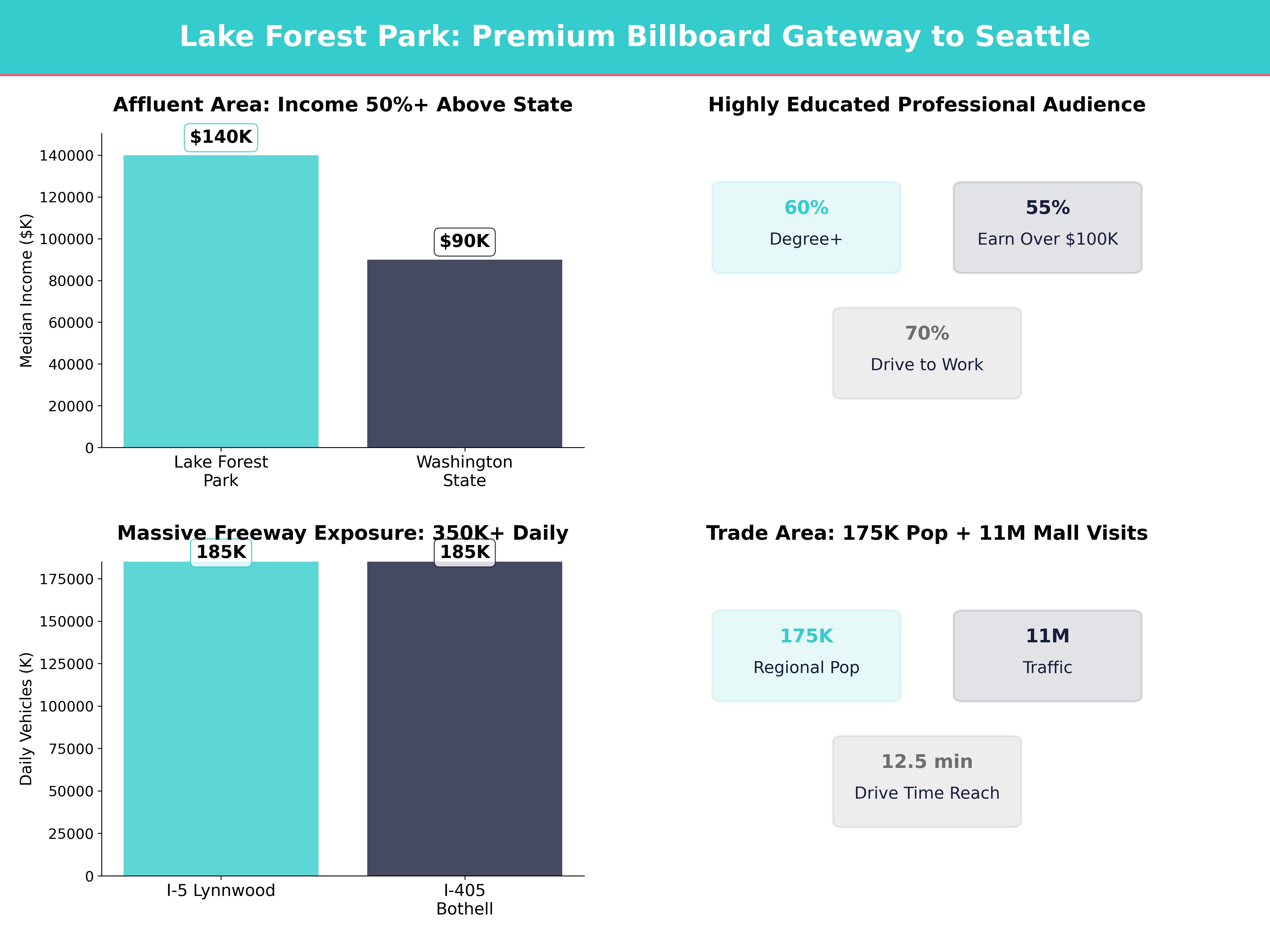
- Local and regional data show the median household income in Lake Forest Park is well above both Washington and U.S. levels, at roughly $135,000–$145,000 per year, versus around $90,000 for Washington overall.
- More than 50–60% of households in Lake Forest Park earn over $100,000 annually, with a sizable share above $150,000, indicating strong discretionary spending for premium goods, travel, dining, and home services that can be effectively reached with Lake Forest Park billboards on nearby commuter routes.
-
Education & professions
- In Lake Forest Park and adjacent North King County suburbs, over 55–65% of adults hold a bachelor’s degree or higher, significantly above national averages.
-
Many residents work in professional, scientific, tech, healthcare, education, and management roles, commuting to job centers in Seattle, Bellevue, Bothell, and Lynnwood. Major nearby employment hubs include:
- The University of Washington Bothell and Cascadia College campus (roughly 6–7 miles away) – together serving 7,000+ students annually: UW Bothell and Cascadia College.
- Tech and biotech offices in Bothell’s Canyon Park and along the I‑405 corridor.
-
Commuting & transportation
- In this part of King and Snohomish County, over 65–75% of workers commute by car, truck, or van.
- Lake Forest Park residents heavily use SR‑522 (Bothell Way NE) and I‑5, which connect directly to our billboard locations in Bothell and Lynnwood.
- Transit adds more eyes on the roads: King County Metro and Sound Transit routes along SR‑522, I‑5, and I‑405 move tens of thousands of riders per weekday through this corridor.
- Nearby park-and-ride facilities such as Kenmore Park-and-Ride and Town Center at Lake Forest Park stops further centralize commuter flows, making billboard advertising near Lake Forest Park especially visible to daily transit and rideshare users.
For advertisers, this means campaigns near the Lake Forest Park area are not mass-market blasts; they are targeted impressions to high-value, educated, and brand-conscious consumers who frequently shop, dine, and recreate throughout the North Seattle suburbs.
For more background on the community, we recommend exploring the City of Lake Forest Park site and local news sources like Shoreline Area News, which regularly cover Lake Forest Park and surrounding neighborhoods. You can also get neighborhood-level context from regional planning and transportation resources such as PSRC – Puget Sound Regional Council.
How Our Nearby Billboards Reach the Lake Forest Park Area
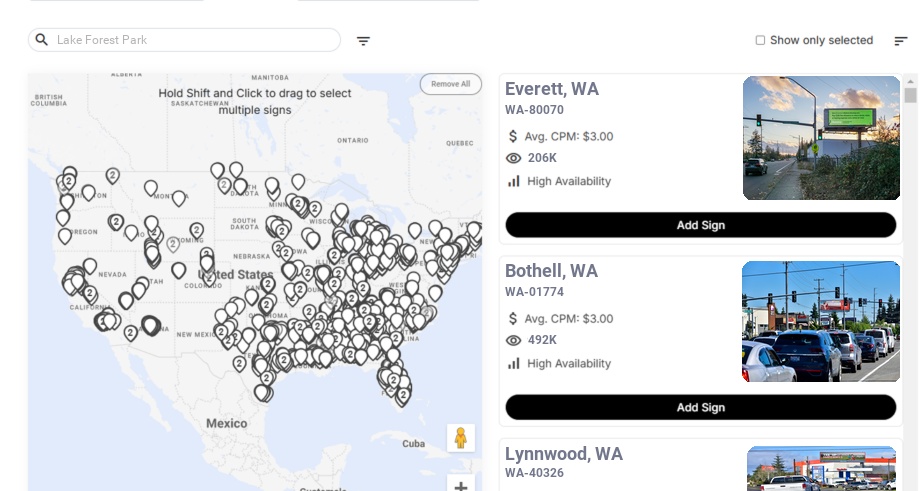
We have 5 digital billboards serving the Lake Forest Park area, all within about 10 miles, primarily in:
- Lynnwood, WA – about 5.5 miles from Lake Forest Park
- Bothell, WA – about 6.4 miles from Lake Forest Park
These locations align with how people in the Lake Forest Park area actually move, making them functionally equivalent to having multiple billboards near Lake Forest Park at the key entry and exit points of the trade area:
- Lake Forest Park residents frequently head to Lynnwood for shopping at Alderwood Mall, big-box retail, dining, and services. Alderwood Mall alone draws an estimated 10–12 million visitors per year, with more than 150 stores and restaurants in one regional destination.
- They regularly drive through Bothell and Kenmore along SR‑522 for commutes to eastside tech and biotech hubs and to access I‑405. I‑405 is one of the state’s busiest freeways, with nearby segments carrying 170,000–200,000 vehicles per day according to WSDOT.
- Many residents visit North Seattle and Snohomish County for Costco runs, youth sports, healthcare, and weekend activities, including trips to Edmonds waterfront, Mountlake Terrace recreation facilities, and surrounding trail systems promoted by Seattle NorthCountry.
That behavior means your message on a Lynnwood or Bothell billboard doesn’t just reach those city populations; it effectively reaches the Lake Forest Park area during high-intent trips: shopping, commuting, and family outings. For businesses evaluating billboard rental near Lake Forest Park, these boards are strategically placed to intercept residents at the moments they are most ready to spend.
To see how local travel patterns flow through the region, you can reference traffic and roadway data from WSDOT and King County, which publish annual average daily traffic (AADT) counts and corridor performance dashboards.
Traffic Patterns and When to Run Your Ads
Blip’s flexibility lets us buy short “blips” of time by hour and day, so understanding local traffic patterns is essential for getting the most from Lake Forest Park billboards and nearby placements.
Key corridors influencing our nearby boards
-
I‑5 through Lynnwood
- WSDOT data show sections of I‑5 in south Snohomish County carrying well over 150,000–185,000 vehicles per day, with some nearby segments exceeding 200,000 AADT.
-
Peak travel is heavily directional:
- Southbound mornings (about 5:30–9:30 a.m.) toward Seattle and Northgate.
- Northbound evenings (about 3:30–7:00 p.m.) toward Lynnwood, Mountlake Terrace, and Everett.
- Even during middays, it’s common to see 80,000–100,000 vehicles over the full midday window.
-
I‑405 and SR‑522 near Bothell
- I‑405 near Bothell typically carries around 170,000–200,000 vehicles per day, serving commuters between the Eastside and Snohomish/King County suburbs.
- SR‑522 between Bothell and Lake Forest Park/Lake City carries an estimated 40,000–55,000 vehicles per day, acting as a primary connector between Lake Forest Park, Kenmore, Bothell, and North Seattle.
- Together, these routes capture a significant share of regional tech, healthcare, and education commuters, making them prime corridors for billboard advertising near Lake Forest Park.
-
SR‑522 (Bothell Way NE/Lake City Way) along Lake Forest Park
- This key arterial runs right along Lake Forest Park’s western edge, forming the city’s commercial spine and its primary route to Bothell and Seattle.
-
Peak travel typically occurs during:
- Morning inbound toward Seattle and Bothell (6–9 a.m.).
- Afternoon/evening outbound toward Lake Forest Park, Kenmore, and Bothell (3–7 p.m.).
- Local studies and WSDOT counts indicate persistent congestion in this corridor even outside peak hours, ensuring consistent billboard visibility.
Suggested daypart strategies
Use this understanding to schedule your Blip campaigns:
-
Morning drive (6–9 a.m.)
- Reach professionals heading into Seattle, Bellevue, Bothell, and Lynnwood, along with university students commuting to nearby campuses.
- In these windows, key corridors routinely see 5,000–8,000 vehicles per hour.
- Best for: coffee shops, breakfast spots, transit services, B2B brands, coworking spaces, SaaS and tech products.
-
Midday (10 a.m.–2 p.m.)
- Strong for errands and shopping; many remote workers and parents are out during this window, and local arterials often maintain 60–70% of peak traffic volumes.
- Best for: grocery stores, retail, healthcare, fitness studios, personal services (salons, auto care).
-
Afternoon school/activities window (2–5 p.m.)
- Local districts such as Shoreline Public Schools and Northshore School District serve tens of thousands of students; school-release and activities traffic drives intense local circulation.
- Ideal to reach families doing school pickup and heading to sports or lessons.
- Best for: youth sports programs, tutoring, family restaurants, pediatric healthcare, after-school activities.
-
Evening peak (4–7 p.m.)
- Heavy commute traffic plus shopping and dining trips toward Lynnwood and local hubs, typically representing the single highest 3-hour block of daily impressions on major freeways.
- Best for: restaurants, entertainment venues, home services, e‑commerce brands with QR codes or URLs.
-
Weekends
- Weekends often show slightly lower freeway AADT but higher discretionary trip share—more trips to malls, parks, and regional attractions.
- Regional data show that weekend visits to shopping centers like Alderwood Mall can spike 20–40% versus typical weekdays.
- Best for: tourism, outdoor recreation, local events, shopping centers, seasonal promotions.
With Blip, we can dial up your presence in these critical windows rather than paying for 24/7 coverage you may not need.
Seasonal and Event-Driven Opportunities
The Lake Forest Park area has distinct seasonal rhythms and community happenings that are ideal for time-sensitive campaigns. Planning billboard rental near Lake Forest Park around these patterns helps you capitalize on peak local interest.
Spring and summer
- Daylight in the Puget Sound region stretches from about 9+ hours in early spring to 15–16 hours in June, increasing both driving visibility and time spent outdoors.
-
Regional tourism organizations like Seattle NorthCountry and Visit Seattle highlight nearby parks, marinas, and trails that collectively attract millions of annual visits, including:
- The Burke-Gilman Trail, which sees estimated 2,000–4,000 daily users in peak season on some segments.
- Lake Washington waterfront parks and marinas in Kenmore, Seattle, and Lake Forest Park’s own access points.
-
Strong time for:
- Outdoor recreation brands, bike and kayak shops.
- Landscaping, painting, roofing, and home improvement services (many homeowners schedule projects between April and September).
- Summer camp and youth program registration—families often finalize summer plans March–May.
- Real estate listings and new developments, as spring and early summer typically account for 40–50% of annual home sales volume in many Puget Sound submarkets.
With Blip, we can run countdowns (“Summer camp starts in 10 days”) and quickly swap creatives when sessions fill or inventory changes.
Back-to-school (late August–September)
- Families in the Lake Forest Park area are focused on schools in Shoreline, Northshore, and private/alternative schools from North Seattle up through Bothell and Lynnwood.
-
Local districts together serve 40,000+ students, driving predictable spikes in:
- Clothing and footwear purchases.
- Tutoring and academic support.
- Health checkups and eye exams.
-
Ideal for:
- Tutoring centers and test prep.
- After-school programs, music and dance schools.
- Kids’ clothing and footwear.
- Dental and eye care providers.
Schedule heavier rotation from mid-August through mid-September with targeted school-themed visuals, especially on corridors connecting neighborhoods to schools and activity hubs.
Fall and winter holidays
- From October through December, U.S. consumers typically make 25–30% of their annual retail purchases, and that impact is amplified in high-income communities like Lake Forest Park.
-
In nearby retail centers such as Alderwood Mall and downtown Bothell/Lynnwood, local tourism and business associations report noticeable foot-traffic peaks around:
- Halloween weekend
- Thanksgiving and Black Friday
- Early December weekends
-
Great for:
- Retail and e‑commerce holiday promotions.
- Restaurants and catering.
- Local events and arts organizations (check calendars from Shoreline Area News and Bothell-Kenmore Reporter).
- Nonprofit fundraising campaigns, as many organizations receive 30–40% of annual donations in the last quarter of the year.
Blip makes it easy to swap creatives for Black Friday, Small Business Saturday, Cyber Monday, and last-minute gift pushes or year-end fundraising deadlines.
Audience Mindset: What Matters to the Lake Forest Park Area
Understanding the local mindset helps shape your creative and tone, and ultimately determines how well billboards near Lake Forest Park resonate with residents.
Values and interests
Based on income, education, and regional trends:
-
Environmentally conscious and outdoor-oriented
- Proximity to Lake Washington, the Burke-Gilman Trail, and the Cascades makes hiking, biking, and water activities an everyday part of life.
- King County’s climate and geography mean easy access to over 200 parks and 175 miles of regional trails, many within a 20–30 minute drive of Lake Forest Park, supported by King County Parks.
-
Family-focused
- A large share of households in nearby suburbs are families with children; in some surrounding zip codes, 30–40% of households include kids under 18.
- Youth sports leagues, music lessons, and enrichment programs are widely used, with local organizations serving thousands of families each season.
-
Tech-savvy and research-driven
- High broadband adoption and smartphone usage in the Seattle metro mean a significant majority of adults research products and services online before buying.
- In similar high-income markets, it’s common for 70–80% of consumers to read reviews or search online before choosing a restaurant, contractor, or healthcare provider.
-
Community and local-business friendly
- Strong support for local restaurants, coffee shops, and services, as highlighted in local coverage by outlets like The Seattle Times and neighborhood blogs.
- Local farmers markets, such as those in Shoreline, Lake Forest Park, and Bothell, attract thousands of visits across their seasonal runs, reinforcing a “shop local” mindset. Examples include the Shoreline Farmers Market and Lake Forest Park Farmers Market.
What this means for your messaging
- Emphasize quality and reliability, not just lowest price—this audience often trades up for better service, ethical practices, and durability.
- Highlight sustainability and local sourcing where relevant (e.g., local ingredients, eco-friendly materials, energy-efficient services).
- Use simple, respectful, and intelligent copy—this audience appreciates clarity, proof points, and practical benefits.
- Include clear, measurable calls-to-action (search phrases, short URLs, or QR codes) for people who will look you up later on their phones.
Creative Best Practices for Billboards Serving the Lake Forest Park Area
Digital billboards near the Lake Forest Park area compete with beautiful scenery, complex interchanges, and busy lives. Strong creative is non-negotiable.
Design for fast-moving traffic
- Aim for 6–8 words of main text maximum; WSDOT research and industry studies show drivers often have 3–6 seconds to absorb a message.
- Use high contrast colors (light text on dark background or vice versa) to improve legibility at highway speeds and in rainy or overcast weather.
- Stick to one focal image plus your logo; clutter can reduce recall by 30–50% compared with clean designs.
- Make web addresses and phone numbers extremely short, or rely on memorable brand names and search terms—most users will search rather than type long URLs.
Reflect regional aesthetics
- Nature-inspired visuals work well: water, forests, mountains, bikes, kayaks, and local landmarks.
- Show real Pacific Northwest weather—rain and clouds can be just as compelling as sunshine and resonate with the local mood.
- Use inclusive, diverse imagery that reflects the region’s demographics across age, race, and family structure.
Sample creative angles
-
For a local HVAC company:
- “Cold Lake Forest Park nights? We’ll keep you warm. [BrandName].com”
-
For a Lynnwood retailer attracting Lake Forest Park shoppers:
- “10 minutes from Lake Forest Park. Style at Alderwood. [StoreName].”
-
For a Bothell tutoring center:
- “Top grades, less stress. Tutoring 15 minutes from Lake Forest Park.”
Because Blip supports multiple creatives, we can A/B test different messages for commuters vs. weekend shoppers or Lake Forest Park–focused vs. broader regional positioning and watch for measurable lifts in web traffic or inquiries.
Geographic Targeting: Matching Messages to Routes
Our 5 nearby billboards in Lynnwood and Bothell allow us to segment audiences by direction of travel and trip type, functioning as a flexible network of Lake Forest Park billboards for different audience segments.
Lynnwood-facing strategy (approx. 5.5 miles away)
Best for reaching:
-
Lake Forest Park residents heading to:
- Alderwood Mall and surrounding retail.
- Costco, Target, Best Buy, and other big-box destinations around Lynnwood where average basket sizes often exceed $100 per trip for family shoppers.
- Medical appointments and professional services in Lynnwood and Edmonds, including clinics, specialty care, and imaging centers.
- Snohomish County residents heading south who may stop or live near Lake Forest Park, Shoreline, or North Seattle.
Consider:
- Weekend-heavy schedules for retail and entertainment, especially Saturdays between 11 a.m. and 4 p.m., when mall and big-box traffic can spike 20–30% above weekday averages.
- “Next exit” or “Just minutes away” style copy to capture spur-of-the-moment decisions.
- Seasonal pushes around back-to-school and holidays tied to shopping, when national data show online + in-store retail spending rising 20–30% vs. off-peak months.
Local context and events can be monitored via Lynnwood Today, Lynnwood Times, and tourism resources such as Visit Lynnwood.
Bothell-facing strategy (approx. 6.4 miles away)
Best for reaching:
- Commuters between the Eastside (Kirkland, Bellevue, Redmond) and the Lake Forest Park area, many of whom work in tech, biotech, or professional services.
-
Families traveling to youth sports, schools, and universities:
- UW Bothell and Cascadia College together educate 7,000+ students annually and employ hundreds of staff and faculty.
- Youth sports complexes and fields around Bothell and Kenmore host leagues that draw families from Lake Forest Park and Shoreline.
- Residents shopping or dining in Bothell’s downtown and Canyon Park areas, where the city’s population has grown by over 40% since the 2000s due to annexations and development.
Focus on:
- Professional services (financial advisors, healthcare, law, real estate) that benefit from top-of-mind awareness in high-earning commuter flows.
- B2B services or SaaS solutions for tech professionals who commute via I‑405 and SR‑522.
- Family-oriented activities, tutoring, and healthcare with simple “minutes away” or “on your way home” messaging.
For local insights, check sites like Bothell-Kenmore Reporter, tourism and business pages such as Explore Bothell, and city resources from City of Kenmore.
Using Blip’s Flexibility to Your Advantage
Blip’s model—purchasing individual ad “blips” rather than long-term, fixed contracts—fits perfectly with the dynamic nature of the Lake Forest Park area and the way businesses want to test billboard advertising near Lake Forest Park before scaling.
Budget control
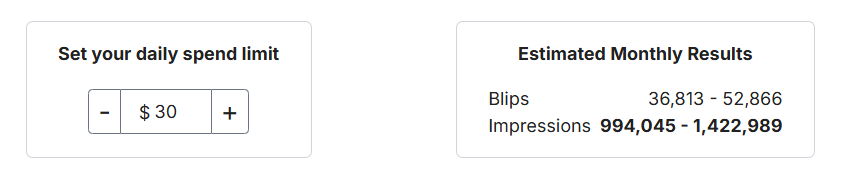
- Set daily or campaign budgets as low or high as you like (from very small test spends up to sustained, multi-board presence).
- Increase bids during key times (weekday rush hours, holiday weekends, major sale days) and scale back during slower periods.
- Ideal for testing the Lake Forest Park area market with modest initial spend—for example, running a two-week test focused on morning and evening peaks—then scaling based on performance metrics like web traffic or in-store visits.
Dynamic campaign adjustments
-
Swap creative in minutes for:
- Weather-based promotions (“Rainy-day specials,” “Sunny weekend patio dining”), especially relevant in a region that averages 150+ days of measurable rain per year.
- Real-time inventory changes (homes sold, vehicles in stock, appointment availability).
- Event reminders and countdowns (5, 3, 1 day before), which can significantly increase attendance when paired with local event calendars.
- React quickly to regional news or opportunities highlighted by outlets like Shoreline Area News or The Seattle Times.
Multi-creative sequencing
-
Use multiple creatives in rotation to:
- Tell a simple 2–3 frame story (“Problem → Solution → Brand”).
- Highlight different benefits (price, quality, local ownership, sustainability).
- Tailor messages by board location (Lynnwood vs. Bothell) while maintaining a consistent brand look and logo.
- Industry benchmarks suggest that rotating 2–4 creatives can improve recall and engagement by 10–20% versus a single static message, especially for repeat commuters.
Industry-Specific Tips for the Lake Forest Park Area
Local retailers and restaurants
- Target weekends and evening rush hours when Lake Forest Park area residents are most likely to dine out or shop; restaurant and retail spending often peak between 5–8 p.m. on Fridays and Saturdays.
-
Use distance-based callouts:
- “5 minutes from Lake Forest Park”
- “Next to Alderwood Mall”
- “Just off SR‑522 in Bothell”
- Promote specific offers, but keep them simple: “Kids eat free Tuesdays” or “20% off this weekend.” Studies show that ads with a single, clear offer can have 15–30% higher response rates than cluttered promotions.
Professional and healthcare services
- Emphasize trust, credentials, and convenience rather than deep discounts—especially important in markets where many residents hold advanced degrees and prioritize quality.
-
Highlight specializations and proximity:
- “Family dentist serving the Lake Forest Park area”
- “Same-day appointments 10 min away in Bothell”
- Run steady, always-on presence at moderate frequency; healthcare and professional services often see decision cycles stretching weeks to months, so consistent exposure builds familiarity and trust.
Real estate and home services
- The Lake Forest Park area and nearby suburbs have high homeownership rates and strong property values compared with state averages.
-
Use billboards to:
- Feature recently sold homes (“Sold in 5 days in Lake Forest Park area”)—short days-on-market stats resonate in competitive markets.
- Promote new listings with price and neighborhood name; even a 1–2% lift in listing traffic can be valuable at local price points.
- Advertise roofing, landscaping, remodeling, and solar services with before/after visuals; home improvement spending typically increases 10–20% in spring/summer vs. winter.
- Consider aligning campaigns with local permitting and building seasons, using resources from City of Lake Forest Park, City of Shoreline, and City of Bothell.
Education, youth programs, and nonprofits
-
Focus on family decision cycles:
- Enrollment seasons (spring/summer for fall programs; late fall for winter activities).
- Fundraising peaks (late year, gala seasons, back-to-school drives).
-
Use clear, impact-driven copy:
- “Help local students in the Lake Forest Park area succeed.”
- “Now enrolling: STEM camps 10 minutes away.”
- Nonprofits often receive 30–50% of individual donations in a few key campaigns each year, so aligning billboards with those drives can significantly boost results.
- Promote events that appear on local calendars via City of Lake Forest Park, Kenmore, Bothell, and nearby arts organizations.
Measuring Success and Optimizing Over Time
Even though billboards near the Lake Forest Park area are an offline medium, we can measure impact and continually refine your campaign.
Trackable elements
-
Unique URLs or landing pages
- Example: BrandName.com/LFP
- Track pageviews, time on site, and conversions tied specifically to your billboard audience.
-
Promo codes specific to your billboard campaign
- Example: “Use code LFP20 online or in-store.”
- Monitor redemptions to quantify direct revenue from the campaign.
-
Search volume changes
- Monitor brand keyword searches and direct visits from Lake Forest Park, Shoreline, Kenmore, Bothell, and Lynnwood zip codes during campaign periods using analytics tools.
- Even a 5–10% uptick in brand search volume during flights is a good sign of lift.
-
Store traffic and sales
- Watch for lifts in transactions from zip codes near Lake Forest Park when your campaign is active.
- Simple before/after comparisons by week or month can reveal patterns, especially when aligned with your dayparting strategy.
Ongoing optimization
- Adjust dayparts after 2–4 weeks based on performance—doubling down on times that correlate with spikes in inquiries, online traffic, or sales.
- Refine creative: if one message or visual drives more engagement (higher direct traffic or promo code usage), shift more impressions to that version.
-
Test geographic expansions:
- Start with Lynnwood and Bothell boards.
- Scale to additional nearby markets as needed, such as more North Seattle or Eastside coverage, once you see consistent ROI from the Lake Forest Park trade area.
- Use local data sources like King County GIS & Maps and city open data portals where available to better understand where your customers are coming from.
By aligning your Blip billboard strategy with the real-world travel patterns, demographics, and values of the Lake Forest Park area, we can help you turn a handful of well-placed digital billboards in nearby Lynnwood and Bothell into a powerful, efficient way to reach one of the most attractive suburban audiences in the Puget Sound region—backed by data, timed to local behavior, and amplified by smart, trackable creative for any business seeking billboard advertising near Lake Forest Park.