Billboards in Stonecrest, GA
No Minimum Spend. No Long-Term Contracts. Just Results.
Turn local traffic into loyal fans with Stonecrest billboards powered by Blip. Launch eye-catching billboards near Stonecrest, Georgia in minutes, set any budget, choose your schedule, and watch real-time results roll in—no long-term contracts, just flexible fun.
Trusted by Leading Brands


Billboard advertising
in Stonecrest has
never been easier
HERE'S HOW IT WORKS
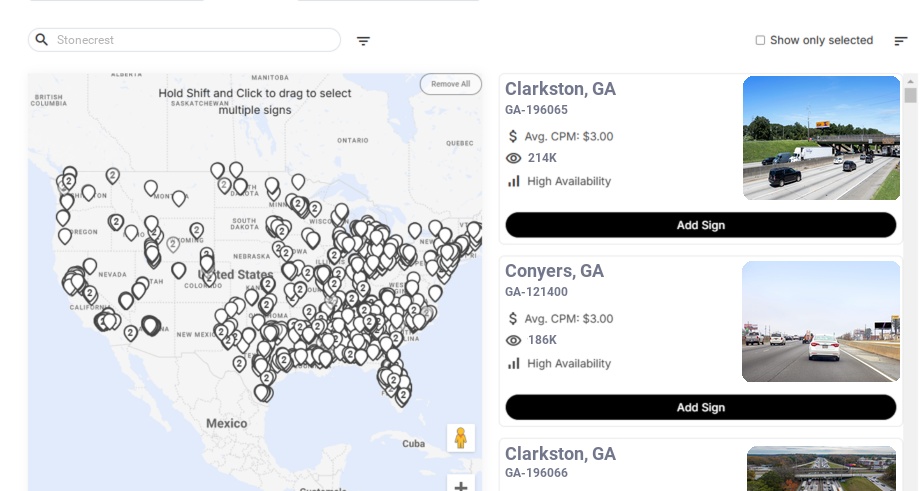
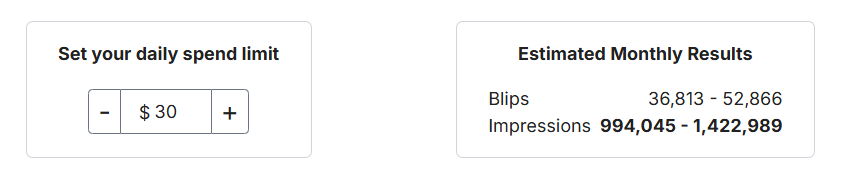
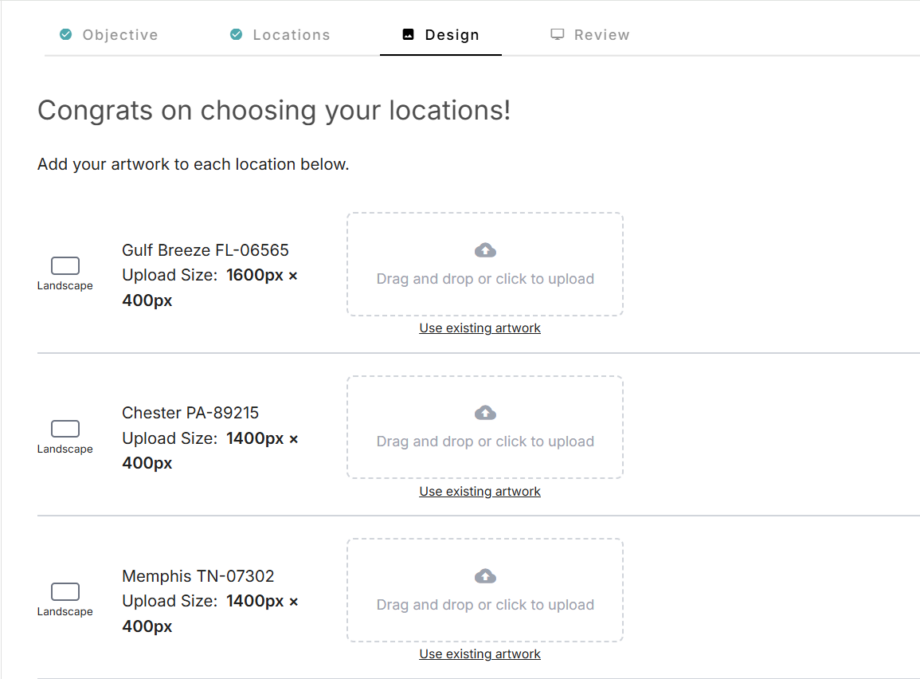
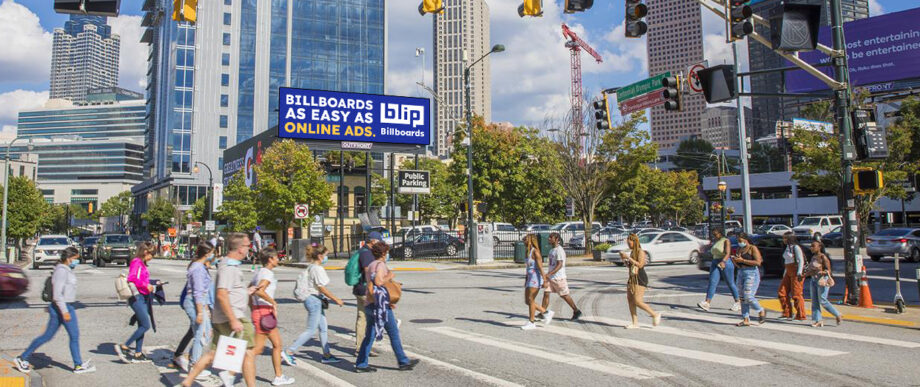
How much is a billboard in Stonecrest?
Billboards in other Georgia cities
Stonecrest Billboard Advertising Guide
The Stonecrest area sits at a powerful crossroads of retail, logistics, and commuter traffic on the east side of metro Atlanta. With major retail anchors like the Mall at Stonecrest, heavy daily flows along I‑20, and fast-growing residential communities, digital billboards near Stonecrest give us a high-impact way to stay visible to local shoppers, commuters, and regional visitors—all without committing to a rigid long-term traditional buy. For many advertisers, these Stonecrest billboards serve as a flexible, always-on presence that complements other local marketing.
Understanding the Stonecrest Area Market
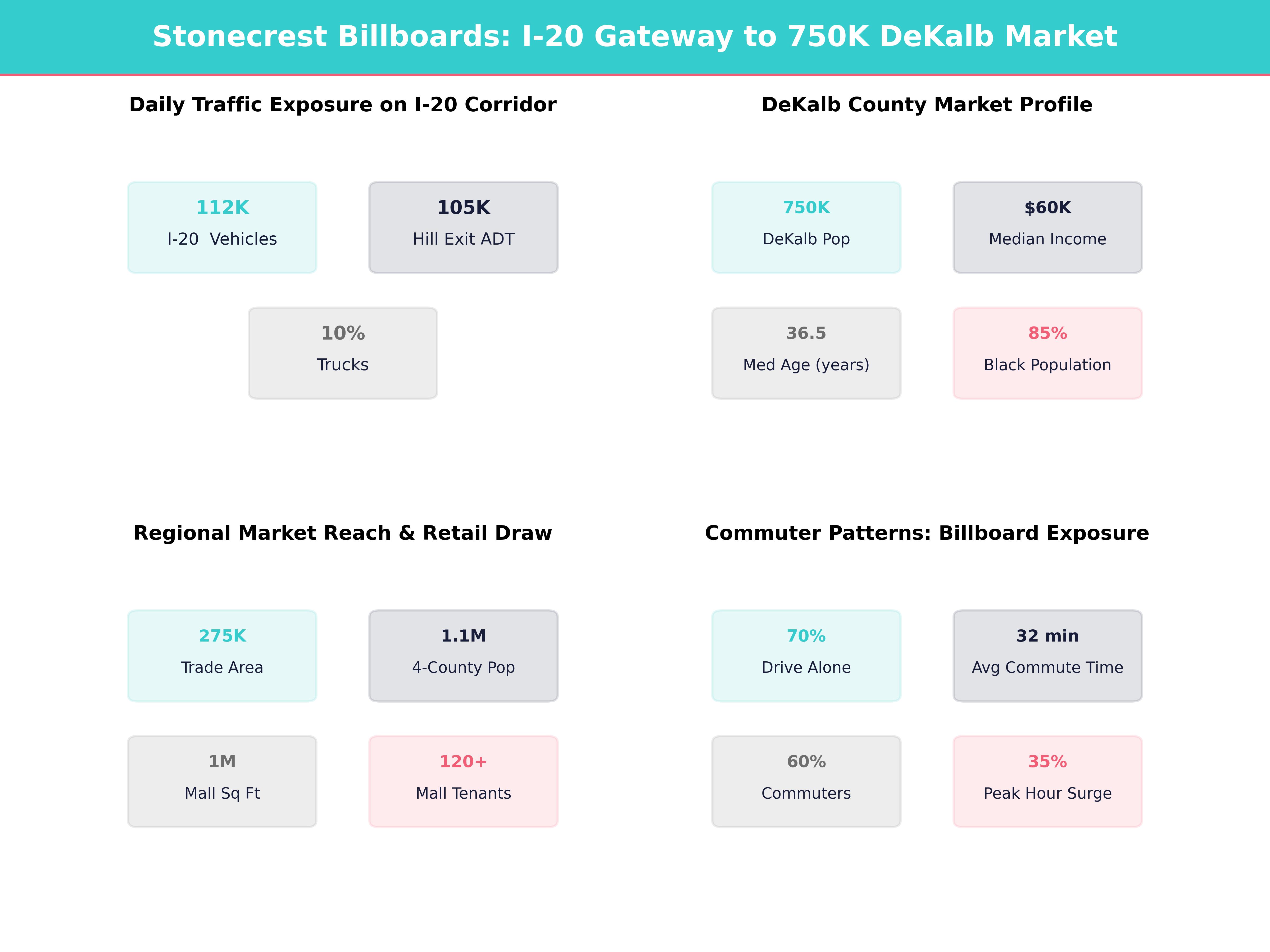
Stonecrest is one of Georgia’s newest cities, incorporated in 2016 and located in eastern DeKalb County. According to the City of Stonecrest and recent population estimates based on 2020 census data, the population is just under 60,000 residents, spread across roughly 37 square miles—about 1,600 residents per square mile, denser than the Georgia statewide average of roughly 190 residents per square mile. This density is concentrated in clusters of neighborhoods, retail centers, and industrial corridors that feed directly into I‑20 and Panola Road, which is why billboards near Stonecrest can reach such a concentrated, high-value audience.
Key market facts:
• DeKalb County, where Stonecrest sits, has more than 750,000 residents (roughly 764,000 as of 2020), making it Georgia’s fourth-most-populous county. DeKalb households have a median age around 36–37 and a median household income in the mid‑$60,000s, with significant pockets of higher-income suburban neighborhoods along the east side.
• Stonecrest is majority Black—over 85% of residents identify as Black or African American—reflecting the broader east DeKalb demographic. This creates strong opportunities for culturally relevant, community-focused messaging and events, especially for brands that already connect with Black consumers in metro Atlanta.
• The area is anchored by major regional draws like the Mall at Stonecrest, which spans more than 1 million square feet of retail space, hosts over 120 stores and restaurants, and draws an estimated several million visitors annually from DeKalb, Rockdale, Newton, and Henry counties.
• Within a 10‑mile radius of Stonecrest, you tap into a trade area of roughly 250,000–300,000 residents across eastern DeKalb, western Rockdale, and northwest Newton counties, plus daytime workers in logistics, manufacturing, healthcare, and education. This broader trade area is exactly what well-placed Stonecrest billboards and nearby units along I‑20 can efficiently cover.
Our 3 digital billboards in nearby Conyers
Useful local resources for understanding the market include:
- City of Stonecrest
- DeKalb County Government
- Discover DeKalb (tourism)
- City of Conyers
- Rockdale County Government
- City of Lithonia (adjacent to Stonecrest)
- Newton County Government (east of Rockdale)
Studying local plans, economic development pages, and events calendars from these sites helps us align billboard campaigns with real-world patterns in the Stonecrest area—such as scheduled road projects, new housing developments, or major festivals that can temporarily increase traffic volumes by thousands of vehicles per day.
Who You Can Reach Near Stonecrest
The Stonecrest area combines several high-value audience segments that respond well to digital out-of-home (DOOH) and other forms of billboard advertising near Stonecrest:
1. Daily Commuters and Corridor Workers
I‑20 is the primary east–west spine. Georgia Department of Transportation (GDOT)
- Around 100,000–110,000 vehicles per day near the Turner Hill Road/Stonecrest exit
- Up to 115,000–125,000 average daily traffic (ADT) on segments between Stonecrest and Conyers
- Roughly 8–12% of that volume as heavy trucks, depending on the segment and year
A large share of Stonecrest-area residents commute toward:
- Downtown and Midtown Atlanta
- Employment hubs around I‑285 and I‑85
- Industrial and logistics centers along I‑20 and around Conyers and Covington
Across DeKalb and Rockdale counties, more than 70% of workers drive alone to work, and typical commute times run 30–34 minutes. That means tens of thousands of impressions every weekday during peak travel windows. For brands targeting working-age adults (25–54), commuter-focused scheduling and messaging are critical, and Stonecrest billboards positioned along their daily routes can keep your brand in front of them consistently.
2. Retail Shoppers and Families
Stonecrest is a major retail destination on Atlanta’s east side:
- The Mall at Stonecrest’s trade area pulls from DeKalb, Rockdale, Newton, and Henry counties, together representing well over 1.1 million residents.
- Discover DeKalb highlights Stonecrest as one of the county’s key shopping and entertainment hubs, alongside areas like Decatur
- DeKalb’s median household size (about 2.6 people) and Stonecrest’s concentration of family households create strong demand for family dining, youth activities, healthcare, and education services.
On weekends and during holiday periods, retail traffic in the Stonecrest–Conyers stretch of I‑20 can spike significantly; local law enforcement and mall reports often plan for 20–30% higher volumes on key holiday weekends. Families from neighboring cities like Lithonia, Conyers, Covington, and Decatur regularly travel through the Stonecrest area for shopping, dining, and weekend activities, meaning our boards near Conyers are well-positioned to capture both local and regional shopping traffic and function as billboards near Stonecrest for these high-intent visits.
3. Industrial, Logistics, and Trade Traffic
Eastern DeKalb and Rockdale counties host industrial parks, distribution centers, and auto-related businesses that depend on I‑20. GDOT freight data consistently ranks I‑20 in this corridor as one of the state’s top truck routes:
- Thousands of trucks use this stretch daily; in some segments, heavy trucks account for more than 1 in 10 vehicles.
- Rockdale and Newton counties together support hundreds of manufacturing, warehousing, and logistics businesses, with many employees commuting via I‑20 from DeKalb and Henry counties.
This is advantageous if we’re marketing:
- B2B services (logistics, staffing, equipment rental, commercial insurance)
- Auto services and dealerships (given the high daily exposure from both commuters and fleet vehicles)
- Workforce recruitment campaigns, especially for logistics, warehouse, and skilled trades jobs in and around the City of Conyers Rockdale County
4. Visitors and Day-Trippers
Attractions near the Stonecrest area include:
- Arabia Mountain National Heritage Area, which spans more than 40,000 acres across DeKalb, Rockdale, and Henry counties and features over 30 miles of multi-use trails. The heritage area draws hundreds of thousands of visitors annually for hiking, cycling, and heritage tourism.
- Panola Mountain State Park, about 25 minutes from Stonecrest, which offers guided hikes, archery, and tree-climbing, and records tens of thousands of visitors each year through its visitor center and programs.
- Georgia International Horse Park in Conyers, a legacy 1996 Olympic venue that now hosts more than 200 events annually—horse shows, concerts, festivals, and sporting events—bringing in hundreds of thousands of attendees and generating millions of dollars in local economic impact.
Many of these visitors arrive by car from across metro Atlanta and beyond, often using I‑20 and nearby surface streets. During major events at the Georgia International Horse Park, daily traffic counts on nearby segments of I‑20 and Georgia Highway 138 can jump noticeably—providing temporary surges in available impressions. This makes digital billboards an effective way to promote tourism, events, and hospitality offerings such as hotels, restaurants, and attractions, especially when you’re looking for flexible billboard rental near Stonecrest that can be scaled up during peak visitor periods.
Key Corridors and Traffic Patterns Serving the Stonecrest Area
Our 3 digital billboards near Stonecrest sit within about 10 miles of the city, primarily around Conyers. To make the most of them, we should think like a driver:
I‑20 East–West Flow
- Runs from Atlanta through Decatur, Stonecrest, Lithonia, and Conyers.
- GDOT data for recent years shows daily volumes on this corridor near Stonecrest and Conyers typically in the 90,000–120,000 ADT range, with some peak segments exceeding 120,000 vehicles on busy weekdays.
- Morning peak: roughly 6:30–9:00 a.m., stronger westbound (into Atlanta and inner DeKalb). In this window, commuter volumes can be 30–40% higher than mid‑day baselines.
- Evening peak: roughly 4:00–7:00 p.m., stronger eastbound (back toward Stonecrest, Conyers, Covington), with similar 30–40% surges in volume.
By aligning campaigns to these peaks, advertisers can maximize impressions during the 3–4 hours when the majority of local commuters are on the road, getting more value from every dollar spent on billboard advertising near Stonecrest.
Stonecrest-Area Surface Streets That Feed I‑20
While our boards are in nearby Conyers, we’re still tapping into traffic originating from:
- Turner Hill Road / Mall Parkway (serving the Mall at Stonecrest and adjacent retail), which handles thousands of vehicles daily, particularly on weekends and holidays.
- Panola Road, connecting residential neighborhoods and industrial sites with direct access to I‑20.
- Evans Mill Road, a key north–south connector feeding both residential areas and local businesses.
- US‑278 (Covington Highway), a major arterial paralleling I‑20 and channeling traffic between Decatur, Lithonia, Stonecrest, and Covington.
Drivers often combine these roads with I‑20 for daily trips; aligning our messaging with their direction of travel (toward home vs. toward work/shopping) can boost relevance and recall. For example, “Tonight Only” offers perform better eastbound in the evening as drivers head home, whereas “Before Work” messages are more effective westbound in the morning.
Conyers as a Capture Point
Because Conyers lies just east of the Stonecrest area, our billboards capture:
- Stonecrest-area residents traveling further east (e.g., Covington, Madison, Augusta)
- Conyers and Rockdale County residents heading west toward Stonecrest and Atlanta
- Regional through-traffic moving across the east Atlanta corridor between Alabama and South Carolina along I‑20
Rockdale County’s daytime population swells beyond its residential base due to inbound workers and visitors, meaning advertisers can reach both local households and non-resident workers. The result is exposure to local households plus regional consumers moving along a heavily trafficked stretch, with nearby Conyers units acting almost like an outer ring of Stonecrest billboards.
For traffic volumes and planning, we can reference GDOT’s traffic data tools
Timing Your Blip Campaign Around Local Rhythms
Blip lets us schedule ads by specific hours and days, which is especially powerful in a commuter-centric market like the Stonecrest area.
1. Commuter-Focused Dayparts
- Morning (6–10 a.m.): Ideal for coffee shops, quick-service restaurants, gas stations, local news, and traffic or weather apps. Across DeKalb and Rockdale, more than two-thirds of workers leave home between 6 and 9 a.m., so this window captures the bulk of outbound commuting.
- Midday (11 a.m.–2 p.m.): Great for lunch offers, same-day services, medical clinics, and government or nonprofit messaging. Many healthcare and government offices in DeKalb and Rockdale report their peak call and visit times in this window.
- Evening (4–8 p.m.): Strong for family dining, retail, grocery, fitness centers, and streaming/entertainment brands. About half of commuters arrive back home between 4 and 7 p.m., making this a key window for “on your way home” offers.
2. Weekday vs. Weekend Behavior
- Weekdays: More regular commuter patterns. In DeKalb County, roughly 80–85% of workers follow a Monday–Friday schedule, so weekday DOOH is ideal for work-related routines (childcare, auto repair, healthcare, professional services, education).
-
Weekends: Retail and recreation dominate. The Mall at Stonecrest, local churches, and regional parks see more activity. Larger congregations in the Stonecrest–Lithonia–Conyers area often report hundreds to thousands of attendees on Sundays, driving higher traffic around morning and midday services. Use heavier weekend schedules for:
- Retail sales and grand openings
- Church services and faith events
- Festivals, sports, and tourism
3. Seasonal Swings
Consider broad metro-Atlanta patterns that affect the Stonecrest area:
- Back-to-school (late July–August in DeKalb County; see calendars at the DeKalb County School District): DeKalb County School District serves roughly 92,000–93,000 students across more than 130 schools, many of them in or near East DeKalb. This is perfect for after-school programs, tutoring, youth sports, and retail (apparel, electronics, school supplies).
- Holiday shopping (November–December): Nationally, nearly 20–25% of annual retail sales often occur in the holiday period, and local malls like Stonecrest typically see significant spikes in weekend traffic—often 30–50% higher than non-holiday weekends on peak days such as Black Friday. The I‑20 corridor near Stonecrest and Conyers gets particularly busy around major sale periods (Black Friday, Christmas, New Year’s). Retail and e-commerce brands should ramp up impressions and rotate multiple creatives.
- Spring and fall events: Temperatures in metro Atlanta during spring and fall (often in the 60s–70s °F) drive strong attendance at outdoor festivals, 5Ks, and park events. Check local news and calendars from outlets like On Common Ground News, the Atlanta Journal-Constitution, Discover DeKalb’s events calendar, and the Georgia International Horse Park for festivals, marathons, and community events to tie into.
Crafting Effective Creative for the Stonecrest Area
In a fast-moving environment like I‑20, simplicity and cultural relevance are critical. A few best practices tailored to the Stonecrest area:
1. Design for Quick Readability
- Aim for 6–8 words or fewer of main copy; drivers at 65–70 mph typically have 6–8 seconds or less to process a message.
- Use large, high-contrast fonts; avoid thin scripts and low-contrast color combinations.
- Prioritize one clear call to action: visit a short URL, use a promo code, call a short phone number, or exit at a specific number.
For example, a Stonecrest-area restaurant might use:
“SEAFOOD TONIGHT? EXIT 82 – CONYERS”
2. Highlight Proximity and Directions
Because our billboards are near but not inside Stonecrest, directional messages work extremely well:
- “5 MINUTES TO STONECREST MALL – NEXT 2 EXITS”
- “STONECREST FAMILIES: ENROLL NOW – AFTER‑SCHOOL CARE NEAR YOU”
Referencing exits (e.g., I‑20 Exits 74–82), landmarks (Mall at Stonecrest, Georgia International Horse Park), or nearby cities (Stonecrest, Lithonia, Conyers) helps drivers connect the message to a real-world destination. Research from outdoor advertising industry studies suggests that including simple directional cues (like “NEXT EXIT” or distance in miles) can increase response and recall by 10–20%.
3. Reflect Local Culture and Community
The Stonecrest area has a strong community identity, with a large Black population and a robust network of churches, civic groups, and small businesses. To resonate:
- Feature diverse, authentic photography that reflects the local population; in East DeKalb and Rockdale, Black residents make up well over half of the population.
- Tie into local events or themes (HBCU football games, Juneteenth celebrations, faith-based conferences, local high school sports).
- Use language that feels community-oriented: “serving Stonecrest families,” “supporting east DeKalb businesses,” etc.
- When relevant, highlight local stats: “Serving Stonecrest for 10+ Years,” or “Trusted by 5,000+ East DeKalb Families.”
4. Use Multiple Creative Variations
Blip allows quick creative swaps, which is valuable in a market with seasonal and weekly rhythm changes:
- A/B test different headlines: price-focused vs. benefit-focused, or “Stonecrest” vs. “Eastside Atlanta” naming.
-
Tailor creative by daypart:
- Morning: “Schedule Your Checkup Before Work”
- Evening: “Walk‑In Clinic Open Till 8 PM Tonight”
- Run countdowns for limited-time events (“3 DAYS LEFT – STONECREST SALE”).
- Consider rotating 3–5 creatives if you expect viewers to see your board multiple times per week—frequent commuters in this corridor may pass a given sign 10 or more times weekly.
Using Blip’s Flexibility to Zero In on the Stonecrest Area
Our boards near Conyers provide a powerful “funnel” of reach for the Stonecrest area, and Blip’s tools let us optimize that reach:
1. Set Budgets by Time and Board
Rather than buying 24/7, we can:
- Concentrate budget on peak commuter windows to stretch limited spend—putting, for example, 60–70% of impressions into morning and evening rush hours.
- Shift budget toward weekends for retail or attractions, especially leading up to holidays or big events at the Georgia International Horse Park.
- Emphasize boards that show stronger results (measured through web traffic, store visits, or promo code redemptions). Even a 10–15% lift in conversions on a top-performing board can justify reallocating spend.
Because Blip operates on a pay-per-blip model, it effectively turns billboard rental near Stonecrest into an on-demand, highly adjustable buy instead of a single large upfront commitment.
2. Align With Local Events and News
Because creative can be updated quickly, we can react to:
- Local news stories covered by 11Alive, WSB-TV, or Atlanta News First (CBS46).
- City announcements from Stonecrest Conyers
- Event calendars from Discover DeKalb, DeKalb County Recreation, Parks and Cultural Affairs
Example: A Stonecrest-area urgent care clinic could update creative during flu season—typically peaking between December and February—to emphasize vaccines, rapid testing, or extended hours. A church or civic group could highlight special community events attracting several hundred attendees, such as holiday festivals or back-to-school giveaways.
3. Use Geo-Connected Calls to Action
Even though we’re advertising on I‑20 near Conyers, our call to action can direct people to services in the Stonecrest area:
- “STONECREST DENTAL – 10 MIN WEST AT EXIT 74”
- “STONECREST DELIVERY: ORDER IN 3 CLICKS – VISIT STONECRESTMEALS.COM”
Pairing digital billboards with mobile ads or social campaigns geofenced around Stonecrest neighborhoods (for example, within a 3–5 mile radius of the Mall at Stonecrest) can significantly reinforce message recall. Industry studies on DOOH plus mobile campaigns often show double-digit lifts in ad recall and engagement compared with single-channel campaigns.
Sample Campaign Approaches for Common Stonecrest-Area Advertisers
To make the most of digital billboards serving the Stonecrest area, it helps to map your campaign to your business type.
Retailers and Restaurants Near Stonecrest
Objective: Capture shoppers heading to or from major retail hubs like the Mall at Stonecrest.
Strategy:
- Heavy scheduling Thursday–Sunday, 10 a.m.–8 p.m., when weekend shopping peaks and many households do their primary weekly spend.
- Clear sale or value proposition (“BOGO WINGS – THIS WEEKEND ONLY” or “UP TO 50% OFF – STONECREST STORE”).
- Directional copy tied to I‑20 exit numbers and landmarks, especially Exits 74–82.
- Multiple creatives for different promotions (weekday lunch vs. weekend family dinner; limited-time holiday offers).
- Track simple KPIs such as weekend sales lift (aim for 5–15%) or redemption of billboard-specific promos.
Local Service Providers (Healthcare, Auto, Financial, Legal)
Objective: Stay top-of-mind for residents along their daily commute.
Strategy:
- Steady weekday presence during morning and evening commutes; consider dedicating 60% of impressions to 6–10 a.m. and 4–8 p.m. slots.
- Trust-building messages: ratings, years in business, “Stonecrest-area owned & operated,” or “Serving East DeKalb & Rockdale for 20+ Years.”
- Easy recall CTAs: short URLs or memorable phone numbers; research shows shorter URLs can improve recall by 20–30% vs. long, complex web addresses.
- Seasonally rotated creatives (tax season for financial and legal services, school sports seasons for sports medicine, storm repair periods for auto and home services).
Faith Organizations and Community Groups
Objective: Promote services, conferences, and outreach events to Stonecrest-area residents.
Strategy:
- Concentrate impressions Wednesday evening–Sunday afternoon, aligning with midweek Bible study and weekend services. Many churches in the area host multiple Sunday services, drawing hundreds or thousands of worshippers.
- Emphasize community and inclusivity: “Join Us This Sunday – 9 & 11 AM Services.”
- Rotate creative for special events (Easter, Christmas, youth retreats, revivals, back-to-school giveaways).
- Tie imagery to local landmarks or familiar Stonecrest scenes to signal “this is for you” to local residents.
Real Estate and Housing
Objective: Promote new subdivisions, apartments, or mixed-use developments near Stonecrest.
Strategy:
- Use bold, aspirational imagery (families, modern interiors, green spaces). Eastern DeKalb and Rockdale counties have seen steady new-home and apartment construction as metro Atlanta’s population has grown (the Atlanta region has added more than 1 million residents since 2000).
- Distance cues: “NEW HOMES 10 MIN FROM STONECREST” or “LUXURY APARTMENTS – 2 EXITS AHEAD.”
- Target commuters heading east in the evening who may be thinking about shorter commutes or upgrading homes.
- Switch messaging as inventory changes (“Now Leasing,” “Few Homes Left,” “Phase II Coming Soon”) and track leads or website form fills; even a small improvement in lead volume (5–10%) during billboard flights can signal a positive return.
Measuring and Optimizing Campaign Performance
While digital billboards don’t provide one-to-one tracking like online ads, we can still make data-driven decisions.
1. Use Time-Based Tracking
Align your Blip schedule with analytics tools:
- Watch for website traffic spikes during and just after your scheduled blip windows using time-of-day reports in analytics platforms. Compare, for example, 6–9 a.m. sessions during campaign weeks vs. non-campaign weeks.
- Compare performance between periods with and without billboard activity. A sustained 5–20% lift in key metrics (calls, form fills, store visits) during campaign windows is a strong indicator of impact.
2. Track Location-Specific Signals
- Use Stonecrest-area promo codes in creatives (“Use Code STONECREST20”).
- Monitor store foot traffic around Stonecrest-area locations during campaign weeks using POS data or simple manual counts. Even small retailers can track weekly transactions or average ticket size.
- Ask customers how they heard about you via intake forms or POS systems; aim to capture at least 5–10% of transactions with a “How did you hear about us?” response to build a usable dataset.
3. Test and Iterate
Because we can adjust budgets, times, and creatives quickly:
- Start with 2–3 creative variations and rotate them evenly. Run each version for at least 2–4 weeks to collect enough data.
- After 2–4 weeks, drop the underperforming messages and double down on the ones associated with better outcomes (calls, visits, sales). Look for differences of at least 10–15% in response rates before making decisions.
- Experiment with adjusting dayparts: if evening impressions drive more conversions, shift more of your budget later in the day; if weekend traffic produces higher average order values, push more of your impressions to Friday–Sunday.
By pairing the high-traffic I‑20 corridor and nearby Conyers boards—reaching roughly 100,000+ vehicles per day—with targeted scheduling and tailored creative, we can efficiently reach shoppers, commuters, families, and visitors across the Stonecrest area. With Blip’s flexibility, billboard rental near Stonecrest becomes accessible for businesses of many sizes, allowing you to test ideas quickly, lean into what works, and build a sustained presence that keeps your brand top-of-mind whenever people travel near Stonecrest.