Small businesses don’t need Fortune 500 budgets to dominate their local markets—they need to stop buying advertising like Silicon Valley startups.
As Blip’s sales leader, Chris Farnkopf has watched thousands of small business owners pour money into Google and Facebook ads because they believe billboards cost tens of thousands of dollars. Meanwhile, the billboard sitting empty on Main Street—the one their customers drive past twice daily—costs less per month than most digital marketing budgets.
Chris has spent 10+ years in out-of-home advertising, working with everything from Fortune 100 brands to thousands of SMBs across 200 different markets. He’s seen both sides of the industry, and one thing has become crystal clear: the math works better for local businesses than almost anyone realizes.
Key Takeaways:
- Local billboards cost less than Google Ads—with better ROI for small businesses. A single location costs less per month than most SMBs spend on digital ads combined, and modern measurement proves ROI through location data and store visit tracking.
- Digital billboards launch fast, with no contracts, letting you test before scaling. You can start with one high-traffic location you already know works, then expand to new spots or adjust creative based on real results—not traffic studies.
- Layer billboards with direct mail and digital to beat ad blindness and drive conversions. Run billboards for 4 weeks to build awareness, then shift budget to direct mail or social ads that convert. This channel rotation prevents consumer fatigue and capitalizes on the mental availability billboards create.
Two Lies Keeping Local Businesses Off Billboards
When Chris talks about OOH with new business owners, they immediately reference Sunset Strip billboards or Times Square spectaculars. “I think everybody gravitates to the imagery of your name in lights on a massive billboard,“ says Chris. They assume all outdoor advertising requires six-figure budgets.
This keeps local businesses trapped in what Chris calls the “Google/Facebook duopoly”—a cycle where small businesses believe paid search and social ads are their only affordable options.
Early-stage brands focus intensely on performance marketing channels with direct dollar-in, dollar-out tracking. They want to see someone click an ad, visit a website, add a product to cart, and check out.
Guess what? You also can measure out-of-home advertising by using mobile location data to track store visits, app downloads, website traffic, and purchases after billboard exposure.
Misconceptions on pricing, misunderstanding on measurements. Small businesses assume they can’t afford billboards, and if they can, they assume they can’t prove ROI. Both beliefs are completely wrong.
How to Win The Local Game
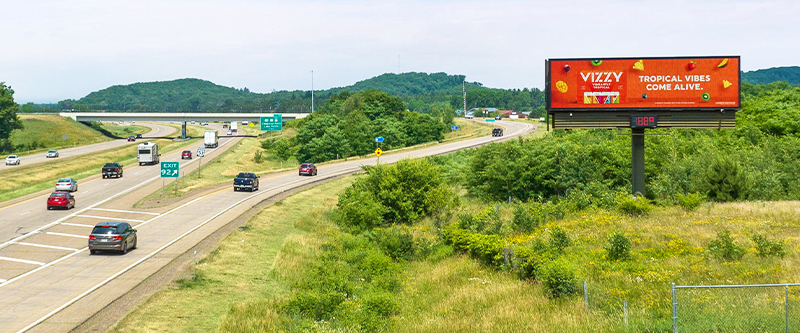
We’ve done the math: with the right unit economics, you can see how a single billboard can pay for itself five times over in just a month. But those unit economics only tell part of the story. Winning the local game means keeping three key principles in mind.
1: Hit The Brakes On Digital
Small businesses make their biggest mistake when they try to measure billboard advertising exactly like digital advertising. Then they get frustrated when it doesn’t work the same way.
Digital platforms have created what Chris describes as walled gardens. “Google and Meta built these walled gardens that suggest to brands: spend your money here, it works! Let me show you how well it works! They don’t allow you easily to take that data outside of those ecosystems,” explains Chris. These platforms have financial incentives to ensure you never test alternative channels.
Billboards deliver something digital ads can’t: genuine social reach. One piece of creative speaks simultaneously to a diverse group of consumers—commuters, families, business travelers, delivery drivers.
That shared physical experience creates conversation, recognition, and earned media in ways display ads never will. “No one’s ever talked about a display ad,” says Chris, “But you will share a photo of something that you saw on the subway, or on the side of a bus, or on a billboard.”
2: Test Like Digital, Commit Like Physical
Digital advertising trained businesses to test fast and iterate constantly. Billboards can work the same way, but once a location fills, it stays filled.
Digital campaigns live in infinite inventory. You can test Facebook ads in Des Moines while someone else tests the same audience at the same time. Physical space doesn’t work that way.
Launch a single billboard for at least 4-8 weeks. 90 days is even better. Track foot traffic, phone calls, branded search volume—similar metrics you already monitor for digital campaigns.
Now, if that billboard cost you $1,200, and it generates 12 customers who each spend $1,000 on average, you just made $12,000. Renew it.
If it only generated 3 customers, adjust your creative or test a different board.
The flexibility lets you scale based on what actually drives customers through your door, not what some traffic study says should work. Success comes from being open to testing and learning.
3: Rotate Channels Like Tires
Consumers develop blindness to advertising channels they see too frequently. Direct mail works until the fifth piece hits the mailbox and goes straight to recycling. Facebook ads perform until users scroll past them automatically. There’s no one solution, so rotate between channels to stay visible.
Billboard advertising works particularly well as a priming mechanism. Run billboards for four weeks to build awareness in your market. Then, shift your budget to direct mail or digital campaigns that convert that awareness into action. After billboards create mental availability, follow-up channels can capitalize on it.
Chris often sees this play out with retail openings. A wholesale club sends direct mailers announcing their new location. Some consumers act immediately. Others need additional touchpoints. Maybe it’s a radio ad during their commute. Maybe it’s a billboard on their route home.
The combination of channels—each hitting at different moments—drives more traffic than any single channel running continuously.
Think about your own behavior as a consumer. How many direct mail pieces does it take before you actually visit that new restaurant? What makes you finally take action? Usually it’s not the mailer alone—it’s seeing the billboard, hearing friends mention it, and then getting that mailer as the final prompt.
Layer your channels instead of betting everything on one.
Testing Costs Less Than Waiting
More small businesses are testing billboard advertising than you realize. They’re just not talking about it yet.
Physical advertising space, however, is finite. Unlike digital platforms that can create near unlimited inventory, billboards require permits, capital, and physical locations. You can’t build new intersections. That scarcity means the best locations fill first and stay filled.
But Blip has made digital billboard advertising as easy to launch as Facebook ads—no contracts, no minimums, live at speeds that would surprise you. Only 10-15% of U.S. billboards are digital today, so before the big digital wave comes (and it is coming) early testers have time to experiment at current rates before increased demand pushes prices up.
To have the customers you’re aiming for a year from now, start testing your billboard advertising this quarter. Hit the gas, we’ll see you on the road. (Literally.)
Frequently Asked Questions
What makes billboard advertising more cost-effective than digital ads for local businesses?
Billboard advertising delivers 24/7 exposure at fixed monthly costs between $600-1,200, compared to digital ads that require continuous spending to maintain visibility.
For local businesses, a single billboard reaching their specific geographic market often costs less than their monthly Google Ads budget while generating measurable foot traffic, branded search volume, and earned media through social sharing.
Can small businesses measure billboard advertising ROI like they measure digital advertising?
Yes. Mobile location data from consumers’ smartphones enables measurement of billboard exposure and subsequent actions including store visits, app downloads, website traffic, and purchases.
Third-party measurement partners aggregate this anonymized data to provide attribution similar to digital channels, tracking whether consumers were exposed to specific billboards and what behaviors followed.