Billboards near Columbine, CO
No Minimum Spend. No Long-Term Contracts. Just Results.
Trusted by Leading Brands


Billboard advertising
near Columbine has never been easier



How much is a billboard near Columbine?
Why Choose Blip for Billboard Advertising near Columbine
-
Blip lets you launch Columbine billboards fast and self-serve, reaching Wadsworth, Kipling, and C-470 commuters without the usual hassle.
-
Set flexible budgets in Columbine and pay only for the 7.5-10 second blips you use—great for testing daytime vs rush-hour reach.
-
No contracts means you can run Columbine campaigns around Jeffco school calendars, summer park traffic, or winter commute shifts.
-
Use Blip's real-time analytics to see what hits Columbine families, homeowners, and Denver-bound commuters, then adjust on the fly.
-
Blip's creative tools make it easy to tailor Columbine ads for Chatfield weekends, home-improvement seasons, and high-income suburban buyers.
Frequently Asked Questions About Billboard Advertising near Columbine
How much does a billboard cost near Columbine, Colorado with Blip?
With Blip, you set your own daily budget and only pay for the digital Columbine billboards exposure you receive, one short “blip” at a time. Each blip is a 7.5–10 second message on rotating digital billboards near Columbine, Colorado, and pricing for each display varies based on location, time of day, and advertiser demand. Blip automatically keeps your campaign within the budget you choose, and you can adjust it whenever you like, giving you full control over your spend in the Columbine area.
Where can I advertise near Columbine, Colorado with Blip?
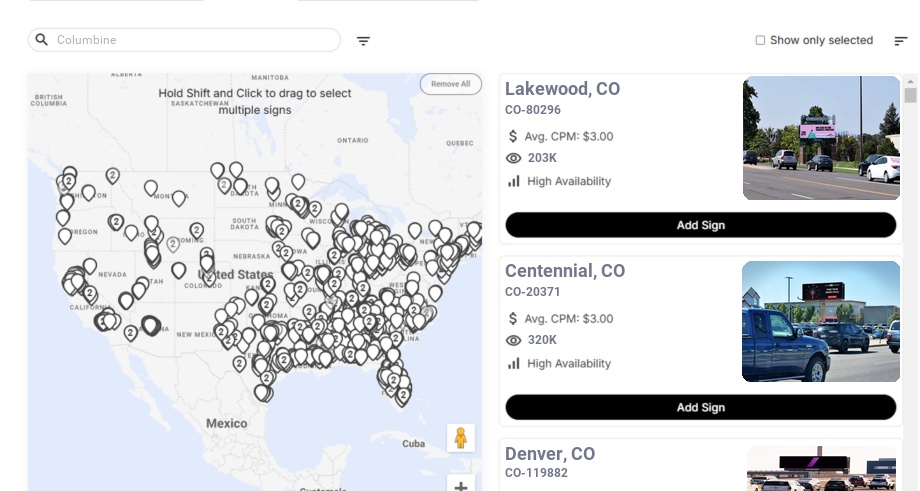
Blip has two nearby digital billboards serving the Columbine area from Lakewood, about 8.5 to 10 miles away. From an advertising standpoint, these placements reach Columbine-area residents through the routes they use to get to work, shopping, and entertainment. The boards also extend reach into Lakewood and nearby communities like Littleton, Morrison, Highlands Ranch, and Columbine Valley.
What kind of audience do Columbine, Colorado billboards reach?
The Columbine area is an unincorporated community in Jefferson County with the profile of a stable, high-income suburb. Median household income in Columbine is in the $105,000–$120,000 range, and owner-occupied housing is typically 80–85% of all occupied units. The area also has a strong share of married-couple families with children and a median age in the low-to-mid-40s.
When is the best time to run Blip billboards in Columbine, Colorado?
There is heavy commuter traffic in the morning, roughly 6:30–9:00 a.m., and evening, 4:00–7:00 p.m., between the Columbine area, Lakewood, and Denver’s core. Midday traffic often maintains 60–75% of peak volume, and weekend volumes remain strong due to shopping, Chatfield State Park, and travel to mountain foothill destinations. Blip can use this pattern to day-part campaigns around morning commutes, evening commutes, and weekend surges.
What roads in Columbine, Colorado have the most traffic for billboard ads?
The Columbine area is framed by several major routes, including Wadsworth Boulevard, South Kipling Parkway, C-470, and US-285. Key segments on these corridors frequently carry tens of thousands of vehicles per day, and some stretches exceed 100,000 vehicles daily. That daily movement makes them strong corridors for billboard advertising near Columbine.
Do I need a contract to advertise with Blip near Columbine?
No, Blip has no long-term contracts or minimum commitments. You can start, pause, or stop your campaign at any time.
How fast can I launch a billboard campaign with Blip near Columbine?
You can have your campaign live in minutes. Create a free account, select your locations, set your budget, upload your design, and start running once approved.
Where can I advertise with Blip near Columbine?
Blip has digital billboards near Columbine. You can browse available locations on a map, choose the ones that fit your audience, and start advertising right away.
Still have questions? Launch a campaign in minutes — no contracts, no commitments.
Start Your CampaignColumbine Billboard Advertising Guide
The Columbine, Colorado area sits at the intersection of affluent suburbs, outdoor lifestyle, and commuter traffic flowing toward Denver and Lakewood. With two nearby digital billboards serving the Columbine area from Lakewood, advertisers can cost‑effectively reach families, professionals, and high‑income homeowners as they move through their daily routines. For brands looking specifically for billboards near Columbine, these placements function like Columbine billboards in practice, capturing the same local audience along their most common routes.
Understanding the Columbine Area Audience
The Columbine area is an unincorporated community in Jefferson County with the profile of a stable, high‑income suburb—ideal for advertisers selling “considered” purchases (home services, healthcare, financial products, education, autos) as well as day‑to‑day retail. That makes billboard advertising near Columbine especially effective for businesses that rely on trust, reputation, and repeat exposure.
Key demographic characteristics (using the Columbine CDP and Jefferson County as proxies):
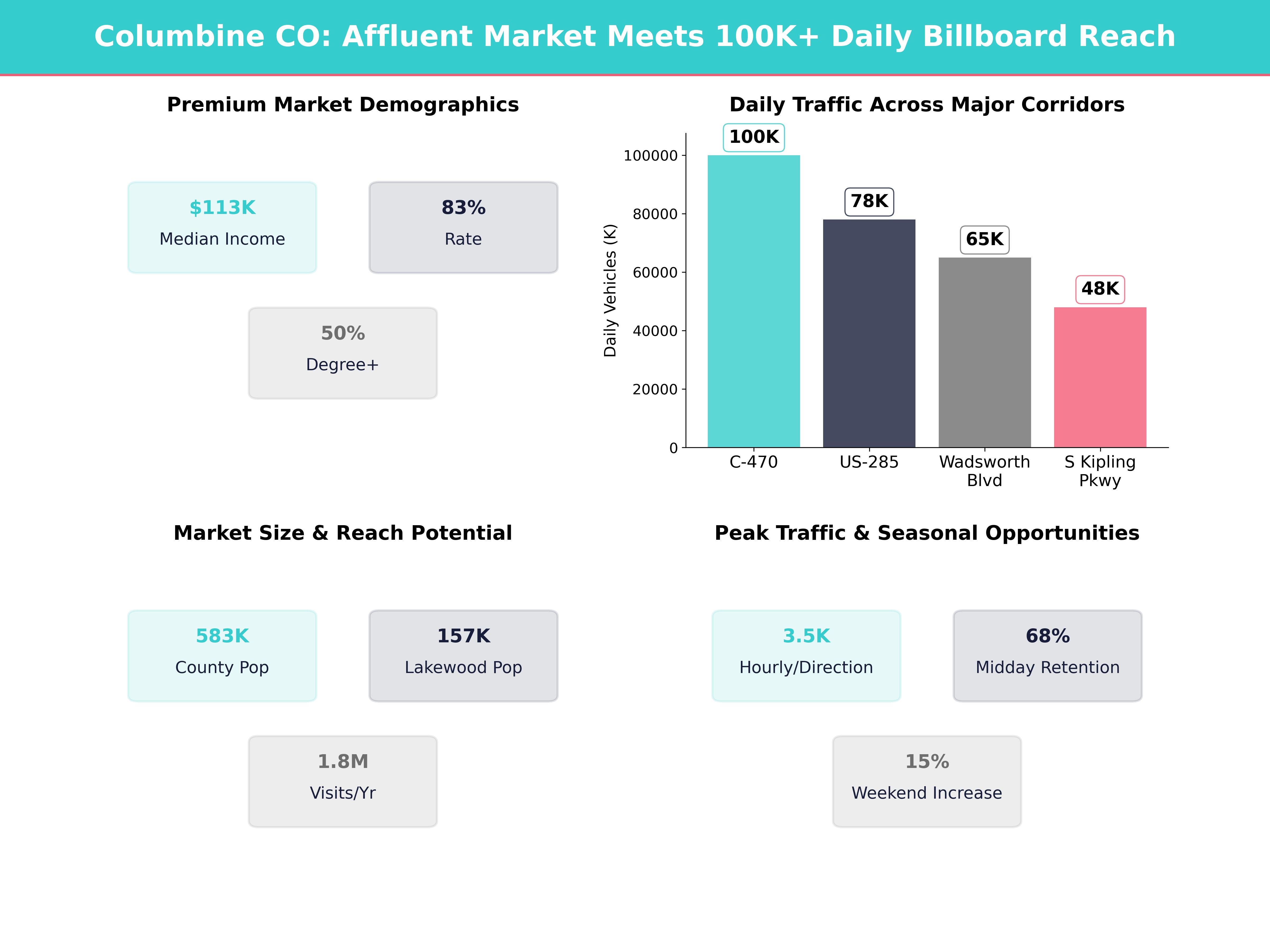
- Population: The Columbine CDP has roughly 25,000–26,000 residents (about 25,000 in the latest full count), while Jefferson County totals about 580,000–585,000 residents. Columbine accounts for roughly 4–5% of the county’s total population.
- Age profile: The median age in the Columbine area is in the low‑to‑mid‑40s (around 43–44 years), roughly 5–6 years older than the U.S. median, reflecting a strong presence of established families and mid‑career professionals. In many nearby Jefferson County suburbs, more than 20–25% of residents are under 18, underscoring the strong family base.
- Household income: Median household income in Columbine is in the $105,000–$120,000 range, compared with Jefferson County overall around the mid‑$80,000s to low‑$90,000s. That places Columbine households roughly 20–30% above metro‑Denver median household income.
- Homeownership: Owner‑occupied housing in Columbine is typically 80–85% of all occupied housing units, compared with closer to 65–70% in many parts of the Denver metro. This indicates long‑term residents invested in their homes and communities.
- Education: In Columbine and adjacent southwest Jefferson County neighborhoods, an estimated 45–55% of adults hold a bachelor’s degree or higher, versus roughly 40–45% in the metro as a whole. This aligns with professional, technical, and managerial occupations.
- Household size: Average household size is about 2.5–2.7 people per household, with a strong share of married‑couple families with children, reinforcing the family‑oriented profile.
These data points suggest several actionable insights for advertisers considering Columbine billboards:
- Premium and “upgrade” offers perform well. With many households earning over $100,000 per year and significant home equity in the area, offers emphasizing quality, reliability, and long‑term value in your billboard copy (e.g., upgraded windows, premium HVAC, financial planning, elective medical services) tend to perform better than bare‑bones discount messaging.
- Family‑centric messaging resonates. The Jeffco Public Schools system serves more than 77,000 students across the county and is a focal point for many households; messaging that references family, safety, education, and community pride aligns with local values.
- Home‑improvement and lifestyle services are strong fits. With homeownership rates above 80% and a large share of homes built in the 1970s–1990s, services like roofing, landscaping, remodeling, solar, and wellness/fitness can capture strong interest as homeowners invest in updates and energy efficiency.
- Commuter and remote‑worker mix. Jefferson County employment data indicate that tens of thousands of residents commute daily to Denver, Lakewood, and the Denver Tech Center, while a growing 20–30% of white‑collar workers report some form of hybrid or remote work. This supports both commute‑focused ads and offers that appeal to people spending more time at home.
For broader context, Jefferson County’s government site Jeffco.us and the City of Littleton community data pages provide useful background on the region’s population, economy, and amenities. Advertisers can also review the Town of Columbine Valley (a nearby high‑income enclave) and Jefferson County Economic Development Corporation for business and income statistics.
How Traffic Flows in the Columbine Area
Even though Blip’s digital billboards serving the Columbine area are located in nearby Lakewood (about 8.5 miles away), drivers from the Columbine area routinely traverse these corridors to reach work, shopping, and entertainment. For billboard advertising near Columbine, what matters most is this daily movement pattern rather than a strict city‑limit boundary.
The Columbine area is framed by several major routes:
- Wadsworth Boulevard (CO‑121) – A primary north–south artery used by Columbine‑area residents heading toward Lakewood and central Denver. CDOT traffic counts on Wadsworth in Lakewood and Jefferson County frequently exceed 60,000–70,000 vehicles per day on key segments.
- South Kipling Parkway – Another key route into Lakewood and along the west side of the metro area, with several stretches handling approximately 40,000–55,000 vehicles daily.
- C‑470 – The beltway linking the Columbine area to I‑25, the Denver Tech Center, and other regional job hubs. Near the Santa Fe and Ken Caryl interchanges, daily traffic routinely runs in the 90,000–110,000 vehicles per day range.
- US‑285 (Hampden Avenue) – A major east–west corridor toward Denver and the foothills, with busy Jefferson County segments carrying around 70,000–85,000 vehicles daily.
According to the Colorado Department of Transportation (CDOT), several segments of these corridors in Jefferson County carry tens of thousands of vehicles per day, with the heaviest stretches exceeding 100,000 vehicles daily. For advertisers, this means:
- There is heavy commuter traffic in the morning (roughly 6:30–9:00 a.m.) and evening (4:00–7:00 p.m.) between the Columbine area, Lakewood, and Denver’s core, correlating with peak flows on Wadsworth, Kipling, and C‑470.
- Midday traffic often maintains 60–75% of peak volume, supported by access to major retail corridors and employment centers.
- Weekend volumes remain strong due to shopping at nearby retail centers, access to Chatfield State Park, and travel to mountain foothill destinations. Chatfield alone records over 1.5–2 million visits per year, driving substantial seasonal traffic past key approaches to the area.
With Blip, we can use this traffic pattern to day‑part campaigns:
- Morning commutes: Promote quick‑decision offers—coffee, QSR, auto repair, gyms, and childcare—when thousands of commuters flow north and east toward Lakewood and Denver each hour.
- Evening commutes: Focus on home services, streaming/entertainment, grocery, restaurants, and events to “catch them on the way home” when outbound traffic from employment hubs surges.
- Weekend/holiday surges: Target outdoor recreation, home improvement, and family entertainment when traffic increases toward parks, trailheads, and shopping districts—especially on sunny spring and summer weekends when CDOT data often show 10–20% higher volumes toward foothill and recreation corridors.
For live traffic and construction updates that can help time campaigns, advertisers can reference CDOT’s travel information, Jefferson County’s transportation & roads resources, and the City of Lakewood traffic alerts page.
Why Lakewood Billboards Are Strategic for Reaching the Columbine Area
Our two digital billboards serving the Columbine area are located in Lakewood, within about 10 miles. From an advertising standpoint, this is a benefit—not a limitation—for several reasons and makes them a smart option for anyone searching for billboards near Columbine or flexible billboard rental near Columbine.
-
Natural travel paths: Columbine‑area residents routinely drive through Lakewood for:
- Employment in Lakewood and downtown Denver. The City of Lakewood itself supports roughly 80,000–90,000 jobs, including major public and private employers.
- Shopping at major retail centers such as Belmar and others along Wadsworth and Kipling, which collectively attract millions of visits per year.
- Access to regional healthcare, professional services, and big‑box retail along Wadsworth, Kipling, and Hampden.
-
Broader reach: Ads near Lakewood not only reach Columbine‑area residents but also:
- Lakewood’s roughly 157,000 residents.
- Commuters from Littleton, Morrison, and Highlands Ranch, as well as nearby communities like Columbine Valley.
- Visitors heading to/from Denver and the foothills via US‑285, C‑470, and I‑70, a corridor that sees tens of millions of vehicle trips annually for recreation and tourism according to regional transportation data.
-
Reinforcement effect: Many Columbine‑area drivers will see your billboard repeatedly along their regular routes. Media research and classic advertising benchmarks indicate that 5–7 exposures within a campaign period can significantly increase ad recall, with some studies showing recall lifts of 20–40% and measurable increases in brand preference when frequency thresholds are met.
Using Blip, we can:
- Constrain your budget so that the majority of impressions occur on faces most aligned with Columbine‑area commute patterns, for example, choosing dayparts when the share of Columbine‑to‑Lakewood traffic is highest.
- Increase your bid and share of voice during peak Columbine‑to‑Lakewood commute times, when hourly traffic on Wadsworth and Kipling may exceed 3,000–4,000 vehicles per direction.
- Rotate different creatives on the same board to test messages aimed at Columbine‑area families versus the broader Lakewood audience and adjust based on response metrics like web visits and calls.
To better understand Lakewood’s economic and demographic context, advertisers can review the City of Lakewood economic development and community profiles, as well as Lakewood Economic Development for business climate and industry data.
Creative Strategies for the Columbine Area
Because the Columbine area is an educated, family‑oriented, and relatively affluent community, creative tone and content matter for any Columbine billboards you run:
1. Match the Visual Style to a Suburban, Outdoor‑Oriented Lifestyle
Locals are proud of their front‑range environment and neighborhood feel. Consider:
- Imagery: Use real or realistic photos of foothills, local parks, cyclists, families at playgrounds, or people enjoying patios and backyard spaces. Nearby amenities like Chatfield State Park, the South Platte River, and Jeffco Open Space trails collectively attract several million visits each year, so outdoor images feel authentic.
- Color palettes: Clear, high‑contrast colors that still feel natural—blues, greens, and warm earth tones—work well against mountain backdrops and changing skies and retain visibility at highway speeds.
- Context cues: Including references like “serving families near Columbine since [year]” or “your southwest Jeffco neighbors” taps into local identity without implying your business is physically in Columbine. References to familiar nearby areas—such as Littleton, Columbine Valley, Ken Caryl, or Lakewood—also ground your brand locally.
2. Speak to Homeowners and Long‑Term Residents
With homeownership around 80–85% and many residents living in the same home for 10+ years, ads that recognize long‑term investment resonate:
- Stress durability and guarantees: “Lifetime roof warranty,” “20‑year window guarantee,” “long‑term financial partner,” etc. Emphasize that upgrades can protect home values that often exceed $500,000–$600,000 in many Columbine‑area neighborhoods.
- Highlight maintenance and upgrades: “Protect your Columbine‑area home,” “Remodel before winter hits the foothills,” “Prep your yard before spring.” This pairs well with local weather patterns—Front Range hail, snow, and sun can all drive demand.
-
Use specific, valuable numbers: Examples:
- “Cut your energy bill by up to 30%.”
- “0% APR for 12 months on projects over $5,000.”
- “Emergency service in under 60 minutes.”
- “Save up to $1,000 with our fall furnace special.”
3. Keep It Minimal but Information‑Rich
Given vehicle speeds on corridors serving the Columbine area—typically 35–45 mph on arterials and 55–65 mph on C‑470 and US‑285—focus on:
- One core idea per creative.
- No more than 7–10 words of main text, plus a logo/URL or short vanity domain, which testing in many OOH campaigns has shown to significantly improve recall.
-
One strong call to action (CTA):
- “Book your free roof inspection”
- “Enroll by August 15”
- “Download your coupon today”
Because Blip supports running multiple creatives simultaneously, we can:
- Create separate designs for awareness (“Who we are”) and offer‑driven (“What you get now”).
- Run A/B tests with 2–3 headline variations and monitor which creatives drive more search or direct traffic, using unique URLs or promo codes.
Advertisers can also look at design tips and readability guidelines from organizations like Downtown Denver Partnership and local wayfinding/transportation documents from Jeffco.us for inspiration on high‑visibility graphics.
Timing Your Campaign Around Local Rhythms
Local calendars and routines strongly influence when Columbine‑area residents are most receptive to billboard messages.
School Year and Family Routines
The Columbine area is closely tied to Jeffco Public Schools and nearby districts:
- Jeffco is one of Colorado’s largest school districts, with 155+ schools and more than 77,000 students, creating heavy morning and afternoon traffic around campuses and main corridors.
-
Back‑to‑school (Aug–Sept):
- Promote tutoring, after‑school programs, pediatric care, dentists, clothing, and school‑supplies retailers.
- Increase impressions during morning and afternoon commute windows when school traffic peaks and bus routes add to volume.
-
Winter and spring breaks:
- Push travel, indoor attractions, ski rentals, and family entertainment; mountain‑bound traffic on weekends can spike by 10–25% on key routes.
-
Graduation season (May–June):
- Target florists, event venues, photography, and gift retailers when families are actively planning events and celebrations.
Check the Jeffco Public Schools calendar to sync campaigns with major dates, and consider layering messaging around events listed on Foothills Park & Recreation District and City of Littleton events pages.
Outdoor & Recreation Seasons
Columbine‑area residents make heavy use of nearby recreation areas like Chatfield State Park, the South Platte River trails, and foothill parks managed by Jeffco Open Space:
- Jeffco Open Space reports over 7 million annual visits across its parks and trails, much of it funneled through the same road network your billboards tap into.
-
Spring (March–May):
- Great for landscape services, garden centers, outdoor gear, and fitness.
- Weekends show strong travel to parks; increase weekend bids when trail use and park visitation can climb by 20–30% on mild days.
-
Summer (June–August):
- Focus on HVAC, roofing, outdoor furniture, recreation gear, and family attractions as temperatures frequently reach the 80s–90s and residents look for cooling and outdoor upgrades.
-
Fall (September–November):
- Emphasize home weatherization, roofing, financial planning (year‑end), and indoor activities. Many homeowners plan larger projects before the first substantial snow, which in the Denver area often falls in October or November.
-
Winter (December–February):
- Promote holiday retail, tax prep, healthcare, and ski/snow activities, especially on Fridays and Sundays when mountain travel peaks.
CDOT’s winter travel alerts and Jefferson County’s park usage trends (via Jeffco Open Space) can help identify peak travel times to and from mountain and foothill destinations. Tourism calendars from Visit Denver and Visit Littleton can help align campaigns with larger regional visitor surges.
Leveraging Local News, Events, and Community Identity
Local media and civic life shape what people in the Columbine area talk about and care about.
Key outlets and institutions include:
- The Denver Post – regional news, politics, features.
- 9NEWS (KUSA) – local and regional TV news.
- City of Littleton – events and community updates just east of the Columbine area.
- Visit Denver – metro‑area tourism, events, and attractions.
- Colorado Community Media and local titles such as the Lakewood Sentinel and Columbine Courier – hyperlocal Jefferson County news, sports, and community coverage.
Practical ways to leverage this:
-
Tie into widely known events and seasons:
- Denver Broncos and Colorado Rockies seasons, which draw tens of thousands of fans per game and spur related retail and hospitality spending.
- Major festivals and concerts in the metro area, many promoted through Red Rocks Park & Amphitheatre and downtown venues.
-
Use billboards to “amplify” local campaigns:
- If you sponsor a local youth sports league, 5K race, or school fundraiser, run creative that mentions it: “Proud supporter of Columbine‑area youth sports.” Recreation districts like Foothills Park & Recreation District serve thousands of youth participants annually—visibility in this space builds credibility.
-
Align messaging with local concerns:
-
Traffic, safety, wildfire smoke/air quality, and cost of living are frequent topics. For example:
- Insurance agents: “Wildfire‑ready coverage for your Columbine‑area home.”
- Healthcare providers: “Breathe easier—same‑day respiratory care near you.”
- Jefferson County and Lakewood both publish regular updates on safety and emergency preparedness via Jeffco Public Safety & Emergency Management and Lakewood Police—these can inform timely, relevant messaging.
-
Traffic, safety, wildfire smoke/air quality, and cost of living are frequent topics. For example:
Example Strategies by Business Type
To make this more concrete, here are sample approaches using Blip’s flexible tools for different types of advertisers targeting the Columbine area and evaluating billboard rental near Columbine.
Home Services (Roofing, HVAC, Solar, Landscaping)
- Who you’re targeting: Homeowners with above‑average incomes and longer‑term ownership; in many Columbine‑area neighborhoods, 70–80% of occupied homes are owner‑occupied and a large share are single‑family houses.
-
When to show:
- Weekday mornings and evenings along Columbine‑to‑Lakewood routes when commuter volumes on key roads exceed 3,000 vehicles per hour in each direction.
- Weekends during spring and fall when project planning spikes and hardware/home centers see elevated traffic.
-
Creative ideas:
- “Columbine‑area roofs repaired in 24 hours – Call [short URL]”
- “Cut your energy bill up to 30% – Local solar experts”
- “HVAC tune‑up just $79 – Book this week”
-
Blip tactics:
- Increase your maximum bid during weather events (after hail, snow, heat waves) when homeowners urgently seek repairs; Front Range hailstorms can generate thousands of insurance claims in a single event.
- Run one awareness creative year‑round and rotate seasonal offer creatives (spring tune‑up, fall furnace checks, pre‑summer A/C specials) to match local climate patterns.
Healthcare & Dental
- Who you’re targeting: Families with children, older adults, and insured professionals; in Jefferson County, insured rates are typically above 90%, supporting demand for preventive and elective care.
-
When to show:
- Morning commute and lunchtime (booking time).
- Early evening for urgent‑care and walk‑in services when many clinics see their daily peak in visit volume.
-
Creative ideas:
- “Pediatric care near Columbine – Same‑day appointments”
- “Emergency dental tonight? Call now – [short phone number]”
- “New patient special: exam + cleaning for $99”
-
Blip tactics:
- Use dayparting to emphasize urgent‑care services after 4 p.m. and on weekends; many urgent‑care centers report 25–35% of visits in evening hours.
- Rotate creatives emphasizing different service lines: family medicine, pediatrics, orthopedics, or dentistry, and track which service‑line promos generate the strongest response.
Local Retail & Restaurants
- Who you’re targeting: Columbine‑area residents shopping or dining in Lakewood and Littleton, plus regional visitors passing through. Retail centers like Belmar and southwest Littleton hubs attract hundreds of thousands to millions of visits per year.
-
When to show:
- Midday and late afternoon for lunch and dinner decisions.
- Weekends for shopping and leisure, especially Friday evenings through Sunday afternoons when retail foot traffic is highest.
-
Creative ideas:
- “Dinner 10 minutes from the Columbine area – Exit at [landmark]”
- “Locally owned boutique – Show this screen for 10% off”
- “Kids eat free on Tuesdays – [Restaurant name]”
-
Blip tactics:
- Increase impressions on Fridays and Saturdays, when restaurant revenues often run 30–40% higher than weekdays.
- Use multiple creatives to promote different specials on different days (“Taco Tuesday,” “Weekend brunch,” etc.), tracking which callouts correlate with higher web or map‑search traffic.
Professional Services (Financial Advisors, Attorneys, Real Estate)
- Who you’re targeting: Higher‑income professionals and homeowners in their 30s–60s; in Columbine‑area ZIP codes, a meaningful share of households report incomes above $150,000, and home values frequently exceed the metro median.
-
When to show:
- Weekday rush hours and midday when decision‑makers commute and run errands.
-
Creative ideas:
- “Plan your retirement – Trusted advisors serving the Columbine area”
- “Move up, not out – Free home value estimate today”
- “Estate plans starting at $X – Call for a free consult”
-
Blip tactics:
- Keep offers high‑level and credibility‑oriented: years in business (“Serving southwest Jeffco for 20+ years”), assets under management, or “Rated 4.8/5 stars by local clients.”
- Run heavier flighting around tax season (January–April), year‑end financial planning windows (October–December), and the spring home‑buying season, when listing volumes historically spike across Jefferson County.
Using Data to Measure and Improve Your Results
Because we’re working with digital billboards serving the Columbine area from Lakewood, we can treat your campaign like any other digital channel: measurable, testable, and optimizable. This applies whether you’re testing a single Columbine billboard or a broader slate of placements.
To close the loop:
-
Align billboard timing with your analytics
-
In your web analytics, create annotations when:
- A new creative launches.
- You significantly change budget or dayparts.
- Monitor direct traffic, brand‑search volume, and landing‑page visits during heavy impression periods. Many OOH advertisers see 10–30% lifts in branded search during strong flight periods.
-
In your web analytics, create annotations when:
-
Use unique tracking elements
- Short URLs or landing pages unique to billboard traffic (e.g.,
yourbrand.com/columbine). - Billboard‑specific promo codes: “Mention code COLUMBINE20.”
- A unique phone number (call tracking) used only on billboard creatives; call‑tracking data can reveal which days and times produce the highest response.
- Short URLs or landing pages unique to billboard traffic (e.g.,
-
Run structured A/B tests
-
Test two creatives at a time:
- Version A: Emphasizes brand/credibility (e.g., “20 years serving southwest Jeffco”).
- Version B: Emphasizes a compelling offer (e.g., “Save $500 this month”).
- Compare which version correlates with better web or call response during equal impression windows. Aim for enough impressions (often tens of thousands per creative) before making decisions.
-
Test two creatives at a time:
-
Adjust bids and schedules based on performance
- If you see disproportionate response during specific hours or days, we can raise your bids for those windows and reduce spend in lower‑performing slots.
- If a message underperforms, swap it quickly—digital makes creative turnover fast and inexpensive, letting you test several concepts in the span of a few weeks rather than committing to a static message for months.
Bringing It All Together for the Columbine Area
Advertising on digital billboards serving the Columbine area through nearby Lakewood allows us to tap into:
- A stable, affluent homeowner base with strong spending power, high homeownership (around 80–85%), and median household incomes often exceeding $100,000.
- High‑volume commuter traffic between Columbine, Lakewood, and Denver, with key corridors carrying tens of thousands to over 100,000 vehicles per day.
- A population deeply engaged in schools, outdoor recreation, and neighborhood life, reflected in strong participation in Jeffco schools, parks, and community programs.
By combining local demographic insights, traffic patterns supported by CDOT and Jefferson County data, and Blip’s flexible scheduling and creative testing tools, we can build campaigns that are:
- Highly visible to Columbine‑area residents on their daily routes via billboards near Columbine and on their key commute corridors.
- Tuned to local rhythms—school schedules, recreation seasons, and regional events documented by entities like Jeffco.us, the City of Lakewood, and the City of Littleton.
- Continuously optimized for performance based on real‑world response, making billboard rental near Columbine as accountable and data‑driven as your other digital channels.
With the right mix of message, timing, and location, digital billboards serving the Columbine area can become a powerful, measurable pillar in your overall marketing strategy.