Billboards near Fruita, CO
No Minimum Spend. No Long-Term Contracts. Just Results.
Trusted by Leading Brands


Billboard advertising
near Fruita has never been easier
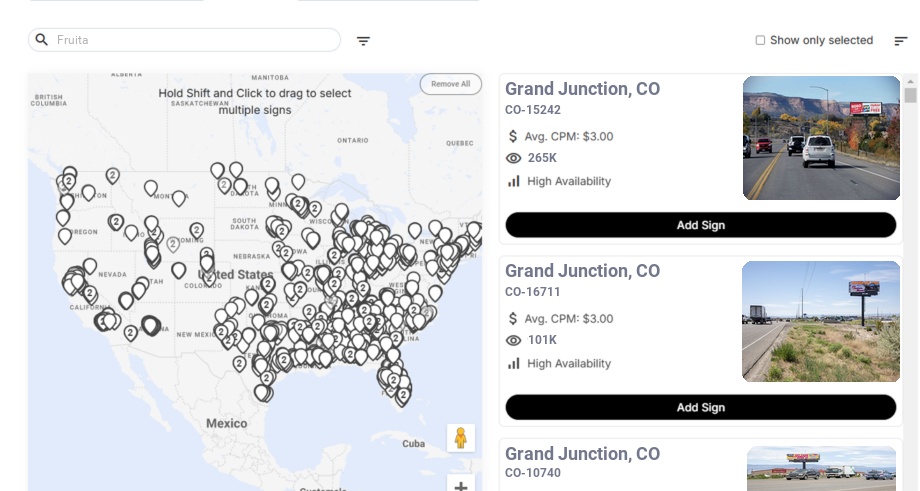



How much is a billboard near Fruita?
Why Choose Blip for Billboard Advertising near Fruita
-
Blip lets you launch Fruita billboards in minutes and reach I-70 commuters plus Grand Junction drivers without a traditional buy.
-
Set a flexible daily budget for Fruita and stay in control as traffic swells on I-70, US-50, and weekend event corridors.
-
Use dayparting in Fruita to hit morning commuters, midday tourists, and evening return traffic from the trails and Monument.
-
No contracts mean Fruita businesses can test ads around Fat Tire Festival, Fall Festival, or peak biking season, then adjust fast.
-
Blip’s real-time analytics help Fruita advertisers see what works and shift spend as visitation rises in spring and fall.
-
Create and rotate fresh visuals for Fruita with Blip, from trailheads and local families to healthcare, retail, and hiring messages.
Frequently Asked Questions About Billboard Advertising near Fruita
How much does a billboard cost near Fruita, Colorado with Blip?
With Blip, advertising on Fruita billboards is flexible and affordable for any budget because you only pay per blip—a 7.5 to 10-second ad display on digital billboards near Fruita, Colorado. You choose your daily budget when setting up your campaign, and Blip automatically keeps your Fruita-area ads within that limit, so costs never spiral beyond what you’re comfortable spending. Pricing for each blip changes based on when and where your ad runs and on advertiser demand, and your total cost is simply the sum of all the blips you receive.
Where can I place billboards near Fruita, Colorado with Blip?
Our three digital billboards serving the Fruita area are in nearby Grand Junction, roughly 10 miles from Fruita. That matters because of how people actually move through the region and how often they encounter Fruita billboards on their regular routes. Focus on the three digital billboards in Grand Junction that drivers from the Fruita area are most likely to pass—especially along I-70, US-50, and main urban arterials with 20,000+ vehicles per day.
What kind of audience can Fruita, Colorado billboards reach with Blip?
A campaign near the Fruita area actually taps into a regional market of 150k+ residents plus 1M+ annual visitors, many of whom pass through the same key corridors multiple times during a trip. Messaging can speak both to “locals” (families, workers, students) and “adventure visitors” (cyclists, hikers, road-trippers) passing between Fruita and Grand Junction. Fruita and Grand Junction together support a strong base of working-age adults and families with children.
When is the best time to run Blip ads in Fruita, Colorado?
The Fruita area’s rhythms are predictable enough to benefit from time-of-day targeting. Morning Commute (6–9 a.m.) is great for Fruita-to-Grand Junction commuters, students, and shift workers, while Afternoon/Evening (3–7 p.m.) reaches return commute, school pickups, and post-ride traffic. We can also layer in midday and weekend coverage to catch tourists and leisure travelers, especially during peak event and recreation seasons.
Why are Fruita, Colorado billboards a good choice for local businesses?
Because Fruita combines a growing local population, a robust outdoor tourism draw, and strong daily movement along I-70 toward Grand Junction, it punches above its size from an advertising standpoint. The area offers access to 160,000+ local residents and exposure to 1M+ annual visitors whose spending is heavily concentrated in lodging, dining, and recreation. Daily traffic volumes on nearby corridors routinely reach tens of thousands of vehicles per day, with seasonal and event-driven peaks that can elevate impressions by 10–25%.
Do I need a contract to advertise with Blip near Fruita?
No, Blip has no long-term contracts or minimum commitments. You can start, pause, or stop your campaign at any time.
How fast can I launch a billboard campaign with Blip near Fruita?
You can have your campaign live in minutes. Create a free account, select your locations, set your budget, upload your design, and start running once approved.
Where can I advertise with Blip near Fruita?
Blip has digital billboards near Fruita. You can browse available locations on a map, choose the ones that fit your audience, and start advertising right away.
Still have questions? Launch a campaign in minutes — no contracts, no commitments.
Start Your CampaignFruita Billboard Advertising Guide
Fruita, Colorado sits at the crossroads of outdoor adventure, agriculture, and regional commerce on Colorado’s Western Slope. With three digital billboards near Fruita serving the area from nearby Grand Junction, we can reach daily commuters, destination tourists, and local families as they move along I‑70 and the main corridors connecting Fruita to the rest of Mesa County. This guide walks through how to translate what makes Fruita unique into a smart, data‑driven digital billboard strategy for businesses comparing Fruita billboards and other local options.
Understanding the Fruita Area Market
Fruita is a small but fast‑growing hub within Mesa County:
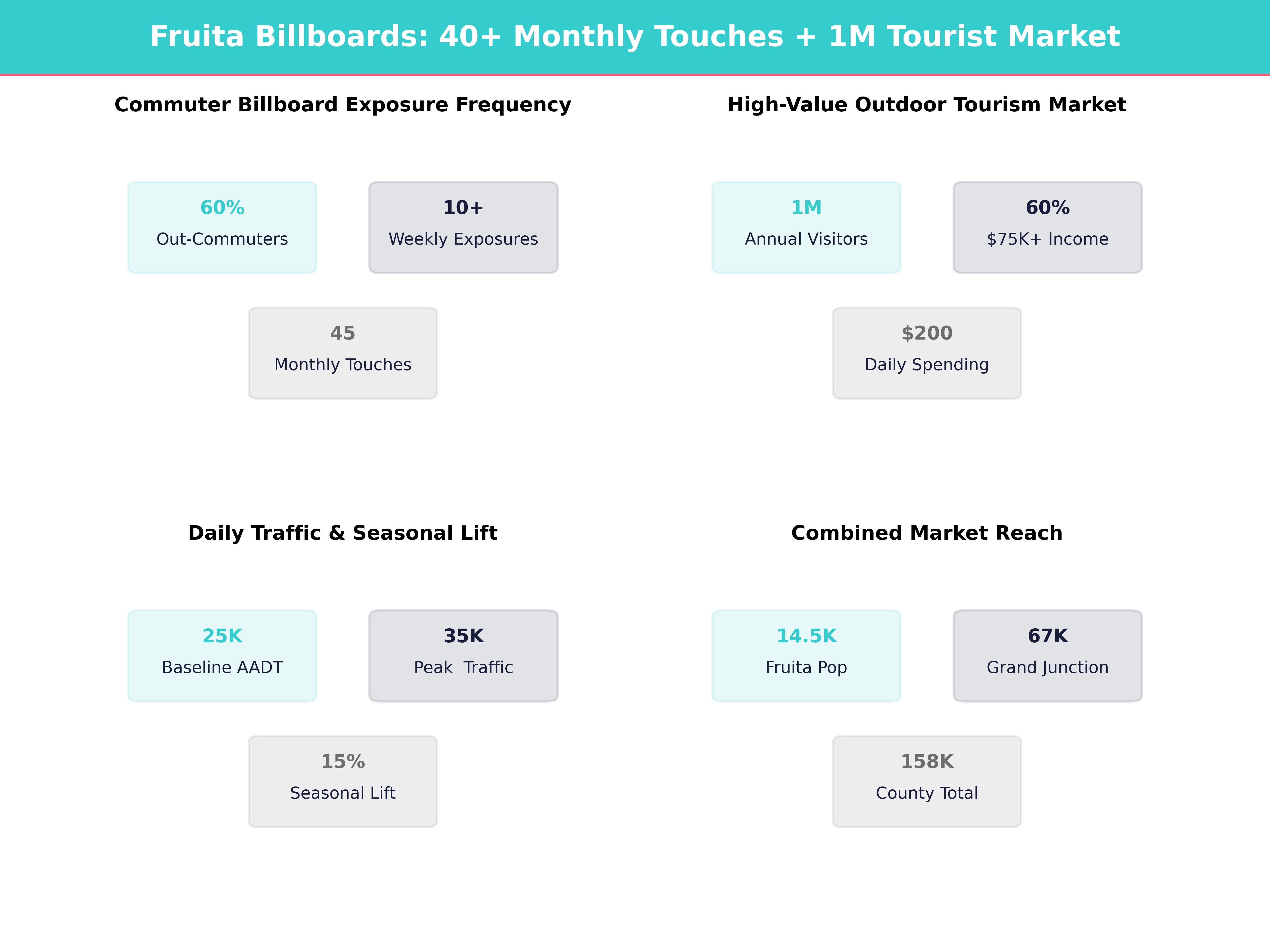
- The City of Fruita estimates its population at roughly 14,000–15,000 residents, up from about 12,600 in 2010, a growth rate of 10–15% over the past decade, reflecting strong Western Slope in‑migration and new housing development on the north and east sides of town.
- Nearby Grand Junction—where our three digital billboards are located—has about 67,000 residents, and Mesa County overall is home to roughly 160,000–155,000 residents, depending on the estimate year, according to Mesa County and the Colorado State Demography Office.
- Mesa County’s median household income is in the $60,000–$65,000 range, with about 55–60% of households owning their home, indicating a solid base of stable, working‑ and middle‑class families.
- According to Mesa County’s economic profiles, healthcare, retail, tourism, agriculture, education, and energy services are major employment sectors. Healthcare and social assistance alone accounts for roughly 14–16% of jobs, retail for around 11–12%, and leisure & hospitality (tourism‑linked industries) for roughly 10–12%, giving the area a broad mix of blue‑collar and white‑collar audiences.
Travel and tourism heavily amplify the local population:
- Visit Grand Junction reports over 1 million annual visitors to the Grand Junction area, with visitation growing steadily since 2020 as outdoor and drive‑to destinations surged in popularity.
- Nearby Colorado National Monument, immediately south of the Fruita area, draws roughly 375,000–400,000 visitors per year, according to the National Park Service, with peak visitation in April–May and September–October.
- Tourism has a meaningful economic footprint: statewide travel data show that visitor spending in Mesa County reaches hundreds of millions of dollars annually, supporting an estimated 4,000–5,000 local jobs in lodging, food service, retail, and recreation.
- Fruita is a nationally known mountain‑biking town; the Fruita Fat Tire Festival, Fruita Fall Festival, and related events together attract tens of thousands of attendees across the spring and fall event seasons, filling local lodging and restaurants and significantly boosting weekend traffic counts.
What this means for advertisers:
- A campaign near the Fruita area actually taps into a regional market of 150k+ residents plus 1M+ annual visitors, many of whom pass through the same key corridors multiple times during a trip, making billboard advertising near Fruita an efficient way to reach both locals and visitors.
- Visitor studies from mountain‑bike‑driven destinations on the Western Slope show that multi‑day outdoor visitors often spend $150–$250 per person per day on lodging, food, and activities—high‑value consumers for billboard advertisers in hospitality, retail, and dining.
- Messaging can speak both to “locals” (families, workers, students) and “adventure visitors” (cyclists, hikers, road‑trippers) passing between Fruita and Grand Junction.
Traffic Flows and Where Our Boards Fit In
Our three digital billboards serving the Fruita area are in nearby Grand Junction, roughly 10 miles from Fruita. That matters because of how people actually move through the region and how often they encounter Fruita billboards on their regular routes:
- I‑70 is the backbone. Colorado Department of Transportation (CDOT) traffic counts show Average Annual Daily Traffic (AADT) of roughly 20,000–30,000 vehicles per day along I‑70 west of Grand Junction near Fruita, with some segments near Grand Junction interchanges exceeding 35,000 vehicles per day. Weekend and holiday peaks can push volumes 10–20% higher.
- US‑6/US‑50 and key arterials in Grand Junction—such as North Avenue, Patterson Road, and Hwy 340 toward Fruita—carry much of the daily commuting between Fruita, Grand Junction, and Palisade, together handling tens of thousands of additional daily vehicle trips through the core urban area.
- Regional travel surveys indicate that well over 60% of Fruita’s employed residents commute outside the city for work, with Grand Junction being the dominant destination, further concentrating impressions along these corridors.
Practically, this means:
- Many Fruita residents commute toward Grand Junction for work, shopping, healthcare, and school. For a 5‑day workweek, a typical Fruita commuter will pass our digital boards 10+ times per week, equating to 40–50 exposures per month for a well‑dayparted campaign. For advertisers exploring billboard rental near Fruita, that frequency is a major advantage.
- Visitors staying in Grand Junction hotels or vacation rentals—Grand Junction has 3,000+ hotel rooms and short‑term rentals—often drive to Fruita for recreation (mountain biking at 18 Road or Kokopelli, river access, or the Colorado National Monument entrance) and then return through Grand Junction corridors where our billboards are located. Many of these visitors make multiple out‑and‑back trips over a long weekend, multiplying exposure.
When we schedule campaigns through Blip:
- We can focus impressions during morning and evening commute windows to reliably reach Fruita‑area commuters; in many Western Slope commuter corridors, 40–50% of daily traffic passes during these combined windows.
- We can layer in midday and weekend coverage to catch tourists and leisure travelers, especially during peak event and recreation seasons when hotel occupancy in Grand Junction and Fruita can climb into the 70–90% range on weekends.
Key Audience Segments in the Fruita Area
By understanding who we are talking to, we can sharpen creative and targeting and make billboard advertising near Fruita more effective:
-
Outdoor Enthusiasts & Tourists
- Drawn by mountain biking, rafting, hiking, off‑roading, and scenic drives, especially to Colorado National Monument and the nearby McInnis Canyons National Conservation Area.
- According to regional tourism data cited by Visit Fruita and Visit Grand Junction, outdoor recreation visitors consistently rate trails and scenery among the top reasons for visiting, with many trips originating from Colorado’s Front Range and neighboring states like Utah and Arizona.
- Outdoor visitors tend to have mid‑ to high‑disposable income; statewide surveys show that more than 60% of Colorado mountain‑bike tourists report household incomes above $75,000, and a significant share above $100,000.
- Responsive to simple, action‑oriented calls to action: “Gear Up 2 Exits Ahead,” “Local Beer After Your Ride,” “Book Tonight’s Room Now.”
-
Local Families and Workers
- Fruita and Grand Junction together support a strong base of working‑age adults and families with children; Mesa County’s median age is around 39–40, and roughly 25% of residents are under 18, creating a large family audience.
- School systems such as School District 51 serve over 20,000 students across more than 40 schools, indicating a significant family segment that drives regular weekday traffic for school drop‑offs, sports, and activities.
- Responsive to value, convenience, and routine: childcare, healthcare, groceries, local restaurants, and events. Local survey work by Mesa County Public Health shows that residents frequently cite cost of living, access to healthcare, and family activities as top priorities—helpful framing for family‑oriented creative.
-
Agriculture and Energy Community
- Mesa County’s economy includes orchards, vineyards, ranching, and energy services, especially natural gas and support services on the Western Slope. According to county economic reports, agriculture and related processing contribute tens of millions of dollars annually in direct output, while mining and energy sectors account for several percent of total employment.
- Many residents in these sectors work irregular hours and may travel across county roads and highways that feed into Grand Junction and Fruita, generating early‑morning and late‑afternoon/evening traffic patterns.
- Responsive to business services, equipment, workforce recruitment, and financial offerings, especially when messages emphasize reliability, uptime, and local knowledge.
-
University and Young Adult Segment
- Colorado Mesa University in Grand Junction enrolls over 10,000 students and employs 1,000+ faculty and staff, many of whom recreate, shop, or work in the Fruita area.
- CMU has grown its enrollment more than 30% over the past decade, expanding the pool of 18‑ to 24‑year‑olds in the region with discretionary spending on food, entertainment, and recreation.
- Responsive to entertainment, nightlife, fitness, food, and affordable services, as well as gig‑ and part‑time job opportunities.
Blip’s flexibility allows us to tailor campaigns to these segments with different creatives, time‑of‑day strategies, and even day‑of‑week strategies that map to their routines, turning Fruita billboards into a finely tuned local and visitor touchpoint.
Seasonal and Event‑Driven Timing Strategies
The Fruita area has clear seasonal patterns that we can turn into campaign advantages, backed by tourism and traffic data from Visit Grand Junction, Visit Fruita, and CDOT.
Spring (March–May)
- Peak for mountain biking, road cycling, and shoulder‑season tourism as snow lingers in higher Colorado elevations. Trail use counts on popular systems like 18 Road and Kokopelli regularly spike 30–50% over winter baselines.
- The Fruita Fat Tire Festival and other events draw thousands over a concentrated few days, often pushing weekend lodging occupancy near 100% in Fruita and into the 80–90% range in Grand Junction.
-
Strategy:
- Increase bids and share of impressions 1–2 weeks before and during events, when online search and social interest also surge.
- Highlight lodging, dining, gear, and transportation offers—categories that see double‑digit percentage revenue bumps during event weekends.
- Use short, event‑specific creatives (“Festival Weekend: Happy Hour in 10 Minutes”).
Summer (June–August)
- Tourist volumes remain high; rafting, river play, and family road trips increase, and CDOT data often show summer weekend traffic volumes 10–20% above annual averages on I‑70.
- Temperatures often hit the 90s°F, and Grand Junction/Fruita can log 20–30 days per year above 95°F, which makes messages about cold drinks, indoor attractions, or evening activities especially compelling.
-
Strategy:
- Run extended daytime coverage for roadside impulse decisions: ice cream, shade, pools, indoor fun.
- Include heat‑related hooks: “It’s 96°—Cool Off at [Brand] Exit 26.” Weather‑triggered creative can align with days when energy use and indoor visitation spike.
Fall (September–October)
- Still strong for biking and hiking; harvest season kicks in for orchards and wineries near Palisade, highlighted by events promoted by Visit Palisade. Agritourism sites report some of their highest‑revenue weekends during fall festivals and U‑pick events.
- Back‑to‑school and college semester starts shape routines; School District 51’s academic calendar sends tens of thousands of daily trips along major arterials for drop‑off and pick‑up.
-
Strategy:
- Shift some budget to weekday commute hours for parents and students.
- Promote fall events, pumpkin patches, vineyards, and local retail, focusing on short‑drive experiences within 15–30 minutes of Fruita/Grand Junction.
- For B2B, focus on Q4 planning and workforce recruitment while schedules stabilize.
Winter (November–February)
- Tourist volumes dip, but local shopping and services become more important; retail sales data across Colorado show November–December can account for 20–25% of annual revenue for many retailers.
- Holiday travel on I‑70 and around the region increases, with CDOT noting consistent traffic surges around Thanksgiving, Christmas, and New Year’s.
-
Strategy:
- Emphasize holiday retail, automotive, financial services, and healthcare (flu shots, urgent care, elective procedures planned around year‑end benefits).
- Use short, urgency‑based messages: “Holiday Sale Ends Sunday,” “Flu Shots Today.”
- Take advantage of typically lower CPMs outside of peak tourist months to build brand presence cost‑effectively.
With Blip, we can dial spending up or down by season, or even by specific festival weekends and holiday periods, rather than committing to a static year‑long schedule for billboard rental near Fruita.
Creative Best Practices for the Fruita Area
Because our billboards serve the Fruita area from Grand Junction, drivers are often at highway speeds or navigating busy arterials. Effective artwork must be built for quick comprehension.
1. Design for Outdoor & Travel Context
- Assume 3–6 seconds of viewing time, consistent with outdoor advertising industry norms at highway speeds of 55–65 mph.
-
Use one main message and a simple call to action:
- “Fuel & Food – Next Fruita Exit”
- “Book Tonight in Fruita – Scan Later at [Short URL]”
- Large, high‑contrast colors work well against Western Slope landscapes, which are often tan, red, and blue (sky). Bright whites, bold blues, and rich blacks usually stand out.
2. Leverage Geography Explicitly
People in the Fruita area know their landmarks. Use them:
- “2 Miles Before Fruita Exit” or “On Your Way to Colorado National Monument?”
- “Post‑Ride Burgers – 10 Minutes from 18 Road Trails”
- Reference recognizable hubs like Downtown Fruita, the Fruita Community Center, or popular trailheads when relevant.
- For service businesses in Grand Junction but serving Fruita‑area residents, try: “Trusted by Fruita Riders and Families Since 2005.”
3. Speak to Outdoor Culture
Fruita’s identity is heavily tied to outdoor recreation:
- Visuals: bikes, mesas, river scenes, trail silhouettes, and the distinct rimrock skyline that visitors will recognize from Colorado National Monument imagery.
- Language that fits the culture: “Ride. Refuel. Repeat.” or “Sleep Where the Trails Start.”
- For non‑outdoor brands (e.g., banks, clinics), connect to lifestyle: “Finance Your Adventure Van,” “Weekend Warrior? Get Same‑Day Care.”
4. Use Dynamic and Rotating Creative
Because Blip allows us to upload multiple creatives and rotate them:
- Run one local‑audience creative (e.g., weekday commute offers for residents) and one tourist‑oriented creative (e.g., weekend or midday focus on lodging or attractions).
- Use A/B variations on headline or imagery to see what drives more engagement (measured through correlated web traffic, phone calls, or in‑store feedback). Businesses that continuously test creative typically report 10–30% improvements in response rates over static, single‑creative campaigns.
Dayparting: Reaching the Right People at the Right Time
The Fruita area’s rhythms are predictable enough to benefit from time‑of‑day targeting:
-
Morning Commute (6–9 a.m.)
- Fruita‑to‑Grand Junction commuters, students, and shift workers. Regional commuting data indicate that over half of workers start shifts between 6–9 a.m.
- Great for coffee shops, breakfast spots, radio stations, daily deals, and traffic‑oriented services.
-
Midday (11 a.m.–2 p.m.)
- Tourists in transit, retirees, service workers on break, and families on day trips; many lodging properties report check‑out and check‑in windows around this period, further boosting drive‑time activity.
- Ideal for restaurants, attractions, shopping, and healthcare (same‑day appointments).
-
Afternoon/Evening (3–7 p.m.)
- Return commute, school pickups, post‑ride traffic; in many corridors this period can represent 35–45% of daily traffic.
- Good for groceries, family dining, fitness, entertainment, and events.
-
Evening/Night (7–11 p.m.)
- Road‑trippers, late‑shift workers, visitors heading back to lodging.
- Excellent for lodging reminders, nightlife, late‑night food, and highway safety messages.
With Blip, we can concentrate budget on whichever dayparts align best with a campaign goal—e.g., only running 6–9 a.m. and 4–7 p.m. if we are focused on local commuting Fruita‑area residents.
Industry‑Specific Strategies for the Fruita Area
Tourism, Lodging, and Attractions
- Place strong emphasis on distance and direction: “Exit 19 – 5 Minutes to Our Campground.” Studies of traveler behavior show that over 70% of road‑trip lodging decisions are made the same day, making clear directional cues powerful.
- Tie into well‑known resources like Visit Fruita and Visit Grand Junction by reinforcing messages seen online or in print. Consistent branding across channels can lift ad recall by 20–30%.
- Use limited‑time or conditions‑based messaging: “Tonight Only: 10% Off Walk‑Ins” during busy festival weekends or holiday periods when occupancy is high and visitors are actively searching for last‑minute options.
Restaurants and Bars
- Capture outdoor visitors post‑ride or post‑hike with timing: show food creatives more heavily 3–9 p.m., when they’re heading back toward Grand Junction and Fruita after trail time.
- Highlight local features (craft beer, local beef, live music). Visitors surveys in Western Colorado show that local/independent restaurants and breweries are a top‑three spending category for overnight visitors, often accounting for 25–35% of trip budgets outside of lodging.
- Simple, appetite‑driven visuals (burgers, tacos, pints) perform well on busy roadways and can increase engagement and recall versus text‑heavy ads.
Healthcare and Professional Services
- Fruita‑area residents frequently travel into Grand Junction for medical, dental, and specialized services, with St. Mary’s Medical Center and Community Hospital acting as regional anchors.
- Emphasize easy access and trust: “Same‑Day Appointments – 10 Minutes from Fruita,” “Serving Mesa County Families for 25 Years.” Healthcare marketing studies show that ease‑of‑access messaging can lift appointment inquiries by 10–20%.
- Consider targeting weekday dayparts when people are most likely to call and schedule (typically 8 a.m.–5 p.m.), and layering heavy exposure on Mondays and Tuesdays, when many residents plan appointments for the week.
Retail and Local Businesses
- Use messages that underline local roots, as Western Slope residents respond strongly to supporting local: “Western Slope‑Owned Since 1998.” Local‑first messaging has been shown in surveys by chambers of commerce to influence 40–60% of shoppers when choosing between similar options.
- For big‑ticket items (furniture, vehicles, equipment), keep the message simple and brand‑centric: “Your Truck Upgrade Starts in Fruita Area,” and drive them to a web URL or dealership. Auto dealers often attribute 15–25% of walk‑in traffic lifts during sale weekends to combined billboard and digital pushes.
- Coordinate with organizations like the Fruita Area Chamber of Commerce and Grand Junction Area Chamber of Commerce for cross‑promotion and event tie‑ins.
B2B and Workforce Recruitment
- Mesa County’s mix of industries means many companies hire regionally; the Mesa County Workforce Center reports thousands of local job postings annually, with especially strong demand in healthcare, transportation, skilled trades, and energy services.
- Use clear recruiting headlines: “Hiring CDL Drivers – Fruita Area Routes,” “Now Hiring Welders – Top Pay in Mesa County.” Short, benefit‑oriented messages (“$28/hr + Benefits”) improve application rates compared to generic recruiting copy.
- Target early morning and late afternoon when workers are commuting and more receptive to job‑related messages.
Integrating Billboards with Local Media and Digital
To maximize results, we should align billboard campaigns with other channels:
-
Local News & Information
- Partner messages with coverage from sources like The Daily Sentinel, KREX/KFQX – WesternSlopeNow, KKCO 11 News, and KJCT8 by reinforcing key storylines (“As Seen on WesternSlopeNow.com”).
- Residents in smaller media markets like Mesa County often rely heavily on a few core outlets; local news sites can reach 50–70% of adults monthly, creating strong synergy with high‑visibility billboard placements.
-
Social Media & Search
- Use the same core slogan or imagery on billboards and social ads targeted to Fruita‑ and Grand Junction‑area ZIP codes; consistent creative across channels can increase brand recognition by up to 3x compared to fragmented messaging.
- Watch for spikes in brand search volume and direct traffic when billboard flights go live; many advertisers see 5–20% increases in branded search during heavy out‑of‑home campaigns.
-
Events and Sponsorships
- If sponsoring events like the Fruita Fat Tire Festival, Fruita Fall Festival, or local concerts and sports advertised by City of Fruita Parks & Recreation and City of Grand Junction Parks & Recreation, reference that sponsorship on your boards: “Proud Sponsor of This Weekend’s Festival.”
- Synchronize billboard schedules with event promotion windows (often 2–4 weeks before the event), when ticket sales and RSVPs typically accelerate.
Practical Steps for Launching a Blip Campaign Serving the Fruita Area
-
Define a Specific Goal
- Examples: increase weekend restaurant covers by 15%, sell out lodging during a bike festival, hire 10 new drivers, or boost clinic appointments by 20 per month.
- Clear numerical targets make it easier to judge whether impression volumes and timing are sufficient.
-
Choose Boards and Time Windows
- Focus on the three digital billboards in Grand Junction that drivers from the Fruita area are most likely to pass—especially along I‑70, US‑50, and main urban arterials with 20,000+ vehicles per day. These are effectively billboards near Fruita for both outbound and inbound traffic.
- Start with commute times plus key weekend periods; adjust once you see performance patterns in web analytics, POS data, or call volume.
-
Set a Test Budget and Duration
- Even a modest daily budget (e.g., $10–$30/day) over 3–4 weeks can build enough impressions—often tens of thousands to low hundreds of thousands—to gauge response.
- Use Blip’s flexibility to increase bids during your highest‑value windows (e.g., event weekends, paydays around the 1st and 15th of the month).
-
Launch 2–3 Creative Variations
- One brand‑focused, one offer‑driven, and one event‑ or season‑specific.
- Monitor which coincides with better web traffic, call volume, or store feedback. Even basic A/B testing can reveal 10–30% performance differences between headlines or images.
-
Measure and Iterate
- Track simple KPIs: website visits from Western Slope IPs, call volume changes, coupon redemptions, or “How did you hear about us?” responses.
- After the first month, reallocate budget toward the times and messages that correlated with the best results, and consider increasing spend by 20–50% on the highest‑performing combinations.
Why the Fruita Area Is Especially Strong for Digital Billboards
Because Fruita combines a growing local population, a robust outdoor tourism draw, and strong daily movement along I‑70 toward Grand Junction, it punches above its size from an advertising standpoint:
- Access to 160,000+ local residents in Mesa County.
- Exposure to 1M+ annual visitors whose spending is heavily concentrated in lodging, dining, and recreation—categories that routinely see double‑digit percentage swings in revenue tied to effective promotional timing.
- Daily traffic volumes on nearby corridors that routinely reach tens of thousands of vehicles per day, with seasonal and event‑driven peaks that can elevate impressions by 10–25%.
By using Blip’s flexible buying model, dayparting tools, and ability to rotate multiple creatives, we can turn those flows into targeted, measurable reach near the Fruita area—meeting locals and visitors where they already are: on the road between adventure, home, and everything in between, and making billboard rental near Fruita a powerful piece of your overall marketing mix.