Billboards near Louisville, CO
No Minimum Spend. No Long-Term Contracts. Just Results.
Trusted by Leading Brands


Billboard advertising
near Louisville has never been easier
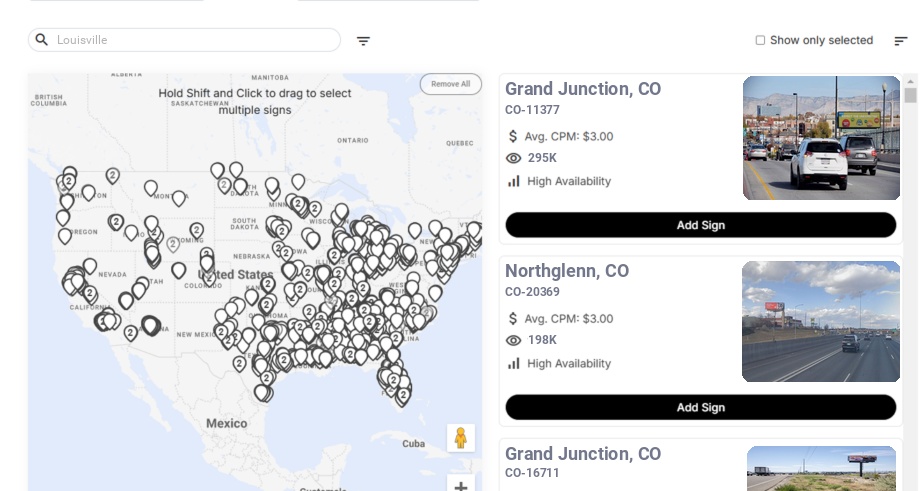



How much is a billboard near Louisville?
Why Choose Blip for Billboard Advertising near Louisville
-
Blip lets Louisville brands launch fast on US 36 and McCaslin commuter traffic—no contracts, no minimums, just flexible pay-per-play control.
-
Target Louisville weekday rush or FlatIron Crossing weekend shoppers with dayparting, so your ad shows when the audience is moving.
-
Louisville campaigns can scale to fit any budget, making it easy to test Boulder-Broomfield corridor reach without a long commitment.
-
Track Louisville results in real time and shift spend as traffic changes for BolderBOULDER, CU games, or Eldora ski season.
-
Use Blip's creative tools to build clear Louisville ads that stand out fast on US 36 and nearby Front Range routes.
Frequently Asked Questions About Billboard Advertising near Louisville
How much does a billboard cost in Louisville, Colorado with Blip?
Blip makes billboard advertising in the Louisville area accessible by using a pay-per-play model, so you only pay when your ad actually appears. Each “blip” is a 7.5-to-10-second display on a rotating digital billboard, and pricing can start as low as $0.01 per display. Since there are no minimums or contracts, you can set a budget that fits your goals, then adjust or pause it anytime.
Where can I advertise near Louisville, Colorado with Blip?
Our 2 digital billboards in nearby Broomfield are only 5.5 miles from Louisville, so we can reach the Louisville area on the same roads people already use for work, school, shopping, dining, and recreation. The dominant corridor serving the Louisville area is US 36, which links Boulder and Denver through Broomfield, Superior, and Louisville-adjacent interchanges. We also see strong supporting traffic on McCaslin Boulevard, South Boulder Road, SH 42, Dillon Road, and the Northwest Parkway.
Why is Blip billboard advertising a good fit for Louisville, Colorado?
Louisville sits in one of the Front Range’s most efficient commuter and shopping corridors, where daily travel flows between Boulder, Broomfield, Superior, and the broader Denver metro. That makes billboard advertising near Louisville especially compelling, even when the digital faces themselves are just outside the city limits. For brands that want visible, flexible, and locally relevant reach serving the Louisville area, this market combines affluent households, strong regional mobility, and year-round destination traffic.
What kinds of people can Blip reach in Louisville, Colorado?
The Louisville area has a strong family audience, and that shapes which categories perform well on nearby billboards. Boulder Valley School District serves about 28,000 students, while neighboring Adams 12 Five Star Schools serves about 33,000 students, and University of Colorado Boulder enrolls nearly 40,000 students. We can also reach commuters, office professionals, weekend shoppers, outdoor recreation users, and event-driven visitors across the same road network.
When is the best time to run Blip ads in Louisville, Colorado?
We usually think about Louisville-area campaign timing in waves rather than in a single always-on pattern. August and September are strong months for education, health care, restaurants, memberships, and family services, while summer, fall football weekends, and winter recreation all create additional opportunities. For commuter-focused brands, weekday dayparts matter most during the shoulder hours around the workday.
Do I need a contract to advertise with Blip near Louisville?
No, Blip has no long-term contracts or minimum commitments. You can start, pause, or stop your campaign at any time.
How fast can I launch a billboard campaign with Blip near Louisville?
You can have your campaign live in minutes. Create a free account, select your locations, set your budget, upload your design, and start running once approved.
Where can I advertise with Blip near Louisville?
Blip has digital billboards near Louisville. You can browse available locations on a map, choose the ones that fit your audience, and start advertising right away.
Still have questions? Launch a campaign in minutes — no contracts, no commitments.
Start Your CampaignLouisville Billboard Advertising Guide
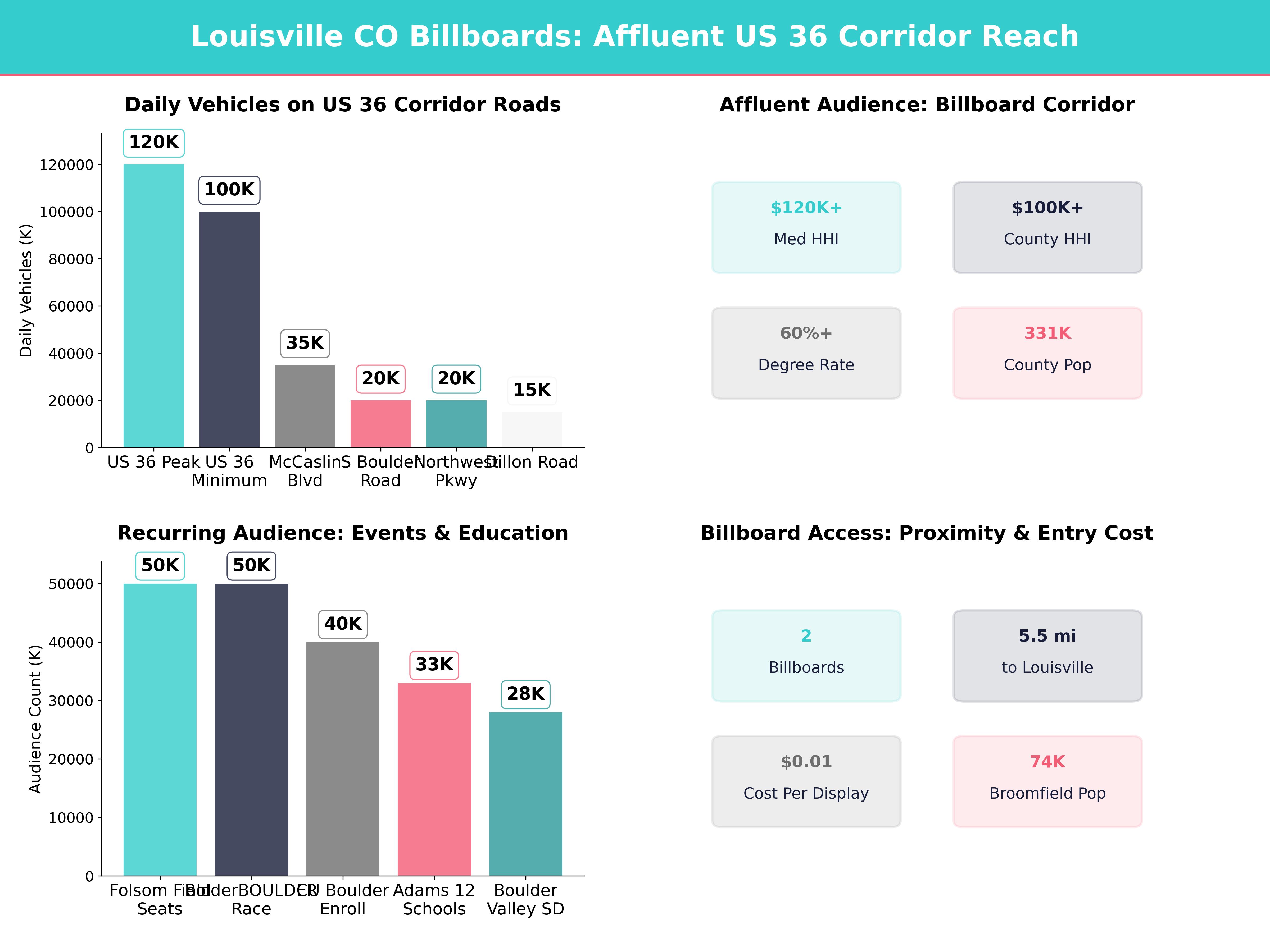
Louisville Boulder, Broomfield Denver metro, with US 36 carrying 100,000-plus vehicles per day through the corridor. That makes billboard advertising near Louisville especially compelling, even when the digital faces themselves are just outside the city limits. Our 2 digital billboards in nearby Broomfield 5.5 miles from Louisville, so we can reach the Louisville area on the same roads people already use for work, school, shopping, dining, and recreation. For brands that want visible, flexible, and locally relevant reach serving the Louisville area, this market combines affluent households, strong regional mobility, and year-round destination traffic, with Louisville median household income well above $120,000, Boulder County above $100,000, and annual draws like the 50,000-participant BolderBOULDER and Eldora’s 680 skiable acres.
Louisville area market overview
Population, affluence, and regional scale
When we plan campaigns serving the Louisville area, we start with the market’s unusual combination of size and purchasing power. The City of Louisville 2020 Census population of 21,226, which gives advertisers a concentrated local audience without the sprawl of a much larger suburb. The surrounding market expands quickly beyond the city line, because Boulder County had 330,758 residents in the 2020 Census, and the neighboring City and County of Broomfield 74,112.
Louisville also benefits from its position between two major economic centers. It sits roughly 10 miles from downtown Boulder and about 25 miles from downtown Denver, which means many residents and visitors pass through the same regional corridor even when their final destination is elsewhere. We see that play out in commuting, shopping, youth sports, university trips, and weekend recreation across Lafayette Westminster
The economic profile near Louisville is also attractive for premium, family, education, health care, and home-service advertisers. Recent ACS estimates place Louisville’s median household income well above $120,000, while Boulder County’s median household income is above $100,000. Boulder County also has a highly educated consumer base, with bachelor’s-degree attainment above 60% among adults age 25 and older, which often correlates with strong demand for professional services, wellness, finance, real estate, and higher-consideration retail.
Commuting behavior and why out-of-home still works near Louisville
Even in a market known for biking, remote work, and transit options, personal vehicles still matter. Recent ACS estimates suggest that workers living near Louisville commute by car, truck, or van at roughly 65% to 70%, while Boulder County overall is closer to 60% to 65% because CU Boulder, downtown Boulder, and local trail-connected neighborhoods produce more bike and transit trips. Neighboring Broomfield tends to be even more auto-oriented, generally landing in the low-to-mid-70% range for private-vehicle commuting.
That mix is exactly why billboard advertising near Louisville works well. We are not relying on a purely tourism-driven audience, and we are not limited to a single downtown core. Instead, we can reach a dependable stream of commuters, parents, professionals, students, shoppers, and weekend travelers who repeatedly use the same corridors serving the Louisville area.
A few core facts summarize the opportunity well:
- Louisville’s city population was 21,226 in the 2020 Census.
- Boulder County’s population was 330,758.
- Broomfield’s population was 74,112.
- Our nearby Broomfield digital billboards are about 5.5 miles from Louisville and within 10 miles of the market we are serving.
- Louisville’s median household income is well above $120,000.
- Boulder County’s median household income is above $100,000.
- Private-vehicle commuting remains roughly 65% to 70% for Louisville-area workers.
Key traffic corridors serving the Louisville area
US 36 and McCaslin Boulevard near Louisville
The dominant corridor serving the Louisville area is US 36 Colorado Department of Transportation traffic counts, segments of US 36 around the Broomfield and Louisville market regularly carry 100,000-plus vehicles per day, and some of the busier Broomfield-area segments exceed 120,000 vehicles per day. That level of daily movement gives us repeated exposure to both weekday and weekend audiences.
The McCaslin Boulevard 30,000 to 40,000 vehicles per day range, depending on the segment and year, which makes it one of the strongest supporting arterials for audience capture near Louisville.
For advertisers, that means nearby Broomfield billboards do more than reach generic pass-through traffic. They intercept Louisville-area consumers while they are still in decision mode, whether they are choosing where to shop after work, where to eat before heading home, where to schedule pediatric care, or which weekend event to attend.
South Boulder Road, SH 42, Dillon Road, and the Northwest Parkway
The secondary road network around Louisville strengthens frequency. South Boulder Road 20,000-plus vehicles per day on busier segments. State Highway 42 and related north-south connectors serving Louisville and Lafayette can also move traffic in the 20,000-plus range on their heaviest stretches.
Dillon Road 15,000 vehicles per day. The Northwest Parkway adds a broader regional layer, with sections commonly above 20,000 daily vehicles, helping connect the Louisville area to E-470, the airport-side suburbs, and southeastern parts of the metro.
Transit also reinforces corridor value. RTD’s Flatiron Flyer serves the US 36 corridor and runs as often as every 15 minutes during peak periods. Even though our billboards are primarily a driver-facing medium, that consistent corridor activity increases overall visibility around park-and-rides, office clusters, and retail nodes.
When we evaluate locations near Louisville, we usually prioritize corridors that do three things at once:
- They carry high daily volume, especially on US 36.
- They connect multiple trip purposes, including work, school, shopping, and recreation.
- They capture Louisville-area audiences before they disperse into smaller neighborhood streets.
Audience segments we can reach near Louisville
Commuters, office professionals, and business travelers
The first major audience near Louisville is the weekday commuter and office professional. The Louisville area sits between Boulder employment centers, the Interlocken
Business travel adds another layer. The nearby Omni Interlocken Hotel 390 guest rooms, which helps support meetings, conferences, and regional business trips near the Louisville area. When we combine commuter timing with hospitality-driven traffic, we often get a stronger weekday audience than Louisville’s city population alone would suggest.
Retail traffic also matters for this group. FlatIron Crossing contributes about 1.5 million square feet of shopping, dining, and entertainment space near the Louisville area, creating frequent after-work and weekend destination trips that overlap with commuter patterns.
Families, students, and education-focused households
The Louisville area has a strong family audience, and that shapes which categories perform well on nearby billboards. Boulder Valley School District serves about 28,000 students, while neighboring Adams 12 Five Star Schools serves about 33,000 students. That puts tens of thousands of students, parents, teachers, and activity-driven households into regular motion across the same road network.
This matters for a wide set of advertisers. Pediatric clinics, orthodontists, tutoring centers, dance studios, youth sports programs, camps, grocery stores, and family entertainment brands can all benefit from Louisville-area billboard campaigns that align with school-year rhythms. We often find that parents near Louisville make repeated, route-based decisions, which means they respond well to frequent exposure over time rather than a single one-off impression.
Higher education expands the audience even further. University of Colorado Boulder enrolls nearly 40,000 students, which creates regular traffic between the Louisville area and Boulder for classes, housing, dining, athletics, and events. That audience is valuable for apartments, furniture, storage, restaurants, consumer tech, telecom, and seasonal retail.
Weekend shoppers, outdoor recreation users, and event-driven visitors
The Louisville area also attracts consumers whose travel is not strictly tied to the workweek. Eldora Mountain Resort offers 680 skiable acres, 53 trails, and 1,400 feet of vertical drop, which makes winter recreation a meaningful source of seasonal travel near Louisville, especially for residents heading toward Boulder Canyon and the foothills. Those trips support advertisers in sporting goods, automotive, coffee, quick dining, urgent care, and outerwear.
Local recreation is important too. Coal Creek Golf Course is an 18-hole municipal course connected to the Louisville lifestyle brand of active families, outdoor weekends, and community events. That tone matters for creative decisions, even when the ad category is not recreation-related.
Event traffic around Boulder also spills into the Louisville area. The BolderBOULDER race draws roughly 50,000 participants each Memorial Day, and Folsom Field seats 50,183 for Colorado Buffaloes football. With typically 6 to 7 home football games each season, plus concerts, commencements, and community events, the Boulder-Louisville-Broomfield corridor gets repeated bursts of event-driven demand.
Seasonal and timing opportunities near Louisville
School calendars, commuter surges, and spring-to-fall momentum
We usually think about Louisville-area campaign timing in waves rather than in a single always-on pattern. The first big planning window starts in late summer, when BVSD, Adams 12, and CU Boulder all bring students and parents back into their normal routines. That means August and September are strong months for education, health care, restaurants, memberships, and family services serving the Louisville area.
Spring also creates momentum. As weather improves along the Front Range, more consumers add errands, recreation, dining, golf, and home projects into the same weekly travel pattern. Home services, landscaping, roofing, windows, HVAC, patios, furniture, and outdoor retail can all benefit from running before demand peaks instead of waiting until every competitor is already active.
For commuter-focused brands, weekday dayparts matter most during the shoulder hours around the workday. We generally see the best relevance when campaigns are aligned with morning decision-making, lunchtime planning, and late-afternoon return traffic serving the Louisville area.
Summer events, fall sports, winter weather, and holiday retail
Summer near Louisville is event-rich. Visit Boulder Downtown Louisville community events calendar
Fall brings another reliable wave because Colorado Buffaloes football typically delivers 6 to 7 home games at 50,183-seat Folsom Field. We can use those weekends for sports bars, retail, lodging, rideshare-adjacent services, and game-day food promotions serving the Louisville area.
Winter is highly specific in this market, and that specificity is valuable. Ski traffic to Eldora increases relevance for automotive service, snow tires, warm beverages, cold-weather apparel, and urgent medical care. Holiday shopping also ramps up around FlatIron Crossing and neighborhood retail districts, making November and December strong periods for gift categories, jewelry, beauty, entertainment, and family dining.
A practical seasonal framework near Louisville often looks like this:
- August to September: Back-to-school campaigns for districts serving roughly 61,000 students combined across BVSD and Adams 12.
- September to November: CU football weekends tied to 6 to 7 home games and 50,183 seats.
- November to April: Winter recreation linked to Eldora’s 680 acres and 53 trails.
- Late May: Event traffic around the 50,000-participant BolderBOULDER.
Billboard design tips for the Louisville area
Creative that fits the Front Range audience near Louisville
Creative near Louisville should feel local, clean, and useful. We usually recommend a visual style that matches the Front Range rather than a generic urban look. Imagery tied to foothills, outdoor activity, patios, schools, families, and modern suburban life tends to feel more native to the Louisville area than stock skyline visuals or overly aggressive sales graphics.
Color also matters. Because Colorado light is bright for much of the year, high-contrast palettes usually perform best. Deep blues, greens, white space, and warm sunset tones often read well against both summer glare and winter overcast conditions. We also suggest avoiding clutter, because drivers on US 36 and nearby arterials make decisions quickly.
A few design principles tend to work especially well serving the Louisville area:
- We keep the main headline to about 6 to 8 words so it reads at driving speed.
- We use one clear promise, one brand cue, and one call to action.
- We reference nearby routes or landmarks when the advertiser has a true local tie, such as “Near McCaslin,” “Off US 36,” or “Minutes from FlatIron.”
- We favor community-minded tone over hard-sell tone, because Louisville-area audiences generally respond well to relevance, quality, and trust.
Offers, imagery, and message styles that resonate near Louisville
The strongest Louisville-area billboard messages usually answer one practical question. Where is the business, why should someone care now, and what makes it locally useful? That structure works well for restaurants, urgent care, dentists, home services, universities, gyms, and retail promotions.
We also recommend creative that reflects season and routine. For example, a winter campaign can highlight warmth, safety, or convenience, while a late-summer campaign can mention school schedules, sports physicals, or family planning. For a higher-income audience near Louisville, premium cues often outperform discount-heavy creative when the brand is selling expertise, quality, or long-term value.
Because each digital display is only 7.5 to 10 seconds, we keep copy disciplined. We also use multiple versions when possible, so a brand can rotate commuter-focused messaging on weekdays and recreation- or family-focused messaging on weekends.
Regional strategies near Louisville
Broomfield and Interlocken strategies serving the Louisville area
Since our Louisville-area inventory is in nearby Broomfield
We usually recommend Broomfield-facing campaigns for:
- Commuter brands that want weekday reach.
- Retailers that depend on destination shopping.
- Medical and wellness brands with multi-city trade areas.
- Restaurants and entertainment venues drawing from Louisville, Superior, and Broomfield together.
This approach is especially strong when the business serves a radius rather than a single block. If a customer is willing to drive 5 to 15 miles for the offer, nearby Broomfield billboard placements can be highly efficient for serving the Louisville area.
Boulder, Superior, Lafayette, and suburban household strategies near Louisville
A second strategy is to map the Louisville area by trip purpose. Traffic toward Boulder often includes university activity, office commuters, health care visits, and event attendance. Traffic toward Superior Lafayette
That means we do not treat all Louisville-area impressions as equal. We align the message with the likely trip:
- We use professional or appointment-based creative for weekday commuter corridors.
- We use family, dining, and retail creative for afternoon and weekend flows.
- We use time-sensitive offers when shoppers are near major decision points like McCaslin, FlatIron, or Dillon Road.
For regional brands, this multi-city framing is a strength. For local brands, it prevents wasted spend by focusing only on travelers who are realistically within reach of the business.
Commercial districts, service radii, and frequency planning near Louisville
The Louisville area is ideal for advertisers that benefit from repeated reminders. Home services, health care providers, gyms, banks, schools, and community events often win by staying visible across several weeks rather than trying to dominate a single day. That is especially true when households are moving between neighborhood streets and regional corridors several times per week.
We usually advise advertisers to define three layers:
- A core trade area where most customers live or work.
- A secondary area where customers will travel for a higher-value offer.
- A corridor layer where we can intercept attention before the final choice is made.
Because we currently have 2 digital billboards near Louisville rather than a huge local network, smart frequency matters. Running consistently on both nearby faces can build broader coverage, while concentrating budget on the better-aligned face can sharpen relevance for a narrower goal.
Blip tools for Louisville-area execution
Budget control, dayparting, and fast local pivots near Louisville
Blip is especially helpful near Louisville because this market has clear timing patterns. We can daypart around commuter peaks, school pickup windows, football weekends, or ski traffic without locking into a rigid traditional schedule. That flexibility matters in a place where weather, events, and seasonal behavior can change quickly.
We often recommend that Louisville-area advertisers start by matching schedule to intent. Morning and late afternoon for commuter and appointment-driven campaigns, midday for lunch, retail, and service reminders, and evenings and weekends for dining, recreation, and event messaging.
Because pricing is pay-per-play and starts at $0.01 per display, we can test ideas without needing a large upfront commitment. We can also increase bids when we want more visibility around specific moments, such as back-to-school week, a CU home game, or a holiday retail push near FlatIron.
Creative testing and analytics for the Louisville area
The Louisville area rewards iteration. A family-service brand may discover that school-year creative outperforms generic brand messaging. A restaurant may find that Thursday and Friday afternoon impressions drive more action than midday placements. A ski-related or winter-service advertiser may need to shift spend quickly when weather changes.
That is where Blip’s real-time analytics become practical rather than theoretical. We can compare timing, spend, and performance patterns, then adjust creative, budgets, or schedules without waiting through a long contract cycle. For a corridor-driven market near Louisville, that speed is a real operational advantage.
Getting started with billboard rental near Louisville
How we evaluate billboard fit for goals serving the Louisville area
The best way to start near Louisville is to work backward from customer behavior. We first identify whether the campaign is trying to drive immediate visits, build local awareness, support an event, or stay top-of-mind over time. Once that goal is clear, we evaluate nearby billboard options by route quality, likely audience, and timing.
For most Louisville-area advertisers, we suggest asking five practical questions:
- Does the location serve the Louisville area commuters we actually want?
- Is the board close to a route people already use, such as US 36, McCaslin, South Boulder Road, or Dillon Road?
- Is the offer something a person will act on within the next few hours, days, or weeks?
- Does the business truly draw from a 5- to 15-mile radius, or is it much more neighborhood-specific?
- Do we need broad awareness across both nearby boards, or stronger frequency on just one?
Those questions matter because billboard buying near Louisville is not just about proximity. It is about whether the route, timing, and audience match the real customer journey.
What to expect from Blip versus traditional billboard companies near Louisville
Traditional billboard companies often sell fixed packages, fixed terms, and limited flexibility. In many markets, that means 4-week placements, broader minimum spends, and longer lead times for changes. We built Blip differently, which is useful for the Louisville area because local demand changes with school calendars, weather, sports, and commuter patterns.
With Blip, we can launch quickly, pause quickly, and refine quickly. We can upload creative, choose nearby digital boards on a map, set a daily budget, and adjust the campaign as the market responds. That makes it easier to test whether one Louisville-area strategy works better than another before committing more spend.
A simple way to begin is this:
- We choose the Louisville-area objective, such as awareness, traffic, leads, or event promotion.
- We select the nearby Broomfield billboards that best serve that audience.
- We schedule around the most relevant times, such as commute windows, weekends, or seasonal peaks.
- We upload simple, route-aware creative with one message.
- We review analytics and improve from there.
For advertisers serving the Louisville area, that process removes much of the friction that used to come with billboard rental. Instead of guessing our way into a long commitment, we can start with the real routes people use, the real timing patterns that shape the market, and the real flexibility needed to grow a campaign confidently near Louisville.