Billboards near Lone Tree, CO
No Minimum Spend. No Long-Term Contracts. Just Results.
Trusted by Leading Brands


Billboard advertising
near Lone Tree has never been easier



How much is a billboard near Lone Tree?
Why Choose Blip for Billboard Advertising near Lone Tree
-
Blip lets you launch Lone Tree billboards fast, reaching I-25 and C-470 commuters without traditional media hassles.
-
Set a flexible budget for Lone Tree and focus spend on peak drives to Park Meadows, Sky Ridge, and the DTC corridor.
-
No contracts make Lone Tree easy to test, so you can scale up when south metro shoppers and professionals respond.
-
Use Blip dayparting in Lone Tree to hit morning commuters, lunch traffic, or Saturday Park Meadows shoppers.
-
Track Lone Tree performance in real time and shift creative or timing as holiday retail and event traffic changes.
-
Blip's creative tools help Lone Tree ads stand out with clear, local messages for affluent families and healthcare visitors.
Frequently Asked Questions About Billboard Advertising near Lone Tree
How much does a billboard cost near Lone Tree, Colorado with Blip?
With Blip, you control exactly what you spend on Lone Tree billboards by setting a daily budget that can be adjusted at any time, so your campaign serving the Lone Tree area always stays within your comfort zone. Each “blip” is a short 7.5–10 second spot on digital billboards near Lone Tree, Colorado, and you only pay for the blips you actually receive. Pricing for each blip changes based on the time of day, location, and advertiser demand, so you can stretch your budget by choosing when and where your ads appear.
Where can I advertise with Blip near Lone Tree, Colorado?
With two Blip digital billboards in nearby Centennial serving the Lone Tree area, advertisers can tap into daily commuter flows along I-25 and C-470, as well as destination traffic headed to Park Meadows, medical campuses, and corporate office parks. Centennial is roughly 4–5 miles from Lone Tree, functionally part of the same employment and retail cluster along I-25 and C-470. These placements offer an efficient, high-impact option for reaching people in the Lone Tree area.
What kind of audience do Lone Tree, Colorado billboards reach?
Campaigns near Lone Tree reach a high-income, commuter-heavy audience that is receptive to both B2C and B2B messaging, and that has the means to act quickly on premium and discretionary offers. Douglas County is one of the highest-earning counties in the state, with median household income reported above $130,000, and more than 55–60% of households in many Lone Tree-area ZIP codes report annual incomes above $100,000. This makes Lone Tree billboards especially attractive for brands that want deep penetration in south metro Denver.
When is the best time to run Blip billboards near Lone Tree, Colorado?
Blip lets us purchase ad time in flexible “blips” as often as once every few minutes, making it easy to match local traffic rhythms. Morning commute hours from 6:30–9:00 a.m., midday from 11:00 a.m.–2:00 p.m., and evening commute hours from 3:30–7:00 p.m. are all strong exposure windows. Weekends and holiday periods can also be valuable, especially around Park Meadows and other retail-heavy destinations.
What makes the Lone Tree, Colorado market good for billboard advertising with Blip?
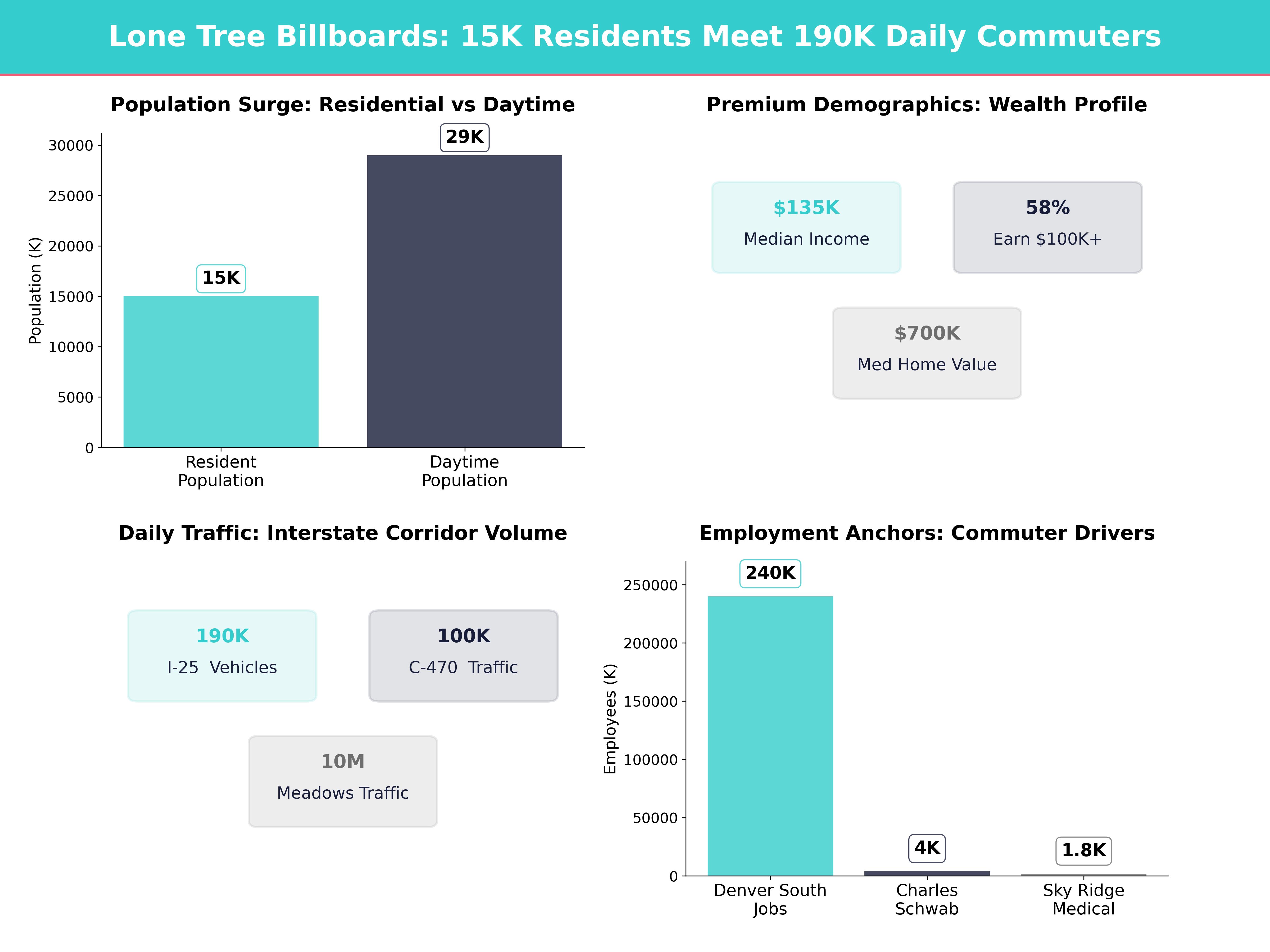
Lone Tree is small in population but outsized in spending power and regional influence, which makes Lone Tree billboards especially attractive for brands that want deep penetration in south metro Denver. The City of Lone Tree has roughly 15,000 residents, but the daytime population nearly doubles when workers, shoppers, and patients are included, bringing the functional population to around 28,000–30,000 on a typical weekday. Heavy traffic along I-25, C-470, and major arterials adds repeated exposure to a high-value audience.
Do I need a contract to advertise with Blip near Lone Tree?
No, Blip has no long-term contracts or minimum commitments. You can start, pause, or stop your campaign at any time.
How fast can I launch a billboard campaign with Blip near Lone Tree?
You can have your campaign live in minutes. Create a free account, select your locations, set your budget, upload your design, and start running once approved.
Where can I advertise with Blip near Lone Tree?
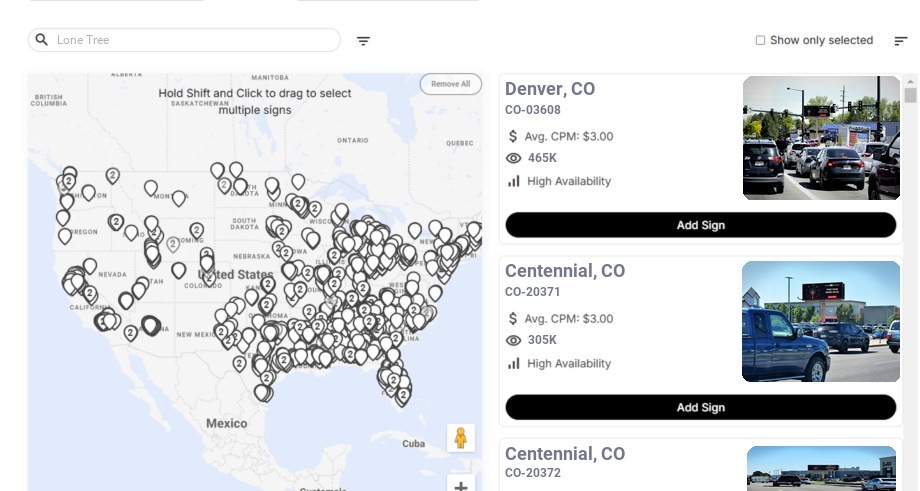
Blip has digital billboards near Lone Tree. You can browse available locations on a map, choose the ones that fit your audience, and start advertising right away.
Still have questions? Launch a campaign in minutes — no contracts, no commitments.
Start Your CampaignLone Tree Billboard Advertising Guide
Lone Tree, Colorado sits at the heart of Denver’s fast‑growing south metro corridor, surrounded by major employers, upscale retail, and high‑income residential neighborhoods. With two Blip digital billboards in nearby Centennial serving the Lone Tree area, advertisers can tap into daily commuter flows along I‑25 and C‑470, as well as destination traffic headed to Park Meadows, medical campuses, and corporate office parks. For marketers specifically looking for billboards near Lone Tree or flexible billboard advertising near Lone Tree without paying downtown Denver prices, these placements offer an efficient, high‑impact option. This guide will walk through how to use those locations—and Blip’s flexible tools—to build efficient, data‑driven campaigns that truly resonate with people in the Lone Tree area.
Understanding the Lone Tree Area Market
Lone Tree is small in population but outsized in spending power and regional influence, which makes Lone Tree billboards especially attractive for brands that want deep penetration in south metro Denver without blanketing the entire region.
-
Population & growth
- The City of Lone Tree has roughly 15,000 residents, and city materials note that the daytime population nearly doubles when workers, shoppers, and patients are included, bringing the functional population to around 28,000–30,000 on a typical weekday. You can explore local stats via the City of Lone Tree Lone Tree Economic Development
- Douglas County, which includes Lone Tree, added more than 50,000 residents between 2010 and 2020—about 17% growth—and has consistently ranked among Colorado’s fastest‑growing large counties, as highlighted by Douglas County
- Neighboring cities that feed commuters into Lone Tree—such as Centennial (about 108,000 residents) and Highlands Ranch 100,000 residents, unincorporated)—expand the draw area well beyond Lone Tree’s city limits.
-
Income & spending power
- Douglas County is one of the highest‑earning counties in the state, with median household income reported above $130,000, and some estimates placing it closer to $140,000 in recent years, according to county and regional economic briefs summarized by Denver South Economic Development Partnership.
- More than 55–60% of households in many Lone Tree–area ZIP codes (such as 80124 and 80112) report annual incomes above $100,000, and a substantial share exceed $150,000.
- Homeownership in Douglas County is above 75%, and in several nearby subdivisions it exceeds 80%, indicating strong equity positions and a robust market for big‑ticket purchases.
-
This translates into strong demand for:
- Financial services and wealth management
- Home improvement, real estate, and mortgage services
- Premium auto, travel, and recreation
- Healthcare, wellness, and elective medical services
-
Education and lifestyle
- Douglas County is a highly educated market, with a majority of adults holding at least some college education and a large share with bachelor’s or graduate degrees, according to local school and workforce profiles from Douglas County School District.
- The county is regularly ranked among the healthiest in Colorado, supporting interest in fitness, outdoor recreation, and preventive healthcare.
-
Employment centers
-
Lone Tree and the south metro corridor host major employers such as:
- The Charles Schwab campus, a regional hub that has been cited as employing 4,000+ workers on site; learn more on Charles Schwab’s Lone Tree campus page
- Sky Ridge Medical Center in Lone Tree, which reports more than 1,800 employees and 300+ physicians across over 60 specialties; details are available via Sky Ridge Medical Center
- Corporate offices clustered along I‑25 in the Denver Tech Center (DTC), Greenwood Village, Centennial, and near RidgeGate and Park Meadows.
-
According to Denver South Economic Development Partnership, the Denver South region supports more than 240,000 jobs, with over 1,000 employers and a strong concentration in:
- Financial services and fintech
- Information technology and telecommunications
- Healthcare and life sciences
- Engineering, aerospace, and professional services
-
Lone Tree and the south metro corridor host major employers such as:
For advertisers, this means campaigns near Lone Tree reach a high‑income, commuter‑heavy audience that is receptive to both B2C and B2B messaging, and that has the means to act quickly on premium and discretionary offers. Choosing billboards near Lone Tree allows you to put your message directly in front of this influential group during their daily routines.
Traffic Patterns and Commuter Flows Near Lone Tree
Our digital billboards in nearby Centennial are positioned to capture some of the most valuable traffic flows serving the Lone Tree area. Local traffic counts are typically reported by the Colorado Department of Transportation, and regional commuting behavior is often summarized by Denver Regional Council of Governments. Understanding these flows helps you decide how much billboard rental near Lone Tree you need to cover your target audience effectively.
-
Interstate 25 corridor
- I‑25 is the spine of the south Denver metro. South of the Denver Tech Center, several segments carry more than 180,000–200,000 vehicles per day, making it one of the busiest stretches of freeway in Colorado.
-
Lone Tree sits at key interchanges (Lincoln Ave, RidgeGate Parkway, C‑470), creating heavy commuter traffic from:
- Castle Rock (about 23 miles to the south) and Parker feeding north toward the DTC and downtown Denver.
- South metro residents heading to Park Meadows, Sky Ridge, and Lone Tree offices.
- Regional labor reports show that a large portion of Lone Tree workers commute in from other cities: more than 80% of jobs in many south metro employment centers are held by non‑residents, increasing through‑traffic during peak hours.
-
C‑470 / E‑470 beltway
- C‑470 and E‑470 form a beltway linking Highlands Ranch, Littleton, Golden, Aurora 100,000 vehicles per day.
- E‑470, operated by the E‑470 Public Highway Authority, reported more than 115 million toll transactions in 2023, illustrating the scale of regional beltway travel that feeds into interchanges serving Lone Tree and Centennial.
- These corridors funnel in shoppers, patients, and recreational visitors, especially on weekends and during major shopping or sports seasons.
-
Arterial roads and local access
- Major arterials such as Lincoln Avenue, Yosemite Street, and Quebec Street serve dense office parks, retail centers, and residential neighborhoods between Centennial and Lone Tree.
- Local traffic counts from municipalities like the City of Centennial and City of Lone Tree
-
Park Meadows and retail gravity
- Park Meadows, billed as Colorado’s “only retail resort,” reports more than 10 million annual visitors, drawing customers from across the Denver metro and visitors passing through on I‑25.
- With 185+ stores and restaurants and a trade area that reaches well into southern Denver, Castle Rock, and Aurora, Park Meadows functions as a regional anchor rather than a purely local mall.
-
Traffic ramps up around:
- Weekday lunch and evening hours (office workers and nearby residents)
- Weekends (especially Saturdays), when many retailers report some of their highest sales days
- Holiday shopping season (November–December), when mall parking lots and adjacent arterials often operate near capacity
By placing digital billboard messages on the Centennial units that serve this corridor, we can intercept both daily commuter routines and destination‑driven trips into the Lone Tree area, generating repeated impressions among high‑value audiences. In practice, this means your billboard advertising near Lone Tree can follow the same consumers from their morning commute to evening shopping trips.
Who You’ll Reach in the Lone Tree Area
Based on regional demographics and land‑use patterns, campaigns near Lone Tree are especially well‑suited for several high‑value segments. Many of these characteristics are highlighted in community profiles from Douglas County, Visit Lone Tree Denver South. When you invest in Lone Tree billboards or nearby placements, these are the people you are most likely to influence.
-
Affluent households & families
- Douglas County has one of the largest shares of family households in Colorado. In many nearby ZIP codes, 40–45% of households include children under 18.
- Homeownership rates above 75% support strong demand for services tied to home value—remodeling, landscaping, roofing, solar, and real estate.
- High median home values (often $600,000–$800,000+ in Lone Tree and adjacent communities) indicate large, well‑maintained homes where discretionary spending on interiors, outdoor spaces, and premium services is common.
-
Strong fit for:
- Family entertainment and attractions
- Education, tutoring, and test prep
- Home services, remodeling, landscaping, roofing
- Financial planning, college savings, insurance, and estate planning
-
White‑collar professionals
- The Denver South corridor has a concentration of finance, tech, telecom, and healthcare jobs. According to Denver South, professional and business services account for roughly 1 in 4 jobs in the region.
- Lone Tree and neighboring business hubs (DTC, Meridian, Inverness, RidgeGate) collectively employ tens of thousands of white‑collar workers with mid‑ to high‑six‑figure household incomes.
-
Perfect for:
- B2B services (IT, staffing, professional services)
- Corporate recruiting and employer branding
- Executive education, MBA programs, and professional certifications
- High‑end consumer products that appeal to career‑focused buyers
-
Healthcare consumers
- Lone Tree functions as a south metro medical hub. Sky Ridge Medical Center alone sees tens of thousands of inpatient and outpatient visits each year, and there are dozens of specialty clinics within a short drive.
- The broader south metro corridor includes major systems such as UCHealth, Kaiser Permanente, and Children’s Hospital Colorado clinics, driving a steady flow of patients and caregivers.
-
Strong targets:
- Specialty medical practices (orthopedics, cardiology, dermatology, fertility, etc.)
- Dental, orthodontics, and vision providers
- Senior care, assisted living, and memory care
- Wellness, fitness, mental health, and physical therapy services
-
Travelers and regional visitors
-
Proximity to I‑25, C‑470, and Denver International Airport
- Business travelers heading to south metro meetings or the Denver Tech Center
- Tourists staying in the south suburbs who may not venture downtown
- Ski travelers and mountain‑bound traffic using C‑470 and I‑25 as connectors to I‑70
- Visit Denver reports that the metro area attracts tens of millions of visitors annually, with a significant share lodging in corridor hotels along I‑25 south of Denver.
-
Proximity to I‑25, C‑470, and Denver International Airport
When building creative, speak directly to these lifestyles: busy professionals, dual‑income families, health‑conscious consumers, and decision‑makers who influence both home and business purchases. This alignment makes every dollar of billboard rental near Lone Tree work harder for your brand.
Local Context: What Shapes Messaging in the Lone Tree Area
Knowing the character of the Lone Tree area helps us tailor both tone and offer. Community surveys and branding efforts from the City of Lone Tree
-
High expectations, time‑starved audience
- With high household incomes and long work hours, many residents are “time rich in money, poor in minutes.” Local transportation studies from DRCOG show that average commute times for south metro workers often approach 30 minutes or more, especially for those driving into downtown or across the metro.
-
Messaging should emphasize:
- Time savings (“Book in 60 seconds,” “Same‑day appointments,” “Skip traffic—shop online, pick up nearby”)
- Quality and expertise (“Board‑certified specialists in the Lone Tree area,” “Rated #1 in Douglas County”)
- Convenience (“Open evenings and Saturdays,” “Located just off I‑25 & Lincoln”)
-
Car‑dependent but tech‑savvy
- The south metro region is heavily car‑oriented; transit share of commute trips is relatively low compared with central Denver. However, smartphone and broadband adoption are very high in Douglas County and south Arapahoe County.
-
Combine billboard calls‑to‑action with:
- Simple URLs or short vanity links
- Clear search prompts (“Search ‘Lone Tree orthodontist’”)
- QR codes large enough to scan from stopped traffic near intersections (if applicable), especially on boards with longer dwell times on arterial roads
-
Family and outdoor orientation
- The region’s brand is active, outdoorsy, and family‑friendly, highlighted by Visit Lone Tree Visit Denver.
- Douglas County manages more than 63,000 acres of open space and 160+ miles of trails, as noted on Douglas County Open Space
- Visuals with outdoor imagery, families, mountains, and active lifestyles often resonate more than generic stock photos.
Timing Your Blip Campaign Near Lone Tree
Blip lets us purchase ad time in flexible “blips” as often as once every few minutes. We can use this control to match local traffic rhythms, leveraging traffic and commuting data reported by CDOT and RTD. This makes it easy to scale billboard rental near Lone Tree up or down around the moments that matter most to your business.
Weekday Daypart Strategy
-
Morning commute (6:30–9:00 a.m.)
- Southbound and northbound I‑25 volumes spike during these hours. In many segments, more than 35–40% of daily traffic occurs during the combined morning and evening peaks.
- Strong exposure to professionals traveling along I‑25 to the Denver Tech Center, downtown, and regional offices.
-
Best for:
- B2B services, corporate recruiting, and training programs
- Financial and healthcare reminders (“Get your checkup scheduled today”)
- Quick‑service breakfast, coffee offers, and convenience services (dry cleaning, car wash, etc.)
-
Midday (11:00 a.m.–2:00 p.m.)
- Workers from offices near Lone Tree, Centennial, Greenwood Village, and the DTC head to lunch, errands, and appointments, and many local parents run school‑related and childcare errands.
- Retail and restaurant districts near Park Meadows and along major arterials see robust lunchtime traffic.
-
Best for:
- Restaurants and fast‑casual dining
- Health and wellness appointments (chiropractic, PT, med spa, dental cleanings)
- Retail and same‑day services (oil changes, cell phone repair, shipping)
-
Evening commute (3:30–7:00 p.m.)
- A mix of commuters heading home and shoppers heading toward Park Meadows and big‑box corridors around I‑25/C‑470.
- Peak grocery, big‑box retail, and family dining times often fall between 4:30 and 7:30 p.m.
-
Best for:
- Family‑oriented offers (dinner, activities, entertainment)
- Home services and real estate (when couples are together to discuss bigger decisions)
- Automotive and car care, including service specials and tire promotions
Weekend and Seasonal Focus
-
Weekends
- Weekend traffic in the Lone Tree area shifts from office commuting to retail, dining, and recreation. Park Meadows and surrounding shopping centers are especially busy on Saturdays.
- Regional tourism data from Visit Denver shows that out‑of‑town visitors significantly boost weekend spending in dining, retail, and attractions.
-
Increase weekend blips for:
- Malls, outlet stores, and specialty retail
- Gyms, golf, and fitness studios
- Events, attractions, and local entertainment (escape rooms, family fun centers, sports)
-
Holiday periods
- Park Meadows and surrounding retail see significant spikes during November–December, with many retailers reporting 20–30% of annual sales during the holiday season.
- Traffic congestion around I‑25 and C‑470 increases noticeably during Black Friday week and the final two weeks before Christmas.
-
Consider heavier schedules for:
- Black Friday and December weekends
- Last‑minute gift pushes and New Year’s services (fitness, financial planning, healthcare)
-
Event‑driven spikes
- Bigger Denver‑area events (Broncos home games, large concerts, conventions at the Colorado Convention Center) increase corridor traffic, particularly on I‑25.
- You can adjust campaigns before and after these events, often noted on outlets like 9NEWS, The Denver Post, and Denverite, as well as the Denver Sports Commission for major sports happenings.
Blip’s scheduling flexibility allows us to concentrate budget in these high‑value windows, rather than paying for low‑impact overnight or off‑peak impressions that may not match your goals. This approach is especially useful if you are testing billboard advertising near Lone Tree for the first time and want to prove results quickly.
Geographic Strategy: Reaching the Lone Tree Area from Centennial
Our two digital billboards in Centennial are positioned to efficiently serve the Lone Tree area, taking advantage of the seamless urban corridor from the Denver Tech Center southward. For many advertisers, these units function as practical, always‑on billboards near Lone Tree, with strong reach into core Lone Tree ZIP codes.
-
Proximity
- Centennial is roughly 4–5 miles from Lone Tree, functionally part of the same employment and retail cluster along I‑25 and C‑470.
- According to the City of Centennial, the city has more than 108,000 residents, many of whom regularly shop, dine, and work in Lone Tree and vice versa.
- Drivers traveling between Lone Tree, Centennial, Greenwood Village, Highlands Ranch, and the Denver Tech Center often pass the billboards on their regular routes, providing repeated exposure to the same high‑value audiences.
-
Key coverage objectives
-
Commuters into the Lone Tree area
- People heading to Lone Tree offices (finance, healthcare, corporate campuses such as Charles Schwab and Sky Ridge)
- Employees working at Park Meadows or nearby retail nodes
-
Outbound commuters from the Lone Tree area
- Residents traveling toward downtown Denver, Aurora, or other suburbs for work or events
- Professionals who live in Lone Tree but work in the DTC, Cherry Creek, or downtown
-
Regional shoppers & patients
- Visitors who may not live in the immediate area but travel there for shopping, medical care, or special services such as elective healthcare or specialty retail
-
Commuters into the Lone Tree area
-
Reinforcing other media
- Because many Lone Tree‑area residents also consume regional media—such as Denver7, FOX31 KDVR Colorado Community Media—billboards in Centennial can reinforce messages seen online, on TV, or in print, helping raise frequency and brand recall.
When we select boards within Blip, we can focus your campaign on the Centennial units serving the Lone Tree area and adjust your bid levels based on which direction or dayparts best align with your audience. This effectively gives you a custom mix of Lone Tree billboards coverage without having to manage dozens of individual placements.
Creative Best Practices for the Lone Tree Area
Outdoor creative needs to work at 55–70 mph and in a sophisticated suburban environment. Studies from organizations such as the Out of Home Advertising Association of America (OAAA) show that simpler creative drives better recall and that adding a clear call‑to‑action can increase response rates by 20–40%. These principles are especially important when your billboard advertising near Lone Tree is competing with a busy visual environment of retail, highway signage, and mobile phone distractions.
We recommend:
-
Ultra‑clear value proposition
-
Lone Tree‑area drivers are busy and selective. Lead with:
- One main benefit (“Cut commute time with our DTC coworking space”)
- One key differentiator (“The only pediatric specialist serving the Lone Tree area evenings and weekends”)
- Aim to communicate “what you do” in 3 seconds or less.
-
Lone Tree‑area drivers are busy and selective. Lead with:
-
Minimal text
- Aim for 7 words or fewer of core message and avoid stacking multiple lines of small copy.
- Use large, bold fonts with high contrast (white/yellow on dark or brand‑consistent, high‑contrast combinations).
- Keep logos simple and avoid intricate taglines that can’t be read at highway speed.
-
Local anchoring
-
Use geographic cues that matter locally:
- “Off Lincoln & I‑25”
- “Next to Park Meadows”
- “Serving the Lone Tree area”
- Avoid claiming a Lone Tree address if you are not actually located there; instead emphasize proximity (“5 minutes from Lone Tree,” “Just north in Centennial”).
-
Use geographic cues that matter locally:
-
Directional and exit messages
-
When relevant, include:
- “Next exit”
- “2 lights east of I‑25”
- “On C‑470 at Quebec”
- Directional OOH messages often show higher immediate visitation rates, especially for restaurant, retail, auto, and medical services.
-
When relevant, include:
-
Align visuals with audience
- For affluent family segments: show real‑looking families, homes, and outdoor lifestyles that match what you see in Lone Tree neighborhoods.
- For professionals: clean, modern design, office imagery, and clear outcomes (productivity, earnings, time saved).
- For healthcare: warm, trustworthy imagery with a focus on outcomes (pain‑free, active, confident smiles) rather than clinical equipment alone.
-
Call‑to‑action clarity
-
Make the next step obvious:
- “Schedule at ExampleClinic.com”
- “Scan to save 20% today”
- “Text LONE to 12345”
- Avoid crowded URLs; use short, memorable links or branded domains. Unique URLs or QR codes per campaign can make performance tracking much easier.
-
Make the next step obvious:
Because Blip supports multiple creative files per campaign, we can test variations—e.g., one focused on “premium quality” vs. another on “time savings”—and then favor top performers as data comes in. This makes it simple to refine your Lone Tree billboards strategy over time.
Using Data and Testing With Blip
To make your investment in the Lone Tree area as efficient as possible, we recommend a test‑and‑optimize approach. Marketers who follow a structured testing process often see 20–50% improvements in cost per lead or cost per acquisition over several iterations.
-
Start with 2–4 creative variations
- Different headlines, offers, or imagery for the same product or service.
-
For example:
- Creative A: “Same‑Day Orthodontics Near Park Meadows”
- Creative B: “$500 Off Braces in the Lone Tree Area”
-
Run an initial 2–4 week test
- Schedule blips during your primary dayparts and days of week (e.g., weekday commuting and Saturday shopping hours).
- Keep budgets and exposure as consistent as possible so you can compare performance fairly.
-
Track response
- Use separate URLs, QR codes, phone numbers, or promo codes per creative if possible.
-
Look for correlations between flight times and:
- Web traffic spikes from south metro ZIP codes (e.g., 80124, 80112, 80111, 80126, 80130)
- Call volume or appointment requests
- Store visits and in‑store mentions
- Web analytics platforms routinely show that adding location‑based keywords (“Lone Tree,” “Park Meadows,” “Centennial”) can increase local search conversion rates by 10–30%, which your creative can help support.
-
Optimize
- Turn off lower‑performing creatives and shift impressions to top performers.
- Shift schedule to the days and hours showing the best engagement (e.g., if weekend foot traffic is strong, increase Saturday/Sunday share).
- Adjust messaging based on what resonates—price vs. convenience vs. quality.
-
Iterate with seasonality
- Rotate new creative for back‑to‑school, holidays, tax season, or healthcare enrollment periods.
- Tie into local happenings listed on City of Lone Tree Visit Denver’s events calendar.
- For example, during the school year, emphasize tutoring and after‑school activities; in summer, highlight camps, recreation, and elective healthcare.
Over time, this data‑driven approach helps transform your campaign from “brand presence” to a reliably measurable driver of leads, sales, and appointments in the Lone Tree area. It also helps you determine the optimal level of billboard rental near Lone Tree for your specific goals and budget.
Leveraging Local Events and Community Ties
The Lone Tree area responds well to community‑minded brands. Local surveys consistently show that residents value civic engagement and support for schools, parks, and cultural amenities.
Consider integrating:
-
Civic and cultural events
-
Promote sponsorships or appearances at:
- Events highlighted by the City of Lone Tree
- Regional happenings featured on Douglas County’s website and local outlets like the Douglas County News-Press via Colorado Community Media.
- Many city events attract hundreds to several thousand attendees, allowing you to pair on‑site engagement with billboard visibility leading into and out of the area.
-
Promote sponsorships or appearances at:
-
Sports and recreation
- Tie into local youth sports seasons, golf tournaments, or trail‑related events promoted through South Suburban Parks and Recreation, which serves portions of the south metro area.
- Use billboard creative to congratulate teams, thank participants, or highlight seasonal offers (“Show your jersey for 10% off tonight”).
-
Cause marketing
- Support local schools, healthcare initiatives, or nonprofits, including foundations linked to major employers like Sky Ridge or local education foundations referenced by the Douglas County School District.
- Use your Blip spots to spotlight campaigns (“We donate 5% of October revenue to local schools”) and reinforce your community presence.
- Cause‑aligned campaigns often see higher engagement; research across multiple markets suggests that brands highlighting social impact can experience 5–10 percentage‑point lifts in favorability and intent.
Community‑aligned messaging often earns more attention and goodwill than pure sales pitches, especially in a tight‑knit, high‑engagement area like Lone Tree. This makes event‑tied Lone Tree billboards particularly effective for building long‑term brand equity.
Putting It All Together
By combining:
- High‑income, fast‑growing demographics in the Lone Tree area
- Heavy daily traffic along I‑25, C‑470, and major arterials
- Two strategically located digital billboards in nearby Centennial
- Blip’s flexible, per‑blip buying model and scheduling tools
we can build campaigns that are both high‑impact and cost‑efficient.
The most successful advertisers near Lone Tree:
- Define their primary audience (affluent families, professionals, patients, B2B buyers).
- Align creative with local context (premium, time‑saving, family‑ and outdoor‑oriented themes).
- Focus spend on peak commuter and retail hours, guided by traffic patterns from sources like CDOT and local municipalities.
- Use multiple creatives and clear tracking to measure response, refining messages based on real‑world performance.
- Continuously refine timing, messaging, and offers according to performance, seasonality, and local event calendars from City of Lone Tree Douglas County, and Visit Denver.
With thoughtful planning and smart use of data, digital billboards serving the Lone Tree area can become a powerful, measurable pillar of your marketing mix, connecting your brand with some of the Denver metro’s most valuable consumers and decision‑makers. Whether you are testing billboard advertising near Lone Tree for the first time or expanding an established presence, Blip’s flexible approach to billboard rental near Lone Tree makes it easier to scale as your results grow.