Billboards near Fairmount, CO
No Minimum Spend. No Long-Term Contracts. Just Results.
Trusted by Leading Brands


Billboard advertising
near Fairmount has never been easier
How much is a billboard near Fairmount?
Why Choose Blip for Billboard Advertising near Fairmount
-
Blip lets you launch fast in Fairmount, reaching I-70, US-6, and Wadsworth commuters without traditional billboard delays.
-
Use Fairmount's weekday drive times to daypart ads for Denver and Golden commuters, then shift spend to weekend mountain traffic.
-
No contracts in Fairmount mean you can test by season—hail, ski trips, or back-to-school—then adjust anytime.
-
Track Fairmount campaign results in real time and fine-tune creative for affluent homeowners, outdoor enthusiasts, and local shoppers.
-
Blip's creative tools help Fairmount ads pop with mountain views, simple CTAs, and bold visuals built for 5-8 second reads.
Frequently Asked Questions About Billboard Advertising near Fairmount
How much does a billboard cost near Fairmount, Colorado with Blip?
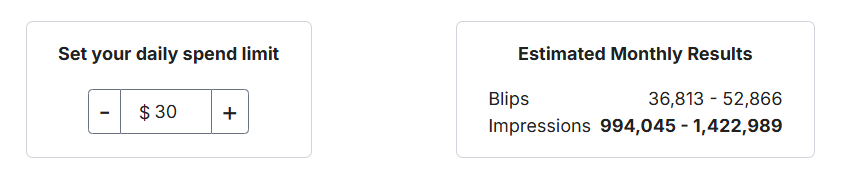
With Blip, you choose a daily budget that works for you, and your ads appear on digital Fairmount billboards serving the Fairmount area whenever your budget and the current advertiser demand allow. Each “blip” is a 7.5 to 10-second display on billboards near Fairmount, Colorado, and you only pay for the blips you receive, similar to pay-per-click online ads. Pricing for each blip varies based on when and where you choose to advertise, so you stay in control of your spend while reaching drivers and commuters locally.
Where can I advertise with Blip near Fairmount, Colorado?
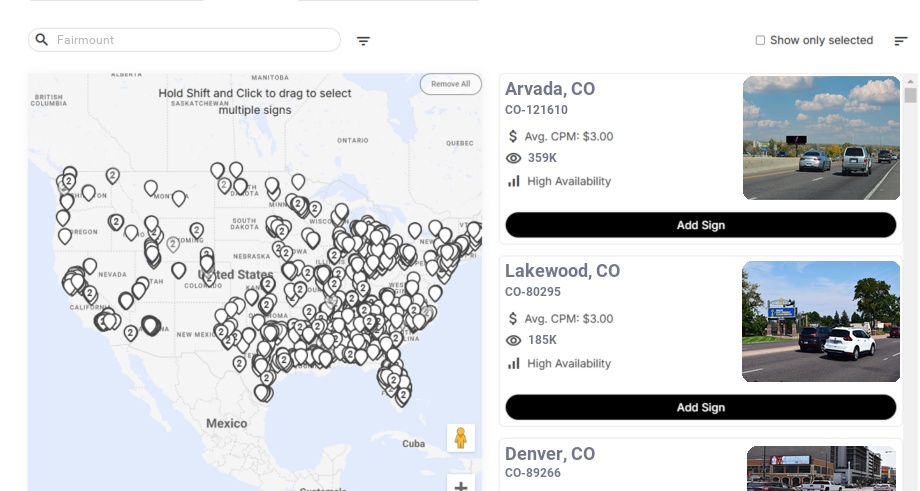
We have 10 digital billboards serving the Fairmount area, all within roughly 10 miles, providing a combined potential reach of tens of thousands of daily impressions depending on schedule and bid strategy. These are prime options if you’re looking for billboards near Fairmount that can capture both local and regional traffic. The boards are located in nearby Arvada and Lakewood.
What kind of audience will Blip billboards in Fairmount, Colorado reach?
The Fairmount area offers advertisers a powerful mix of affluent households, heavy commuter traffic, and strong outdoor recreation culture. The area is characterized by a median household income well into six figures, high homeownership rates, and many households earning $150,000+ annually. It also skews family-oriented and established, with a median age in the mid-40s and an average household size around 2.7–2.8 people.
When is the best time to run a billboard campaign in Fairmount, Colorado with Blip?
Using Blip’s scheduling, ads can be tailored to match how people move around the Fairmount area. Weekday morning commute, midday, and evening commute all offer strong opportunities, with the evening commute often the single busiest window of the day. Weekends are also strong for mountain trips, shopping, and recreation, and winter ski weekends can push traffic counts 20–30% above typical non-winter weekends.
What nearby roads or areas should I target for billboard advertising in Fairmount, Colorado?
Arvada boards capture west–east and north–south movement between Golden, Fairmount, Arvada, and Denver, and arterials there frequently carry 30,000–60,000 vehicles per day. Lakewood boards near key routes feeding US-6, C-470, and I-70 put messages in front of Fairmount area residents heading to Denver, the mountains, and south metro job centers. West-metro corridors like I-70, Wadsworth Blvd, and Kipling St often see 50,000–120,000 vehicles per day, depending on the specific segment.
Do I need a contract to advertise with Blip near Fairmount?
No, Blip has no long-term contracts or minimum commitments. You can start, pause, or stop your campaign at any time.
How fast can I launch a billboard campaign with Blip near Fairmount?
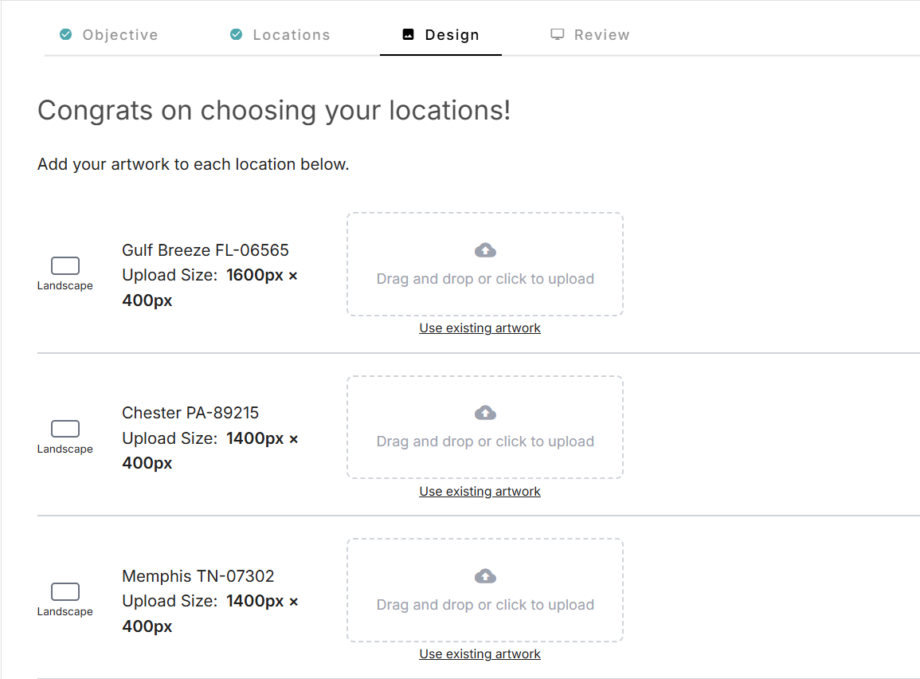
You can have your campaign live in minutes. Create a free account, select your locations, set your budget, upload your design, and start running once approved.
Where can I advertise with Blip near Fairmount?
Blip has digital billboards near Fairmount. You can browse available locations on a map, choose the ones that fit your audience, and start advertising right away.
Still have questions? Launch a campaign in minutes — no contracts, no commitments.
Start Your CampaignFairmount Billboard Advertising Guide
Tucked between Golden, Arvada, and Lakewood along the western edge of the Denver metro, the Fairmount area offers advertisers a powerful mix of affluent households, heavy commuter traffic, and strong outdoor recreation culture. With Blip’s network of 10 digital billboards near Fairmount—located in nearby Arvada and Lakewood—we can help you reach this high-value audience with flexible, data-driven campaigns that can deliver thousands of impressions per day at a fraction of the cost of traditional mass media. Whether you’re a local business or a regional brand, these Fairmount billboards give you a scalable way to build awareness right where your customers live, work, and drive.
Understanding the Fairmount Area Market
The Fairmount area is a residential pocket of Jefferson County with quick access to both the city and the mountains. It’s characterized by:
-
Population & growth
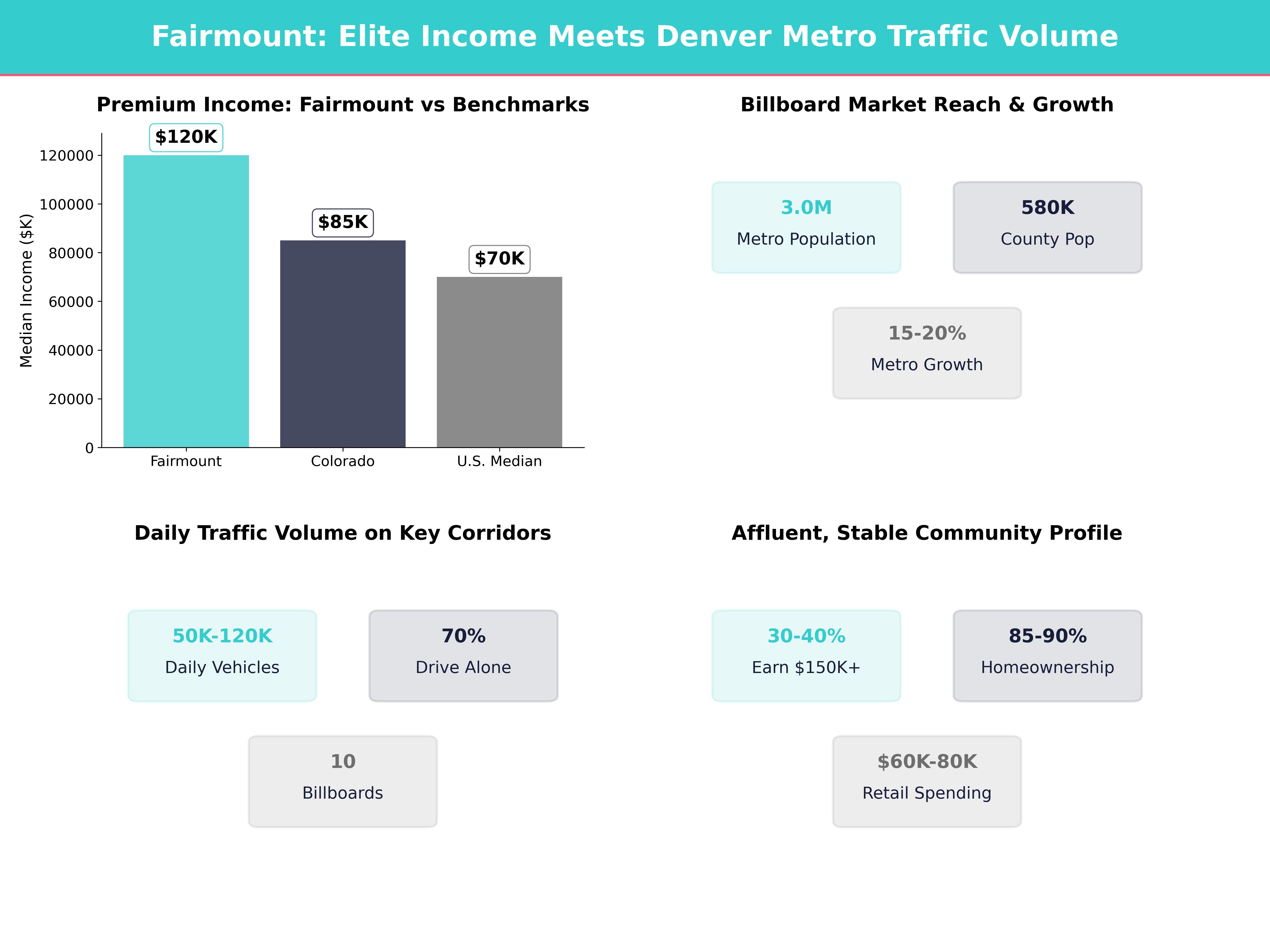
- The Fairmount CDP had about 9,300 residents in 2020, part of Jefferson County’s roughly 580,000 residents and the 3.0+ million residents across the Denver–Aurora–Lakewood metro.
- Jefferson County’s population has grown by about 8–10% since 2010, while the broader Denver–Aurora–Lakewood metro has expanded by roughly 15–20%, reflecting sustained in‑migration and housing demand along the western corridor.
-
Nearby cities magnify the market:
- Arvada has about 125,000–125,500 residents.
- Lakewood has roughly 157,000–160,000 residents.
- Golden has around 20,000 residents but a daytime population that swells with commuters, students, and tourists.
- The Fairmount area skews family‑oriented and established: median age is in the mid‑40s, and average household size is around 2.7–2.8 people, which supports demand for family, education, and home‑oriented services.
- For updated population, housing, and planning data, advertisers can monitor local sources such as Jefferson County, Arvada, Lakewood, and City of Golden.
-
Income & spending power
- Median household income in the Fairmount CDP is well into six figures (over $120,000), markedly higher than Colorado’s statewide median around $85,000 and significantly above the U.S. median in the low‑ to mid‑$70,000s.
- In many Fairmount‑adjacent neighborhoods, 30–40% of households earn $150,000+ annually, putting a substantial share of the market in a high‑discretionary‑spend bracket.
- Jefferson County’s per‑capita personal income exceeds $70,000, and household retail spending per year commonly runs in the $60,000–80,000 range, supporting premium services, home improvement, and discretionary purchases such as travel, outdoor gear, and dining.
- Home values illustrate the level of wealth: median home values around Fairmount are frequently in the $750,000–900,000 range, compared with the Colorado median closer to $500,000–$550,000, indicating strong equity and borrowing capacity.
- Regional economic updates and business climate data are regularly published by entities such as Jefferson County Economic Development Corporation and Jeffco Business & Workforce Center.
-
Commuter patterns
- Many residents work in Denver, Golden, Boulder, and the Denver Tech Center, creating robust peak-period traffic near Fairmount.
- More than 70% of workers in the area drive alone to work, and average commute times are roughly 25–30 minutes, keeping people on key roadways where our digital billboards serve the Fairmount area.
- Across the Denver metro, regional transportation data show 75–80% of commuters primarily use a personal vehicle, with only about 5–8% using transit and a smaller share working from home full time—meaning roadside media and billboard advertising near Fairmount remain dominant awareness channels.
- Local commuting and transit usage trends can be tracked through Denver Regional Council of Governments (DRCOG) and RTD Denver, which publish corridor studies and ridership patterns relevant to advertisers.
For planning broader regional strategy and understanding development trends, it’s worth periodically reviewing updates from Jefferson County and local municipalities like Arvada and Lakewood, as well as tourism and visitor data from Visit Arvada and Visit Golden.
Where Our Billboards Serve the Fairmount Area
We have 10 digital billboards serving the Fairmount area, all within roughly 10 miles, providing a combined potential reach of tens of thousands of daily impressions depending on schedule and bid strategy. These are prime options if you’re looking for billboards near Fairmount that can capture both local and regional traffic:
-
Arvada (about 5.8 miles from Fairmount)
- Boards along major commuter and arterial routes, capturing west–east and north–south movement between Golden, Fairmount, Arvada, and Denver.
- Arterials in and around Arvada frequently carry 30,000–60,000 vehicles per day, giving repeated exposure to the same high‑value households over the course of a week.
- Strong visibility for residents heading toward shopping hubs like Arvada’s retail corridors and into Denver, where downtown Denver alone hosts more than 130,000 workers on a typical weekday.
-
Lakewood (about 8.1 miles from Fairmount)
- Boards near key routes feeding US‑6, C‑470, and I‑70, putting messages in front of Fairmount area residents heading to Denver, the mountains, and south metro job centers.
- Many Lakewood freeway segments see 80,000–120,000 vehicles per day, supporting both brand‑building and direct‑response style campaigns.
- Excellent for reaching Fairmount area shoppers at destinations such as Colorado Mills, which can draw millions of visitors per year, and Lakewood’s commercial centers and nearby employment hubs that collectively employ tens of thousands of workers.
To understand traffic flows, advertisers can reference Colorado Department of Transportation (CDOT) traffic count maps. West-metro corridors like I‑70, Wadsworth Blvd, and Kipling St often see 50,000–120,000 vehicles per day, depending on the specific segment—ideal volume for high-frequency, digital billboard campaigns. When you layer Blip’s ability to show your ad multiple times per hour, a focused campaign can easily generate hundreds of thousands of weekly impressions across our Arvada and Lakewood locations, functioning as an always-on billboard rental near Fairmount.
Who You’re Reaching: Audience Profile Near Fairmount
The Fairmount area audience is especially attractive for:
-
Affluent families & homeowners
- Homeownership rates in and around Fairmount routinely exceed 85–90%, compared with Colorado’s statewide homeownership rate closer to 65–70%.
- A high share of households are married-couple families, and many neighborhoods have 40–50% of households with children under 18.
-
High homeownership rates and larger lot sizes mean strong demand for:
- Home services (landscaping, roofing, HVAC, solar)
- Remodeling and high‑end furnishings
- Financial services, insurance, and wealth management
- With median property tax bills that can exceed $4,000–$5,000 annually for many homes, tax planning, insurance, and financial advisory offerings resonate strongly in this market—making Fairmount billboards a natural fit for reaching these decision-makers.
-
Outdoor and recreation enthusiasts
-
Proximity to North Table Mountain, the Jeffco Open Space trail system, and I‑70 mountain access means above-average interest in:
- Outdoor gear and apparel
- Bikes, ski and snowboard shops, 4x4 and truck accessories
- Gyms, physical therapy, and wellness services
- Jefferson County Open Space manages more than 57,000 acres of land and over 260+ miles of trails, attracting millions of visits per year from hikers, bikers, runners, and equestrians.
- Golden-area trailheads such as North Table Mountain and White Ranch regularly see weekend parking lots reach capacity during peak seasons, translating into thousands of potential impressions in just a few hours as recreation traffic streams past your billboards.
- Check local trail and park information via Jefferson County Open Space to sync campaigns with peak recreation seasons and specific events like trail races or volunteer days.
-
Proximity to North Table Mountain, the Jeffco Open Space trail system, and I‑70 mountain access means above-average interest in:
-
Commuters & knowledge workers
- Many professionals commute to Denver and Golden (think tech, energy, engineering, higher education). Nearby Colorado School of Mines in Golden enrolls around 7,000–8,000 students and employs more than 1,000 faculty and staff, adding to daytime traffic.
- Golden is also home to the National Renewable Energy Laboratory (NREL) and other research and energy employers, contributing thousands of high‑income jobs within a short drive of Fairmount.
- Messages about professional services, continuing education, and B2B solutions can be timed for drive times to maximize relevance, especially during weekday morning and evening windows, which in many corridors account for 40–50% of daily traffic volume.
-
Local shoppers
- Residents frequently travel to Arvada and Lakewood for groceries, big-box retail, and dining. Regional shopping destinations within a 10–15 minute drive can draw 10,000–30,000 visitors on busy weekends.
- In consumer surveys, 70–80% of shoppers report noticing roadside signs on their way to make purchases, and more than 40% say outdoor advertising has reminded them of a store or product they later visited or bought.
- Our boards near these retail nodes are natural touchpoints for local restaurants, boutiques, breweries, medical offices, and personal care services, especially as consumers make multiple trips past the same sign each week. For many of these businesses, billboard advertising near Fairmount offers a highly visible complement to search and social campaigns.
Crafting Effective Creative for the Fairmount Area
Billboard creative serving the Fairmount area should be fast to understand, visually strong, and tailored to local lifestyles. Drivers often have only 5–8 seconds to absorb your message, and research on out‑of‑home (OOH) advertising consistently shows that simple, high‑contrast designs generate 20–40% higher recall than cluttered layouts.
1. Visuals that resonate locally
-
Use imagery that reflects:
- Mountain backdrops, foothills, or familiar local landscapes (North Table Mountain, Clear Creek, Golden’s downtown)
- Outdoor lifestyle: hiking, biking, skiing, camping
- Family and home-oriented scenes, given high rates of homeownership and families with children
-
Keep visuals high contrast and simple:
- Aim for no more than 7–10 words of text.
- Use large fonts and bold colors that stand out in bright Colorado sun and snow glare.
- Maintain a clear focal point; tests show creatives with a single dominant image and short headline can achieve up to 2x the ad recall of more complex designs.
2. Messaging angles
For Fairmount area commuters and residents, consider:
-
Home services & trades
- “Fairmount area roofs ready for hail season? Free inspection – Call [Brand].”
- “Upgrade your mountain-view windows. Book a free quote today.”
- Highlight urgency: during peak hail months, storm-related service calls in Jefferson County can spike by 100–200% over normal months.
-
Healthcare & wellness
- “Back on the trails faster – Fairmount area physical therapy.”
- “New pediatric clinic near you – Same‑week appointments.”
- Health systems report that 60–70% of patients choose providers within a 15–20 minute drive of home, so emphasizing proximity and fast appointments is highly effective.
-
Retail, dining, and entertainment
- “Dinner before the game? Exit at [landmark], 10 minutes from Fairmount.”
- “Locally roasted coffee, just off I‑70 – Open early for commuters.”
- Time‑relevant offers (happy hour, weekend brunch) can see 20–30% higher response when paired with targeted dayparts on digital billboards.
-
Professional services
- “High‑income, high‑tax bracket? Talk to a Fairmount area tax expert.”
- “Protect your mountain home – Custom insurance for Jefferson County.”
- In affluent corridors, financial and insurance advertisers often see cost‑per‑lead efficiencies 30–50% better than in broad, non‑targeted media when campaigns are localized and repeated.
3. Clear calls to action
-
Use direct CTAs tied to quick actions:
- “Visit [short URL]”, “Text FAIR to 555‑1234”, “Exit at [street]”
- Keep web addresses short and easy to remember; consider vanity URLs or memorable brand names of 12 characters or fewer, which testing shows are easier for drivers to recall.
-
Rotating multiple creatives with Blip allows you to test:
- Different CTAs (call vs. web visit)
- Offers (free estimate vs. discount)
- Audience segments (families vs. outdoor enthusiasts)
- Campaigns that A/B test creatives and optimize over 4–8 weeks typically see 10–30% improvements in response metrics compared with static, “set‑and‑forget” creative.
Timing Your Campaign Around Local Traffic Patterns
Using Blip’s scheduling, we can tailor when your ads run to match how people move around the Fairmount area. Traffic count data indicate that in many west‑metro corridors, weekday volumes are roughly 10–20% higher than weekend volumes, but weekend traffic is more oriented toward shopping, recreation, and leisure trips—perfect for certain categories.
Weekday patterns
-
Morning commute (6–9 a.m.)
- Heavy eastbound and southbound flows toward Denver, Golden, and Lakewood. In many corridors, 30–35% of daily traffic occurs before 10 a.m.
-
Great for:
- Quick-service restaurants and coffee shops
- Traffic, weather, and day-starter services (gyms, news subscriptions)
- B2B services where “start your workday with us” resonates
- National commuter research shows that about 60–70% of drivers notice roadside messages during their morning commute, making this a prime awareness window.
-
Midday (10 a.m.–3 p.m.)
- Reaching work‑from‑home residents, retirees, and service‑call traffic.
- Volume is somewhat lower than peak periods but still typically 30–40% of the daily total, offering more efficient bids.
-
Ideal for:
- Home services, healthcare appointments, and retail errands
- Restaurant lunch specials
- Businesses that shift a portion of spend into these “shoulder” hours can often secure 10–25% more impressions per dollar.
-
Evening commute (3–7 p.m.)
- Often the single busiest window of the day, with many corridors seeing 35–40% of daily traffic in the afternoon/evening period.
-
Strong opportunity for family and lifestyle messaging:
- Dinner and takeout
- Kids’ activities and clubs
- Fitness, events, and entertainment
- Survey data indicate that over 80% of drivers who notice OOH ads do so during their commute home from work, when they are thinking about evening plans and errands.
Weekend and seasonal timing
-
Weekends
- I‑70 and west‑metro arterials see strong volumes tied to mountain trips, shopping, and recreation; winter ski weekends can push traffic counts 20–30% above typical non‑winter weekends.
-
Great for:
- Outdoor gear, ski and bike shops
- Attractions, festivals, and local events
- Car dealerships and big-ticket purchases
- Local event calendars and visitor trends are published by organizations like Visit Denver, Visit Arvada, and Visit Golden, which can help you align weekend campaigns with high‑traffic event dates.
-
Seasonal hotspots
- Winter: Ski trips and holiday shopping—push seasonal promotions, 4x4 and tire services, and heating/HVAC. Tire and auto service shops often see service volumes increase by 30–50% ahead of major snowstorms.
- Spring hail season: Jefferson County often experiences significant hail; Colorado is consistently among the top U.S. states for hail damage claims, and storm seasons can generate tens of thousands of insurance and repair claims regionwide. Emphasize roofing, auto body repair, and insurance.
- Summer: Camping, hiking, and backyard projects—emphasize outdoor, landscaping, home upgrades. Open space visitation can rise 40–60% vs. winter months.
- Back‑to‑school (Aug/Sept): Education, tutoring, activities, and youth services. Families often increase spending on supplies, clothing, and activities by $500–800 per student over the late summer period.
Staying tuned to local news from outlets like The Denver Post, Arvada Press, and Lakewood Sentinel helps identify events or trends worth aligning your campaigns with—such as local school calendars, construction updates, new retail openings, or major traffic pattern changes.
Leveraging Blip’s Flexibility for the Fairmount Area
Blip’s platform lets us fine‑tune your presence near Fairmount to match your budget and goals, while making the most of the high‑value impressions available along the west‑metro corridors. Instead of committing to a single long-term poster, you can treat our Fairmount billboards as flexible, auction-based billboard rental near Fairmount that adjusts with your needs.
1. Start small, scale strategically
-
Set a daily or campaign budget that fits your comfort level; you can begin with just a few dollars per day while still generating hundreds to thousands of daily impressions, depending on your bid and schedule.
- Use lower bids during off‑peak hours to secure cost‑efficient impressions. In many markets, shifting even 20–30% of spend to off‑peak windows can increase total impressions by 10–25%.
-
As you see results, increase either:
- The number of boards (Arvada + Lakewood coverage), or
- The share of time (more “blips” per hour) on your best‑performing placements.
- Many advertisers find that ramping spend by 15–25% per optimization cycle (instead of large jumps) provides a good balance between growth and measurement.
2. Choose locations that match your customer journey
-
Arvada boards:
- Focus on Fairmount area residents heading east for work, shopping, or nightlife.
- Ideal for brands targeting families, shoppers, and commuters into Denver, including those who pass through Arvada’s major retail corridors that can attract tens of thousands of daily visitors.
-
Lakewood boards:
- Target Fairmount area residents heading south or toward I‑70 and US‑6.
- Excellent for mountain‑trip related offers, regional attractions, and Lakewood‑based businesses, especially those near Colorado Mills and the Union Boulevard and Belmar areas, which host thousands of employees and shoppers daily.
- Mapping your existing customers’ ZIP codes against these corridors can highlight where 60–80% of your current business already comes from, helping you prioritize board selection.
3. Run multiple creatives and A/B test
Use Blip to upload multiple designs and compare performance indicators, such as:
- Direct response metrics (web traffic, calls, promo code usage)
- Branded search volume from the Fairmount area
- Differences in engagement by time of day or day of week
- Changes in store visits or appointment volume that correlate with your flight dates
Rotate creatives highlighting:
- Different value propositions (price vs. quality vs. convenience)
- Different audiences (families vs. outdoor adventurers)
- Different offers (limited‑time vs. evergreen)
- Campaigns that regularly test at least 2–3 creative variations often see 15–30% better performance than those running a single design over the same time period.
Local Campaign Ideas by Industry
Here are practical ways businesses can use our digital billboards serving the Fairmount area:
Home services & construction
-
Target hail season and spring renovation:
- “Hail hit your roof? Fairmount area inspections in 24 hours.”
- Run heavier during stormy months (April–July) and evenings when homeowners are driving home.
- In heavy hail years, roofing and exterior contractors can see inbound inquiries jump by 100–300% in just a few weeks; billboards help you capture that surge.
-
Promote hyper-local trust:
- “Serving Jefferson County homes for 25+ years – [Brand].”
- Including local proof points (years in business, number of local projects completed, number of 5‑star reviews) can boost response by 10–20% in service industries.
Healthcare, dental, and vision
-
Emphasize convenience and access:
- “New patient appointments this week – 10 minutes from Fairmount.”
- Time campaigns to open enrollment or flu season peaks, when health plan changes and preventive care visits rise by 20–40%.
- Many practices find that even a modest billboard campaign can lift new-patient inquiry calls by 10–25% over a 2–3 month period when paired with online booking.
Retail & e‑commerce
-
For brick‑and‑mortar in Arvada or Lakewood:
- “2 exits away – [Store Name], outdoor gear for your next hike.”
- Highlight strong reasons to visit now (limited‑time sales, new arrivals); sale events promoted through OOH can see foot traffic increases of 10–30% vs. unadvertised periods.
-
For e‑commerce:
-
Focus on brand awareness and simple URLs:
- “Colorado-founded, Fairmount area shipped – [Brand].com”
- Studies of multi‑channel campaigns show that pairing OOH with digital can increase online activation (website visits, app downloads) by 20–40% compared with digital‑only campaigns.
-
Focus on brand awareness and simple URLs:
Restaurants, breweries, and coffee shops
-
Use time‑based messaging:
- Breakfast/coffee: heavy 6–9 a.m. scheduling
- Dinner and happy hour: focus 3–7 p.m. and weekends
-
Mention proximity:
- “From Fairmount area to full plate in 10 minutes – Exit [X].”
- The average household in affluent suburbs can spend $3,000–4,000+ per year on dining out; capturing even a small share of this wallet among Fairmount‑adjacent families can translate into substantial recurring revenue.
Attractions, events, and tourism
- Partner your campaigns with local tourism bodies such as Visit Denver, Visit Golden, and Visit Arvada, which collectively promote events that attract millions of visitors annually to the metro area.
-
Promote:
- Concerts, festivals, markets, and seasonal events
- Mountain resorts or adventure parks accessed via I‑70
-
Countdown creatives:
- “3 days until opening night – Get tickets now.”
- Event campaigns using countdown messaging frequently see ticket sales increase by 15–25% in the final week as urgency builds.
Measuring and Optimizing Performance
While digital billboards don’t track individuals, there are reliable ways to understand and improve ROI from campaigns serving the Fairmount area. Across many advertisers and studies, well‑executed OOH campaigns have been shown to:
- Increase brand awareness by 20–40%
- Drive lifts in web traffic of 10–30%
- Improve overall campaign ROI when combined with digital and social by 20–40%
To translate this into your own measurement plan:
-
Web and search analytics
-
Watch for lifts in:
- Direct URL visits
- Branded search queries (e.g., “[Your Brand] Fairmount”, “[Your Brand] Arvada”)
- Traffic spikes aligned with your Blip schedule windows
- Plot your Blip impression schedule against website sessions; even a 5–15% sustained increase during flight periods is meaningful.
-
Watch for lifts in:
-
Offer and code tracking
- Use unique promo codes (“FAIRMOUNT10”) or URLs to attribute response.
- Compare redemption rates when boards run more heavily (e.g., weekend pushes) vs. baseline.
- If 5–10% of new customers use a billboard‑specific code, that’s typically strong attribution for an OOH campaign.
-
Call tracking
- Dedicated phone numbers for billboard campaigns make attribution straightforward.
- Track call volume fluctuations by daypart when you adjust schedules; businesses often see call volume from billboard campaigns increase by 10–30% during active flight periods.
- Simple metrics like cost per call or cost per booked job can then be compared with search, social, or direct mail.
-
Customer surveys
- Ask new customers: “How did you hear about us?”
- Even a modest percentage citing “billboard” or “sign near Arvada/Lakewood” is strong evidence of brand visibility.
- Over time, many local advertisers find 10–20% of new customers reference signage when asked open‑ended questions about awareness.
Over time, we recommend:
- Starting with a 4–8 week test to capture commuting patterns and weekend behavior—long enough to reach the same drivers multiple times, as OOH impact builds with frequency. A frequency of 8–12 exposures per month is a common benchmark for strong recall.
-
Reviewing performance weekly, tweaking:
- Hours and days of week
- Creative mix
- Board selection (Arvada vs. Lakewood emphasis)
- Locking in a longer‑term presence on the best‑performing boards, especially around your most important sales seasons. Many businesses that maintain a consistent OOH presence for 6–12 months report more stable lead flow and stronger brand recognition compared with short, sporadic flights.
By combining local knowledge of the Fairmount area with Blip’s flexible, data-driven billboard platform, we can help you reach affluent, active, and highly mobile audiences as they move through their daily routines. With strategic placement near Arvada and Lakewood, thoughtful creative tailored to mountain‑metro lifestyles, and smart scheduling based on real traffic and demographic data, your brand can become a familiar and trusted presence for thousands of drivers and families near Fairmount every day through targeted billboard advertising near Fairmount.